High Ticket Ecommerce: A Creator’s Guide to Selling Premium Products

When you hear "high-ticket ecommerce," what comes to mind? We're talking about a business model built around selling premium products or services, typically those with a price tag of $1,000 or more. It represents a significant strategic shift away from the classic ecommerce game of chasing high sales volume.
Instead, the focus is on delivering exceptional value, building deep and lasting customer relationships, and ultimately, achieving much healthier profit margins with fewer sales.
The Shift from Volume to Value
Think of it this way: traditional ecommerce often feels like a sprawling department store. It’s all about high foot traffic, competitive pricing, and moving as much inventory as possible. High-ticket ecommerce, on the other hand, is the exclusive boutique down the street. It thrives on expertise, trust, and a meticulously curated experience.
This isn't just about marking up your prices; it’s a complete overhaul of your business philosophy. You're moving from a purely transactional mindset to a relational one. Your goal isn't to sell to everyone. Instead, you concentrate all your efforts on a smaller, highly-qualified audience that truly needs what you offer.
Redefining The Customer Journey
The path someone takes to buy a $50 gadget is usually short, often driven by impulse. But the journey to investing thousands of dollars? That's a whole different story. It’s a deliberate, considered process. High-ticket customers need more information, more reassurance, and a much deeper level of trust before they're ready to commit.
Your marketing, sales, and customer service strategies have to reflect this. You’re not just a vendor; you become a trusted advisor, guiding them toward the right solution. You can learn more about building these value-packed offers by exploring how to monetize your online content effectively.
The sheer scale of this market is staggering. The global high-ticket eCommerce space is a powerhouse, with total online sales projected to soar to nearly $6.9 trillion by 2025. Big-ticket categories like consumer electronics and furniture alone are on track to generate over $1 trillion in sales.
The Financial Advantage of Selling Premium
The numbers behind a high-ticket business look fundamentally different from those of a volume-based model. Let’s break down the core principles.
High Ticket vs Traditional Ecommerce Models
| Attribute | High Ticket Ecommerce | Traditional Ecommerce |
|---|---|---|
| Primary Goal | Maximize value per customer | Maximize transaction volume |
| Pricing Strategy | Value-based, premium | Cost-plus or competitive |
| Customer Focus | Niche, highly qualified | Broad, mass market |
| Marketing Focus | Education, trust-building, relationships | Discounts, urgency, brand awareness |
| Sales Cycle | Longer, consultative | Short, often impulsive |
| Profit Margin | High (per sale) | Low (per sale) |
| Customer LTV | Extremely high | Variable, often low to moderate |
As the table illustrates, the entire business is oriented differently. The focus shifts from acquiring a high quantity of customers to acquiring a high quality of customers.
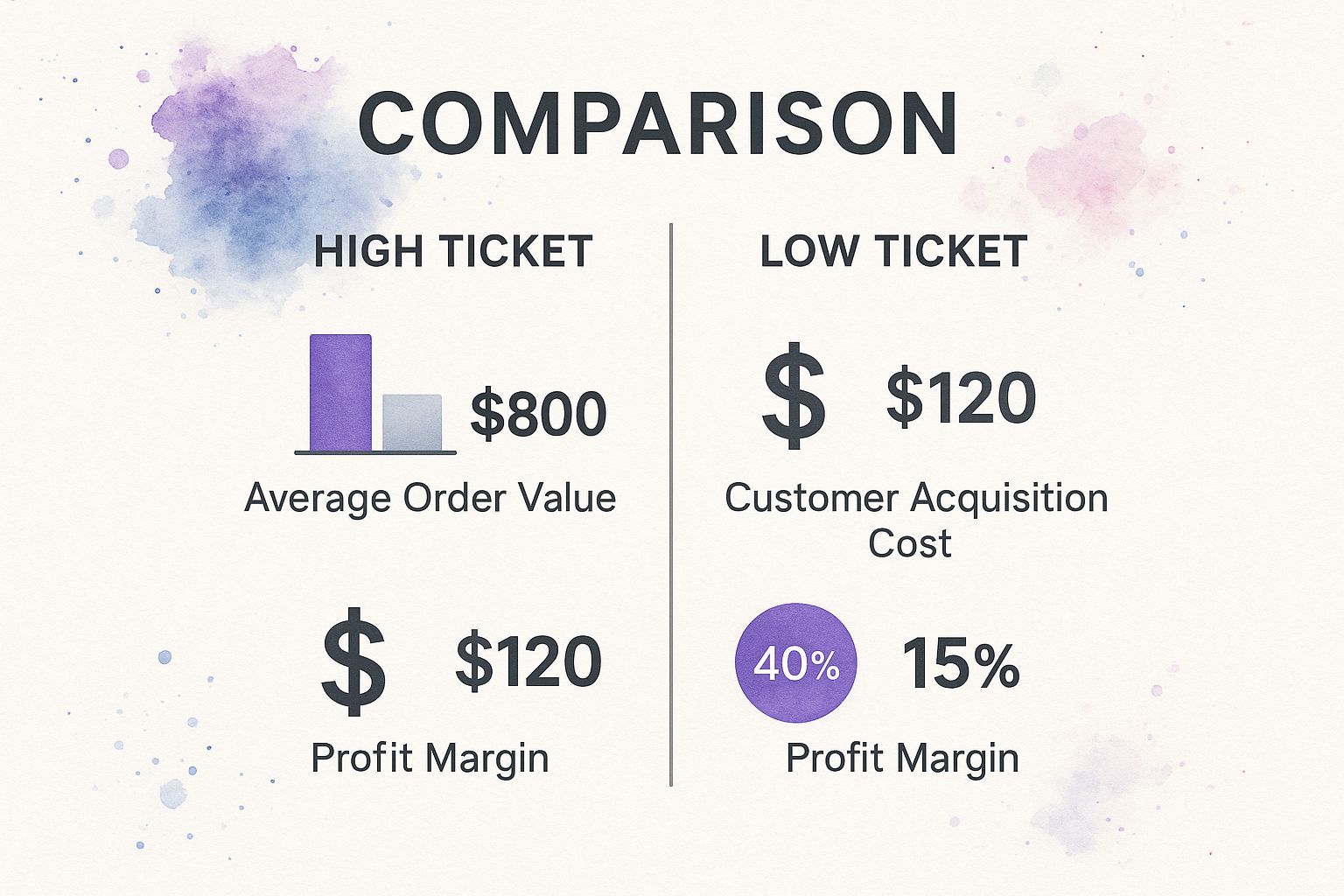
Ultimately, those higher profit margins aren't just for show. They give you the crucial resources needed to invest back into acquiring the perfect customers and delivering an experience they'll never forget. This creates a sustainable, profitable cycle—one that doesn't depend on the constant, exhausting grind for low-value sales.
Building a Brand That Commands Premium Prices
When you're selling high-ticket items, you're not just selling a product; you're selling confidence. It all comes down to building a brand that radiates trust and authority. The goal isn't just to have a checkout page—it's to create an entire world around your offer, one where the value is so clear that the price tag simply makes sense.
This work begins way before a potential client ever sees a price. You have to get almost obsessive about understanding your ideal customer. Forget basic demographics. What are their biggest fears? What do they truly want to achieve? The product you're selling is just a vehicle for the transformation they're really after.
Once you know that, your brand has to become a megaphone for that transformation. Everything from your logo and color scheme to the way you write your emails needs to scream expertise and quality. Being consistent isn't just a good idea; it's the absolute foundation of a high-end brand people trust.
Defining Your Premium Identity
A powerful brand identity is like a magnet for the right people. It pulls your ideal clients in close and politely signals to everyone else that this might not be the right fit for them. And in the high-ticket world, that's exactly what you want. You’re not trying to be a little something for everyone; you’re aiming to be everything for a select few who will become your biggest fans.
To really nail this identity, focus on a few key areas:
- Expert Positioning: Don't be shy about what you know. Share your expertise generously through in-depth articles, webinars, or detailed guides. This builds trust and shows you're the real deal long before you ask for a single dollar.
- Visual Cohesion: Great design isn't a luxury; it's a requirement. Your website, social media, and product packaging must look and feel premium. A polished, professional look subconsciously tells people your offer is high-quality.
- Consistent Messaging: Figure out what makes you uniquely valuable and then say it, again and again. Every piece of content, every ad, and every email should echo the core promises of your brand.
This is why having a single, unified online presence is so critical. Juggling a patchwork of different tools and platforms can seriously dilute your brand's impact, creating a clunky experience that kills trust before it even has a chance to grow.

As you can see, a unified platform allows you to present your courses, community, and digital products under one professional brand. It’s more than just convenient; it's a strategic decision that solidifies your authority by letting you control the customer journey from start to finish.
Creating a Branded Ecosystem
Your online space should feel like an exclusive club, not a stall in a crowded marketplace. This reinforces the idea that people aren't just buying a product—they're investing in your unique world. To position your brand as a leader and justify those higher prices, you'll need to explore some smart premium pricing strategies that reflect the incredible value you're providing.
Building a brand is not about standing out, but about being chosen. The goal is to create such a strong preference that the customer sees no other viable option.
This is where your choice of platform can make or break you. With Zanfia, you can instantly build that credibility with personalization features like a custom domain and brand colors. From the second a customer lands on your page to the moment they log into their private dashboard, every single interaction is wrapped in your brand. It takes the chaos of managing a dozen different tools and replaces it with a single, professional hub that oozes quality.
A solid brand is also the perfect launchpad for an engaged customer base, which is why a built-in Community space is the perfect next move in building your high-ticket empire.
How to Craft an Irresistible High Ticket Offer
When you're selling a high-ticket item, it shouldn't feel like an expense to the customer. It needs to feel like an investment—a clear path to a transformation they deeply want. The secret isn't just about the price; it's about building such a compelling package that the premium price becomes the only logical conclusion.
The strategy behind this is often called "value stacking."
Think of it this way: instead of just selling one thing, you bundle your core product with exclusive bonuses, access to a community, and solid guarantees that dissolve any hesitation. The goal is to make the perceived value of the entire stack so much greater than the price tag.
At the heart of it all is creating an effective value proposition. You're not just selling a course or a service; you're selling the outcome. That's the key.

The Anatomy of a High-Value Stack
A powerful high-ticket offer is built in layers. Each layer adds to the overall value and helps justify the price. This isn't about just throwing in a bunch of random extras, either. Every single component should solve a specific problem or make the customer's journey to their goal faster and easier.
Here's a breakdown of what a solid offer stack looks like:
- The Core Product: This is your flagship offering, the main reason people are showing up in the first place. It might be an in-depth online course, a coaching program, or a mastermind group. Whatever it is, it must be comprehensive and deliver a real result all on its own.
- Exclusive Bonuses: Think of these as accelerators. They are supplementary resources that help your customers get results faster or solve related problems. This could include templates, checklists, breakdowns of case studies, or bonus workshops that support the main product.
- Community Access: Honestly, this is often the most valuable part of the entire stack. Giving someone access to a private community of like-minded peers and experts creates a powerful sense of belonging and provides support long after they've finished the core material.
- Direct Support & Access: For truly premium offers, giving customers direct access to you or your team is a massive value-add. This could be group coaching calls, Q&A sessions, or a dedicated support channel.
- Risk Reversal (The Guarantee): A strong guarantee completely removes the financial risk for the buyer. It screams confidence in what you're selling. This could be a simple satisfaction guarantee or, even better, a results-based promise.
This approach turns a simple product into a complete, all-in-one solution. Getting this right is a cornerstone of any high-ticket business because it completely shifts the conversation from "How much does it cost?" to "Look at all the value I'm getting."
Unifying Your Offer for a Seamless Experience
Now, here’s where a lot of people mess up. The biggest challenge with value stacking is the delivery.
Imagine your customer has to log into five different systems to access their course, download the bonuses, and join the community. That premium experience you promised? It falls apart instantly. This kind of logistical nightmare creates friction and cheapens your whole offer.
This is exactly why the right platform is more than just a tool—it's a strategic advantage. A messy, disjointed tech stack is the enemy of a high-ticket business.
The perceived value of an offer is directly tied to the seamlessness of its delivery. A clunky, fragmented experience can undermine even the most compelling value stack.
Instead of fighting with plugins and trying to tape different systems together, a unified platform lets you deliver this entire high-value package effortlessly.
Building Your Offer Stack with Zanfia
Using a single, integrated system like Zanfia makes putting together and selling a stacked offer ridiculously simple. You can seamlessly bundle your core product with all those value-added components, and it's all managed from one central hub.
Here’s a practical look at how it works:
- Core Product: Host your flagship Online Course right on the platform. It handles everything from video hosting and progress tracking to dripping out content over time to guide your students.
- Community Access: With a click, you can grant instant, exclusive access to your private Community space, complete with dedicated channels for discussion, support, and networking.
- Exclusive Bonuses: Package up your supplementary materials—like ebooks, reports, or templates—as Digital Products that are automatically included with the main offer.
- Effortless Checkout: Zanfia’s modern cart handles the entire bundled transaction. You can sell a multi-part, high-value package with a single checkout link, giving your customers an incredible, professional experience from the very first click.
This integrated approach means that from the moment of purchase, your client has everything they need in one clean, branded, and professional space. It's the kind of thing that reinforces the premium quality of their investment.
Your Marketing Funnel for High-Value Customers
You can't sell a $2,000 course the same way you sell a $20 ebook. The customer's mindset is completely different, which means your strategy has to be, too. High-ticket sales aren't built on impulse buys; they’re built on relationships and a deep sense of trust.
This calls for a more "high-touch" marketing funnel, one designed to carefully guide potential customers from casual interest to a confident purchase. It's a deliberate journey where you attract the right people, build genuine trust through personalized communication, and walk them through a consultative sales process. In this world, you're not just a marketer—you're a trusted advisor.
Attracting the Right Audience at the Top
The first step is awareness, but it’s a very specific kind. Instead of throwing a wide net with generic ads, your real goal is to pull in a smaller, much more qualified group of people. You do this by creating incredibly valuable, in-depth content that speaks directly to their biggest problems and goals.
Think about content like:
- Deep-dive blog posts and guides that prove you know your stuff.
- Webinars or live workshops where you teach a tangible skill they can use.
- Detailed case studies that show your methods actually work for people like them.
This kind of content acts as a natural filter. It attracts people who are serious about finding a real solution and gently pushes away those just hunting for a quick, cheap fix. The main goal here is to get them to raise their hand and join your email list in exchange for something truly valuable.
Nurturing Leads with Personalized Communication
Once someone is on your email list, the real work of building trust begins. This is your chance to shift from a one-to-many broadcast to a more personal, one-to-one conversation. A generic, automated email blast just won't cut it here.
Your email sequences need to educate, build rapport, and show you genuinely understand their situation. Share success stories from past clients, address the common doubts and fears head-on, and keep providing value. You want them to feel seen, understood, and confident that you are the expert who can guide them.
This is where smart automation becomes your best friend. Trying to manage this process manually is a recipe for disaster as your business grows.
A high-touch marketing funnel doesn’t mean you do everything by hand. It means using smart automation to deliver a personalized, high-touch experience at scale.
This is exactly where Zanfia’s Automations and Integrations become the engine driving your funnel. By linking your email system, like ActiveCampaign or MailerLite, directly into Zanfia, you can build sophisticated nurture sequences that kick off based on what people do. Someone downloads a guide or signs up for a webinar? A personalized journey begins, building the confidence they need to make a high-ticket investment.
Guiding Prospects Through a Consultative Sale
For most high-ticket offers, the final step isn’t a simple "Buy Now" button. It usually involves a more hands-on sales process, like filling out an application, hopping on a strategy call, or receiving a personalized proposal. This final touchpoint solidifies the relationship and confirms that your offer is the perfect solution for them.
The entire funnel—from the very first blog post to the final conversation—is engineered to systematically erase doubt and build certainty. By the time someone is ready to buy, the price is no longer their main focus. The value and the promised outcome are. A great funnel makes the investment feel not just reasonable, but completely essential. To really nail this, you need to understand the numbers behind it, which is why our guide on conversion rate optimization strategies is a great next step.
The high-ticket ecommerce space is a massive and growing slice of the digital economy. In fact, U.S. retail e-commerce sales recently hit $292.9 billion in a single quarter, with online purchases now accounting for 16.3% of all retail sales. Categories known for big-ticket items, like electronics and furniture, often see conversion rates around 3.6%—a figure that's well above the general ecommerce average. This just goes to show that people are more comfortable than ever making major purchases online. (Learn more about recent U.S. e-commerce trends).
Delivering a Premium Post-Purchase Experience

For a high-ticket business, the sale isn't the finish line. It’s the starting gun. A premium price tag carries the weight of premium expectations, and if you drop the ball after you've made the sale, you’re setting yourself up for buyer's remorse and killing any shot at long-term loyalty.
A truly world-class post-purchase experience is all about validating the customer's decision. It needs to make them feel smart, cared for, and absolutely confident they just made the right investment. This is your moment to transform a high-value customer into a raving fan.
Beyond the "Thank You" Page
The real work begins the instant their payment goes through. A generic confirmation email just won't cut it. Your onboarding process needs to be every bit as thoughtful as your sales funnel, guiding new clients smoothly into your world and showing them exactly how to get the value they just paid for.
This means crystal-clear instructions, setting expectations for what happens next, and giving them immediate access to the resources they need. Any friction or confusion at this early stage plants a seed of doubt, which is the last thing you want for a premium brand.
The quality of your post-purchase experience is a direct reflection of your brand's integrity. It's where you prove your promises weren't just a sales tactic.
This is exactly why having a single, unified platform is non-negotiable. Trying to make a client juggle different logins for a course, a community, and bonus materials creates a clunky, disjointed experience that instantly cheapens the premium feel you've worked so hard to build.
Building a Centralized Hub for Your Clients
To deliver a truly premium experience, you need to create one branded home base for your customers. Think of it as a central hub that contains everything they've purchased, making it effortless for them to dive into your material and connect with others.
This is where an integrated platform like Zanfia really shines, giving you the power to create this exact experience without wrestling with a bunch of different tech tools.
- Seamless Onboarding: When someone buys your high-ticket package, they get one login to one professional, branded dashboard. No confusion, just immediate access.
- Structured Learning: You can deliver your flagship Online Course with features built for a premium learning journey. Track student progress, drip content out over time with scheduled unlocks, and host all your lessons in one polished space.
- Vibrant Community: At the same time, you can give them exclusive access to your professional Community. With dedicated channels for discussions, Q&As, and networking, you create an environment for real support and connection.
This approach takes your offer from being a simple digital product and turns it into a comprehensive, high-value program. Every time they log in, their decision to invest is reinforced when they see their course material and community hub living side-by-side. The result? An experience that not only crushes buyer's remorse but actively builds loyalty, turning satisfied customers into your most powerful marketing asset.
Scaling Your Business with Systems and Referrals
Growing a high-ticket business sustainably isn't about putting in more hours—it's about building smarter systems. Once you've got a solid offer and a steady stream of clients, the real challenge becomes growing without hitting a wall. The secret is to stop being the one doing everything and start building intelligent systems that do the work for you.
The two best ways to do this? Automation and referrals. By automating all the tedious, repetitive tasks, you get your time back to focus on what actually moves the needle—things like building client relationships or making your products even better. We dive deep into this shift in our guide to scaling with systems.
Automating for Efficiency
Just think about all the little things you do by hand. Sending welcome emails. Granting access to courses. Tagging customers after a purchase. It’s manageable when you only have a handful of clients, but it quickly becomes a massive time-sink as your business grows.
This is exactly why you need a central system to do the heavy lifting. Forget about trying to patch together a dozen different tools; a single, unified platform can make your entire operation run smoothly.
The real point of scaling isn't just to get bigger. It's to build a business that can thrive without you being hands-on 24/7. True scale comes from systems, not just sheer effort.
With a platform like Zanfia, for example, the built-in Automations feature is designed to handle this. You can set up simple rules that trigger actions based on what a customer does. When someone buys a product, you can automatically add them to a private community and tag them in your email list—all without you having to lift a finger.
Turning Happy Clients into Your Best Sales Force
The other secret to scalable growth is turning your existing customers into your best marketers. In the high-ticket world, nothing sells better than trust. A glowing recommendation from a happy client is worth more than any ad campaign you could ever run.
When you create a formal referral program, you're not just hoping for word-of-mouth—you're building a predictable engine for growth. Consider the global B2B eCommerce market, which is where many high-ticket sales happen. It's valued at a staggering $32.11 trillion. A huge chunk of that value is driven by relationships and trusted referrals, not just traditional marketing. (Discover more insights about B2B ecommerce growth on sellerscommerce.com).
Zanfia makes this dead simple with its built-in Referral Program for digital products. You can set it all up right inside the platform, decide on the rewards for your advocates, and even automate the messages they receive. This turns your biggest fans into powerful brand ambassadors, creating a growth loop that practically runs itself.
Got Questions? We've Got Answers
Stepping into the world of high-ticket sales can feel like a big move. It's totally normal to have questions. Here are some of the most common ones we hear from creators making the shift from selling many things to selling the right things.
What's Actually Considered "High-Ticket"?
Most people in the space agree that anything priced over $500 to $1,000 falls into the high-ticket category.
But honestly, the exact number isn't the point. A product is high-ticket when its price makes a potential buyer pause and really think. It's a considered purchase, one that demands a deep level of trust before they're willing to hit "buy."
Do I Need a Massive Following to Make This Work?
Absolutely not. This is one of the biggest myths out there. High-ticket success is all about the quality of your audience, not the size of it.
Think about it: a small, dedicated group of people who hang on your every word and trust your expertise is infinitely more valuable than a giant, passive audience that barely knows you exist.
The goal isn't to be a celebrity to everyone; it's to be an indispensable guide to the right people. A hyper-engaged audience of 100 true fans will build a far more stable and profitable business than a general following of 10,000.
What are the Biggest Stumbling Blocks I Should Watch Out For?
Where do I start? The most common mistakes usually come from trying to apply low-ticket strategies to a high-ticket offer. People often trip up by:
- Not building a brand that feels genuinely premium and trustworthy.
- Creating a muddled or weak offer that doesn't scream "value!"
- Using generic marketing tactics that just don't build the necessary connection.
- Forgetting that the customer experience after the sale is just as important as the one before it.
Each of these erodes the trust you're working so hard to build, making that premium price point impossible to justify.
What Kinds of Products Actually Sell Well at High Prices?
The best high-ticket products don't just sell information; they sell a transformation. They solve a painful, urgent problem or provide a clear path to a deeply desired outcome.
The most common successful offers include:
- Comprehensive Online Courses: These aren't just a few video lessons. They are signature programs that guide someone from A to Z on a valuable skill.
- Exclusive Coaching Programs: Think personalized, one-on-one guidance and direct access to you, the expert.
- Mastermind Groups: High-level communities that offer accountability, networking, and peer support you can't find anywhere else.
- Specialized Consulting Services: Rolling up your sleeves and helping a client solve a specific, high-stakes business challenge.
These work because their value is tied directly to a tangible, life-changing result.
Ready to build the premium, all-in-one experience your high-ticket clients deserve? With Zanfia, you can seamlessly bundle your courses, community, and digital products into one branded hub. Start building for free today!