

Best Platform for Selling Digital Products
When you’re ready to find the best platform for selling digital products, the perfect choice often boils down to a single question: what’s your ambition? An all-in-one platform like Zanfia is a fantastic fit for Polish creators looking to scale up with 0% transaction fees, but other tools might be better for different goals. It’s all about matching the platform to your unique vision.
Matching Your Ambition to the Right Platform
Before you get lost in a sea of features and pricing tables, the most important step is to look inward. Seriously. The "best" platform isn't the one with the longest feature list; it's the one that feels like a natural extension of your business goals, where you are now, and where you want to go. Without that clarity, you're just guessing. You could end up with a tool that holds you back or, just as bad, one that's so complicated you never even use half of it.
So, let's start there. What kind of creator are you, really?
Are you a "Potential Explorer"? Maybe you're an expert with valuable know-how, but you're stuck in pre-launch paralysis, overwhelmed by tech and looking for the simplest, lowest-risk way to launch your first digital product.
Or are you a "Business Architect"? You might already be pulling in PLN 10k–100k+ a month, but you’ve hit the ceiling with piecemeal tools and need a professional, integrated solution to scale efficiently while protecting your margins.
Or perhaps you're a "Craft Master"? You're an established expert taking in PLN 100k+ a month, committed to delivering top-tier content and needing elegant, rock-solid tech that matches your premium positioning. Knowing which persona you fit into makes it so much easier to cut through the noise and find what you need.
Define Your Business Model
Okay, next up: how do you plan to make money? Your business model directly impacts the features you can't live without.
Think about which of these buckets you fall into:
- One-Time Products: This is the classic approach—selling individual e-books, templates, downloads, or standalone online courses. It’s a solid and straightforward way for many creators to get started.
- Subscriptions & Memberships: Are you looking to build a reliable, recurring revenue stream? This model works great for professional communities, paid newsletters, or libraries of content with ongoing access.
- Bundles & Tiered Offers: This is where you can get creative by packaging multiple products together. Think about a signature course bundled with private community access, installment plans, and a set of exclusive resources.
If subscriptions are a core part of your strategy, you’ll want to get serious about how you manage those payments. Looking into the top SaaS billing software solutions can give you a much clearer picture of what’s required to handle recurring revenue efficiently.
This decision tree gives you a visual for how your starting point—whether as an 'Explorer' or an 'Architect'—can steer you toward the right kind of platform.
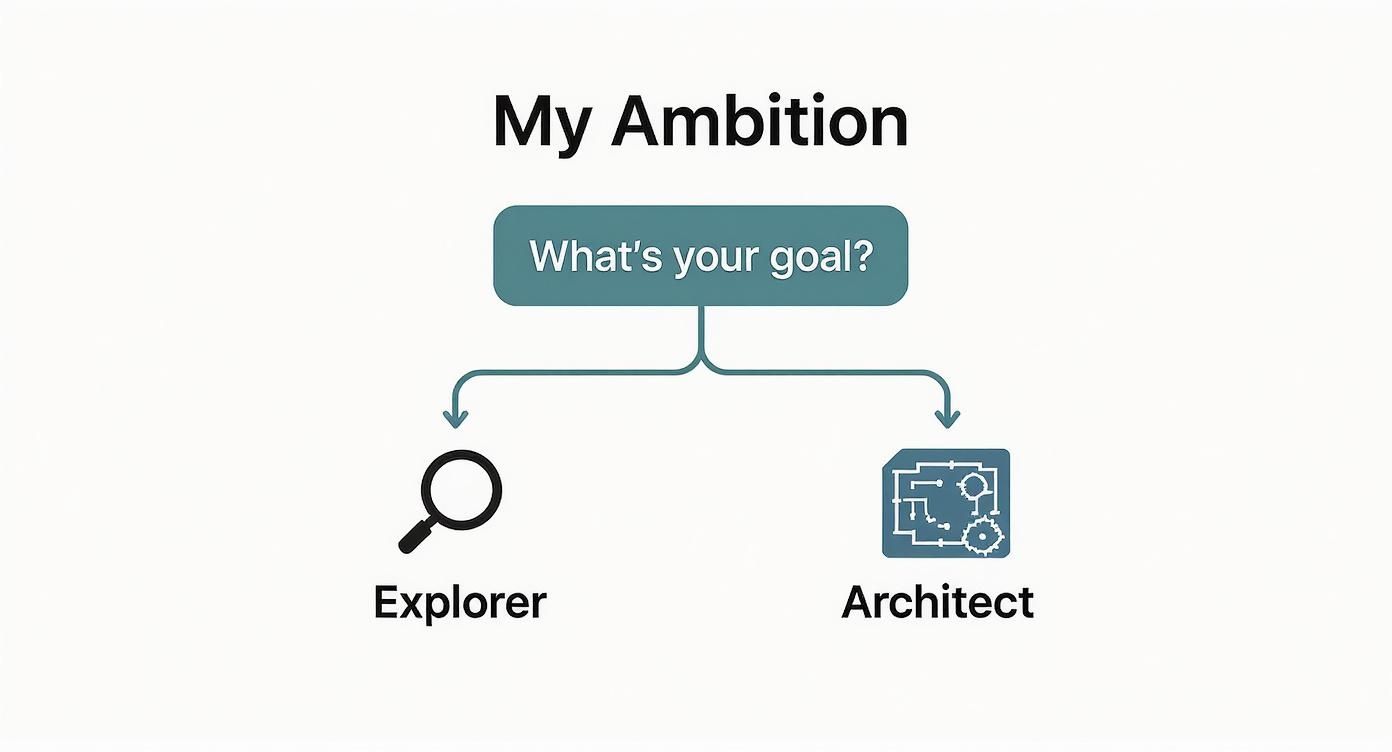
As the graphic shows, your core ambition is the foundation. Whether you’re just starting out or aggressively scaling, that goal should directly influence the tools you choose. This is especially true for course creators, where the little details can make a huge difference.
Make no mistake, the opportunity here is massive. The digital product industry generates trillions annually worldwide. By defining your ambition first, you put yourself in the best possible position to carve out your slice of this incredible market.
The Non-Negotiable Features of a Winning Platform

When you're hunting for the right platform to sell your digital products, it’s all too easy to get sidetracked by flashy features that don't actually move the needle. A great platform isn't just a payment processor; it’s the central hub of your entire online business.
Think about it. A customer buys your course, gets a single login, and is instantly added to your private community. Moments later, they see a one-click upsell for your new e-book. That’s the kind of smooth, automated experience you should be aiming for. This only happens when a platform is a truly integrated ecosystem, saving you from the headache of juggling a dozen different logins and subscriptions.
Ditch the Duct Tape: Integrated Community and Content
One of the biggest wins is finding a platform that lets you house your community right alongside your content. So many creators create unnecessary friction by pushing their audience to external tools like Discord or Facebook groups. Every extra step is a chance to lose their attention and dilute the brand experience.
Platforms like Zanfia keep everything unified under the creator’s brand. Your students can drop questions and discuss lessons in topical channels right below the video they just watched. This keeps the conversation focused, builds stronger connections, and makes your brand the go-to spot for everything they need. The result? Engagement, lifetime value, and member retention are dramatically boosted.
“Without Zanfia, developing a paid newsletter and community in Poland would be much harder—it’s the best tool in the market.”
— Wojciech Pisarski, CEO of wMinutę
Don't Get Nickel-and-Dimed: Native Video and Flexible Sales Models
Video is probably the core of your digital product, but hosting it can become a huge hidden expense. If you have to pay for a separate subscription to a service like Vimeo or Wistia, that's another tool to manage and another bill eating into your profits.
Look for a platform with native video hosting built right in, which eliminates the need for costly external services while still supporting flexible integrations with YouTube, Vimeo, Wistia, and Bunny.net. This feature alone can easily save you hundreds of zlotys a year and ensures your students get a buffer-free viewing experience with a smart player that automatically saves their progress.
Beyond video, your platform needs to support the way you want to sell—both now and in the future. Your business will evolve, so make sure the system can handle:
- One-time purchases for things like e-books or workshops.
- Subscriptions for ongoing memberships and paid newsletters.
- Installment plans to make your premium offers more accessible.
- Product bundles and upsells to package your offers and boost your average order value.
This kind of flexibility means you’re never stuck with just one way to make money.
It's Your Brand, Not Theirs: Full White-Label Control
At the end of the day, your brand is your single most important asset. The right platform gives you complete ownership of the customer experience through white-labeling and custom domain support.
Your customers should feel like they are on your site, interacting with your business—not the platform's. When a platform slaps its own logo all over your pages, it dilutes your reputation. For recognized experts and premium brands, having full brand control is vital.
Part of building that strong brand experience involves providing excellent support. This often means creating a solid knowledge base, and you can learn more about the best knowledge base software to see how it fits into your ecosystem.
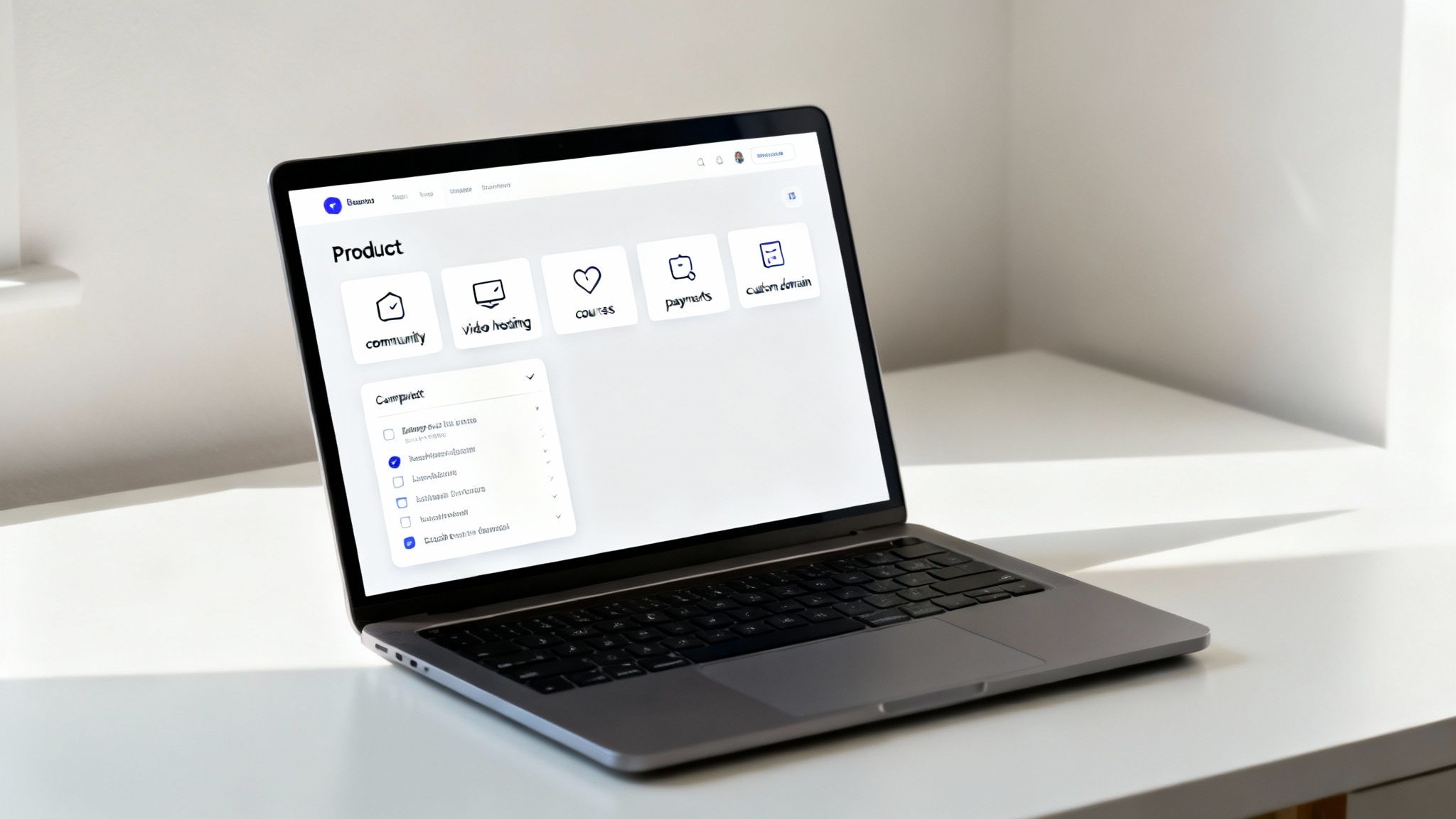
Before making a final choice, it helps to map out exactly what you need. I've put together a quick checklist to distinguish the absolute must-haves from the nice-to-haves.
Essential Platform Feature Checklist
| Feature | Why It's Critical | Impact on Your Business |
|---|---|---|
| All-in-One Dashboard | Simplifies management by consolidating tools with a single login. | Saves time, reduces subscription costs, and prevents data silos. |
| Integrated Community | Keeps members engaged where your content lives. | Increases retention, builds a loyal following, and adds value to your offers. |
| Native Video Hosting | Avoids costly third-party video subscriptions. | Lowers overhead costs and provides a seamless user experience for students. |
| Flexible Sales Models | Lets you sell how you want (subscriptions, bundles, etc.). | Maximizes revenue opportunities and allows you to adapt your business model. |
| Custom Domain & White-Labeling | Puts your brand front and center. | Builds brand trust, creates a professional image, and improves customer experience. |
| Marketing & Email Tools | Allows you to nurture leads and communicate with customers. | Drives sales, increases customer lifetime value, and automates marketing tasks. |
Use this checklist as your guide. The platform that ticks the most boxes in the 'Must-Have' column is likely the one that will grow with you, not hold you back.
How Pricing Models Impact Your Bottom Line
It’s not what you make; it’s what you keep. This old saying is painfully true for digital creators, as platform fees can quietly eat away at your profits, especially as your business grows. The pricing model of your chosen platform is one of the most critical factors you'll face, directly impacting your long-term profitability.
You'll generally run into two dominant models: a flat monthly subscription fee or a per-transaction commission. While a small percentage fee might seem insignificant when you're just starting, it can become a major expense as your revenue climbs.
The Hidden Cost of Transaction Fees
Let’s run some real numbers. Imagine your business starts bringing in PLN 10,000 per month. A platform charging a 5% transaction fee is already taking PLN 500 right off the top. Fast forward a year, and you’re scaling to PLN 50,000 per month. Suddenly, that fee balloons to PLN 2,500—every single month.
This model effectively creates a tax on your success. The more you earn, the more you pay, which can start to feel like the platform is profiting from your hard work rather than truly partnering in your growth. It also makes financial forecasting a headache, since your platform costs fluctuate directly with your sales.
A platform's pricing reveals its philosophy. Is it designed to grow with you or at the expense of you? The right model should feel like a partnership, not a penalty for doing well.
Before you commit, it’s worth taking the time to explore different platform pricing models to get a clear picture of subscription fees, transaction percentages, and other potential hidden costs.
The Freedom of a 0% Transaction Fee Model
Now, let's flip the script. A pure SaaS subscription model offers something invaluable: clarity and predictability. Platforms like Zanfia operate on a flat zero-percent (0 %) transaction fee basis. You pay one clean SaaS subscription, and 100% of your hard-earned revenue is yours to keep (minus the standard fees charged by payment operators themselves).
This transparent, partnership approach has powerful advantages for creators:
- Predictable Expenses: You know exactly what your platform will cost each month. This makes budgeting and financial planning straightforward and accurate.
- True Scalability: As your revenue grows from PLN 10k to PLN 100k+ a month, your platform costs don't change. This protects your margins and frees up more profit to reinvest back into your business.
- Better Alignment: The platform is motivated to provide excellent features and support to keep you as a happy subscriber, rather than just taking a cut of your sales.
For creators aiming for significant growth, this financial clarity is a game-changer. It turns your platform from a variable cost center into a fixed, strategic investment. This is especially true if you're building a business around recurring revenue, a concept you can dive deeper into by checking out these subscription business model examples for creators. Choosing a pricing model that aligns with your financial goals ensures your tech stack supports your success instead of holding it back.
Automating Your Business to Reclaim Your Time
As a creator, your real job is making great content. You shouldn't be spending your days buried in administrative busywork. The right platform isn’t just a place to list your products; it's an operations hub that can hand you back 5–10+ hours every single month. The secret is leaning into powerful automation and setting up workflows that run the business for you.
Imagine this: someone buys your flagship course. Instantly, they get access to the materials, are added to the right community channels, and receive the first email of your welcome sequence. This all happens in the background, without you having to click a single button. It delivers a polished, professional experience for every customer, whether they buy at 2 PM or 2 AM. For a growing business, this kind of seamless onboarding isn't just a nice-to-have; it's essential for delivering value.
From Manual Tasks to Seamless Workflows
A top-tier platform does more than just host your files—it manages the nuts and bolts of your business. All those repetitive, time-consuming manual tasks can be put on autopilot, freeing you up to focus on value-packed content instead of admin chores.
Here’s what that looks like in the real world:
- Subscription Management: Your platform should handle subscription renewals and chase down failed payments automatically. If a plan ends, it revokes access without any manual intervention from you.
- Automated Invoicing: A purchase is made, and an invoice is immediately generated and sent. For Polish creators, integrations with leading accounting suites like inFakt and Fakturownia are crucial for dramatically simplifying finances and compliance.
- Targeted Communication: Customers are automatically tagged and segmented based on what they buy. This lets you add them to the right email list or community group so you can send relevant follow-ups and upsells.
If you're an established creator pulling in PLN 10k–100k+ a month, these automations are absolutely critical. Getting even five hours back each month gives you the breathing room to create new products, connect with your audience, or just step away and avoid burnout.
Building a Personalized Tech Stack
For creators with more complex needs, a platform's built-in tools are just the start. This is where advanced features like solid API access and webhooks become non-negotiable. They are the keys to connecting your sales platform with your favorite tools, billing systems, CRMs, and marketing automation software for a truly personalized tech stack.
This means you can connect your sales platform to your favorite CRM, sophisticated marketing software, or a custom-built analytics dashboard. For example, a new course enrollment could trigger a complex sequence in an external tool, or a cancelled membership could set off a specific offboarding process. This level of control allows you to build powerful, interconnected systems that fit your workflow like a glove. To dive deeper into this concept, check out our guide on scaling with systems.
By handing off the repetitive work to a reliable platform, you get your most precious resource back: your time. That’s when you can finally get back to doing what you love—creating incredible products and growing a business you're proud of.
Finding a Platform That Speaks Your Customers' Language

Here's something I’ve seen trip up countless creators: the best platform for someone in the US can be a complete dead-end for an entrepreneur in Poland. It’s a detail that seems small but can make or break your entire business.
Think about it. We often focus on flashy features, but what really matters are the local nuances—the preferred payment methods, automatic tax compliance, and even cultural expectations. Choosing a platform that understands your home turf isn't just a nice-to-have; it's a serious strategic advantage.
For instance, international giants like Kajabi or Teachable are incredibly powerful, but they often miss the mark on local integrations. A customer in Poland isn't just going to pull out a credit card; they expect to pay with BLIK, PayU, or Przelewy24. A platform built by a domestic team gets this instinctively. They’ll offer seamless integrations with local invoicing systems like inFakt and Fakturownia, which automates VAT handling and supports Apple Pay/Google Pay. That’s a massive headache solved right there.
This is the kind of detail that turns a good platform into a true business partner.
Marketplace vs. Your Own Domain
Another fork in the road is deciding between a bustling marketplace and your own branded storefront. A marketplace like Etsy can be a fantastic launchpad, especially if you’re new and selling things like design templates or photo presets. You immediately get access to a built-in audience of millions of buyers actively searching for products like yours.
But for established experts or anyone building a premium brand, that model has some serious downsides. You’re essentially building your business on "rented land," stuck competing side-by-side with countless other sellers. It’s tough to build a unique brand identity or command higher prices when you’re just another tile in a massive grid.
On the flip side, a white-labeled platform on your custom domain gives you total control. It's the go-to choice for creators who already have an audience and want to build a professional, independent brand. When customers land on your site, they experience your brand from start to finish, which builds incredible trust and loyalty.
Platform Type Comparison
To help you visualize this, here’s a quick breakdown of the different platform models. Choosing the right one depends entirely on where you are in your business journey and what you want to achieve.
| Platform Type | Ideal For | Key Advantage | Potential Drawback |
|---|---|---|---|
| All-in-One Marketplace | New creators, template/preset sellers, artists | Huge built-in audience and discoverability | High competition, limited branding, "rented land" |
| White-Labeled Platform | Established experts, course creators, coaches | Full brand control and ownership | Requires you to generate your own traffic |
| WordPress Plugin | Tech-savvy creators, bloggers with existing sites | Ultimate customization and flexibility | Higher maintenance, plugin juggling, and tech know-how required |
| Specialized Niche Platform | Newsletter writers, community builders | Features are perfectly tailored to one product type | Can be limiting if you want to expand your offerings |
Ultimately, the best choice aligns with your specific product, audience, and long-term vision for your brand.
Match the Platform to Your Product
The world of digital products is huge and getting bigger, with certain platforms becoming the undisputed leaders for specific niches.
For example, a platform like Gumroad has seen massive growth fueled by online courses. But what if you're selling a combination of courses, a paid community, and a newsletter? Piecing together separate tools for each can be a nightmare. This is where an all-in-one, community-based platform provides a unified, reliable system.
If you’re still figuring out where your products fit in, our guide on what are digital downloads offers a great overview of the different categories and opportunities.
Serial entrepreneur and PLN 55m tech investor Artur Kurasiński calls Zanfia “the most convenient and simplest solution for paid newsletters, courses and community on the Polish market.”
This kind of feedback says it all. When a platform is built from the ground up for a specific market, it delivers a level of ease and functionality that global competitors just can't replicate. So, what’s your goal? Are you looking for quick discovery in a crowded market, or are you building a lasting, independent brand with deep roots in your local community? Answering that question will point you in the right direction.
Common Questions About Choosing Your Platform
Deciding on the best platform for selling digital products is a big deal. It's easy to get bogged down by all the options, but a few questions pop up time and time again. Let's tackle them head-on so you can feel confident in your choice and get back to what you do best—creating.
All-in-One vs. Piecemeal Tools
One of the first forks in the road is deciding between a slick, all-in-one platform and a DIY approach using a handful of separate tools, like a bunch of WordPress plugins.
An all-in-one system, like Zanfia, is designed to bring everything under one roof. Think courses, community, e-commerce, and your storefront, all working together seamlessly with a single login. The beauty of this is that you offload the technical nightmares—no more plugin juggling, security patches, or wrestling with tech. It delivers peace of mind from professionally managed SaaS infrastructure.
The alternative, a self-hosted WordPress stack, gives you a ton of flexibility, but it requires tech know-how. You’re not just a creator; you become your own IT department. For most people, the time and sanity saved with an all-in-one solution is a game-changer. It frees you up to focus on your actual business, not the backend tech.
The Real Impact of Transaction Fees
When you're first starting out, a 5-10% transaction fee doesn't sound like much. But as your revenue grows, those little percentages start to take a big bite out of your profits. This is a classic scaling problem that can sneak up on you.
Look for a platform with 0 % transaction fees and a straightforward SaaS subscription model. This kind of pricing structure is built for creators who plan to succeed. The platform wins when you win by providing great tools, not by taking an ever-increasing cut of your hard-earned cash. It makes your financial forecasting way simpler and lets you reinvest more money back into your business.
Marketplace vs. Your Own Domain
Should you list your products on a big marketplace or build your business on your own turf? It’s a crucial distinction.
A marketplace like Etsy can be fantastic for getting eyeballs on your products, especially if you're just starting and sell things like digital templates. They bring the traffic to you.
However, if you're building a premium brand or you're an established expert, you absolutely need your own domain. It's non-negotiable for long-term growth. Having your own site gives you total control over branding, pricing, and, most importantly, your customer relationships. You're building an asset, not just renting space on someone else's platform.
The right platform is also your marketing engine. With the global digital marketing industry projected to reach $472.5 billion by 2025, you can't afford to ignore it. You need a platform that integrates powerful sales tools with modern marketing features. For instance, we know that short-form interactive videos can boost conversions by up to 80%. A platform that lets you easily incorporate strategies like this gives you a serious advantage. Discover more insights about digital marketing statistics on hostinger.com.
Ready to build your digital product business on a platform that grows with you? With Zanfia, you get a true all-in-one solution with 0% platform fees, native video hosting, and powerful automations, all under your own brand. Start building your future at Zanfia today!

One comment
Comments are closed.


[…] settings. For those looking to understand the creator's side of this marketplace, exploring the best platforms for selling digital products can offer valuable insight into how this community thrives. With powerful search filters and […]