

10 Actionable Content Repurposing Strategies to Scale Your Business
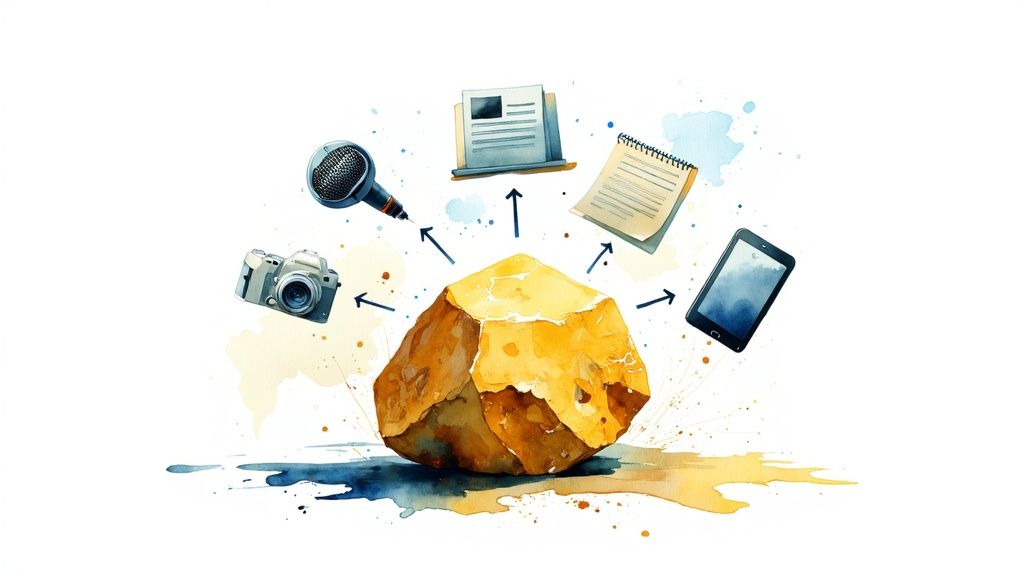
As a creator, you're constantly told to 'create more.' But what if the secret to scaling isn't more content, but making your existing content work harder? The endless cycle of creation leads to burnout and overwhelm, a real business problem for entrepreneurs trying to build stable revenue. This guide isn't about generic tips; it's a practitioner's playbook of proven content repurposing strategies that save time, amplify your message, and attract new audiences without starting from scratch.
This article provides a curated collection of high-impact tactics. We will show you exactly how to transform one core asset, like a detailed online course, into a dozen pieces of micro-content. For example, a single video lesson from a course hosted on Zanfia can be fragmented into short-form videos for social media, key insights for a paid newsletter, and discussion prompts for your built-in community space—all managed from one central hub.
We'll break down actionable methods to transform one great piece of content into a diverse portfolio of assets. This approach positions you as an authority and drives consistent growth. You already have a goldmine of content; it's time to learn how to excavate it efficiently. Let's dive into the specific strategies that will help you stop the content treadmill for good.
1. Long-Form to Short-Form Social Media Content
One of the most effective and time-saving content repurposing strategies is transforming a single, comprehensive piece of content into a multitude of smaller assets for social media. This approach involves deconstructing a long-form article, webinar, or podcast episode into its most valuable components: key statistics, impactful quotes, actionable tips, and core concepts. According to research, 54% of social media users use these platforms to research products. By repackaging your core content, you meet them where they are.

For instance, a detailed 2,500-word blog post can yield several weeks' worth of content. A single statistic can become a compelling graphic, a powerful quote can be an Instagram post, and a list of key takeaways can be transformed into a LinkedIn carousel. This method, popularized by figures like Gary Vaynerchuk, allows you to maintain a consistent and high-value presence across multiple channels without the constant pressure of creating new content from scratch.
Actionable Steps for Implementation
To execute this strategy effectively, follow this structured process:
- Identify Core Assets: Before you start, review your long-form piece and pull out 5-10 of the most compelling takeaways. These are your raw materials.
- Create Visual Templates: Use tools like Canva to create branded templates for different post types, such as quote cards, data visualizations, and tip carousels. This ensures brand consistency.
- Schedule Strategically: Map out the release of these micro-posts on a content calendar. This prevents audience fatigue and extends the lifespan of your original pillar content.
- Include a Clear CTA: Each repurposed piece should guide your audience back to the original source. Use a clear call-to-action like, "Read the full analysis in our latest blog post," to drive traffic.
By mastering this approach, you can turn one major content effort into a sustained campaign that engages audiences on their preferred platforms. This not only maximizes your content's ROI but also reinforces your authority on the subject.
2. Blog Post to Video Content Transformation
Another powerful content repurposing strategy is converting your high-performing written articles into engaging video formats. This approach taps into the massive audience on platforms like YouTube—the world's second-largest search engine—and caters to the growing preference for visual and auditory learning. By transforming a detailed blog post into a dynamic video, you can present the same valuable information in a more digestible and personal way, reaching an entirely new segment of your audience.

For example, a comprehensive guide on "How to Start an Online Business" can be turned into a step-by-step YouTube tutorial, a whiteboard animation, or even a series of short-form videos for TikTok and Instagram Reels. Creators like Pat Flynn and Ali Abdaal have mastered this by turning their productivity and business articles into highly-viewed video content, leveraging YouTube’s search engine to drive traffic and build authority. This method allows you to double your content's impact without reinventing the wheel.
Actionable Steps for Implementation
To effectively turn your blog posts into compelling videos, follow these steps:
- Analyze Performance: Start by identifying your best-performing blog posts. Use analytics to find articles with the highest traffic and engagement, as this indicates proven interest in the topic.
- Adapt to a Script: Don't just read your blog post verbatim. Adapt the key points into a conversational video script. Structure it with a clear hook, main content, and a call-to-action.
- Focus on Quality: You don't need a Hollywood studio, but good audio and lighting are non-negotiable. Invest in a decent microphone and a simple lighting setup to ensure a professional look and feel.
- Enhance and Distribute: Embed the final video back into the original blog post to increase its value and time-on-page. Also, add timestamps in the YouTube description for better user navigation.
By turning written content into video, you're not just creating a new asset; you're building a library of educational resources. Platforms like Zanfia can then help you package these videos into structured online courses, complete with secure video hosting, student progress tracking, and an integrated community space. This transforms a single blog post into a scalable revenue stream.
3. Podcast to Multi-Format Content Ecosystem
One of the most powerful content repurposing strategies involves treating a podcast as the central hub of a content ecosystem. This approach transforms a single audio recording into a diverse range of assets, including blog posts, video clips, social media graphics, and newsletter excerpts. Instead of being a standalone product, each episode becomes the raw material for a multi-platform content campaign.
This strategy, championed by creators like Tim Ferriss, maximizes the significant investment required for podcast production. A one-hour interview can fuel weeks of high-value content, ensuring your insights reach audiences across different formats and platforms, from YouTube viewers to blog readers.
The process flow infographic below illustrates how a single podcast episode can be deconstructed into multiple, valuable content assets.
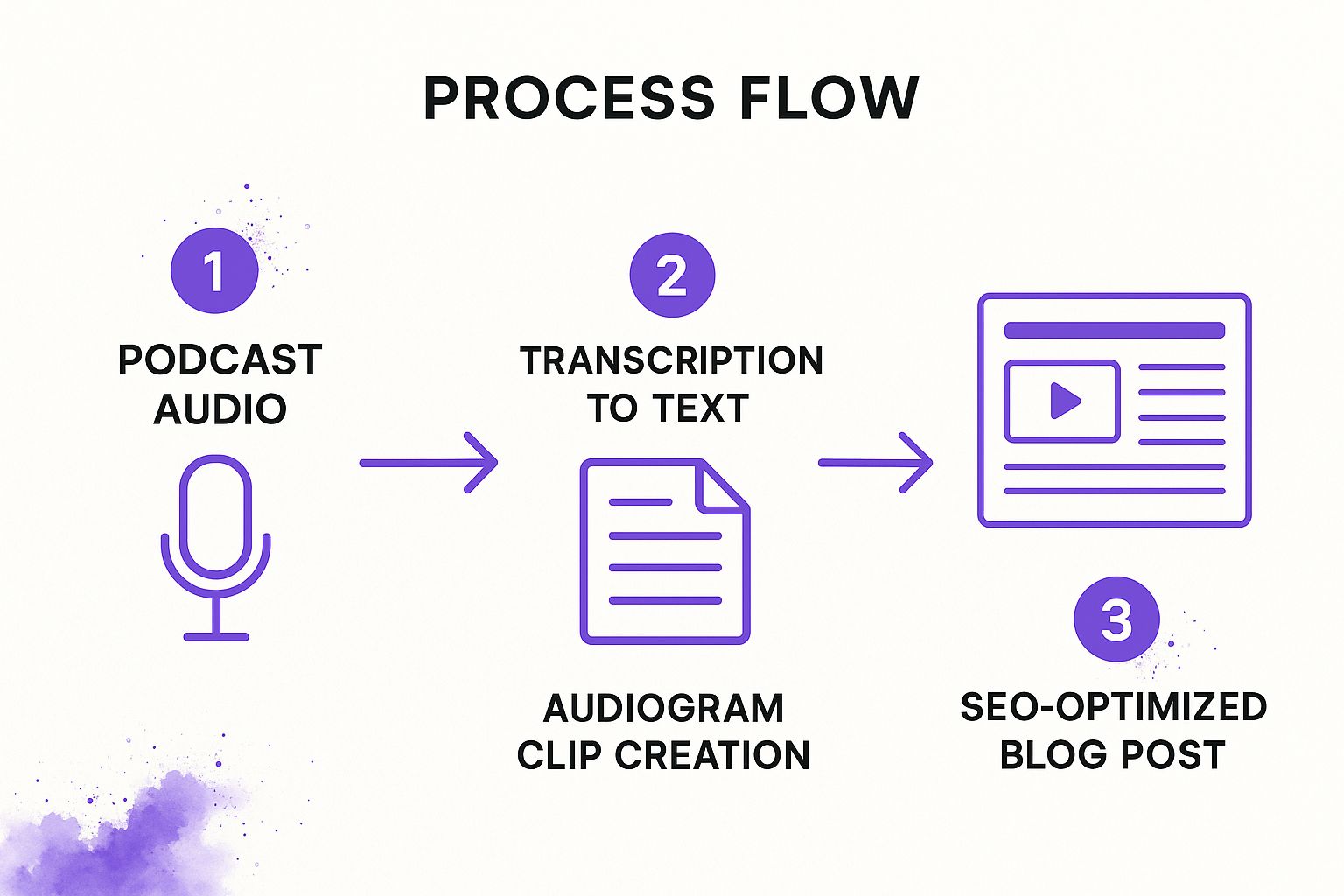
This simple workflow shows how audio is systematically converted into text and visual assets, each optimized for a specific channel to maximize reach.
Actionable Steps for Implementation
To build your own podcast-centric content engine, follow this structured process:
- Transcribe Everything: The foundation of this strategy is a high-quality transcript. To efficiently transform your audio content into text for wider use, consider utilizing a dedicated sermon transcription service or tools like Descript to create an accurate text version of your episode.
- Identify Key Moments: During the editing process, pinpoint 3-5 of the most impactful quotes, surprising data points, or actionable tips. These will become your primary social media assets.
- Create Audiograms and Video Clips: Use tools like Headliner to turn your key audio moments into shareable audiogram clips for social media. For video podcasts, edit these same segments into short-form videos for platforms like YouTube Shorts and Instagram Reels.
- Publish SEO-Optimized Show Notes: Use the full transcript to create a comprehensive blog post. This not only serves your existing audience but also captures significant search engine traffic, attracting new listeners.
By applying these content repurposing strategies, you can significantly extend the life and impact of every episode. This method turns a single recording session into a sustainable content machine that reinforces your expertise.
4. Email Newsletter Content Recycling
A common mistake is treating your email newsletter as a separate, disposable channel. This strategy flips that script by recycling valuable newsletter content into more permanent assets like blog posts, or conversely, compiling existing content into exclusive newsletter digests. This recognizes that your email subscribers and general website audience are often distinct groups, allowing you to maximize the value of your insights by serving both effectively.
This approach is championed by creators like James Clear, who often publishes his popular newsletter content as blog posts weeks later, reaching a broader audience. Similarly, media brands like Morning Brew and The Hustle frequently adapt their most engaging email segments into high-performing social media content. This method treats your newsletter not as a one-off communication but as a testing ground for ideas that can be expanded into evergreen content.
Actionable Steps for Implementation
To implement this recycling strategy, follow a clear workflow:
- Establish a Delay: Wait 2-4 weeks before republishing newsletter content elsewhere. This preserves the feeling of exclusivity for your most loyal subscribers.
- Optimize for Format: Adapt the content for its new home. A conversational email needs a more structured, SEO-friendly format for a blog post, including clear headings and keywords.
- Use High-Performers as a Guide: Analyze your newsletter's open and click-through rates. The most popular topics are clear indicators of what will resonate as a full-length blog post or video.
- Add a Subscriber CTA: When you publish the content on your blog, include a note like, "This was originally shared with our newsletter subscribers," and add a clear call-to-action to sign up.
By treating your newsletter as an integral part of your content repurposing strategies, you can create a sustainable content engine. Zanfia makes this even more efficient, allowing you to manage and sell paid newsletters directly alongside your other digital products. You can even use the automations feature to automatically grant newsletter access to anyone who purchases your online course, creating a seamless, profitable ecosystem.
5. Webinar and Live Event Content Fragmentation
Transforming a single live event into a vast library of marketing assets is one of the most powerful content repurposing strategies available. This approach involves capturing a webinar, workshop, or conference session and systematically breaking it down into smaller, more digestible content pieces. The goal is to maximize the significant investment of time and resources required for a live event by extending its value long after the broadcast ends.
Major brands like HubSpot and Salesforce have perfected this model, turning their annual conferences into a year-round content engine. A single keynote can be fragmented into YouTube tutorials, blog posts featuring panel discussions, and social media clips with key insights. This strategy not only serves the existing audience with on-demand replays but also attracts new leads by showcasing the event's high-value content across various platforms.
Actionable Steps for Implementation
To get the most out of your live events, adopt a fragmentation mindset from the beginning:
- Record Everything: Capture high-quality video and audio of all sessions, including Q&A segments and informal discussions, as these often contain authentic and valuable moments.
- Identify Key Moments: Immediately after the event, create a timestamp guide noting the most impactful quotes, statistics, and audience questions. This makes extraction much easier later.
- Repurpose Visuals: Convert presentation slides into standalone assets. A well-designed deck can become a compelling LinkedIn carousel or a downloadable resource on your website.
- Create Highlight Reels: Quickly edit and release short "best of" video clips across social media within 48 hours to capitalize on the post-event buzz and drive traffic to the full recording.
For creators, hosting a premium webinar recording within a dedicated platform like Zanfia's online courses creates an evergreen asset. You can sell access to the replay as a standalone digital product, building a revenue stream from a one-time event while fostering a learning environment for your community. This turns a fleeting live experience into a lasting educational resource.
6. User-Generated Content Curation and Amplification
Harnessing content created by your audience is one of the most powerful content repurposing strategies available. This approach involves collecting, curating, and sharing content made by your customers and community members, such as testimonials, creative product uses, or reviews. By amplifying their voices, you leverage authentic social proof that builds trust far more effectively than traditional branded messaging.
This strategy transforms your audience from passive consumers into active brand advocates. Iconic campaigns like Apple's 'Shot on iPhone' or GoPro's customer-shot videos demonstrate its power. By showcasing real people using and loving your products, you create relatable and highly compelling marketing assets that resonate deeply with potential customers, all while strengthening the bond with your existing community.
Actionable Steps for Implementation
To effectively curate and amplify user-generated content, follow this process:
- Create a Collection System: Launch a branded hashtag for your community to use on social media. This simplifies the process of discovering and collecting relevant user-generated content (UGC).
- Establish Clear Guidelines: Develop a straightforward process for obtaining permission to use customer content. Always credit the original creator prominently to show respect and encourage future submissions.
- Incentivize High-Quality Submissions: Run contests or feature the best content on your main channels. Acknowledgment and rewards are powerful motivators for your community to create and share.
- Showcase Content in a Hub: A dedicated community space is the perfect venue to feature top user contributions. This not only rewards creators but also inspires others to participate.
Building an engaged community is the foundation for a successful UGC strategy. To learn more about fostering this type of environment, you can develop a community with Zanfia. Zanfia makes it easy to create a central hub where your members can connect in thematic discussion channels, share their experiences, and contribute content, providing a rich source of authentic material to repurpose across all your marketing channels.
7. Content Updating and Republishing
One of the most powerful yet underutilized content repurposing strategies is to breathe new life into your existing assets through systematic updates. This involves revisiting older, high-potential blog posts or guides, enriching them with fresh information, current statistics, and new examples, and then republishing them. This approach boosts SEO performance, re-engages your audience, and maintains your content's relevance without the heavy lift of starting from scratch.
Pioneered by SEO experts like Brian Dean of Backlinko and widely adopted by content hubs like HubSpot, this method turns your content library into a sustainable growth engine. Instead of letting a valuable article gather dust, you treat it like a living document. For instance, an outdated guide to social media trends can be updated with the latest platform changes, data, and case studies, instantly making it valuable again. This signals to search engines that your content is current, often resulting in a significant rankings boost.
Actionable Steps for Implementation
To make this strategy a core part of your content workflow, follow these steps:
- Conduct a Content Audit: Use analytics to identify pages that have high traffic but are experiencing a decline in rankings or engagement. These are your prime candidates for an update.
- Enrich and Expand: Don't just change a few dates. Aim to add 20-30% new, valuable content. This could include new sections, updated screenshots, more current examples, or deeper insights. To extend the longevity and reach of your existing assets, discover smart ways to recycle your LinkedIn content.
- Update and Re-promote: Change the "Last Updated" date on your post and promote it across your channels as if it were brand new. Announce the "newly updated" guide to your email list and social followers.
- Measure the Impact: After republishing, track key metrics to validate your efforts. Learn more about how to measure content marketing ROI to understand the direct impact of your updates.
When your updated content drives traffic to a knowledge base with paid access built on Zanfia, you directly connect your content efforts to a stable revenue stream. This turns a simple content refresh into a strategic business move.
8. Cross-Platform Content Adaptation
Effective content repurposing strategies go beyond simply reposting the same content everywhere. Cross-platform content adaptation involves strategically modifying a core message to fit the unique culture, format, and audience expectations of each platform. This means you aren't just cross-posting; you are creating platform-native versions that feel authentic and are designed to maximize engagement on each specific channel.
This approach acknowledges that what works on LinkedIn (professional, text-heavy) will likely fail on TikTok (short-form, entertaining video). Brands like Duolingo excel at this, maintaining a playful, meme-focused personality on TikTok that is distinct from their more educational Instagram content. This tailored strategy ensures their message resonates deeply with each segmented audience, boosting relevance and performance.
Actionable Steps for Implementation
To implement this strategy, focus on adapting, not just duplicating:
- Establish a Core Message: Create a central document outlining the key idea, main talking points, and desired call-to-action. This becomes your source material to adapt for each platform.
- Master Platform Nuances: Understand the technical and cultural requirements. This means vertical video for TikTok/Reels, horizontal for YouTube, and square or vertical for the Instagram feed. Adjust video lengths accordingly: 15-60 seconds for TikTok, up to 90 seconds for Reels, and longer for YouTube.
- Reimagine, Don't Just Resize: Instead of just cropping a video, rethink how to best present the idea. A key insight from a YouTube video could become a Twitter thread, a LinkedIn article, or an Instagram carousel.
- Centralize Your Assets: To ensure consistency across platforms while adapting your message, a single source of truth is vital. A platform like Zanfia allows you to house your core video courses and digital products in one place, making it simple to pull from this central library when creating adapted content for various channels.
9. Content Compilation and Resource Creation
A powerful way to elevate your authority and provide immense value is by aggregating multiple related content pieces into a single, comprehensive resource. This strategy involves bundling a series of blog posts, webinars, or social media threads into a cohesive e-book, ultimate guide, or even a mini-course. Instead of leaving your audience to piece together information, you present them with a definitive, high-value asset that showcases your expertise on a specific topic.
This approach transforms scattered insights into a premium product that can serve as a potent lead magnet, a paid digital offering, or a cornerstone content piece that solidifies your brand's authority. Companies like HubSpot master this by turning blog series into certification courses, while authors like Seth Godin have famously compiled blog posts into bestselling books. It's one of the most effective content repurposing strategies for demonstrating deep knowledge and creating assets with a long shelf life.
Actionable Steps for Implementation
To build a high-value compiled resource, follow these steps:
- Identify a Core Theme: Review your existing content and find a topic you've covered extensively, ideally with 8-12 related pieces. This forms the foundation of your compilation.
- Structure and Enhance: Organize the content into a logical flow, like chapters in a book. Add 15-20% new, exclusive material, such as a new introduction, a concluding chapter, or updated case studies, to increase its perceived value.
- Package as a Premium Asset: Use professional design to create a polished final product. Zanfia allows you to easily package your compilation as a digital product, like a paid e-book, or build it out as a structured knowledge base with paid access, complete with a modern cart and secure file delivery.
- Gate and Promote: Use the compilation as a lead magnet by requiring an email for download or sell it directly. Promote it as your "ultimate guide" or "complete resource" to attract your ideal audience and generate leads or revenue.
Content Repurposing Strategies Comparison
| Content Strategy | Implementation Complexity 🔄 | Resource Requirements ⚡ | Expected Outcomes 📊 | Ideal Use Cases 💡 | Key Advantages ⭐ |
|---|---|---|---|---|---|
| Long-Form to Short-Form Social Media Content | Medium – requires platform knowledge and design skills | Moderate – graphic tools and content creation time | Increased reach and traffic, content longevity | Social media audience engagement, multi-format reach | Extends content lifespan; cost-effective; drives traffic |
| Blog Post to Video Content Transformation | High – video production and editing skills needed | High – equipment, software, time investment | Higher engagement and SEO benefits via video platforms | Educational, tutorial, and brand personality building | High engagement; builds audience connection; repurposable content |
| Podcast to Multi-Format Content Ecosystem | High – transcription, editing, multi-format production | High – tools for transcription, editing, distribution | Massive content multiplication; SEO and multi-channel reach | Podcasters aiming at diverse audience preferences | Very high output volume; cross-format SEO benefits; evergreen content |
| Email Newsletter Content Recycling | Low – mostly adaptation and formatting | Low – mostly writing/time investment | Increased content value and audience crossover | Thought leadership, subscriber engagement | Efficient reuse; boosts SEO and subscriptions; sense of exclusivity |
| Webinar and Live Event Content Fragmentation | High – video editing, multi-format editing | High – production and editing resources | Extensive content library and lead generation | Professional events, webinars, conferences | High-value content; evergreen; generates leads; multi-perspective views |
| User-Generated Content Curation and Amplification | Medium – rights management and curation effort | Low to Moderate – tools and approval processes | Authentic content; social proof; community engagement | Brands with active user communities | Highly authentic; cost-effective; builds loyalty and advocacy |
| Content Updating and Republishing | Medium – requires audits and content research | Moderate – research and editing time | Improved SEO and content relevance | Evergreen content maintenance, SEO growth | Boosts rankings; efficient vs new creation; improves accuracy and freshness |
| Cross-Platform Content Adaptation | High – platform-specific customization required | Moderate to High – content creation and management | Max engagement per platform; audience segmentation | Multi-channel brand presence | Maximizes reach; higher engagement than cross-posting; platform-native quality |
| Content Compilation and Resource Creation | High – extensive editing and design | High – content aggregation, design tools | Premium lead magnets; authority building; monetization | Lead generation, educational products | Creates high-value assets; monetizable; extends content lifespan; user-friendly resources |
Your Central Hub for Content Repurposing and Monetization
We've explored a comprehensive suite of content repurposing strategies, from atomizing long-form blog posts into bite-sized social media clips to compiling newsletters into premium knowledge bases. The core lesson is clear: every piece of content you create is not a final destination but a starting point for countless new opportunities. By transforming podcasts into quote cards, webinars into community discussions, and old blog posts into new, updated resources, you build a powerful, interconnected content ecosystem that works smarter, not harder.
The true value of these tactics isn't just about saving time or filling a content calendar. It's about strategic amplification. Mastering these approaches allows you to meet your audience on their preferred platforms, reinforce your expertise through multiple touchpoints, and extract maximum ROI from every creative effort. You are no longer on a content treadmill; you are building a library of assets that can be redeployed, repackaged, and remonetized indefinitely. This shift from single-use content to a perpetual value engine is what separates thriving creators from those who burn out.
From Strategy to Scalable System
Implementing these content repurposing strategies might seem like adding another layer of complexity. How do you manage turning blog posts into courses, newsletters into paid knowledge bases, and webinars into community discussions without getting lost in a dozen different tools? This is precisely the operational bottleneck that a unified platform is designed to eliminate.
Imagine this workflow, all within Zanfia: you compile your best blog posts into a high-value online course, using integrated video hosting and a clear lesson structure. That course is sold through a modern cart system, with automations that enroll students and notify your email list via MailerLite or ActiveCampaign. The discussions from that course, happening right inside the platform's community space, become your next source of user-generated content and FAQs for future marketing. You can even set up a paid newsletter, repurposed from your podcast notes, and use automations to grant access to everyone who buys your e-book.
This level of integration is no longer a luxury; it's a necessity for scaling your creator business. Instead of duct-taping various services together, a central hub connects your content, community, and commerce in one place. It’s the operational backbone that makes these advanced content repurposing strategies not just possible, but simple and profitable.
Ready to stop juggling platforms and start building a scalable content empire? Zanfia provides the integrated toolkit to turn your repurposing ideas into revenue by combining courses, communities, and digital products in one place. Start building your central creator hub on Zanfia for free today.

One comment
Comments are closed.


[…] helpful to review a variety of approaches. For a foundational overview, you can explore these 10 actionable content repurposing strategies that provide a solid starting point. This article will build on those fundamentals, offering […]