

How to Create an Ebook to Sell and Grow Your Brand
Selling an ebook seems simple on the surface, right? You spot a problem your audience has, you write a fantastic solution, and then you put it up for sale. But the real magic, the part that separates a bestseller from a digital dust-collector, happens before you even start writing. It's all about making sure people actually want to buy what you're planning to share.
Laying the Foundation for a Profitable Ebook

Before a single word hits the page, you need a strategy. This foundational work is what makes the difference between an ebook that sinks without a trace and one that becomes a hit. Think of it as building your project on solid ground, ensuring there's a real market need from day one. It saves you from pouring months of effort into something nobody wants.
And the market is definitely there. The global ebook space is huge and getting bigger every year as more people embrace digital content. By 2025, the market is expected to be worth around $18 billion, and that number is projected to climb to $22.76 billion by 2030. This isn't just a trend; it's a massive opportunity for creators who can figure out what readers are itching to buy.
Uncover a Niche That People Will Pay For
So many creators fall into the same trap: they create something they think their audience needs, not what their audience knows they want. Your mission is to find a specific, burning problem that your ideal reader is actively trying to solve with their wallet.
Stop guessing and start investigating. Here’s how to find an idea that will actually sell:
- Become an Online Detective: Dive into Facebook groups, Reddit threads, and forums where your audience hangs out. What questions pop up constantly? Listen to the exact words people use to describe their frustrations—those are pure gold for your future ebook titles.
- Check Your Own Data: What are your most popular blog posts or social media updates? Which topics get the most comments, shares, and DMs? That's your audience telling you exactly what they value from you.
- Scope Out the Competition: Look at what ebooks are already selling well in your space. You're not looking to copy them. Instead, you're searching for gaps. Can you offer a fresh perspective, a more hands-on approach, or a simpler solution to a common problem?
Key Takeaway: A successful ebook isn't about some earth-shattering, never-before-seen idea. It’s about solving a proven problem better or more uniquely than anyone else. That's your ticket to standing out.
Validate Your Idea Before You Write
Got a promising idea? Great. Now, you need to make sure people will actually pay for it. Think of validation as your insurance policy against a flop.
One of the easiest ways to do this? Just ask. Shoot an email to your subscribers or put up a poll on Instagram stories. A simple, "If I created an ebook that showed you exactly how to [achieve X specific result], would you be interested?" can give you an incredible amount of clarity.
An even better method is to pre-sell it. Set up a quick landing page that spells out the promise of your ebook and offer a special pre-order discount. If people pull out their credit cards, you’ve not only proven your idea is a winner but you've also made some money to fuel you through the writing process. This strategy is a cornerstone of how top creators launch their digital products.
To help keep you on track, I've put together a quick checklist that covers these crucial early steps.
Ebook Planning Checklist
This table breaks down the essential planning steps to make sure your ebook has a solid foundation for success from the very beginning.
| Phase | Key Action | Why It Matters |
|---|---|---|
| Discovery | Find a recurring problem in online communities. | Ensures you're solving a real, existing pain point, not an imagined one. |
| Analysis | Review your own most popular content. | Identifies topics your current audience already loves and engages with. |
| Research | Analyze competitor ebooks for gaps or opportunities. | Helps you find a unique angle that makes your ebook the obvious choice. |
| Validation | Ask your audience directly if they'd buy your idea. | Provides direct feedback and builds early anticipation before you write a word. |
| Pre-Sale | Set up a pre-order page to test the market with real sales. | The ultimate validation—if people pay for it before it exists, you have a winner. |
Following this roadmap doesn't just improve your chances of success; it practically guarantees you won't waste your time. For a deeper dive into this process, the guide on Crafting Your First Ebook: Tips, Tools, and Strategies for Success is a fantastic resource.
Bringing Your Ebook to Life with Great Content and Design
Alright, you’ve validated your idea and hammered out a solid outline. Now for the fun part: moving from planner to creator. This is where you actually build the product your audience is waiting for, turning your expertise into a solution that’s as enjoyable to read as it is valuable.
The mission is to write content that truly delivers on your promise and wrap it in a design that looks sharp and professional.

It’s easy to get stuck here, staring at a blank page. I’ve been there. The trick is to remember you're not trying to write the next great American novel. You’re creating a practical tool. Your one and only job is to get your reader from Point A (their problem) to Point B (the solution) as clearly and painlessly as possible.
Crafting Content That Connects
That outline you made? It’s your secret weapon against writer's block. It breaks down the overwhelming task of "writing an ebook" into manageable, chapter-sized bites.
The biggest mistake I see people make is trying to write and edit at the same time. Don't. Just get the words down. Your first draft is supposed to be messy. Turn your outline points into clear, helpful advice. Write like you're talking to one person, guiding them through the process. It builds a much stronger connection than stiff, formal language ever could.
Once that first draft is done, step away. Seriously. Let it sit for a day or two before you put on your editor hat. This little bit of distance will give you fresh eyes to spot typos, fix awkward sentences, and improve the overall flow.
To make your content really pop, try these tactics:
- Show, Don't Just Tell: Instead of saying "organization is key," give them a specific checklist or a fill-in-the-blank template they can actually use.
- Tell Stories: People remember stories. Share a quick anecdote about a client's success or even a personal mistake you learned from. It makes your advice feel real and relatable.
- Make It Scannable: Let's be honest, people skim. Use short paragraphs, bullet points, and bold text to highlight key ideas. This is crucial for readers on phones and tablets.
An ebook's worth isn't in its page count; it's in the results it delivers. A punchy, 30-page guide that solves a specific, nagging problem is infinitely more valuable than a 200-page book filled with fluff.
Designing an Ebook That Looks Pro (Without Being a Designer)
You could write the most brilliant content in the world, but if it looks like it was thrown together in five minutes, people won't trust it. Good design builds instant credibility and just makes the whole experience better for your reader.
The good news? You don’t need to be a graphic designer anymore.
Tools like Canva are a game-changer. They have thousands of gorgeous ebook templates that give you a massive head start. You can easily tweak the colors, fonts, and images to match your own brand. A great design is more than a pretty cover—it's about creating a cohesive, readable experience from start to finish.
When you're working on the design, focus on these three things to get a polished, professional result.
| Element | Best Practice | Why It Matters |
|---|---|---|
| Cover | Clear title, compelling subtitle, high-quality image or graphic. | This is your book's first impression. It has to grab attention and instantly communicate what the reader will get out of it. |
| Fonts | Use a clean, readable font for body text (like Lato or Open Sans) and a complementary one for headings. | The wrong font can make your ebook a chore to read. Keep it simple and clean to avoid eye strain. |
| Layout | Maintain consistent margins, use clear headings, and leave plenty of white space. | A clean layout guides the reader's eye, improves comprehension, and makes the content feel less overwhelming. |
And here's a time-saving tip: if you already have blog posts, videos, or podcast episodes on this topic, repurpose them! There's no need to start from scratch. We have a whole guide on content repurposing strategies that can help you flesh out your chapters in a fraction of the time.
By nailing both the content and the design, you’re creating more than just a product. You're building an asset that solves a real problem and strengthens your brand at the same time.
Choosing Your Platform and Pricing Strategy
You’ve poured your expertise into a beautifully designed ebook. Now what? You’re at a crucial fork in the road: deciding where to sell it and how much to charge. Don't treat these as afterthoughts; they’re the gears that will either drive your business forward or stall it before it even starts.
Your choice of platform directly impacts how much control you have, what kind of relationship you can build with your readers, and, frankly, how much of your own money you get to keep.
Owning Your Business vs. Renting a Market Stall
Broadly speaking, you have two paths. You can set up shop in a massive marketplace like Amazon KDP, or you can build your storefront on a dedicated creator platform.
Marketplaces give you access to a huge audience, which is tempting. But it comes at a steep price. You'll hand over a significant cut of every sale, have virtually no say over branding, and get zero access to your customer's data. Building a real, lasting relationship with your buyers is next to impossible.
An all-in-one creator platform is a different world entirely. It’s the difference between renting a tiny stall in a chaotic bazaar and building your own beautiful flagship store. When you sell on your own terms, you control everything—your brand, your pricing, and that all-important direct line to your audience.
This is where a Polish-built platform like Zanfia really shines. It's an all-in-one solution designed for creators who want to sell ebooks, courses, and community memberships under their own domain. Its model is built on a 0% platform transaction fee, which completely flips the script. You keep 100% of your revenue, aside from standard fees from payment operators like Stripe or PayU. For creators earning PLN 10k–100k+ a month, this transparent approach means Zanfia grows with them, not at their expense.
Zanfia is for creators serious about building a real business. When you own the entire customer journey—from discovery to purchase, all under your own custom domain—you create a foundation for long-term growth and customer loyalty.
Picking the right home for your ebook is one of the most critical business decisions you'll make. For a deeper dive, our guide on selecting the best platform to sell digital products can help you weigh the pros and cons.
Ebook Sales Platform Comparison
Deciding between a massive marketplace and a dedicated platform can feel overwhelming. This table breaks down the key differences to help you see which model aligns with your business goals.
| Feature | Marketplaces (e.g., Amazon KDP) | All-in-One Platforms (e.g., Zanfia) |
|---|---|---|
| Transaction Fees | High (often 30-70% of your revenue) | 0% platform fees (only standard payment processor fees apply) |
| Brand Control | Very limited; you operate under the marketplace's brand | Full white-label control over your branding, domain, and storefront |
| Customer Data | No access; the marketplace owns the customer relationship | You own 100% of your customer data and email list |
| Pricing Flexibility | Restricted by the platform's rules and royalty structures | Complete freedom: one-time sales, subscriptions, bundles, installments |
| Audience Reach | Massive built-in audience, but with high competition | You build and own your audience directly through your own marketing |
| Product Ecosystem | Primarily focused on a single product type (e.g., books) | Integrated ecosystem: sell ebooks, courses, and communities in one place |
Ultimately, the choice comes down to your long-term vision. Do you want a quick sale, or do you want to build a sustainable, independent brand?
Setting a Price That Reflects True Value
Alright, let's talk numbers. The single biggest mistake I see new creators make is plucking a price out of thin air or, even worse, pricing their ebook way too low because they lack confidence.
A strategic price isn't about what you think someone might pay. It's about anchoring your price to the actual value of the transformation or solution you're offering.
Start with some market research. What are other ebooks in your niche going for? But don't just glance at the price. Dig deeper. Look at the quality, the depth of the content, and any bonuses they include. The goal isn't to copy them—it's to understand the value conversation happening in your market so you can position yourself smartly. Can you offer something better, more comprehensive, or a unique angle that justifies a higher price point?
It's also worth noting that the market is maturing. According to some recent data, simply slapping a high price tag on an ebook is becoming less effective. As you can discover more insights about ebook market trends on whop.com, successful creators are now focusing on smarter pricing, building strong customer relationships, and creating multiple ways to earn from their work.
Smart Pricing Tactics to Maximize Revenue
Once you've got a feel for the market, you can start using some proven tactics to boost both your sales and the average amount each customer spends.
Here are a few strategies that have worked for countless creators:
-
Psychological Pricing: There's a reason you see prices like $27 or $49 everywhere. It's a classic for a reason—it just works. Ending a price with a 7 or 9 makes it feel like a better deal to our brains, and that little nudge can be enough to turn a "maybe" into a "yes."
-
Tiered Pricing and Bundles: Why sell just one thing? Create a bundle that pairs your ebook with a companion workbook, a video masterclass, or a set of templates. This is a win-win. Your customer gets way more value, and you significantly increase your average order value.
-
Offer Multiple Payment Options: Don't limit how people can pay you. A platform like Zanfia gives you incredible flexibility here. You can sell your ebook as a one-time purchase, include it in a monthly subscription, offer installment plans for higher-priced bundles, or sell it alongside your online courses. This flexibility opens the door to a much wider audience.
Combine a powerful, creator-friendly platform with a smart, value-driven pricing strategy, and you’re not just selling an ebook. You’re building the foundation of a profitable, scalable digital business.
Selling Your Ebook Seamlessly on Zanfia
You've done the hard work—your ebook is written, edited, and ready to go. Now comes the exciting part: turning that polished file into a profitable product. This is where you shift from creator to entrepreneur, and honestly, the system you choose to sell it with can make or break your success. A clunky, complicated process doesn't just frustrate customers; it creates a ton of extra work for you.
This is exactly why a comprehensive Polish platform like Zanfia is such a game-changer. It’s not just a storefront to list your ebook. It’s the entire engine that automates your sales, delivery, and customer management, letting you run a professional business under your own brand without getting bogged down in administrative tasks.
Building Your High-Converting Product Page
Think of your product page as your best salesperson, working 24/7. Its sole mission is to convince your ideal reader that your ebook is the exact solution they've been searching for. With Zanfia, you build this crucial page on your own custom domain, which is a huge deal for brand credibility. It looks like your business, not a generic platform.
When you're writing the copy, focus on the benefits, not just the features. Nobody really cares if your ebook has "10 chapters." What they care about is how those chapters will "help them save 5 hours a week" or "finally master that tricky skill." You need to speak directly to their problems and show them the light at the end of the tunnel.
Key Takeaway: A great sales page doesn't just describe your ebook; it paints a picture of the transformation the reader will experience after reading it. Focus on the outcome, and the sale will follow.
And please, make the checkout as frictionless as possible. Nothing kills a sale faster than a clunky payment process. Zanfia integrates seamlessly with the most popular Polish and global payment gateways—think Stripe, PayU, Przelewy24, and BLIK. By also supporting Apple Pay and Google Pay, you remove hurdles and make it incredibly easy for people to give you their money.
The infographic below really nails the core strategy, from picking the right platform to actually making a profit.
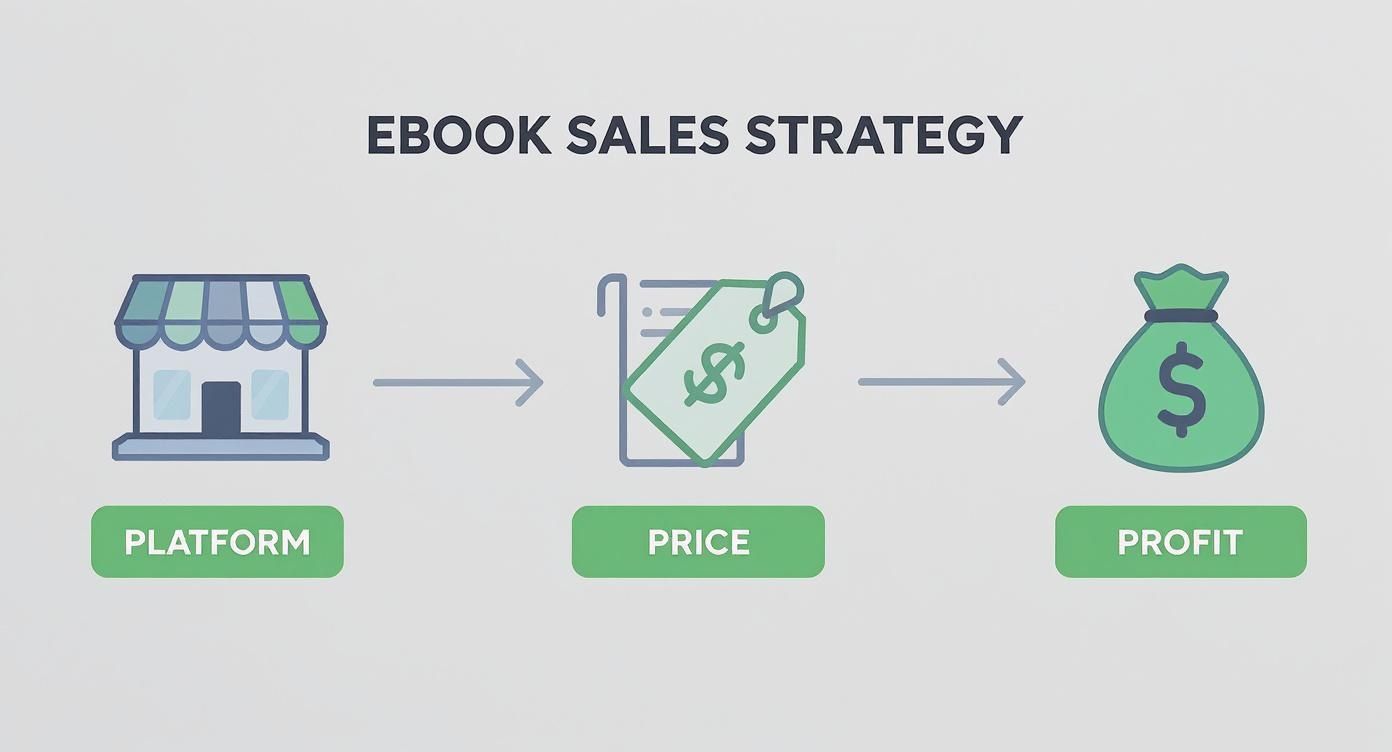
As you can see, choosing a platform that handles everything is the straightest line to maximizing your earnings.
The Magic of Automation
This is where you get your time back. I've seen so many creators fall into the trap of handling every sale manually. It seems fine at first, but it quickly becomes a nightmare. Imagine having to personally email every single buyer with the download link, then send a follow-up, and manually add them to your email list. It’s a fast track to burnout.
Zanfia’s powerful automations are designed to completely eliminate these repetitive tasks, saving creators 5–10+ hours a month. You can set up a simple "flow" that kicks in the second a customer hits "buy."
Here’s a real-world example of what that looks like:
- Instant Access: The moment their payment goes through, the system automatically gives the customer access to the ebook in their personal library. No delays, no "I'll send it over shortly" emails. It's instant gratification.
- Welcome Email Sequence: You can have a personalized welcome email fire off immediately. It can thank them, show them exactly how to access their purchase, and start building that crucial customer relationship.
- Automated Invoicing: Zanfia integrates with leading Polish invoicing suites like inFakt and Fakturownia to automatically generate and send an invoice after every transaction, dramatically simplifying your finances.
This isn't just about saving time (though that's huge). It's about delivering a professional, seamless experience that builds trust and makes people want to buy from you again. For a deeper dive into different platforms, our guide on where you can sell your ebooks is packed with more insights.
Creating a Unified Customer Experience
Selling an ebook on Zanfia is about more than just a single transaction; it's about welcoming a customer into your world. Because the platform keeps your ebooks, online courses, and communities all under one roof (and a single customer login), upselling becomes natural and effortless.
Someone who loved your ebook is the perfect person to pitch your more advanced online course or your paid community. With everything connected in a true all-in-one system, you can easily create bundles, offer tiered memberships, or set up subscription plans. This is how you turn a one-time ebook buyer into a loyal, long-term customer and build a truly sustainable online business.
Getting the Word Out: How to Market Your Ebook for a Killer Launch
https://www.youtube.com/embed/2EXuuPz-IgQ
You've poured your heart and soul into writing your ebook. That feels like the finish line, but in many ways, it's just the start. Now, you need to switch gears from creator to marketer. A well-planned launch strategy is what separates an ebook that sits on a digital shelf from one that actually makes money and builds momentum.
Believe it or not, your marketing should kick off long before you type that final word. The key is to build anticipation. Start dropping hints about your topic on social media or in your newsletter. You could share some behind-the-scenes peeks at your writing process or even get your audience involved by letting them vote on cover designs. This small step makes them feel like part of the journey, getting them invested from day one.
Start by Building Your Pre-Launch Waitlist
I can't stress this enough: your email list is your single most powerful marketing tool. It’s a direct line to your biggest fans—the very people who are most likely to buy your ebook the moment it drops. Your main goal in the weeks leading up to the launch is to pack that list with people who are genuinely interested.
Whip up a simple landing page to announce your upcoming ebook. It doesn't need to be fancy. Just a clear title, a headline that promises a tangible result, and a big, obvious button to join the waitlist. To make it a no-brainer, offer a little something extra for signing up. Think an exclusive launch-day discount or a free companion resource, like a checklist or template.
For a deeper dive, our guide on how to build an email list is packed with actionable tips.
Nail Your Launch Day Plan
Launch day is all about creating a concentrated burst of energy. You want to frame your ebook as an event, something people will regret missing out on. A coordinated plan ensures all your marketing channels are firing on all cylinders, driving traffic and making sales.
Here’s what your launch day should look like:
- An Email Onslaught (The Good Kind): Don’t just send one email and call it a day. Map out a sequence of messages that builds excitement, tackles common questions, and creates a real sense of urgency.
- A Social Media Blitz: Go live on all your platforms with eye-catching graphics and direct links to your sales page. Pull powerful quotes or early testimonials from the ebook to stop the scroll.
- Create Scarcity: A limited-time launch discount is one of the oldest tricks in the book for a reason—it works. Offering a special price for the first 48 or 72 hours gives people a powerful reason to buy now instead of "later."
Pro Tip: A great launch isn't just about day-one sales. It’s about generating a wave of social proof—testimonials, positive comments, and shares—that you can leverage for months to keep the sales rolling in.
Keep the Momentum Going with Long-Term Promotion
The launch is just the first sprint in a marathon. To turn your ebook into a reliable source of income, you need a plan to keep selling it over the long haul. This is where you shift from that high-intensity launch buzz to a more consistent, evergreen marketing rhythm.
Content marketing is your best friend here. Write blog posts or create social media content that touches on topics related to your ebook. At the end of each piece, you can naturally position your ebook as the perfect next step for readers who want to dive deeper.
Collaborations are also incredibly effective. Find other creators in your space who serve a similar audience but aren't direct competitors. You could offer to write a guest post for their blog, hop on their podcast, or even set up an affiliate deal where they earn a cut for promoting your ebook to their followers. Looking for more ideas? There are plenty of startup marketing strategies that work perfectly for promoting a digital product.
The timing couldn’t be better. The market for digital content is buzzing with potential. While print sales have wavered, ebook revenues are climbing. In the first half of 2025 alone, ebook revenues jumped 2.4% year-over-year, hitting $526.7 million. This isn't just a fluke; it shows a real shift in how people consume content, making your new ebook a very smart move.
Common Ebook Publishing Questions
You’ve poured your heart and soul into creating your ebook, and now you’re on the home stretch. But this is often where a new wave of questions pops up. Don't worry, that's completely normal. Let's walk through some of the most common things creators ask right before they hit "publish."
Getting these final details sorted out is what separates a polished, professional product from one that feels a bit rushed.
What’s the Best Format for My Ebook?
For anyone selling an ebook directly from their own site, the answer is almost always a PDF. It's the gold standard for a reason.
A PDF locks in your formatting, fonts, and images. This means your beautifully designed ebook will look exactly the way you intended it to, no matter if your customer is reading it on a giant desktop monitor or a tiny smartphone screen. This is crucial if your ebook includes worksheets, checklists, or a lot of visual branding elements.
You might have heard about other formats like EPUB, which is what you'll find on e-reader stores like Amazon Kindle. EPUBs are "reflowable," meaning the text shifts around to fit the screen. That’s great for a novel, but not so great when your carefully crafted layout gets jumbled. Sticking with a PDF when you sell directly through a platform like Zanfia gives you total control over the experience.
How Long Should My Ebook Be?
This question trips up so many people, but the answer is surprisingly simple: your ebook should be as long as it needs to be to deliver on its promise, and not a word more.
Focus on the value you're providing, not some arbitrary word count. Think about it—a concise, 30-page guide that helps someone achieve a specific goal is infinitely more valuable than a rambling 200-page book filled with fluff.
Your readers are buying a solution, not a certain number of pages. Quality and clarity always win.
The real measure of your ebook's worth isn't its length; it's the size of the transformation it provides. If you deliver on your promise, your customers will be thrilled, regardless of the page count.
Do I Need an ISBN for My Ebook?
Short answer: Nope, not if you're selling it yourself.
An ISBN (International Standard Book Number) is really just a product tracking number for big retailers, distributors, and libraries. It helps them manage inventory.
You'll need an ISBN if you plan to sell through major platforms like Amazon KDP, Apple Books, or Barnes & Noble. But if you’re selling directly to your audience from your own website or using an all-in-one platform like Zanfia, an ISBN is completely unnecessary. Skipping it saves you both the cost and the paperwork.
How Do I Protect My Ebook from Piracy?
While you can't stop piracy completely, you can make it much harder for people to share your work illegally. The key is to shift your focus from complex anti-piracy tech to a smart, secure delivery system.
First, the basics: always include a clear copyright notice on your title page. Some creators also add a subtle watermark with the customer's email on each page, which can be a good deterrent.
But your best defense is how you deliver the file. Never, ever just email a direct download link to your customers. Those links can be forwarded and shared in a heartbeat.
A much safer approach is to use a platform where customers have to log into a secure account to access their downloads. This is built right into systems like Zanfia. It creates a protected space that dramatically cuts down on casual sharing and makes sure only paying customers can get their hands on your ebook.
Ready to stop juggling tools and start building your digital product business on a single, powerful platform? With Zanfia, you can sell your new ebook, launch online courses, and build a thriving community—all under your own brand and with 0% platform fees. Discover how Zanfia can save you time and help you keep 100% of your revenue. Start building your creator business with Zanfia today.

One comment
Comments are closed.

[…] just one piece of the puzzle. It's also vital for authors to understand the entire process of how to create an ebook to sell and build their brand. Ultimately, choosing EPUB isn't just a technical decision; it's a […]