

How to Measure Content Marketing ROI Like a Pro (Without the Guesswork)

Measuring your content marketing ROI is about drawing a straight line from your creative work to your bank account. You track the revenue generated by a specific piece of content—like a blog post that leads directly to a course sale—and weigh it against what you spent to create it. What you're left with is a crystal-clear percentage showing your return. It's the ultimate proof that your content is a powerful business asset, not just a creative outlet.
Why You Absolutely Have to Track Content ROI
Let's be blunt: you have to stop guessing whether your content is actually working. As a creator building a real business, you can't afford to treat your content like a hobby. It needs to be a growth machine you can rely on.
The first real step toward building a profitable brand is to look past vanity metrics like 'likes' and 'shares'. The only question that truly matters is this: how does your content directly make you money?
Once you understand the financial return on your content, you stop seeing it as just another expense. It becomes a strategic investment. When you know for a fact which articles or videos are driving sales, you can finally invest your time and money with confidence.
Shifting Your Mindset from Creator to CEO
Picture this: you're a course creator who's active on your blog, a YouTube channel, and a weekly newsletter. You pour hours into all three, but your sales are just… okay. If you're not tracking your ROI, you're flying blind. You probably just assume every channel is pulling its own weight.
But what if you dug into the numbers and discovered your weekly newsletter was responsible for 80% of your course sales? This isn't just a hypothetical scenario; it's a common lightbulb moment for creators who finally start tracking. Armed with that one piece of information, you can double down on your newsletter, knowing it's your most powerful sales tool. This is the exact mindset shift that separates struggling creators from thriving entrepreneurs.
This focus on measurable returns is quickly becoming the standard. A study from Firework found that by 2025, 83% of marketing leaders will prioritize proving ROI. The problem? Only 36% feel confident they can actually measure it well. That's a huge gap between what's needed and what's actually being done.
Tying Your Content, Community, and Commerce Together
Every single piece of content you create should have a job: to guide your audience into a deeper relationship with you. That could mean getting them to join your email list, enroll in a course, or become a paying member of your community.
The problem is, when your blog lives on one platform, your courses on another, and your community on a third, it's almost impossible to connect the dots and see the full journey. This chaos of managing multiple tools is the #1 reason creators can't track ROI effectively.
This is where having a single, unified platform makes all the difference. Instead of trying to stitch together a blog view from one system with a community sign-up in another, an all-in-one hub like Zanfia shows you that path automatically. You can clearly see which articles are driving the most members into your paid groups, turning content views into stable, recurring revenue. A solid community platform for creators acts as the bridge between your free content and your paid products, making the whole process of measuring ROI incredibly straightforward.
Define Your Business Goals Before Tracking Metrics
Before you even think about measuring your content marketing ROI, you need to know what success actually looks like for your business. It's a classic mistake to jump straight into tracking metrics without first setting specific, revenue-focused goals. It's like starting a road trip with no destination—you’re moving, sure, but are you getting anywhere that matters?
Forget about vague targets like “more traffic” or “better engagement.” Those are vanity metrics, not business goals. A real goal is tied directly to a financial result. Your content needs to be a tool that actively drives your business forward, not just a megaphone shouting into the void.
For instance, instead of just aiming for more website visitors, a much stronger goal would be to generate 50 qualified leads for your high-ticket coaching program from your blog this quarter. See the difference? This simple shift connects your content directly to a potential revenue stream.

Aligning Goals with Your Creator Business Model
The specific goals you set will depend entirely on how you make money. A course creator’s definition of success is going to look very different from that of a community owner or a consultant.
Let's walk through a few practical examples:
- For the Course Creator: Your goal might be to drive 100 new sign-ups for your free email mini-course, which acts as the main funnel for your paid flagship program. Each of those sign-ups has a potential dollar value based on your course's conversion rate.
- For the Membership Owner: You could aim to increase monthly recurring revenue (MRR) by 15% by creating exclusive content that nudges free followers to become paying members.
- For the Coach or Consultant: A tangible goal here is to book 10 discovery calls per month from a series of in-depth case study articles that prove your expertise and results.
Key Takeaway: Every single piece of content needs a job. Whether its purpose is to capture a lead, nurture a prospect, or close a sale, you must know what you want it to accomplish before you even start creating.
This goal-first approach is the bedrock of a profitable content strategy. It forces you to think like a business owner, ensuring every article, video, or newsletter is a calculated investment designed to produce a measurable return. You can get more ideas for connecting your work to direct income streams in our guide on how to monetize online content.
When you operate this way, measuring ROI becomes a whole lot simpler. You’re no longer guessing; you’re just checking if your content did the job you assigned it. Did that blog post generate the leads you needed? Did that video series drive new membership sign-ups? This clarity is what separates creators who see content as a cost from entrepreneurs who use it as a powerful revenue engine.
Choose the Right Metrics (and Ignore the Noise)
Alright, you've got your big, revenue-focused goals locked in. What's next? It's time to pick the right numbers—the metrics that will actually tell you if you're on the right track.
This is where so many creators get stuck. It’s easy to get lost in a sea of data from Google Analytics, your email platform, and all your social channels. But trying to track everything is a fast track to burnout and confusion.
The real secret is to cut through the noise. Focus on a handful of Key Performance Indicators (KPIs) that connect directly to the goals you just set. A creator selling a high-ticket coaching program, for example, should be far more obsessed with the quality of their leads than raw page views.
Let's break this down into four simple categories that follow your audience's journey from stranger to customer.
From Consumption to Conversion
Think of your audience's journey as a series of steps. Your job is to measure how well you're guiding them from one stage to the next.
-
Consumption Metrics: First things first, are people even finding and looking at your stuff? This is where metrics like page views, unique visitors, and video watch time come in. They’re your baseline for reach and initial interest.
-
Engagement Metrics: Okay, they found you. Do they care? This is where you find out if your content is actually hitting the mark. Look at comments, shares, time on page, and email open/click-through rates. These tell you that your audience is leaning in and paying attention.
-
Lead Generation Metrics: This is the magic moment an anonymous visitor raises their hand and becomes a real prospect. You need to track email sign-ups, freebie downloads, and webinar registrations. This is how you start building a direct line to future buyers.
-
Sales Metrics: And finally, the ultimate proof of ROI. These are your bottom-line numbers: course purchases, membership subscriptions, and coaching packages sold.

This focused approach isn't just a hunch; it's becoming the industry standard.
Research shows that by 2025, a staggering 81% of marketers will be actively measuring their content’s effectiveness. The top metrics they’re watching are website traffic (86%) and engagement (83%), because these are the numbers that directly feed into lead generation and sales.
Key Content Marketing Metrics for Creators
To make this even more practical, let's map these metrics directly to the kinds of goals you probably have for your creator business. The table below shows which KPIs matter most depending on what you're trying to achieve.
| Creator Goal | Primary Metrics to Track | Why It Matters for ROI |
|---|---|---|
| Increase Brand Awareness | Website Traffic (Unique Visitors), Social Media Reach, Video Views | These top-of-funnel metrics show how many new people are discovering your brand, which is the first step toward future sales. |
| Build an Engaged Community | Email Open/Click Rate, Time on Page, Comments & Shares | High engagement signals a loyal audience that trusts you, making them far more likely to buy when you have something to offer. |
| Generate Qualified Leads | Email Subscribers, Lead Magnet Downloads, Webinar Sign-ups | This is the direct link between content and potential revenue. A growing list of qualified leads is a core business asset. |
| Drive Product Sales | Conversion Rate, Average Order Value (AOV), Sales Revenue | These bottom-line metrics directly measure the financial return of your content marketing efforts. No guessing required. |
| Improve Customer Loyalty | Churn Rate (for subscriptions), Repeat Purchase Rate, Customer Lifetime Value (CLV) | Keeping existing customers is often more profitable than acquiring new ones. These metrics prove the long-term value of your content. |
As you can see, the "best" metrics are entirely dependent on your specific goals. A creator focused on a membership business will live and die by their churn rate, while someone selling a one-off digital course will be laser-focused on their sales conversion rate.
When you're choosing your metrics, remember that truly measuring SEO success beyond rankings is critical. It's not just about getting people to your site; it’s about what they do once they get there.
Ultimately, every metric you track should help you understand and improve that journey from traffic to transaction. For instance, if you're getting tons of email sign-ups but very few sales, you've just pinpointed a disconnect in your sales funnel. Fixing that gap is exactly how you drive real financial results, which is a key part of our deep dive into conversion rate optimization strategies.
Building Your Content ROI Tracking System
You’ve got your goals and metrics sorted. Now for the hard part: connecting the dots between your content and your bank account. Building a tracking system sounds technical and maybe a little intimidating, but it doesn't have to be a nightmare of juggling a dozen different tools.
The whole point is to get a single, clear view of how a stranger discovers you and eventually becomes a paying customer.
While something like Google Analytics is a must-have for seeing where your traffic comes from and what people do on your site, it only gives you part of the story. The real headache for creators is attribution—knowing exactly which blog post or video inspired someone to buy. Trying to stitch that information together manually is a one-way ticket to frustration and bad data.
Centralizing Your Data to See the Full Picture
The real magic happens when you stop running your business from a bunch of scattered platforms. When your blog, email list, courses, and community all live under one roof, the tracking system is basically built-in. This is where a unified platform becomes your secret weapon for measuring content marketing ROI.
Instead of just guessing, you get solid answers. An integrated system like Zanfia can automatically connect a blog view to a newsletter signup, see which email converted a follower into a community member, and show you precisely which video drove a course purchase. It completely solves the attribution puzzle for you by acting as the central hub for your entire creator business.
This kind of unified view gives you a crystal-clear picture of the entire customer journey, from their very first click to their final purchase, all in one place.
This process flow visualizes the core steps for calculating your return on investment.
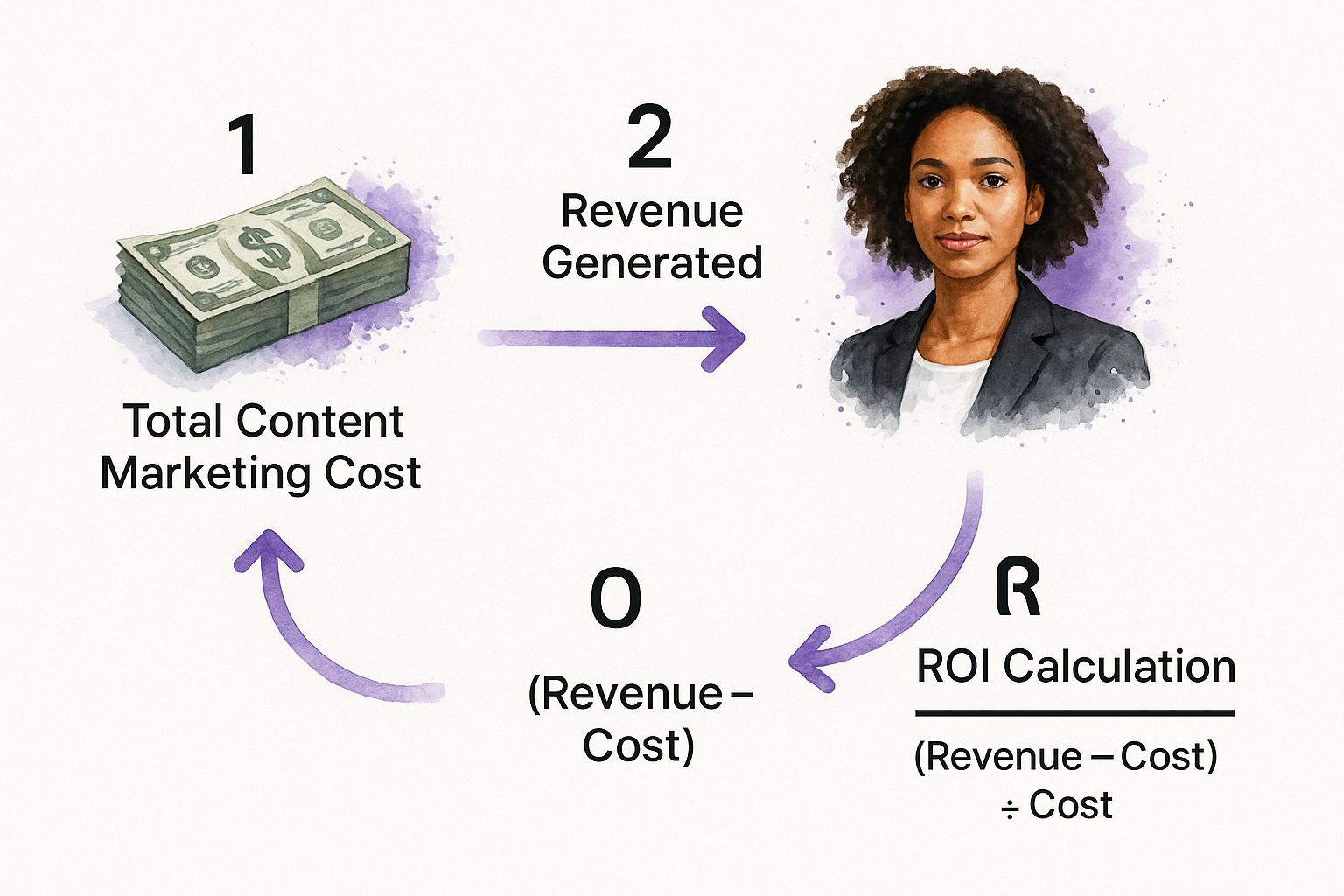
The infographic breaks down the ROI formula, showing how to connect your total costs with the revenue you brought in to find your final return.
Connecting Content to Conversions Automatically
Let's say you sell online courses. Your tracking system should be able to effortlessly show you the exact path a new student took. Did they first find you through a blog post on the best online teaching platforms, sign up for your free email challenge, and then purchase your flagship course a week later?
If you're using separate tools, that journey is broken into three different data sets. With an all-in-one platform, it's one continuous story. This immediately lets you see:
- Top-Performing Content: You can instantly identify the blog posts, videos, or newsletters that actually generate the most leads and sales.
- Customer Journey Insights: You start to understand the typical path a customer takes before buying, which shows you exactly where you can improve your sales funnel.
- Accurate Revenue Attribution: You can confidently trace every dollar of revenue back to the specific marketing effort that earned it.
This isn't just about making your life easier; it's about making smarter business decisions. When all your data is in one place, you can confidently double down on the channels and content formats that are proven to work, cutting out the guesswork and maximizing your profit.
By bringing your operations under one roof with Zanfia, you’re not just simplifying your workflow. You're building a powerful, self-contained system for measuring content marketing ROI with incredible precision. And that clarity is what allows you to scale your business predictably and sustainably.
Calculating and Analyzing Your Content ROI
Alright, you’ve set your goals, picked your metrics, and have your tracking humming along. Now for the moment of truth: running the numbers. This is where we stop talking about abstract concepts like "engagement" and start connecting your content directly to your bottom line.
The good news? The actual math is surprisingly straightforward. You don't need a degree in finance to figure this out.
The classic formula for content marketing ROI is simple:
(Return – Investment) / Investment x 100 = ROI %
Let's break down what actually goes into that little equation, because the details are what make the final number meaningful.
Defining Your Return and Investment
To get a number you can trust, you have to be brutally honest about what you earned and what you spent.
-
Return: This is the total revenue you can directly attribute to your content. We're talking about sales of your digital products, new membership sign-ups, affiliate commissions—any income that your tracking shows came from a specific blog post, video, or social media campaign.
-
Investment: This is the full cost of producing and promoting that content. Tally up everything: software subscriptions, payments to freelancers (like a video editor or writer), your ad budget, and—the one most people forget—the value of your own time.
It’s easy to feel like you’re guessing here, especially with social media. The Sprout Social Index™ found that while 97% of marketing leaders feel confident they can communicate the value of social media, a staggering only 30% of marketers believe they can actually measure its ROI. That gap often comes from getting bogged down in vanity metrics instead of tying efforts back to real business results.
If you want to dig a bit deeper into the fundamental principles, this guide on how to calculate marketing ROI is a great resource.
Turning Data Into Actionable Insights
Getting your ROI percentage is just the beginning. The real magic happens when you analyze that number to figure out what's working and what's a waste of time.
Let’s run a real-world scenario. Say you spent a total of $200 (factoring in your time and tools) to create and promote a YouTube video. Your tracking shows that this single video led to 15 sales of your course, which sells for $99. That’s a total return of $1,485.
Let's plug that into our formula:
($1,485 – $200) / $200 x 100 = 642.5% ROI
That’s an incredible return!
Now, let's say you also spent $300 on a series of blog posts that only brought in $400 in sales. That's a 33% ROI. The analysis here isn't about feeling bad about the blog posts; it's about making smarter decisions next quarter.
The goal of analysis is to find what works so you can do more of it. By identifying your highest-performing content formats and channels, you can confidently double down on the strategies that deliver the best returns, systematically increasing your profitability.
Seeing a massive ROI from your YouTube content is a clear signal that your audience loves video. This insight gives you the confidence to shift more of your budget and time toward that channel. You can even use the data from your most successful videos to come up with new ideas for what is upselling and cross-selling opportunities.
This simple process transforms your data from a confusing spreadsheet into your most powerful strategic asset. It's how you stop guessing and start building a predictable, scalable business as a creator.
Frequently Asked Questions About Content ROI
Let's dig into some of the most common questions and roadblocks I see creators run into when they're trying to figure out their content marketing ROI. If you've ever felt a bit lost in the data, these answers should help clear things up.

How Do I Value My Own Time in the ROI Calculation?
This is the big one. It's the "cost" that almost every creator overlooks, and it can completely skew your numbers. Your time isn't free—it's your most valuable asset.
To put a number on it, figure out a realistic hourly rate for your work. What would you have to pay a contractor with your skills to do the same job? Be honest.
Let's say you decide your time is worth $50 an hour. If you sink six hours into writing, editing, and promoting a single blog post, that's a $300 investment right there. When you add that to your other expenses like software or ad spend, you get a much clearer picture of what you're actually putting in.
What If My Content Generates Leads but Not Immediate Sales?
This is a scenario I see all the time, especially for creators with high-ticket offers like coaching programs or in-depth courses. The truth is, most content isn't meant to make a sale on the first click. Its job is often to start a conversation and bring in a qualified lead.
So, how do you measure that? You have to assign a value to each lead.
A straightforward way to do this is by looking at your lead-to-customer conversion rate. For instance, if you know that for every 20 people who sign up for your newsletter, one eventually becomes a customer who spends $500, then you can say each lead is worth $25 ($500 ÷ 20). Suddenly, your lead-gen content has a tangible value, long before the final sale happens.
My Two Cents: Don't get hung up on immediate sales. The real magic happens when you understand the entire customer journey. A lead generated by a blog post today might turn into a major sale next month. Tracking this proves the value of your top-of-funnel work.
How Often Should I Review My Content Performance?
You're looking for the sweet spot between checking your stats every five minutes and letting an entire quarter go by without a peek. For most creators, a monthly ROI check-in is the perfect rhythm.
This gives your content enough time to actually gain traction and collect meaningful data, but it's also frequent enough to catch underperforming pieces before they waste too many resources.
During this monthly review, I always recommend asking yourself three simple questions:
- Which specific posts or videos drove the most revenue?
- Which channels delivered the best, most qualified leads?
- Where are people getting stuck or dropping off in my funnel?
Making this a regular habit transforms measurement from a big, scary task into a simple, ongoing process that helps you steer the ship.
Stop Guessing and Start Measuring with Zanfia
Measuring your content marketing ROI isn't an academic exercise; it's the most powerful tool you have for building a stable, scalable business. The clarity you gain from knowing exactly what works allows you to invest your time and money with confidence, turning your content from an expense into your most profitable asset.
But you can't get that clarity when your data is scattered across a dozen different tools. To truly connect your content to your revenue, you need a single source of truth.
Zanfia is the all-in-one platform built to give you that clarity. By bringing your website, courses, community, and email marketing into one central hub, Zanfia automatically connects the dots for you, showing you the complete journey from first click to final sale. It's the strategic solution for creators who are ready to stop guessing and start building a predictable, profitable business.
Start your free Zanfia trial today and see exactly what your content is worth.

One comment
Comments are closed.

[…] in this chain has a quantifiable value. To get the full picture, it's critical to understand how to measure content marketing ROI. By tracking these key metrics, you can draw a straight line from a healthy sender reputation to a […]