

Instagram Ad Cost: Your 2026 Budgeting Guide
Instagram ads usually start around $0.40 to $2.00 per click and $5 to $15 per 1,000 impressions, but those numbers only tell you the entry price. For creators selling courses, memberships, and digital products, the key question isn't what Instagram traffic costs. It's whether that traffic turns into profitable customers.
A lot of creators reach the same point. Organic content works, but only up to a limit. You publish valuable posts, build an audience, maybe even launch a course or paid newsletter, and then growth slows. You know ads could help, but Instagram ad cost feels slippery. One guide says clicks are cheap. Another says leads are expensive. Your real fear is simpler: if you spend money, will it come back with margin left over?
That's the right question.
If you sell digital products, Instagram can work very well. But it only works when you stop treating ads like a visibility tool and start treating them like a customer acquisition system. That means understanding what you're buying, what makes prices move, and how to connect media spend to revenue from the first click through checkout and retention.
Is Instagram Advertising Worth the Cost
A creator launches a course, gets strong feedback from early buyers, and then hits a wall. Friends and followers have already seen the offer. The sales page is live. The checkout works. But the next wave of buyers doesn't arrive on its own.
That's where Instagram ads usually enter the conversation. Not because they're cheap, but because they can put an offer in front of people who would never discover it organically.
The catch is that "worth it" has almost nothing to do with whether your click costs look low on day one. It depends on whether your economics hold up after the click. If you sell a low-priced download, you need a very different ad strategy than someone selling a premium course or recurring membership.
Cost matters less than fit
Instagram advertising is worth the cost when three things line up:
- The offer is clear: Buyers understand what they're getting and why it matters now.
- The audience has intent: You're targeting people with a believable reason to care.
- The backend converts: The landing page, checkout, and follow-up don't leak demand.
If one of those breaks, ads feel expensive fast.
I've seen creators obsess over CPC while ignoring the page they send people to. That's backwards. A decent ad can survive average creative for a while. It can't survive a vague offer and a weak sales page for long.
Practical rule: Don't ask whether Instagram ads are cheap. Ask whether you can buy attention and turn it into revenue predictably.
For many small businesses and creators, that shift changes everything. Instead of trying to "go viral with ads," they build a repeatable funnel. If you're still shaping that foundation, these digital marketing strategies for small business help put ads in the right role. They should amplify a working offer, not rescue a broken one.
Decoding the Lingo of Instagram Ad Costs
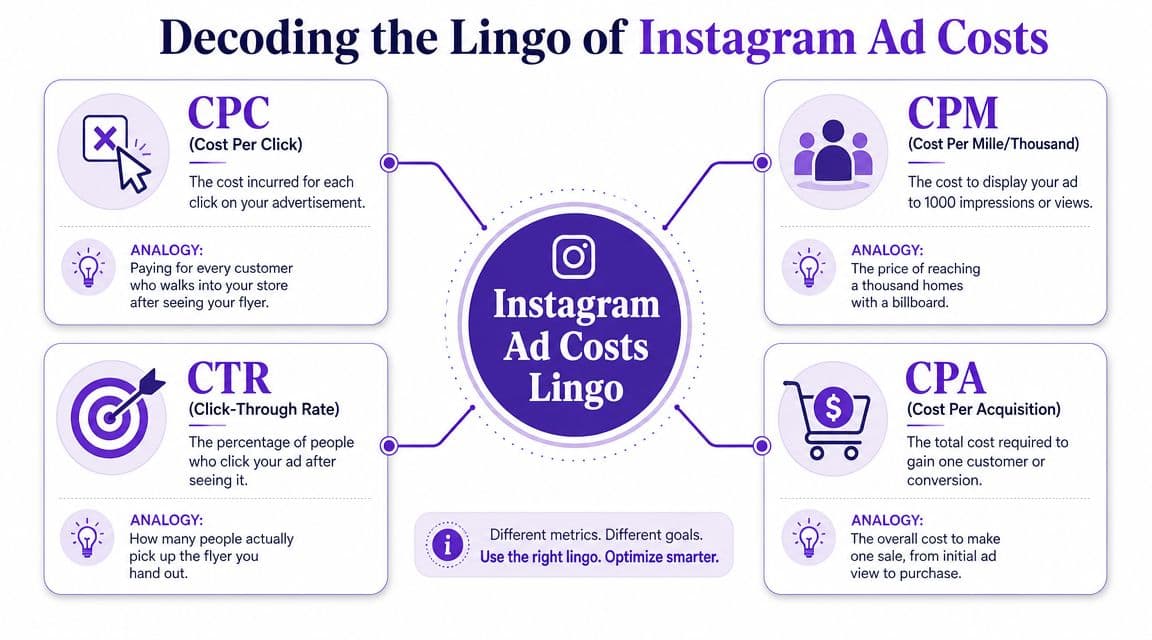
If you don't understand the billing logic, Instagram ad cost feels random. It isn't random. Meta sells ads through an auction system, and advertisers usually track spend through CPC, CPM, and CPE. Recent benchmark reporting places Instagram at about $0.40 to $2.00 CPC, $5 to $10 CPM, and $0.01 to $0.05 CPE, while many small businesses spend $500 to $5,000 per month and larger brands often spend $10,000+ monthly, according to Bastion's Instagram ad cost guide.
CPM is the price of attention
CPM means cost per thousand impressions. This is comparable to renting a digital billboard. You're paying for visibility, not action.
For creators, CPM matters most when you're trying to reach cold audiences with a new idea, launch message, or brand story. A low CPM can look efficient, but awareness alone doesn't pay for your course platform, video production, or customer support. If your campaign goal is sales, CPM is just the top of the equation.
CPC tells you what traffic costs
CPC means cost per click. This is the price you pay when someone takes the next step and visits your page.
For a digital product business, CPC is more useful than CPM because it gets closer to buying intent. You're no longer paying for someone to scroll past your ad. You're paying for a visitor who showed enough interest to tap.
That still doesn't mean the campaign is healthy. Cheap clicks from the wrong audience can burn budget just as effectively as expensive clicks from a competitive audience.
CPE is engagement, not revenue
CPE means cost per engagement. Engagement can include likes, comments, or similar interactions depending on campaign setup.
This metric matters if social proof supports the sale, especially for creators whose audience buys based on trust and perceived authority. But engagement is a supporting signal, not the business goal.
A campaign with strong engagement and weak sales isn't efficient. It's just popular.
CPA is the metric creators should care about most
Meta reports many cost metrics, but the one that matters most to a seller is CPA, or cost per acquisition. That's the all-in price of generating a real outcome such as a lead, trial, or customer.
For course creators and membership operators, CPA answers the only question that matters: what did it cost to get a buyer?
Once you think in CPA, your decisions get cleaner. You stop chasing cheap traffic and start asking whether the funnel converts well enough to support the spend.
The 5 Key Factors That Drive Your Ad Price
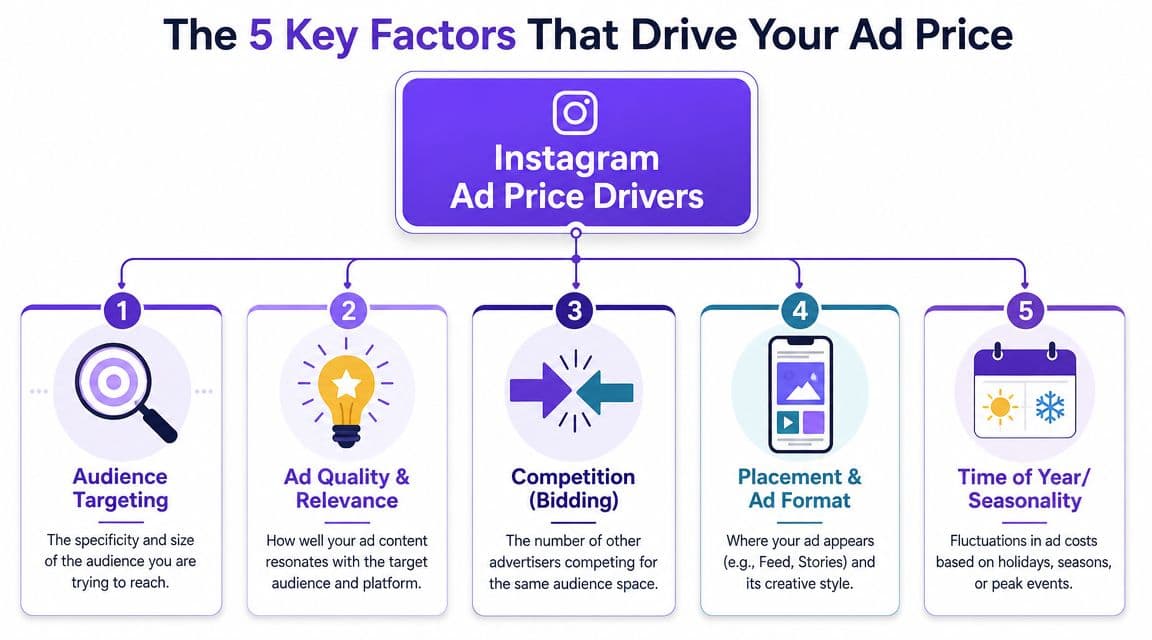
You can run the same offer on two different weeks and get very different costs. That's normal. Instagram ad cost moves because the auction is dynamic, and your campaign enters it with strengths and weaknesses that change over time.
Audience targeting changes the level of competition
The more specific your targeting, the more likely you are to compete in a tighter pool. Sometimes that's good. A narrow audience can be high intent. Sometimes it's expensive and unstable.
Creators often make one of two mistakes. They either target so broadly that the offer loses context, or so narrowly that delivery becomes choppy and costs rise. The right move depends on how strong your creative is and how clearly the product matches the audience.
If you want a wider view of how ad prices vary across channels, Wand Websites' advertising cost analysis is a useful comparison point.
Ad quality and relevance affect what you pay
Meta doesn't just look at your bid. It also reacts to how people respond to the ad. If people stop, watch, click, and engage, the system gets a better signal that your ad belongs in front of similar users.
That's why creators with average targeting and strong message-market fit often beat creators with "perfect" targeting and forgettable creative. Good ads lower friction. Bad ads make you pay extra just to keep showing up.
Placement and format aren't equal
Feed, Stories, and Reels don't behave the same way. Neither do static images, carousels, and short video.
A creator selling a transformation-heavy course may do well with video that demonstrates the result. A paid newsletter might convert better from a direct, text-led creative with a strong hook. The point isn't to force one format. It's to match the ad format to the buying decision.
Seasonality changes the auction
Costs often rise when more advertisers compete for the same attention. That can happen around launches, shopping periods, industry events, or any time demand for inventory increases.
You can't control seasonality, but you can control whether you enter a more competitive period with tested creative and a clear offer. Going into a high-pressure window with unproven ads is one of the easiest ways to waste spend.
Industry economics shape your baseline
Some niches are more competitive. If you sell into a market where many advertisers can afford to pay aggressively for a lead or buyer, your costs will reflect that.
This is why generic social media advice fails so often. A creator selling a low-priced template pack can't copy the ad strategy of someone selling a premium cohort program. The unit economics are different from the start.
The fastest way to lower costs isn't usually a targeting tweak. It's a stronger offer presented in a format people want to consume.
If you're building a broader acquisition system around social platforms, these social media marketing ideas for small business help connect content, distribution, and conversion more effectively.
Instagram Ad Cost Benchmarks for 2026
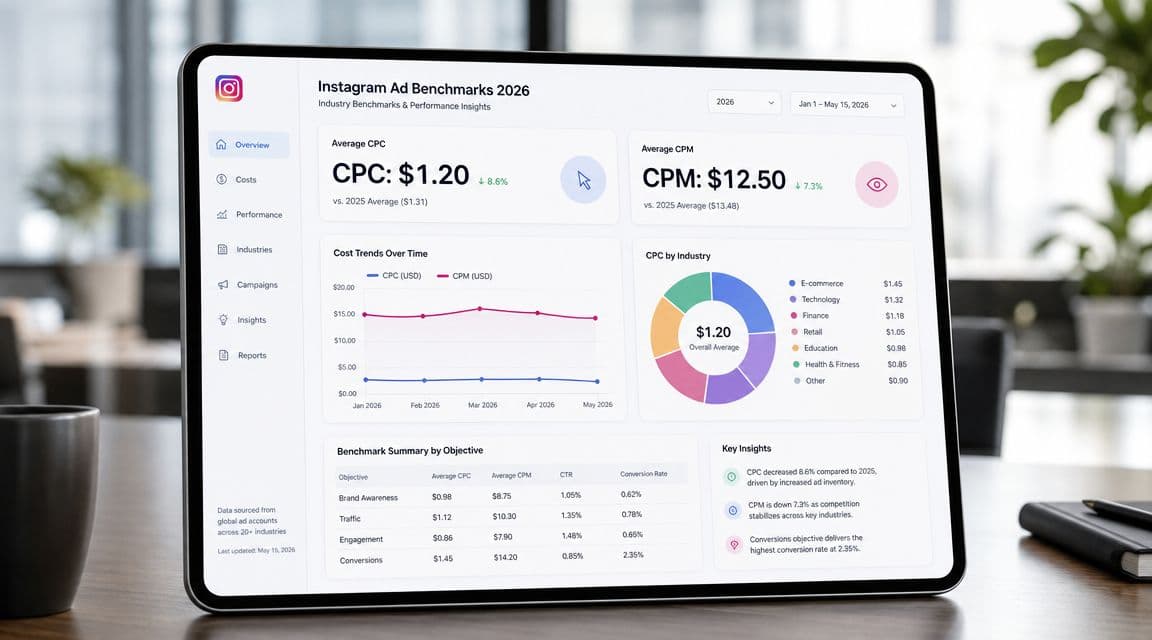
Benchmarks help when you use them as orientation, not as promises. The point isn't to hit an average. The point is to know whether your campaign is within a believable range for the objective you're buying.
A 2025 benchmark cited by Hootsuite found average Instagram ad costs of $1.31 CPC, $15.26 CPM, $0.067 CPE, and $11.31 CPL, according to Hootsuite's Instagram ads guide. That same reporting also referenced historical figures showing Instagram CPC around $0.80 in 2018 and a broad $2 to $20 CPM range in March 2021.
What these benchmarks actually tell you
Those numbers are useful for one reason. They show how different campaign goals produce different cost structures.
A click-focused campaign can look reasonable on paper while a lead campaign feels much heavier. That doesn't automatically mean the lead campaign is worse. If the lead quality is strong and leads convert into customers, the higher upfront cost can still be the better buy.
For creators, that's especially important. Selling a course rarely happens from a casual impression alone. Buyers often need education, proof, and trust before they purchase. A campaign optimized for leads or conversions will usually feel more expensive than a traffic campaign because it's asking the platform to find people closer to action.
Benchmarks by objective mindset
Here's the practical way to read Instagram ad cost benchmarks:
| Campaign mindset | What you're buying | What usually matters most |
|---|---|---|
| Awareness | Reach and visibility | CPM and message clarity |
| Traffic | Site visits | CPC and landing page quality |
| Lead generation | Signups or inquiries | CPL and lead intent |
| Sales | Purchases | CPA and margin |
This is why the wrong benchmark can mislead you. A creator who compares a sales campaign to a traffic campaign may think performance is poor when the campaign is buying a more valuable outcome.
The historical pattern matters
The older figures are worth paying attention to because they show a trend. Instagram ad pricing hasn't become more volatile overnight. Competition and cost pressure have built over time.
That means lazy campaigns don't survive for long. Broad promises, weak hooks, and generic landing pages get punished faster now because there are too many alternatives in the auction. Creators who keep costs under control usually do three things well: they tighten targeting, refresh creative, and treat testing as a normal operating expense.
How to Budget for Instagram Ads That Actually Work
Budgeting gets easier when you stop asking, "How much should I spend?" and start asking, "How much can I spend to acquire a customer profitably?"
That sounds obvious, but most creators still budget backwards. They pick a round number, run ads for a few days, and hope something happens. Then they call Instagram expensive when the underlying issue is that they never tied spend to product economics.
Gupta Media's June 2025 tracker put average Instagram CPM at $8.16 and average cost per link click at $0.69, while agency guides for 2026 cite typical CPMs of $5 to $15, CPCs of $0.50 to $2.50, and lead costs often $10 to $80, as summarized in Gupta Media's Instagram ads cost breakdown. Their framing is the right one: the better question is how much you need to spend before Meta has enough data to optimize and before you can trust the result.
Start with your break-even acquisition number
If you sell digital products, begin with a simple rule. Your acquisition cost must leave room for fulfillment, payment processing, refunds, and profit.
Use this sequence:
- Know your average first purchase value: This is what a new buyer pays first, not what you hope they'll buy later.
- Estimate your acceptable acquisition cost: This is the most you're willing to pay to get that buyer.
- Factor in retention and upsells carefully: Recurring revenue can justify a higher acquisition cost, but only if retention is real.
- Decide how much testing loss you can absorb: Early campaigns are often partly for learning.
If you don't know your acceptable acquisition cost yet, calculate it before you launch. This guide to customer acquisition cost calculation is a good place to pressure-test the math.
Budget for learning, not just for outcomes
One of the biggest mistakes creators make is underfunding the learning period. They want purchase data, but they only give the system enough budget for a handful of low-signal clicks.
That creates false negatives. The campaign didn't necessarily fail. It may never have gathered enough data to show you whether the offer could work.
Budgeting lens: Your first budget is buying information as much as it is buying customers.
A practical budget should cover enough spend to judge three things:
- Traffic quality: Are the right people clicking?
- Page conversion: Does the offer hold up after the click?
- Acquisition path: Can the funnel produce buyers at a sustainable cost?
Sample Monthly Instagram Ad Budgets for Creators
| Creator Persona | Goal | Example Product | Sample Monthly Budget (USD) | Primary Metric |
|---|---|---|---|---|
| Potential Explorer | Validate demand and messaging | First e-book or mini-course | Low four-figure range | Lead quality or first purchase |
| Business Architect | Scale a proven funnel | Course, membership, or bundle | Mid to higher four-figure range | Customer acquisition cost |
| Craft Master | Support premium acquisition and remarketing | Premium cohort, expert program, or paid community | Higher, controlled growth budget | Profit per acquired customer |
That table is intentionally directional. The right budget depends on your price point, conversion path, sales cycle, and whether you're driving to a webinar, lead magnet, sales page, or direct checkout.
Don't separate ad spend from funnel quality
A creator with average ads and a strong funnel often beats a creator with great ads and a weak backend. If the page loads cleanly, the message matches the ad, and the checkout removes friction, your budget goes further. If not, every click gets more expensive in practice, even when platform-reported CPC looks fine.
7 Actionable Tactics to Lower Your Instagram Ad Spend
Lowering Instagram ad cost isn't about gaming the platform. It's about removing waste. Better targeting, better creative, and a better post-click experience all make the same budget work harder.
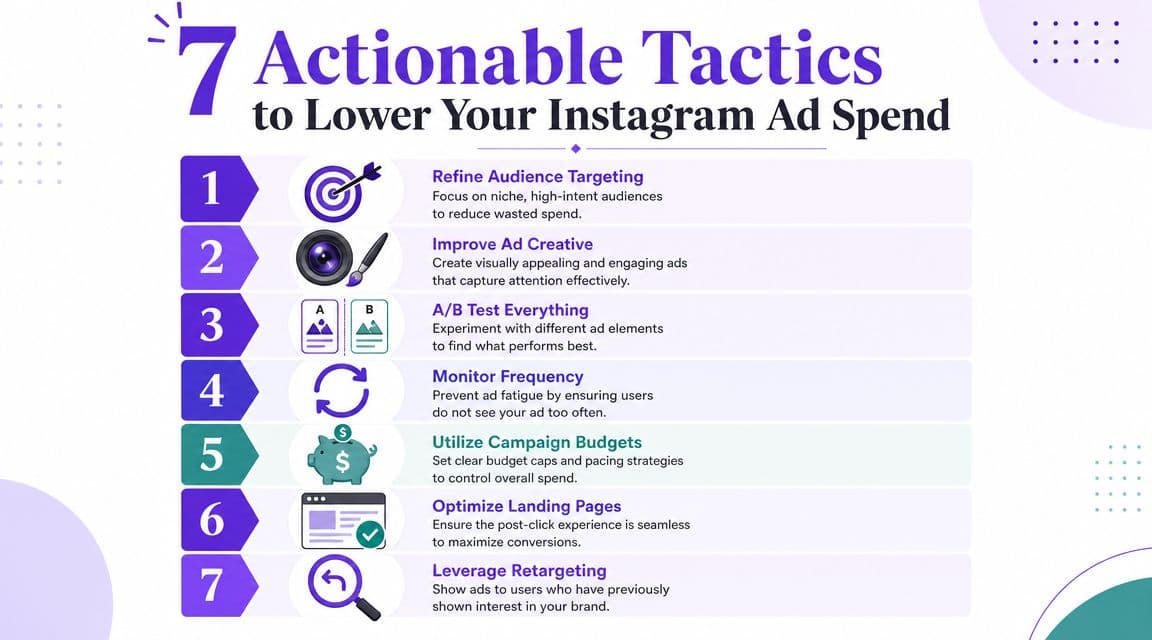
Tighten the audience without choking delivery
Targeting should be specific enough to preserve relevance and broad enough to let the system find buyers. For creators, that often means separating cold audiences from warm retargeting audiences and excluding existing customers where appropriate.
The biggest leak here is overlap. If your campaigns compete against each other for similar people, you create your own cost pressure.
Improve the creative before touching the budget
Most cost problems show up first as creative problems. Weak hooks attract low-intent clicks. Generic visuals disappear in the feed. A vague headline may get attention without getting qualified interest.
If you're building more visual-first ads, especially for Reels or short-form placements, this roundup of AI fashion video generator tools is a useful example of how creators can speed up visual production workflows without turning every test into a full shoot.
Run real A/B tests
Test one meaningful variable at a time. Hook, angle, creative format, offer framing, or CTA. Don't change everything at once and then guess why the result moved.
Keep the tests honest:
- Change the hook: Lead with a problem, a promise, or a belief shift.
- Change the format: Compare static, carousel, and short video.
- Change the angle: Teach, challenge, or demonstrate.
Watch for fatigue and wasted impressions
A creative that worked last week can fade quickly. When the same audience sees the same message too often, performance usually gets less efficient.
Creators often overspend on the familiar. They keep the "winner" running after it stops being a winner.
To see how experienced media buyers think about optimization mechanics in practice, this short video gives useful context:
Match campaign objective to the sale
If you want purchases, don't optimize only for vanity signals. Engagement can support the funnel, but it doesn't replace a conversion-focused setup when the goal is revenue.
This sounds simple, but a lot of creators still boost posts and hope buyers appear. That's rarely the cleanest path to profitable acquisition.
Fix the landing page and checkout
A large share of ad waste happens after the click. If the sales page is cluttered, slow, unclear, or poorly matched to the promise in the ad, you're paying for visitors you can't convert.
Audit the page for:
- Message match: The headline should continue the ad, not restart the conversation.
- Mobile flow: Most Instagram traffic arrives on mobile, so the page has to feel effortless there.
- Checkout friction: Too many steps or unclear payment flow can undermine economics. A checkout that supports order bumps and splits a $600 course into installments turns more visitors into buyers before they hesitate.
If you want a sharper process for improving that handoff, these conversion rate optimization strategies are worth applying before you raise budget.
Better ads lower acquisition cost. Better pages make that lower cost count.
Use retargeting with discipline
Retargeting matters because not every buyer converts on the first visit. But creators often overestimate how much budget it deserves.
Use it to re-engage people who viewed the sales page, interacted with launch content, or started checkout. Don't let it become a crutch that hides weak cold acquisition.
Making Your Ad Spend a Profitable Investment
Instagram ad cost is only dangerous when you treat it like a disconnected expense. Once you tie it to product margin, funnel performance, and retention, it becomes easier to judge clearly.
The useful mental shift is this: you're not buying clicks. You're buying chances to acquire customers. Some of those chances are cheap and low quality. Others cost more but produce buyers who stay, upgrade, and refer others. Your job is to know the difference.
That's why experienced creators focus less on platform averages and more on business fit. They understand the metrics, respect the auction, budget for learning, and improve the system after the click. If you also advertise across Meta more broadly, this guide to Facebook ad cost strategies for POD is a useful companion because the same discipline around offer, creative, and conversion applies.
For a final gut check, measure ads the way an operator would. Use this framework for how to calculate marketing ROI and judge campaigns by profit, not by vanity metrics.
FAQ
How much of my Instagram ad budget should go to testing before I expect sales?
Treat your first budget as buying information as much as buying customers. Fund enough spend to judge three things: traffic quality, page conversion, and whether the funnel can produce buyers at a sustainable cost. Underfunding this learning period creates false negatives, where the campaign never gathered enough data to show whether the offer could work.
Why is my sales campaign more expensive than the traffic campaigns I see in benchmarks?
A sales or lead campaign asks Meta to find people closer to action, which usually costs more upfront than a traffic campaign buying casual visits. That doesn't automatically mean it's worse. If leads convert into customers, the higher cost per acquisition can still be the better buy, especially for courses where buyers need education and trust before purchasing.
Should I target a narrow audience or go broad to lower my Instagram ad cost?
Neither extreme works reliably. Very broad targeting can strip context from your offer, while very narrow targeting can make delivery choppy and drive costs up. The right choice depends on how strong your creative is and how clearly your product matches the audience, so match targeting width to message strength rather than defaulting to one approach.
What's the fastest way to reduce my Instagram ad costs?
It's usually not a targeting tweak. A stronger offer presented in a format people want to consume lowers costs faster, because Meta reacts to how people respond to your ad. When users stop, watch, click, and engage, the system rewards you with better delivery, while forgettable creative makes you pay extra just to keep showing up.
How do I decide the maximum I can spend to acquire a customer?
Start with your average first purchase value, which is what a new buyer actually pays first, not what you hope they'll buy later. Subtract room for fulfillment, payment processing, refunds, and profit to set an acceptable acquisition cost. Factor in retention and upsells only if retention is real, and calculate this number before you launch, not after.
If you're ready to turn ad traffic into revenue, Zanfia is where an AI team runs the business behind your checkout. You dictate the work by chat or voice, and the assistant performs any action the interface can do, so your ad traffic lands on courses, memberships, newsletters, e-books, and community access built to sell under your own domain. The checkout carries order bumps, upsells, and installments that split a $600 course into four payments, test mode lets you buy your own product before launch, and Zanfia charges 0% platform commission today, so more of every acquired customer stays with you. Availability of specific AI capabilities depends on the plan, see the current Zanfia pricing.