

How to Sell AI Prompts as a Real Digital Product Business in 2026

The AI prompt market is no longer a curiosity. According to The Business Research Company, the AI prompt marketplace category sits at roughly $2.51 billion in 2026 and is projected to reach $7.01 billion by 2030, growing at a 29.2% CAGR. That is not a side hustle category anymore. It is an infrastructure category around how knowledge workers, marketers, designers, and developers actually do their jobs with AI.
And yet most people trying to make money selling AI prompts are stuck in two failure modes. Either they list a few prompts on a marketplace, earn $11 in three months, and quit. Or they build a sprawling Notion doc, drop a Gumroad link in their bio, and watch it convert at 0.3%. Neither of those is a business. They are experiments wearing a business costume.
This guide is for the third path: building a real digital product business around AI prompts. Not a marketplace listing. Not a freebie funnel. An actual product line with packaging, pricing tiers, recurring revenue, and a checkout you own. If you can write effective prompts and document a repeatable workflow, you can build something that compounds, and 2026 is genuinely the best year so far to start.
Why prompt packs are the lowest-friction digital product in 2026
A prompt pack has the cleanest cost-to-deliver economics in the digital product world. There is no video to film, no PDF to design from scratch, no live cohort to run, no software to maintain. Your inventory is text. Your delivery is a download. Your cost of goods sold is effectively zero after the initial write.
Compare that to a course. To launch a credible course in 2026, you need a working camera setup, video editing time, a lesson structure that holds attention, a quiz layer, completion certificates, refund handling for buyers who never logged in, and the constant pressure to update modules whenever the tool you teach changes its UI. The barrier to entry is real, and the ongoing maintenance is heavier than people admit.
A prompt pack avoids all of that. Buyers want a result they can copy, paste, edit, and use today. They are not buying education. They are buying a head start.
Three structural reasons prompt packs work right now:
- AI literacy is still uneven. The gap between people who can write a useful prompt and people who only know how to type “write me a blog post” is enormous. That gap is a market.
- Tool fragmentation is increasing, not decreasing. ChatGPT, Claude, Gemini, Midjourney, Runway, Suno, Veo. Each one rewards different prompt structures. Buyers want curated stacks for the specific tool they pay for.
- Workflow buyers convert higher than novelty buyers. Someone buying “200 productivity prompts” is window-shopping. Someone buying “the 40 prompts I use to run a recruitment agency on Claude” is a workflow buyer, and workflow buyers pay 5 to 10 times more per unit.
The implication: do not sell prompts as a generic asset class. Sell them as a complete operating system for a specific job-to-be-done.
The 4 niches that consistently move $2K-$10K/month in prompts
Not all prompt categories are equal. Some sit in oversaturated commodity territory where buyers expect to pay $5 and complain about $9. Others are commercial niches where buyers will pay $97 to $297 because the prompts plug into an existing money-making workflow.
Across the prompt seller cohort observable on marketplaces and independent stores in 2026, four niches consistently produce $2K to $10K per month for serious operators.
1. Marketing operators and agency owners
Performance marketers, copywriters, SEO consultants, and small agency owners are willing to pay real money for prompt systems that compress hours of client work. A Meta ads angle generator, a 50-prompt SEO content cluster framework, a cold email personalization engine. These are not novelty. They are revenue-coupled tools the buyer uses every week.
2. E-commerce and DTC operators
Product description generators, customer service reply libraries, review response systems, return-handling scripts, Klaviyo flow rewrites. E-commerce operators run on margin, so anything that cuts a virtual assistant out of the loop pays for itself in week one.
3. Recruiters, HR, and legal-adjacent workflows
Job description rewrites, candidate screening rubrics, offer letter templates, interview question banks segmented by role and seniority. These buyers are professionals who bill clients or operate in compliance-sensitive environments, and they pay for prompts that reduce review time without introducing risk.
4. Creators selling to other creators
YouTube scriptwriting frameworks, podcast outline generators, Substack newsletter templates, course outline builders, lead magnet ideation engines. Creators have both the demand and the audience-access to share what works, which means the buyer base is also your distribution channel.
Notice what is not on the list: generic “ChatGPT for productivity” packs, “100 prompts for writers” bundles, and “AI hacks for life” collections. Those sell, but at $7 to $19, and they require constant marketplace SEO work to keep moving. The four niches above support $47 to $297 price points because the buyer is using the output to make or save money.
How to package prompts so buyers feel they got expertise, not just text
The single biggest unlock between a $19 pack and a $147 pack is packaging. Buyers do not pay for raw prompts. They pay for a feeling of structured competence delivered to them in a usable container.
Here is the packaging structure that separates a real product from a Notion dump:
- A short onboarding guide (2 to 4 pages). Explain who the pack is for, what tool it runs on, and the order to use the prompts in. This single artifact accounts for most of the perceived value because it tells buyers they bought a workflow, not raw inventory.
- Prompts grouped by workflow stage, not by topic. Group them by what the buyer does on a Tuesday morning. Discovery prompts, draft prompts, refinement prompts, QA prompts. Not “marketing prompts” and “writing prompts.”
- Variables in plain English. Use
{your_brand_name},{ideal_customer},{competitor_url}. The buyer should be able to scan and fill in 10 seconds of context without parsing your shorthand. - One worked example per section. Show what the output looked like when you used it. The example does more sales-after-purchase work than any other element. It is what converts a one-time buyer into a future repeat buyer.
- An update commitment. “I add 5 new prompts every month based on model updates and what buyers send me.” This single line shifts the buyer’s mental model from “I bought a file” to “I bought access to a maintained system.” That mental shift is the entire foundation of recurring revenue.
You can deliver this as a structured PDF, a Notion duplicate, an Airtable base, or a hosted knowledge base. The format matters less than the structure. What matters is that opening the product feels like opening a tool, not opening a list.
Pricing tiers that work: the $47 pack vs the $19 mistake
The most common pricing error in the prompt market is anchoring against marketplaces. PromptBase listings average $2 to $9 per prompt. Recent reporting notes that PromptBase offers an 80% revenue share and that niche-focused sellers earn $300 to $800 per month from passive prompt sales after about six months on the platform. That math works only if you treat marketplaces as a discovery channel, not as your main business.
When you sell from your own store with your own checkout, the pricing logic changes completely. You are not selling a single prompt against a $4 baseline. You are selling a curated system to a buyer who is already past the price comparison phase.
A pricing ladder that consistently works for serious prompt sellers in 2026:
- $0 free lead magnet. 10 to 20 prompts, no support, no updates. Optimized for email capture and demonstrating prompt quality.
- $47 starter pack. A focused 40 to 80 prompt system covering one workflow end-to-end. This is the volume tier. It converts cold traffic and builds your buyer list.
- $147 to $197 pro pack. 150 to 300 prompts plus the onboarding guide, worked examples, and a quarterly update. This is the profit tier. It carries most of the margin.
- $27 to $49 per month subscription. Monthly drop of new prompts, access to all past packs, early-access to model-specific releases. This is the compounding tier.
- $497 to $997 done-with-you tier. One call where you adapt your prompt system to the buyer’s specific business. Capped seats, sold to high-fit subscribers.
The $19 pack is a mistake not because $19 is a bad price, but because at $19 you cannot afford to keep the product alive. You cannot reinvest in updates, you cannot afford ads, you cannot afford support, and your buyer never reaches the price ceiling where they take you seriously as a vendor. Price the entry tier where you can profitably acquire customers from paid traffic or partner channels, not where you feel comfortable.
Marketplace as discovery, your own checkout as the business
One of the cleanest mental models for a prompt seller in 2026 is treating marketplaces and your own store as different organs of the same body. Marketplaces drive cold discovery. Your own checkout drives the actual business.
Why both matter:
Marketplaces like PromptBase, AIPRM, FlowGPT, and Snack Prompt put your work in front of buyers who are searching for solutions but do not yet know you. Marketplace listings function as paid SEO that you do not pay for upfront. The downside is the revenue share (20% on PromptBase, more on others), the limited buyer relationship (you usually do not get the buyer’s email), and the price ceiling enforced by competition with $4 listings.
Your own checkout flips every one of those constraints. You keep the full margin minus payment processor fees. You own the email list and can sell again. You can run upsells, order bumps, and subscription tiers that marketplaces do not allow. And critically, you can position your product as a premium system rather than a marketplace SKU.
The actual business workflow looks like this:
- List 5 to 10 high-quality samples on PromptBase or AIPRM as discovery bait at $7 to $14 each.
- Inside each marketplace product, include a one-page “for the full system, see [your store URL]” upsell. Most platforms allow this in the product description or in the delivered file.
- On your own store, the same prompts are part of a $47 or $147 system with onboarding, worked examples, and updates.
- At checkout, offer a one-click order bump (a $27 add-on pack) and a subscription upsell (the monthly drop).
- Drop everyone who buys into a buyer email list that you mail every two weeks with new prompt content, model updates, and the occasional offer.
Marketplace as discovery, your own checkout as the business. That is the structural separation that turns a prompt seller into a real digital product operator.
Recurring prompt subscriptions: the model that compounds
Single-purchase products are a treadmill. Every month, you need to fill the top of the funnel just to stay flat. Recurring subscriptions break that pattern, and in the prompt category they are particularly well-suited because the underlying technology actually changes every month.
New model versions, new modalities, new context window limits, new tool-use capabilities. Buyers feel the change and want a partner who keeps up. That is the gap a subscription product fills.
The math is dramatic. Stripe’s 2025 annual letter reported that Stripe Billing now manages nearly 200 million active subscriptions for over 300,000 companies, with the suite tracking toward a $1 billion annual run rate in 2026. Subscriptions are not a niche payment model anymore. They are the dominant pattern for digital products.
A workable prompt subscription structure:
- One core promise. “10 new prompts every month, hand-tested on the latest model versions, in the marketing operator niche.” Not “all the prompts.”
- One delivery rhythm. First Tuesday of every month. Predictability beats variety.
- One archive bonus. Active subscribers get every past pack you have ever shipped. This raises perceived value and reduces cancellation in month two.
- One easy cancel. Self-serve from the customer portal. Trying to make people fight a chatbot to cancel destroys word-of-mouth, which is the only growth channel that works long-term in this category.
The number to optimize is not subscriber count. It is months of average tenure. A subscription that retains for 9 months at $27 is worth more than one that retains for 3 months at $47. Build for the long tenure, even if it means slower top-line growth in the first two quarters.
How Zanfia helps prompt sellers run a real product business
Most prompt sellers cobble together Gumroad for one-off packs, Substack for the newsletter, Stan.store for the bio link, and Discord for the buyer community. That stack works at $500 a month in revenue. It actively limits you at $5,000.
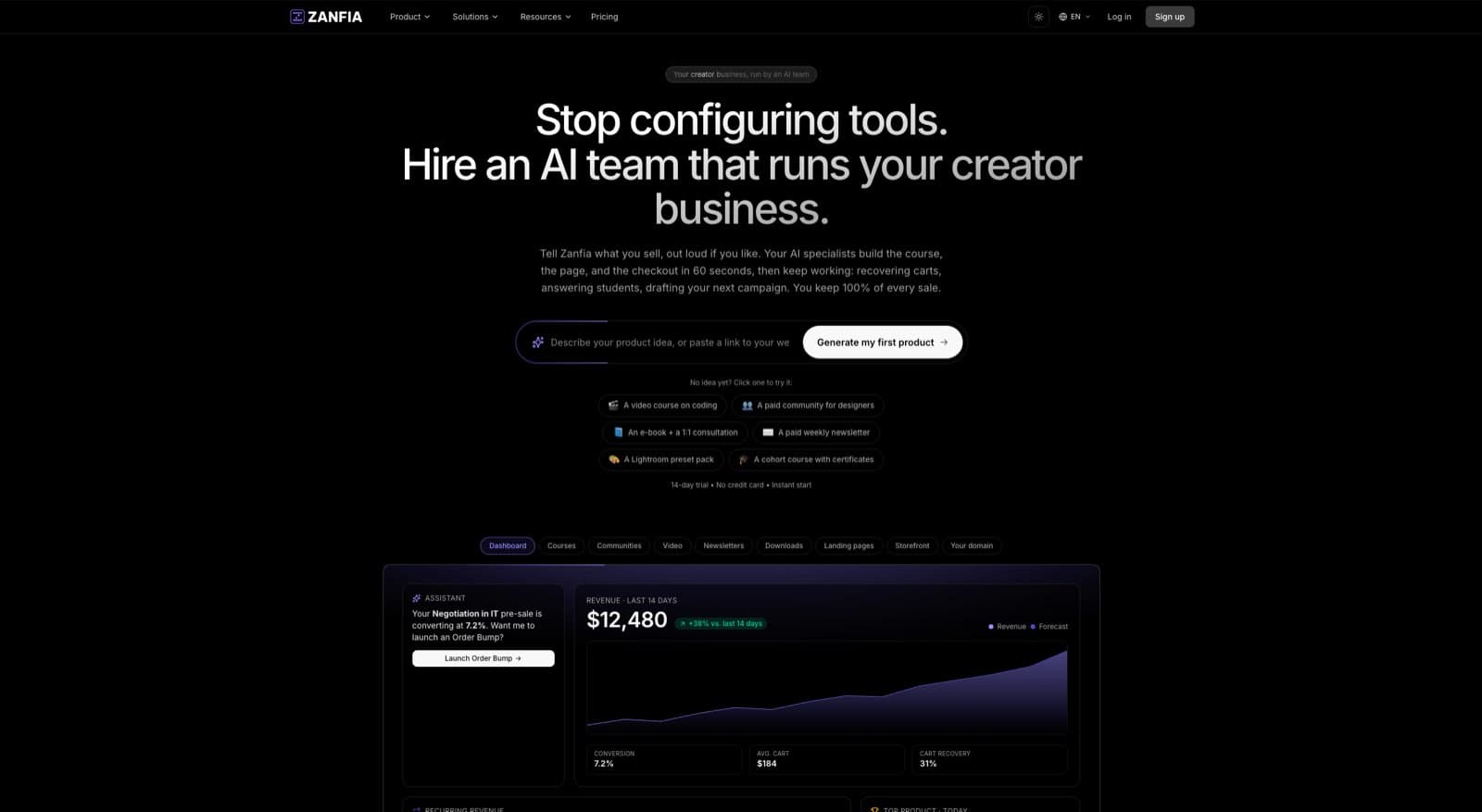
Zanfia is built as a single platform where an AI team runs your creator business alongside you, and courses, communities, newsletters and downloadable packs are the surfaces where that work lands. For a prompt seller, that framing matters: you dictate what needs to happen (by chat or by voice), the assistant performs actions available in the interface, and everything ends in a checkout built to sell. Any Zanfia workspace is also reachable over the MCP endpoint, so your own AI agents can act on it directly, though the full Assistant and the MCP endpoint depend on the plan you pick, so check the current Zanfia pricing before you decide how deep to lean on that side.
One checkout for every product format you actually need. The starter pack is a one-time purchase. The pro pack is a one-time purchase with an order bump and a subscription upsell. The monthly drop is a recurring subscription. The done-with-you tier is a consulting booking. Cart 2.0 supports one-time, subscription, installment, and free trial pricing in the same product catalog, with order bumps, discount codes, and Apple Pay plus Google Pay at checkout. Stripe and PayPal handle the actual processing. Before you go live you can open the exact same checkout in test mode, run a real card flow end to end, and keep those test orders hidden from your real order list, so the first buyer is never the person who finds a broken button.
0% platform commission on customer sales. You pay your Zanfia subscription and Stripe’s processing fees, and that is it. Compared to Gumroad’s 10% plus $0.50 per direct transaction (or 30% through their marketplace), the difference at $5$10,000 per month in sales is roughly $500 a month you keep instead of forwarding to a platform you do not control. Entry pricing starts at $39/month, or $31/month billed annually, on Starter, and every plan comes with a 14-day free trial and no credit card required.
White-label custom domain. Buyers check out at your own subdomain (each creator gets their own slug.zanfia.co subdomain, or you can map a fully custom domain). That positioning matters when the buyer is a marketing director debating whether to expense your $147 product. A branded store reads as a real company. A platform-branded checkout reads as a side hustle.
Knowledge bases for delivering the prompts themselves. Instead of sending a PDF or a Notion duplicate, you can deliver the entire prompt system as a searchable knowledge base hosted under your brand. Buyers log in, search, copy, paste. Updates happen in one place, and every buyer sees them automatically. That delivery method alone justifies the price ceiling jump from a Notion dump to a real product.
Built-in community for buyer support. Topic discussion channels for the prompt categories you sell, an announcement-only channel for monthly drops and model updates, and group-based access so the $147 buyer sees a different set of channels than the $27 subscriber. Native integration with the rest of your product catalog, so you do not pay for Circle or Discord on top. Inside the community you can also run an AI agent that answers members using your own content, and everything it publishes is labeled as AI so the disclosure is clear from the first message.
Native iOS and Android app. The Zanfia mobile app on iOS and Android lets buyers access courses, paid newsletters, and knowledge bases on the go. For a prompt seller, that means the buyer who paid $147 can pull up the prompt library on their phone in a client meeting, not just on the desktop where they bought it.
The point of running on a single platform is not technical convenience. It is positioning. When your starter pack, pro pack, subscription, community, and consulting all live under one brand at one URL with one login, buyers see one company. That is the difference between a creator and a vendor, and vendors get paid more.
FAQ
Is the AI prompt market saturated in 2026?
The generic end is saturated. The vertical end is not even close. Anyone listing “100 productivity prompts for ChatGPT” is fighting in a commodity market. Sellers building “the prompt system for solo recruitment consultants using Claude” or “the e-commerce returns workflow on GPT” are operating in markets where there is essentially no direct competition. Saturation is a function of how narrowly you scope the product, not of the category as a whole.
Do I need an audience before I start selling prompts?
No, but you need a distribution plan. The two paths that work without a pre-existing audience are marketplace seeding (list samples on PromptBase or AIPRM and use them as discovery bait for your own store) and partner outreach (find five creators or operators in your target niche who would benefit from giving the pack to their audience in exchange for affiliate revenue or co-promotion). Audience helps, but a clear distribution plan matters more than follower count.
What is the realistic timeline to $5$10,000 per month?
Most serious prompt sellers in the four niches above reach $1,000 to $2,000 in monthly recurring revenue within six months if they ship one new pack per month and treat email list-building as a primary activity. The path to $5,000 typically takes 9 to 14 months and requires either a subscription product that retains for 6 plus months, or a partner-driven distribution channel that brings consistent cold traffic to a pro-tier product. It is not a 30-day game.