How to Build an Email List: Actionable Steps for Creator Businesses

Forget chasing social media algorithms for a moment. If you want to build a stable, scalable business as a creator, you need a direct line to your audience—one you completely own. This starts by offering something genuinely valuable in exchange for an email address. This isn't just about collecting contacts; it's about building a rock-solid foundation for predictable revenue and a thriving community.
Table of Contents
Your Email List Is Your Most Valuable Business Asset
Before we get into the "how," let's lock in the "why." It's easy to get caught up chasing likes and followers, but that's like building your business on rented land. One algorithm change from a social media giant can torpedo your reach overnight, cutting you off from the very people you worked so hard to connect with.
Your email list, on the other hand, is an asset you own. It's a direct, dependable channel for building relationships, sharing your best work, and creating stable revenue from what you do.
The Power of Ownership
Think of your email list as the central operations hub for your creator business. It’s where casual followers become a loyal community. You're not just broadcasting into the void; you're starting a conversation in a personal space—their inbox. That kind of direct access fosters a level of trust that a public feed simply can't replicate.
Your social media accounts are your storefronts, but your email list is your private office. It's where you build genuine relationships and conduct real business, away from the noise and distractions of the digital crowd.
This ownership brings stability. When you’re ready to launch a new course, a digital product, or a premium newsletter, your email list is a warm audience that's already listening. It removes the guesswork and frees you from relying on platforms that don’t have your best interests at heart. Looking at various email marketing strategies used across different industries just reinforces how critical this owned channel is for any serious business.
More Than a List—It's a Community
A well-managed email list is the seed of a thriving community. It gives you the power to segment your subscribers based on what they care about, creating personalized experiences that make them feel seen. For instance, you can send tailored content to people who downloaded a specific guide or signed up for a particular waitlist.
This is where real connection begins. As your list matures, you can invite your most dedicated subscribers into more exclusive spaces. With a tool like Zanfia, you can create a professional, branded community space directly linked to your digital products and courses. For creators ready to take that next step, our guide on how to create a membership website explains how an email list serves as the perfect launchpad for a paid community.
The numbers don't lie. Globally, the number of email users is expected to hit roughly 4.6 billion by 2025—a user base that makes even the biggest social platforms look small. With nearly 92% of online adults using email and over 60% checking it daily, this channel gives you incredible reach. These stats make it clear: focusing on your list isn't just a good idea; it's a non-negotiable strategy for any creator serious about long-term success.
Create Lead Magnets People Actually Want
An email address is a valuable piece of personal information. If you want someone to hand theirs over, you need to offer something equally valuable in return. I'm talking about something so good, your audience would have seriously considered paying for it. That's the secret to a great lead magnet.
Let's be direct: most people are tired of the generic, one-page PDFs filled with advice they could find with a quick Google search. Your goal should be to solve a specific, urgent problem for your ideal subscriber. A powerful lead magnet delivers a quick, tangible win and immediately positions you as a credible expert.
Go Beyond the Basic Checklist
Simple checklists have their place, but to really stand out, you need to think bigger. People are drowning in information; what they're really looking for is a shortcut to a tangible result.
Here are a few high-impact ideas I've seen work incredibly well:
- Exclusive Video Training: Record a quick, 15-minute workshop that solves one niche problem. A photographer, for instance, could offer a mini-class on "5 Steps to Perfect Food Photos with Just Your Phone." It's specific, actionable, and immediately useful.
- High-Value Template Pack: Don't just tell them what to do—give them the tools to do it. A business coach could bundle together Trello board templates for project management or a ready-to-use content calendar spreadsheet.
- Resource Library: Instead of just one download, what if you gave them access to a curated collection of your best tools, guides, and resources? This gives them a reason to keep coming back.
- Free Chapter of an Ebook: Give people a real taste of your best work. This not only gets you their email but also serves as one of the most effective sales tools for your full product.
The best lead magnets feel like a generous gift, not a marketing gimmick. They should solve a real problem and leave the new subscriber thinking, "Wow, if this is what they give away for free, I can't imagine how valuable their paid stuff is."
Specificity is everything here. "How to Grow on Instagram" is far too broad. But "A 7-Day Plan to Get Your First 100 Instagram Followers"? That’s a concrete promise that delivers a quick win, making it much more compelling.
Match the Magnet to Your Paid Offers
A truly strategic lead magnet doesn't just attract any subscriber; it attracts the right one—someone who is a perfect fit for your paid products down the line. Think of your free offer as the natural first step on the path to becoming a customer.
For example, if you sell an in-depth online course on digital illustration, a fantastic lead magnet would be a custom brush pack for Procreate or a mini-tutorial on a foundational drawing technique. This instantly pre-qualifies subscribers by confirming their interest in the exact topic you teach. You're not just getting an email; you're starting a relationship with a potential future student.
This is where an all-in-one platform like Zanfia eliminates the usual tech headaches.

You can use Zanfia’s Digital Products feature to easily host and deliver these valuable resources. Whether it's an ebook, a paid knowledge base, or even a subscription newsletter, you manage everything from one dashboard.
You could, for instance, create a killer ebook and offer the first chapter as your lead magnet. To get the full picture on that, check out our guide on https://zanfia.com/blog/how-to-make-and-sell-an-ebook/. Zanfia handles the delivery seamlessly, creating a smooth journey from a curious new subscriber to a happy paying customer without you having to stitch multiple tools together.
Design Signup Forms That Convert
You've created a brilliant lead magnet, but that’s only half the battle. Now you need a solid delivery system: the signup form. Think of it as the storefront for your free offer. If your form is confusing, hard to find, or just plain clunky, you’re essentially locking the door on potential subscribers. A well-designed form, on the other hand, swings that door wide open.
The goal isn't just to have a form somewhere on your site. It's about putting the right form in the right place at the right time. Your website is a powerful engine for growing your list, but only if you strategically place these gateways where your most engaged visitors will actually see them.
Finding the Best Placement for Your Forms
Where you put your signup forms has a massive impact on whether people sign up. Some spots on your website are simply higher-traffic areas, while others are perfect for catching visitors when their interest is at its peak. You don't need to plaster forms everywhere, but you absolutely need to be intentional.
From my experience, these are the highest-impact locations to focus on:
- Embedded Within Blog Posts: When someone is deep into reading an article, they're clearly engaged. This is the perfect moment to offer a relevant content upgrade—like a checklist or template related to the post—right inside the content.
- The Website Header or Navigation Bar: A "sticky bar" that stays at the top of the screen is a fantastic, non-intrusive way to keep your signup offer visible no matter where someone scrolls.
- The Website Footer: People who scroll all the way down are invested. The footer is a classic, expected spot for a newsletter signup, so don't neglect it.
- On Your "About" Page: This is where visitors go to learn your story and connect with you on a personal level. It's a natural place to invite them to become part of your community.
Choosing the Right Type of Form
Not all forms are created equal, and their performance can vary wildly. Pop-ups, for instance, get a bad rap for being annoying, but the data doesn't lie—they work because they demand attention. The trick is to use them thoughtfully.
This chart breaks down the average conversion rates for the most common form types.
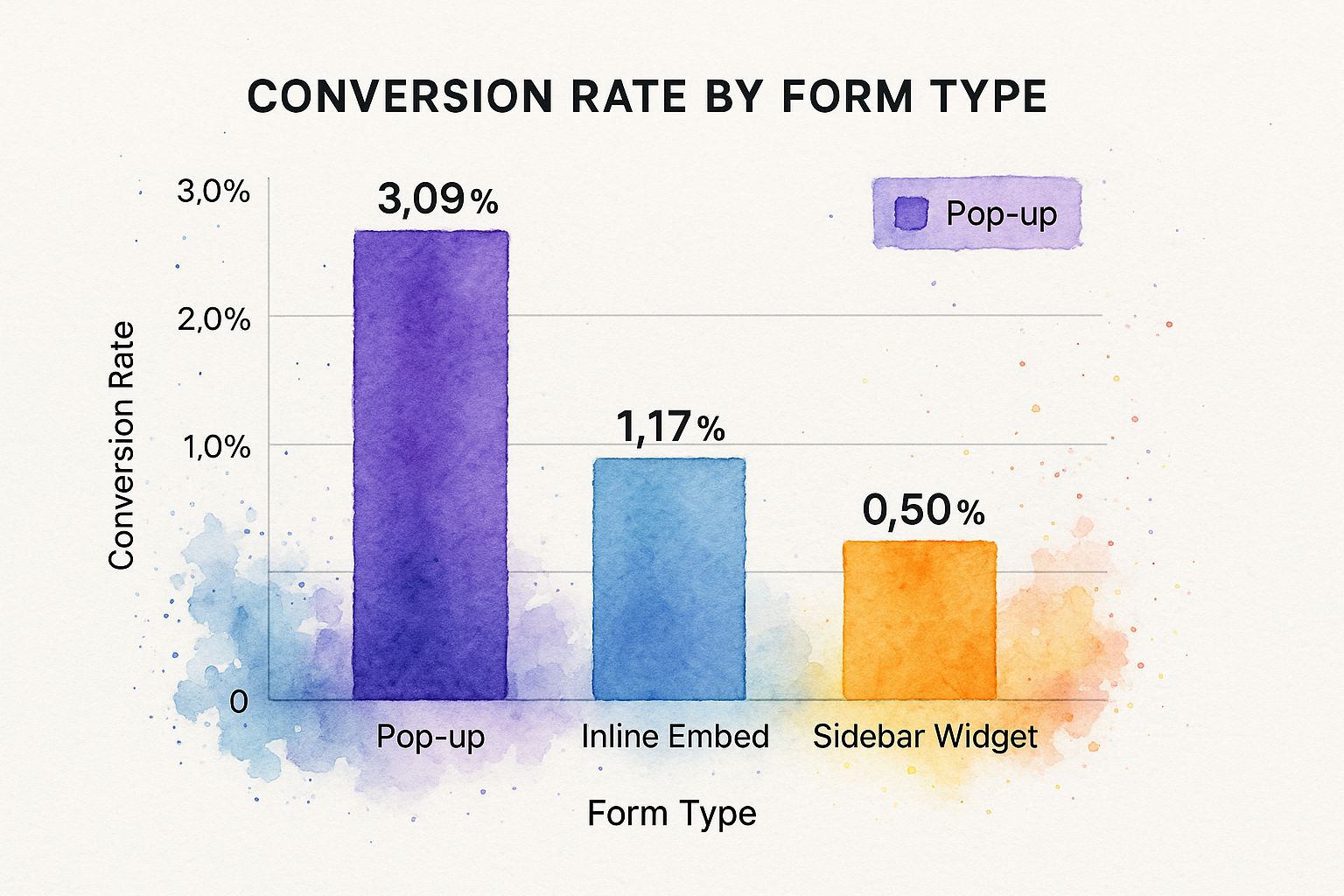
The numbers are clear: pop-up forms, on average, convert at 3.09%, blowing away inline (1.17%) and sidebar (0.50%) forms. This doesn't mean you should go all-in on pop-ups and ditch everything else. A balanced strategy that uses different form types in different places almost always works best.
Actionable Tip: Use an exit-intent pop-up. It only appears when a visitor is about to leave your site, so it doesn't disrupt their experience. It’s a "nothing-to-lose" final offer that can be surprisingly effective at capturing emails you would have otherwise lost.
Writing Copy That Inspires Action
The words you use on your form are just as critical as its design and placement. Your copy needs to be direct, persuasive, and completely focused on what the subscriber gets. Ditch generic platitudes like "Sign up for our newsletter."
Instead, zero in on the value. What's in it for them?
- Headline: Start with a bold promise. Instead of "Join My List," try "Get My 5-Step Framework for Landing Your First Client."
- Body Copy: Quickly explain the benefit and add credibility. "Join 10,000+ creators and get weekly, actionable tips delivered straight to your inbox," provides powerful social proof.
- Call-to-Action (CTA) Button: Use strong, action-oriented words. "Download Now" or "Get the Guide" is much more compelling than a passive "Submit."
At the end of the day, your forms are a key part of your brand experience. To really sharpen these elements and turn more visitors into loyal subscribers, it's worth brushing up on some fundamental conversion rate optimization strategies.
Promote Your List to Find Your Audience

You’ve done the hard work of creating a fantastic lead magnet and setting up your signup forms. But here's the thing: a system without traffic is just a well-built machine that sits idle. The next step is to get out there and actively promote your offer to the right people. It’s time to shift from a "build it and they will come" mindset to a proactive strategy that drives targeted traffic to your opt-in pages.
There are many ways to get the word out, and I've found that a mix of organic and paid methods usually works best. The real trick is figuring out where your ideal audience hangs out online and showing up there with a clear solution to their problems.
Leverage Your Own Content Channels
Your existing platforms are the lowest-hanging fruit. You've already built a relationship with your audience there, which makes it the perfect place to start. Your content should be the natural bridge that guides engaged readers and followers directly to your email list.
Let’s get specific:
- Your Blog: Every single article is an opportunity. If you write a post about creator productivity, you should absolutely mention your "Ultimate Creator Productivity Template" and link straight to the signup page. It’s not pushy; it's helpful.
- Social Media Bios: This is prime real estate! Don't waste it. Use a punchy call to action like, "👇 Download my free 5-day creator launch plan" and link it up.
- Regular Social Posts: Don’t just announce your lead magnet once. Weave it into your regular content. Create a cool graphic, share a testimonial from someone who loved it, or run a poll on the topic. For more ideas, check out our guide on social media marketing for small business.
A common mistake I see is treating promotion like a one-time event. The reality is, people need to see an offer multiple times before they act. Consistent, gentle reminders across your channels are far more effective. Don't be afraid to keep mentioning it in fresh, interesting ways.
To really dial in your strategy, it helps to understand the fundamentals of lead generation best practices. These principles will help you refine your promotional tactics and build a more robust system for attracting subscribers.
To help you decide where to focus your energy, here’s a quick rundown of some of the most effective channels for promoting your email list.
Email List Promotion Channel Comparison
| Channel | Potential Reach | Average Cost | Best For |
|---|---|---|---|
| Your Blog/Website | Medium (Your existing traffic) | Free | Converting warm, engaged readers who already trust your expertise. |
| Social Media | High (Potential for virality) | Free (Organic) / Variable (Paid) | Reaching new audiences and leveraging visual content to attract interest. |
| Guest Blogging | High | Free (Time investment) | Tapping into an established audience in your niche and building authority. |
| Collaborations | Medium to High | Varies (Cross-promotion is often free) | Partnering with other creators to access a new, relevant audience. |
| Paid Ads (Social/Search) | Very High | Variable (Can start small) | Quickly testing offers and scaling what works with a targeted audience. |
| Referral Programs | High (Exponential potential) | Free to Low (Cost of rewards) | Turning your current subscribers into an automated marketing engine. |
This table is just a starting point. The best mix of channels will ultimately depend on your niche, your budget, and where your specific audience spends their time. Experiment, track your results, and double down on what works for you.
Turn Subscribers into Your Best Marketers
One of the most powerful—and most overlooked—ways to grow your list is to mobilize the people who are already on it. Your current subscribers are your biggest fans. They already value what you do, which makes them the perfect advocates to spread the word to people just like them.
This is where a referral program can be a total game-changer. The idea is simple: reward your subscribers for bringing new people into your community.
It’s exactly why we built a Referral Program feature directly into Zanfia. You can set up an automated system that gives subscribers exclusive content, discounts, or other perks when their friends sign up through their unique referral link. It becomes an organic growth engine that runs 24/7, replacing the chaos of manual tracking with a simple, automated solution.
With Zanfia, you can:
- Create referral programs for your newsletter or digital products.
- Define custom rewards that actually motivate people to share.
- Automate welcome messages for both the referrer and the new subscriber.
- Integrate seamlessly with your mailing systems and signup forms.
By empowering your audience to become your marketing team, you don't just grow your list faster—you build a stronger, more invested community through genuine, word-of-mouth connections.
Keep Your Subscribers Engaged for the Long Haul
https://www.youtube.com/embed/i2IdUpyu53w
Getting someone to subscribe is a fantastic start, but it's just the beginning. The magic of a great email list isn't about hitting a certain number; it's about building real relationships with the people on that list. Once someone signs up, your focus needs to pivot from getting them in the door to making them want to stay.
The moment someone hits "subscribe" is when they're most interested in what you have to say. This is your chance to make a killer first impression. If you don't engage them right away, you miss a critical opportunity. You have to capitalize on that initial excitement and start building a connection from day one.
A Welcome Series That Actually Welcomes
A well-crafted welcome email series is essential. This is an automated set of emails that goes out to every new subscriber over their first few days. It's how you introduce yourself, deliver on your promise, and set expectations for what's coming next.
The numbers don't lie. Email marketing brings in an average of $42 for every $1 spent, but you only see that kind of return if you engage people properly. Welcome emails are your secret weapon here—they have an average open rate of 51%, which blows most other marketing emails out of the water. That first interaction truly matters.
Your welcome sequence should feel less like a sales pitch and more like a personal onboarding. Here's a simple, proven flow:
- Email 1 (Immediately): Deliver what you promised! Make it incredibly easy to download the lead magnet they signed up for. Keep this email short and focused.
- Email 2 (Day 2): Share your story. Who are you? Why do you do what you do? People connect with people, not faceless brands. This is your chance to build that human connection.
- Email 3 (Day 4): Provide a quick win. Share your absolute best tip, a link to your most-read article, or a short video tutorial. This proves your value immediately and reinforces their decision to subscribe.
- Email 4 (Day 6): Ask a question. A simple "What's the biggest challenge you're facing right now with [your topic]?" can spark a conversation and give you invaluable insight into your audience's needs.
Speak to Individuals, Not a Crowd, with Segmentation
As your list grows, blasting the same email to everyone stops being effective. The key to keeping people engaged long-term is sending them content they actually care about. That all starts with segmentation.
Simply put, segmentation is splitting your audience into smaller groups based on their interests, their purchase history, or how they've interacted with you.
Someone who downloaded your "Beginner's Guide to Sourdough" has completely different needs than the person who just bought your advanced pastry course. Segmentation lets you talk to each of them in a way that makes sense for where they are in their journey.
This is where having your products, courses, and community all under one roof becomes a strategic advantage. When everything is connected, segmentation happens almost automatically.
For example, Zanfia works seamlessly with email platforms like ActiveCampaign and MailerLite. This integration means you can automatically "tag" subscribers based on their actions. Someone buys your productivity ebook? They get a "Productivity" tag. Someone joins your community for course creators? They get a "Creators" tag. Zanfia's Automations feature allows you to connect these events in the customer journey with specific tasks, creating a powerful, personalized experience without the manual work. This is how you move from just having an email list to building a thriving community and a stronger business. If you want to dive deeper into this, check out our guide on how to develop a community around what you do.
Your Top Email List Questions, Answered
Once you get the ball rolling, you're bound to run into a few questions. It happens to every creator. Let's walk through some of the most common issues so you can troubleshoot with confidence.
How Often Should I Email My List?
There isn't a single magic number here, but a great starting point is once per week. That’s a solid rhythm that keeps your audience engaged without overwhelming their inbox.
Of course, the real answer depends on your audience and your content. If you're in the middle of a product launch, you might increase the frequency. The most important thing is consistency. Set an expectation early on and stick to a schedule your subscribers can rely on.
My Open Rates Are Low. What's the Problem?
It’s easy to get discouraged by low open rates, but don't panic—this is usually a fixable problem. Before you overhaul your entire strategy, take a look at these common culprits:
- Your Subject Lines: Are they specific and intriguing? Your subject line is the gatekeeper. Try experimenting with different approaches. Ask a question, use a short and punchy phrase, or create curiosity about what's inside.
- Your "From" Name: People open emails from senders they know and trust. Make sure your "from" name is instantly recognizable, whether it's your personal name or your brand name.
- A "Stale" List: It’s natural for some subscribers to go cold over time. Regularly pruning your list of people who haven't opened an email in a few months is good hygiene. This can give your open rates a surprisingly big boost and improve your overall sender reputation.
Actionable Tip: Open rate is just one piece of the puzzle. You also need to look at your click-through and unsubscribe rates. Together, these numbers paint a much richer picture of how your audience is really responding to your content.
How Can I Re-Engage Subscribers Who Have Gone Quiet?
Before you delete those inactive subscribers, try a re-engagement campaign. You'd be surprised how many people you can win back.
Set up a simple, automated sequence for anyone who hasn't opened an email in 90 days. Kick it off with a direct subject line like "Is this goodbye?" or "Do you still want to hear from me?". Gently remind them why they signed up in the first place and offer a new resource or a special discount to remind them of the value you provide.
The inbox is a crowded place. With worldwide email traffic expected to hit over 408 billion messages daily by 2027, you have to earn that click. Sending one-size-fits-all emails just doesn't cut it anymore. If you want to dive deeper into the data, you can learn more about email marketing statistics on Hostinger.com.
Building and nurturing your email list is the most reliable way to create a stable, lasting creator business. It requires consistent effort, but that direct line to your audience is an incredible asset that will serve you for years to come. Instead of trying to patch together a dozen different tools, having everything in one place can be a game-changer.
With a platform like Zanfia, you can create lead magnets, manage digital products, host your community, and even run a referral program—all from a single dashboard. It's built to replace the tech chaos with a simple, powerful system designed to help you scale your business.