

How to Create Lead Magnets That Actually Convert
At its core, a lead magnet is simply you, packaging up a piece of your expertise into a valuable, free resource. It could be an e-book, a checklist, a mini-course—anything you can offer in exchange for an email address. The secret is to solve one specific, nagging problem for your audience, giving them a quick win that immediately builds trust.
Table of Contents
Why a Great Lead magnet Is Non-Negotiable
Let's face it: in a world of overflowing inboxes, just asking someone for their email is a big ask. People are guarded. A generic "subscribe to my newsletter" box just doesn't cut it anymore. This is precisely where a high-impact lead magnet changes everything.
It's so much more than a freebie. It's the first real, tangible proof of the value you bring to the table. Think of it as the ultimate digital handshake. When you offer a specific, immediate solution to a problem that's keeping someone up at night, you tap into a powerful psychological trigger: reciprocity. They get something genuinely useful from you, which makes them far more open to hearing from you again.
Building Trust and Qualifying Your Audience
A truly strategic lead magnet does more than just inflate your subscriber numbers—it acts as a powerful filter. By creating a resource that solves a very specific pain point for your ideal customer, you attract people who are actually interested in what you have to say. They aren't just grabbing free stuff; they're actively looking for the solutions you provide.
This is where the magic happens. You're not just collecting random email addresses. You're building a targeted audience of pre-qualified leads who have already gotten a tangible result from your expertise. That's the start of a real relationship.
A well-crafted lead magnet is your best salesperson. It works 24/7 to prove your expertise, build trust with your ideal customers, and seamlessly guide them into your world—all before you’ve even had a conversation.
The Foundation of Your Entire Funnel
Ultimately, your lead magnet is the front door to your entire business. It's the critical first step in a journey that can take a subscriber from a free download to a paid online course, a thriving community, or a premium membership. For a deeper dive into this first step, check out our guide on building an email list from scratch.
Without a compelling offer at the start, you're asking strangers to trust you blindly. A great lead magnet removes that friction entirely. It proves your future content is worth their time and instantly positions you as the go-to expert they've been looking for.
Finding the Perfect Lead Magnet Idea for Your Audience
The best lead magnets aren’t created in a vacuum. They come from knowing exactly what problem your audience is struggling with right now. A generic e-book just won't cut it. You need to create something that gives them a tangible "quick win" and makes them feel like you truly get them.
Your job is to dig deeper than surface-level ideas and pinpoint their most nagging frustrations. What complex process are they wishing someone would just simplify for them? Is there a repetitive task they dread, where a simple template could literally save them hours of work? Nailing this is the first step to creating a lead magnet people actually want.
This doesn't have to be some massive research project. A great place to start is simply listening. Pay attention to the language your audience uses in the places they already hang out—think Facebook groups, subreddit comments, or even the questions they ask on your own social media posts. Those repeated questions are pure gold.
Uncovering Your Audience’s Core Needs
To really understand what will hit home, you have to get inside their daily workflow and challenges. It’s less about what they say they want and more about observing what they actually do. I always recommend starting by mapping out the customer journey for your ideal client.
Where do they get stuck?
- Identify the friction points. Is it the confusing setup for a new piece of software? Planning their content calendar? Trying to make sense of analytics? A simple checklist or a quick setup guide can be a lifesaver here.
- Look for repetitive tasks. What are they forced to create from scratch over and over again? This is where things like templates, email scripts, or swipe files become absolutely irresistible.
- Listen for knowledge gaps. Is there a key concept or strategy they consistently misunderstand? A short mini-course, a live webinar, or a detailed guide can fill that gap and instantly position you as the go-to expert.
Getting a handle on these specific needs is a huge part of smart marketing. For creators wanting to group their audience based on these problems, diving into different audience segmentation strategies can bring a ton of clarity and help you create offers that feel personal.
This simple flowchart breaks down the gut-check questions you need to ask yourself. Does your idea provide real value? Does it solve a real problem?
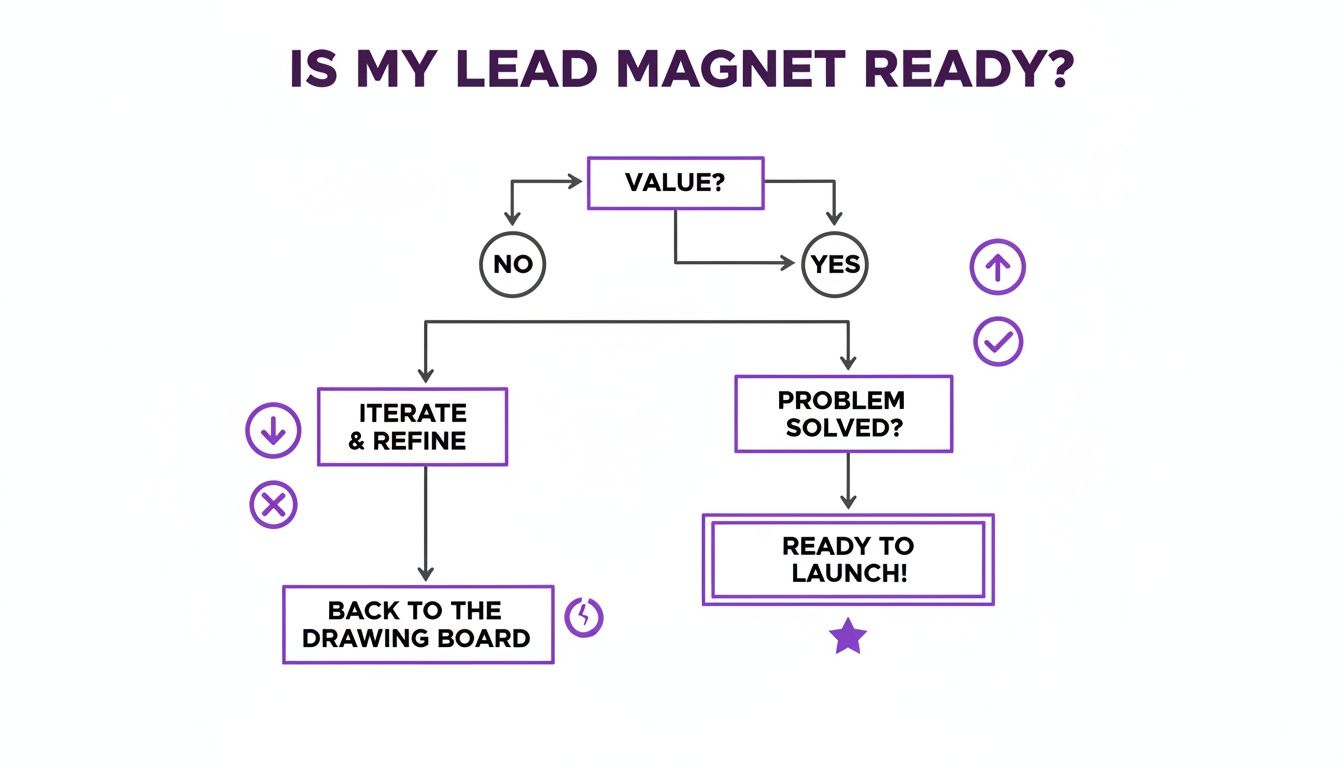
If the answer to either of those is "no," it's time to go back to the drawing board. Don't launch something just for the sake of it.
Matching the Format to the Problem
Once you've got a solid idea, the next step is choosing the right format. This is crucial. The format has to match both the problem you're solving and how your audience likes to consume content. A time-crunched CEO isn't going to read a 100-page e-book, but you can bet they’ll download a one-page checklist they can use immediately.
Think about these real-world scenarios:
- A B2B SaaS company with a tricky setup process could offer a "10-Point Configuration Checklist." It’s actionable, direct, and solves an immediate headache.
- A fitness coach whose clients are busy professionals might create a "7-Day High-Protein Meal Prep Template." This saves time, cuts down on decision-making, and delivers a quick result.
- A digital marketer helping small businesses could host a webinar on "How to Set Up Your First Google Ads Campaign in 30 Minutes." This live format is perfect for Q&A and a hands-on demonstration.
Perceived value is everything. Your lead magnet should feel so valuable that people would have considered paying for it.
Which Lead Magnet Format Should You Choose?
The format you choose has a direct impact on how well your lead magnet performs. While a standard landing page might see an 18% conversion rate, the right format can blow that number out of the water. To help you decide, here’s a breakdown of the most popular options.
| Lead Magnet Type | Best For | Solves This Problem | Typical Conversion Rate |
|---|---|---|---|
| Checklists & Cheatsheets | Action-takers who need a quick reference | "How do I do this complex task correctly and quickly?" | 25% – 35% |
| Templates & Swipe Files | People who want to save time and effort | "I don't want to create this from scratch." | 20% – 30% |
| E-books & Guides | Audiences seeking in-depth knowledge | "I need a comprehensive understanding of this topic." | 15% – 25% |
| Webinars & Workshops | Learners who want interactive, expert guidance | "Show me how to do this, step-by-step." | 20% – 30% (for registrants) |
| Mini-Courses (Email/Video) | Individuals looking for a structured learning path | "Teach me this new skill over a few days." | 10% – 20% |
| Quizzes & Assessments | Users wanting personalized results and insights | "What's the right solution/type for me?" | 30% – 40%+ |
Ultimately, picking the right format comes down to aligning your offer with what your audience truly needs to solve their problem. A simple cheat sheet can sometimes outperform a massive e-book, proving that value lies in utility, not volume.
Crafting and Designing Your High-Value Offer
You've nailed down the perfect idea. Now for the fun part: bringing it to life.
Let’s be honest, the success of your lead magnet isn't just about the words on the page. It's about the entire package. Your audience will judge the value of your advice long before they read the first sentence. A sloppy, poorly designed document can sink your conversions instantly.
Think of your lead magnet as a handshake—it’s the first real taste someone gets of your brand's quality. A polished, professional design sends a clear signal: you care about the details, and your paid offerings are probably even better. The good news? You don't need to be a graphic designer to create something that looks incredible.

Structuring Your Content for Maximum Impact
Before you start playing with colors and fonts, you need a solid structure. The goal is to make your content easy to scan and immediately useful. No one has time to dig through dense walls of text to find what they need.
The easiest way to start is with a simple outline. This little bit of prep work forces you to organize your thoughts logically and ensures a smooth, intuitive flow for your reader.
Here are a few ground rules for any lead magnet:
- Hook them immediately. The first page needs to scream, "You made the right choice!" Reiterate the problem you're solving and let them know they’re in the right place.
- Use clear headings. Break your content into bite-sized, scannable sections. This helps people find exactly what they’re looking for and makes the information feel way less intimidating.
- Keep paragraphs short and sweet. I aim for 2-3 sentences max. This creates valuable white space and makes your content a breeze to read on any screen.
- Bring in visuals. Use checklists, bullet points, and simple graphics to illustrate key points and break up the text.
Remember, this isn't the time to break out the thesaurus. Simple, direct language always wins. The faster your reader can understand and apply your advice, the more they'll value what you’ve given them.
Designing a Professional-Looking Asset
With your content structured, it's time to make it look good. A clean, consistent design doesn't just look nice—it builds trust and reinforces who you are.
Thankfully, you've got incredible tools at your fingertips. Platforms like Canva have made professional design accessible to everyone, with thousands of ready-made templates for e-books, checklists, and guides.
As you design, keep these principles in mind:
- Brand Consistency: Stick to your brand’s colors, fonts, and logo. This small detail creates a cohesive experience and helps people remember you.
- Visual Hierarchy: Your most important points should pop. Use larger fonts for headings, bold text for key takeaways, and a splash of color to guide the reader’s eye.
- Readability is King: Choose clean, simple fonts. Avoid those fancy scripts for body text—they’re a nightmare to read. Also, make sure there’s enough contrast between your text and background.
A great lead magnet isn't just about what you say; it's about how you make the reader feel. A clean, well-organized design instills confidence and makes your advice feel more credible and authoritative.
For those of you creating an e-book, the design process is especially crucial. To dive deeper into that specific format, check out our complete guide on how to create an e-book to sell, which walks through everything from content to cover design.
The Final Polish and Pre-Launch Checklist
Before you send this out into the world, one final review is a must. A single typo can make an otherwise brilliant resource feel amateurish. It’s worth the extra few minutes.
Run through this quick checklist:
- Proofread. Then proofread again. Read the whole thing through at least twice. Better yet, run it through a tool like Grammarly and then ask a friend to give it a fresh set of eyes.
- Test every single link. If you've linked to your website, social profiles, or other resources, click them all to make sure they work. Broken links are a dead end.
- Check it on multiple devices. Open the PDF on your computer, tablet, and phone. Does the formatting hold up? Is it still easy to read everywhere?
- Is your call to action clear? Make sure your final ask—whether it’s to join your Facebook group or check out your course—is obvious and compelling.
This final once-over is a small step that makes a huge difference in how professionally your brand is perceived. Your lead magnet is out there representing you 24/7, so make sure it’s doing a great job.
Building a Seamless Automated Delivery System
You could have the world's best lead magnet, but if getting it to your new subscriber is a clunky, delayed, or broken experience, you've lost before you've even started. That first interaction is everything. A smooth, instant delivery makes you look like a pro, while a manual process that takes hours (or worse, days) immediately plants a seed of doubt.
The whole point is to create a slick, automated workflow that zips your resource over the second a user hits "subscribe." This isn't just about being efficient; it’s about capitalizing on that peak moment of interest. They want your solution right now, and your system needs to deliver without you lifting a finger.

The Core Components of an Automated System
At its heart, a solid delivery system is built on three key parts that work in harmony: a landing page, an opt-in form, and an email automation sequence. Each one plays a critical role in turning a casual visitor into an engaged lead.
- The Landing Page: Think of this as a dedicated sales page with one mission: convincing visitors to grab your lead magnet. It needs a magnetic headline, a crystal-clear rundown of the benefits, and a nice visual of what they're getting. No distractions, just a single call to action.
- The Opt-In Form: Keep it simple. Seriously. Every extra field you add is another reason for someone to bail. For most lead magnets, a first name and an email address is the sweet spot.
- The Automated Email: This is the magic. It's the email that fires off the instant someone signs up. It must include a direct link to the goods, a warm welcome, and maybe a little hint of what other cool stuff they can expect from you.
This first email is your opening line in a new conversation. Don't just drop a link and disappear. Reassure them they made a smart choice and set the stage for the relationship you're about to build.
Streamlining the Entire Workflow with an All-in-One Platform
Trying to stitch together separate tools for your landing pages, forms, and email marketing can quickly become a technical nightmare, especially for creators who’d rather focus on content than code. This is where an integrated, all-in-one platform like Zanfia changes the game, bringing the entire delivery process under one roof. It eliminates the need to juggle plugins or pay for multiple, expensive subscriptions.
Picture this unified workflow:
- A visitor signs up for your e-book through a simple form on your own domain, powered by Zanfia.
- The system instantly shoots them a welcome email containing a secure download link for your lead magnet.
- Simultaneously, it can tag them as a "new lead" and add them to the right community channel based on their interest.
- From there, it kicks off a pre-built welcome sequence to build trust and seamlessly introduce your other products—like a paid newsletter, online course, or premium community.
This level of built-in automation can save creators 5–10+ hours a month that would otherwise be spent on manual admin tasks. It guarantees every new lead gets a polished, professional first impression of your brand, even while you sleep. To get a deeper understanding of how these sequences function, take a look at our guide on what is email automation.
Your automated delivery system is more than just a technical setup; it's your brand's virtual onboarding specialist. It works tirelessly to welcome every new lead, deliver on your promise instantly, and guide them seamlessly into your world.
Expanding Your Automation Strategy
Once you have your core delivery system humming along, you can start plugging it into your other marketing channels to get even more out of it. For a truly powerful setup, you can automate lead generation with Google Ads and connect it directly to your delivery process. This lets you drive highly targeted traffic straight to your landing pages, turning your ad spend into qualified leads with very little hands-on effort.
You've created an incredible lead magnet. That's a huge win, but the work isn't over yet. A fantastic resource gathering digital dust on your website won't bring in a single lead. Now comes the fun part: getting it in front of the right people.
It’s time to shift from a "build it and they will come" mindset to a proactive promotion plan. The objective isn't just random clicks; it's about attracting targeted traffic that eagerly signs up. This means blending smart organic tactics with paid strategies that can blast your message out to brand new audiences.
Start with Your Home Turf: Your Website and Social Profiles
Your most powerful (and cheapest) promotional tools are the digital assets you already own. Your website and social media channels are where your warmest audience hangs out, making them the perfect place to launch your new offer.
The trick is to make your lead magnet completely unavoidable. Take a walk through your website from a visitor's perspective. Where are the high-traffic spots?
- Homepage: Don't bury it. Add a clear call-to-action (CTA) right at the top, above the fold, introducing your free resource.
- Blog Posts: Embed opt-in forms directly inside relevant articles. If a blog post talks about the exact problem your lead magnet solves, that’s a golden opportunity.
- About Page: This page gets more traffic than you think. A simple link here can capture some of your most engaged visitors.
- Exit-Intent Pop-ups: Catch people just before they click away. A well-timed pop-up offering your guide can be surprisingly effective.
Give your social media the same treatment. A single post won't cut it. Pin a link to your lead magnet's landing page to the top of your profiles on Facebook or X (formerly Twitter). Make the link the star of your Instagram bio and even create a dedicated Story Highlight for it.
Your lead magnet shouldn't be a hidden treasure. Weave it into the fabric of your online presence, making it a natural next step for anyone interested in your expertise.
If you really want to turn social followers into paying customers, it's worth a look into Mastering Social Media Lead Generation.
Broaden Your Horizons with Strategic Outreach
Once your own channels are dialed in, it's time to step outside your bubble. The quickest way to get fresh, qualified leads is to tap into communities that are already built. This is all about building relationships and delivering value where your ideal customers already are.
Guest posting is a classic for a reason—it works. Writing for a respected blog in your industry immediately positions you as an expert in front of a new, relevant audience. You can then naturally mention your lead magnet in your author bio or within the content as a way for readers to dive deeper.
Collaborations are another powerhouse move. Think about partnering with a non-competing business or creator for a joint webinar, a social media giveaway, or an Instagram Live session. This kind of cross-promotion is a win-win, introducing both of your audiences to something new and valuable.
Pour Some Gas on the Fire with Paid Ads
Organic growth is the foundation, but paid advertising is the accelerator. Platforms like Facebook, Instagram, and Google Ads let you get incredibly specific, targeting people based on their interests, demographics, and what they do online. This ensures your offer lands in front of a receptive crowd.
A rookie mistake is just hitting "boost post." Don't do that. Instead, set up a proper conversion campaign designed specifically for lead generation. Write compelling ad copy and create visuals that scream "value!" For instance, instead of a boring "Download Our E-book," try something like, "Tired of X? Get the 5-Step Checklist the Pros Use."
Start small. Test a few different audiences and ad designs with a modest budget. Keep a close eye on your cost per lead. Once you find a combination that works, you can confidently ramp up your spending, knowing you have a predictable system for bringing new leads into your world.
How to Measure and Optimize Your Lead Generation Funnel
So, you’ve built a fantastic lead magnet. That’s a huge win, but hitting "publish" is just the starting line, not the finish. If you want to build a reliable engine that consistently brings in new leads, you can't rely on guesswork. You need to get serious about the data.
Measuring your lead generation funnel's performance is the only way to know what’s actually working and, more importantly, where you're leaving potential customers behind. This isn't about getting bogged down in complicated spreadsheets. It’s about understanding the journey someone takes from first seeing your offer to becoming a subscriber. By keeping an eye on a few key numbers, you can pinpoint the weak spots and make smart, targeted improvements.
The Key Metrics That Tell the Real Story
To get a true pulse on your funnel's health, you need to monitor a handful of critical numbers. Think of these metrics as a story—they reveal how well your lead magnet is connecting with your ideal audience.
- Landing Page Conversion Rate: This is the big one. It's the percentage of people who hit your page and actually sign up. If this number is low, it could point to a disconnect in your headline, copy, or even the perceived value of the offer itself.
- Email Open Rate: They signed up—great! But are they opening the email that delivers the goods? A low open rate might mean your subject line is falling flat or, worse, your emails are getting caught in spam filters.
- Click-Through Rate (CTR): Of those who open the delivery email, what percentage clicks the link to download your resource? This tells you how eager they are to get what you promised.
- Subscriber Quality: This is the long-term play. Are these new leads sticking around? Are they opening your follow-up emails? Do they eventually buy from you? Tracking this ensures you're attracting the right people, not just collecting email addresses.
The goal isn't just to get more subscribers—it's to get more of the right subscribers. A lead magnet that attracts a highly engaged audience who eventually buys from you is far more valuable than one with a high conversion rate but low long-term value.
Fine-Tuning Your Funnel with A/B Testing
Once you have a baseline for your metrics, the real fun begins. It's time to start optimizing.
A/B testing, or split testing, is your best friend here. It’s a straightforward method of pitting two versions of a page or email against each other to see which one performs better. The trick is to change only one thing at a time. That way, you know for sure what's making the difference.
Here are a few high-impact elements you can start testing on your landing page:
- Headlines: Try framing the outcome as a direct benefit versus asking a provocative question.
- Calls-to-Action (CTAs): See what happens when you change your button text from "Get the Guide" to "Download Now." Even a simple color change can have a surprising impact.
- Visuals: Does a clean image of your e-book cover outperform a mockup showing it on a tablet?
- The Offer Itself: If you're feeling bold, you could even test two completely different lead magnet ideas to see which one your audience is more excited about.
This process of testing and tweaking is the heart of effective online marketing. For a more detailed look at the mechanics of running these tests, check out our guide to conversion rate optimization strategies. By making this a consistent practice, you can turn a decent lead magnet into a powerhouse asset that reliably fuels your business growth.
Your Top Questions About Lead Magnets Answered
As you start creating your own lead magnets, a few questions always seem to pop up. Let's tackle some of the most common ones I hear from creators so you can get your offer out there with confidence.
How Long Should a Lead Magnet Actually Be?
Honestly, there's no magic number. I've seen one-page checklists outperform 50-page ebooks time and time again.
Value isn't measured in page count; it's measured by the problem you solve. If you can deliver a powerful solution on a single, well-designed page that saves someone hours of guesswork, you've created an incredibly valuable lead magnet. The real goal is efficiency, not length. Focus on giving your new subscriber a quick, tangible win.
Is It Okay to Have More Than One Lead Magnet?
Not just okay—it's one of the smartest things you can do. Having multiple lead magnets allows you to create highly specific offers that align perfectly with what different visitors are looking for. It's a game-changer for conversion rates.
Imagine you run a blog for online business owners. You could have:
- A "Content Planning Template" offered on your marketing posts.
- A "Sales Script Checklist" available on articles about closing deals.
See how that works? The offer is directly tied to the visitor's immediate interest, making it almost irresistible.
What's the Easiest Lead Magnet to Make If I'm Short on Time?
If you're looking for a quick win, my go-to recommendation is always a checklist or a simple template. You probably have the content for one already sitting in your most popular blog post.
Just pull out the key action steps, resources, or takeaways from an existing article. Format it into a clean, easy-to-read PDF, and you're done. This is a fantastic way to provide real value without spending weeks on creation.
How Can I Tell If My Lead Magnet Is Any Good?
The numbers don't lie. The ultimate test is how well it performs in the wild. A good lead magnet converts a healthy percentage of your landing page visitors into subscribers. If people are eagerly trading their email for it, you know you've created something they genuinely want.
But what if the conversion rate is low? Don't guess—ask. Send it to a few trusted peers or poll your existing social media audience for honest feedback. They'll quickly tell you if you've hit the mark or if it's time to go back to the drawing board.
Ready to deliver your lead magnets, online courses, and community content seamlessly? Zanfia is the all-in-one platform built for Polish creators to sell digital products and build thriving communities with 0% platform fees. Stop juggling tools and start growing your business with clarity and control. Explore Zanfia today.

2 Comments
Comments are closed.

[…] their reach, offering a free color book is an excellent strategy for creators to learn how to create lead magnets that effectively grow an […]
[…] We actually have a full guide on how to create lead magnets that truly resonate and get results. You can check it out here: https://zanfia.com/blog/how-to-create-lead-magnets/ […]