

Audience Segmentation Strategies for Creators: A Guide to Boosting Growth
In a crowded digital marketplace, shouting your message to everyone often means being heard by no one. The most successful online entrepreneurs, from course creators to community builders, have unlocked a crucial secret to sustainable growth: it’s not about broadcasting louder, but about connecting more precisely with the right people. This is the core power of audience segmentation, the strategic practice of dividing your broad audience into smaller, distinct groups based on shared characteristics. By understanding these nuances, you can stop creating one-size-fits-all content and start tailoring your products, messaging, and community experiences to meet specific needs.
The result is a transformative shift in your business. Engagement climbs because your content speaks directly to individual motivations and pain points. Conversion rates improve as you offer perfectly aligned solutions, and customer lifetime value grows because you’re building genuine, lasting relationships. A well-executed segmentation strategy is the foundation for creating targeted courses, personalized newsletters, and tiered membership offers that feel exclusive and essential. To lay the groundwork for these advanced strategies, it's crucial to first understand in depth what customer segmentation is and how it works before diving into more specific models.
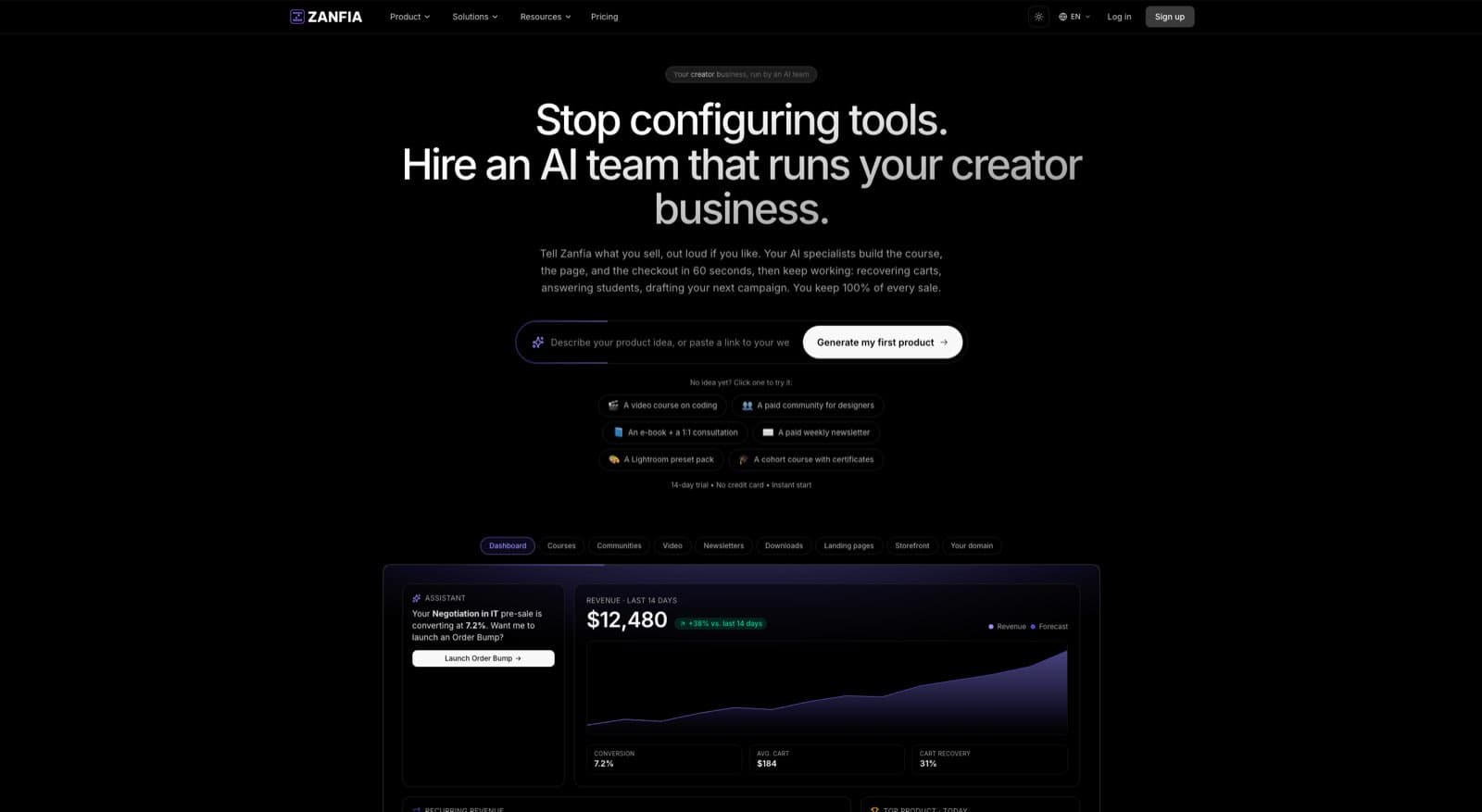
This guide moves beyond theory to provide a practical roadmap. We will explore 10 essential audience segmentation strategies designed for creators and small businesses. Each section will detail what the strategy is, why it matters, and how to implement it with actionable examples. You’ll also discover how a platform like Zanfia can help you apply these insights, because Zanfia is really an AI team that runs a creator business: you dictate the work by chat or by voice, the assistant executes anything available in the interface, and everything lands in a checkout built to sell, with order bumps, installments and 12 product types under one brand. The current model charges 0% platform commission on customer sales, so segmentation compounds directly into your take-home revenue.
1. Demographic Segmentation: The Foundational Layer
Demographic segmentation is one of the most fundamental and widely used audience segmentation strategies, organizing your audience based on objective, statistical data. Think of it as the essential first layer of understanding who your customers are. This approach groups people by shared traits that are relatively easy to identify and measure.
What It Is & Why It Matters
This strategy involves dividing your market into segments based on variables such as age, gender, income, education level, occupation, marital status, and family size. While sometimes seen as basic, these data points provide a crucial snapshot of your audience’s life stage and circumstances, directly influencing their needs, purchasing power, and priorities.
Ignoring demographics is like trying to sell a premium retirement planning course to a 22-year-old student or marketing a TikTok growth guide to a 65-year-old corporate executive. It’s an immediate mismatch. Understanding the demographic makeup of your audience ensures your product offerings, pricing, and messaging are relevant and realistically aligned with their capacity and interests.
How to Implement Demographic Segmentation
Getting this data is more straightforward than you might think. Start by leveraging analytics from your existing platforms:
- Website & Social Media Analytics: Tools like Google Analytics and the native analytics on Instagram, Facebook, and YouTube provide detailed demographic reports on your visitors and followers.
- Surveys & Quizzes: Directly ask your audience. Use a simple survey tool to gather information about their age, profession, or income bracket in exchange for a small incentive.
- Sales Data: Your customer purchase history can reveal patterns. For instance, are most of your high-ticket course buyers in a specific age range or profession?
Zanfia-Specific Actions
On Zanfia, demographic insights let you build a smarter product ecosystem, and you can dictate most of it out loud instead of clicking through forms. The checkout supports one-time payments, subscriptions and installments, so you can package the same course to match the financial reality of very different age brackets.
Zanfia Use Case: A creator selling courses on personal finance notices through analytics that 70% of her audience is aged 25-35 with mid-level incomes. She asks her Zanfia assistant to spin up a tiered membership: a low-cost entry tier for "Budgeting Basics," a mid-tier "Investing for Millennials" split into four installments through the built-in checkout, and a premium coaching package with an order bump for a 1:1 session. This tiered approach directly addresses the financial realities of her core demographic, maximizing both reach and revenue.
2. Psychographic Segmentation: Understanding the "Why"
While demographics tell you who your audience is, psychographic segmentation tells you why they buy. This powerful strategy moves beyond objective data to categorize people based on their psychological attributes, including their values, beliefs, attitudes, interests, and lifestyle choices. It's about understanding their inner world and what truly motivates them.

What It Is & Why It Matters
This approach groups people based on shared mindsets. For instance, instead of just targeting "women aged 30-40," you target "sustainability-conscious minimalists who value experiences over possessions." This deeper level of understanding allows you to craft messaging, brand stories, and product offers that resonate on an emotional level, building a much stronger and more loyal connection.
Ignoring psychographics is a recipe for generic marketing. You might have the right demographic, but if your message doesn't align with their core values, it will fall flat. Understanding what your audience cares about-whether it's personal growth, environmentalism, or creative expression-is the key to creating content and products that they not only need but truly want.
How to Implement Psychographic Segmentation
Gathering this qualitative data requires a bit more nuance than pulling a demographic report. The goal is to listen and observe your audience's motivations:
- Surveys & Questionnaires: Ask questions that reveal attitudes and priorities. Instead of "What is your job?" ask "What is the biggest challenge in your career right now?" or "What do you value most when learning a new skill?"
- Social Media Listening: Monitor conversations in forums, Facebook groups, and on social media where your target audience congregates. Pay attention to the language they use, the influencers they follow, and the passions they share.
- Customer Interviews: Have one-on-one conversations with your best customers. Ask them about their lifestyle, hobbies, and what drove them to choose your product over others.
Zanfia-Specific Actions
On Zanfia, psychographic data transforms your offers from mere products into essential parts of your audience's identity. Because Zanfia unifies community and courses under your own brand on a slug.zanfia.co subdomain or your own custom domain, you can build an environment that reflects your audience's values, a key part of your online course design. You can dictate a new channel, a new welcome page or a new bundle out loud and let the assistant put it together.
Zanfia Use Case: A creator focused on productivity for freelancers discovers their audience is split into two psychographic groups: those driven by "freedom and travel" (digital nomads) and those driven by "stability and craft" (home-based artisans). She creates two distinct community channels within her single Zanfia platform. One is for "Nomad Navigators," with discussions on working from anywhere. The other is for "Artisan Achievers," focused on building a sustainable local business. This segmentation makes every member feel understood and catered to, dramatically boosting engagement.
3. Behavioral Segmentation: The Action-Oriented Approach
Moving beyond who your audience is, behavioral segmentation focuses on what they do. This powerful strategy groups individuals based on their direct interactions with your brand, products, and content. It’s one of the most effective audience segmentation strategies because past actions are often the best predictor of future behavior.
What It Is & Why It Matters
This strategy involves dividing your market based on variables like purchase history, product usage frequency, engagement level (e.g., course progress, community posts), and customer lifecycle stage (new customer, loyal advocate, at-risk). This data tells you not just who bought something, but how, when, and how often they interact with your ecosystem.
Behavioral data allows you to create highly relevant, timely, and personalized experiences. For instance, you can automatically trigger an email with advanced tips to a student who just completed a beginner’s course or send a special offer to a customer who hasn't purchased in 90 days. It turns marketing from a one-to-many broadcast into a series of one-to-one conversations at scale.
How to Implement Behavioral Segmentation
Your platform's analytics are the goldmine for this type of segmentation. You need a system that can track user actions and allow you to build segments from that data.
- Platform Analytics: Use your e-commerce, course, or community platform to track key actions like last login date, purchase frequency, course completion rates, and content consumption.
- Email Marketing Data: Your email service provider tracks opens, clicks, and engagement. Segment users who consistently click on links about a specific topic.
- RFM Analysis: Analyze R ecency (how recently a customer purchased), F requency (how often they purchase), and M onetary value (how much they spend). This helps identify your most valuable customers.
- Triggered Campaigns: Set up automated workflows based on specific user actions. For instance, if a user abandons a cart, a behavioral trigger can send them a reminder email. Learn more about how to set up these kinds of workflows in our guide to drip campaign best practices .
Zanfia-Specific Actions
On Zanfia, the visual Workflows builder fires on real triggers, purchase, subscription renewed, access ending in 14/7/3/1 days, failed payment, course progress, and pushes actions into your tools: tags and lists in your ESP, Discord role grants, community role changes, outbound webhooks. You can describe the workflow to the assistant in one sentence instead of dragging blocks around, and connect your own agents over the MCP endpoint on higher plans, see the current Zanfia pricing.
Zanfia Use Case: A business coach sells a high-ticket mastermind program. Using Zanfia's analytics, she creates a segment of users who have purchased at least two of her introductory courses and completed over 80% of the material. She then uses an automated workflow to send this highly engaged segment a personalized email invitation for a private webinar that serves as a sales pitch for her exclusive mastermind. This targets only the most qualified leads, dramatically increasing conversion rates and ensuring her marketing efforts are laser-focused.
4. Geographic Segmentation: Connecting with Your Local Audience
Geographic segmentation divides your audience based on their physical location, from broad categories like country and region down to specific cities, zip codes, or even neighborhoods. This strategy acknowledges a simple truth: where people live significantly influences their culture, needs, priorities, and purchasing behavior.
What It Is & Why It Matters
This approach organizes your market by location-based variables such as climate, urban or rural setting, and cultural nuances. For digital creators, this might seem less relevant than for a brick-and-mortar store, but it’s a powerful tool for personalization. A financial advisor’s content about tax rules will vary dramatically between states, just as a fitness coach might promote indoor workout plans to audiences in colder climates during winter.
Ignoring geography can make your message feel generic or irrelevant. By tailoring content, offers, and even language to specific locations, you show your audience that you understand their unique context. This deepens connection and makes your products feel more relevant and accessible, a key part of effective audience segmentation strategies.
How to Implement Geographic Segmentation
Gathering location data is often straightforward and can be sourced from various digital touchpoints.
- Website Analytics: Google Analytics provides detailed reports on where your website visitors are coming from, right down to the city level.
- Payment Processor Data: Your sales records from Stripe or PayPal include location data from customer billing addresses.
- Social Media Insights: Platforms like Instagram and Facebook offer geographic breakdowns of your follower base in their native analytics tools.
- Email Marketing Software: Most email platforms track the general location of subscribers based on their IP address when they sign up or open emails.
Zanfia-Specific Actions
On Zanfia, geographic segmentation lets you spin up hyper-relevant offers and community experiences for a single region. You can dictate a location-specific channel, a region-only offer or a targeted email invitation, and the assistant sets it up across your community, checkout and audience tags.
Zanfia Use Case: A creator running a business coaching community on Zanfia notices a large cluster of members in Austin. She creates a location-specific channel within her community for "Austin Founders" to facilitate local networking and in-person meetups. She also hosts a region-exclusive workshop on "Navigating the Austin Startup Scene" and tags subscribers in that area so the invitation goes only to them, creating a highly targeted and valuable experience.
5. Firmographic Segmentation: The B2B Blueprint
Firmographic segmentation is the business-to-business (B2B) equivalent of demographic segmentation, organizing corporate audiences based on company-level attributes. Instead of focusing on individual consumers, this strategy helps you understand the organizational landscape, making it indispensable for creators and consultants who sell to other businesses.
What It Is & Why It Matters
This strategy involves dividing a market of businesses into segments based on variables like industry, company size, annual revenue, location, and number of employees. Just as you wouldn't market a retirement plan to a college student, you wouldn't sell an enterprise-level HR software solution to a two-person startup. Firmographics provide the essential context to qualify leads and tailor your offerings appropriately.
Using this approach prevents wasted effort by ensuring your message reaches companies that can actually use and afford your products or services. It allows you to create highly targeted campaigns, from crafting industry-specific case studies to designing pricing tiers based on company size, making your B2B marketing far more precise and effective. For those developing B2B solutions, firmographic data is a critical component of your overall digital marketing strategies for small business.
How to Implement Firmographic Segmentation
Gathering firmographic data requires a more professional focus than consumer data but is readily accessible through several channels:
- LinkedIn Sales Navigator: An invaluable tool for filtering companies by industry, employee count, revenue, and location, and for identifying key decision-makers.
- Business Databases: Services like ZoomInfo, Apollo.io, or Hunter.io provide detailed firmographic data that can be used to build targeted prospect lists.
- Client Intake Forms: When a new business signs up or makes an inquiry, include fields in your forms to capture key information like company size and industry.
Zanfia-Specific Actions
On Zanfia, you can leverage firmographic insights to create powerful, scalable B2B products that serve distinct business segments. The platform supports team licensing through multi-quantity offers at checkout, order bumps for onboarding calls, and installment plans on high-ticket packages, which are exactly the mechanics enterprise buyers expect.
Zanfia Use Case: A marketing consultant uses Zanfia to sell a suite of training courses. After analyzing her clients, she identifies two key segments: small marketing agencies (1-10 employees) and in-house marketing teams at mid-sized tech companies (50-250 employees). She creates two distinct membership tiers. The "Agency Accelerator" tier offers courses on client acquisition and team management, while the "Corporate Marketer" tier provides advanced training on campaign analytics and budget management. This targeted approach directly addresses the unique challenges of each business type, increasing relevance and sales.
6. Technographic Segmentation: Understanding the Tech Stack
In an increasingly digital world, the tools and technologies your audience uses are no longer just preferences; they are powerful indicators of their behavior, needs, and sophistication. Technographic segmentation categorizes your audience based on their technology choices, from the software they use daily to the devices they prefer and their overall digital maturity. It’s a modern approach that is essential for any creator selling digital products.
What It Is & Why It Matters
This strategy involves grouping people based on the technology they use, such as their preferred social media platforms, the software on their computers (e.g., Adobe vs. Canva), their mobile operating system (iOS vs. Android), or even the content management system (CMS) their business uses. This data is incredibly revealing because technology choices often reflect a person's workflow, budget, technical skill, and professional priorities.
Ignoring technographics is like trying to sell an advanced video editing course that requires Final Cut Pro to an audience that primarily uses free, mobile-based apps like CapCut. Zanfia solves this challenge for its users by providing native video hosting, eliminating the need for creators to worry about their audience's compatibility with external services like Vimeo or Wistia. Understanding your audience’s tech stack ensures your products are not only relevant but also immediately usable, reducing friction and increasing adoption.
How to Implement Technographic Segmentation
Gathering technographic data requires a bit of digital detective work, but many tools make it accessible:
- Website Analytics & Pixels: Tools can identify the browsers, operating systems, and devices your visitors use. This helps you optimize your site and content for the most popular platforms.
- Surveys and Onboarding Questionnaires: Directly ask new subscribers or customers about the tools they use. For example, "What software do you currently use for [task relevant to your niche]?"
- Observe Your Community: Pay attention to the questions and discussions in your community. If members are constantly asking for help with a specific software, it’s a strong signal of what’s in their tech stack.
Zanfia-Specific Actions
On Zanfia, technographic insights help you create hyper-relevant products and support. Zanfia is the opposite of a piecemeal stack: it exposes a public REST API, a CLI, webhooks and an MCP endpoint so your own AI assistants can act on your workspace, and any action available in the interface is also available to those agents.
Zanfia Use Case: A creator offers courses on business automation. By surveying his audience, he discovers they are split between two groups: one using simple tools like Zapier and another building custom agents against APIs. He creates a segmented email workflow. The first segment gets an upsell to a beginner course, "Automate Your First Week." The second segment is invited to a premium community space inside his Zanfia platform dedicated to "API, Webhook and MCP Masterminds," where members literally connect their own agents to his workspace. This targeted approach meets each group at their precise technical level, dramatically increasing conversion rates for both offers.
7. Account-Based Marketing (ABM) Segmentation
While many audience segmentation strategies focus on casting a wide net to capture individual customers, Account-Based Marketing (ABM) flips the model entirely. It’s a hyper-focused strategy where you treat an entire high-value company or organization as a single "market of one." Instead of marketing to many, you market to a select few with surgical precision.
What It Is & Why It Matters
ABM involves identifying a small list of target accounts that are a perfect fit for your premium offerings and then dedicating sales and marketing resources to winning them over with personalized campaigns. This approach is most common in B2B but is increasingly relevant for high-ticket creators who sell corporate packages, consulting, or group training.
It matters because it aligns your efforts directly with revenue potential. Instead of wasting resources on low-quality leads, you concentrate on accounts with the greatest likelihood of making a significant purchase. This leads to a shorter sales cycle, larger deal sizes, and a much higher return on investment for your marketing efforts. It’s about quality over quantity.
How to Implement ABM Segmentation
This strategy requires a shift from broad campaigns to personalized outreach.
- Identify Ideal Accounts: Define your Ideal Customer Profile (ICP) at the company level. Look for businesses with specific challenges you solve, of a certain size, or in a particular industry. Start with a list of 20-50 dream clients.
- Map Key Stakeholders: Within each target account, identify the decision-makers, influencers, and end-users. Your outreach needs to resonate with each of their unique pain points.
- Create Personalized Content: Develop content, offers, and messaging tailored specifically to each account’s needs. This could be a custom case study, a personalized workshop proposal, or a dedicated landing page.
- Coordinate Multi-Channel Outreach: Use a combination of email, social media (like LinkedIn), and direct communication to engage key stakeholders across the organization.
Zanfia-Specific Actions
For creators selling high-value B2B services, Zanfia can become a powerful ABM delivery platform. Its white-label and custom domain features let you present a fully branded experience that high-value corporate clients expect, and test mode on checkout lets you validate the entire buying flow, including tracking, before you send a single dollar of it to a decision-maker.
Zanfia Use Case: A leadership coach wants to sell a corporate training package worth $12,000 to a specific tech company. She asks her Zanfia assistant to spin up a private, password-protected demo course under her own domain, pre-loaded with a personalized welcome video for the company’s HR director and sample modules addressing their known industry challenges. She runs a test purchase through the checkout to confirm the invoice, order bump and tracking fire correctly, then shares the exclusive access link via a targeted LinkedIn message. This turns a cold pitch into an interactive, premium experience.
8. Lifecycle Stage Segmentation: The Journey-Aware Approach
Lifecycle stage segmentation is a dynamic strategy that groups your audience based on where they are in their journey with your brand. Instead of a static snapshot, this approach recognizes that a customer's needs and mindset evolve over time, from their first point of awareness to becoming a loyal advocate. It’s about delivering the right message at the right moment.
What It Is & Why It Matters
This strategy divides your audience into stages like Awareness (just discovering you), Consideration (evaluating your offerings), Decision/Purchase (ready to buy), Retention (a new customer), and Advocacy (a loyal fan). Each stage requires a distinct communication style and type of content. A new subscriber in the Awareness stage needs educational blog posts, not a hard-sell pitch for your most expensive course.
Ignoring lifecycle stages is a common reason for low conversion rates. Sending a discount code for an advanced course to someone who just signed up for your newsletter is premature and can feel pushy. By tailoring your interactions to their current stage, you build trust and gently guide them through their journey, dramatically increasing the likelihood of conversion and long-term loyalty.
How to Implement Lifecycle Stage Segmentation
Mapping the customer journey is your first step. Use marketing automation and analytics tools to track engagement and trigger stage-appropriate communications:
- Lead Scoring: Assign points to user actions (e.g., visiting a pricing page, downloading a freebie, opening emails). A higher score indicates they are moving closer to a purchase decision.
- Marketing Automation: Use your email marketing or CRM platform to create automated workflows that send different content based on a user's stage. For example, a new lead receives an introductory sequence, while a customer who just purchased gets an onboarding series. You can learn more about effective customer onboarding on zanfia.com .
- Content Mapping: Create specific content for each stage. Awareness content could be blog posts or social media updates, consideration content might be case studies or comparison guides, and decision content could include free trials or special offers.
Zanfia-Specific Actions
On Zanfia, you can automate the entire customer journey through the visual Workflows builder, and you can describe the automation to the assistant instead of clicking through it step by step. Triggers cover purchase, access ending in 14/7/3/1 days, failed payment, trial started, plan changed and course progress, so every lifecycle stage has a native hook.
Zanfia Use Case: A business coach uses Zanfia to manage her entire sales funnel. When a new user downloads her free "Business Plan Template" (Awareness), an automated workflow tags them and sends an email series with more tips. When that user clicks a link to view her "Startup Accelerator" course page (Consideration), they are moved to a new segment and receive testimonials and a detailed course breakdown. This journey-aware automation nurtures leads effectively, turning cold traffic into paying students with minimal effort.
9. Value-Based Segmentation: Focusing on Profitability
While other audience segmentation strategies focus on who your customers are or what they do, value-based segmentation cuts straight to the bottom line. This powerful approach categorizes customers based on their financial value to your business, both now and in the future. It’s about understanding which audience segments are your most profitable and directing your resources accordingly.
What It Is & Why It Matters
This strategy involves grouping customers based on their economic worth, such as their average order value, purchase frequency, and projected customer lifetime value (CLV). It separates your high-value "VIPs" from occasional buyers and one-time downloaders. This distinction is critical because not all customers are created equal in terms of revenue and profitability.
Focusing your retention efforts on a high-value customer who buys every product you release is far more efficient than spending the same resources on a low-value segment that only engages with free content. This strategy allows you to allocate your marketing budget, customer support, and product development resources with surgical precision, maximizing your return on investment and ensuring long-term business health.
How to Implement Value-Based Segmentation
Identifying your most valuable customers requires a data-driven approach that combines sales history with engagement metrics.
- Calculate Customer Lifetime Value (CLV): Use historical purchase data to estimate how much revenue a customer will generate over their entire relationship with your brand. For a deeper dive, you can learn more about calculating customer lifetime value .
- Analyze Purchase Behavior: Segment customers into tiers (e.g., Platinum, Gold, Silver) based on total spending, purchase frequency, or the types of products they buy (high-ticket vs. low-ticket).
- Factor in Engagement Costs: Consider how much support or resources a segment requires. A high-spending but high-maintenance customer might be less profitable than a quiet, consistent mid-tier buyer.
Zanfia-Specific Actions
On Zanfia, you can easily implement value-based segmentation to build a more profitable creator business. The current pricing model charges 0% platform commission on customer sales, so every dollar of upsell you send to a VIP segment stays with you, minus the processor's standard cut.
Zanfia Use Case: A creator selling business courses and a premium community uses their sales data to identify a "VIP" segment of customers who have purchased every course and are active community members. They create an exclusive, hidden offer on Zanfia for a high-ticket mastermind group and use targeted email automation to invite only this segment. This rewards their most loyal supporters with exclusive access, generates significant revenue from a highly qualified group, and avoids diluting the offer by promoting it to a less-invested audience.
10. Lookalike & Predictive Segmentation: The AI-Powered Advantage
Lookalike and predictive segmentation represent the cutting edge of audience targeting, leveraging machine learning and AI to forecast behavior and discover new customers. Instead of just analyzing what your audience has done, this strategy predicts what they will do, allowing you to reach high-potential prospects with unparalleled accuracy.
What It Is & Why It Matters
This advanced approach involves two key concepts. Lookalike audiences are created by platforms like Meta or Google, which analyze the characteristics of your best existing customers (e.g., your email list or top buyers) and find new people who share similar traits and behaviors. Predictive segmentation uses your own data to build models that forecast outcomes, such as which leads are most likely to convert or which subscribers are at risk of churning.
These audience segmentation strategies are powerful for creators focused on growth because they move beyond historical data to anticipate future actions. This allows you to allocate your marketing budget more efficiently, focusing on prospects with the highest probability of converting and proactively re-engaging customers before they leave. It’s the difference between navigating with a map of where you’ve been and using a GPS that predicts the fastest route to your destination.
How to Implement Lookalike & Predictive Segmentation
While it sounds complex, modern marketing platforms have made this accessible. Here’s how to start:
- Build Lookalike Audiences: Upload a high-quality "source" list of your best customers (e.g., repeat buyers, high-value members) to ad platforms like Facebook Ads or Google Ads. The platform’s algorithm will then find and target new users who mirror that ideal profile.
- Leverage Platform AI: Many email marketing and CRM platforms have built-in predictive features, such as lead scoring, which automatically rank prospects based on their likelihood to purchase.
- Analyze Behavioral Patterns: Use your analytics to identify leading indicators of churn or purchase. For example, a drop in community engagement or course logins could be a predictive signal of a member planning to cancel.
Zanfia-Specific Actions
On Zanfia, your integrated customer data is the perfect fuel for building powerful predictive models and lookalike audiences. Because all sales and activity data lives in one place, you can export a clean, high-quality list of your best customers, and Meta Conversions API, GA4, TikTok, X and LinkedIn tags are wired natively into checkout so the source signal is clean before it ever hits the ad platform.
Zanfia Use Case: A creator wants to run a targeted ad campaign for their premium mastermind community. They export a list of their most engaged members from Zanfia, specifically those who have completed multiple courses and actively participate in discussion channels. They upload this list to an ad platform to create a lookalike audience, ensuring their ad spend is directed toward prospects who behave exactly like their best, most dedicated customers, dramatically improving conversion rates and new member quality.
10-Point Audience Segmentation Comparison
| Segmentation Type | 🔄 Implementation Complexity | ⚡ Resource Requirements | 📊 Expected Outcomes | 💡 Ideal Use Cases | ⭐ Key Advantages | ❗ Key Limitations |
|---|---|---|---|---|---|---|
| Demographic Segmentation | Low — rule-based, easy to set up | Low — surveys, census, CRM | Broad targeting, reliable reach (⭐⭐) | Mass marketing, media planning, baseline personas | Cost-effective; easy to action | Lacks psychological depth; can stereotype |
| Psychographic Segmentation | Medium — requires qualitative research 🔄 | Medium–High — surveys, social listening, interviews ⚡ | Deeper engagement, emotional resonance (⭐⭐⭐) | Brand positioning, lifestyle brands, loyalty programs | Reveals motivations; enables personalization | Hard to quantify; time-consuming to gather |
| Behavioral Segmentation | Medium–High — tracking & analytics needed 🔄 | High — analytics, tracking tools, data engineers ⚡ | Highly predictive of purchases; strong ROI (⭐⭐⭐) | E‑commerce, retention, recommendation engines | Actionable personalization; identifies high-value users | Privacy concerns; requires data infrastructure |
| Geographic Segmentation | Low — straightforward rules & geodata 🔄 | Low–Medium — location data, local research ⚡ | Region-relevant results; reduced waste (⭐⭐) | Local businesses, global product localization, geo-campaigns | Improves relevance by location | Oversimplifies intra-region diversity; tracking privacy |
| Firmographic Segmentation | Medium — B2B data mapping 🔄 | Medium — business databases, CRM enrichment ⚡ | Better account qualification and sales alignment (⭐⭐) | B2B marketing, ICP creation, account prioritization | Crucial for ABM; aligns sales & marketing | Misses individual decision-maker nuance; data decay |
| Technographic Segmentation | Medium — specialized detection & profiling 🔄 | Medium–High — builtwith/clearbit, tracking tools ⚡ | Predicts product fit for tech solutions (⭐⭐) | SaaS, enterprise tech sales, product positioning | Targets by tech needs; identifies adopters | Fast-changing tech; data obsolescence |
| Account-Based Marketing (ABM) Segmentation | High — highly customized per account 🔄 | Very High — research, content, sales coordination ⚡ | Very high ROI on targeted accounts (⭐⭐⭐) | Enterprise sales, high-value deals, complex procurement | Deep personalization; shorter predictable cycles | Resource-intensive; limited scale; slow to show results |
| Lifecycle Stage Segmentation | Medium — journey mapping & automation 🔄 | Medium — marketing automation, lead scoring ⚡ | Improved conversions and retention (⭐⭐) | Nurturing, onboarding, churn reduction | Stage-appropriate messaging; workflow automation | Non-linear journeys complicate attribution |
| Value-Based Segmentation | Medium — financial modeling required 🔄 | Medium–High — CLV analytics, finance input ⚡ | Optimized ROI; better resource allocation (⭐⭐) | Loyalty programs, premium services, retention focus | Prioritizes profitable customers; informs pricing | May neglect low-value but strategic segments |
| Lookalike & Predictive Segmentation | High — ML models and testing 🔄 | Very High — historical data, ML expertise, infra ⚡ | Highly predictive scaling of best customers (⭐⭐⭐) | Acquisition scaling, churn prediction, high-growth targeting | Discovers hidden segments; reduces wasted spend | Data-hungry; black-box bias risks; privacy concerns |
From Segmentation to Scale: Unify Your Strategy with Zanfia
Throughout this guide, we've explored ten powerful audience segmentation strategies that can transform your creator business. We've moved from foundational methods like demographic and geographic segmentation to more nuanced approaches such as psychographic, behavioral, and value-based analysis. We also touched on advanced tactics like technographic profiling and lifecycle stage tracking that allow for hyper-precise communication. The central theme is clear: success is no longer about shouting your message to the largest crowd possible. It's about whispering the right message to the right person at the right time.
Effective audience segmentation is the bridge between creating great content and building a great business. It allows you to tailor your course content, membership tiers, and email newsletters to solve specific problems for specific groups of people. This targeted approach not only boosts conversion rates but also fosters deeper loyalty and increases customer lifetime value. When a member feels understood, they don't just buy a product; they join a brand.
However, insight without action is just data. The true challenge lies in implementing these strategies without getting tangled in a web of disconnected tools. If your course platform, community space, email service, and payment processor don't talk to each other, your segmentation efforts will be fragmented and inefficient. You'll spend more time exporting CSV files and wrestling with integrations than you will creating value for your audience.
The Power of an Integrated System
This is where a unified platform becomes a strategic advantage. Imagine automatically tagging a user based on the e-book they downloaded, then seamlessly adding them to a targeted community channel and triggering a welcome email sequence tailored to their interests. Picture creating a premium membership bundle that grants access to specific courses and exclusive content, all managed under a single login. This level of automation and coherence is precisely what turns audience segmentation strategies from theory into profitable reality.
Zanfia is built around this idea. It is an AI team that runs the operational side of a creator business: you dictate the workflow, the upsell, the segment or the community channel by chat or by voice, the assistant executes it across courses, community, checkout and audience data, and your own agents can connect to the workspace through the MCP endpoint on higher plans, see the current Zanfia pricing. Instead of fighting with plugins or paying for expensive third-party tools, you can focus on your craft. Because your behavioral data, purchase history, and community engagement are all in one place, you get a 360-degree view of every member, and you can:
- Implement Lifecycle Segmentation: Automatically offer an upsell to a masterclass course once a student completes an introductory module.
- Leverage Value-Based Segments: Create exclusive community channels or bonus content accessible only to your highest-tier subscribers.
- Respond to Behavioral Cues: Trigger a re-engagement email campaign if a user's activity in your community drops off.
By unifying your tools, you unify your strategy. This consolidation doesn't just save you time and money, especially with Zanfia's current 0% platform commission on customer sales; it empowers you to build a more sophisticated, responsive, and ultimately more successful online business. The checkout is built to sell, with order bumps, installments, upsells and test mode so you can validate an offer before your first real customer sees it, and 12 product types (courses, communities, newsletters, memberships, bundles, services, consultations, events and more) live under one brand. Your focus shifts from managing technology to cultivating your community and scaling your impact.
FAQ
How many audience segments should a creator start with?
Start with just two or three well-defined segments rather than trying to slice your audience into a dozen groups. The article's productivity coach example shows this in action, splitting her list into 'Nomad Navigators' and 'Artisan Achievers' inside one platform. Two clearly understood segments beat ten fuzzy ones because you can actually tailor content and offers to each without burning out.
What's the difference between demographic and psychographic segmentation, and do I need both?
Demographics tell you who your audience is (age, income, occupation), while psychographics tell you why they buy (values, beliefs, lifestyle). The article treats demographics as the foundational first layer and psychographics as the deeper 'why' behind purchasing decisions. You need both because targeting the right person with the wrong message still falls flat.
How do I actually gather psychographic data if I don't have thousands of followers yet?
The article recommends three low-volume methods: open-ended survey questions like 'What is the biggest challenge in your career right now?', social listening in forums and Facebook groups where your audience gathers, and one-on-one customer interviews. You don't need scale for this, five honest conversations with existing customers reveal more than a survey of a thousand strangers. The goal is qualitative insight into motivations, not statistical significance.
What is RFM analysis and when should I use it?
RFM stands for Recency (how recently a customer purchased), Frequency (how often they buy), and Monetary value (how much they spend). The article positions it as a behavioral segmentation technique for identifying your most valuable customers so you can prioritize them. Use it once you have enough purchase history to see patterns, typically after a few months of consistent sales, then trigger targeted campaigns to your top RFM segment.
Does geographic segmentation matter for a fully digital business?
Yes, even without a physical location. The article gives examples like a financial advisor whose tax content varies by state, or a fitness coach promoting indoor workouts to colder climates in winter. Location shapes culture, priorities, and buying behavior, so tailoring language, offers, or timing to a region makes your content feel relevant instead of generic.
Ready to stop juggling tools and start building a unified, profitable business? See how Zanfia brings your courses, community, and commerce together, so you can dictate the work to an AI team that runs the business day to day and implement powerful audience segmentation strategies with ease. Explore Zanfia today and start a 14-day free trial, no credit card required.