

Mastering Customer Lifetime Value Calculation
At its core, customer lifetime value calculation is all about figuring out the total amount of money a customer is likely to spend with you over their entire relationship with your business. It's a game-changing metric that pulls the focus away from short-term wins and puts it squarely on sustainable, long-term growth.
Why Calculating Customer Lifetime Value Is So Crucial
Thinking about your Customer Lifetime Value (CLV) isn't just a bean-counting exercise; it's the bedrock of a resilient business. This metric forces you to look past the quick sale and concentrate on building genuinely profitable, lasting relationships with your audience.
In a world where finding new customers is more expensive than ever, the community you've already built is your biggest asset.
When you have a solid handle on your CLV, you can make smarter, more confident decisions across the board. It gives you the clarity to:
- Set smarter marketing budgets: You'll know exactly what you can afford to spend on acquiring a new customer and still come out ahead.
- Improve your products or services: It helps you pinpoint what your best customers love, so you can double down on what works.
- Invest in better customer support: You can finally prove how a great customer experience directly ties back to revenue, making it an easy investment to justify.
For digital creators, this one number is an incredibly practical tool for survival and growth. It helps you justify ad spend and makes it crystal clear why focusing on retention is absolutely essential.
The Growing Importance of CLV
More and more businesses are catching on to how vital CLV is, but actually calculating it correctly is another story. The infographic below really brings to life the kind of long-term revenue growth you can unlock when you truly understand CLV.
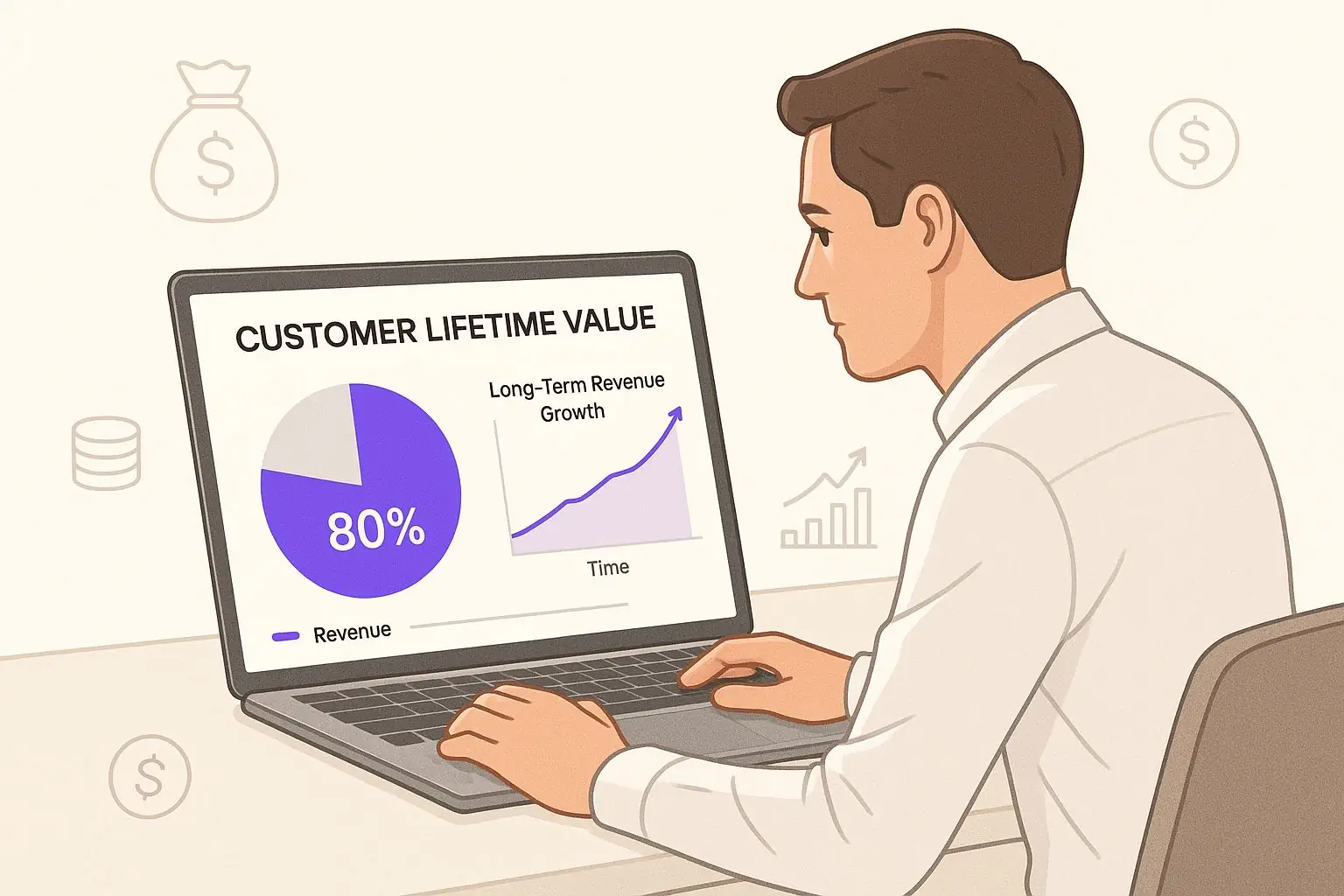
You can see how consistent engagement and keeping customers around doesn't just add up—it compounds. Over time, those initial customer acquisitions transform into a reliable, growing stream of income.
But here's the reality check: while 89% of companies say CLV is important, only a mere 42% feel they can measure it accurately. This gap is a huge problem, especially when you consider that customer acquisition costs (CAC) have skyrocketed by 222% in the last eight years. Without a precise CLV, it's nearly impossible to know if your marketing dollars are being well spent.
Focusing on CLV is about shifting from a transactional mindset to a relational one. This is non-negotiable for creators, especially on platforms where community and subscriptions are the whole point—it's all designed to maximize that long-term member value.
Business models built on long-term relationships, like paid communities or recurring memberships, are engineered to boost CLV from the very beginning. You can see some great examples in our guide on 7 subscription business model examples for creators in 2025. For creators, this isn't just business theory; it's a direct route to a far more predictable and scalable online business.
The Core Formulas Behind CLV Calculation
Alright, let's get into the nuts and bolts of how you actually figure out Customer Lifetime Value. It sounds a bit technical, but trust me, the math is more straightforward than you might think. Once you get the hang of it, you'll have a powerful way to turn customer behavior into a number you can actually use for business planning.
We’ll walk through two key methods. The first is a simple, back-of-the-napkin calculation that gives you a quick read, and the second is a more forward-looking model that helps you predict future profits.
The Simple CLV Formula for a Quick Snapshot
The fastest way to get a CLV number is to look at what your customers have done in the past. This historical approach gives you a solid baseline—what has an average customer been worth to your business up to this point?
The most common formula for this looks like this:
CLV = (Average Purchase Value × Purchase Frequency) × Average Customer Lifespan
Let's break that down with a real-world example for a digital creator selling online courses.
- Average Purchase Value: This is just the average amount a customer spends per transaction. Let's say it’s $200 .
- Purchase Frequency: How often does a customer buy from you in a given year? Maybe they pick up a new mini-course every six months, making their frequency 2 .
- Average Customer Lifespan: How long does the average person stick around as an active customer? Let's say it's 3 years .
Plug those numbers in, and you get: ($200 × 2) × 3 = $1,200.
Just like that, you know your average customer is worth $1,200 over their lifetime. This simple formula is a fantastic starting point. It’s easy to calculate and gives you an immediate, actionable number to guide decisions, especially when you're figuring out your marketing budget. It's a key piece of the puzzle when you're trying to figure out if your marketing efforts are paying off, which we dive into more in our guide on how to measure content marketing ROI.
The Predictive CLV Formula for Greater Accuracy
The simple formula is great, but it has one big limitation: it's all based on the past. To get a more accurate picture of the future, you need a predictive approach. This is where things get really interesting, as it brings in crucial factors like profit margins and customer retention rates.
This method is especially powerful for businesses with recurring revenue, like a subscription-based community or ongoing coaching. Many creators run these models on Zanfia, where an AI team handles the recurring work of a creator business while courses, communities and newsletters live under one brand. The creator dictates what to do next by chat or by voice, and the assistant can perform any action available in the interface. Add a checkout built to sell, with order bumps, installments and a test mode for buying your own product before launch, and 0% platform commission on top, and CLV calculations get cleaner because you keep the whole customer revenue minus the payment processor cut.
Instead of just looking at historical averages, predictive CLV tries to forecast what a customer will be worth. It’s less about what they’ve spent and more about what they’re likely to spend moving forward. This is where a lot of the major ecommerce platforms, like Shopify, really focus their attention.
The big shift here is from asking "What did a customer spend?" to "What profit will a customer likely generate in the future?". This is the mindset you need for making smart, forward-looking decisions.
To help you see the difference clearly, let's compare the inputs and uses for both the simple and predictive models.
Simple vs Predictive CLV Formula Breakdown
| Component | Simple CLV Formula | Predictive CLV Formula |
|---|---|---|
| Primary Goal | To understand the historical value of an average customer. Quick and easy to calculate. | To forecast the future profitability of a customer segment. More complex but far more accurate. |
| Key Inputs | Average Purchase Value, Purchase Frequency, Average Customer Lifespan | Average Gross Margin, Customer Retention Rate, Churn Rate, Average Order Value |
| Time Focus | Backward-looking (based on past data) | Forward-looking (uses historical data to predict future behavior) |
| Best For… | Small businesses, initial analysis, or getting a quick baseline understanding of customer worth. | Subscription models, e-commerce stores, or any business focused on long-term growth and retention. |
As you can see, the predictive model gives you a much richer understanding. It helps you see the true financial health of your customer relationships. For example, you might find that a customer who spends a lot but only buys low-margin products is actually less valuable over time than a moderate spender who consistently buys your most profitable offerings.
If you're ready to go deeper into the more advanced techniques, you can find some great resources that explain how to calculate customer lifetime value using predictive modeling. By getting comfortable with both the simple and predictive formulas, you can pick the right tool for the job and make sure your CLV calculations are truly driving your business forward.
Gathering the Right Data for an Accurate CLV

Any CLV calculation is only as good as the data you feed it. I always think of it like baking a cake—if you use the wrong ingredients, the result will be a flop, no matter how perfect your recipe is. The goal here is to pull together clean, reliable metrics that give you an honest look at how your customers actually behave.
The good news? You don't need a data science degree to find this stuff. Most of the essential figures are already sitting inside the tools you use every day, like your e-commerce platform, payment gateways, and analytics software.
Key Data Points and Where to Find Them
To get a solid CLV number, you need to lock down three core metrics. Each one tells a crucial part of the customer story.
- Average Purchase Value (APV): This is simply the average amount a customer spends per transaction. To get it, just divide your total revenue by the number of orders over a set period, like the last 12 months. Your payment processor, like Stripe or PayPal, is a great place to pull this raw financial data.
- Purchase Frequency (F): Next, you need to know how often the average customer buys from you in that same timeframe. You can figure this out by dividing the total number of orders by the number of unique customers. Your e-commerce dashboard or sales analytics reports should have these numbers handy.
- Customer Lifespan: This is the average time a customer sticks around and keeps buying from you. It's often easier to track for subscription-based businesses, and you can usually find detailed churn and retention data in specialized tools. If you're looking for one, our guide to the best subscription management software can point you in the right direction.
Dealing with Common Data Challenges
Let's be real—data is rarely perfect. You’re bound to run into a few snags, but the trick is to handle them consistently so you don't throw off your results.
Refunds are a big one. My simple rule of thumb is to subtract all refunded amounts from your total revenue before calculating your Average Purchase Value. This way, your CLV reflects the real, hard cash a customer brings in, not just what they initially spent.
Another tricky area is inconsistent purchase histories, especially if you don't have a subscription model. To get around this, you have to define what an "active customer" actually means for your business. Is it someone who bought something in the last 12 months? The last 18? Pick a clear rule and stick to it across the board.
The most powerful CLV insights come from segmentation. Don't just calculate one number for your entire audience. Instead, calculate CLV for different cohorts—like community members versus one-off e-book buyers—to see where your true value lies.
By segmenting your data, you start to see which parts of your business are actually creating the most loyal and valuable customers. This is exactly where Zanfia is useful: courses, community memberships, digital downloads, newsletters and consultations sit under one brand with a single login, and the assistant can pull that unified customer history for you when you ask, by chat or by voice. That single view of each customer's journey makes your customer lifetime value calculation far more meaningful, and the checkout on the other end is built to turn that data into repeat revenue with order bumps, installments and upsells.
Translating Your CLV into a Smarter Business Strategy
Calculating your Customer Lifetime Value is a great start, but it's just a number on a spreadsheet until you put it to work. The real magic happens when you let that metric guide your business strategy, turning a simple data point into a powerful tool for making decisions. It helps you answer the one question that truly matters: "Are we building a sustainable business?"
The most critical relationship to grasp is the one between CLV and your Customer Acquisition Cost (CAC). This is everything you spend on sales and marketing to land a single new customer. The ratio between these two numbers tells you, in no uncertain terms, if you're spending your money wisely.
Balancing CLV and Customer Acquisition Cost
For a long time, Customer Lifetime Value was the North Star for SaaS and subscription companies. These businesses live and die by their ability to balance the customer lifetime value calculation against their CAC.
Think about it: if your average CLV is $1,500, but it also costs you $1,500 to acquire that customer, you're on a fast track to nowhere. You’re essentially just treading water. Most industry veterans will tell you that a healthy LTV to CAC ratio should be at least 3:1 to fuel sustainable growth. For a fantastic deep-dive on this, check out the profitability insights over at TheSaaSCFO.com.
A 3:1 ratio means for every dollar you invest to bring a customer in the door, you get three dollars back over their entire relationship with you.
- A ratio below 1:1: You're actively losing money on every new customer.
- A ratio of 1:1: You're just breaking even on the acquisition, leaving zero margin for any other operational costs.
- A healthy ratio (3:1 or higher): Your business model is solid. You have a real foundation for growth.
This one ratio gives you a surprisingly clear snapshot of your company's long-term financial health.
Using CLV to Guide Your Marketing Spend
Your CLV is a direct signal for how much you can—and should—be investing in your marketing. A high CLV gives you the green light to spend more aggressively on the channels that attract those valuable, long-term customers. On the flip side, a low CLV is a major red flag.
A low CLV isn't always a marketing problem. In my experience, it often points to something deeper—issues with the product itself, a clunky customer onboarding process, or a subpar experience. It's a signal to look inward before you pour more cash into acquisition.
Let's say you discover that customers coming from paid ads have a CLV of $150, but customers from organic search have a CLV of $450. That insight is pure gold. It tells you to double down on SEO and content marketing to attract the right kind of customer, rather than just cranking up your ad budget.
Identifying and Rewarding Your Best Customers
Your CLV calculation will quickly prove that not all customers are created equal. Once you start segmenting your audience, you'll be able to pinpoint your most valuable customers—the ones who buy again and again, engage with your brand, and tell their friends about you.
When you know who these people are, you can build specific strategies to keep them happy and engaged.
- Exclusive Content: Give them early access to a new course or bonus material that nobody else gets.
- Loyalty Programs: Reward them for repeat purchases or for being a long-term subscriber.
- Personalized Offers: Use their purchase history to recommend other products you know they'll love.
These kinds of targeted engagement tactics can have a massive impact on purchase value. If you want to explore this more, take a look at our guide on what upselling and cross-selling is and how to use it effectively.
By focusing your retention efforts on these high-CLV segments, you're making sure your time and money are spent where they’ll make the biggest difference to your bottom line.
Ready to Increase Your Customer Lifetime Value? Here's How.

Knowing your Customer Lifetime Value is the first step. The real magic, though, is in making that number grow. Boosting your CLV isn't about finding a single silver bullet. It's about strategically working the three levers that drive the metric: getting customers to spend more, encouraging them to buy more frequently, and keeping them around longer.
A fantastic way to move all three levers at once is to build an integrated customer experience where every touchpoint adds value and strengthens your relationship. For a creator, this is exactly where Zanfia is useful: an AI team runs the recurring work, you dictate what to change by chat or by voice, and courses, communities, newsletters and a checkout built to sell live under one brand.
Build a Community That Sticks
Want to know one of the best ways to keep customers around for the long haul? Build a dedicated community. When people feel like they belong, they have a powerful reason to stay connected well beyond finishing a single course or buying one product.
Zanfia is designed to help you create community-based products that naturally lead to deeper engagement. Instead of sending your audience off to third-party tools like Discord or a Facebook group, you keep everything under your own branded roof. The AI assistant can add members, spin up channels or draft an announcement on your instruction, so the ongoing work of running the community stays out of your calendar. This simple change is a game-changer for engagement, retention, and, ultimately, lifetime value. You’re not just selling a product; you’re inviting them into your world.
When your community, courses, and content all live in one spot, you’ve built an ecosystem. Churn drops dramatically because leaving isn't just about losing access to one thing—it’s about losing an entire hub of value and connection.
Crafting this kind of environment is a foundational part of running a successful online business. For a deeper dive into the nuts and bolts, our guide on how to build a membership site is a great place to start.
Nudge Up Your Average Transaction Value
Getting customers to spend a little more with each purchase is a direct line to a higher CLV. The good news is you don't need a massive product overhaul. It's all about smart, timely offers.
A few tactics I've seen work incredibly well:
- Product Bundles: Try packaging a core course with a related e-book and access to an exclusive community channel. The perceived value skyrockets, and so does the cart total. Zanfia carries 12 product types under one brand, so a bundle can genuinely span a course, a downloadable, a community and a consultation without stitching separate tools together.
- Tiered Offerings: Don't just sell one version of your product. A basic tier could be the course itself, while a premium tier adds high-value extras like one-on-one coaching or bonus content. Moving a customer between plans on Zanfia changes their access immediately.
- Installments and Order Bumps: At checkout, split a $600 course into four payments so price stops being the reason someone bounces, and offer a small, relevant digital download as an add-on. It's an easy "yes" for a customer who is already in a buying mindset. Before you launch, run a test purchase in Zanfia's test mode so you buy your own product end to end and catch anything that would kill a real sale.
These strategies work because they present relevant value right when someone is ready to pull out their wallet. While these tips are geared toward creators, businesses of all types can explore customer loyalty platforms like goodkudos to implement similar ideas.
Put Your Customer Experience on Autopilot
A smooth, hassle-free experience builds trust and encourages people to come back. The secret to delivering that consistently without burning out? Smart automation.
Think about all those small, crucial moments: the instant access to a course after purchase, the personalized welcome email that lands in their inbox, or getting a new member into the right community channel without a hitch. Zanfia is built to handle this grunt work, and because the assistant sits on top of the whole interface, you can tell it out loud "grant every buyer of my flagship course access to the VIP channel and send them the welcome sequence" and it does it, saving creators a solid 5–10+ hours a month on tasks like granting course access, adding members to community channels, and triggering email sequences.
That's time you can pour back into what you do best—creating amazing content. And when your content is great, your audience has every reason to stick around, naturally driving their lifetime value higher.
Got Questions About CLV? Let's Clear Things Up.
Even with the formulas laid out, putting CLV into practice for your own business always brings up a few practical questions. It's one thing to understand the math, but another to apply it in the real world. Let's walk through some of the most common sticking points I see with creators and entrepreneurs.
What’s a "Good" Customer Lifetime Value?
This is easily the most common question, and the honest answer is: it depends. There’s no magic number that works for everyone. A "good" CLV is all about its relationship to what you spend to get a customer in the first place—your Customer Acquisition Cost (CAC).
The real metric to obsess over is the CLV to CAC ratio.
For most online businesses, especially those with recurring revenue like memberships or subscriptions, a healthy target is a 3:1 ratio. Simply put, for every dollar you invest in acquiring a new customer, you should be making at least $3 back from them over their entire relationship with you.
If you find your ratio is closer to 1:1, you're basically in a hamster wheel, spending as much to get a customer as you're making from them. There's no profit there. But if you're hitting a 5:1 ratio or higher? That’s a strong signal you have room to get more aggressive with your marketing and really scale things up.
How Often Should I Be Calculating This?
CLV isn't a one-and-done calculation. Think of it as a living metric that tells you about the health of your business.
For most creators, running the numbers quarterly or semi-annually is a great rhythm. It’s frequent enough to catch important trends and see if your new marketing campaigns, product launches, or community efforts are actually paying off in the long run.
A pro tip is to calculate CLV for specific customer groups, or cohorts. For example, compare the CLV of customers who signed up in Q1 to those who joined in Q2. This is how you find out if the quality of your new customers is getting better or worse over time.
Can I Even Calculate CLV If My Business Is New?
You absolutely can, but with a slight twist. Without years of historical data, your first CLV calculation will be more of a forecast based on smart assumptions.
Look at industry benchmarks for things like average churn rate or customer lifespan in your niche. Then, take your early sales data to estimate an average purchase value and how often customers might buy again.
Maybe you're launching a paid newsletter. You could start by projecting a customer lifespan of 12–18 months and go from there. The most important part is to be clear about your assumptions and promise yourself you'll revisit and update your CLV with real, hard data as soon as you have it.
Ready to build a business where customer relationships and lifetime value are at the core? Zanfia gives creators an AI team that runs the recurring work of the business, with courses, communities, newsletters and digital products under your own brand and a checkout built to sell, at 0% platform commission on customer sales. You dictate the next move by chat or by voice, and the assistant carries it out across the interface. Start with a 14-day free trial, no credit card required. Discover how Zanfia can help you grow a more profitable online business today.