

Your Guide to Modern Community Management in 2026
Let's be clear: modern community management isn't about deleting spam comments anymore. That’s table stakes. Today, it’s a core business strategy that turns a passive audience into a thriving, self-sustaining ecosystem.
It’s the fundamental difference between talking at people and building a space where they connect, collaborate, and create value with you and each other. This isn't just a "nice-to-have"—it's a strategic imperative for any serious creator in 2026.
From Audience to Ecosystem
In the old model, a creator's "community" was really just a list of followers on social media or names on a mailing list—a one-way broadcast channel. Modern community management flips that entire model on its head.
The goal isn't to just rack up follower counts. It's to cultivate an environment where members feel a genuine sense of ownership and actively contribute to the group's value. This is how you transform your audience from passive consumers into your most loyal advocates and a powerful growth engine.
This isn't just a feel-good concept; it directly impacts your bottom line. The data is overwhelming. A staggering 86% of businesses now consider community essential to their mission, and brands that invest in community see a 70% boost in customer retention. Why? Because proactive engagement turns casual users into lifelong fans. You can dig into the data yourself in this detailed 2025 community management report.
Traditional vs Modern Community Management at a Glance
The evolution from a reactive, cost-center mindset to a proactive, value-creation strategy is dramatic. This table breaks down the core differences between the old way of thinking and the modern framework.
| Aspect | Traditional Approach (The Past) | Modern Approach (The Future) |
|---|---|---|
| Primary Goal | Brand protection and customer support | Growth, retention, and value co-creation |
| Key Metric | Ticket response times, number of followers | Member engagement, retention rate, user-generated value |
| Community Role | A broadcast channel or a cost center | A strategic business asset and profit center |
| Member Status | Passive consumers of content | Active contributors and advocates |
| Tooling | Fragmented (social media, forums, email lists) | Integrated (all-in-one platforms) |
| Mindset | Reactive and defensive (moderation) | Proactive and strategic (cultivation) |
This shift isn't just semantics; it represents a complete change in how successful creators build and scale their businesses. The future belongs to those who build ecosystems, not just audiences.
The Strategic Shift in Focus
The core idea is simple but powerful: a successful community isn't just a group of people who bought your product. It's a space where they connect over shared interests, celebrate wins, solve problems together, and grow—all anchored by your brand.
A thriving community doesn't just consume value; it co-creates it. When members start helping each other, answering questions, and sharing their own insights, the community becomes a powerful, self-perpetuating engine for growth and retention.
This evolution demands a new class of tools. Trying to manage a modern community with a patchwork of different software is a recipe for failure. Juggling a Discord for discussion, a separate platform for courses, and another for payments creates a fragmented and clunky member experience. It kills engagement before it even has a chance to start.
This is precisely why integrated platforms are becoming the non-negotiable standard. A system like Zanfia is built for this new reality as an AI team that runs a creator business, not just another content tool. An in-app assistant handles the work by chat or by voice (any action available in the interface can be dictated), and an MCP endpoint lets your own AI agents act on your workspace. That AI work lands in real surfaces creators sell: courses, communities, paid newsletters, digital products, and knowledge bases, all under a single login and a single brand on your own domain. Advanced tools like topical discussion channels and read-only announcement spaces keep audiences engaged in a checkout-ready environment built to sell, not scattered across external tools.
By eliminating the friction between your offerings, you create a seamless journey where learning, interaction, and commerce flow together naturally. This unified approach is the foundation of modern community management, allowing you to build an asset that grows with you, not a technical liability that drains your time.
The Four Pillars of a Thriving Community
A great community doesn't just spring up out of nowhere. It's built, piece by piece, on a solid foundation. Experienced creators know that a truly powerful community rests on four pillars that guide every member’s journey: Onboarding, Engagement, Moderation, and Retention.
When you get these four areas right, you transform a simple group into a self-sustaining ecosystem. This is the critical difference between a community that fizzles out after a few weeks and one that becomes an essential part of your members' lives—and a core asset for your business.
The old way was a one-way broadcast from the creator to the audience. The modern approach, supported by these pillars, is about building an interactive world.
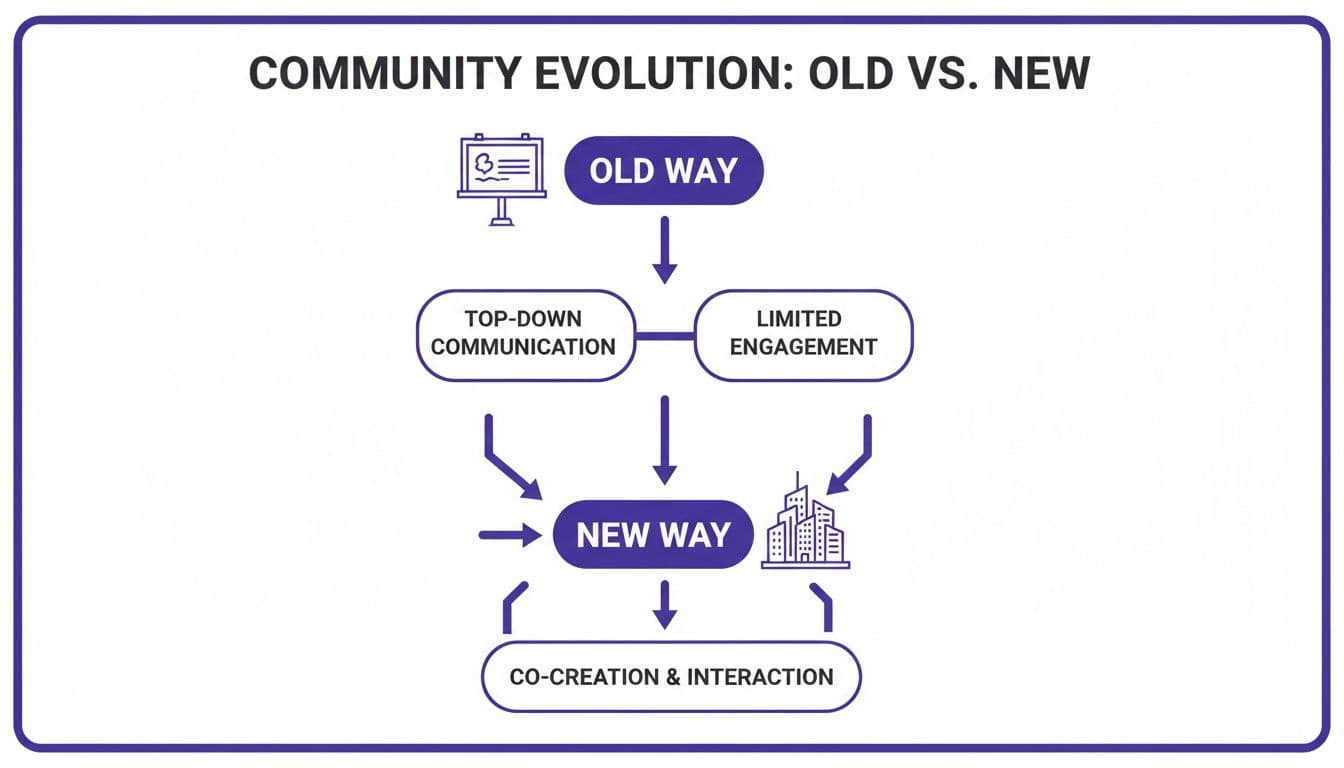
This shift is like moving from a lecture hall to a bustling city square where members connect, collaborate, and create value together. Let’s break down the pillars that make this city run.
Onboarding New Members
First impressions are everything. Onboarding is the first—and most crucial—pillar, designed to make new members feel welcome, seen, and instantly grounded. A confusing or silent welcome is the fastest way to lose someone you just worked so hard to attract.
A strong onboarding process doesn't just say "hello"; it guides members to their first small win. This might be introducing themselves in a specific channel, finding a key resource, or connecting with another member who shares their interests.
Effective creators use a few key plays to nail this:
- Automated Welcome Sequences: Triggered emails or in-app messages that show newcomers the layout, rules, and core features.
- Guided Tours: Short, interactive walkthroughs pointing out important channels, introducing community leaders, and explaining how to get the most value.
- "Start Here" Channels: A dedicated, read-only space with essential links, guidelines, and a clear call to action for their very first step.
Driving Active Engagement
Once a member is settled in, the work shifts to Engagement. This is the ongoing process of sparking conversations and creating genuine opportunities for connection. Modern community management is so much more than just posting a daily question.
Real engagement is about building a culture of participation. It means designing experiences that pull members in and encourage them to contribute, share, and even lead. The goal is to shift the dynamic from a creator-centric broadcast to a member-driven network.
Engagement isn't about getting people to talk to you; it's about getting them to talk to each other. When members start forming their own connections, your community becomes sticky and self-sustaining.
Here are some tactics for driving deeper engagement:
- Themed Discussion Channels: Create dedicated spaces for niche topics to allow for more focused and high-value conversations.
- Member-Led Events: Empower your experienced members to host their own workshops, Q&As, or networking sessions.
- Integrated Content and Conversation: Platforms like Zanfia are well-suited for this by seamlessly integrating community spaces with course content, creating a unified learning environment where discussion reinforces course material.
Moderation as Culture Building
The third pillar, Moderation, is widely misunderstood. In a modern community, it's not about policing comments with an iron fist. It's a proactive effort to cultivate a positive, safe, and productive culture where everyone feels comfortable contributing.
Think of it less as enforcement and more as gardening. Your job is to create the right conditions for healthy growth by setting clear expectations and gently pruning behaviors that harm the community's purpose.
This involves:
- Clear Community Guidelines: A public document outlining expected behaviors, core values, and what won't be tolerated.
- Empowered Member-Leaders: Identifying and training trusted members to serve as moderators and cultural ambassadors.
- Private and Public Reinforcement: Celebrate positive contributions publicly while addressing negative behavior privately and constructively whenever possible.
Ensuring Long-Term Retention
Finally, the fourth pillar is Retention. A community is only valuable if its members stick around. Retention strategies are all about consistently delivering value and making your space an indispensable resource.
This is where all-in-one platforms truly shine. Powerful automation and workflow features eliminate time-consuming manual tasks. For instance, Zanfia automates workflows like instantly granting course access after payment, adding buyers to the right community channels, or revoking access at the end of a plan. This can save creators 5–10+ hours a month, freeing them to focus on high-impact retention activities.
Key retention strategies include:
- Exclusive Content: Provide bonus materials, behind-the-scenes content, or early-bird offers that are only available to members.
- Member Recognition Programs: Highlight top contributors, celebrate member milestones, and create special roles like "Community Expert."
- Feedback Loops: Actively solicit member feedback through surveys and direct conversations to co-create the community's future.
By building your strategy around these four pillars, you create a robust framework for a community that not only survives but thrives, driving both member satisfaction and business growth.
How to Monetize Your Community Authentically
Let's get one thing straight: turning your community into a business shouldn't feel sleazy or transactional. Authentic monetization isn't about nickel-and-diming your members. It's the natural result of delivering so much value that your audience is genuinely excited to pay for deeper access and better results.
Think of it as a value ladder. Once someone feels understood, supported, and successful inside your free spaces, paying for premium content or direct guidance is the logical next step—not an awkward sales pitch.

Monetization Models That Build on Value
Instead of asking, "What can I sell?" start asking, "What bigger problems can I solve?" Your monetization strategy needs to be a perfect match for the ambitions of your most dedicated members.
Here are three proven models that work because they’re built on trust:
- Paid Memberships & Subscriptions: This is the most direct path. You offer exclusive community spaces, premium content libraries, or both for a recurring fee. This model generates predictable revenue and attracts your most committed followers.
- Premium Content Tiers: Keep your main community free but create paid add-ons. This could be a vault of advanced tutorials, weekly expert Q&A sessions, or an exclusive paid newsletter. It lets members choose their level of investment.
- Community + Course Bundles: Combine access to your community with a flagship online course. This creates an incredible learning loop where discussion reinforces the content, driving up completion rates and member satisfaction. Zanfia , for example, gives you flexibility on how to sell: one-time purchases, subscriptions, installment plans (split a $600 course into four payments), order bumps at checkout, and product bundles under a single brand.
The psychology here is simple: you’re not selling a product. You’re selling access, transformation, and a sense of belonging.
The Power of a 0% Transaction Fee Platform
Here’s a major problem for most creators: the more successful you become, the more your platform penalizes you. As your revenue grows, so does the cut they take from every single sale. You're forced to either eat the cost or raise prices on your members. It’s a broken model.
This is where a partnership philosophy completely changes the game. Platforms like Zanfia are built to grow with you, not at your expense.
Zanfia’s current model charges 0% platform transaction fees. Creators keep 100% of their revenue from every sale, paying only the standard fees to payment processors like Stripe and PayPal.
This isn’t a minor detail—it fundamentally rewires the economics of your entire business. For a creator earning $10k, $50k, or $100k+ a month, avoiding a 5-10% platform tax adds up to tens of thousands of dollars in your pocket each year. This transparent, SaaS subscription approach means the platform grows with, not at the expense of, its users.
Reinvesting Revenue into a Growth Cycle
That extra revenue doesn't just pad your bank account. It becomes fuel for a powerful growth flywheel. When you keep 100% of your sales, you can:
- Invest in Better Content: Hire a video editor, bring in guest experts, or develop more in-depth workshops.
- Improve the Member Experience: Offer more 1:1 support or host exclusive live events that create raving fans.
- Scale Your Marketing: Run ad campaigns to attract new, high-quality members into your ecosystem.
This advantage is especially critical for "Business Architects" and "Craft Masters"—experienced creators who’ve hit a scaling wall with messy tool stacks and high-commission platforms. By keeping platform fees at 0%, Zanfia lets you protect your margins while investing in growth. As serial entrepreneur Artur Kurasiński puts it, it's "the most convenient and simplest solution for paid newsletters, courses and community."
You get to build a sustainable business where your success directly benefits your community, creating a virtuous cycle of value that attracts and keeps loyal members for the long haul. This is the heart of effective modern community management.
Measuring Your Community's Health and ROI
Let's be honest: vanity metrics are tempting. A big, impressive member count looks great on a slide, but it tells you almost nothing about the actual health of your community. Modern community management is about tracking the numbers that prove you’re creating real, tangible business value.
You can't manage what you don't measure. Flying blind means you're just guessing—guessing what content your members want, which problems need solving, and whether your community is actually helping your bottom line. Tracking the right KPIs is how you stop guessing and start making confident, data-driven decisions.

Key Performance Indicators That Actually Matter
Forget total sign-ups. Your focus needs to shift to the core metrics that signal a vibrant, healthy, and—most importantly—profitable community.
Here are the essential KPIs you should have on your dashboard:
- Active Member Rate: This is your community’s pulse. It’s the percentage of members who are actually participating—posting, commenting, reacting—over a specific time. A high active rate means your space is alive and delivering value.
- Engagement Rate: This metric digs a layer deeper. It measures the volume of interactions (posts, comments, replies) against your number of active members. It shows you just how invested your core members really are.
- Community-Sourced Revenue: This is the gold standard for proving ROI. It’s the direct revenue generated from your members, from subscriptions and course sales to any upsells they purchase after joining.
These metrics are more than just numbers; they’re signals. A sudden dip in engagement in one of your channels might mean the topic is stale, or it could be a cue to reignite the conversation with a new piece of content.
The real power comes from connecting community activity directly to business outcomes. When you can show your stakeholders that members who join your weekly Q&As have a 30% higher lifetime value, you’ve just proven the undeniable ROI of your work.
Analytics are now the backbone of professional community operations. Just look at Harness, a tech firm that used community data to drive a 25% improvement in response rates across 10,000 organizations. By tracking the right metrics, they demonstrated their community’s direct value. You can dig into their strategy in this comprehensive guide on community analytics.
The Power of a Unified Dashboard
Trying to track these KPIs with a handful of disconnected tools is a recipe for disaster. How can you possibly measure Community-Sourced Revenue if your community platform doesn't speak to your sales system? This is exactly where an all-in-one platform becomes essential.
A unified dashboard, like the one built directly into Zanfia, acts as your single source of truth. It gives deep visibility at every stage of the funnel, pulling together data from every corner of your creator business to give you the complete picture:
- Sales Activity: Track revenue from new members, ongoing subscriptions, and digital product sales in real-time.
- Course Progress: See exactly how community engagement impacts course completion and student success.
- Community Activity: Monitor active members, engagement rates, and which discussion channels are getting the most traction.
This level of integration is a game-changer. It allows you to draw a straight line from a specific community initiative—like launching a 7-day challenge—to a direct spike in member retention or sales of an advanced course. This is how you prove the direct link between modern community management and real business growth.
With this kind of visibility, you can pinpoint bottlenecks, optimize your content strategy, and refine your offers to maximize both engagement and revenue. You’re no longer just managing a community; you’re operating a core growth engine for your entire business.
Choosing the Right Community Platform
Picking the technology to power your community isn't just about features and buttons. It’s a strategic decision. This choice will define your brand, shape every single member interaction, and ultimately dictate whether you can grow sustainably.
Your platform is the digital home you build for your people. It can be a seamless, integrated space that sparks connection and makes members feel valued. Or, it can be a frustrating puzzle of disconnected tools that drives them away.
This often boils down to one critical choice: do you duct-tape multiple tools together, or do you invest in an all-in-one platform? A fragmented setup—cobbling together a WordPress site, a separate course plugin, and a Discord server—might feel flexible at first. But this quickly creates a jarring experience. Members are forced to juggle multiple logins and navigate different interfaces, which is a surefire way to kill engagement before it even starts.
Defining Your Core Platform Needs
Before you start looking at shiny new tools, you need to get brutally honest about what your business actually needs to thrive. The right platform for a creator launching their very first product is worlds apart from what a seasoned entrepreneur scaling past six figures a month requires.
Your evaluation should focus on four mission-critical areas:
- Brand Control: Does the platform let you use your own domain and branding? Or are your members constantly reminded they’re on someone else’s turf? A true white-label solution is non-negotiable for building a strong, independent brand (availability depends on the plan, see the current Zanfia pricing ).
- Member Experience: How smooth is the journey from seeing your offer to becoming an active participant? An integrated system where your community, courses, and content all live under one roof provides a far superior experience that dramatically boosts retention. The best platforms also let creators dictate work by chat or by voice, so day-to-day operations don't require constant clicking through settings.
- Monetization Flexibility: Can you actually sell your products the way you want to? You need support for one-time purchases, recurring subscriptions, installment plans, order bumps, and product bundles. A platform with restrictive payment models will put a ceiling on your revenue.
- Administrative Overhead: How much of your week will be spent on manual, soul-crushing tasks? A platform with smart automation—like automatically granting course access on purchase or handling failed subscription payments—can easily save you 5–10+ hours a month .
Comparing All-in-One Platform Philosophies
Even in the world of all-in-one platforms, not all are built with the same DNA. They have fundamentally different philosophies about branding, monetization, and their relationship with you, the creator. Let's look at how these differences play out in the real world.
Skool vs. Integrated Platforms: A platform like Skool is built around a slick, community-first model, which is fantastic for driving engagement. The trade-off, however, is a steep loss of brand control and financial flexibility. Unlike Zanfia, which offers full white-label control (availability depends on the plan, see the current Zanfia pricing), Skool locks creators into a restrictive "one community, one price" payment model and doesn't support custom domains, diluting brand equity over time.
International Giants vs. All-in-One Alternatives: Global players like Kajabi or Teachable offer an impressive suite of features, but they often come with a massive catch: steep transaction fees. These platforms can skim 5-10% off every single sale, which mercilessly eats into your profit margins as your business grows.
This is the fundamental trade-off so many creators face. Do you sacrifice a percentage of your hard-earned revenue for convenience, or do you find a partner that wants you to keep 100% of it?
A platform like Zanfia takes a different approach: an AI team that runs the creator business, not just a content stack. It delivers complete white-label control on your own custom domain, deep monetization flexibility (one-time, subscriptions, installments, order bumps, product bundles), an in-app assistant you can drive by chat or voice, an MCP endpoint so your own AI agents can act on your workspace, and a business model that charges 0% platform transaction fees. It also includes native video hosting, so you don't need a separate Vimeo or Wistia subscription.
Making a Strategic Choice for Growth
The platform you choose is your business partner. Its business model is your business model. When a platform takes a cut of your revenue, its success literally comes at your expense. In sharp contrast, a clean SaaS subscription model aligns their success with yours—they only grow when you decide their service is valuable enough to keep paying for.
Think about the real-world implications. Selling online means running a full commerce stack: a checkout with order bumps, installment plans, and post-purchase upsells; test mode so you can buy your own product end-to-end before launch; and 12 product types living under one brand. Zanfia ships all of that in one place, alongside integrations with Stripe and PayPal (with Apple Pay and Google Pay wallets), so you spend less time wiring tools together and more time selling.
Ultimately, your decision has to align with your long-term vision. If you're a "Business Architect" or "Craft Master" earning $10k–$100k+ a month, a platform with 0% platform fees and a checkout built to sell isn't just a perk—it's a core financial strategy that can save you thousands. If you're a "Potential Explorer" just getting started, a true all-in-one system removes the tech paralysis that stops so many brilliant experts from ever launching.
Choosing your platform is the bedrock of modern community management. Make the choice that empowers you to own your brand, control your revenue, and focus on what you actually do best: creating value for your members.
Common Questions About Community Management
As you start building your business, you're bound to have questions. Community management isn't a static field, and the best creators know how to tackle challenges head-on. This section cuts through the noise to give you clear, actionable answers to the questions we hear most often, reinforcing the principles you need to build a community that lasts.
How Much Time Does It Take to Manage a Community?
The time you'll spend depends on the size of your community and how active it is, but modern tools have completely changed the game. When you're just starting, it’s smart to block out 5-10 hours per week for setting things up, creating your first pieces of content, and getting those initial conversations going.
But the real key to scaling without burning out is smart automation. This is where an integrated platform becomes your most valuable employee.
For example, a platform like Zanfia is designed to give you time back, with creators reporting they save 5–10+ hours a month. An in-app AI assistant (drivable by chat or voice) plus powerful automations handle the repetitive but essential work—like instantly giving a new customer access to a course, adding them to the right community channel, or sending out a welcome sequence.
The long-term goal is to build a culture where members start to lead. As your community matures, you'll see member-generated content and peer-to-peer support take off. This frees you from having to be the one driving all the activity, so you can focus on creating high-value work, not doing admin.
Can I Build a Community Without a Large Audience?
Absolutely. In fact, starting small is one of the biggest strategic advantages you can have. A huge, disengaged audience is worth far less than a small, tight-knit group of true fans. Building with a smaller initial base allows you to create much deeper, more meaningful connections.
Think of your first members as your founding partners. Your entire mission should be to deliver overwhelming, undeniable value to your first 10, 50, or 100 members. These are the people who will help you dial in your products, define your community's culture, and become your most powerful advocates.
This is where a simplified, all-in-one platform gives you a massive leg up. For creators who feel overwhelmed by tech—the "Potential Explorers"—a solution like Zanfia offers a low-risk path to launching a first digital product and community. A 14-day free trial (no credit card required) lets you prove your idea and build a solid foundation without needing a giant following, so you can focus on your expertise and your core members from day one.
What Is the Difference Between an Audience and a Community?
This is the single most important distinction in the modern creator economy. Getting this right is everything.
- An audience is a group of people who listen to you. It's a one-way broadcast—you create, they consume. Think of social media followers or YouTube subscribers.
- A community is a group of people who connect with you and, more importantly, with each other . The conversation flows in every direction. Members don't just consume; they contribute, interact, and build the experience together.
An audience is transactional; a community is relational. Your job as a modern creator is to master the art of turning a passive audience into an active community, where members feel a real sense of belonging and add to the collective value.
How Do I Justify the Cost of a Community Platform?
A professional community platform should never be seen as a cost. It’s a strategic investment in a revenue-generating asset. You justify the investment by measuring its return (ROI) through clear business results.
First, look at direct revenue from memberships, subscriptions, and digital product sales. This is where your platform's business model is critical. A platform like Zanfia is built to maximize your take-home pay with its 0% platform transaction fee model. You keep 100% of your revenue, which immediately impacts your bottom line.
Second, measure the growth in Customer Lifetime Value (LTV). Members who are active in a community stick around much longer and are far more likely to buy other products from you. An integrated platform gives you the analytics to track this directly.
Finally, don't forget the indirect financial wins:
- Reduced Support Costs: When members start helping each other and answering questions, it dramatically reduces the support burden on you and your team.
- A Powerful Marketing Engine: A thriving community is the best marketing you can have. It naturally generates authentic testimonials, referrals, and user-generated content that brings in new members organically. EFL teacher Mateusz Grzywiński confirms, “If you plan to sell digital products and build a community of paying customers, Zanfia is a strong fit.”
When you add up the new revenue, higher LTV, and lower operating costs, a professional all-in-one platform pays for itself many times over. It’s the essential infrastructure for building a sustainable business.
Ready to stop juggling tools and start building a true community-based business? Zanfia gives creators an AI team that runs the business (courses, communities, paid newsletters, and digital products under one brand), a checkout built to sell, and a model where you keep 100% of your revenue. Explore how to build, monetize, and scale your online business with full control.