

Agent Boost Marketing: Scale Your Business, Ditch Leads 2026
Most advice about Agent Boost Marketing is too small-minded. It treats growth like a refillable expense. Buy more leads, chase more callbacks, replace the pipeline every month, repeat.
That isn't a business. It's rented attention.
If you're an experienced agent, your biggest asset isn't your dialer, your ad account, or your lead vendor. It's your judgment. You know how to explain products, handle objections, manage compliance, and help buyers make decisions. That's the raw material for a digital product business. When you package that expertise into courses, paid newsletters, downloads, or a private member community, you stop acting like a lead buyer and start acting like an owner.
The Real Meaning of Agent Boost Marketing
The usual definition of Agent Boost Marketing is shallow. It says your business grows when you buy more opportunities from someone else. More names. More calls. More appointments. More volume.
That logic breaks down fast for expert agents. Public information around this category shows how the model has evolved into a broader service stack of technology, training, and support, not just simple lead generation. A clear milestone was the July 10, 2025 SMA and Agent Boost Marketing partnership announcement, which described Agent Boost as a "premier provider of marketing and technology solutions for insurance agents" and positioned the partnership around combining tools with industry expertise.
That tells you something important. The underlying game isn't lead volume. It's infrastructure.
Why the common advice misses the point
If your entire growth system depends on a vendor, you don't own your pipeline. You rent it. You also inherit their constraints, their pricing model, and their definition of what counts as a good opportunity.
A smarter interpretation of agent boost marketing is this: build assets that attract, educate, and convert buyers or trainees under your own brand. That can mean:
- A course for rookie agents entering the market
- A premium newsletter analyzing product positioning, outreach, or objection handling
- A paid community for experienced agents who want scripts, workflows, and peer support
- A resource library with templates, onboarding guides, and compliance-friendly messaging
Practical rule: If your marketing disappears the moment you stop paying for leads, you don't have a growth system. You have a monthly dependency.
You need a model with compounding value. That means content, audience ownership, and productized expertise. If you want a broader strategic lens on that shift, Rebus has a useful breakdown of scalable growth tactics that maps well to expert-led businesses.
The Old Model vs The New Creator Playbook
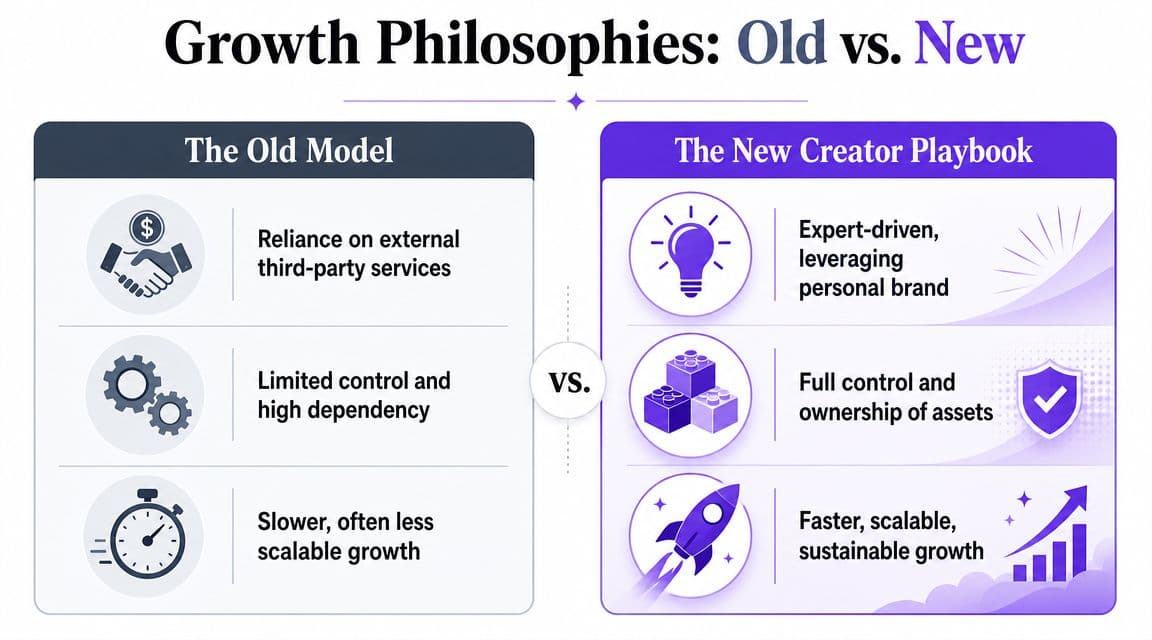
The old model is familiar because it feels simple. Pay a provider. Get leads. Work the list. Hope enough convert to justify the spend.
The problem is that simplicity at the front end creates fragility on the back end.
The old model
Public materials make the economics clear enough. Agent Boost's privacy policy states that it offers a monthly subscription service providing leads from its dialer system, priced at $199 per month.
That figure matters less than the structure. You pay before you close. You carry recurring acquisition cost before revenue exists. You keep feeding the machine or the machine stops.
Here's what that model usually produces:
| Issue | Strategic consequence |
|---|---|
| Third-party lead dependence | Your pipeline is outside your control |
| Recurring subscription cost | Margin pressure starts before the sale |
| Channel opacity | You can't easily judge quality, retention, or risk |
| Commodity positioning | You compete on speed, not authority |
A lot of agents stay stuck here because they confuse activity with methods for amplifying results. They make more calls, but they don't build anything that compounds.
The new creator playbook
The alternative is to productize what you already know. Instead of buying attention every month, you publish content that attracts the right audience and convert that audience into buyers of your knowledge, systems, and community access.
This changes the business in four ways:
- You own the asset . Your course, newsletter, membership, and customer list belong to you.
- You control positioning . Buyers come to you for expertise, not because your name happened to appear in a queue.
- You can monetize more than one need . Training, templates, community, and premium analysis can sit in one offer ladder.
- Revenue quality improves . A customer who trusts your thinking is usually worth more than a cold lead who barely remembers opting in.
If you want a practical lens on where creator-driven acquisition is heading, SleekPost's guide to 2026 marketing trends for creators is worth reading alongside this shift.
Where the economics improve
The creator model works because you stop paying for the same beginning over and over again. One strong training module can sell many times. One useful community can deepen retention. One article can attract qualified buyers long after publication.
You also stop outsourcing your conversion logic. The funnel becomes yours. Offer, page, onboarding, upsell, retention.
A useful reference point is this piece on leads and conversions. The key shift is simple. Stop asking, "How do I get more names?" Start asking, "How do I build a business that makes every qualified relationship more valuable?"
The old model buys chances. The new model builds equity.
Laying Your Foundation with a Digital Product
Most agents overcomplicate the first product. They think they need a giant flagship course, a full media brand, and a polished content library before launch. They don't.
Start with a narrow problem that you can solve better than others in your niche.
Pick a problem you already solve in real life
Your first product should come from repeated conversations, not brainstorming theatre. Think about the questions people already bring to you.
Examples:
- For new insurance agents : first appointment prep, compliance-safe outreach, product comparison logic, follow-up discipline
- For real estate agents : listing presentation systems, neighborhood authority content, buyer consultation scripts, referral process design
- For team leaders : onboarding, call review frameworks, accountability cadence, recruiting education
A simple filter works well here:
- Urgent problem . People want relief now.
- Clear transformation . The result is easy to describe.
- Repeatable process . You can teach it the same way more than once.
- Suitable buyer . The audience already spends money to improve performance.
Choose the right format
Don't default to a course because "course creator" sounds respectable. Match the format to the job.
| Product type | Best when your audience needs |
|---|---|
| Course | A step-by-step process |
| Paid newsletter | Ongoing analysis, commentary, or updates |
| Community | Support, accountability, and peer discussion |
| Download bundle | Templates, scripts, checklists, and frameworks |
| Membership | A mix of training, updates, and interaction |
If you're just starting, one of the cleanest paths is a compact course plus community access. That gives buyers structure and support without forcing you to produce endless new content.
Build the minimum version that sells
Your first version doesn't need breadth. It needs usefulness.
A strong outline often looks like this:
- Outcome module . Define what success looks like.
- Foundation module . Fix the common mistakes first.
- Execution module . Show the exact workflow.
- Review module . Cover optimization and troubleshooting.
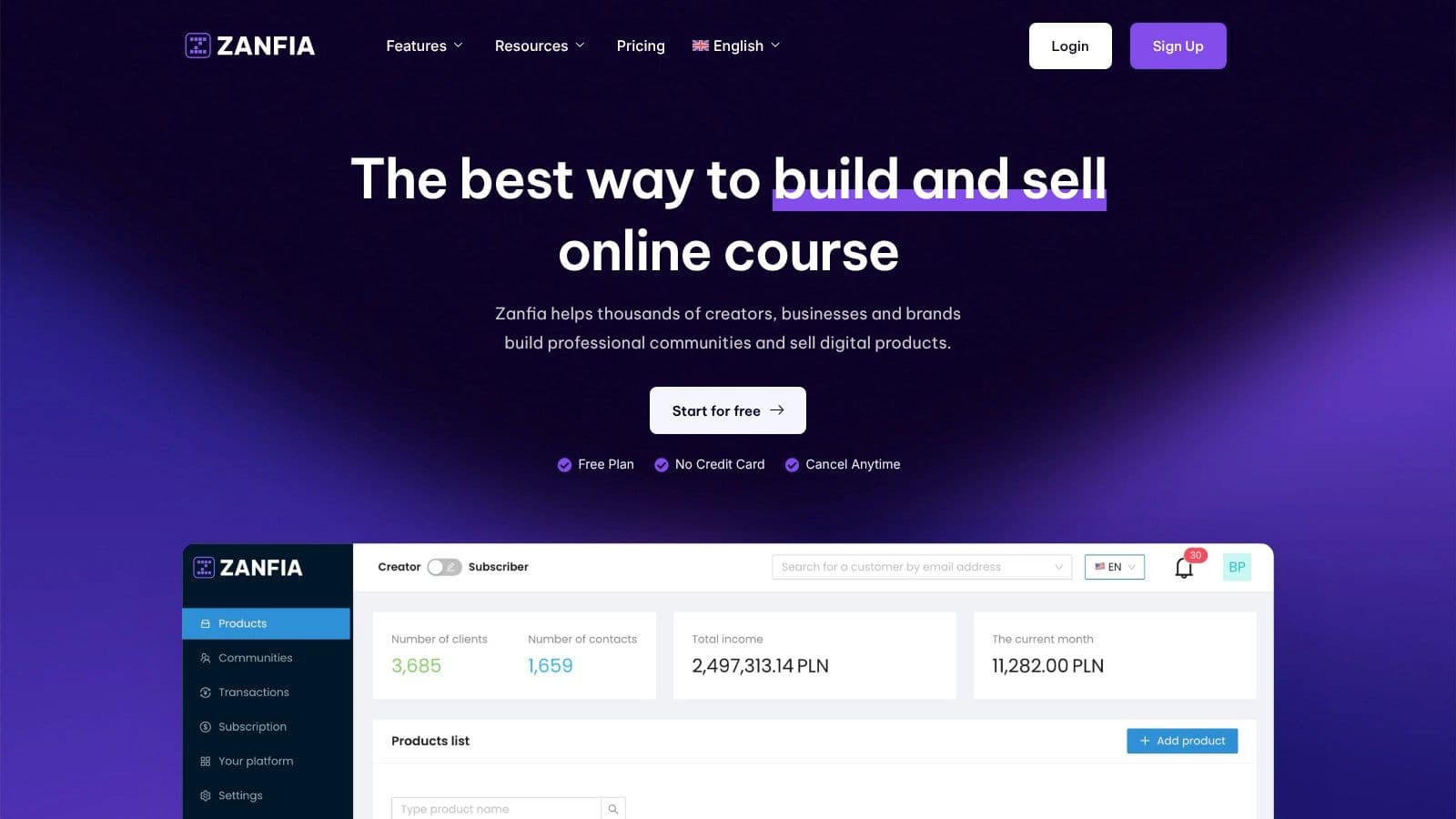
For delivery, use one system that keeps content, checkout, access, and communication together. Zanfia is built as an AI team that runs a creator business rather than a bare course tool: an assistant that knows the whole application performs any action available in the interface, by chat or by voice, so you can dictate a change to a lesson, a checkout, or a community post instead of clicking through menus. Courses, paid newsletters, communities, subscriptions, bundles, and downloads sit on top of that under your own domain, and the checkout is built to sell with order bumps, installments, and upsells so a $600 course can be split into four payments without a separate cart tool. Zanfia takes 0% platform commission on customer sales as of July 2026, with only the payment processor's standard cut applying, and there is a 14-day free trial with no credit card. Availability of specific AI capabilities depends on the plan, so check the current Zanfia pricing before committing to a workflow.
For a tactical starting point, this guide on how to start a digital product business lays out the operational basics.
Don't launch with everything you know. Launch with the smallest product that produces a meaningful result.
Structure matters more than production polish
Agents often think credibility comes from fancy editing. It doesn't. Buyers stay when the sequence makes sense and the lessons remove friction.
Good course design for expert operators usually includes:
- Short lessons that answer one question at a time
- Templates and worksheets so buyers can act immediately
- Decision frameworks so they can apply your judgment, not just memorize tips
- Clear next actions at the end of each lesson
Later, add deeper assets. Case breakdowns. Objection libraries. Member Q&A archives. Industry updates. Don't start there.
A quick walkthrough helps if you're mapping your first product stack visually:
Three product ideas that fit expert agents
Rookie training offer
Teach a new agent how to avoid the first-year chaos. Focus on routine, client conversations, paperwork discipline, and sales process basics.
Market intelligence newsletter
Sell analysis, not headlines. Write for agents who need interpretation, positioning, and talking points they can use with clients or recruits.
Private operator community
Create a member space for working professionals who want scripts, implementation feedback, and peer discussion without social-media noise.
Each path turns your expertise into an asset. That's the foundation you were missing when lead-buying was your whole growth plan.
Building Your Automated Sales and Community Engine
A digital product business gets interesting when it stops depending on your constant presence. That's where automation changes the economics. Not because automation is fashionable, but because manual work kills margin.
The strongest agent-style conversion systems already point in this direction. Agent Boost publicly describes a stack built around an evolving lead pipeline, technology, and training, including CRM tracking, workflow automation, and integrated quoting or enrollment tools in its about page. The useful takeaway is broader than insurance. A high-conversion stack ties lead capture, follow-up, and conversion tracking into one flow.
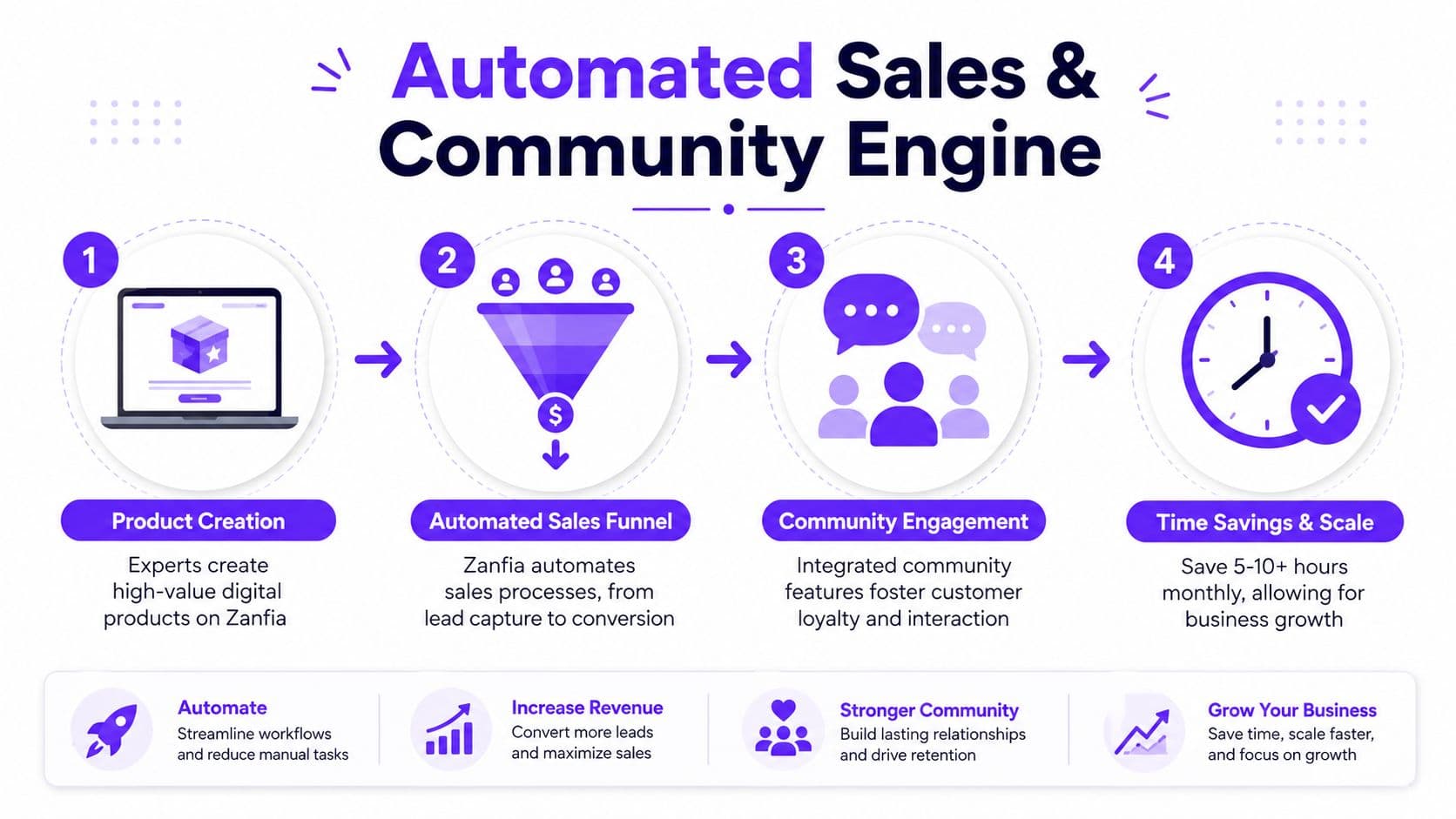
Build one path from attention to access
Most experts make a messy handoff between marketing and delivery. They collect an email in one tool, sell in another, onboard in a third, and dump customers into an unrelated chat app. That fragmentation creates drop-off.
A cleaner setup looks like this:
- Entry point . A lead magnet tied to one specific problem
- Email sequence . Welcome, educate, and point toward one paid offer
- Sales page . Make the promise and show the path
- Post-purchase access . Grant entry immediately
- Community onboarding . Put the buyer in the right discussion space
- Retention loop . Use updates, prompts, and events to keep engagement active
Community isn't decoration
A lot of creators bolt on community as an afterthought. That's a mistake. Community is where buyers stay longer, get unstuck faster, and see your product as a living system instead of a static download.
Use it deliberately:
| Community element | Business function |
|---|---|
| Announcement channel | Launches, updates, new lessons |
| Topical channels | Peer problem-solving and discussion |
| Customer-only space | Retention and premium positioning |
| Course-linked discussion | Better completion and implementation |
One practical model is to connect a free entry asset to a nurturing email sequence, then move buyers into a paid product with structured onboarding. If you want tactical ideas for that, this guide on how to automate your business is a useful operational reference.
What to automate first
Don't automate everything at once. Automate the moments where delay or inconsistency costs trust.
Start with:
- Access delivery after purchase
- Welcome emails that explain where to go next
- Community placement based on product bought
- Subscription handling for renewals or removals
- Re-engagement prompts when members go quiet
For newsletter-based products, timing still matters. CleanMyList has a practical data-driven guide to newsletter timing that can help you test cadence and send windows with more discipline.
A buyer shouldn't wonder what happens after payment. The system should answer that instantly.
Acquiring Your First 100 Customers
Your first customers won't come from trying to look big. They'll come from sounding useful to a narrow group of people with a clear pain point.
That means your marketing should act like pre-qualification. You don't need broad attention. You need the right people to think, "This was made for me."
Start with authority content, not broad content
Write and publish around buying intent, operating pain, and career friction. If your product helps newer agents, your content should answer the questions they ask when they're under pressure, confused, or stuck.
Use topics like:
- Early-stage mistakes . What new agents do that destroys trust
- Process breakdowns . How to run a first consult, first follow-up, or first review call
- Decision guides . How to choose between tools, workflows, or outreach channels
- Career acceleration content . What to learn before you spend on marketing

One of the easiest ways to make this work is to pair each content piece with a lead magnet. Checklists, onboarding packs, templates, scripts, and mini-guides work well because they solve a small problem immediately. If you need ideas, this collection of lead magnet examples is a useful prompt library.
Use direct outreach like a professional, not a spammer
Your first customers often come from warm adjacency:
- Former colleagues who trust your judgment
- Existing clients who know your communication style
- Industry peers who need training or systems
- LinkedIn contacts who follow your commentary
Don't pitch cold in the first message. Publish useful observations, comment intelligently on industry posts, and send targeted invitations when you have a relevant offer.
The fastest path to early traction is simple. Teach in public. Invite selectively. Sell one clear result.
Paid traffic works when it supports content, not when it replaces it
Running ads to a cold sales page is usually lazy. Running ads to a useful lead magnet is smarter. It gives you a chance to warm the audience before asking for money.
For early campaigns, keep the structure tight:
| Channel | Better objective |
|---|---|
| Facebook or Instagram | Promote a free guide or training |
| Google Search | Capture high-intent problem searches |
| Reach niche professional segments | |
| Retargeting | Bring back people who engaged but didn't buy |
The point isn't instant scale. The point is message testing. Which topic earns clicks? Which lead magnet attracts the right buyer? Which email sequence gets replies? Those answers help you improve the product and the pitch at the same time.
Momentum comes from repetition
Your first hundred customers usually come from consistency, not one launch trick. Publish useful content every week. Improve the lead magnet. Tighten the onboarding. Listen to objections. Then fold those objections back into the next version of your copy and lessons.
That's how a creator business grows. Not by chasing random volume, but by building trust in public and converting that trust into a focused offer.
Measuring What Matters for Long-Term Growth
If you're still measuring success like a lead buyer, you'll make bad decisions. Cost per lead can matter in a transactional model, but it tells you very little about the health of a knowledge business.
Your new dashboard should answer different questions. Are customers staying? Are they buying more than one product? Are they engaging enough to renew, refer, or upgrade?
Track creator metrics, not call-center metrics
The most useful indicators are straightforward:
- Monthly recurring revenue if you sell subscriptions, memberships, or newsletters
- Lifetime value so you understand what a customer relationship is worth over time
- Churn so you can see whether buyers stay or leak out
- Offer conversion by source so you know which content and channels bring the right people
- Engagement by product area so you know what buyers use
This shift matters even more in expert fields where compliance, licensing, and certification shape what you can say and sell. Agent Boost's agent center highlights that agents must be licensed, contracted, certified, and compliant before selling, which reinforces that this isn't a simple lead game. A creator-led model gives you more control over messaging and business design, which can make ROI clearer than the hidden variables inside third-party lead services, as discussed on the Agent Boost agent center.
Read the business like an operator
A drop in newsletter opens might signal weak topic selection. A low conversion rate on a course page might mean the promise is vague. A strong first purchase with weak retention often means onboarding is sloppy or the community isn't active enough.
You don't need more dashboards. You need better questions.
Use your analytics to review:
- Acquisition quality . Which content brings serious buyers
- Activation quality . Whether customers start using what they bought
- Retention quality . Whether the product remains valuable after the first burst of interest
- Expansion quality . Whether buyers want the next offer from you
If you want a practical framework for judging channel performance and offer efficiency, this guide on how to calculate marketing ROI is a useful reference.
Strong businesses don't just acquire customers. They learn from customer behavior and improve the system continuously.
When you think this way, agent boost marketing stops meaning "buy more names." It starts meaning "build a business with durable assets, clear economics, and full control over how value is created."
FAQ
Do I need a giant flagship course to launch my first digital product as an experienced agent?
No. The article recommends starting narrow with a problem you already solve in real conversations, then building the minimum version that sells. A useful outline is four modules: outcome, foundation, execution, and review. Structure and usefulness matter more than production polish or breadth.
How do I choose between a course, paid newsletter, community, or download bundle?
Match the format to the job your audience needs done. Courses fit a step-by-step process, paid newsletters fit ongoing analysis and updates, communities fit support and accountability, and download bundles fit templates and scripts. If you are just starting, a compact course plus community access is one of the cleanest paths.
What should I automate first when moving off a lead-buying model?
Automate the moments where delay or inconsistency costs trust. That means access delivery after purchase, welcome emails explaining next steps, community placement based on the product bought, subscription renewals or removals, and re-engagement prompts when members go quiet. A buyer should never wonder what happens after payment.
How do I acquire my first 100 customers without buying leads?
Publish authority content aimed at buying intent and operating pain for a narrow audience, so marketing acts as pre-qualification. Focus on early-stage mistakes, process breakdowns like running a first consult, and decision guides for tools and workflows. The goal is for the right people to think, "This was made for me," not to reach a broad audience.
Why is depending on a monthly lead subscription risky for an experienced agent?
Because you pay recurring acquisition cost before revenue exists, and if you stop paying the pipeline stops. The article cites Agent Boost's $199-per-month lead subscription as an example of a structure where you carry cost before you close, compete on speed rather than authority, and never build an asset you own. Productizing your expertise into courses, newsletters, or communities builds equity instead of renting attention.
If you're done renting your pipeline and want to build a business around your expertise, Zanfia is worth evaluating as the operational layer under your own domain. It works like an AI team that runs the business day to day: the assistant performs any action available in the interface, by chat or by voice, so you can dictate a new lesson, a checkout tweak, or a community post instead of configuring it. Courses, paid newsletters, digital products, and branded communities all sit on the same checkout, which is built to sell, with order bumps and installments so you can split a $600 course into four payments and test the whole flow in test mode before your first real sale. The point isn't to add another tool. It's to move from lead dependence to owned infrastructure.