

How to Start a Digital Product Business A Practical Guide
Starting a digital product business is really about one thing: packaging your expertise into something people will happily pay for online. The whole journey follows a surprisingly straightforward path. You find a real problem, test your solution with a real audience, build the product, launch it well, and then figure out how to grow.
This roadmap isn't about getting lost in technical jargon; it's about building a sustainable business, step-by-step.
Your Blueprint for a Digital Product Business
Turning that spark of an idea into a profitable business can feel like a huge mountain to climb, but it's more doable today than ever before. The secret isn't just about what you know—it's about how you frame that knowledge to solve a specific, painful problem for a niche group of people.
This guide is your playbook. We're skipping the vague, fluffy advice and digging into a concrete strategy. This is your map for building a business that actually works for you, putting you in control at every stage. If you're building something more complex, it also helps to understand the basics of how to start a tech company.
The Modern Creator's Path
The timing couldn't be better. The digital products market is already a massive $9.8 billion industry, and the entire digital commerce space is expected to rocket to $19.6 trillion by 2035. That kind of explosive growth tells you one thing: you're tapping into a market with almost unlimited demand.
At its core, the process is simple.
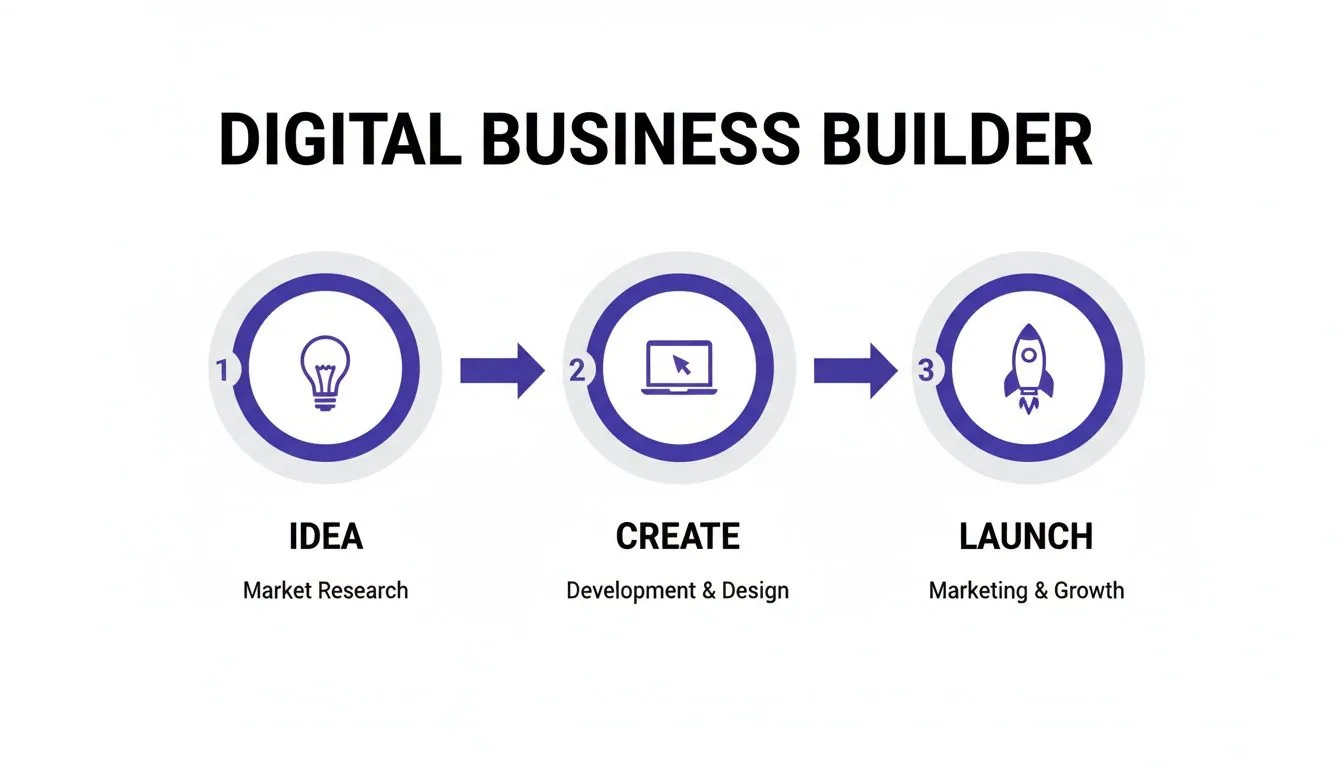
This breaks the journey down into three clear actions: Idea, Create, and Launch. It's a direct line from concept to a product that's out in the world, making an impact.
To give you a clear roadmap of everything we'll cover, here's a quick look at the five major phases you'll go through.
| The Five Phases of a Digital Product Business Launch | ||
|---|---|---|
| Phase | Core Objective | Key Activities |
| Phase 1: Idea & Validation | Confirm your idea solves a real, painful problem people will pay for. | Niche selection, customer research, competitive analysis, and pre-selling. |
| Phase 2: Product Creation | Build a high-value Minimum Viable Product (MVP) that delivers a quick win. | Outlining content, creating the product, and designing the user experience. |
| Phase 3: Infrastructure & Pricing | Set up the technical and financial systems to sell your product effectively. | Choosing a platform, setting up payments, and creating pricing tiers. |
| Phase 4: The Launch | Execute a coordinated marketing campaign to drive initial sales and momentum. | Building an email list, creating launch content, and running promotions. |
| Phase 5: Growth & Community | Scale revenue by nurturing your audience and creating long-term value. | Gathering testimonials, iterating on the product, and building a community. |
Each of these phases builds on the last, taking you from a rough concept to a thriving, scalable business.
From Concept to Community
So many creators get stuck in "pre-launch paralysis," totally overwhelmed by the tech and the sheer number of choices. The secret is to start simple and focus on what matters: delivering value. Instead of trying to tape together a dozen different tools, a single, unified platform can handle the grunt work for you.
A successful digital business isn't built on complex technology; it's built on a strong connection with an audience. Your tools should serve that connection, not complicate it.
This mindset frees you up from being a part-time IT manager so you can be the expert your audience came for. When your payments, course access, and community chats all live in one place, you create a frictionless experience for your customers.
Choosing the right platform is often the first real step toward building that ecosystem. This is where one-time buyers start to feel like they belong, turning them into loyal members of your brand for the long haul.
Finding and Validating Your Profitable Idea
The best digital products aren’t born from a flash of random inspiration. They’re engineered to fix a specific, nagging problem for a specific group of people. Before you write a single line of text or record one second of video, your first job is to put on your detective hat and uncover the real-world frustrations your future customers are struggling with right now.
Forget the cliché advice to "follow your passion." A much smarter approach is to find the intersection of your passion and a problem so painful that people will gladly pay you to make it go away. Your expertise is the tool, but the problem is the entire point.
Start by listening. Seriously. Go hang out where your ideal audience lives online. This could be a niche subreddit, a focused Facebook group, or a specialized industry forum. Pay close attention to the recurring questions, the common complaints, and the half-baked solutions people are already trying to use. These conversations are an absolute goldmine.
Uncovering Problems Worth Solving
Another killer strategy? Solve a problem you’ve already conquered yourself. Did you figure out a system to train for a marathon while working a 60-hour week? Did you finally master that one piece of software that drives everyone else crazy? Your past struggles are often your most authentic—and profitable—product ideas.
Once you’ve got a short list of potential ideas, it’s time for the most important step of all: validation. This is where you test your idea with real people before you sink months into building something nobody actually wants. And validation isn't about asking your friends if they "like" your idea. It’s about getting a genuine signal that someone would pull out their credit card for it.
The global eCommerce market is a beast, projected to hit $7.5 trillion in sales by 2025, serving over 2.77 billion shoppers. Your audience is definitely out there. Validation is how you find them and confirm you’ve got something they truly value.
The Lean Validation Method
The goal here is to prove there’s real demand with the least amount of effort. The most effective way I’ve seen this done is with a simple pre-launch test. You don’t need a finished product. You just need a compelling promise.
Here’s how you pull it off:
- Spin Up a Simple Landing Page: Build a single page that clearly describes the product you plan to create. Don't list features; sell the transformation. What result will your customer achieve?
- Nail the Problem: Start by articulating the pain point you discovered. You need your visitor to nod their head and think, "Yes, that's me."
- Present Your Solution: Briefly explain how your e-book, course, or template will solve that specific problem.
- Create a No-Brainer Call to Action: Instead of a "Buy Now" button, use something like "Join the Waitlist" or "Get Notified at Launch." Your only goal is to capture email addresses from people who are genuinely interested.
This simple act of collecting emails is your first, most critical validation signal. If you can't convince people to give you an email address for free, it's going to be a tough sell asking for their credit card details later. A huge part of this is knowing exactly who you're talking to. If you haven't already, dive deep into finding your target audience.
A waitlist is so much more than a list of emails. It’s a focus group of your most motivated future customers. It’s your direct line for feedback, and it’s your built-in audience for launch day.
Treat this early group like gold. Send them updates. Ask for their opinions. Involve them in the creation process. This feedback loop is priceless for shaping a product that truly hits the mark and solves their problem. It de-risks the entire venture. If you're weighing different formats, our guide on how to create digital downloads that sell can help you decide. By building on a foundation of proven demand, you're not just hoping for success—you're building it.
Choosing Your Product and Building Your Tech Stack
You’ve got a validated idea—now for the fun part. It’s time to decide what form your digital product will take and how you’ll actually build and sell it. This is a critical fork in the road, as the format you choose dictates everything from how you create it to how you price it.
This decision isn’t about chasing trends. It's about picking the right tool for the job your audience needs done.
An e-book or a slick set of templates is often the smartest place to start. They're relatively low-risk, fast to produce, and can start bringing in revenue almost immediately. That first sale gives you momentum and, more importantly, hard data on what your audience truly values.
A deep-dive online course, on the other hand, can fetch a much higher price but demands a serious commitment of time and energy upfront. Then you have the holy grail: a paid community or premium newsletter, which opens the door to recurring revenue. This builds incredible long-term relationships but requires you to show up consistently to keep members engaged.
Selecting the Right Digital Product Format
The best way to decide is to match the product type directly to the problem you’re solving.
- For quick, actionable solutions: Think e-books, checklists, or focused video workshops. These deliver a specific, satisfying win without overwhelming your customer.
- For in-depth skill transformation: An online course is the clear winner here. It lets you guide students through a structured learning journey, one module and lesson at a time.
- For ongoing support and connection: Nothing beats a paid community or membership. You're creating a dedicated space for continuous learning, networking, and direct access to you.
Many of the most successful creators we work with start with a smaller product to generate cash flow and fund a more ambitious project later. Don't build a massive course if a simple, targeted e-book solves the immediate pain point more effectively.
The Crossroads of Technology: Your Tech Stack
Once you know the "what," you have to figure out the "how." This means assembling your tech stack—the collection of tools that handles everything from hosting your content to processing payments. This is where so many aspiring founders get completely stuck, and it’s a decision that can make or break your business.
A common path is the DIY approach, usually cobbled together with WordPress. You start with a basic site, then bolt on a collection of plugins for e-commerce, memberships, course delivery, and email marketing. While it feels flexible at first, it often devolves into a technical nightmare.
You end up spending your days fighting compatibility issues, patching security holes, and dealing with a clunky, disjointed experience for your customers. For creators building a real business, that wasted time is a direct hit to the bottom line.
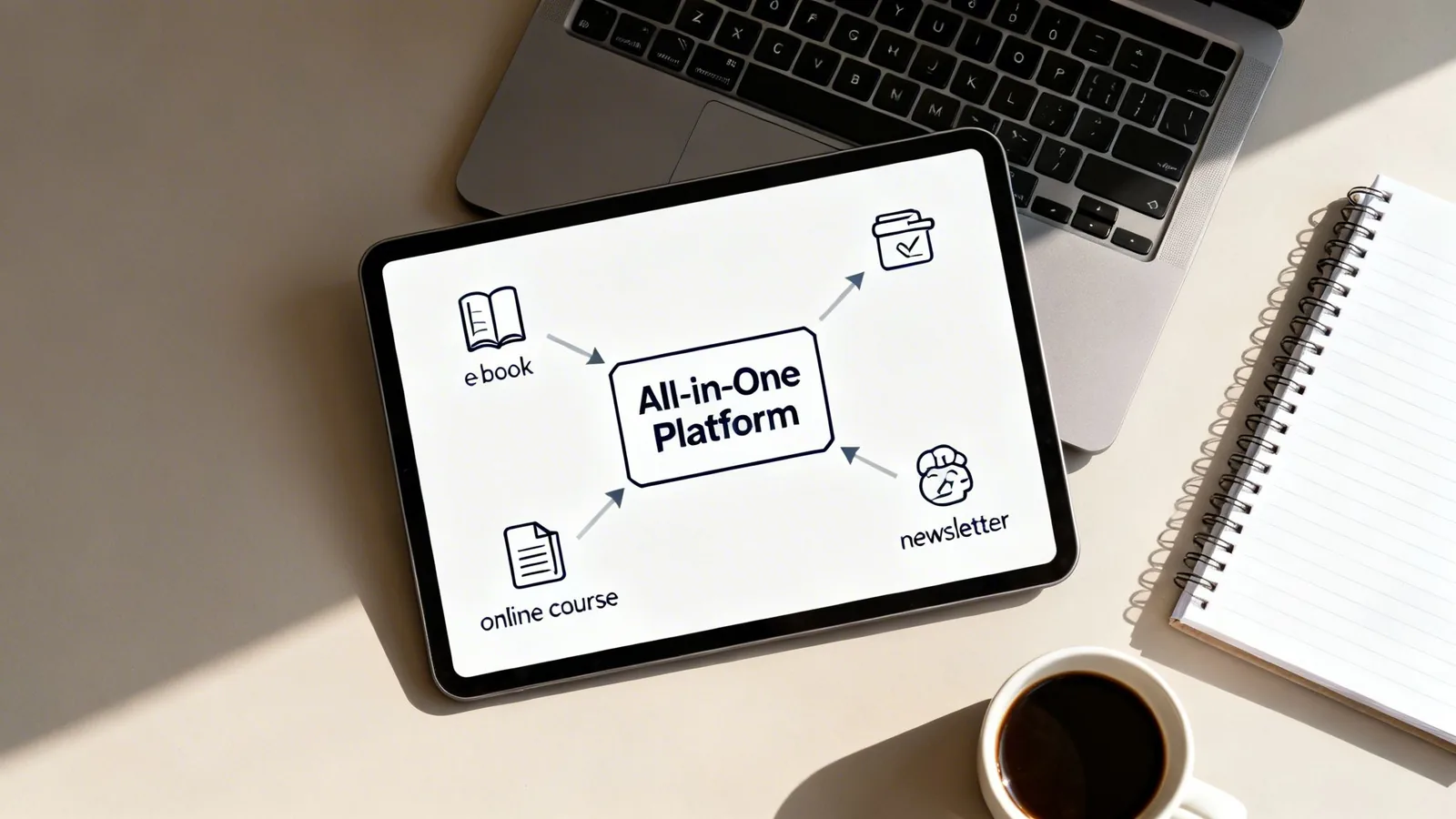
There’s a much simpler, more scalable way: an all-in-one platform.
An all-in-one platform isn’t just about convenience; it’s a strategic choice to protect your time and focus. It automates the administrative busywork, freeing you to create the high-value content your business depends on.
These platforms are built from the ground up specifically for creators selling digital products, bundling every essential feature into one seamless system.

Why an Integrated System Wins
Picture this: a customer buys your online course. With an integrated platform like Zanfia, an AI team runs the moving parts for you: the system takes payment, enrolls them in the course, adds them to the right community channel, and fires off a welcome email sequence. You can tell the assistant what to change by chat or by voice instead of digging through settings, and anything doable in the interface is doable that way. That automation alone easily saves you 5–10+ hours of manual work every single month.
Now imagine that same scenario on a pieced-together system. Your payment gateway has to "talk" to your course plugin, which then has to ping your separate community tool (like Discord) and your email provider. If a single one of those connections breaks—and they will—the whole process fails. You’re left with an angry customer and a support ticket headache.
For creators building a true ecosystem across 12 product types—courses, communities, newsletters, downloads, memberships, bookings and more—a unified platform is non-negotiable. It gives your customers a single login to access everything they've ever bought from you, all under one brand. That seamless experience is what drives engagement and keeps people coming back. To see how different options compare, you can explore some of the best platforms to sell digital products right now.
Choosing your tech stack is a foundational step in learning how to start a digital product business. By going with a reliable, all-in-one solution, you aren't just buying software; you're buying back your time and the mental space to focus on what actually grows your business.
Crafting and Pricing Your Digital Offer
Alright, time to switch hats. You've been the architect, and now you become the builder. With your idea validated and your tech stack chosen, your entire focus shifts to actually creating the thing you’re going to sell.
Whether you're outlining an e-book or recording video lessons for a course, the mission is always the same: deliver a clear and tangible transformation.
Your customer isn't just buying a bunch of files or a login to a portal. They are buying a result. They're paying for a shortcut from their current frustration to where they want to be. Every single piece of content you create needs to serve that journey.
This is exactly why the nuts and bolts of your platform matter so much. Tools like Zanfia have features that seem small but make a huge difference. Think about native video hosting—it means you don't have to pay for a separate, expensive service like Vimeo or Wistia. Or a smart video player that remembers where a student left off. There's also a test mode on every checkout, so you can buy your own product end to end before the first real sale and confirm the funnel works. These aren't just bells and whistles; they create a smooth, professional experience that keeps people engaged and moving forward.
Architecting Your Pricing Strategy
You could build the most incredible product in the world, but if your pricing strategy is broken, you’ll never get off the ground. Pricing isn't just about pulling a number out of thin air. It’s a strategic signal that communicates your product's value, attracts the right kind of customer, and dictates the financial health of your business.
Please, don't just look at what your competitors charge and copy it. Your price needs to be anchored to the outcome you provide. If your course helps a freelance designer land one more client, its value is directly tied to the thousands they’ll earn from that project. You have to frame your price around that ROI.
The goal is to make your offer's value so undeniably clear that the price becomes an easy "yes" for the right customer. The more tangible the result, the easier it is to justify a premium price.
And trust me, the market is ready for it. The digital content creation space, which is the engine behind courses and newsletters, was valued at $32.28 billion in 2024 and is projected to smash $70 billion by 2030. This isn't just noise; it’s proof that people are more than willing to pay good money for expertise that solves a real-world problem. Don't be afraid to charge what you're worth. You can see the full research on these trends to really grasp the opportunity.
Models for Monetization
How you charge is just as important as how much. A flexible platform lets you meet different customers where they are and seriously maximizes your revenue potential.
- One-Time Purchase: Simple and clean. They pay once and get access forever. This is perfect for e-books, template packs, and one-off workshops.
- Subscriptions: This is the holy grail for predictable, recurring revenue. It's the go-to model for communities, paid newsletters, and any kind of ongoing content library.
- Installment Plans: For higher-ticket courses, offering a payment plan makes your product far more accessible without devaluing it. Split a $600 course into four payments and watch conversion climb.
- Bundles & Tiers: This is how you increase your average order value. You could bundle your main course with community access and a private coaching call to create a premium, irresistible package. Order bumps at checkout let you attach an add-on to any purchase.
The creators I see scaling up are almost always using a mix of these models. They’ll sell a core course as a one-time buy but offer a premium community subscription as an upsell. This kind of flexibility is a non-negotiable in today's creator economy, which is why choosing a platform that supports all these options from day one is so critical. If you want to go deeper on this, we've got a complete guide on the psychology behind effective pricing strategies.
Ultimately, your offer is the whole package: the product itself, the transformation it promises, and the pricing that makes it a no-brainer. Nail these three, and you've built an engine for growth.
Launching and Marketing Your First Digital Product
A powerful launch doesn't happen by accident. It's a carefully orchestrated event, and the real work begins weeks—sometimes even months—before you ever think about opening the cart. The goal is to build a groundswell of anticipation, creating an audience of warm leads who are genuinely excited to buy the moment you go live.
Your existing channels, like your email list and social media profiles, are your best friends during this pre-launch phase. Start dropping hints. Share behind-the-scenes content that pulls back the curtain on your creation process—the outlines scribbled on a whiteboard, your recording setup, the late-night writing sessions. This kind of transparency forges a real connection and makes your audience feel like they're part of the journey.
The single most effective pre-launch tactic? A waitlist. This isn't just a list of emails; it's your VIP club, filled with people who have explicitly raised their hands and said, "I want this." A waitlist is your final validation check and gives you a hyper-engaged group to market to on day one.
Orchestrating a High-Impact Launch
Once it's time to go live, your marketing needs to shift gears from building buzz to driving action. This is where a well-crafted email sequence becomes your money-maker. Don't just send a single "hey, it's here!" email and call it a day. You need a multi-day campaign that educates, builds trust, and systematically dismantles any objections.
A killer launch sequence might look something like this:
- Day 1: The Big Announcement. Reveal the product, focusing entirely on the core problem it solves and the transformation it promises.
- Day 2: Show, Don't Tell. This is all about social proof. Share testimonials from beta testers or early feedback. Let real people show the real results they’re getting.
- Day 3: The "Why" Behind the What. Tell the story of why you created this product. What problem did you face? What inspired you? Connect with your audience on a human level.
- Day 4: Overcome Every Objection. Tackle common questions and concerns head-on with a detailed FAQ-style email. Be honest and direct.
- Day 5: The Ticking Clock. Introduce a launch-only bonus or special pricing that disappears when the cart closes. Urgency, when used ethically, is a powerful motivator.
This structured approach is designed to guide potential customers from casual curiosity to a confident "yes."
The Power of Automation in Your Launch
Now, imagine trying to manage all of this by hand. A new customer buys your course, and you have to personally email them the login details, manually add them to your email platform, and then send a separate invite to your private community. It's not just a headache; it's a recipe for burnout and a clunky customer experience.
This is where automation becomes your secret weapon.
An automated system doesn't just save you time; it creates a professional, seamless experience that makes your customers feel cared for from the moment they click "buy." It ensures every new member gets the same high-quality onboarding, every single time.
With an integrated platform like Zanfia, an AI team handles these post-purchase workflows without you having to babysit them, and you can adjust the flow by dictating to the assistant instead of clicking through settings screens. The system just works in the background:
- Instant Access: The moment a payment clears, the customer automatically gets access to their course, download, or community. No waiting.
- Smart Onboarding: They're immediately added to the right welcome email sequence, guiding them through their first steps and pointing out key resources.
- Community Integration: If your product includes a community, they are automatically added to the right spaces or channels based on their purchase.
These automations can easily save you 5–10+ hours per month, especially during a hectic launch. That's time you can pour back into engaging with your new customers and promoting your product instead of getting bogged down in administrative tasks. You can get a head start by exploring our guide on the perfect sales funnel template, a key piece of the puzzle.
This level of operational smoothness is what separates amateur creators from professional business owners. It lets you scale without sacrificing quality, ensuring your launch isn’t just profitable but sustainable for the long haul.
Scaling Your Business Beyond the First Sale
That first sale is an incredible feeling, isn't it? But your launch isn’t the finish line—it’s the starting gun. While it’s tempting to see that initial revenue as the big win, the real, sustainable success of your digital product business hinges on everything that comes next.
The goal isn't just to make a sale; it's to build an entire ecosystem around your products, turning one-time buyers into loyal, long-term fans.

One of the most effective ways to do this is by building a community. A dedicated space transforms the customer relationship from a simple transaction into an ongoing conversation. This dramatically increases customer lifetime value and gives you an invaluable, real-time feedback loop for whatever you build next.
And a quick tip: avoid scattering your audience across third-party tools like Facebook groups or Discord. An integrated community keeps everyone under your brand. When your course content and discussion channels live in the same place, it creates a seamless, premium experience that boosts engagement.
Optimizing Your Growth Engine
Once you’re making sales, your focus has to shift from pure creation to smart optimization. This is where you put on your analyst hat and start digging into the data. Your sales platform should be more than just a checkout page; it needs to give you deep visibility into how customers are finding and interacting with your offers.
Start asking some critical questions with your built-in analytics:
- Where are people dropping off in the sales funnel? Is your sales page the problem, or is something clunky at checkout?
- What content is actually driving sales? Which blog posts or emails are bringing in the most traffic and conversions?
- How are members really using your products? Which course lessons have the highest completion rates? What topics are blowing up in the community?
Spotting these patterns allows you to make targeted, high-impact improvements. Sometimes a small tweak to a sales page headline or clarifying a confusing step at checkout can make a massive difference in your conversion rates.
The most successful creators obsess over these details. They know that scaling isn’t about huge, risky bets. It's about making consistent, data-informed optimizations that compound over time.
This mindset is what separates a fleeting side hustle from a sustainable business. It moves you from relying on the adrenaline of launch spikes to building predictable, recurring revenue you can count on.
The Power of Smart Automation and Flexible Monetization
To truly scale, you need systems that work for you, not against you. This is where automation and flexible payment models become your best friends. Imagine the hours you could get back if your platform automatically handled subscription renewals, sent transactional emails, and revoked access when a plan ends—and if you could tell an AI assistant, by chat or voice, to spin up a new offer or a launch sequence instead of building it click by click.
That's not just a convenience; it's a strategic advantage. For creators serious about growth, those reclaimed 5–10+ hours a month are a game-changer. It's time they can spend on strategy and creation instead of wrestling with spreadsheets.
Even more crucial is choosing a platform that doesn't penalize your growth. Many platforms take a percentage cut of every single sale, which means their fees get bigger right as you're starting to succeed. As of publication, Zanfia charges a 0% platform fee on transactions, so you keep 100% of what your buyers pay (only your payment processor, e.g. Stripe, takes its standard cut, typically around 2.9% + $0.30 in the US).
This transparent SaaS model means the platform grows with you, not at your expense. It protects your margins as you scale, allowing you to build a powerful, independent brand and a truly profitable digital business.
Frequently Asked Questions
How Much Does It Cost to Start a Digital Product Business?
The honest answer? It depends. The investment to get started can swing wildly based on the path you choose.
One route is the classic DIY approach: cobbling together a WordPress site with various plugins, paying for separate video hosting, and adding a third-party email tool. This can feel cheaper upfront, but the costs become unpredictable. You're constantly dealing with maintenance fees, surprise updates, and things that just… break. It adds up fast.
The more modern, straightforward path is using an all-in-one platform like Zanfia. This shifts your costs into a clear, predictable monthly subscription—Zanfia starts at $39/month, or $31/month billed annually, on the Starter plan, with a 14-day free trial and no credit card required (as of August 2026, see Zanfia pricing). Your main expenses simply become the platform fee and the standard payment processor fees (like from Stripe or PayPal). It’s a much lower-risk and more scalable way to get your business off the ground.
What Is the Easiest Digital Product to Sell First?
For most experts jumping in for the first time, you can't go wrong with a concise e-book, a short video workshop, or a paid newsletter. These are fantastic starting points.
Why? Because they require significantly less upfront creation time than, say, a massive, 20-module online course.
This "start small" strategy lets you test the waters, validate that people actually want what you're teaching, and start building an audience of real, paying customers. Once you have that initial success and cash flow, you can reinvest that momentum into creating your more comprehensive flagship products.
How Do I Protect My Digital Products from Piracy?
While no security is 100% foolproof, using a secure, professional platform is your best line of defense. These systems are built to manage user access tightly. They make sure only authenticated, paying customers can view your content behind a required login.
Protecting your content is less about building an impenetrable fortress and more about making it more convenient to buy than to steal. A seamless user experience and a strong community culture are your best deterrents.
Platforms that offer native video hosting also add a crucial layer of security, making your content much harder to illegally download compared to just embedding public YouTube or Vimeo links. More importantly, when you build a strong community around your work, you create a culture of support where members genuinely value what you do and are far less inclined to share it illicitly.
Do I Need a Large Social Media Following to Succeed?
Absolutely not. This is one of the biggest myths out there. You don't need a huge following, but you do need a targeted one.
It is far more valuable to have 100 highly engaged email subscribers who trust your expertise than 10,000 passive social media followers who barely see your posts anyway.
Your real focus should be on building a direct line of communication with your potential customers through an email list or a private community space. This is where you can build real relationships, deeply understand their problems, and market your products effectively to people who have already raised their hands to say they're interested.
Ready to stop juggling tools and start building your digital product business with confidence? Zanfia is an all-in-one platform where an AI team runs the moving parts for you: you can dictate changes to the assistant by chat or voice, sell across 12 product types under one brand, and use a checkout built for order bumps, installments and upsells—with a test mode so you can buy your own product end to end before launch. As of publication, Zanfia charges a 0% platform fee on customer sales. Start your 14-day free trial.