

10 Powerful Pricing Psychology Strategies to Boost Your Sales in 2026
Pricing isn't just a number; it's a powerful signal that communicates value, quality, and trust. For digital creators and online businesses, mastering the art of pricing is the key to unlocking sustainable growth. The difference between a thriving online course and one that struggles to gain traction often comes down to the subtle cues embedded in its price. This is where understanding and applying proven pricing psychology strategies can fundamentally change your business trajectory.
This guide moves beyond theory to provide a detailed, actionable roundup of the most effective tactics used by successful entrepreneurs. We will explore 10 distinct strategies, from the familiar "Charm Pricing" to the sophisticated "Decoy Effect," breaking down not only what they are but precisely why they work on a psychological level. More importantly, you'll learn how to implement them for your own digital products, whether you sell courses, memberships, paid newsletters, or e-books.
Each strategy includes specific A/B testing ideas and practical examples tailored for creators using platforms like Zanfia, an AI team that runs your creator business. You can dictate changes to your checkout, courses, or community by chat or by voice, and connect your own AI agents through the MCP endpoint on higher plans. Because Zanfia was built to sell, with order bumps, installments and test mode all under one roof, you can experiment with pricing without sacrificing revenue thanks to its 0% platform commission on customer sales. To truly unlock higher revenue and understand how customers perceive prices, it's essential to delve into strategies that genuinely help increase conversion rates and boost sales. This article gives you the tools to do just that, turning psychological insights into measurable financial results.
1. Charm Pricing (The .99 Effect)
Charm pricing is one of the most widely recognized and effective pricing psychology strategies. It involves ending a price with the number nine, most commonly .99 or .97, to make it seem significantly lower than it is. For example, customers perceive $29.99 as being closer to $20 than to $30, even though it's only a one-cent difference. This psychological phenomenon happens because we read from left to right, and our brain anchors on the first digit (the "left-digit effect"), creating a powerful perception of a bargain.
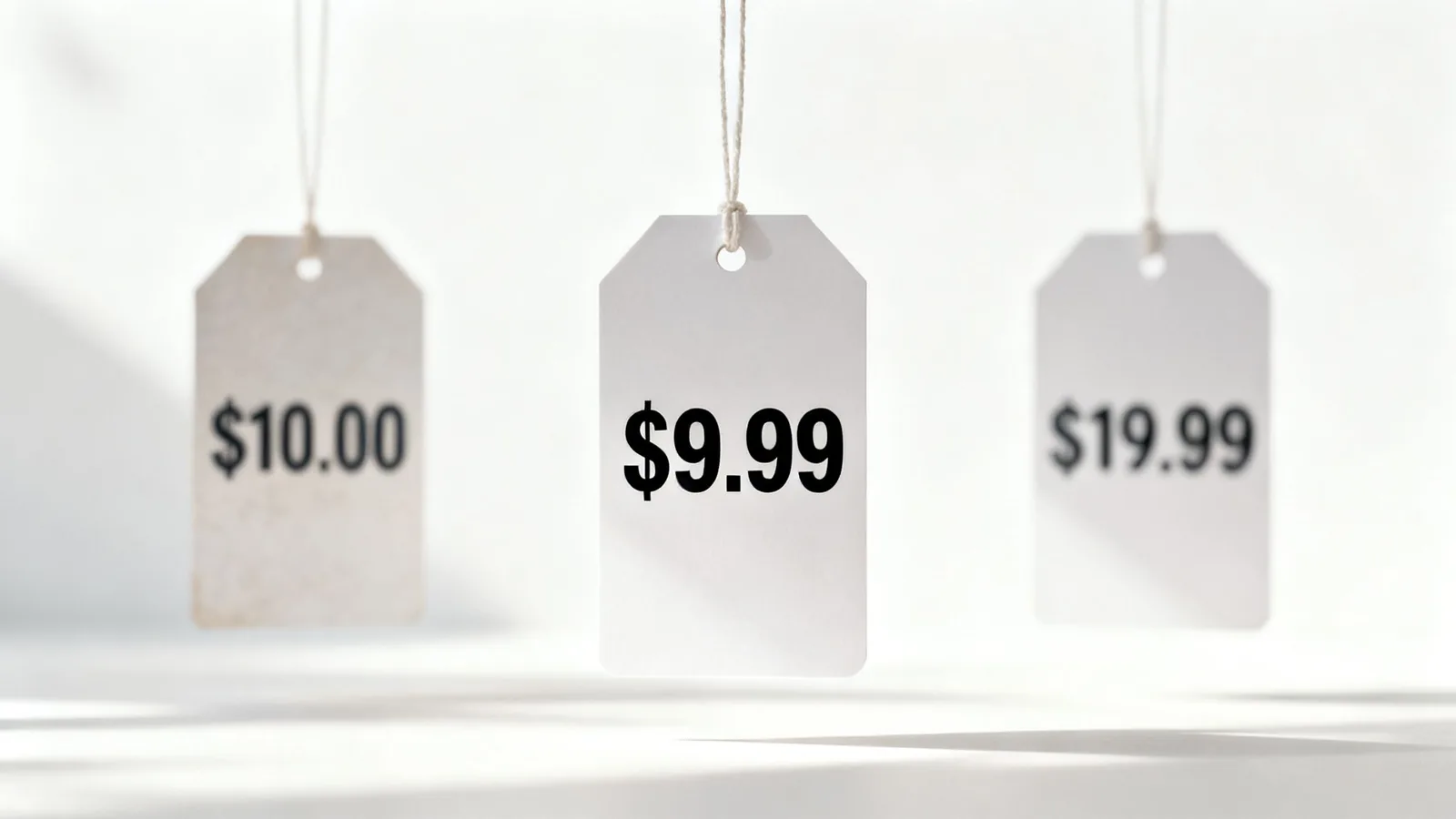
This tactic is particularly potent for digital products and subscriptions, where perceived value heavily influences purchasing decisions. It creates an immediate sense of getting a good deal without you having to sacrifice significant revenue.
How to Implement Charm Pricing on Zanfia
For creators using a platform like Zanfia, applying charm pricing is straightforward and can yield immediate results. Because Zanfia charges 0% platform commission on customer sales, every cent you keep matters, and this strategy helps maximize revenue on each sale. You can adjust prices across your storefront by dictating the change to the Zanfia AI Assistant, no clicking through settings required.
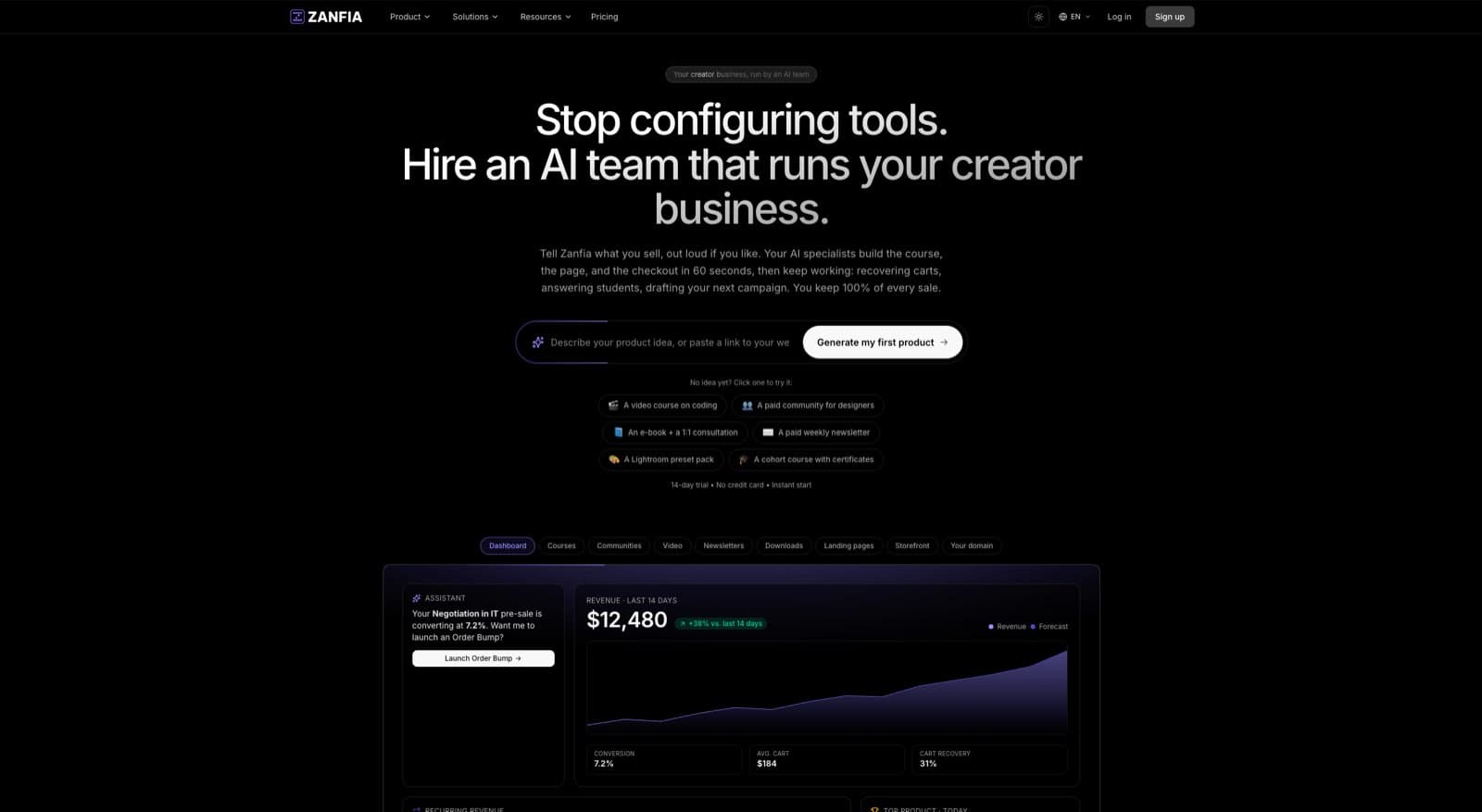
- Set Course and Product Prices: When creating a new online course or e-book, price it at $49, $97, or $197 instead of rounding up to $50, $100, or $200. This small change can improve your conversion rate.
- Structure Subscription Tiers: Apply charm pricing to your community membership or paid newsletter tiers. A membership at $19.99/month feels more accessible and appealing than a flat $20/month.
- Create Bundles: When bundling products, such as an e-book and a mini-course, use a charm price like $77 or $97 to signal a high-value combination deal.
Key Insight: Charm pricing works best for value-focused offers. For premium or luxury-positioned products, a rounded number (e.g., $500) can sometimes convey higher quality and confidence.
A/B Testing Ideas
To validate its effectiveness for your audience, run simple tests:
- Test Endings: Pit a price ending in .99 against one ending in .95 (e.g., $29.99 vs. $29.95) to see which resonates better.
- Charm vs. Round: Test a charm price ($47) against a rounded price ($50) for the same product to measure the direct impact on sales conversions. Before you launch either, open the checkout in test mode and run a test purchase so you know the price, tax and conversion event all fire correctly. Then monitor the live results using Zanfia’s built-in analytics to make a data-driven decision.
2. Tiered Pricing (Good, Better, Best)
Tiered pricing is a powerful strategy that presents multiple options to customers, typically in a "Good, Better, Best" format. By offering distinct packages at different price points, you empower customers to choose the one that best fits their needs and budget, effectively capturing multiple market segments with a single product offering. The psychology behind this is that it shifts the customer's question from "Should I buy this?" to "Which version should I buy?"

This approach leverages the "Goldilocks Effect," where customers naturally gravitate toward the middle option, perceiving it as the best balance of features and value. It's a cornerstone of the SaaS industry, used by giants like Slack and Notion to guide users toward their most popular plans.
How to Implement Tiered Pricing on Zanfia
For creators, tiered pricing is ideal for monetizing memberships, courses, and knowledge bases. Zanfia’s integrated platform makes it simple to create distinct value levels, and because you keep 100% of your revenue with its 0% platform commission, this strategy directly boosts your bottom line. You can spin up new tiers by dictating them to the AI Assistant, then preview them end to end with a test purchase before going live.
- Create Membership Tiers: When you build a membership website , offer different access levels. A "Basic" tier might grant community access, a "Plus" tier could add exclusive courses, and a "Premium" tier might include one-on-one coaching calls.
- Structure Course Packages: Sell a single course with tiered options. A base package could include video lessons, while a "Plus" package adds downloadable workbooks and access to a private community channel.
- Price Tiers Strategically: Use a multiplier like 1x, 2x, and 4x to price your tiers (e.g., $49, $99, $199). This makes the middle option appear as the most reasonable and attractive deal.
Key Insight: The success of tiered pricing depends on meaningful feature differentiation. Each tier must offer a clear and compelling increase in value to justify the higher price, guiding customers to self-select the best option for them.
A/B Testing Ideas
To optimize your tiers, experiment with their presentation and value proposition:
- Feature Highlighting: Test which features you emphasize in each tier. Does highlighting "community access" in the middle tier outperform highlighting "exclusive content"?
- Tier Positioning: A/B test the order of your tiers. While "Good, Better, Best" is standard, some audiences might respond better to seeing the premium option first. Use Zanfia’s built-in analytics to see which layout drives more conversions to your target tier.
3. Anchoring Effect
The anchoring effect is a cognitive bias where we rely heavily on the first piece of information offered (the "anchor") when making decisions. Pioneered by psychologists Daniel Kahneman and Amos Tversky, this strategy involves presenting a higher-priced option or an initial price point first, which makes subsequent prices seem more reasonable and attractive in comparison. For digital products, where tangible value is abstract, the anchor powerfully shapes a customer's perception of what a course or membership is "worth."
Presenting a higher-priced "original" value anchors the customer's expectation, making the actual selling price feel like a significant bargain. This tactic is fundamental to many effective pricing psychology strategies because it reframes the purchase from an expense into a smart investment.
How to Implement the Anchoring Effect on Zanfia
On Zanfia, you can strategically place anchors across your product pages and sales funnels to guide customer perception and boost conversions. Since Zanfia gives you full control over your branding and product presentation via white-label features and custom domains, implementing this is simple and effective. Any change you want to run, from a strike-through price to a new installment plan, you can dictate to the AI Assistant instead of hunting through menus.
- Show a "Compare At" Price: When setting up a promotion for a course or e-book, display the original price crossed out next to the sale price (e.g., $97 $47 ). This immediately establishes the higher value and highlights the savings.
- Lead with Your Highest Tier: When offering multiple membership tiers, always list the most expensive option first. An "All-Access" plan at $497/year makes a lower plan at $47/month seem far more affordable and accessible by comparison.
- Frame Installment Plans: For high-ticket courses, anchor with the full price before presenting the installment plan. For example, show "Value: $997" prominently before offering "or 3 payments of $347." Zanfia's checkout supports installments natively, so you can split a $600 course into four payments without a third-party tool.
Key Insight: The anchor must be believable. An inflated, unrealistic original price can break trust and backfire. The anchor should reflect the genuine value your product delivers, which you can effectively communicate by learning how to write compelling product descriptions.
A/B Testing Ideas
To find the most effective anchor for your audience, test different approaches:
- High vs. Medium Anchor: Test a significantly higher "compare at" price (e.g., $197 $47) against a more conservative one (e.g., $97 $47) to see which one drives more conversions without appearing disingenuous.
- Annual vs. Monthly Anchor: For subscriptions, test showing the annual price first ("$299/year") versus showing the monthly price first ("$29/month"). The higher annual anchor often makes the monthly option feel like a low-risk choice.
4. Pay-What-You-Want (PWYW) Pricing
Pay-What-You-Want (PWYW) is a bold pricing psychology strategy that flips the traditional sales model on its head. Instead of setting a fixed price, you empower customers to pay what they feel your product is worth, often with a suggested price to guide them. While it seems risky, this approach can build incredible goodwill, increase sales volume, and create a loyal audience that feels trusted and respected. Iconic examples, like Radiohead's In Rainbows album, prove it can generate significant revenue by fostering a sense of fairness and reciprocity.
This strategy is exceptionally effective for digital creators looking to generate leads, validate a new product idea, or lower the barrier to entry for their community. It allows potential customers to experience your value firsthand without financial risk, making them more likely to invest in your premium offerings later.
How to Implement PWYW Pricing on Zanfia
For creators using Zanfia, PWYW is a powerful tool for audience building. Because the platform charges 0% platform commission on customer sales, you can experiment with this model for lead generation without worrying about a platform cut eating into the contributions you receive. Zanfia offers a 14-day free trial with no credit card required, so you can wire up a PWYW funnel end to end before you decide on a plan.
- Offer a Lead Magnet: Create a high-value resource, like a mini-e-book, a template, or the first module of a course, and offer it with PWYW pricing. Capture emails during the checkout process to grow your list.
- Launch a New Product: Use PWYW for the initial launch of a small digital product to gather feedback, generate testimonials, and build initial momentum. Always include a "suggested price" to anchor customer expectations.
- Build Community Access: Offer a trial or entry-level tier to your community with a PWYW model. This allows new members to experience the value of your community before committing to a full subscription.
Key Insight: PWYW thrives on transparency and goodwill. Use it for introductory products to build trust and guide users toward your core, fixed-price offerings like comprehensive courses or premium memberships.
A/B Testing Ideas
To see how PWYW resonates with your audience, try these simple tests:
- Suggested vs. No Suggested Price: Run one PWYW offer with a clearly stated suggested price (e.g., "Suggested Price: $15") and another with no anchor to see which generates a higher average contribution.
- Minimum vs. No Minimum: Test a PWYW offer with a small minimum price (e.g., $1) against a true "$0+" offer. Analyze not only the average payment but also the conversion rate using Zanfia's analytics to see which approach attracts more long-term customers.
5. Decoy Pricing (Asymmetric Dominance)
Decoy pricing, also known as the asymmetric dominance effect, is a sophisticated strategy that nudges customers toward a specific option by introducing a third, slightly inferior "decoy" choice. This decoy is strategically designed to make your preferred option (the target) look far more valuable in comparison. As behavioral economist Dan Ariely famously demonstrated, when presented with two choices, people weigh them based on their merits; when a third, clearly worse option is added, it changes their entire decision-making process.
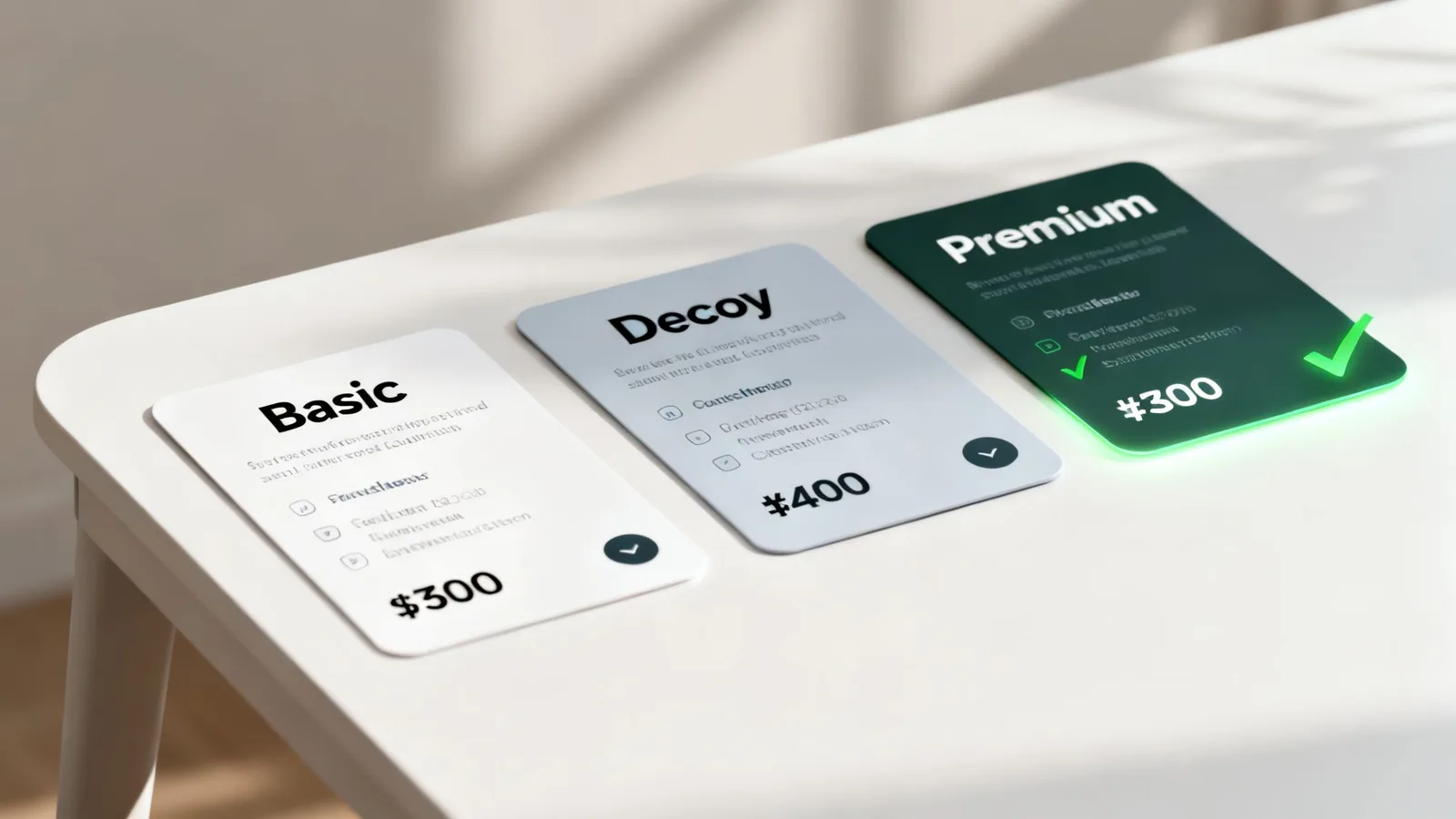
The classic example is The Economist's subscription offer: Web Only for $59, Print Only for $125, and Print + Web for $125. The "Print Only" option serves as the decoy; almost no one chooses it, but its presence makes the "Print + Web" package seem like an incredible deal, dramatically increasing its selection rate.
How to Implement Decoy Pricing on Zanfia
For creators on Zanfia, this is one of the most powerful pricing psychology strategies for structuring multi-tiered offers like memberships or course bundles. It guides new customers toward the exact package you want them to choose, boosting average order value and profitability, especially when every dollar earned is kept thanks to the 0% platform commission on customer sales.
- Structure Membership Tiers: Create three community tiers. For example: an entry plan with limited access for $19/month, a full plan with all access for $49/month, and a decoy plan with slightly less access than the top option (e.g., no live Q&As) for $45/month. The decoy makes the full plan look like a clear winner.
- Design Course Bundles: When selling courses, offer a single course for $197, a bundle of three courses for $397, and a decoy option of two courses for $377. The small price difference makes the three-course bundle the obvious, high-value choice.
- Tier Your Digital Products: Offer an e-book for $27, the e-book plus a video workshop for $77, and a decoy "e-book plus audio version" for $67. The video workshop bundle now appears far more valuable for just $10 more.
Key Insight: The decoy's purpose isn't to sell; it's to make the comparison easy and steer customers to your target offer. Ensure the decoy is priced and featured in a way that makes the target option seem overwhelmingly superior.
A/B Testing Ideas
To perfect your decoy strategy, test how your audience responds:
- Price Proximity Test: Test a decoy priced very close to your target option (e.g., $95 decoy vs. $97 target) against one priced further away (e.g., $87 decoy vs. $97 target) to see which one provides a stronger cognitive push.
- Feature-Based Decoy Test: Create two versions of your pricing page. One uses a price-based decoy, and the other uses a feature-based decoy (e.g., Target: Course + Community, Decoy: Course + E-book for a similar price). Use Zanfia’s analytics to track which approach drives more conversions to your target tier.
6. Psychological Price Points
Beyond the simple .99 effect, certain price thresholds carry significant psychological weight and dramatically influence how customers perceive value. Psychological price points are specific numbers, such as $47, $97, or $499, that have become market-accepted signals for different tiers of quality and investment. Hitting these precise points can frame your offer correctly and justify the purchase in the buyer's mind.
This strategy works because consumers are conditioned to associate certain price ranges with specific value levels. A course priced at $97 is perceived as a serious, valuable resource, whereas a $100 price might trigger more scrutiny. These thresholds act as mental shortcuts, helping customers categorize your product and make faster, more confident purchasing decisions.
How to Implement Psychological Price Points on Zanfia
For Zanfia creators, aligning product prices with established psychological price points is crucial for positioning and conversions. It helps your audience immediately understand the value proposition of your courses, memberships, and digital downloads. Zanfia makes setting these specific price points simple across one-time sales, subscriptions, and bundles, and you can dictate the change to the AI Assistant across every product at once instead of editing them one by one.
- Price Entry-Level Products: For introductory courses, e-books, or workshops, use prices like $27 or $47. These figures suggest a low-risk, high-value entry point that encourages new customers to join your ecosystem.
- Set Core Offer Prices: For your main courses or signature programs, price points like $97, $197, and $297 are ideal. These are recognized as standard investments for substantial, high-quality educational content.
- Position Premium Offers: Use prices like $497, $997, or higher for advanced masterminds, in-depth certifications, or extensive coaching programs. These prices signal exclusivity, expertise, and a significant transformation for the buyer.
Key Insight: The difference between $97 and $100 is far more than three dollars. It’s the difference between an accessible, standard digital product and a "three-figure investment," which requires a higher level of cognitive justification from the customer.
A/B Testing Ideas
Use Zanfia’s analytics to find the optimal price point for your specific audience and offer:
- Test Value Tiers: For a mid-range course, test a $147 price point against a $197 price point. This can reveal whether your audience is more motivated by a perceived discount or by the higher implied value.
- Beginner vs. Intermediate Pricing: Launch a new mini-course and test two prices: $47 (appealing to beginners) versus $77 (positioning it as a more intermediate resource) to see which resonates better and drives more revenue.
7. Bundle Pricing
Bundle pricing is a powerful strategy that involves selling multiple products or services together as a single package for one price. This price is typically lower than what a customer would pay for each item individually, creating a strong perception of value and savings. For example, bundling three related online courses for the price of two and a half not only makes the offer more attractive but also significantly increases the average transaction value. This approach works because it simplifies the buying decision and frames the purchase as a high-value deal.
This tactic is especially effective for digital creators who have a library of complementary products. By combining courses, memberships, and digital downloads, you can create compelling, all-in-one solutions that cater to different customer needs and drive higher revenue per customer.
How to Implement Bundle Pricing on Zanfia
Zanfia's all-in-one platform makes creating and selling bundles incredibly simple, allowing you to combine any of your 12 product types into a single, seamless offer. Since Zanfia charges 0% platform commission on customer sales, this strategy directly boosts your bottom line by increasing your average order value without adding extra costs. You can also stack order bumps at checkout to lift the same cart even further. Learn more about how to increase your average order value with these techniques.
- Create Tiered Course Bundles: Combine a beginner, intermediate, and advanced course into a "Mastery" bundle. Offer it at a price that clearly shows a significant saving compared to buying each course separately (e.g., "Get all three for $297, save $150!").
- Offer a "Total Access" Package: Bundle your flagship course, a premium community membership, and a resource library of templates and e-books. This creates an irresistible high-ticket offer for your most dedicated followers.
- Launch-Specific Bundles: For a new product launch, create a limited-time bundle that includes the new product plus exclusive bonus content, like a live Q&A session, to drive urgency and sales. Zanfia's powerful automations can instantly grant access to all bundled products after a single purchase.
Key Insight: The most effective bundles combine complementary products that solve a larger problem together. A bundle should feel like a complete toolkit, not just a random collection of items.
A/B Testing Ideas
To find the most profitable combination for your audience, experiment with different bundle compositions:
- Test Bundle Composition: Offer two different bundles at the same price point. Bundle A could be Course + E-book, while Bundle B is Course + Community Access. Use Zanfia's analytics to see which combination converts better.
- Price vs. Value: Test a lower-priced, smaller bundle (e.g., two e-books) against a higher-priced, high-value bundle (e.g., a course, community, and e-book) to understand your audience's appetite and price sensitivity.
8. Price Anchoring Through Scarcity
This strategy combines two powerful psychological principles: anchoring and scarcity. By presenting a price alongside a message of limited availability (e.g., limited seats, time-sensitive offers), you create an anchor that justifies the price while simultaneously introducing urgency. The perceived scarcity enhances the product’s value and compels customers to act immediately to avoid missing out.
This tactic is extremely effective for digital products where value is subjective. A limited-time "early-bird" price for a course or a "founding member" discount for a community signals an exclusive opportunity. This motivates potential buyers to commit quickly, fearing the loss of a special deal or access to a limited cohort.
How to Implement Price Anchoring Through Scarcity on Zanfia
For creators, scarcity is a powerful tool to drive action for course launches, membership drives, and product sales. Zanfia’s all-in-one platform makes it easy to automate these campaigns through its visual automation builder, ensuring a smooth and professional experience for your customers while you benefit from increased conversions. You can dictate a full launch flow (early-bird price, deadline, follow-up sequence) to the AI Assistant instead of wiring it by hand.
- Launch Cohort-Based Courses: Set a firm cap on enrollment for a live course (e.g., "Only 50 seats available"). This genuine scarcity justifies a premium price and creates a compelling reason for immediate sign-up.
- Create Early-Bird Offers: When launching a new course or community, offer a lower price for a limited time. Use Zanfia’s tools to automatically revert to the standard price after the deadline, rewarding early adopters.
- Run Flash Sales: Offer a significant discount on a course bundle for a short period, like 48 hours. Promote this using countdown timers on your sales page and in email campaigns to maximize urgency.
Key Insight: The most effective scarcity is genuine. Use it for real constraints like limited spots in a live workshop or a true deadline for a launch discount. Artificial or constant scarcity can erode trust with your audience.
A/B Testing Ideas
To find the most effective scarcity message for your audience, test different approaches:
- Time vs. Quantity Scarcity: Test a time-based offer ("Offer ends in 48 hours") against a quantity-based one ("Only 20 spots left at this price"). Measure which type of scarcity drives a higher conversion rate for your product.
- Discount Framing: A/B test the scarcity message. Compare "Save $100 with our early-bird offer" against "Price increases to $297 after Friday" to see which frame creates more urgency and leads to more sales.
9. Subscription and Recurring Pricing Models
Subscription pricing is a powerful model that shifts the focus from one-time transactions to long-term customer relationships. Instead of a single large payment, customers are charged a smaller, recurring fee, typically monthly or annually, for continuous access to a product or service. This approach leverages the psychology of smaller commitments, making high-value offers feel more affordable and accessible. It transforms customer acquisition into a sustainable, predictable revenue stream.
This model thrives on creating ongoing value. For digital creators, it's ideal for memberships, premium communities, and paid newsletters where content and engagement are consistently delivered. Customers benefit from lower initial costs, while you secure predictable income and increase customer lifetime value, creating a win-win scenario that fosters loyalty and reduces sales friction.
How to Implement Subscription Pricing on Zanfia
Zanfia is built to excel with subscription-based products, providing the tools to manage recurring payments, automate access, and build engaged communities. Because Zanfia charges 0% platform commission on customer sales, you retain 100% of your recurring revenue, making it an incredibly profitable model for creators. Recurring revenue lands in the live sales feed and MRR reports, so you can watch the impact of every plan change in real time.
- Launch a Paid Community: Create tiered membership plans for your community. You could offer an entry plan at $29/month for access to discussion channels and a premium plan at $99/month that includes exclusive content and live Q&A sessions.
- Offer Annual Discounts: Encourage long-term commitment by offering a significant discount for annual payments. A common strategy is to offer 12 months for the price of 10, which locks in revenue and reduces churn.
- Monetize a Paid Newsletter: Use Zanfia to launch a premium newsletter with a recurring fee, such as $10/month or $99/year, delivering exclusive insights directly to your subscribers' inboxes.
- Bundle Subscriptions: Combine access to a course, a community, and a newsletter into a single, high-value subscription bundle. For those looking to implement recurring revenue streams, a comprehensive guide to Shopify subscription products is essential for setting up effective subscription and recurring pricing models.
Key Insight: The success of a subscription model depends on consistently delivering value. Focus on retention by regularly adding new content, fostering community interaction, and demonstrating the ongoing benefits of membership.
A/B Testing Ideas
To optimize your recurring revenue, experiment with different subscription structures:
- Monthly vs. Annual Emphasis: On your pricing page, test which option you highlight more prominently. See if promoting the annual plan with its savings ("2 Months Free!") results in more long-term sign-ups compared to emphasizing the low monthly fee.
- Tier Feature Testing: Test different feature combinations in your subscription tiers. For example, see if adding a monthly "expert Q&A" to your top tier significantly increases conversions compared to offering a library of pre-recorded videos. Use Zanfia’s analytics to track which offers generate the most sustained memberships. You can find more ideas in our guide to subscription pricing strategies .
10. Value-Based Pricing
Value-based pricing is one of the most powerful pricing psychology strategies for creators selling transformational products. Instead of basing your price on your costs or what competitors charge, this strategy anchors it to the perceived value and tangible outcomes your product delivers to the customer. For a business course that helps entrepreneurs add $10,000 in annual revenue, a $1,000 price tag feels like an incredible investment, not an expense.
This approach shifts the conversation from cost to results. It positions your offer as a solution to a significant problem or a direct path to a desired outcome, allowing you to command premium prices that reflect the true transformation you provide. It requires a deep understanding of your audience’s pain points, goals, and what they are willing to pay to achieve them.
How to Implement Value-Based Pricing on Zanfia
For creators on Zanfia, value-based pricing is a strong fit for scaling revenue, especially since the platform charges 0% platform commission on customer sales, so you keep 100% of the value-based price you set.
- Price by Transformation: When pricing a high-ticket coaching program or an advanced course, focus on the quantifiable outcome. For a creator running a small business, a program that automates tasks to save 5 to 10 hours a month has a clear, high monetary value.
- Communicate ROI: Use your sales page to clearly articulate the return on investment. For a business-focused community, this could be access to networking opportunities, expert insights, or time-saving resources. Clearly defining your value proposition is essential for this strategy to work.
- Use Case Studies: Feature testimonials and success stories that highlight specific, measurable results achieved by past students or members. This provides powerful social proof that justifies your premium price.
Key Insight: Value-based pricing is most effective when the outcome is clear and desirable. It works best for courses, memberships, and coaching that deliver specific professional, financial, or personal transformations.
A/B Testing Ideas
To dial in your value-based price, test the framing of your offer:
- Outcome vs. Features: Test two versions of a sales page. One focuses on the features (e.g., "native video hosting"), and the other focuses on the outcome (e.g., "Launch your online business with peace of mind"). Measure which message converts better at the same price point.
- Test Different Value Propositions: Segment your audience and test different value angles. For one segment, highlight time savings; for another, focus on income generation. Use Zanfia’s analytics to see which proposition resonates most and drives more sales.
Pricing Psychology — 10-Strategy Comparison
| Strategy | 🔄 Implementation Complexity | ⚡ Resource Requirements | 📊 Expected Outcomes / Impact | 💡 Ideal Use Cases | ⭐ Key Advantages |
|---|---|---|---|---|---|
| Charm Pricing (The .99 Effect) | Low — minimal UI/text change | Very low — just price formatting | Moderate uplift in conversions (≈5–10%) | Subscriptions, course tiers, checkout pages | ⭐ Boosts perceived affordability with little cost |
| Tiered Pricing (Good, Better, Best) | Medium — requires clear feature differentiation | Medium — product design, pages, management | High — captures multiple segments, increases revenue | Memberships, multi-level courses, SaaS-like offerings | ⭐ Enables upsell and maximizes revenue per segment |
| Anchoring Effect | Low — strategic price presentation | Low — display/order of prices | High — increases willingness to pay and AOV | Sales pages, bundles, discounts, comparison tables | ⭐ Makes lower options feel like bargains vs. anchor |
| Pay-What-You-Want (PWYW) | Low — simple checkout option | Low–Medium — tracking, suggested price, volume | Variable — higher volume, lower ARPU; builds loyalty | Lead magnets, first modules, community entry offers | ⭐ Drives volume and goodwill; best for audience-building |
| Decoy Pricing (Asymmetric Dominance) | Medium — requires careful option design | Medium — testing and calibration | High — nudges choices toward target higher-margin option | Tiered memberships, course bundles, pricing pages | ⭐ Increases selection of intended higher-value option |
| Psychological Price Points | Low–Medium — research to identify thresholds | Low — price point choices and testing | Moderate–High — aligns perceived value and conversion | Positioning entry vs premium courses, membership tiers | ⭐ Signals positioning and sets natural purchase thresholds |
| Bundle Pricing | Medium — bundle composition & messaging | Medium — packaging, tracking, potential discounts | High — raises AOV and perceived savings | Course bundles, membership+course packages, resource kits | ⭐ Encourages cross-sell and increases average order value |
| Price Anchoring Through Scarcity | Medium — timing, messaging, logistics | Medium — cohort limits, timers, communication | High — strong short-term conversion lift via urgency | Cohort launches, early-bird pricing, limited seats | ⭐ Creates FOMO and justifies premium pricing when real |
| Subscription / Recurring Models | Medium — billing & retention systems needed | High — billing infra, content cadence, support | Very high — predictable revenue and higher LTV | Memberships, newsletters, ongoing access courses | ⭐ Produces recurring revenue and boosts customer lifetime value |
| Value-Based Pricing | High — deep customer research & proof of ROI | High — case studies, marketing, segmentation | Very high — enables premium pricing and margins | High-ticket coaching, business courses, B2B training | ⭐ Prices on outcomes; maximizes margins and attracts quality buyers |
From Theory to Profit: Implementing Your Pricing Strategy with Zanfia
We've journeyed through ten powerful pricing psychology strategies, from the subtle nudge of Charm Pricing to the compelling logic of Tiered and Decoy options. Each strategy offers a unique lens through which to view your product's value and communicate it effectively to your audience. Understanding the cognitive biases that drive purchasing decisions, like the Anchoring Effect or the fear of missing out leveraged by scarcity, is the foundational first step. The real transformation, however, happens when you move from academic understanding to active implementation.
The true art of pricing isn't about picking a single tactic from a list; it's about orchestration. A truly effective pricing page is a symphony of these psychological principles working in harmony. Imagine a scenario where you use Anchoring by first presenting a high-value, all-access annual plan, which makes your quarterly or monthly options seem more affordable. Then, you apply Tiered Pricing to segment your audience, offering an entry package, a popular middle package, and a premium package. Finally, you polish each tier with Charm Pricing, listing them at $47, $97, and $197 to maximize their perceived value. This multi-layered approach doesn't just present prices; it guides customers through a carefully constructed decision-making process.
The Power of Experimentation and Iteration
The most crucial takeaway is this: there is no universal "perfect price." The optimal pricing structure for your digital products, courses, or community is a moving target, influenced by your audience, market conditions, and the perceived value of your offer. This is why continuous testing is not just recommended; it's essential for sustainable growth. The insights you gain from A/B testing different price points, bundles, and subscription models are invaluable.
This is where your choice of platform becomes a strategic business decision. A flexible, creator-centric platform empowers you to experiment without friction. With a tool like Zanfia, you aren't locked into a rigid pricing structure. Zanfia is an all-in-one platform where an AI team runs the back office for you: you can dictate pricing changes to the AI Assistant by chat or by voice, connect your own agents through the MCP endpoint on higher plans (see the current Zanfia pricing), and verify every change end to end with a test purchase before you launch. It lets you effortlessly set up and test:
- One-time purchases for e-books and standalone courses.
- Recurring subscriptions for communities and ongoing content.
- Installment plans to make high-ticket programs more accessible, for example splitting a $600 course into four payments of $150.
- Creative bundles and order bumps that combine courses, community access, and digital downloads to increase average order value.
By leveraging built-in analytics, funnels and the live sales feed, you can move beyond guesswork. You can track conversion rates for different price points, identify your most popular tiers, and understand which offers resonate most deeply with your customers. This data-driven feedback loop is the engine that drives revenue optimization.
Aligning Price with Value and Vision
Ultimately, your pricing strategy is a direct reflection of your brand and the value you provide. It’s a powerful signal to the market. A well-considered price attracts the right customers, those who are committed, engaged, and appreciate the expertise you share. It filters out those who aren't a good fit, allowing you to build a stronger, more vibrant community.
Mastering these pricing psychology strategies helps you build a more resilient and profitable online business. It shifts you from simply selling a product to strategically positioning its value in the marketplace. When your platform supports this vision instead of penalizing it with a platform commission, you unlock more of your scaling potential. With Zanfia's 0% platform commission on customer sales (only your payment processor takes its standard cut), every sale, subscription, and new member contributes to your growth, letting you reinvest in creating even better content and experiences. You get to focus on what you do best, sharing your knowledge, while your pricing and platform work in the background to build your digital business.
FAQ
Does charm pricing work for premium or high-ticket products?
Charm pricing works best for value-focused offers where a sense of a bargain matters. For premium or luxury-positioned products, a rounded number like $500 can convey higher quality and confidence, so a .99 ending may actually undercut the perception you want.
How do I make the anchor in a compare-at price feel believable?
The anchor must reflect the genuine value your product delivers, because an inflated or unrealistic original price can break trust and backfire. Test a significantly higher anchor (e.g., $197 crossed out next to $47) against a more conservative one (e.g., $97 next to $47) to see which drives conversions without appearing disingenuous.
How do I price tiers so customers gravitate to the middle option?
Use a multiplier like 1x, 2x and 4x (for example $49, $99, $199) so the middle tier looks like the most reasonable and attractive deal. The success of this depends on meaningful feature differentiation, so each tier must offer a clear increase in value to justify the higher price.
Is Pay-What-You-Want risky if I still want to make money?
PWYW can build goodwill, increase sales volume and grow a loyal audience, and it's especially effective for lead magnets, new product launches or entry-level community access. Always include a suggested price to anchor expectations, and treat PWYW as a way to build trust that guides users toward your fixed-price core offers later.
How can I test a new price without hurting real revenue?
Open the checkout in test mode and run a test purchase first, so you can confirm the price, tax and conversion event all fire correctly before going live. Zanfia's checkout supports test mode so you can experiment with pricing end to end without recording production data, then monitor live results in built-in analytics.
Ready to turn these pricing psychology strategies into real-world revenue? Zanfia is an AI team that runs your creator business: dictate pricing, courses, checkout and campaigns by chat or voice, sell 12 product types under one brand, and use order bumps, installments and test mode to make selling easier, all with 0% platform commission on customer sales. Start with a 14-day free trial, no credit card required, at Zanfia.