

How to Build an Online Community from Scratch
To build an online community that truly lasts, you have to start with a solid blueprint. I've seen it time and time again: the most successful communities are built on a crystal-clear purpose and a genuine understanding of their members. This groundwork ensures every single interaction feels meaningful from day one.
Getting this initial strategy right is what separates a thriving, energetic hub from a digital ghost town.
Laying the Groundwork for a Thriving Community

Before you even think about sending that first invitation, you need to answer one fundamental question: Why should this community exist?
A fuzzy mission will only attract a disengaged audience. Your job is to spell out a compelling reason for people to show up, connect, and contribute under your brand. This isn't just about what you get out of it; it's about the value or transformation you're offering to them.
For example, if you sell courses on financial planning, your community's purpose could be to provide a safe, supportive space for members to share their progress, ask tough questions without judgment, and celebrate their financial wins together. That’s a powerful "why."
Defining Your Ideal Member
Once your purpose is locked in, you need to get inside the head of your ideal member. Are they a "Potential Explorer"—an expert with valuable knowledge who's stuck in pre-launch paralysis, overwhelmed by tech and looking for the simplest, lowest-risk way to launch their first digital product?
Or maybe they're a seasoned "Business Architect," a six-figure creator who has hit the ceiling with piecemeal tools and needs a professional, integrated solution to scale efficiently. Perhaps they're a "Craft Master," an established expert running a seven-figure business who needs elegant, rock-solid tech that matches their premium brand.
Understanding their specific pains and aspirations is everything. Ask yourself:
- What are their biggest frustrations right now? (Think: juggling multiple platforms, paying high transaction fees, or feeling isolated).
- What does success actually look like to them? (Is it launching a profitable course, protecting their margins, or mastering a new skill?)
- Where do they already hang out online? (This gives you huge clues about their expectations for how an online space should feel and function).
This level of empathy lets you design an experience that truly connects. Your 'Potential Explorer' needs a welcoming, straightforward environment. On the other hand, the 'Business Architect' will value efficiency, powerful features, and the ability to scale without seeing commissions eat into their margins.
Setting Clear and Measurable Goals
Your community isn't a side project; it should be a strategic asset that directly supports your business goals. Vague aspirations like "increase engagement" won't cut it. You need to tie your community's success to concrete, measurable outcomes.
Here's what a real goal looks like: "Increase the lifetime value of our course students by 25% by creating an exclusive community that encourages them to purchase advanced workshops." See the difference? It's specific, measurable, and tied directly to revenue.
A community without clear goals is just a hobby that eats up your time. By defining your success metrics upfront—like member retention, upsell conversion rates, or active participation—you can focus your energy on activities that deliver real, quantifiable results.
The demand for these connected online spaces is exploding. The global online community platform market shot up from $408.587 million in 2021 to $736.9 million by 2025, and projections show it hitting $2.39 billion by 2033. This isn't just a trend; it's a massive shift. Businesses are finally realizing that community is no longer a "nice-to-have"—it's a core driver of long-term value.
To help you get started, I've put together a quick-reference table that boils down the essential strategic pillars. Answering these questions now will save you countless headaches down the road.
| Strategic Pillar | Key Question to Answer | Zanfia Application Example |
|---|---|---|
| Community Purpose | What specific problem does this community solve for its members? | A space for our "Financial Freedom" course students to get peer accountability and celebrate debt-payoff milestones together. |
| Ideal Member Persona | Who are we building this for, and what do they truly need? | The "Business Architect" persona: A six-figure creator who needs advanced automation and networking, not beginner tutorials. |
| Core Value Proposition | Why should someone join our community over any other group? | Members get direct Q&A access with the founder and exclusive templates not available anywhere else. |
| Business Goals (KPIs) | How will this community contribute to business growth? | Increase student retention by 30% year-over-year by fostering a supportive post-course environment. |
| Moderation & Culture | What are the non-negotiable rules for engagement and tone? | All discussions are constructive and supportive. No self-promotion outside of the designated "Wins Wednesday" channel. |
This foundation—a clear purpose, a deep understanding of your members, and measurable goals—informs every single decision you'll make, from the platform you choose to the content you create.
To lay the proper groundwork, it's worth diving into proven community building strategies that really foster engagement. Remember, understanding your core purpose is central to your brand's messaging.
Choosing the Right Home for Your Community

Let's be honest, the platform you pick isn't just software. It's the digital home where your members will gather, connect, and invest their time. This one decision has a massive ripple effect on everything, shaping the entire member experience and setting the foundation for your entire community-based business.
I see so many creators fall into the "Frankenstein" trap. They'll stitch together a WordPress site for courses, a free Discord server for chats, and another tool for payments. It might feel like you're saving money at first, but it creates a clunky, disjointed experience that forces your members to juggle multiple logins and confusing interfaces. This kind of friction is a killer for engagement and retention.
The smart move? An integrated, all-in-one platform that brings every piece of your business under one roof. This is how your community becomes a true extension of your brand, not just an outpost on someone else's turf.
Owning Your Brand and Member Experience
Brand ownership is a non-negotiable. When you build your paid community on a third-party platform like Facebook or Discord, you're essentially building on rented land. You're at the mercy of their branding, their distracting algorithms, and their rules. It dilutes your identity and pulls your members' attention away from what they paid for—your content.
Using a platform that supports a custom domain is the only way to establish a truly professional, independent brand. This white-label approach means your members are immersed in your world, not the platform's. It builds trust and instantly positions you as a serious expert.
When members log into a space that has your logo, your colors, and your domain, it feels like an exclusive, private club. That unified environment is what boosts member lifetime value and keeps churn rates low.
This is where a platform like Zanfia comes in as more than a course tool. Zanfia is an AI team that runs your creator business, with courses, communities, newsletters and 12 product types living under one brand. You dictate what needs to happen by chat or by voice, the assistant executes anything available in the interface, and your creator business can also be driven by outside AI agents through an MCP endpoint (availability depends on the plan, see the current Zanfia pricing). Members stay inside your branded space rather than being punted to external tools, which dramatically boosts engagement.
Look Beyond Features—Focus on Business Impact
It’s easy to get lost comparing feature lists. Instead, shift your focus to the direct business impact of the technology. Three areas really matter: operational efficiency, monetization flexibility, and the cost structure.
Key Platform Considerations
- A Truly Unified Ecosystem: Can members discuss a specific lesson right next to the video player? Zanfia does this brilliantly by letting you create dedicated community channels linked to specific course modules. No more telling people to "head over to the Discord" to ask a question.
- Native Video Hosting: Juggling a Vimeo or Wistia subscription on top of everything else adds complexity and cost. A platform with native video hosting eliminates the need for costly external services while supporting flexible integrations with YouTube, Vimeo, and others.
- A Checkout Built to Sell: Can your customers actually buy without friction? A modern checkout should support Stripe and PayPal, Apple Pay and Google Pay, order bumps, subscription upsells, and installment plans so a $600 course can be split into four payments. You should also be able to run a test purchase on your own product before launch, so you know the checkout and tracking work end to end.
This move toward integrated solutions isn't just a hunch; it's a massive market trend. The global community engagement platform market was valued at $4,313 million in 2025 and is projected to explode to $23,193.4 million by 2035. That's a mind-boggling 437% increase, showing a clear shift away from basic forums toward powerful, all-in-one business hubs.
Protect Your Margins and Automate Your Growth
Finally, you need to look at how a platform makes its money, because it directly affects your bottom line. Many platforms take a percentage cut of every single sale you make, slowly eating away at your revenue. For six- and seven-figure creators, those fees become a massive, unnecessary tax on your success.
Zanfia stands out with a 0% platform transaction fee model on customer sales. You only pay the standard fees from payment processors like Stripe or PayPal. Zanfia grows with you through a transparent subscription starting at $39/month, or $31/month billed annually, on the Starter plan, and every plan includes a 14-day free trial with no credit card required.
Combine that with an assistant that can execute inside your workspace (by chat or voice) and automations that instantly grant course access after a purchase or drop new customers into the right community channels, and you can easily save 5–10+ hours every single month. It's a strategic choice that frees you up to do what you do best: creating incredible value for your members.
If you want to dig deeper into the options out there, check out our guide on the best community platforms.
Creating Content That Sparks Real Engagement

An empty community has no pulse. It feels dead on arrival, and that initial silence can be enough to stop momentum in its tracks. If you want to build an online community that actually feels alive, you have to be the one to light the first spark—especially in those early days.
The goal here is simple: create content that invites people in. You're shifting members from being passive lurkers to active participants.
This all starts with a basic content calendar. Seriously, just a simple schedule of planned posts is enough to signal that the lights are on and someone's home. It creates consistency and gives members a reason to build the new habit of checking in.
Kickstarting Conversations From Day One
The first few posts you make will set the entire tone. Your very first thread needs to be a warm, welcoming space that gets new members talking and introducing themselves. But don't just ask, "Hey, who are you?" Go deeper with prompts that actually forge connections.
A great welcome thread might ask things like:
- What's the #1 thing you're hoping to learn or achieve by joining us?
- Share a recent win you've had, big or small, related to our main topic.
- What's a project you're fired up about right now?
These kinds of questions get people talking about their goals and passions—the real stuff that connections are built on. From there, keep the value coming. A weekly Q&A with you is a huge draw, and so is a regular "share your wins" thread where people can celebrate their progress.
Structuring Your Space for Focused Discussion
How you organize your community is just as important as what you post. A single, messy feed is a recipe for overwhelm. This is where using different channels becomes an absolute game-changer. Zanfia makes it easy to create a clean, organized layout that guides members right where they need to go, with topic-based discussion channels, announcement-only channels, channel groups, and role-based access.
Essential Channel Types to Consider:
- Announcements Channel: A read-only space for your most important updates. Think new course drops or event details. This keeps the critical info from getting buried.
- Topical Discussion Channels: Break your big subject down into smaller, focused channels. Instead of one "marketing" channel, create
#Marketing-Strategy,#Copywriting-Tips, and#Client-Acquisition. This helps people find relevant help, fast. - Social & Networking Channels: You need spaces for informal chat. A
#Water-Cooleror#Introductionschannel lets members connect as people, building the relationships that make a community stick.
This kind of structure makes it incredibly easy for members to jump in where they feel most confident. For creators selling digital products, this is non-negotiable. Imagine automatically granting buyers of your "Advanced SEO" course access to an exclusive #SEO-Masters channel. That seamless integration, a core feature in Zanfia, delivers instant value and makes their purchase feel even smarter.
The secret to a vibrant community isn't just posting more content; it's about creating clear pathways for meaningful interaction. When members know exactly where to go to ask a question or share an idea, their likelihood of participating skyrockets.
Creating Exclusive Content for Paying Members
Your paying members are investing in you. They deserve a premium experience that they can't get anywhere else. Exclusive content is how you justify that investment and keep them around for the long haul.
Get creative and think beyond just text posts. You could offer:
- Monthly expert workshops or guest interviews.
- Behind-the-scenes videos showing your creative process.
- "Office hours" where you give direct feedback on their work.
- Downloadable templates, checklists, or other resources.
This is the stuff that transforms a paid group from a simple forum into an indispensable resource hub.
Of course, to keep a paid community growing, you need a steady stream of new members. It helps to explore effective strategies to increase YouTube subscribers that actually stick, as a strong top-of-funnel is key. For a deeper look at the tactics that get people talking, check out our guide on community engagement strategies.
Monetizing Your Community Authentically
Making money from your community isn't about slapping a price tag on everything you do. It’s about creating a value exchange that feels completely natural and fair to your members. The best monetization happens when your paid offerings are a seamless extension of the community experience, turning a simple purchase into a meaningful investment in your brand.
It all comes down to a critical shift in mindset. Stop asking, "How can I sell to my community?" and start asking, "How can I offer even more value that members would be happy to pay for?" That's the heart of authentic monetization.
The real goal is to weave your products so deeply into the community that they become the next logical step in a member's journey, not some disruptive sales pitch that feels out of place.
Structuring Your Monetization Models
There’s no magic bullet for community revenue. The right model is completely dependent on your audience and the transformation you’re helping them achieve. The key is flexibility—giving your members different ways to invest in your world.
Here are a few proven models that work especially well when you put your community first:
- Tiered Memberships: Create different levels of access. A lower-cost tier might give people a taste of the community, while premium tiers unlock exclusive channels, monthly Q&A sessions, or even direct access to you.
- One-Time Product Sales: Sell standalone online courses, e-books, or digital downloads. Your community then becomes a powerful support system for these products, which instantly boosts their perceived value.
- High-Value Bundles: Package multiple offerings into a single deal. Think of a "Mastery Bundle" that includes your signature course, lifetime community access, and a library of premium templates.
A modern creator platform like Zanfia is built for this kind of flexibility. You can mix one-time purchases, recurring subscriptions, installment plans, and product bundles across 12 different product types, all living under one brand, giving you the tools to meet your members wherever they are financially.
Below is a quick comparison of the most common models to help you decide which path makes the most sense for your community.
Community Monetization Models Compared
| Monetization Model | Best For | Pros | Cons |
|---|---|---|---|
| Tiered Memberships | Creators with ongoing content & engagement (coaches, community leaders). | Predictable, recurring revenue. Fosters long-term loyalty. | Requires constant value delivery to prevent churn. |
| One-Time Products | Experts with a signature framework (course creators, authors, designers). | High upfront revenue. Clear, tangible value proposition. | Revenue can be unpredictable. Requires ongoing marketing. |
| High-Value Bundles | Established creators with multiple products looking to increase average order value. | Maximizes customer lifetime value. High-ticket sales potential. | Can be a higher barrier to entry for new customers. |
| Affiliate Marketing | Influencers and content creators with a trusted audience and product recommendations. | Low startup cost. Passive income potential. | Dependent on third-party products. Can feel inauthentic if done poorly. |
Each model has its place, and the most successful creators often blend two or three together to create a robust and resilient business.
Integrating Products Seamlessly into the Community
The real magic happens when your products and community aren't just connected, but completely intertwined. This creates a frictionless journey for your members and constantly reinforces the value of being a paying customer.
For example, when a member buys your "Advanced Copywriting" course, they shouldn't just get a login. They should be automatically dropped into an exclusive #Copywriting-Pros channel within your community. This simple automation delivers instant gratification and immediately connects them with a peer group on the exact same journey.
This seamless integration transforms a purchase from a simple transaction into an act of joining an inner circle. It validates their decision and provides immediate, tangible value beyond the course content itself.
You can take this even further by creating dedicated discussion spaces for each of your products. Imagine a channel where students of a specific course can ask questions, share their work, and get feedback directly under the relevant lesson. This removes all barriers to engagement and makes the community an indispensable part of the learning process. Zanfia excels at this, letting you create community spaces directly tied to course content, and you can even dictate the setup by voice instead of clicking through configuration.
Protecting Your Revenue and Brand
As you grow, the little financial details start to matter a lot more. Many platforms quietly nibble away at your income with transaction fees, which can easily add up to thousands of dollars lost over time. This is especially painful for established six- and seven-figure creators.
Choosing a platform with a transparent pricing model is a strategic business decision. Zanfia, as of publication, charges 0% in platform transaction fees on customer sales. You only pay the standard rates from payment gateways like Stripe or PayPal. That means you keep the revenue your customers pay you (minus the standard processor cut of roughly 2.9% + $0.30), which you can then reinvest into creating even more value for your members.
To dive deeper into the various ways you can generate income from your content and community, explore our detailed guide on how to monetize your online content. It provides a solid framework for building a sustainable business around your expertise.
Automating Your Way to Sustainable Growth
When you finally succeed in building a thriving online community, a new kind of problem emerges. The very growth you worked so hard for starts to bog you down, burying you in a mountain of manual tasks that drain your time and kill your focus. This is the critical moment when you have to shift from working in your business to working on it.
The secret to scaling without burning out is smart automation. It's not about being hands-off; it’s about strategically reclaiming your time to focus on what really matters—creating incredible content and building genuine relationships. When you get this right, you can easily save 5–10+ hours every single month.
Just think about the entire member journey, from the moment they discover you to their first purchase and beyond. Every single manual step is an opportunity to automate. The goal is a seamless, professional experience that just works, 24/7, without you lifting a finger.
Building Your Automated Workflows
An automated workflow is really just a series of actions that kicks off when a specific event happens, like a customer buying your product. Instead of just talking theory, let's look at a few practical examples you can set up.
- Instant Onboarding: The second a new member buys your course, a workflow can grant them access, add them to the right community channels, and fire off a personalized welcome email sequence. No more frustrating delays for them, no more manual work for you.
- Segmented Communication: Imagine a member buys an advanced workshop. An automation can immediately tag their profile, add them to a specific "Advanced" list in your connected email tool, and send an invite to an exclusive channel just for those students.
- Subscription Management: This is a huge one. Workflows can handle the nitty-gritty of recurring payments, send reminders before a renewal, and automatically revoke access if a subscription lapses. This alone can save you from countless administrative headaches.
These aren't just nice-to-haves; they are the bedrock of a scalable business. With Zanfia, you can even describe the workflow you want out loud and let the assistant wire it up for you inside the interface, instead of clicking through a builder step by step.
Smart automation doesn't replace the human touch—it creates more time for it. By systemizing the predictable tasks, you free up your mental and creative energy to surprise and delight your community in ways that only a human can.
Using Analytics to Fuel Your Growth Engine
Automation's other superpower is data. As your workflows run, they create a goldmine of information about how your members behave. This is where you stop guessing and start making data-driven decisions.
This decision tree gives you a visual guide on how to think about your monetization strategy depending on what your revenue goals are.
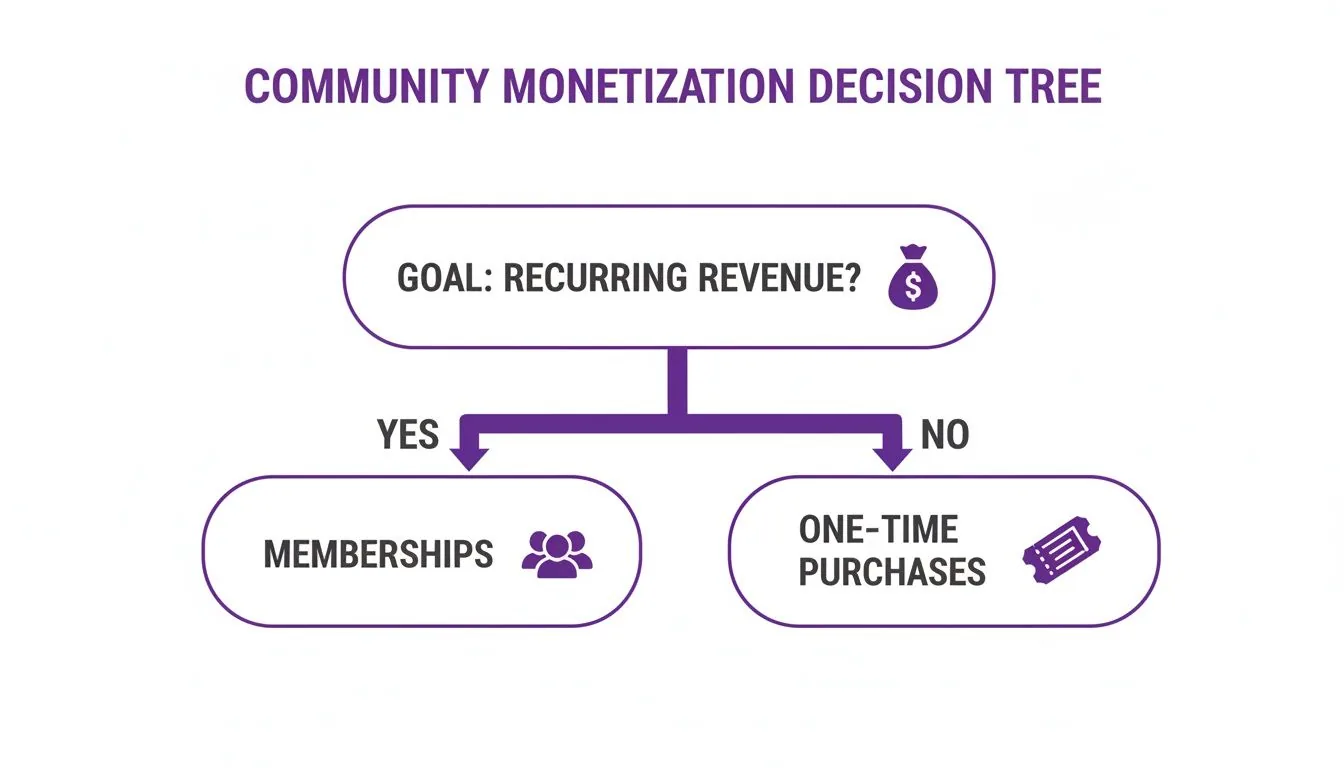
The key takeaway here is that your automation needs to support your revenue model, whether that’s the recurring income of a membership or one-off product sales. Your platform’s analytics dashboard is your command center for this.
Key Metrics to Monitor:
- Conversion Rates: Which of your sales pages are actually working? Where are people dropping off? This data is crucial for A/B testing headlines, offers, and layouts to squeeze more revenue out of your traffic.
- Member Engagement: Which community channels are buzzing with activity? What types of content get the most likes and comments? These insights tell you exactly what your audience wants more of.
- Churn Rate: For any subscription community, this is a vital health metric. A high churn rate might be a sign that your onboarding needs work or that you need to add more exclusive value for your paying members.
By checking in on this data regularly, you can spot weaknesses early, double down on what’s working, and constantly refine your entire community experience. If you want to go deeper, you can find more inspiration in these marketing automation workflow examples.
This is how you turn a good community into a sustainable and profitable business that can truly scale.
Answering Your Top Community-Building Questions
As you gear up to launch your own community, it's totally normal to have a few questions swirling around. Getting from a spark of an idea to a buzzing, self-sustaining space means making some smart calls right from the jump. Let's tackle some of the most common questions I hear from creators, so you can move forward with a clear head.
Think of this as a quick-start guide to sidestepping the common pitfalls and getting the fundamentals right.
How Much Time Does It Really Take to Manage an Online Community?
Honestly, it depends on the size of your community and just how fired up your members are. When you're just starting out, a good rule of thumb is to budget around 10–15 hours per week. This time will go into sparking conversations, creating a bit of content, and personally welcoming every new face that walks through the digital door.
As your member count climbs, so will the time commitment. But this is exactly where your choice of platform becomes your secret weapon. A system with smart automation, like Zanfia, can be a lifesaver. Automating things like the new member welcome sequence, payment reminders, and access to different channels, and letting the assistant handle common tasks by voice or chat, can easily hand you back 5–10+ hours every single month. That's precious time you can reinvest into what actually matters: creating killer content and building real relationships.
What’s the Single Biggest Mistake People Make When Building a Community?
Easy. Chasing a big member count before you've built a solid foundation of value. Too many creators get obsessed with vanity metrics like hitting "1,000 members," only to end up with a digital ghost town. Engagement doesn't magically appear with scale; it's born from genuine connection and a shared purpose.
The trick is to start small and go deep. Pour all your energy into a tiny group of "founding members." Give them incredible value, your undivided attention, and make them feel like VIPs. This core group will become your most passionate advocates and set the cultural tone for everyone who joins later.
A buzzing, tight-knit community of 20 die-hard members is infinitely more valuable than a silent audience of 2,000. Prioritize the quality of your interactions over the quantity of your members, especially at the beginning.
Can I Really Do This by Myself, or Do I Need a Team?
You can absolutely build and run a thriving community solo, especially if you have the right tech stack in your corner. This is the whole reason all-in-one platforms were invented—to give individual creators and small businesses the leverage they need to compete.
A platform like Zanfia pulls your course hosting, community hub, digital storefront, and checkout into one clean dashboard, and adds an AI team that can execute inside your workspace by chat or by voice. It completely eliminates the tech headaches and duct-taping of trying to make five different tools talk to each other. Down the road, when you're managing thousands of members, you might decide to bring on a moderator. But for the launch and early growth stages, a single person with a streamlined setup can absolutely crush it.
Should I Use a Free Platform or a Paid One?
This is a huge decision, and it all comes down to your long-term goals. Free platforms like Facebook Groups or Discord are fantastic for casting a wide net and building awareness at the top of your funnel. The downside? You're at the mercy of their algorithms, battling constant distractions, and engagement is often lower because there's no skin in the game.
Hosting a paid community on your own branded platform creates a totally different vibe. When members have a financial stake, they're naturally more invested and committed. They show up differently. Versus platforms like Skool, Zanfia gives you complete white-label control, an AI team you can drive by voice, and far more monetization flexibility, with support for subscriptions, installment plans, and bundles across 12 product types instead of a restrictive payment model. Zanfia offers a 14-day free trial with no credit card required so you can test the fit before committing.
A powerful strategy is to use both. Run a free group to attract a broad audience and nurture potential customers. Then, you can funnel your most dedicated followers into your premium, paid community. That’s where they get exclusive access, your best content, and a focused environment—all the things that are nearly impossible to deliver on a noisy, public platform.
Ready to ditch the juggling act and build your community, courses, and digital products in one place? Zanfia gives you an AI team that runs the work for you, an assistant you can drive by chat or voice, and a checkout built to sell with order bumps, installments and upsells, so you can create a seamless member experience and keep your revenue with a 0% platform transaction fee model. Plans start at $39/month, or $31/month billed annually, with a 14-day free trial and no credit card required. Build your online community with Zanfia today.