

Rise Up Together: Build Your Community Campaign on Zanfia
You already know the feeling. Your audience is interested, your message is strong, and your offer should work. But the experience around it is messy.
People discover you on social media, join a chat group somewhere else, buy a course on another platform, and then miss your updates because your newsletter lives in a separate tool. You spend more time stitching systems together than leading the community you wanted to build.
That's where a rise up together campaign becomes useful. Not as a slogan, but as a practical operating model. You give people a shared mission, a clear place to participate, and a product ecosystem that makes action easy instead of scattered.
Why 'Rise Up Together' Is Your Next Big Move
Fragmented communities lose energy fast.
A member joins because they want momentum. Instead, they find disconnected touchpoints, mixed expectations, and too many logins. The result is predictable. They lurk, forget, and drift away. You, meanwhile, keep manually answering access questions, reposting updates, and trying to recreate continuity across tools that were never designed to work as one.

A rise up together campaign solves a different problem than a standard launch. You're not just selling a product. You're building a reason for people to gather, contribute, and stay involved. That works better because people commit more when they can see the mission, the path, and their role in it.
Why movements outperform scattered offers
A good campaign gives your audience three things at once:
- A shared direction . Members know what the community stands for and what progress looks like.
- A visible journey . They can move from free content to deeper participation without confusion.
- A place to belong . The experience feels coherent, not patched together.
If you want a strong foundation, start with the discipline behind community building. The creators who win here don't chase more channels. They reduce friction and make participation feel natural.
What works and what doesn't
Some choices consistently help:
- Works well: one branded home for content, discussion, and paid access.
- Works well: offers that connect to one mission instead of random products added over time.
- Works well: pricing models that preserve margin so your campaign can stay sustainable.
Other choices create drag:
- Doesn't work well: pushing members from a newsletter to a social platform to a course portal and back again.
- Doesn't work well: treating community as an afterthought once the sale is complete.
- Doesn't work well: accepting avoidable platform cuts when your campaign depends on healthy unit economics.
Practical rule: If a member has to ask where to go next, the campaign architecture is weak.
A rise up together model is strong because it aligns the emotional side of community with the operational side of running a creator business. People need meaning. You need clarity, retention, and a system that doesn't leak revenue through unnecessary fees.
That's the opportunity. You stop managing fragments and start leading a cohesive campaign people can join.
Defining Your Campaign's Mission and Structure
Most weak community campaigns don't fail because of bad technology. They fail because the creator never defined the promise sharply enough.
"Rise up together" only works when it means something specific in your niche. For a fitness educator, it might mean consistency and accountability. For a consultant, it might mean helping independent professionals build authority. For a parenting expert, it might mean turning isolated readers into an active support circle.
Start with the change, not the content
Write one sentence that answers this question:
What changes for a member after joining your campaign?
If the answer sounds like a feature list, keep going. Members don't join for "weekly calls" or "exclusive materials." They join for outcomes, structure, confidence, and progress.
A useful mission statement usually includes:
- Who it serves
- What struggle they're trying to overcome
- What kind of progress they'll make together
Here's the test. If a stranger read your campaign promise, would they instantly know whether it's for them?
Borrow the discipline of mission-led organizations
Clear missions attract committed participants.
When Rise Up Together officially launched as an independent nonprofit in 2025 after 16 years, it capped a year of extraordinary growth and welcomed 104 new visionary leaders, a sign that a well-defined mission can mobilize a community around a shared cause, as noted in Rise Up Together's 2025 highlights.
That principle matters for creators too. People commit faster when your campaign stands for more than access. They want to know what they're joining and why it matters.
A campaign with a vague purpose attracts curiosity. A campaign with a sharp purpose attracts commitment.
Build around one core member
Don't design for "everyone interested in my topic." That creates mushy messaging and bloated offers.
Instead, define one primary member:
- Current situation: What are they dealing with right now?
- Desired progress: What do they want to become better at, faster at, or more confident about?
- Buying trigger: Why would they pay now instead of waiting?
- Community fit: What kind of conversations do they want to join?
If you need help tightening that message, revisit the idea of a value proposition. It forces you to stop describing your content and start clarifying your relevance.
Structure the campaign before you build it
A practical rise up together campaign usually has three layers:
| Layer | Purpose | Member experience |
|---|---|---|
| Mission layer | Gives meaning | "I know what this community stands for." |
| Offer layer | Gives access | "I know what I get and how to join." |
| Participation layer | Gives momentum | "I know what to do next." |
Creators often overbuild the offer layer and ignore the other two. That's backwards. If the mission is weak, the sale feels transactional. If participation is unclear, even a strong sale turns into passive consumption.
Your campaign needs a center of gravity. Define that first. Everything else gets easier after that.
Building Your Integrated Offer Suite on Zanfia
Once the mission is clear, the offer suite becomes a design problem. You're deciding how people enter, how they deepen involvement, and how they buy in ways that fit their situation.
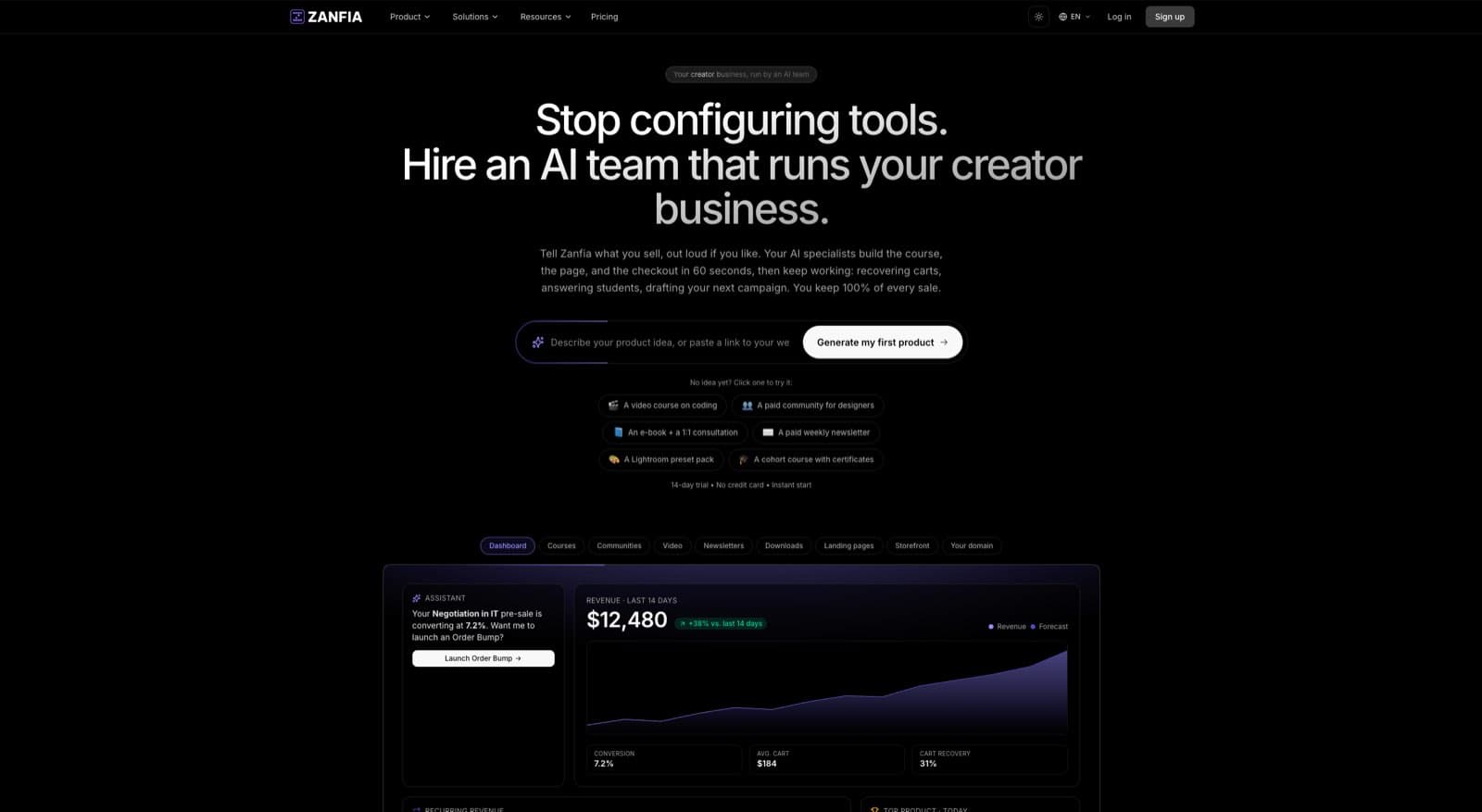
Zanfia is designed as an AI team that runs a creator business, not just a place to host a course. The assistant knows the whole interface, so instead of configuring the campaign click by click you describe what you want, by chat or by voice, and it acts on the workspace. Courses, communities, paid newsletters and the checkout are all surfaces where that work lands, and they can be exposed to your own AI agents through the MCP endpoint on higher plans. Check the current Zanfia pricing to see which plan unlocks the full Assistant and MCP.
The mistake I see most often is overcomplication. A creator launches with too many unrelated products, too many pricing paths, and no obvious progression. Members hesitate because they can't tell where to start.
Think in paths, not products
A rise up together campaign works best when each offer answers a different stage of commitment.
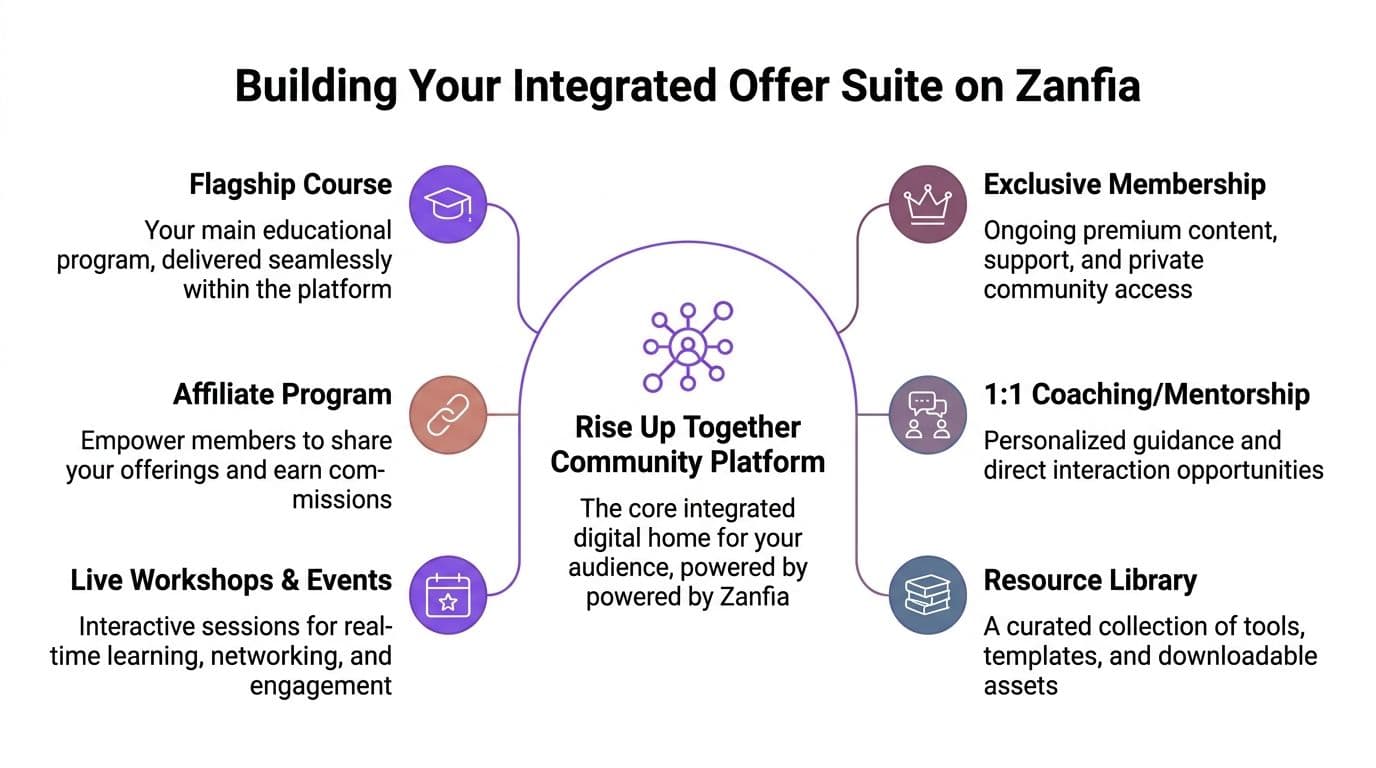
A clean structure usually includes:
- An entry point for people who want a low-friction first step
- A core transformation offer where your main method lives
- An ongoing membership layer that keeps members engaged after the initial purchase
- A premium support path for people who want proximity, feedback, or direct guidance
If you're still shaping the commercial side, it helps to ground yourself in what a digital product needs to do. It shouldn't just deliver information. It should move someone into action.
Match pricing to real buying behavior
Different members need different payment logic.
Some buyers are happy with a one-time purchase. Others prefer a subscription because they want continuity and fresh value. Others need installments because they're ready for the offer but want more flexibility in how they pay.
That's why a rigid setup hurts conversions. It assumes all motivated buyers behave the same way. They don't.
A stronger offer suite gives you options such as:
- One-time sales for focused courses or workshops
- Subscriptions for memberships, newsletters, or ongoing access
- Installment plans for higher-ticket educational offers, so you can split a $600 course into four payments instead of losing the buyer
- Bundles for people who want the full ecosystem from day one
Zanfia's checkout supports all four models with Stripe and PayPal, plus Apple Pay and Google Pay, and you can add order bumps and subscription upsells on the same page. Before you launch, use test mode to run a test purchase on the real checkout: conversion events fire to your platforms' test surfaces tagged TEST, and test orders stay out of the real order list, so you can confirm the funnel works end to end before the first real sale.
Use tiers to reduce confusion
A tiered structure helps members self-select. It also helps you avoid the common mistake of stuffing every product into one giant offer.
Here's a practical example.
Sample 'Rise Up Together' Membership Tiers in Zanfia
| Tier Level | Included Products & Access | Ideal For |
|---|---|---|
| Starter | Paid newsletter, selected community channels, basic resources | People who want consistent guidance without a large commitment |
| Core | Full flagship course, complete community access, resource library, live workshops | Members ready for structured learning and active participation |
| Inner Circle | Everything in Core plus 1:1 coaching or mentorship access | Advanced members who want personalized support |
Protect the brand experience
Offer architecture isn't only about monetization. It's also about trust.
If your community lives under someone else's branding, your authority gets diluted. Members remember the tool before they remember your framework. That's a poor trade if you're trying to build a premium business.
A white-label setup under your own domain changes the psychology. The space feels owned, cohesive, and intentional. That matters when you're asking members to commit to an ongoing campaign rather than a one-off purchase.
What to include first
If you're launching your first serious rise up together campaign, keep the initial stack lean:
- Flagship course as the main transformation engine
- Private community for accountability and discussion
- Paid newsletter for recurring insight and rhythm
- Resource library for templates, replays, and tools
Build for the next yes. Every product should lead naturally to the next level of commitment.
That's the standard to use. Not "Can I sell this?" but "Does this deepen the member journey in a way that feels obvious and useful?"
Fueling Engagement with Strategic Content
A community campaign becomes real through what members experience week after week.
Most creators don't struggle because they lack content. They struggle because they publish the wrong type of content in the wrong place. The result is noise instead of momentum.

Separate conversation from broadcast
Your campaign needs both open participation and controlled clarity.
Discussion channels should invite response. Use them for prompts, wins, field reports, peer support, and applied questions. Announcement channels should do the opposite. Use them for deadlines, event details, release notes, and essential updates that members need to find quickly.
That distinction sounds simple, but it changes behavior. When every channel is treated like a chat room, important information disappears. When every channel is locked down, the community feels lifeless.
A practical weekly rhythm might look like this:
- Monday: mission-aligned prompt in a discussion space
- Midweek: lesson-related check-in tied to implementation
- Friday: recap and next-step announcement
- Monthly: live workshop or focused challenge
If you want the broader branding around that content to feel consistent, this guide on how to craft a powerful digital brand is worth reviewing. It's useful when your campaign message needs to feel coherent across profiles, landing pages, and member touchpoints.
Tie content to action, not just consumption
Rise Up Together's network has impacted 172 million people by enabling local leaders to advocate for 218 new and improved laws, with examples including protections for 13 million women in Brazil and education access for nearly 10 million girls in India, according to Rise Up Together. The creator lesson is straightforward. Value-driven action changes outcomes.
Members stay engaged when content leads somewhere.
That means:
- a lesson should trigger a discussion
- a discussion should surface practical blockers
- a newsletter should sharpen focus
- a live session should help members apply, decide, or commit
Content that only informs creates spectators. Content that prompts action creates members.
Design course content for participation
Course libraries often become graveyards because creators treat lessons as final products. They're not. A lesson is a conversation starter.
Use each module to create a loop:
| Content element | Best use | What it drives |
|---|---|---|
| Short video lesson | Teach one decision or framework | Clarity |
| Prompt beneath lesson | Ask for application | Participation |
| Community thread | Let members compare execution | Accountability |
| Newsletter follow-up | Reinforce the lesson and address objections | Retention |
For creators mapping that system more deliberately, this article on how to create a content strategy is a practical next step.
A useful reference point for pacing and teaching style is below.
Make the paid newsletter earn its place
A paid newsletter should never feel like recycled social posts emailed later.
It should do one of these jobs well:
- Interpret the moment so members know what matters now
- Curate intelligently so they don't have to sift through noise
- Advance a framework in a way that supports the rest of your campaign
- Show member proof so people can see progress inside the community
The most effective rise up together campaigns treat content as infrastructure. Every post, lesson, and issue reinforces the same mission from a different angle. That repetition doesn't bore people when the material is useful. It builds identity.
Automating Your Workflow to Focus on People
Manual operations make creators feel busy while weakening the member experience.
A strong campaign should feel immediate. Someone buys, gets access, receives the right welcome sequence, enters the right space, and understands what to do first. If any of that depends on you remembering to click through a checklist, the system is fragile.
Build the campaign as modular workflows
Modular thinking matters here.
Successful programs often use a modular architecture that allows for customization and scalability. For a platform like Zanfia, that principle shows up in automation workflows, which act as configurable components and can support 40-60% faster implementation than monolithic systems, according to riseup4equity.org.
In practice, that means you don't build one giant operational mess. You build smaller workflow units that each do one job well.
Examples:
- Purchase workflow grants access to the correct product and community area
- Onboarding workflow sends a welcome email sequence and first-step instructions
- Subscription workflow handles renewals and access changes automatically
- Offboarding workflow removes access cleanly when a plan ends
What to automate first
Creators often automate the flashy things before the boring but critical ones. That's backwards.
Start with the flows that touch every member:
- Access assignment after payment
- Welcome sequence with orientation
- Subscription renewal handling
- Access revocation when needed
These workflows save more than time. They create trust. Members don't wonder whether the system worked because it works immediately and predictably. In Zanfia, you set them up in the visual builder, or you describe what you want to the assistant by chat or voice and it wires the triggers for you.
If you're building educational events into the campaign, a practical companion resource is this guide to webinar automation software. It's useful when live sessions are part of your acquisition or retention strategy.
The gain isn't technical
The author brief notes that automation can save a significant amount of time each month. That matters, but the bigger advantage is focus.
You get to spend those hours where creators create value:
- answering smart questions
- improving lesson quality
- hosting stronger live sessions
- noticing friction before members complain
If you want a concrete starting point, this piece on how to automate your business is the right operational lens.
The best automation is invisible to members and obvious to the operator.
That's the trade-off to remember. Over-automation can make a community feel cold. Under-automation makes it unreliable. Good systems remove admin so you can show up more human where it counts.
Using Analytics to Guide Your Community's Growth
A rise up together campaign needs judgment, not guesswork.
You don't need to obsess over every dashboard view. You do need a small set of signals that tell you whether members are engaging, progressing, and sticking around. Without that, you'll keep changing offers and content based on your own mood instead of member behavior.
Track behavior that reveals health
Start with questions, not metrics.
Ask:
- Where are members participating most?
- Which lessons are completed and which are ignored?
- Which offers convert cleanly and which create hesitation?
- Where do members stop showing up?
Effective organizations prove their impact with data. Rise Up Together's evaluations show that technical assistance demonstrably enhances both the capacity and visibility of its leaders, as shared in its technical assistance evaluation insights. Creators should take the same posture with community operations.
Read the numbers in context
A drop in lesson completion doesn't always mean the course is weak. It may mean the lesson is too long, the promise is unclear, or the next action isn't visible.
Low activity in a community channel doesn't always mean members are disengaged. Sometimes the prompt is bland. Sometimes the conversation belongs in a more focused group. Sometimes the announcement flow is drowning out discussion.
Use a simple review framework:
| Signal | What it may indicate | Practical response |
|---|---|---|
| Low engagement in discussion spaces | Weak prompts or poor channel structure | Narrow the topic and ask for concrete responses |
| Course drop-off | Friction in lesson design or unclear payoff | Shorten modules and strengthen the action step |
| Poor offer conversion | Misaligned pricing or muddy messaging | Rework the sales page and clarify the member outcome |
| Retention pressure | Value isn't recurring enough | Improve cadence with newsletters, events, and accountability |
Measure what helps you decide
Vanity metrics are tempting because they look active. Decision metrics are better because they tell you what to change.
Watch the indicators tied to:
- Engagement , so you know where conversation is alive
- Completion , so you can improve educational design
- Retention , so you can see whether your model creates ongoing value
- Revenue , so you know which offers support the business
That combination gives you a working picture of community health. The point isn't to become obsessed with dashboards. The point is to lead with evidence.
FAQ
How do you write a mission statement for a community campaign?
Write one sentence that answers what changes for a member after joining, and include who it serves, what struggle they're overcoming, and what progress they'll make together. If the answer sounds like a feature list (weekly calls, exclusive materials), keep going, because members join for outcomes and confidence, not deliverables. The test: a stranger reading it should instantly know whether the campaign is for them.
How should I structure the offers inside a rise up together campaign?
Design offers as a path, not a pile of products. Use an entry point for low-friction first steps, a core transformation offer where your main method lives, an ongoing membership layer that keeps members engaged after purchase, and a premium support path for people who want proximity or direct guidance. Each product should lead naturally to the next level of commitment instead of sitting as an unrelated add-on.
Which pricing model should I use for community-based offers?
Match the model to how members actually buy. Use one-time sales for focused courses or workshops, subscriptions for memberships and newsletters, installments for higher-ticket offers (splitting a $600 course into four payments instead of losing the buyer), and bundles for people who want the full ecosystem from day one. A rigid setup assumes all motivated buyers behave the same way, and that assumption costs conversions.
What is the difference between discussion and announcement channels, and why does it matter?
Discussion channels invite response and should hold prompts, wins, field reports, and peer questions. Announcement channels do the opposite: deadlines, event details, release notes, and essential updates members need to find quickly. When every channel is treated like a chat room, important information disappears; when every channel is locked down, the community feels lifeless. Separating the two changes member behavior and preserves signal.
How do I make course content actually drive community participation?
Treat each lesson as a conversation starter, not a final product. Build a loop: a short video teaches one decision or framework, a prompt beneath it asks for application, a community thread lets members compare execution, and a newsletter follow-up reinforces the lesson and addresses objections. Content that only informs creates spectators, while content that prompts action creates members.
If you're ready to turn a scattered audience into a focused, branded community business, Zanfia gives you an AI team that runs the work under your own domain: courses, community, paid newsletters and a checkout built to sell, with order bumps, installments and test mode, all reachable by chat or voice through the assistant. As of publication, 0% platform fees on customer sales apply on every plan (only the payment processor takes its standard cut), and a 14-day free trial with no credit card lets you build the campaign before you commit. See the current Zanfia pricing for which plan unlocks the full Assistant, the MCP endpoint and white-label options.