

What Is a Digital Product? A Quick Guide for Creators
Let's get one thing straight: if you're a creator, your time is your most valuable asset. But you can only sell an hour once. A digital product, on the other hand, lets you package your expertise and sell it a thousand times over while you sleep.
It’s the ultimate "create once, sell forever" business model. This is the core magic behind what a digital product truly is.
The Power of Intangible Assets

In simple terms, a digital product is any valuable item that exists purely in a digital format. It’s sold and delivered online, and it’s made of bits and bytes, not atoms. Think online courses, ebooks, templates, and premium newsletters.
This distinction from physical goods is where all the power lies. When you sell a physical item—like a t-shirt or a printed book—each sale means one less item in your inventory and additional costs for manufacturing and shipping.
Digital products completely flip that script. Your main investment is the upfront time and knowledge it takes to create the product. After that, the cost to deliver it to the next customer is practically zero.
The Zero-Inventory Advantage
This model eliminates the biggest headaches of traditional retail. No warehouses to rent. No boxes to pack and ship. No supply chain nightmares to worry about.
For creators and experts, this efficiency is a complete game-changer. It’s the key to turning your knowledge into a scalable income stream that isn't directly tied to your time.
To help you instantly grasp the core concept, this table offers a quick comparison highlighting the key differences between selling digital and physical goods.
Digital Products vs Physical Products at a Glance
| Attribute | Digital Products | Physical Products |
|---|---|---|
| Inventory | Infinite. No stock to manage. | Finite. Requires inventory management. |
| Distribution | Instant, automated delivery online. | Requires shipping and logistics. |
| Upfront Cost | Primarily time and expertise. | Production, materials, storage costs. |
| Marginal Cost | Near-zero cost per additional sale. | Cost of goods sold for each unit. |
| Scalability | Extremely high. Sell to 1 or 1,000,000. | Limited by production and fulfillment. |
| Profit Margins | Very high, often 80-95%. | Lower due to recurring costs. |
| Customer Access | Immediate access after purchase. | Delayed by shipping times. |
As you can see, the digital model offers unparalleled leverage. A consultant can only bill one client for an hour of their time. But by packaging that same expertise into an online course or a detailed ebook, they can serve hundreds of clients simultaneously. This creates a business that works for them, even when they aren't actively working.
If you're curious about the mechanics, you can learn more about how ebooks work and are delivered instantly to customers.
The market for these assets isn't just growing; it's exploding. The entire digital content sector generated over $2.5 trillion in annual value as of 2025. A staggering 68% of internet users now pay for digital content every single month.
For individual creators, online courses are a massive opportunity, projected to generate $12.8 billion in revenue by 2026 alone.
From Idea to Automated Income
The journey from a great idea to a source of automated income comes down to two things: creating genuinely valuable content and choosing the right platform to handle the sales and delivery for you.
This is where a modern, all-in-one platform makes all the difference. Instead of duct-taping five different tools together, a unified system simplifies the entire process.
A platform like Zanfia is built as an AI team that runs the business behind your digital products, not just a place to host files. You describe what you want by chat or by voice and the assistant performs any action available in the interface, from spinning up a new product to editing a checkout. Everything lands in surfaces built to sell: PDF downloads, premium newsletters, online courses, private communities and a checkout with order bumps, installments and test mode, all under one login and one brand.
For those looking to start with something straightforward like a template or a guide, our post on what are digital downloads is the perfect place to begin.
Discover the Best Digital Products to Sell

Okay, so you get what a digital product is. The real question now is, which one should you build?
This isn't just a random choice. The right product type is the foundation of your entire online business, and it has to be a perfect match for your unique skills and the audience you serve.
Let's ditch the theory and get practical. We’ll walk through the most popular and profitable product categories to help you find that perfect fit.
Online Courses for the Expert Teacher
If you have a repeatable process that gets people real results, an online course is your ultimate tool. This is for the experts who love to teach and guide people from Point A to a clear, life-changing Point B.
Courses let you package your knowledge into a rich, structured experience using video lessons, downloads, and quizzes. A modern platform like Zanfia hosts your video natively so you can drop Vimeo or Wistia subscriptions, and it ties courses directly into a private community with drop-off analytics and quiz results answering the "why do my students quit" question. You can also dictate the setup out loud instead of clicking through it: the AI assistant will create a module, upload a lesson or update a price for you.
- Best For: Coaches, consultants, skilled professionals, and anyone with a step-by-step system.
- Example: A marketing consultant builds a powerhouse course on SEO for small business owners, filled with actionable video tutorials and templates.
Ebooks and Guides for the Knowledge Sharer
For writers and deep thinkers, ebooks and guides are a fantastic way to package expertise into a tight, digestible format. They are often the simplest digital products to create—all you really need is a great idea and a word processor.
But don't mistake simple for ineffective. An ebook can be a short, laser-focused guide that solves one specific problem, or it can be a comprehensive deep dive into an entire subject. They're also incredible for building authority and work brilliantly as valuable lead magnets to grow your email list. If you're looking for ideas, check out our guide on lead magnet examples.
- Best For: Writers, researchers, industry specialists, and anyone with deep, specialized knowledge.
- Example: A financial advisor writes a 50-page ebook, "The Millennial's Guide to Investing," and sells it as an instant download.
Key Insight: The digital product market is exploding. Projections for 2026 show templates hitting a $7.7 billion market, ebooks reaching $4.8 billion, and paid communities becoming a $2.5 billion industry. This growth gives you the freedom to pick a lane that perfectly matches your skills and your audience's needs. Learn more about these market trends and their potential.
Memberships and Communities for the Community Builder
Do you thrive on connection and ongoing conversation? If so, a membership or paid community isn't just a product; it's your business model.
Instead of a one-time purchase, you deliver continuous value for a recurring subscription fee. This is how you build deep, long-term relationships with your customers and create predictable, recurring revenue. A great membership might offer exclusive content, group coaching calls, a private forum, or all of the above.
Platforms like Zanfia are purpose-built for this, with branded channels for different topics, roles and gamification, and a community AI agent that writes from your own content and clearly labels everything it publishes as AI. Members sit in the same interface as your courses and can even read and write community content from their own AI environment through the CLI.
- Best For: Natural leaders, networkers, and creators who want to build a loyal tribe.
- Example: A fitness coach launches a subscription community offering weekly workout plans, nutrition advice, and a private forum where members cheer each other on.
Templates and Resources for the Problem Solver
Are you the person who creates brilliant spreadsheets, organized systems, or beautiful designs that make life easier? If you're a natural problem-solver, selling templates and digital resources is your sweet spot. This category is all about giving people a shortcut.
Think about the tools you build for yourself to be more efficient. Chances are, someone else would gladly pay for them.
Popular types of templates and resources include:
- Productivity: Notion templates, Trello boards, spreadsheet dashboards.
- Creative: Social media graphics, Lightroom presets, video editing effects.
- Business: Contract templates, invoice designs, business plan outlines.
These products are incredibly scalable and attract customers looking for a quick win. It's proof that you don't always have to teach the skill—sometimes, just providing the tool is more valuable.
- Best For: Designers, organizers, developers, and anyone who loves building efficient systems.
- Example: A graphic designer sells a bundle of professionally designed Canva templates for Instagram, saving small business owners hours of work.
Paid Newsletters for the Consistent Curator
For writers and thought leaders with a unique point of view, a paid newsletter is the most direct line you can have to a dedicated audience. It's an intimate format that lets you deliver exclusive analysis, deep insights, or curated content right into your subscribers' inboxes.
This model shines when you serve a specific niche and can consistently deliver value that people just can't get for free. Using a platform with a built-in paid newsletter product means you can manage subscribers, payments and access from one place, and lean on the same AI team to draft, edit and schedule issues by chat or voice while you focus on the ideas.
- Best For: Journalists, industry analysts, expert curators, and niche bloggers.
- Example: A tech analyst runs a weekly paid newsletter breaking down industry news with analysis that goes far beyond the headlines.
By understanding these core product types, you can stop guessing and start making a strategic choice—one that plays to your strengths and delivers exactly what your ideal customer is looking for.
Here is the rewritten section, crafted to match the specified human-written style, tone, and voice.
Why You Should Start Selling Digital Products Now
If you're a creator or consultant, you’re likely caught in the classic trap: trading your time for money. It feels productive, but it’s a dead end. There are only so many hours in a day, which means there's a hard ceiling on what you can earn. The real "why" behind building a digital product business is simple—it’s the only way to break that ceiling.
Imagine this: instead of waking up to a calendar crammed with client calls, you wake up to a string of sales notifications. That’s not a pipe dream. It’s the shift that happens when you stop selling one-on-one services and start building a scalable digital business. A digital product lets you package your genius once and sell it forever, multiplying your income without multiplying your hours.
Achieve True Scalability and Reach
When you deliver a service, you help one person at a time. When you create a digital product, you package that same expertise and can serve one thousand—or even one hundred thousand—people with no extra effort for each new sale.
This is what true scalability looks like. Suddenly, your market isn't limited by your schedule or your zip code. You can connect with a global audience, helping people and generating revenue from anywhere in the world, at any time of day.
- No Inventory, No Limits: Unlike physical goods, you never run out of stock. Your online course or ebook has an infinite supply .
- Global Access: Your customers can be in Warsaw, New York, or Tokyo. The internet is your storefront, and it never closes.
Unlock Automated Income and Incredible Margins
Maybe the most powerful benefit is the potential for automated income. You pour your time and expertise into creating a phenomenal product upfront. But once it’s live on the right platform, the system takes over.
For creators who feel like they're hitting a wall, a digital product isn't just another revenue stream; it's a new business model. It's the difference between working in your business and having your business work for you.
A coach might spend years offering personalized sessions at an hourly rate. By turning that coaching framework into a dynamic online course, they create an asset that makes sales while they sleep. The same knowledge that once brought in a one-time fee now generates income around the clock, freeing them up to create more, innovate, or just take a vacation. If this idea is new to you, check out our deep dive on what passive income really means for creators.
This model also comes with incredible profit margins. With no manufacturing, shipping, or storage costs, the vast majority of your revenue is pure profit. Platforms built for creators, like Zanfia, are designed to amplify this by charging 0% platform commission on customer sales today. You keep 100% of what you sell, paying only the standard fees from payment processors like Stripe (roughly 2.9% + $0.30 in the US). At even a few thousand dollars a month in revenue, that gap between a platform's cut and zero adds up fast.
Establish Yourself as a Leading Authority
Finally, selling a high-value digital product does more than just bring in revenue—it cements your status as a leader in your field. A well-crafted course, a definitive ebook, or a thriving membership community acts as undeniable social proof of your expertise.
It’s a tangible asset that showcases your knowledge, attracting media opportunities, speaking gigs, and high-ticket collaborations. When you stop selling your time and start selling your wisdom, you fundamentally change how the world sees you. You're no longer just a service provider; you're the go-to expert in your niche.
How to Create and Sell Your First Digital Product
It's time to stop just thinking about it and actually turn your expertise into a real, sellable asset. This isn’t some monumental task reserved for gurus; it's a series of clear, manageable steps. We're going from idea to income, one move at a time.
But here’s the most important part: the journey doesn't start with building the product. It starts with validating the idea. A brilliant concept is worthless if no one will actually pay for it. Before you write a single page or record a minute of video, you have to prove there’s real demand.
Step 1: Find and Validate Your Idea
The best digital products don't try to appeal to everyone. They solve a very specific, often painful, problem for a niche audience you know inside and out.
- Listen to your DMs and comments. What questions are people always asking you? What are their biggest headaches? Your most profitable product idea is probably already sitting in your inbox.
- Survey your audience. Don't guess—just ask. A simple poll asking what they struggle with the most is pure gold. Let them spell out exactly what they need help with.
- Check your analytics. What are your most-read blog posts, most-watched videos, or most-shared content? These are flashing signals of what your audience already finds valuable.
Got an idea? Test it. The lowest-risk way to launch is with a pre-sale. Announce your product idea at a discount before you've finished it. If you get enough buyers to make it worthwhile, you've not only validated the idea but also funded its creation. This single move can break the cycle of indecision and get you moving.
Step 2: Create Your Minimum Viable Product
Now it’s time to build. But your goal isn't perfection; it’s completion. You're building a Minimum Viable Product (MVP)—the simplest version of your product that still delivers on its core promise.
For an ebook, that might just be a clean, well-structured PDF you put together in Canva or even Google Docs. For a course, it could be a handful of screen recordings made with a simple tool like Loom. The whole point is to get it into the hands of paying customers fast, so you can gather real feedback and make it better. For a deeper dive, check out our guide on how to create digital downloads that sell.
Step 3: Price Your Product for Value
Pricing can feel like a shot in the dark, but it doesn't have to be. Don't price based on the hours you put in; price based on the value and transformation you deliver. Here are the three most common models:
- One-Time Purchase: Simple and effective. The customer pays once for lifetime access. This works perfectly for ebooks, templates, and most standalone courses.
- Subscription/Membership: The engine of predictable revenue. Customers pay a recurring fee (monthly or yearly) for ongoing access to content, updates, and community.
- Payment Plans: This makes your premium offers feel much more accessible. By splitting a higher price into smaller installments, you can dramatically increase your conversion rates without devaluing your product.
Platforms like Zanfia are built for this kind of flexibility. You can sell the same course as a one-time purchase, split a $600 program into four installments, or bundle it into a community membership, and test the whole flow with a real checkout in test mode before you take a single live payment.
Step 4: Choose Your Sales Platform Wisely
Finally, you need a system to actually sell your product and deliver it to your customers. For many creators, this is the scariest part. You could try to stitch together a WordPress site with a bunch of plugins, but that path often leads to a technical nightmare of broken updates, security holes, and compatibility issues. It's a massive distraction.
This is where an all-in-one platform becomes your secret weapon.
Key Insight: A unified platform isn’t a luxury; it’s a strategic advantage. It eliminates the tech overwhelm that paralyzes so many creators, letting you focus on value, not code. By centralizing your course, community, payments, and automations, you launch with clarity and control.
An integrated system like Zanfia is engineered to remove this friction, bringing your entire business under one roof. From a single dashboard, you can host a course with native video, run a private community, manage a paid newsletter, and sell ebooks—all tied to a single login and payment system for your customers. Better still, you can drive the whole thing with an AI assistant that knows every corner of the interface: dictate a new landing page, launch an installment plan or reorganize a community by voice, then hook your own agents into the workspace through the MCP endpoint (available on higher plans, see the current Zanfia pricing). This seamless experience is crucial. With the global digital commerce market projected to hit an incredible $29.29 trillion by 2035, and mobile browsing dominating traffic, a flawless mobile checkout isn't negotiable. You can discover more insights about the digital commerce market on Precedence Research.
Whether you're a seasoned business architect or an expert just starting out, this is the smart way to turn your knowledge into a real business: an AI team handles the busywork, courses, communities, newsletters and downloads live under your own brand, and the checkout is engineered to sell with order bumps, installments and a 14-day free trial with no credit card required.
How to Market Your Digital Product for Consistent Sales
A brilliant digital product that nobody sees is just a file on your hard drive. Getting it in front of the right people is where the real work begins, but you don't need a massive marketing budget—you need a smart system that predictably turns strangers into customers.
It all starts with building a connection long before you ask for the sale. Your first mission is to build an email list of engaged followers. These aren't just random contacts; they're potential buyers who trust your expertise. Attract them by offering a high-value lead magnet—a free checklist, a mini-guide, or a template that solves one specific, painful part of their problem.
This builds a foundation of trust. When it’s time to launch, you’re not shouting into an empty room. You're having a conversation with a warm audience that’s already listening.
Attract Your Ideal Customers with Content Marketing
Content marketing is the engine that drives organic traffic to your digital doorstep. By consistently creating valuable blog posts, videos, or social media content that answers your audience's most pressing questions, you establish yourself as the go-to authority in your niche.
Each piece of content has a job: it educates, builds trust, and subtly positions your digital product as the ultimate solution. This strategy naturally filters for the right people—those actively searching for the answers you provide.
This simple process flow breaks down the entire journey, from idea to the final, critical step of getting your product into your customers' hands.
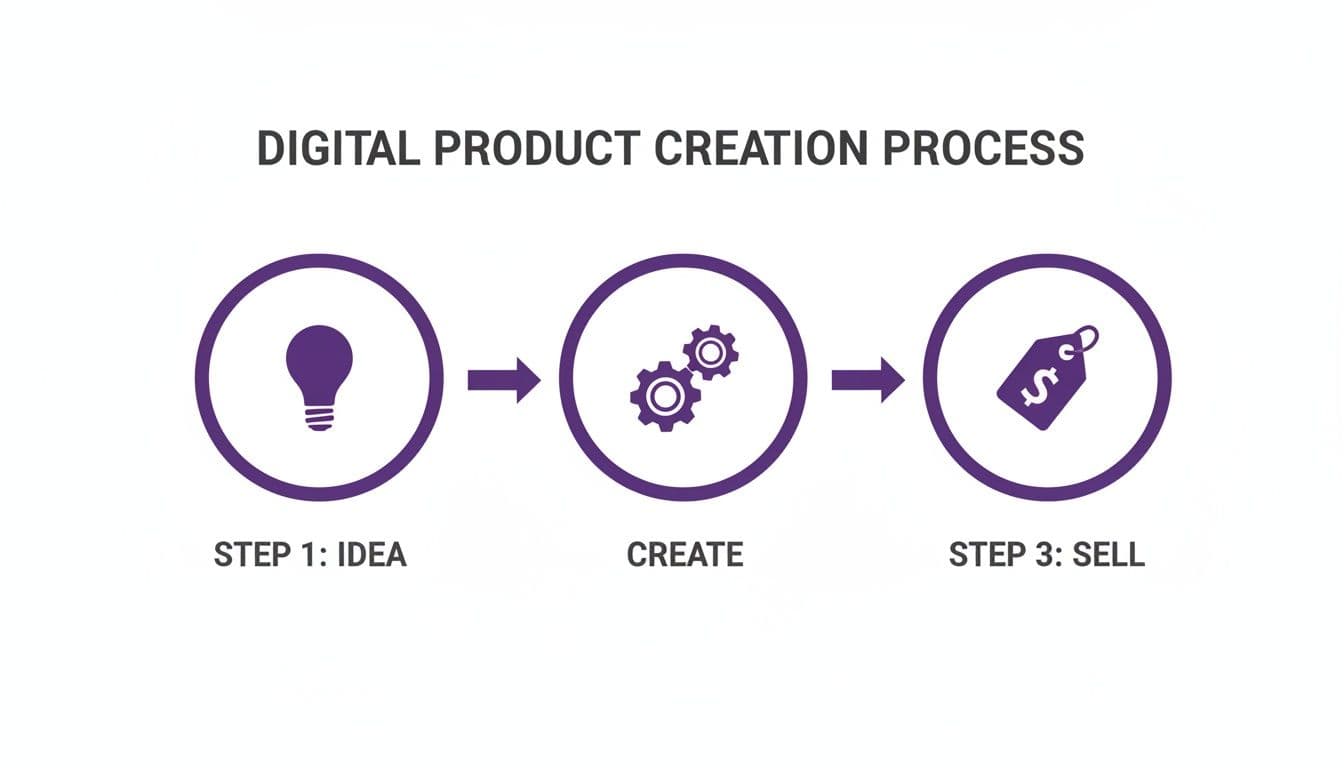
As the graphic shows, marketing isn't an afterthought. It's the bridge that connects your hard work to your audience.
Crafting a High-Converting Sales Page
Your sales page has one job: to convince a visitor that your digital product is the exact solution they’ve been searching for. It needs to be clear, persuasive, and relentlessly focused on the customer’s transformation.
A powerful sales page must include:
- A Compelling Headline: Grab their attention by speaking directly to their biggest pain point or desired outcome.
- A Clear Value Proposition: Instantly explain what the product is, who it's for, and the result it delivers.
- Benefit-Driven Copy: Don’t just list features. Show them how each feature makes their life better or solves their problem. "You get a 10-page template" is a feature. "You'll create a professional proposal in under 15 minutes" is a benefit.
- Social Proof: Integrate testimonials, case studies, or reviews. This builds trust and proves your product actually works for people just like them.
- A Clear Call-to-Action (CTA): Tell them exactly what to do next with bold, unmissable buttons like "Buy Now" or "Get Instant Access."
Think of your sales page as your best salesperson, working 24/7. It must anticipate every question and overcome every objection. For a deeper dive, check out our complete guide to building an effective sales funnel.
The Non-Negotiable Frictionless Checkout
You can have world-class marketing and a killer sales page, but if your checkout is clunky, you will hemorrhage sales. A customer must be able to go from "I want this" to "It's mine" with the absolute minimum number of clicks and fields.
A seamless checkout is not a luxury feature; it's a fundamental requirement. Every extra field, every confusing step, and every second of loading time is an invitation for a buyer to abandon their cart. Simplicity wins, every time.
This is where a modern, all-in-one platform provides a massive competitive advantage. A system like Zanfia is engineered around the sale: Stripe and PayPal for cards, Apple Pay and Google Pay for wallets, order bumps and one-click upsells at checkout, installments that let you split a $600 course into four payments, and a test mode that lets you run a real purchase end to end (with GA4, Meta and TikTok firing to test surfaces) before you spend a dollar on ads.
By analyzing the entire journey from traffic source to final sale, you can see exactly where your funnel is working and where it's leaking customers. Built-in analytics tools give you this critical visibility, and on Zanfia that includes Microsoft Clarity and Hotjar session recordings and heatmaps loaded on the checkout itself, so you watch the exact clicks where buyers hesitate, not just an aggregate drop-off rate.
Choose the Right Platform to Build Your Business
The technology you choose is the bedrock of your digital business. This single decision separates creators who scale with total confidence from those who get tangled in endless technical problems. Getting this right from the start will save you countless hours and thousands of dollars down the line.
Let's be blunt: the platform you use isn't just a piece of software. It’s your business partner. It directly impacts how much you earn, the way you connect with your customers, and how much real control you have over your own brand.
Comparing Your Options
When it comes to selling your expertise online, creators usually follow one of three well-trodden paths. Each has its own set of trade-offs, and you need to understand them before you commit.
- The DIY WordPress Route: This path promises total freedom but delivers a massive headache. You'll spend weeks, maybe even months, wrestling with dozens of expensive plugins for your store, courses, and memberships—only for a simple update to break everything. It’s a full-time job for a developer, not a creator.
- International All-in-One Platforms: Big names like Kajabi or Teachable offer a slick, integrated experience. But they often come with high monthly fees and in some cases a transaction fee skimmed off every sale. Their entry tiers can start around $149/month, which puts a real dent in early revenue.
- A True Integrated Solution: This is the smart path. You get the power of an all-in-one system without the technical chaos, at a fraction of the entry cost.
This is precisely where Zanfia gives ambitious creators a clear, strategic edge. It was built from day one to be a supportive partner, not just another software tool.
The Power of 0% Platform Fees
The most dramatic difference is the financial model. Zanfia runs on a clean SaaS subscription with 0% platform commission on customer sales today. You keep 100% of what you sell. The only fees you'll see are the standard ones charged directly by payment processors like Stripe (roughly 2.9% + $0.30 in the US) or PayPal. Entry pricing starts at $39/month, or $31/month billed annually on the Starter plan (as of August 2026, see Zanfia pricing), and every plan comes with a 14-day free trial and no credit card required.
Compared with entry tiers around $149/month on some competitor platforms, this gap adds up fast. For a creator moving $10k+ a month, keeping every dollar of gross revenue (minus processor fees) instead of handing over a platform cut can mean thousands back in the business each month. This is a model built on partnership, not a toll booth on every sale.
This is exactly why so many "Business Architects"—creators who have hit a growth ceiling with other tools—choose Zanfia. They need to protect their profit margins while scaling their business efficiently.
A Unified Ecosystem Under Your Brand
Beyond the fees, the real magic is in the unified ecosystem. Zanfia isn’t just a place to host a course; it's your entire business hub, run by an AI team that acts inside the business, not just next to it. It comes with native video hosting, which means you can ditch expensive services like Vimeo. It also has advanced community tools that keep your audience engaged right under your own brand, with a community AI agent that writes from your own content and labels everything it publishes as AI.
Instead of pushing your paying members out to a random Discord server or a noisy Facebook Group, Zanfia keeps your courses and community living together in one place. This creates a seamless, sticky experience that dramatically boosts member retention and lifetime value. To successfully launch your digital product, choosing the right platform is crucial, as highlighted in this guide to the best platforms to sell digital products.
And, crucially, white-label features and custom domain support mean your customers only ever see your brand, not Zanfia's. For established experts who have spent years building their reputation, this is non-negotiable.
The social proof speaks for itself. Respected entrepreneurs and creators consistently praise Zanfia for its clarity and power.
Serial entrepreneur Artur Kurasiński calls Zanfia “the most convenient and simplest solution for paid newsletters, courses and community.” Wojciech Pisarski, CEO of wMinutę, agrees, saying, “Without Zanfia, developing a paid newsletter and community would be much harder—it’s a best-in-class tool.”
Whether you're about to sell your first ebook or you're running a six-figure membership, your platform choice sets the ceiling for your potential. By bringing all your operations into one reliable system, with an AI team ready to run it by chat or voice, you gain the confidence, clarity, and control to focus on what really matters: creating incredible value for your audience.
Frequently Asked Questions About Digital Products
You’ve got the idea for a digital product, but a dozen questions are probably holding you back. It’s a common feeling. Let's cut through the noise and get you some straight answers to the questions we hear from creators every single day.
How Much Does It Cost to Create a Digital Product?
This can range from zero to a serious investment. You can write an ebook with a free tool like Google Docs, or you can go all-in on a video course with professional cameras and editing software.
Here’s the key: start lean. Your first product doesn't need a Hollywood budget. Use the tools you already have, create something genuinely valuable, and test the idea. Once you have paying customers, you can reinvest that revenue into making your next project even bigger and better.
How Do I Handle Taxes and Invoicing?
For many new creators, this is the single biggest headache. Manually tracking sales and generating compliant invoices is a nightmare waiting to happen, especially in markets with specific regulations. This is exactly where a smart platform becomes a non-negotiable part of your tech stack.
This is a problem that’s best solved with automation. A platform like Zanfia keeps a clean record of every order, ties each sale to a customer profile, and pushes the data your accounting workflow needs, so your books don't become a scramble at quarter-end. On top of that, you can ask the AI assistant to pull a report or export orders for a specific period by chat or voice, instead of digging through settings.
How Can I Protect My Product from Piracy?
Let's be blunt: 100% prevention is a myth. But you can absolutely make it harder for pirates and easier for honest customers. Your first line of defense is a secure platform that gates access based on verified purchases. You can also add watermarks to videos or PDFs and include clear licensing terms.
Your best defense, however, isn't technical—it's relational. The most powerful way to combat piracy is to build a brand and a community so strong that your true fans want to support you. They value your work and feel connected to your mission. An integrated community space makes this connection much deeper and piracy far less appealing.
Which Digital Product Is Best for Beginners?
If you're just starting out, the goal is to get a quick win and build momentum. Don't try to build a massive, 50-hour video course on your first go.
Focus on lower-effort, high-value products that let you test an idea and get crucial feedback without a huge time investment.
- Ebooks or Guides: Package your expertise into a focused, actionable PDF.
- Resource Bundles: Curate a "swipe file" of valuable checklists, links, or tools.
- Templates: Create a spreadsheet, a design file, or a document that saves people hours of work.
Starting small lets you build your confidence and your audience. Once you've proven your concept and have paying customers, then you can tackle that flagship online course you've been dreaming about.
Ready to turn your knowledge into a scalable business with a platform that partners in your success? With Zanfia, you get an AI team that runs the business by chat or voice, 12 product types (courses, communities, paid newsletters, ebooks and more) under your own brand, and a checkout built to sell with order bumps, installments and test mode—all on a 14-day free trial with no credit card. Start building your digital product empire on Zanfia today.