

A Practical Review of ClickFunnels for 2026
You’re probably looking at ClickFunnels because your business stack has started to feel like a maintenance job.
The website lives in one tool. Email automation sits in another. Checkout works, mostly, through a third. Courses or gated content run somewhere else. Your community, if you have one, is often pushed into a platform that doesn’t even carry your brand. Every launch becomes a small integration project.
That’s the problem ClickFunnels has promised to solve for years. It became famous by turning the messy process of online selling into something more structured: landing page, offer, checkout, upsell, follow-up. For the right business, that structure still matters a lot. For the wrong business, it can become expensive complexity wrapped in persuasive marketing.
The Search for an All-in-One Business Engine
A familiar pattern shows up when creators outgrow simple tools.
A coach starts with a landing page builder. Then adds Mailchimp for emails, Stripe for payments, a course tool for delivery, Calendly for calls, and a Facebook group or Discord server because the original stack never handled community well. Nothing is broken enough to justify a rebuild. But nothing feels unified either.

At that point, ClickFunnels enters the conversation fast. It has the kind of name recognition that makes people assume it must be the default answer. That didn’t happen by accident. ClickFunnels grew from about 200 beta users in early 2014 to more than 150,000 active customers by 2023, while revenue rose from US$14.4 million in 2016 to US$265.3 million in 2023, according to ClickFunnels statistics compiled by ElectroIQ.
That scale matters for one reason. It tells you this isn’t a niche experiment. It’s a mature platform that has shaped how online marketers think about selling.
Why creators still look at it first
ClickFunnels appeals to people who want a business engine, not just a page builder.
It says, in effect: stop stitching together tools and build the customer journey in one place. For many buyers, that’s more compelling than feature lists. They want fewer moving parts and more direct control over the path from visitor to customer.
If you're still deciding whether funnels should even be a major part of your model, this plain-language breakdown of what funnels are used for is worth reviewing before you commit to a funnel-first platform.
Some teams also compare it against broader stacks before buying. This roundup of top marketing automation platforms is useful because it places funnel software within the broader context of automation, instead of treating it like the only answer.
Practical rule: If your business relies on launches, upsells, order bumps, and segmented follow-up, ClickFunnels deserves a serious look. If your business runs on ongoing content, retention, and community, the evaluation needs to be stricter.
The real question behind this review of ClickFunnels
The review of ClickFunnels that matters isn't “can it build funnels?” It can.
The better question is whether its funnel-centric way of organizing a business matches how creators earn. A high-ticket consultant, a course seller, a paid newsletter operator, and a community-led educator don’t need the same machine. Many people buy ClickFunnels for the promise of consolidation, then discover they’ve consolidated around the wrong center.
What Is ClickFunnels and Who Is It Really For
ClickFunnels is best understood as a sales funnel platform first.
That sounds obvious, but it matters. A sales funnel platform doesn’t begin with content publishing, student experience, or community interaction. It begins with conversion flow. Someone lands on a page, opts in, sees an offer, buys, gets upsold, and enters a follow-up sequence.
What the platform is trying to organize
A funnel is just a controlled sequence of decisions.
Instead of sending someone to a normal website and hoping they browse their way to a purchase, ClickFunnels pushes them through a tighter path. That path can be short or layered, but the underlying logic stays the same: reduce distraction and increase intent.
In practical terms, ClickFunnels is strongest when you need to build journeys like these:
- Lead generation funnels for collecting emails before a later offer
- Application funnels for consultants, agencies, or coaches screening prospects
- Product launch funnels that build momentum before a timed sale
- Webinar funnels that move registrants toward a pitch
- Upsell-driven checkout flows where average order value matters
That’s a specific worldview. It’s not neutral software.
Who usually gets the most from it
The best fit is usually one of these operators:
- Direct-response marketers who test hooks, headlines, pages, and offers constantly
- High-ticket coaches and consultants who need application pages, follow-up, and sales sequencing
- Info-product sellers running launches, webinars, and limited-time campaigns
- Operators managing paid traffic who care about each step between click and sale
These users don’t just want a home for content. They want a machine that can shape buyer behavior.
By contrast, some creators need something else entirely. A teacher selling a course library, a writer monetizing a paid newsletter, or an expert building a branded member space may value continuity more than funnel pressure. They still need sales pages, but they don’t want the whole business to revolve around funnel mechanics.
Where many buyers misread the product
The common mistake is treating ClickFunnels like a universal all-in-one platform.
It can cover a lot of surface area. But “can do many things” isn’t the same as “best center of gravity for your business.” If your core asset is a recurring relationship with members, readers, or students, then content architecture and user experience after the sale matter as much as the conversion path before it.
ClickFunnels works best when the transaction path is the product strategy, not when the funnel is only one layer of a broader creator business.
A simple fit test
Use this quick lens before you go deeper:
| Business pattern | ClickFunnels fit |
|---|---|
| Selling one main offer through ads and follow-up | Strong |
| Running timed launches with upsells and order bumps | Strong |
| Managing a content library with ongoing member engagement | Mixed |
| Building a branded community-first business | Often limited |
| Publishing-heavy model with education and retention focus | Mixed to weak |
If your instinct is to ask, “Can I still use ClickFunnels for courses or memberships?” the answer is yes in a technical sense. The more important question is whether you want your operating system built around campaigns and conversion paths, or around owned audience experience.
A Deep Dive into Core Features and Functionality
ClickFunnels 2.0 is more capable than many people assume. It’s not just the old landing-page tool with cosmetic upgrades. The platform now tries to act like the operating layer for pages, products, automations, and parts of business management.
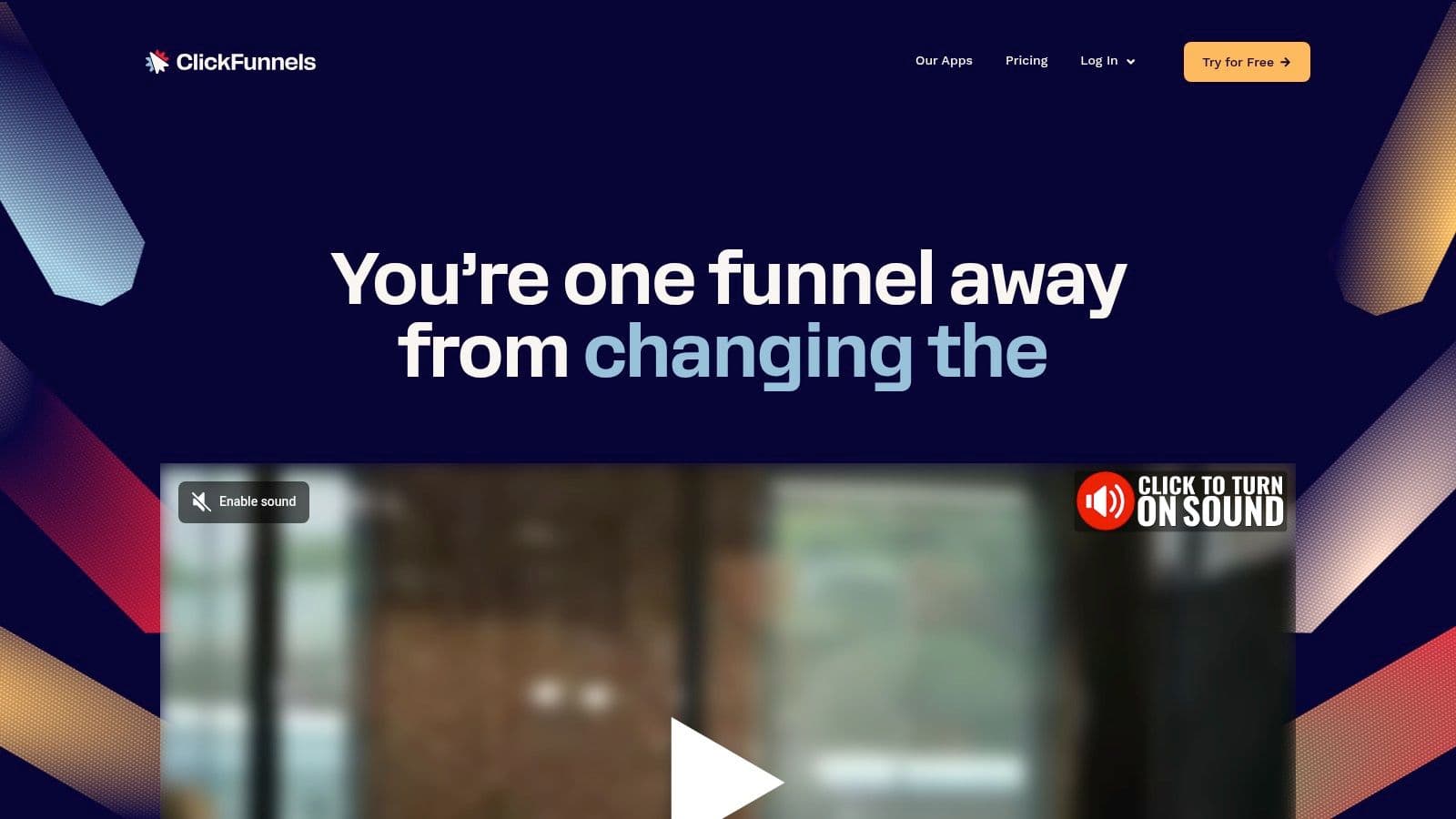
The first thing most users touch is the editor, and that’s still the center of the experience. You drag sections into place, build the page visually, then connect each step to the next one in the flow.
The page builder and funnel flow
The editor is built for speed over purity.
That’s good when you want to launch quickly. It’s less good when you want the fine-grained design control of a dedicated site builder. ClickFunnels wants you focused on outcomes, not pixel-perfect craftsmanship.
Its technical improvements matter here. Reviews note that ClickFunnels 2.0 was optimized for faster load times in both the editor and live pages. That matters because page speed affects abandonment. One review also cites general web performance data that pages loading beyond 3 seconds can lead to 32% visitor abandonment, which is why speed improvements have real funnel impact in practice, according to The Marketing Agency’s ClickFunnels review.
That doesn’t mean every page will be fast by default. It means the platform has moved in the right direction, which is important if you’re running paid traffic.
Templates are useful, but not magic
Templates save time, especially if you already understand what kind of funnel you’re building.
They won’t compensate for a weak offer. They also won’t remove the need to make choices about copy, page order, or follow-up logic. What they do well is give non-designers a usable starting point.
A practical way to think about templates in ClickFunnels:
- Good for momentum when you need to ship a lead magnet funnel or sales page fast
- Helpful for learning because they reveal how experienced marketers structure page sections
- Risky when copied blindly because a template can make weak positioning look polished
If your team still confuses a landing page with a full funnel, this explainer on what a landing page is helps clarify where ClickFunnels shines and where it can be overkill.
Automations, testing, and operational depth
ClickFunnels becomes more interesting once you move beyond page building.
A/B testing, workflows, product logic, and customer journey automation are where the platform starts behaving like a serious sales system rather than just a page tool. That’s also where the learning curve climbs.
Here’s where experienced operators usually get value:
- Split testing helps compare page variants instead of guessing
- Workflows let you trigger follow-up based on user actions
- Checkout logic supports post-purchase revenue tactics such as upsells
- Integrations make it possible to connect external tools when needed
The trade-off is straightforward. More capability means more setup, more monitoring, and more chances to create a messy backend if nobody owns the system.
A quick product walkthrough makes that easier to visualize:
What works well and what gets frustrating
ClickFunnels is strongest when one person thinks in funnels all day.
That person could be a founder, a marketer, or a specialist. Without that owner, advanced setups often become brittle. A team launches a complex flow, then months later nobody remembers why three different automations fire after the same purchase.
The platform rewards disciplined operators. It punishes casual complexity.
The frustrations I see most often are qualitative, not technical. Users can build a lot, but they can also overbuild. Newer features may feel less settled than the core funnel builder. And if your business needs a polished publishing workflow, a rich community environment, or a low-friction creator hub, ClickFunnels can start to feel like a platform optimized for transactions first and experience second.
Understanding Pricing Performance and True ROI
Most software reviews stop at the plan price. That’s not enough.
The right question isn’t whether ClickFunnels is expensive in isolation. The right question is what it costs to operate your business on it well, and whether that operating model produces enough return to justify the complexity.
Reliability is one of its strongest business arguments
If you depend on funnels to sell around the clock, uptime isn’t a technical footnote. It’s revenue protection.
ClickFunnels reported 99.97% uptime in 2023, and its analytics track metrics such as Opt-in Rate, Sales Rate, and Average Cart Value, according to ClickFunnels funnel stats documentation. Those metrics matter because they let teams diagnose where money is leaking. You can look at page views, opt-ins, sales activity, and recurring revenue signals without leaving the platform.
That’s a genuine strength. Operators who know how to read funnel data can improve weak pages or offers faster when analytics are tied directly to the build environment.
The hidden part of ROI
ROI comes from more than conversions.
It also comes from reduced tool sprawl, fewer handoffs, less manual work, and lower decision fatigue. If ClickFunnels replaces several disconnected systems in your stack, the value can be real even before you improve a single page.
But the reverse is also true. If you buy ClickFunnels and still need separate tools for functions your business treats as essential, then the all-in-one promise starts weakening.
Use a simple ROI lens:
| Cost or value driver | What to examine |
|---|---|
| Subscription cost | Is the plan justified by your sales process? |
| Team time | Who will maintain funnels, automations, and pages? |
| Replaced tools | What software can you actually remove? |
| Missing capabilities | What must still be handled elsewhere? |
| Margin impact | Does the stack support your profit model, not just top-line sales? |
For a deeper framework on this, the practical guide to how to calculate marketing ROI is a useful companion read.
TCO matters more than list price
Total Cost of Ownership is where many creator businesses misjudge ClickFunnels.
A consultant selling a high-ticket offer may happily pay for a powerful funnel machine because one closed client can justify the software. A creator with lower-priced products, memberships, or ongoing educational content has a different math problem. That business often depends more on retention, margin discipline, and smooth delivery than on maximizing every upsell opportunity.
Field note: Software feels affordable when viewed against potential revenue. It feels expensive when viewed against everything your team must do to use it well.
That’s why the review of ClickFunnels has to be tied to business model fit. Performance is solid. Analytics are useful. Reliability is credible. But strong infrastructure doesn’t automatically mean strong economics for every type of creator.
The Verdict on ClickFunnels Pros and Cons
ClickFunnels is a serious platform. It earned its place.
It also carries the usual burden of mature, ambitious software: broad capability, uneven fit, and a tendency to make sense fastest for businesses already committed to a conversion-heavy operating style.
Where ClickFunnels is strong
The clearest advantage is strategic focus.
It helps businesses design and control a buyer journey rather than just publish pages. That’s why marketers still gravitate to it. The software isn’t trying to be neutral. It pushes you toward structure, sequencing, and monetization logic.
Its biggest strengths are these:
- Funnel depth . ClickFunnels is built around offers, pages, checkout steps, and follow-up logic.
- Operational concentration . You can manage important parts of selling in one environment instead of spreading them across disconnected tools.
- Analytics tied to funnel stages . That shortens the loop between diagnosis and action.
- Mature market presence . A large user base usually means abundant tutorials, community advice, and implementation patterns.
For launch businesses, direct-response offers, and paid-traffic operators, those strengths are substantial.
Where it gets weaker
The all-in-one pitch has limits.
ClickFunnels can support more than funnels, but not every extension feels equally natural for every business. If your model depends on rich content experience, long-term member engagement, native publishing strength, or a highly branded customer environment, you may find yourself adapting your business to the tool rather than the tool to your business.
The recurring drawbacks are usually these:
- The learning curve grows fast once you move past simple pages
- The backend can become cluttered if nobody owns architecture and naming discipline
- Some creator-first functions feel secondary compared with funnel mechanics
- TCO can rise when you keep extra tools for capabilities that aren’t strong enough inside the platform
The short version
This review of ClickFunnels comes out positive if your business wins through controlled customer journeys.
It becomes more mixed if your business wins through trusted audience relationships, education, recurring memberships, or community-led retention.
Buy ClickFunnels when the funnel is the engine. Think harder when the funnel is only one component of a larger creator business.
That distinction sounds subtle. In practice, it determines whether the software becomes a profit driver or an expensive center of gravity.
An Alternative for Creators Zanfia vs ClickFunnels
Creators often compare platforms as if they all solve the same problem. They don’t.
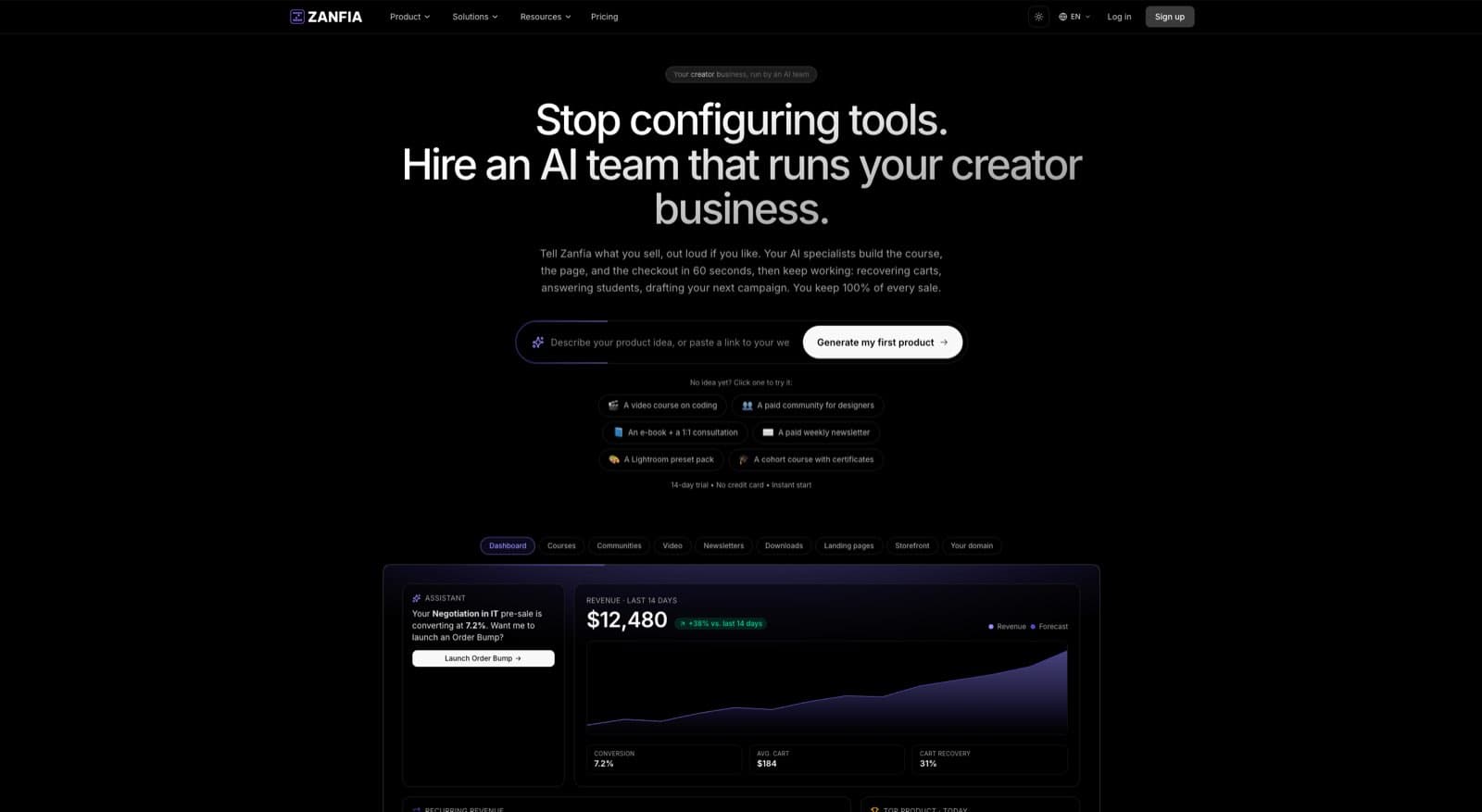
ClickFunnels starts from sales mechanics. Zanfia starts from the creator business itself and puts an AI team at the center of it. The creator dictates the work by chat or by voice, and the assistant carries out anything available in the interface: publishing a course, spinning up a community, setting up a paid newsletter, or building a checkout with order bumps and installments. Courses, newsletters, communities, and 12 product types live under one branded roof, and the whole surface is exposed to outside AI agents through an MCP endpoint. That difference changes the economics and the daily workflow.
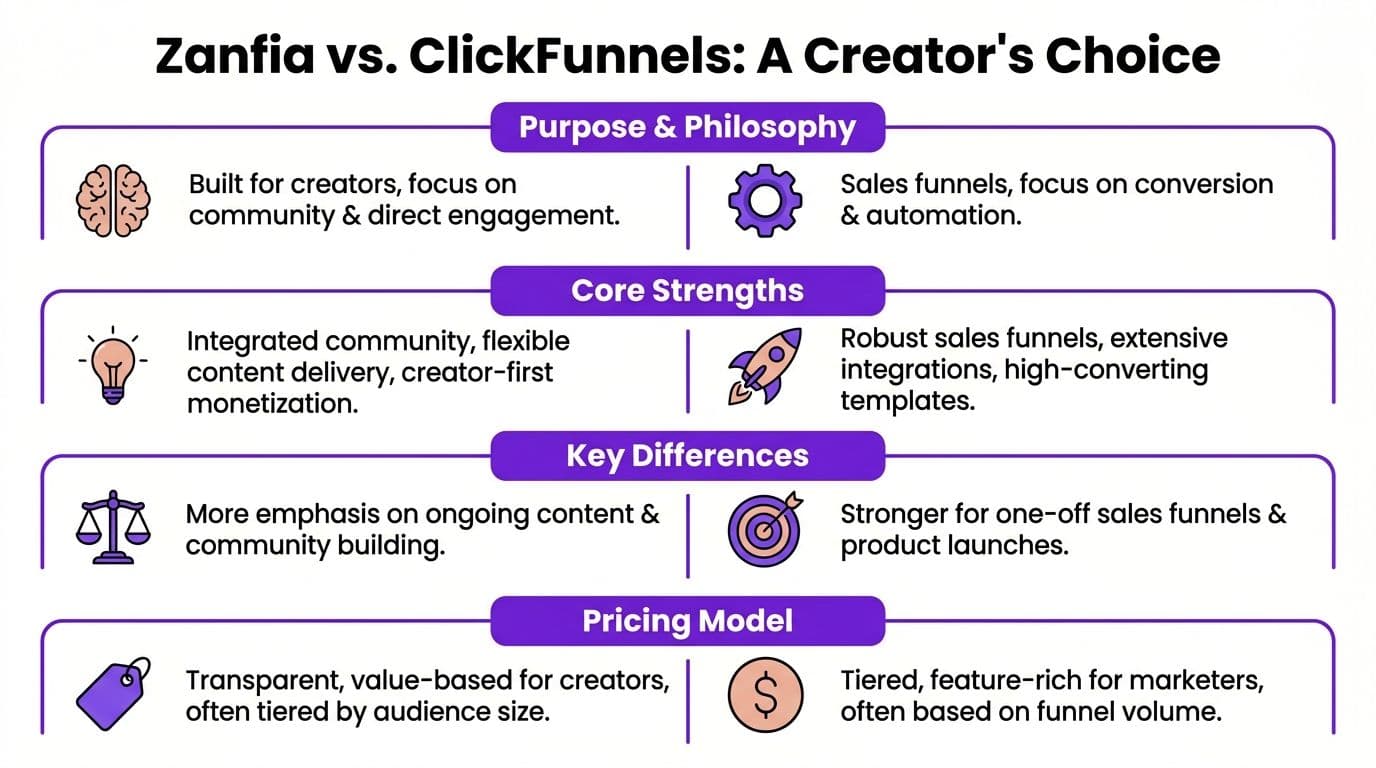
The biggest difference is business model fit
ClickFunnels is excellent when your business is designed around funnel optimization.
Zanfia is a stronger fit for creators who want an AI team to do the operational work while they keep owned audience relationships and margin protection intact. That includes creators selling courses, paid newsletters, subscriptions, communities, e-books, downloads, and bundled digital offers under their own brand. The assistant dictated by voice or chat handles the setup, and the built-to-sell checkout, with order bumps, installments, and test mode for buying your own product before launch, is designed to turn that setup into revenue.
TCO is where the comparison gets serious
Reviews of all-in-one platforms often skip this point, but they shouldn’t. G2 reviews note that while ClickFunnels claims $600+/month savings, that won’t necessarily apply to lean operations, and users also report it can be a poor fit for serious blogging or native webinars, which can force extra tool purchases and weaken the savings case, as noted in G2 ClickFunnels reviews.
That observation matters for creators because low-friction businesses often win on margins, not just front-end conversion.
Zanfia takes a different economic approach. Its model is built around a SaaS subscription with 0% platform transaction fees as of the current pricing, so creators keep their sales revenue apart from the fees charged by payment operators. Entry starts at $39/month, or $31/month billed annually, on Starter, with a 14-day free trial and no credit card required. For a business selling digital products each month, that can be easier to model and easier to trust. Availability of advanced AI capabilities, including the MCP endpoint and the full assistant, depends on the plan, so check the current Zanfia pricing before deciding which tier fits.
Head-to-head comparison
| Feature | ClickFunnels | Zanfia |
|---|---|---|
| Core philosophy | Funnel-first sales system | AI team running a creator-first business platform |
| Best for | Launches, upsells, direct-response selling | Courses, communities, newsletters, memberships, digital products |
| Community model | Not the natural center of the product | Integrated community under your own brand, with an AI agent that writes from your content and labels everything as AI |
| Course delivery | Available, but not the product’s core identity | Strong native fit for digital education businesses |
| Video hosting | Not the standout differentiator | Native video hosting included |
| Revenue model | SaaS pricing with value tied to funnel use case | SaaS from $39/month, or $31/month billed annually, with 0% platform transaction fees as of the current pricing |
| Brand control | Strong selling environment | White-label and custom domain (plan-dependent) |
| AI and agents | Not the product’s focus | Voice-ready AI assistant that can perform anything available in the interface, plus an MCP endpoint for outside agents (plan-dependent) |
| Payment setup | Broad integrations | Supports Stripe and PayPal, with Apple Pay and Google Pay via wallet payments |
| Checkout depth | Order bumps and upsells are a core strength | Order bumps, installments (e.g., split a $600 course into four payments), subscription upsells, and test mode for buying your own product before launch (some features plan-dependent) |
| Automation | Funnel and workflow automation | Visual automation builder for access, email flows, subscriptions, and community access |
| Best strategic use | Optimize transaction paths | Build a branded, recurring digital business run day-to-day by an AI team |
If you’re comparing broader selling stacks, this overview of the best platforms to sell digital products is a useful complement because it frames platform choice around the product you sell, not just the pages you build.
Where Zanfia has the edge for creators
For a creator, software quality isn’t just about launch performance. It’s about whether the entire customer experience can stay in one coherent brand environment, and whether the day-to-day operating work can be handed to an AI team instead of another hire.
Zanfia stands out in a few practical ways:
- An AI team runs the business day-to-day . The creator dictates the work by chat or by voice, and the assistant carries out anything available in the interface, from publishing a lesson to setting up a checkout.
- Community and content live together . You don’t need to push your audience into a separate space that weakens brand control, and a community AI agent can write from your own content, with everything it publishes labeled as AI.
- Native video hosting reduces stack sprawl . That’s useful for course businesses that don’t want to manage another service just to deliver lessons.
- Automations handle operational chores . Access control, post-purchase actions, welcome flows, and subscription logic are built to reduce admin.
- Built to sell . The checkout supports order bumps, installments, subscription upsells, and test mode so you can buy your own product before launch, across 12 product types under one brand.
- Open to outside AI agents . The MCP endpoint lets external assistants act on your workspace, so your stack isn’t limited to what one vendor builds inside.
When ClickFunnels still wins
There are cases where ClickFunnels remains the better pick.
Choose it when your business revolves around campaigns, multi-step launch funnels, paid traffic experimentation, and aggressive conversion optimization. If you think in order bumps, one-click upsells, and segmented follow-up before you think in lessons, member spaces, or recurring content, ClickFunnels is closer to your operating model.
A creator doesn’t need the most famous platform. A creator needs the platform that matches how revenue is actually earned and retained.
For creators who care about margin protection, community ownership, clean operations, and handing routine work to an AI team they can dictate to by voice, Zanfia is often the more natural fit.
Final Recommendations and Choosing Your Path
ClickFunnels is worth buying for a narrow but important kind of business.
Choose it if you’re a marketer, coach, consultant, or offer-driven operator who lives inside launches, paid acquisition, upsells, and tightly managed conversion paths. In that environment, its funnel depth, analytics, and sales logic can justify the commitment.
Skip it, or at least test it more skeptically, if you’re a creator whose business depends on ongoing delivery rather than campaign architecture. That includes educators, newsletter operators, community builders, and experts selling digital products through trust, retention, and branded experience.
If your business leans on recurring content, community, and clean operations, the decision gets even more practical. White-label control, the ability to keep community, content, and commerce together, and an AI team that carries out the setup work you dictate often matter more than having the most elaborate funnel builder.
For those businesses, a creator-first platform is usually the cleaner move. The software doesn’t need to impress your inner marketer. It needs to support your margins and reduce operating friction.
If your next step is building a branded member area rather than another complex launch stack, this guide to a member website builder points in the right direction.
The best review of ClickFunnels ends with a simple truth. It’s a powerful machine. But not every creator should build their business around a machine designed primarily for funnels.
FAQ
Is ClickFunnels worth it for a business built around a content library or membership rather than launches?
The article says ClickFunnels works best when the transaction path IS the product strategy, and it becomes a mixed to weak fit for publishing-heavy models focused on retention and ongoing member engagement. If your core asset is a recurring relationship with members or students, content architecture and post-sale experience matter as much as the conversion path, and ClickFunnels is not organized around that.
How should I think about the true cost of running ClickFunnels beyond the monthly plan price?
The article argues that Total Cost of Ownership matters more than list price. You need to factor in team time to maintain funnels and automations, how many tools you can actually remove, what capabilities still need to be handled elsewhere, and whether the stack supports your margin, not just top-line sales. Software feels affordable against potential revenue but expensive against everything a team must do to use it well.
Does ClickFunnels replace all the tools in a typical creator stack?
It can cover a lot of surface area, but the article warns against treating it as a universal all-in-one. If ClickFunnels replaces several disconnected systems, the value is real, but if you still need separate tools for functions your business treats as essential, the all-in-one promise weakens. The platform is best when one person thinks in funnels full-time; without that owner, advanced setups often become brittle.
What kind of operator gets the most value from ClickFunnels?
The article names direct-response marketers who constantly test hooks and offers, high-ticket coaches and consultants running application funnels, info-product sellers running launches and webinars, and operators managing paid traffic who care about each step between click and sale. These users want a machine that shapes buyer behavior, not just a home for content.
Do the reported speed and uptime numbers actually matter for my funnel results?
Yes, according to the article. ClickFunnels 2.0 was optimized for faster load times, and pages loading beyond 3 seconds can lead to 32% visitor abandonment, so speed improvements have real funnel impact, especially if you run paid traffic. Reported 99.97% uptime in 2023 protects revenue for businesses that depend on funnels selling around the clock.
If your business is built around courses, paid newsletters, digital products, and community, Zanfia is worth a close look. It gives creators a branded all-in-one environment where an AI team, dictated by chat or voice, handles the operational work: publishing courses, running communities, setting up newsletters, and building a checkout designed to sell, with order bumps, installments, subscription upsells, and test mode across 12 product types. Entry starts at $39/month, or $31/month billed annually, with a 14-day free trial, no credit card required, and 0% platform transaction fees as of the current pricing. Advanced AI capabilities and the MCP endpoint for outside agents are available on higher plans, so see the current Zanfia pricing for the exact fit.