

What Are Funnels Used For? A Guide to Boosting Your Online Growth
At its core, a funnel is simply the guided journey you create for your audience. The entire point is to systematically lead people from initial curiosity to becoming a paying customer and, eventually, a loyal advocate for your brand. Think of it as a strategic map for building relationships and solving problems, one step at a time.
What Exactly Is a Funnel and Why Does It Matter?
Forget the idea of a funnel as some rigid, aggressive sales tool. It's much more like a helpful, one-on-one consultation. It’s a process designed to deliver the right message to the right person at precisely the right moment.
Instead of shouting your offer from the rooftops to anyone who will listen, a funnel helps you whisper the perfect solution to those who actually need it, building genuine trust along the way.
The structure is simple but incredibly powerful. It works by gradually filtering your broad, general audience into a much smaller, more committed group of customers. This is why the visual of a funnel works so well—it shows the natural progression from a wide top to a narrow bottom.
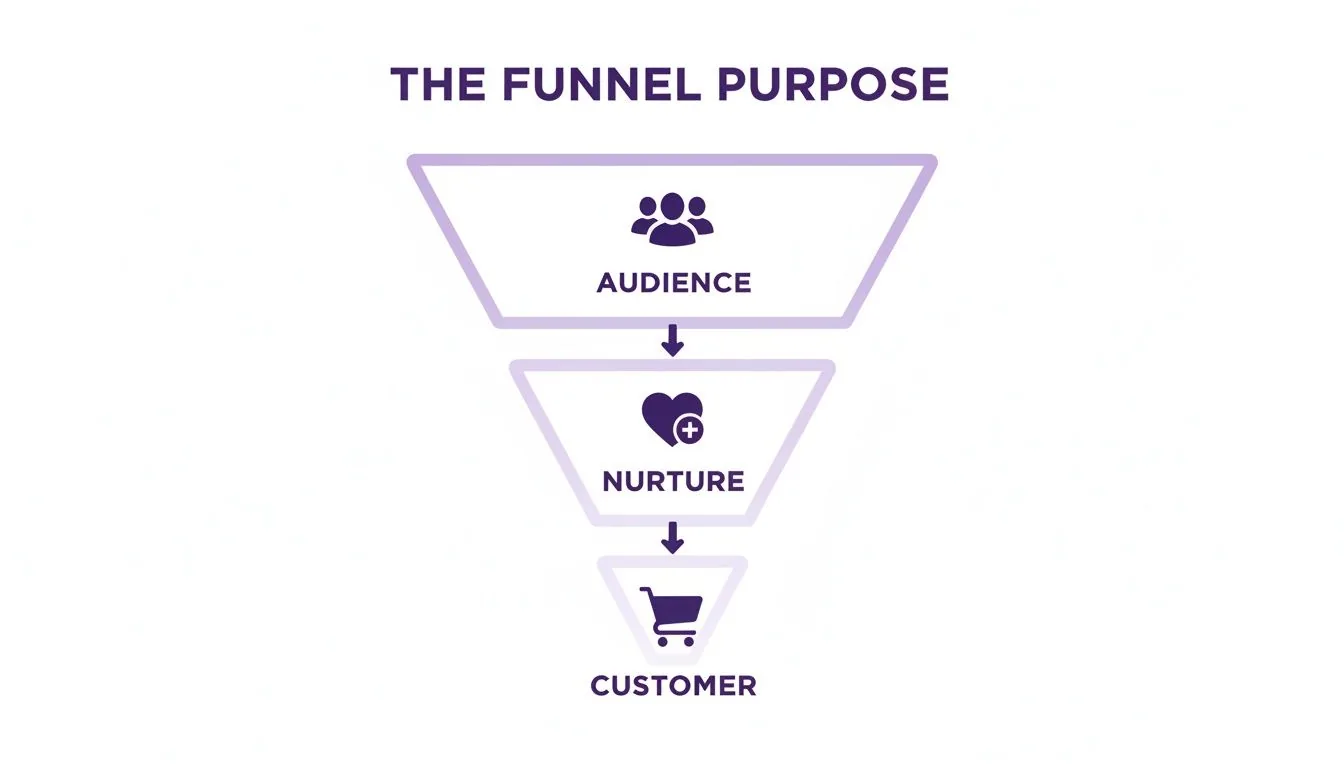
This process makes sure you’re focusing your precious time and energy on the people who are genuinely interested in what you have to offer. That means more efficiency and way better results.
The Strategic Advantage of a Funnel
So, why is this structure so crucial for digital creators, educators, and small businesses? In a word: predictability.
Without a funnel, your growth feels random and chaotic—a great sales month here, a quiet one there. With a well-designed funnel, you build a reliable, repeatable system for attracting, nurturing, and converting your audience. If you want to see how this applies in the real world, it’s helpful to understand the mechanics of a SaaS customer acquisition funnel and its key stages.
The impact isn't just theoretical; the numbers back it up. For instance, businesses that master this guided approach see dramatically higher revenue and average deal sizes compared to those that don't. That’s the power of a guided customer journey.
A funnel isn’t just about making sales. It's a strategic map for onboarding new customers, nurturing a thriving community, and creating loyal fans for life. This makes it one of the most powerful tools in your entire business toolkit.
Ultimately, funnels are essential for so much more than just transactions. They are critical for:
- Building Real Relationships: When you guide users with valuable content at each stage, you foster trust and a genuine connection.
- Improving Your Efficiency: Automating the customer journey saves you countless hours, freeing you up to focus on creating amazing products or content.
- Deeply Understanding Your Audience: By analyzing where people drop off in your funnel, you uncover powerful insights into their biggest needs and pain points.
By truly understanding what funnels are used for, you can start building a more sustainable, predictable, and profitable online business. To go even deeper, check out our complete guide on what a marketing funnel is.
What Are the Most Common Funnels for Digital Creators?

While every funnel guides a user down a path, the destination—and the journey itself—changes completely depending on your goal. For digital creators, knowing what funnels are used for is all about picking the right tool for the job. You wouldn't use a hammer to turn a screw.
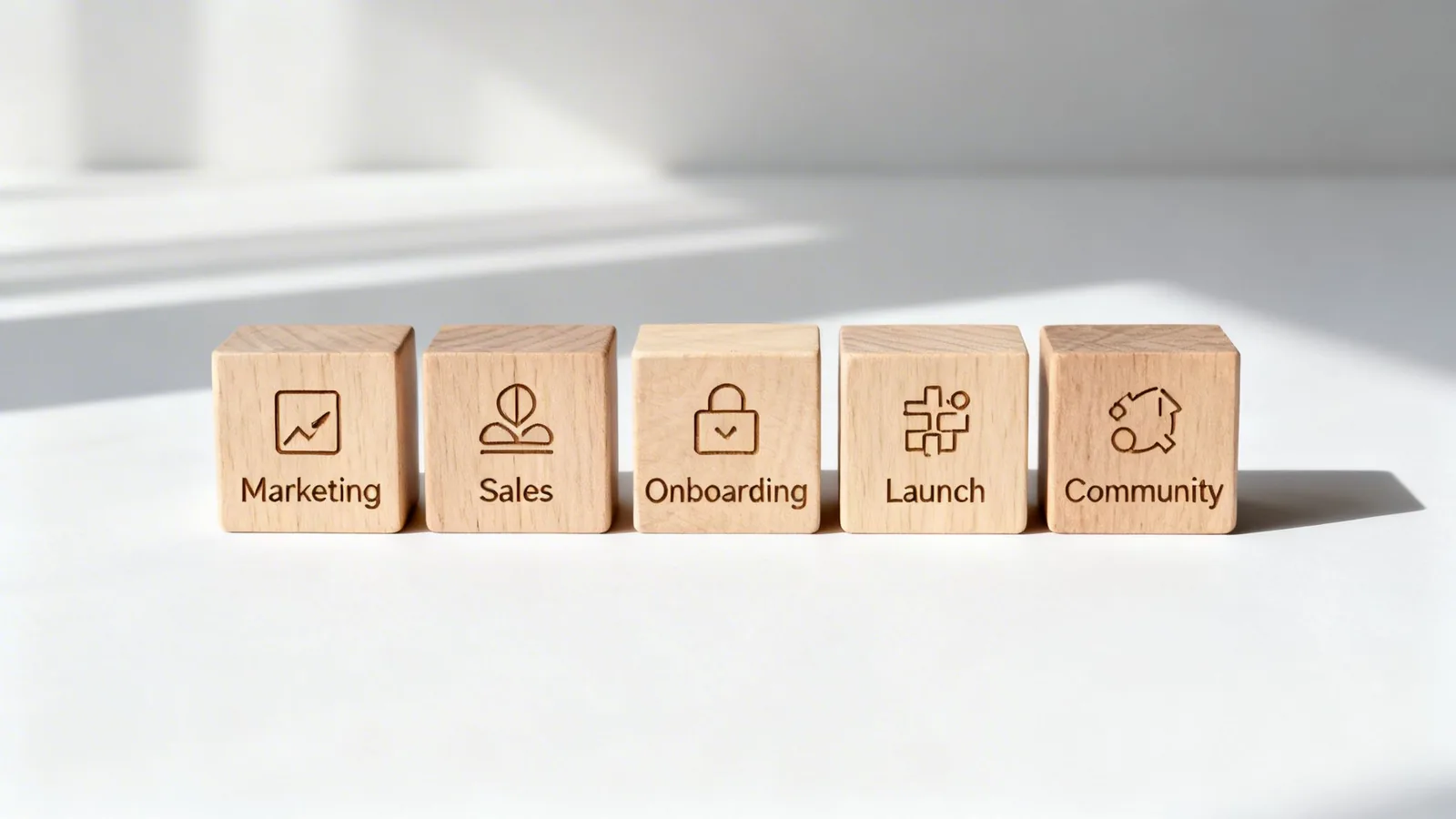
Think of these five funnels as strategic blueprints. They're the most effective and battle-tested systems that creators use to build their audiences, sell their products, and turn casual followers into a loyal tribe.
The Marketing Funnel
This is ground zero. The marketing funnel is your machine for turning strangers into leads. Its only job is to get in front of people who have a problem you can solve and earn their trust enough to get an email address. This is the top of your entire business system, where you cast a wide net to capture attention.
- Purpose: Build awareness and generate qualified leads.
- Typical Steps: You might create a blog post or social media content that points to a landing page with a freebie (like a checklist or a short guide) that people get in exchange for their email.
- Example: A business coach posts a YouTube video about productivity. In the video, she mentions a free "Weekly Planning Template" and links to the download page. Anyone who signs up is now a lead.
The Sales Funnel
Once someone has raised their hand and shown interest, the sales funnel kicks in. This is where you smoothly transition from giving free value to offering a paid solution. The goal here is simple and direct: convert that lead into a customer. You do this by showing them exactly how your product or service is the bridge from where they are to where they want to be.
These funnels can be dead simple for a low-cost digital download or much more involved for a high-ticket coaching program. If you're looking for a great starting point, exploring a few proven sales funnel templates can save you a ton of guesswork.
The secret to a high-converting sales funnel isn’t just listing features. It’s all about selling the transformation. You’re guiding the customer from their specific pain point to their ultimate desired outcome.
The Onboarding Funnel
Making the sale is not the finish line. In fact, what happens after the purchase is just as important. The onboarding funnel is a crucial, but often forgotten, process that welcomes new customers and makes sure they get value right away. A great onboarding experience crushes buyer's remorse, slashes refund requests, and paves the way for a long-term customer relationship.
- Purpose: Welcome new customers, get them their "first win" fast, and make them feel great about their purchase.
- Typical Steps: This usually looks like a welcome email sequence, a quick-start guide, and a few automated check-ins that walk them through the first few steps of a course or community.
- Example: A student enrolls in a course on Zanfia. They immediately get an email series that points them to the first module and invites them to an exclusive community channel just for new members.
The Product Launch Funnel
A product launch funnel is an event. Instead of just dropping a new product and hoping people notice, you build massive hype and anticipation before it even goes live. It’s a multi-day experience designed to build a waitlist, handle objections upfront, and get people counting down the minutes until they can buy.
The Community Funnel
Last but not least, the community funnel is all about retention and creating super-fans. The goal is to turn one-time buyers into lifelong members and evangelists for your brand. This funnel centers on creating a space—like a community built right inside Zanfia, where an AI team handles the busywork of running it, the creator can dictate updates by voice, and members reach every product they own from a single account—so your customers can connect, learn from each other, and get continuous value, making them feel like they truly belong.
How Funnels Drive Sales and Increase Revenue
A well-designed funnel isn't just a map of the customer journey—it's a system built for one primary purpose: generating predictable revenue. It takes the guesswork out of growth. Instead of hoping for sales, you create a data-backed framework that turns casual visitors into paying customers, directly boosting your bottom line.
This whole process boils down to conversion optimization. It’s about tweaking every single step, from the headline on your landing page to the color of the checkout button, to make the path to purchase as smooth as possible. Applying proven conversion rate optimization techniques is what separates a leaky bucket from a high-performance sales engine.
Maximizing Every Opportunity
Knowing how people find you is just as important as the funnel itself. The source of your traffic has a massive impact on its quality and how likely those leads are to convert. High-quality traffic from channels like referrals, email marketing, and organic search consistently outperforms channels like cold calling. Knowing this helps you stop wasting money on channels that don't work and double down on the ones that do.
But a truly smart funnel doesn't stop at the first sale. It's designed to maximize the value of every single transaction by making strategic offers at just the right moment.
A great funnel doesn't just make a sale; it intelligently increases the value of that sale. By integrating smart offers, you can turn a single purchase into a higher-value transaction, boosting immediate revenue and long-term customer relationships.
Advanced Revenue-Boosting Strategies
You can build a few key strategies directly into your funnel to seriously increase your average order value (AOV) and customer lifetime value (LTV).
- Upsells: The moment a customer clicks "buy," you present them with a one-time offer for an upgraded or more powerful version of what they just purchased.
- Order Bumps: This is a small, can't-say-no add-on right on the checkout page. Think of it as the "impulse buy" of your funnel—a simple checkbox is all it takes.
- Downsells: If someone says no to your bigger upsell, don't let the opportunity vanish. Instead, offer them a lower-cost alternative. It’s a great way to capture revenue you would have otherwise lost.
These tactics turn your checkout page from a simple payment form into a dynamic revenue generator. Zanfia is built around this: the creator can dictate the offer stack by voice or chat and an AI team assembles the checkout, so order bumps, one-time upsells, subscriptions and installment plans (like splitting a $600 course into four payments) sit inside the same sales flow instead of three different tools. To see how these ideas work in practice, check out our guide on upselling and cross-selling. This is how you use funnels not just for sales, but for real, exponential growth.
Using Your Funnel to Find and Fix Business Leaks
A funnel is more than just a path to purchase; it’s one of the most powerful diagnostic tools you have for your entire business. Think of it like a series of checkpoints in a pipeline.
By measuring how many people successfully move from one point to the next, you can instantly see where your process is strong and, more importantly, where it’s breaking down. This transforms your funnel from a static sales path into a living system you can constantly improve. Instead of guessing why sales are down, you get a clear, data-driven answer.
Pinpointing Your Weakest Links
The real magic happens when you start tracking the micro-conversions between each stage. These are the small "yeses" a person gives on their way to becoming a customer. Monitoring these transitions lets you isolate problems with surgical precision.
For example, you might look at the conversion rates for:
- Website Visitor to Email Subscriber: This tells you how effective your landing page and lead magnet are. A low rate here means your initial offer isn’t compelling enough to earn an email address.
- Email Subscriber to Sales Page Visitor: This measures how well your welcome sequence or nurture emails build interest and drive action. Are people actually clicking the links you send them?
- Sales Page Visitor to Checkout: A big drop-off here often signals issues with your sales copy, pricing, or the clarity of your offer. Something on that page is turning people away.
- Checkout to Completed Purchase: High abandonment at this final hurdle usually points to technical friction, unexpected fees, or a clunky payment process. Zanfia runs on Stripe and PayPal with Apple Pay and Google Pay built in, and lets you run a test purchase on the real checkout before the first customer arrives so tracking and payment flow are confirmed end to end.
Understanding Industry Benchmarks
Analyzing your funnel data is powerful, but it's even better with context. In some industries, it's normal for only a fraction of marketing leads to become sales-ready. For example, some data shows only about 15-21% of marketing qualified leads (MQLs) become sales qualified leads (SQLs).
Knowing benchmarks like these helps you see if a drop-off is normal or a sign of a real problem. If your MQL-to-SQL rate is only 5%, you know exactly where to focus your optimization efforts.
Your funnel isn't just a sales tool; it's a feedback loop. Every drop-off is a customer telling you something is wrong. Your job is to listen to that data and fix the underlying problem.
By systematically identifying these leaks, you can make targeted improvements that have a direct impact on your bottom line. It could be as simple as rewriting a headline, simplifying a checkout form, or clarifying your value proposition. These small, data-informed changes add up to significant gains over time.
This diagnostic approach is at the heart of all successful conversion rate optimization strategies. It turns your funnel into your most valuable tool for building a sustainable business.
To help you get started, here's a quick guide to diagnosing common issues at each stage of your funnel.
Identifying Common Funnel Problems and Solutions
| Funnel Stage | Common Problem | Potential Cause & Solution |
|---|---|---|
| Top of Funnel (ToFu) | Low landing page sign-up rate | Cause: Your offer (lead magnet) isn't compelling, or the copy is unclear. Solution: A/B test your headline and call-to-action. Make sure the value proposition is crystal clear. |
| Middle of Funnel (MoFu) | Low click-through rates from emails | Cause: Your emails aren't building enough interest, or the subject lines are weak. Solution: Improve your email copy to build curiosity and urgency. Segment your list to send more relevant content. |
| Bottom of Funnel (BoFu) | High sales page bounce rate | Cause: The price is a shock, the offer is confusing, or there isn't enough social proof. Solution: Add testimonials or case studies. Clarify the offer and break down the value. Consider a payment plan. |
| Checkout & Purchase | High cart abandonment rate | Cause: Unexpected fees, a complicated form, or lack of trust signals. Solution: Be transparent with all costs upfront. Simplify the form to ask for essential information only. Add trust badges (e.g., security seals) and run a test purchase on your live checkout to catch friction before real buyers do. |
Think of this table as your first-aid kit for funnel optimization. When you see a number you don't like, find the corresponding stage and start investigating the potential causes. This is how you move from guessing to knowing.
How to Build Your First Funnel Seamlessly

Knowing what funnels are for is one thing. Actually building one? That's where a lot of creators hit a wall.
It's easy to get stuck in "pre-launch paralysis," staring at a tangled web of separate tools. You need one for landing pages, another for email marketing, a third for payments, and a fourth to actually deliver your product. The result is a clunky, disjointed system that costs a fortune in both money and time.
This is exactly why an all-in-one platform makes such a massive difference. Instead of duct-taping different apps together, Zanfia brings every step of the customer journey under one roof, and pushes it a step further: an AI team runs the busywork for you, and the creator can dictate what happens next by chat or voice instead of clicking through menus. Sales page, checkout, and course or community access sit inside the same ecosystem, and 12 product types (courses, communities, newsletters, memberships, downloads, consultations, bundles and more) live under one brand and one checkout.
The Power of an Integrated System
When all your tools talk to each other, you get your most valuable asset back: time.
Instead of manually adding every new customer to your email list or personally granting access to a course, a unified platform does the heavy lifting for you. Zanfia leans hard on this: the assistant can perform any action available in the interface, and you can trigger it by voice, which turns most admin work into a spoken sentence. These automations can save creators 5–10+ hours a month, time you can pour back into creating instead of clicking.
An integrated approach also radically improves the customer experience. A single login gives your members access to everything—their courses, community chats, and purchase history—all on your own custom domain. This keeps your audience inside your world, building loyalty instead of shipping them off to third-party tools like Discord or generic course portals.
Building a funnel shouldn't require a degree in computer science. An all-in-one platform demolishes the technical hurdles, letting you launch your first digital product with total confidence.
Building a Simple Digital Product Funnel
So, what does this actually look like in practice? Let's walk through building a simple funnel for a new e-book or mini-course using Zanfia, where all the pieces are already connected.
- Create Your Sales Page: First, you’ll build a simple page that sells the value of your product. Forget complicated design—just clearly state the problem it solves and the transformation it delivers. If you don't want to build it by hand, you can describe the offer to the assistant by voice and let the AI team draft the page for you.
- Set Up a Streamlined Checkout: Next, connect Stripe or PayPal (with Apple Pay and Google Pay ready to go), add an order bump or an installment plan if it fits the offer, and run a test purchase on the live checkout before your first real buyer arrives. As of publication, Zanfia charges 0% platform commission on customer sales, so you keep what your customers pay minus standard processor fees.
- Automate Product Delivery: The second a purchase goes through, the platform automatically fires off a welcome email. This email can instantly grant access to a course, add the buyer to an exclusive community channel, and deliver the download link for their e-book.
That’s really it. Those three steps are the heart of a successful funnel.
By using an integrated system, you strip away the complexity and focus on the only thing that matters: serving your audience. And if you want a running start, you can grab a ready-to-use sales funnel template to get going even faster.
Common Questions About Building Funnels
Diving into your first funnel always brings up a few questions. It's one thing to understand the theory, but it’s the practical side of building one that really matters. Let's walk through some of the most common hurdles I see creators run into.
How Long Does It Take to Build a Successful Funnel?
Honestly, you can get a simple, working funnel live in a day or two. On an all-in-one platform like Zanfia, putting together a sales page, a checkout, and a way to deliver your product can be surprisingly quick, especially when you can dictate what you want to the AI assistant instead of wiring up separate tools yourself.
But the real magic isn't in the initial launch. A truly successful funnel is never "done"—it's an evolving system. The most profitable funnels are the ones that get tweaked and refined over weeks and months based on what real people are actually doing.
Do I Need a Big Audience to Use a Funnel?
Absolutely not. In fact, a funnel is one of the best ways to systematically grow a small audience. Its whole job is to squeeze every last drop of value out of the traffic you already have.
Instead of needing thousands of followers just to make a handful of sales, a good funnel helps you convert a much higher percentage of the people who show up. It turns a casual visitor into a committed customer, making it the perfect growth engine when you're just starting out.
Funnels don’t require a large audience to be effective; they create a larger, more engaged audience by design. Every visitor is guided through a process that builds trust and demonstrates value.
What Are the Most Important Metrics to Track?
It’s way too easy to get buried in data. To keep from getting overwhelmed, just focus on the three numbers that tell you almost everything you need to know about your funnel’s health:
- Conversion Rate at Each Stage: This is your "leak detector." It shows you exactly where people are dropping off. Once you find the biggest leak, you know exactly where to focus your energy.
- Average Order Value (AOV): This simply tells you how much each customer spends on average. Adding a smart upsell or order bump is one of the fastest ways to increase your AOV and bring in more revenue without needing more traffic.
- Customer Lifetime Value (LTV): This is the long-term report card for your business. LTV shows you the total revenue a single customer brings in over their entire relationship with you. It’s the ultimate proof that your funnels are creating real, lasting value.
Ready to stop juggling tools and build your first funnel with confidence? Zanfia gives you an AI team that runs the busywork, an assistant you can drive by voice, and a checkout built to sell with order bumps, installments and 12 product types under one brand. As of publication, platform commission is 0%. Start with a 14-day free trial, no credit card required. Launch your online business today.