

How Much Does YouTube Pay for Shorts in 2026?
YouTube Shorts typically pays about $0.01 to $0.07 per 1,000 views, and creators in the YouTube Partner Program keep 45% of Shorts ad revenue. That's why a Short can pull huge reach and still generate surprisingly little direct ad income.
If you're searching how much does YouTube pay for Shorts, you're probably doing it right after checking Analytics and thinking something is off. A video hits a million views, comments are flying, subscribers come in, and the revenue still looks tiny compared with what is generally expected from YouTube.
That reaction is normal. Shorts monetization feels confusing because the payout isn't a simple per-view rate. The practical answer is that Shorts often pay far less than long-form videos, and the reason isn't just “YouTube pays less.” The reason is the system itself.
Creators who understand that system make better decisions. They stop treating viral reach as the same thing as revenue, and they start building Shorts in a way that supports a bigger monetization plan. If you want the broader business context behind that shift, this content monetization guide is a useful companion.
Your Viral Short Paid Less Than You Expected
A lot of creators learn the same lesson the hard way. A Short pops off, gets shared, maybe becomes the biggest piece of content on the channel, and the payout still feels underwhelming.
That doesn't mean your channel is broken.
According to Shorts monetization benchmarks summarized here, YouTube Shorts uses a revenue-sharing model where creators keep 45% of Shorts ad revenue and YouTube keeps 55%. The same source summarizes typical Shorts RPM at about $0.01 to $0.07 per 1,000 views, and notes that 10 million views can amount to only a few hundred dollars in direct ad revenue depending on niche, audience geography, and ad demand.
What that means in practice
Shorts are excellent at reach. They are not automatically excellent at ad revenue.
That distinction matters because many creators still carry long-form expectations into short-form performance. They assume that if a Short gets huge numbers, the money should follow in roughly the same way. It usually doesn't.
Practical rule: Treat Shorts as a distribution engine first, and an ad-revenue product second.
The upside is that Shorts can still be worth producing. They can introduce new viewers to your channel, surface your brand repeatedly in the feed, and create a steady stream of discovery that long-form often can't match. The mistake is expecting the view count alone to tell you what the video was worth.
Why the disappointment happens
Most creators look at one number first: views.
The platform doesn't reward Shorts in a straight line based on that one metric. That's why two channels can report very different outcomes from what looks like similar performance on the surface. One creator sees modest revenue from a breakout Short. Another gets similar reach and sees noticeably less.
If you only ask “how much does YouTube pay for Shorts,” you get a partial answer. The more useful question is, “What kind of Shorts activity gets paid well?” That's where the mechanics matter.
How the Shorts Monetization Model Really Works
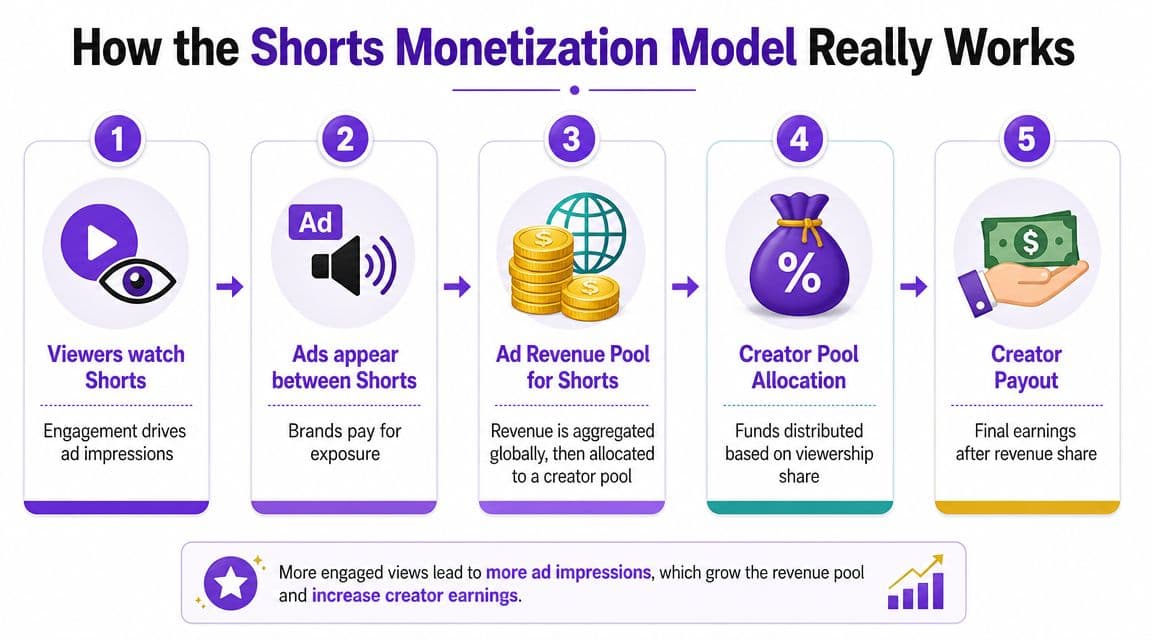
The simplest way to understand Shorts monetization is this: YouTube doesn't attach a clean, fixed payout to each view. It collects Shorts ad revenue into a pool, then allocates that money through a country-based system.
If you want the official monetization setup before diving into the numbers, this walkthrough on how to enable YouTube monetization helps connect the product side with the policy side.
The pool matters more than people think
Google explains the core model in its Shorts monetization documentation. Shorts ad revenue is pooled each month, then distributed to monetizing creators based on their share of engaged views within each country. Creators keep 45% of the revenue allocated to them, and Premium revenue is also allocated separately by country.
That one detail changes how you should think about Shorts earnings.
Your payout is not just “views multiplied by rate.” It depends on how your share of engaged viewing compares with other creators in the same country pool, and on what advertiser demand looks like in those markets.
The real unit isn't raw reach
A lot of articles quote broad averages, and those averages can be directionally helpful. But they hide the part that explains the variance.
On Shorts, engaged views matter more than raw views.
That means the same top-line view count can produce different outcomes based on factors like:
- Country mix: A channel with a stronger audience in higher-value ad markets can see better results from the same nominal reach.
- Engagement quality: If viewers keep watching instead of swiping away, that signals stronger value inside the Shorts feed.
- Audience concentration: A scattered audience behaves differently from one concentrated in a few strong markets.
A better mental model
Think of Shorts monetization as a share-of-pool system, not a flat-price system.
Here's the cleaner way to frame it:
| What many creators assume | How Shorts actually works |
|---|---|
| Every view has roughly the same value | Payout depends on country-based pooled revenue |
| Reach drives revenue directly | Engaged views help determine allocation |
| A viral spike should always pay well | Audience geography and watch quality can change the outcome |
That's why asking only “how much does YouTube pay for Shorts” usually leads to frustration. The platform doesn't reward raw scale in a uniform way. It rewards your share of valuable, engaged viewing within the pool you're competing in.
Calculating Your Potential Shorts Earnings
Once you understand the pooled model, the next question is practical: what might your own Shorts earn?
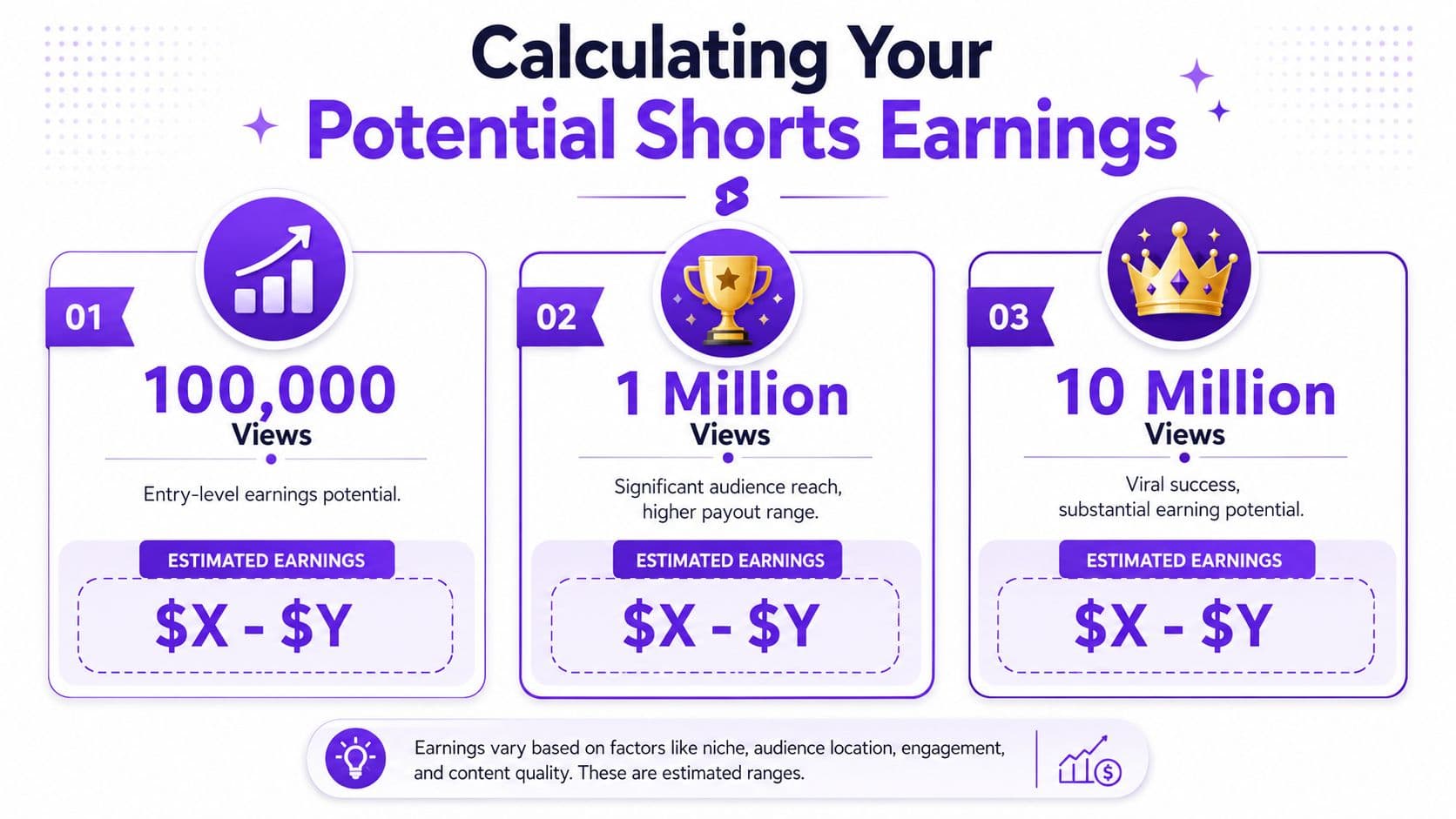
Independent benchmarks summarized by vidIQ put typical Shorts RPM around $0.03 to $0.07 per 1,000 views, with some channels reporting roughly $0.10 or slightly higher when audience geography, niche, and engagement are favorable. In practical terms, that means 1 million Shorts views often produces something like $30 to $70 in ad revenue, though results can land lower or higher depending on engaged views and advertiser demand in the audience's market, as explained in this YouTube Shorts monetization breakdown.
If you want to place those ad numbers in the wider business model of creator income, this article on how internet sites make money is worth reading.
Example payout ranges
Using the benchmark range above, here's the rough math:
| Views | At $0.03 RPM | At $0.07 RPM |
|---|---|---|
| 100,000 | $3 | $7 |
| 1,000,000 | $30 | $70 |
| 10,000,000 | $300 | $700 |
These aren't guarantees. They're expectation-setting numbers.
A creator with stronger audience geography or more favorable demand may do better. A creator with weaker engagement quality or less valuable market mix may do worse. But for planning purposes, this range is more honest than assuming every viral Short will become meaningful ad income.
Watch the payout logic in action
This explainer is useful if you want to see how creators talk through Shorts earnings in real terms.
You must qualify before any of this matters
A lot of confusion comes from discussing earnings before discussing eligibility.
For Shorts ad revenue sharing inside the YouTube Partner Program, you need:
- 1,000 subscribers
- 10 million valid public Shorts views in the last 90 days
If you haven't crossed that threshold, you can still use Shorts for growth, testing, and audience development, but you won't see the ad-revenue outcome creators talk about after full program entry.
The most useful way to read Shorts earning estimates is as post-eligibility math, not as a promise attached to any viral clip.
Key Factors That Influence Your Shorts Payout
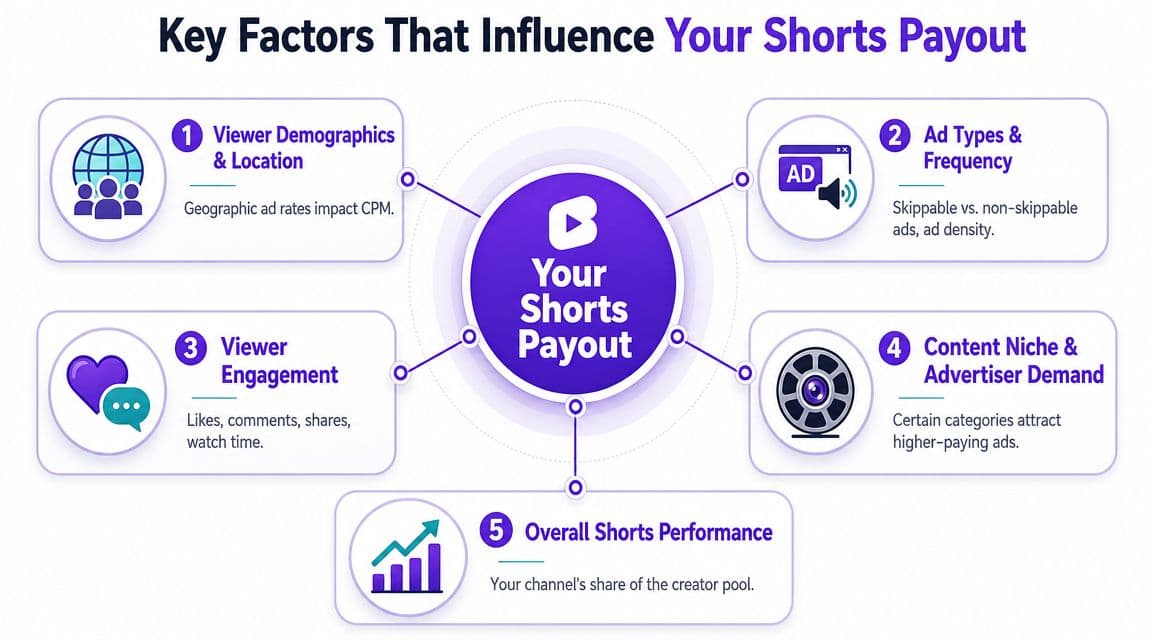
Two Shorts can get similar reach and still land very different payouts. Once you stop looking for a fixed rate, that starts to make sense.
Audience geography changes the economics
This is the first thing I look at when a creator says, “My views are high but the money is low.”
Shorts revenue is allocated by country, so audience location affects what kind of pool you're participating in. A channel whose engaged audience is concentrated in stronger advertising markets can see materially different outcomes from one getting the same number of views across lower-value markets.
That doesn't mean you should force your content into a market that doesn't fit you. It does mean you should know who is watching.
Engagement quality matters more than vanity metrics
Shorts is a fast-feedback environment. People either keep watching or they swipe.
That behavior matters because engaged viewing sits closer to the payout logic than headline reach does. A Short that grabs attention but loses viewers instantly can still rack up views. It just may not create the kind of viewing quality that supports stronger monetization.
A practical review checklist:
- Hold: Are viewers sticking with the Short instead of abandoning it immediately?
- Repeatability: Does the format produce the same behavior across multiple uploads?
- Audience fit: Are the people watching the same people advertisers want to reach in that market?
Niche and advertiser demand shape the ceiling
Some subjects naturally attract stronger commercial intent than others.
If your Shorts content sits closer to buyer-driven categories, software, business tools, education, product-led content, or other commercially relevant themes, advertiser demand may be stronger. If your content is broad entertainment, meme-heavy, or highly casual, the monetization profile often looks different.
This doesn't mean every creator should pivot niches for money. It means you should understand the trade-off between broad reach and valuable reach.
A Short can perform well as content and still perform weakly as inventory.
Seasonality and timing still matter
Even without attaching exact seasonal figures, creators usually notice that payouts don't stay stable all year. Advertiser demand rises and falls, and Shorts earnings can move with it.
That's why I don't judge a format based on one upload or one week. I look for patterns over time. If the same style keeps attracting the right audience, holds attention, and aligns with a monetizable topic, then it becomes worth scaling.
How to Track Your Earnings in YouTube Analytics
Most creators don't need more theory. They need to know where to click and what to look at.
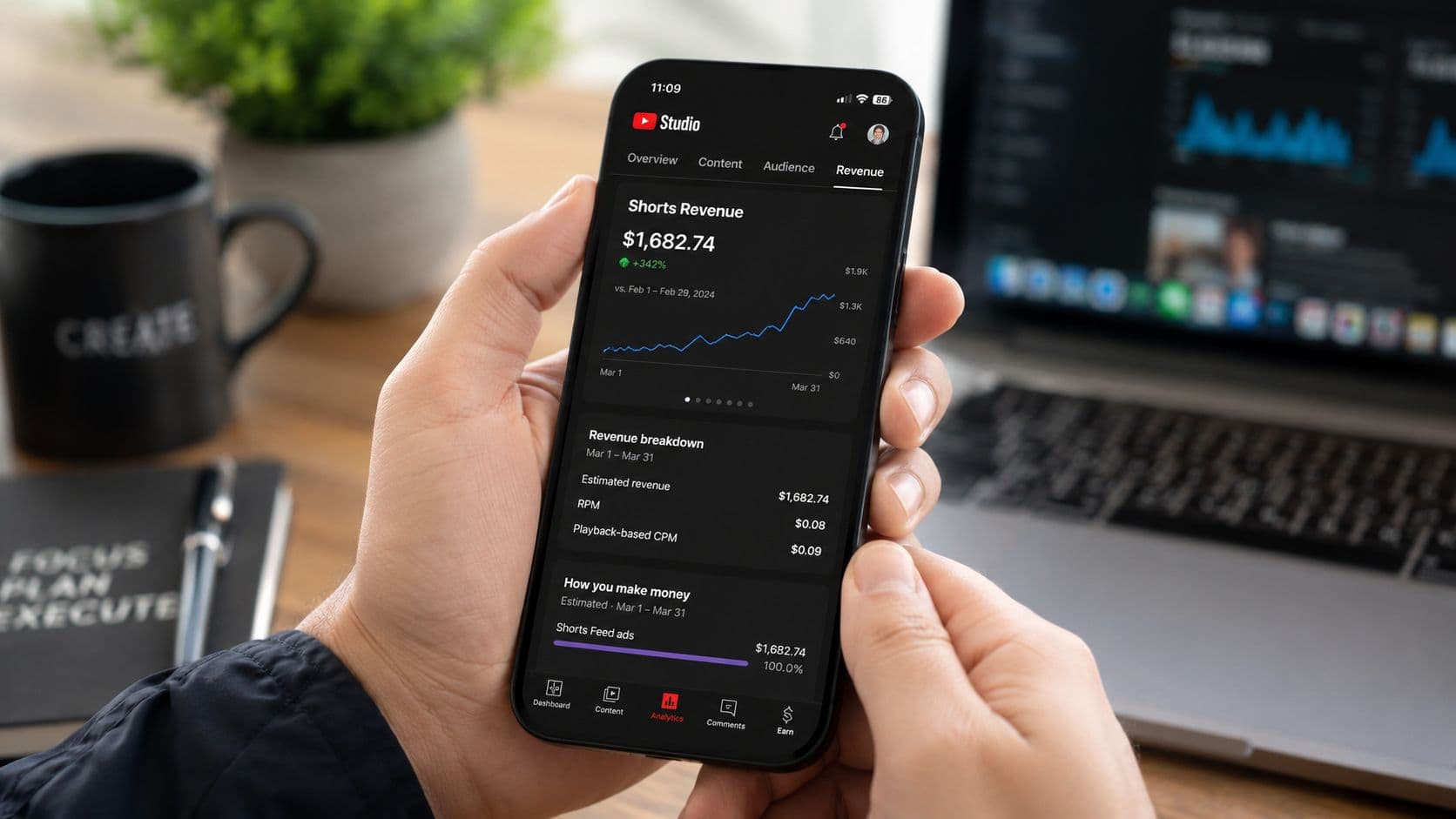
If you already use website and funnel data elsewhere, this guide on how to analyze website traffic pairs well with YouTube Studio because the habit is the same: stop guessing and read behavior.
Where to find Shorts revenue
In YouTube Studio, go to your analytics area and open the revenue reporting tied to monetization. From there, look specifically at your Shorts performance rather than blending it mentally with long-form results.
When I audit creator channels, I tell people to compare Shorts revenue trends alongside topic, format, and audience location. That's what turns Analytics from a scoreboard into a decision tool.
What the key terms mean
A few terms cause confusion:
- RPM: This is your revenue per thousand views from the creator side. For Shorts, it reflects the monetization outcome after the platform's allocation model, not a simple direct ad price.
- Playback-based CPM: Creators often see this term in YouTube revenue discussions, but it's easier to think of it as an advertiser-side pricing metric. It does not tell you what you personally take home from Shorts.
- Estimated revenue: This gives you a working view of earnings, but it's more useful as a trend signal than as a standalone verdict on one video.
What to track each month
Don't just watch the revenue line. Pair it with content attributes.
I'd review:
- Which Shorts topics hold attention best
- Which audience markets appear most often
- Which formats bring subscribers or clicks, not just views
- Whether revenue changes with content style or timing
If a Short earns little but drives the right viewers into your broader ecosystem, it may still be one of your most valuable assets.
That's the shift many creators miss. Shorts analytics should inform monetization strategy, not just satisfy curiosity.
Strategies to Increase and Diversify Shorts Income
A Short can hit hard on views and still underperform on revenue. I see this all the time with creators who chase broad reach without asking whether those views came from markets and audience segments that support stronger ad demand or downstream sales.
The practical goal is simple. Raise the quality of the views you attract, then give those viewers somewhere valuable to go after they discover you.
Improve the inputs that affect payout
Shorts revenue is pooled, so one viral upload does not guarantee a strong return by itself. Better outcomes usually come from improving the signals around your content over time.
Focus on the parts you can influence:
- Target audience markets deliberately: If your niche attracts viewers in higher-value regions, shape topics, language, examples, and references for that audience instead of chasing the widest possible reach.
- Hold attention through the full Short: A sharp hook matters, but the bigger gain comes from keeping viewers engaged past the opening seconds and into repeat viewing behavior.
- Choose topics with commercial intent: Tutorials, product comparisons, buying decisions, problem-solving content, and professional outcomes often attract more valuable audiences than random entertainment traffic.
- Build repeatable formats: A series gives you cleaner feedback than one-off hits. You can spot which structures bring returning viewers, subscribers, and buyers.
Creators who publish across platforms can also borrow ideas from AppStarter's guide to app monetization frameworks, especially if they want a revenue mix that is not tied to one platform payout system.
Use Shorts as audience acquisition, not just ad inventory
This is the shift that changes the economics.
Shorts ad revenue is often the smallest piece of the opportunity. The stronger play is to use Shorts to attract the right viewers, then move them toward offers you control, such as a newsletter, paid community, digital product, service, or course. If sponsorships are part of that plan, this guide on how to get sponsors on YouTube is worth reading.
Zanfia is built for that shift. Instead of just a course tool, it works like an AI team that runs the business behind your channel: the assistant knows the whole platform and takes instructions by chat or by voice, so you can dictate a new product, a checkout, or an email to your list instead of clicking through menus. Your buyers land on a checkout designed to sell, with order bumps, installments that can split a $600 course into four payments, and a test mode you use to buy your own product before launch. Courses, paid communities, newsletters, ebooks, consultations, and other product types all live under one white-label domain with a 14-day free trial, no credit card required, and pricing starts at $39 a month, or $31 a month billed annually. For creators who want AI agents to reach into that setup directly, higher plans expose an MCP endpoint, and you can see which plan unlocks what on the current Zanfia pricing page. For a Shorts-heavy channel, the point is that the business becomes less dependent on the next payout cycle.
What tends to work
- Creating Shorts that qualify viewers for a specific offer
- Publishing around a clear problem, skill, or outcome
- Sending traffic into owned channels you can monetize directly
- Evaluating Shorts by conversion quality, not view count alone
What tends to disappoint
- Basing strategy on viral spikes with no follow-up path
- Assuming all views have equal revenue value
- Treating Shorts ad revenue as the entire business model
- Copying high-reach formats that attract the wrong audience
FAQ
Why did my viral Short pay so little compared with the views it got?
Shorts don't pay a flat per-view rate. YouTube pools Shorts ad revenue, allocates it by country based on your share of engaged views, and gives creators 45% while keeping 55%. That's why even 10 million views can amount to only a few hundred dollars depending on niche, audience geography, and ad demand.
What RPM range should I realistically expect from YouTube Shorts?
Independent benchmarks put typical Shorts RPM around $0.03 to $0.07 per 1,000 views, with some channels reporting roughly $0.10 or slightly higher when geography, niche, and engagement align. In rough terms, 1 million Shorts views often produces about $30 to $70 in ad revenue, with results landing lower or higher based on engaged views and advertiser demand.
Do I need to qualify before I earn anything from Shorts ads?
Yes. For Shorts ad revenue sharing inside the YouTube Partner Program, you need 1,000 subscribers and 10 million valid public Shorts views in the last 90 days. Before crossing that threshold you can still use Shorts for growth, testing, and audience development, but you won't see the ad-revenue outcome that eligible creators talk about.
Why do two channels with similar view counts earn very different amounts?
Because Shorts payouts depend on your share of engaged viewing inside a country-based revenue pool, not raw reach. Audience geography, engagement quality, and how concentrated your audience is in stronger advertising markets can all change the outcome. The same top-line views can produce different revenue depending on where and how people actually watched.
Where do I check my actual Shorts earnings in YouTube Analytics?
Open YouTube Studio, go to the analytics area, and look at the revenue reporting tied to monetization, filtering specifically to Shorts rather than blending it with long-form. Track RPM and estimated revenue as trend signals, and pair them with topic, format, and audience location so Analytics becomes a decision tool instead of just a scoreboard.
The creators who earn the most from Shorts usually do two things well. They attract viewers from markets and topics that monetize better, and they turn that attention into revenue streams they own.