

How to Monetize Content in 2026: Models That Actually Pay
So, what exactly is content monetization?
At its core, it's the art of turning what you create—be it videos, blog posts, online courses, or even a private community—into a real source of income. It's about a mindset shift. You stop seeing your content as just a marketing tool and start treating it as a valuable, sellable product that can be the foundation of a lasting business.
From Hobby to Business The Power of Monetization

For a long time, content was seen as an expense, a way to grab eyeballs and hopefully point them toward a different product or service. That entire model has been flipped on its head. Today, for millions of experts, coaches, and creators, the content is the product.
This shift is huge because it puts you in the driver's seat. Instead of depending on unpredictable ad revenue or chasing brand sponsorships, you get to build a direct line to your audience and create a more reliable, predictable income stream. You’re no longer at the mercy of some mysterious algorithm.
To really get a handle on this opportunity, it helps to understand what is a content creator and the many hats they wear in this new economy. It all comes down to building an asset that you truly own and control.
The Evolution of Earning Online
The way people make money from their content has come a long way. The early days were all about indirect methods where big platforms held all the cards. Now, the power is shifting, allowing individual creators to build their own independent businesses from the ground up.
And this isn't some niche trend—it's happening on a massive scale. The global creator economy is on track to hit over $250 billion in 2025 and is projected to skyrocket to $480 billion by 2027. This incredible growth is powered by more than 207 million creators worldwide who are turning their knowledge and passion into real businesses.
This table shows just how much things have changed, moving power from platforms to creators.
The Evolution of Content Monetization Models
| Monetization Era | Primary Model | Creator's Role | Platform Control |
|---|---|---|---|
| Traditional Era | Advertising & Sponsorships | Attention Generator | High (Platforms dictate terms and payouts) |
| Transitional Era | Affiliate Marketing | Trusted Recommender | Medium (Relies on third-party products and programs) |
| Modern Era | Digital Products & Memberships | Expert & Community Builder | Low (Creator owns the product, audience, and revenue) |
As you can see, the game has fundamentally changed.
This shift represents more than just a change in tactics; it’s a transfer of power from platforms to individual creators. You are no longer just a participant in someone else’s ecosystem—you are the architect of your own.
Why Direct Monetization Matters Most
When you focus on direct monetization—like selling an online course or running a paid community—you're building a much more reliable path to financial freedom. Your success is tied directly to the value you deliver to your audience. When someone buys your digital product, they aren't just getting information; they're investing in a transformation that you can provide.
This model is the engine behind countless successful online businesses and is a huge part of understanding what is passive income for modern creators. By creating systems to sell your expertise, you build revenue streams that aren't tied directly to the hours you put in.
Platforms like Zanfia are built for this modern approach, but they take it further. Zanfia is an AI team that runs a creator business, and a platform second: an assistant that knows the whole application and acts on your workspace by chat or voice, agents that write inside communities from your own content (clearly labeled as AI), and an MCP endpoint so your own AI tools can plug straight in (availability depends on the plan, see the current Zanfia pricing). Courses, communities, and digital products are where that work lands, and Zanfia's current model charges 0% platform commission on customer sales, so you keep your revenue and only pay the standard processor fees.
Breaking Down the 5 Core Monetization Models

So, what are the actual blueprints for turning your content into cash? Think of these models as different trails up the same mountain—some are wide and easy to start, while others are steeper but get you to the top faster.
Let's walk through the five foundational models that creators rely on to build a real business. Each one works differently and requires a unique approach, so finding the right fit (or the right combination) is key to your success.
1. Ads and Sponsorships
This is the classic way to earn from content. Picture your blog or YouTube channel as a bustling town square. Because so many people pass through, businesses are willing to pay to put up a poster. You're essentially selling access to your audience's attention.
It usually plays out in two ways:
- Display Ads: These are the automated banner ads you see on websites, often paying you per thousand views (CPM) or per click (CPC).
- Sponsorships: This is a more direct deal where a brand pays you to talk about their product. It could be a shoutout in your newsletter or a dedicated segment in a video.
The catch? You typically need a pretty big audience to make serious money this way. Still, it’s a massive market—global content marketing revenue is projected to hit $107.5 billion by 2026.
2. Affiliate Marketing
With affiliate marketing, you shift from being a billboard to a trusted guide. You're not just selling eyeballs; you're recommending products you actually use and stand behind. When someone in your audience makes a purchase through your unique link, you get a cut of the sale.
This model is built entirely on trust. Your followers count on you to have done the research for them, so they can buy with confidence. The most successful affiliate strategies don't just push random products; they focus on high-value tools that genuinely solve a problem for their audience. Promoting a software that pays a 30-50% commission is a much better use of your time than trying to sell dozens of low-ticket items.
3. Selling Digital Products
This is where things get really exciting. You’re no longer a middleman—you’re the manufacturer. By packaging your knowledge into an asset, you create something you can sell directly to your audience. It’s the difference between busking on a street corner and opening your own theater. You own the stage, set the ticket price, and build a direct relationship with every customer.
Common digital products include:
- Online Courses: Step-by-step learning programs that help people achieve a specific goal.
- E-books & Guides: Deep-dive resources that solve a pressing problem.
- Templates & Downloads: Ready-to-use tools that save your audience a ton of time.
Sure, creating a great e-book or course is more work upfront, but the economics are far more powerful. To make $10,000, you could sell a $20 e-book to 500 people, or you could sell a $500 course to just 20. Finding those 20 dedicated fans is often a whole lot easier. This is where a platform like Zanfia earns its keep: an AI assistant that can help draft lesson outlines and summaries, native video hosting that saves you a separate Vimeo or Wistia bill, and course analytics that show where students actually drop off.
4. Paid Subscriptions and Memberships
This model is all about creating a recurring revenue stream by giving your biggest fans exclusive, ongoing value. Instead of one-off purchases, you build a private space—like a premium community, an exclusive newsletter, or a library of members-only content—that people pay a monthly or yearly fee to access.
The subscription model shifts your audience from being passive consumers to active members. It's one of the most stable and predictable ways to earn, as it's built on loyalty and deepens your relationship with your community over time.
This is the ultimate creator-owned business. You’re not just selling a product; you're cultivating an ecosystem around your expertise. With a platform like Zanfia, community and course content live in one interface under your own brand instead of pushing your audience to external tools like Discord or Facebook groups. Communities can even have their own AI agent that writes from your content, and everything it publishes is labeled as AI so members know what they're reading. To see what this looks like in practice, check out these subscription business model examples for creators.
5. Offering Direct Services
Last but not least, you can sell your expertise directly by offering your time and skills. This often works as a high-ticket offering that complements your other revenue streams. Your free content—like blog posts, videos, or podcasts—acts as powerful social proof, attracting clients who are ready to pay for personalized help.
This could look like:
- Coaching & Consulting: 1-on-1 or group sessions to offer tailored advice.
- Workshops & Masterminds: Live, hands-on training for small groups.
- Freelance Services: Applying your skills (writing, design, etc.) to specific client projects.
While services can generate the most revenue per customer, this model is limited by your available time. It works best once your content has firmly established you as an authority, making clients eager to pay a premium for direct access to you.
Your Step-by-Step Monetization Action Plan
Turning your expertise into a real business isn't something that happens by chance; it’s the result of a deliberate, well-thought-out strategy. This plan breaks the journey down into six essential steps, guiding you from that first spark of an idea all the way to a successful launch. Think of it as your roadmap for building a reliable revenue engine.
It helps to think of this process like building a house. You wouldn't just start throwing up walls without a solid foundation and a detailed blueprint. Each step here builds directly on the last, making sure you create a sturdy, valuable structure that stands the test of time.
Step 1: Define Your Niche and Ideal Audience
Before you even think about creating a product, you have to know exactly who you're creating it for and what specific problem you're solving. Vague goals will only ever lead to vague results.
So, instead of trying to help "everyone interested in fitness," get specific. Zero in on something like, "busy professionals over 40 who want to build strength with 30-minute home workouts." That hyper-focus is your secret weapon. It lets you tailor your content, your marketing, and your product to connect on a much deeper level with a very specific group of people who are already looking for what you have to offer. When you speak directly to their struggles, they’ll actually listen—and eventually, buy.
Step 2: Cultivate an Engaged Community
Monetization is built on relationships, not just website traffic. Your next mission is to gather your ideal audience in one place and start building a genuine connection. This is where you stop just broadcasting content and start having a real, two-way conversation. An email list is, without a doubt, the best tool for the job.
Unlike your social media followers, your email subscribers have explicitly given you permission to show up in their inbox. This is an asset you truly own and control, one that’s completely immune to sudden algorithm changes. To get started, you need a compelling reason for people to sign up. You can learn how to build an email list by offering a valuable freebie—a checklist, a mini-course, or a guide—that solves a small but nagging problem for your audience. That first act of generosity is the first step in building the trust you’ll need for a future sale.
Step 3: Choose Your Monetization Model
Now that you have a growing, engaged community, you can start thinking about how you want to make money. Looking back at the models we've discussed, which one feels like the best fit for your niche and your audience's needs?
- High-Ticket Course: Perfect if you're teaching a complex skill that delivers a clear, life-changing result.
- Paid Community/Membership: A great fit for providing ongoing support, networking, and exclusive access in a field that's always changing.
- E-books and Downloads: Ideal for offering a quick, affordable solution to a very specific problem.
The model you choose will shape everything about your offer, so really think about which format will deliver the most value. Often, the smartest move is to start with one core offer and then expand from there.
Step 4: Create a High-Value Digital Offer
Okay, it's time to build the thing! This is where you package up all your knowledge into a tangible solution. The key here is to focus on transformation, not just information. Your customers aren't just buying a bunch of videos or a PDF; they’re buying a result.
Structure your course, e-book, or community around a clear promise. What will your customer be able to do after they've finished it? Break that journey down into logical, easy-to-follow steps. This clarity not only makes your product more effective, but it also makes it a whole lot easier to market.
Step 5: Select the Right Technology Platform
Your platform is the engine that runs your business. It’s what handles everything from hosting your content and processing payments to giving customers access. A clunky, disconnected system just creates headaches for you and a frustrating experience for them. This is why using an all-in-one platform is so important.
A system like Zanfia brings your entire operation under one roof, and treats AI as the operator instead of a side feature. You get an assistant that can act on your workspace by chat or voice, community agents that write from your own content (clearly labeled as AI), and an MCP endpoint so your own AI tools can plug straight in (availability depends on the plan, see the current Zanfia pricing). Underneath that, you host your course with native video, run your paid community, and sell your digital downloads—all under your own brand and domain, with one login for you and one for your customers.
What's more, the right platform protects your bottom line. Zanfia charges 0% platform commission on customer sales as of 2026, so you keep your revenue and only pay the standard payment processor fees (Stripe is roughly 2.9% + $0.30 per transaction in the US). For creators earning five figures a month and up, that transparent split adds up fast.
Step 6: Launch and Market Your Product
With your audience warmed up, your offer built, and your tech in place, it’s finally time to launch. A good launch is a planned event, not just flipping a switch and hoping for the best.
Start building anticipation within your community. Share behind-the-scenes content, tease the transformation your product delivers, and answer common questions before they're even asked. Your email list should be the primary channel for your launch campaign. Craft a sequence of emails that tells a compelling story, overcomes potential objections, and clearly spells out the value of your offer. A well-run launch to a warm audience is the single most effective way to generate that first rush of sales and build momentum for the long haul.
Choosing the Right Platform for Your Business
Picking your technology is one of the most critical decisions you'll make when you start monetizing your content. Get it right, and your platform feels like a true growth partner, making everything in your business click into place. But the wrong choice can quickly become a constant source of frustration, technical nightmares, and, worst of all, lost revenue.
Most creators find themselves at a crossroads with three main paths to choose from for their tech stack. Each one comes with its own set of trade-offs, balancing cost, control, and complexity.
The Main Contenders in a Creator's Tech Stack
Think of your platform as the central hub for your entire operation. It's where your content lives, where you get paid, and where your community comes together. Understanding the real-world differences between your options is the key to making a smart decision that will serve you for years to come.
Let's break down the three primary approaches you can take:
- The DIY Approach (WordPress + Plugins): This is the "build-it-yourself" route. You start with a WordPress site and patch together different plugins for e-commerce, memberships, and course delivery. This gives you total control, but it requires tech know-how, constant plugin juggling, and makes you responsible for maintenance and security.
- The Established All-in-One Platforms (Kajabi, Teachable): These are the big, established, all-in-one platforms like Kajabi or Teachable. They offer a broad feature set, but the entry-tier pricing is high (Kajabi's entry plan is around $149/month as of 2026) and some still take transaction fees on top of your payment processor cut on lower plans.
- AI-First Creator Platforms (Zanfia): A newer generation of platforms treats AI as the operator, not a bolt-on. Zanfia is built around an AI assistant that can act on your workspace by chat or voice, community agents that write from your content (clearly labeled as AI), and an MCP endpoint so your own AI tools can plug in (availability depends on the plan, see the current Zanfia pricing). Pricing starts at $39/month, or $31/month billed annually, with a 14-day free trial and no credit card required.
This flowchart maps out a simple path to a successful launch—it all starts with an engaged audience and a high-value offer.
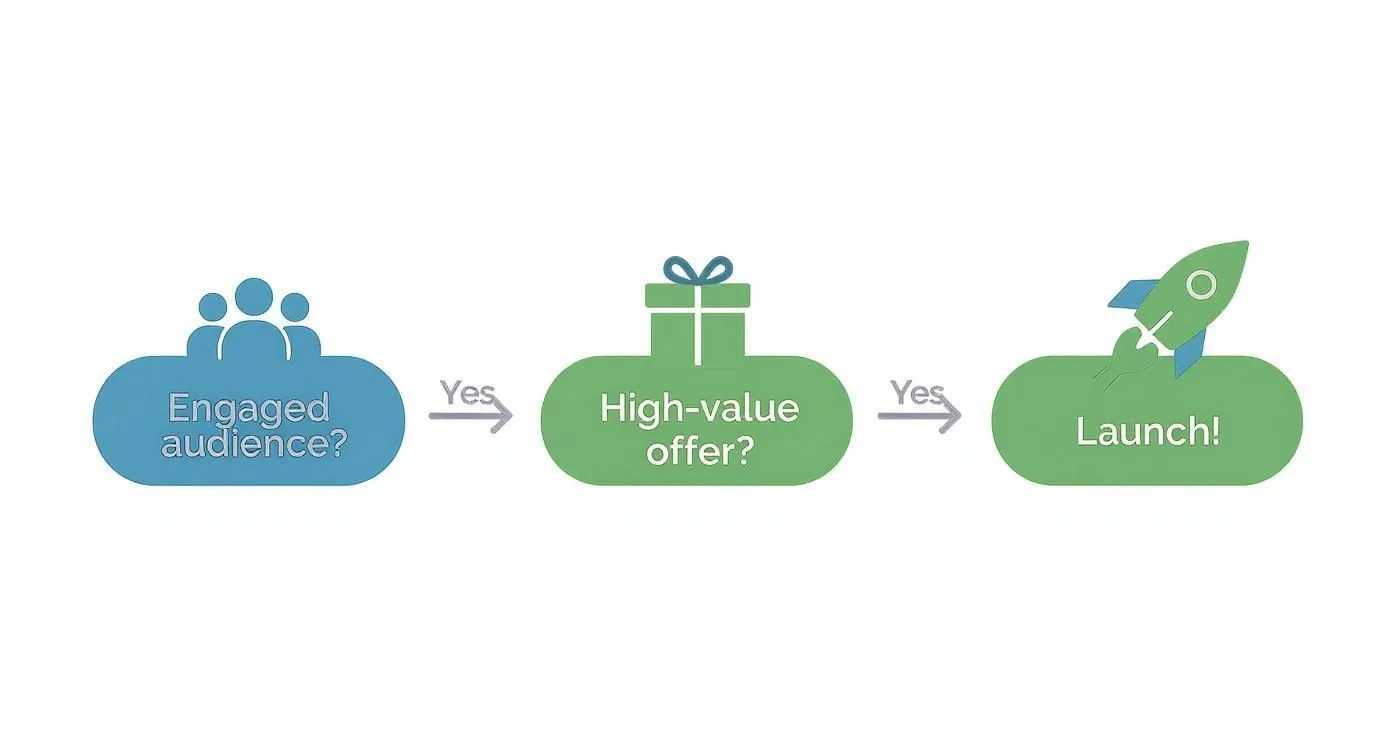
As you can see, success is built on community and value. That makes your choice of platform—the very tool you use to deliver both—absolutely essential.
A Comparison of Platforms for Digital Creators
To really grasp the differences, it helps to see a side-by-side comparison of how these platforms stack up on the features that matter most when you're growing a business. The table below breaks down the key differences in fees, branding, and core functionality.
| Feature | WordPress + Plugins | Established All-in-One Platforms | Zanfia (All-in-One) |
|---|---|---|---|
| Platform Fees on Sales | Only payment gateway fees | Up to 5% on top of gateway fees on lower tiers | 0% platform fees (only gateway fees apply) |
| Branding Control | Full control, but complex to implement | Limited; often platform-branded on lower tiers | Custom domain and removing Zanfia branding (plan-dependent) |
| Community | Requires separate, often clunky plugins | Sometimes available, often disconnected from courses | Fully integrated with courses and products |
| Payment Plans & Order Bumps | Requires additional checkout plugins and manual setup | Available, often gated behind higher tiers | Built-in installments, order bumps and upsells (order bumps plan-dependent) |
| Video Hosting | Requires costly third-party services (Vimeo, Wistia) | Often included, but with storage limits | Native video hosting included, plus YouTube, Vimeo, Wistia and Bunny.net adapters |
| AI & Automation | Manual: bolt on separate AI plugins and connectors | AI features added on top of the core product, no open MCP endpoint | AI-first: assistant, community agents, visual workflows, plus an MCP endpoint (plan-dependent) |
| Technical Overhead | High; you are responsible for security, updates, and plugins | Low; professionally managed SaaS infrastructure | Zero; professionally managed SaaS infrastructure |
Seeing it laid out like this makes the trade-offs much clearer. Your choice ultimately depends on what you value most: total but complex control, broad but potentially expensive features, or a streamlined, AI-first solution built around the creator.
Why an Integrated Approach Wins
When you look at the comparison, a clear picture emerges. The WordPress route forces you to become an IT manager, constantly juggling updates, security risks, and plugin conflicts. Established all-in-one platforms take the tech headache away but often introduce a new one: higher entry pricing (around $149/month for Kajabi's starter tier) and a feature set built long before AI became the operator.
An integrated, creator-first platform like Zanfia is designed to close that gap. It removes the technical burden of the DIY route, opens at a much lower price point ($39/month, or $31/month billed annually, with a 14-day free trial), and treats AI as the operator rather than a bolt-on feature.
As of 2026, Zanfia charges 0% platform commission on customer sales, so you keep your revenue and only pay the standard payment processor fees. For creators doing five figures a month, that difference compounds fast.
Features like native video hosting, a community space that's truly connected to your courses, an AI assistant that can act on your workspace, and support for Stripe, PayPal, Apple Pay and Google Pay at checkout aren't just nice-to-haves. They are strategic advantages. They save you money, simplify your day-to-day work, and help you create a seamless, professional experience for your customers, all under your own brand.
If you're serious about building a business, you can explore more about choosing the right platform to sell digital products in our detailed guide.
Advanced Strategies to Scale Your Creator Business
So, you’ve launched your first digital product and have a steady stream of income. That's a huge milestone. Now what? The next step is to scale, but that doesn't mean working twice as hard. It means working smarter by building systems that multiply your revenue and your impact.
This is the point where you shift from just selling content to actually building a business. The goal is to get more value from every customer interaction, increasing your average order value (AOV) and customer lifetime value (LTV) without needing to constantly chase a bigger audience. It’s all about creating more ways for your existing community to get value from what you offer.
Building a Sophisticated Product Ecosystem
Your first product is a fantastic start, but it shouldn't be the end of the road. A truly scalable business has a whole suite of products that meet people where they are, both in terms of price and commitment. Think of it as a value ladder—it gives you a way to serve a broader audience while creating obvious next steps for your biggest fans.
Here are a few proven ways to structure your offers:
- Product Bundles: Take complementary products—like an e-book, a related mini-course, and a set of templates—and package them together at a slight discount. It’s one of the simplest and most effective ways to instantly bump up your average sale.
- Tiered Memberships: Instead of a one-size-fits-all membership, create different levels. A basic tier might give someone access to your community, while a premium tier could include the community, all of your courses, and even monthly group coaching calls.
- Order Bumps and Upsells: These are automated offers you present right at the point of sale. An order bump is a small, no-brainer add-on (like a checklist) they can add with a single click on the checkout page, and Zanfia supports them (availability depends on the plan, see the current Zanfia pricing ). An upsell is a bigger, more valuable offer (like a masterclass) shown right after they complete their initial purchase.
By designing a thoughtful product ecosystem, you turn a single transaction into a long-term relationship. Each product becomes a stepping stone, guiding your customers deeper into your world and delivering more value along the way.
Leveraging Flexible Payment Options
One of the biggest levers for scaling is making your high-ticket offers more accessible. Not everyone can drop $1,000 on a course all at once, but many can easily handle it if you break it down. This one tweak can make a massive difference in your conversion rates.
Consider setting up these two options:
- Subscriptions: These are perfect for communities or any kind of ongoing content. Subscriptions create predictable, recurring revenue, which becomes the stable financial foundation of your entire business.
- Installment Plans: Break up the cost of a premium course or program into smaller, more manageable monthly payments. For example, you could split a $600 course into four payments of $150 , removing the sticker shock for many potential customers without lowering your price.
Platforms like Zanfia handle the backend work for you: recurring billing on subscriptions and installments, access management tied to payment status, and checkout that supports Stripe, PayPal, Apple Pay and Google Pay so customers can pay their preferred way. Before you push traffic, you can also run a real end-to-end test purchase in test mode, so GA4, Meta and TikTok events land on their test surfaces (tagged TEST) without polluting your live data. As you look to diversify, it’s also smart to understand related models like newsletter advertising best practices to get a fuller picture of monetization.
Automating Your Operations for Growth
As your business picks up steam, you’ll notice that manual admin tasks start eating up your day. This is the bottleneck that holds so many creators back. Automation is your solution—it's like hiring the most reliable employee you'll ever have.
Powerful automations can handle tedious work like instantly granting course access after payment, adding new customers to the right community channels, or kicking off a welcome email sequence through your connected email tool (ActiveCampaign, Mailchimp, Kit, MailerLite, GetResponse and more). Zanfia's visual workflow builder covers triggers like new purchase, subscription renewed, plan changed, failed payment, access ending in 14/7/3/1 days, and trial started, and higher plans add API, CLI and webhooks so you can wire in whatever else you already use (availability depends on the plan, see the current Zanfia pricing). These systems can easily save you 5–10+ hours a month, freeing you up to focus on creating great content and connecting with your audience.
This isn’t just about saving time; it's about delivering a polished, professional experience for every customer. Want to go deeper on this? Check out our guide on scaling with systems in our dedicated guide. With the right automations humming in the background, your business can run and grow 24/7, even while you sleep.
Common Monetization Mistakes to Avoid
Starting to monetize your content is a huge step, but it's also where a lot of talented creators get tripped up. It's rarely about the quality of your work; it's almost always about the strategy behind it. Getting this right from the start is what separates the creators who build a lasting business from those who just… don't.
One of the most common blunders I see is trying to monetize way too soon. Before you can ever ask your audience for a dime, you have to build genuine trust. If you jump straight to selling without first giving away tons of free, high-quality value, you just come across as transactional. That's a surefire way to push away the very people you're trying to attract.
Misaligning Your Model with Your Audience
Another big one? Picking a monetization model that just doesn't vibe with your audience or your content. Let's say you've built a following around deep, complex analysis. Tossing out a cheap, low-ticket e-book probably isn't going to land. Your audience is there for a real transformation, making them a perfect fit for a premium online course or a high-value paid community.
On the flip side, if your community loves you for quick, actionable tips, trying to sell them a massive, time-sucking course could be a total miss. The secret is to simply listen. What questions are they asking? What problems are they really trying to solve? Choose the model that gives them the most direct and valuable solution.
Underpricing Your Expertise
So many creators, especially when they're new to this, massively undervalue what they know. It's a classic case of imposter syndrome—that little voice that tells you your expertise isn't worth a premium price. But here's the thing: people aren't just paying for information. They're paying for a well-organized solution that saves them time and gets them a specific result.
Believe it or not, selling a $997 course to ten people is often way easier than selling a $20 e-book to 500. Don't be afraid to charge what your knowledge is worth. The right customers will gladly pay for a real solution to a real problem.
Creating a Clunky User Experience
Nothing will torpedo a sale faster than a confusing, disjointed customer experience. When you try to duct-tape a bunch of different tools together for your courses, community, and payments, you create friction. Imagine making someone use one login for your course, another to join the community on Discord, and then forcing them through a clunky checkout process. It just screams unprofessional.
This is exactly why an all-in-one platform like Zanfia can be such a game-changer. When your courses, community, and sales are all in one place under a single login, the experience is seamless and professional. This doesn’t just help you make the initial sale; it dramatically improves how long members stick around.
Ignoring Your Data
Finally, a huge mistake is just flying blind. You launch a product, cross your fingers, and hope for the best, never bothering to look at the numbers to see what's actually working. Your analytics are your roadmap. They tell you which pages are converting, where people are dropping off in your funnel, and what content is hitting home.
Platforms with built-in analytics give you the clarity you need to make smart moves. Zanfia's reporting covers live sales, funnels and MRR out of the box, and its checkout also loads Microsoft Clarity and Hotjar (with your own Project ID or Site ID) so you can watch session recordings and heatmaps of exactly where buyers hesitate. By keeping an eye on your key metrics, you can spot the bottlenecks, tweak your sales process, and double down on what your audience loves. Ignoring this feedback is like trying to drive across the country without a map—you're just guessing.
Got Questions About Monetization? We've Got Answers.
Let's tackle some of the most common questions creators ask when they're figuring out how to turn their content into a real business.
"How many followers do I actually need to start making money?"
This is the big one, isn't it? The honest answer is that you need to stop focusing on the follower count and start focusing on engagement. Think about it: a small, tight-knit group of 100 "true fans" who hang on your every word is way more valuable than an audience of 10,000 people who barely notice you.
Monetization models like selling online courses or running a paid community don't depend on massive numbers. They depend on the quality of the relationship you've built.
"What kind of content makes the most money?"
The most profitable content isn't about a specific format—it's about solving a specific, high-value problem for a clearly defined audience. It's that simple.
That said, things like in-depth online courses, exclusive paid communities, and specialized newsletters often generate the highest margins because they deliver a real, tangible transformation. Profit comes from the value you provide, not the container it comes in.
"Is it possible to monetize without dealing with ads or sponsors?"
Absolutely. In fact, selling directly to your audience is often far more profitable and gives you 100% control over your business and your brand.
When you sell digital products, courses, or memberships straight to your community, you're building a sustainable business on your own terms. You’re not at the mercy of an algorithm or a brand's marketing budget.
This is exactly why platforms like Zanfia exist. They're built for the direct-to-creator model, with an AI team running alongside you. As of 2026, Zanfia charges 0% platform commission on customer sales, so you only pay the standard payment processor fees on each transaction. Plans start at $39/month, or $31/month billed annually, with a 14-day free trial and no credit card required.
Ready to stop leaving money on the table and build your business on a platform that actually puts you first? With Zanfia, you get an AI-first all-in-one system to launch your courses, build your community, and sell your digital products, starting at $39/month (or $31/month billed annually) with a 14-day free trial. Start building your business with Zanfia today.