

How to Create a Content Strategy That Drives Real Growth
A solid content strategy is the difference between building a predictable growth engine and just making random posts. It’s about defining your goals and audience, mapping your content to their journey, building a real editorial calendar, and actually measuring what works. This is how you move from shouting into the void to building a real business.
Why Random Acts of Content Are Costing You Growth
If your content plan feels like throwing spaghetti at the wall—a blog post here, a social media update there, all while crossing your fingers—you're not alone. So many creators get stuck in this "scattergun" trap. It feels productive because you're busy, but it rarely translates into more sales or a stronger community.
This is exactly the problem a documented content strategy fixes. Think of it less as a plan for what to post and more as the operational blueprint for your entire online business.

When your efforts are disconnected, you get frustrating results. A great video might get a burst of views but doesn’t lead anyone to your paid newsletter. A brilliant blog post pulls in traffic but fails to guide a single reader toward your online course. It’s a vicious cycle of sporadic engagement and unpredictable revenue.
The Power of a Purposeful System
A strong content strategy transforms that chaos into a reliable system. Every single piece of content connects back to a specific business goal, making sure all your hard work builds momentum over time.
- Predictable Lead Generation: You stop hoping for leads and start systematically attracting and nurturing them through a planned journey.
- Enhanced Brand Authority: Consistent, high-quality content cements you as the go-to expert in your niche, which is the foundation of trust.
- Increased Customer Lifetime Value: By thoughtfully guiding users from a free blog post to a thriving paid community, you deepen relationships and build incredible long-term loyalty.
A documented strategy makes you proactive, not reactive. You stop chasing shiny new trends and start building an asset that works for you 24/7, turning passive followers into dedicated customers.
From Content Creation to Business Building
For creators on a platform like Zanfia, this shift is a game-changer. Zanfia is less a course tool and more an AI team that runs the business around your content: the assistant knows the whole interface, so you can dictate work by chat or by voice, and any action available to click is available to your own agents through the MCP endpoint (a capability that depends on the plan, see the current Zanfia pricing). Every blog post can have a clear call-to-action for an ebook. Every newsletter can promote a new course module. Every social post can drive traffic back to a unified community and a checkout built to sell, with order bumps, installments and upsells living under one brand. As of publication, Zanfia charges 0% platform commission on customer sales, so only the payment processor (roughly 2.9% + $0.30 in the US) takes its standard cut.
The numbers back this up. The global content marketing industry has exploded from $36.8 billion in 2018 to a projected $600 billion by the end of 2024. This isn't just a passing trend; it’s a clear signal that a purposeful content strategy is the most effective way to build a sustainable online business. To really wrap your head around a comprehensive plan, it’s worth exploring a full guide on how to develop a content marketing strategy.
Ultimately, getting the foundations right is everything. You can also read our guide on content marketing best practices to sharpen your approach.
Defining Your North Star Goals and Audience
Before you write a single word, every great content strategy starts by answering two dead-simple questions: "Why are we doing this?" and "Who are we doing this for?"
Get these wrong, and you're just making noise. Your content won't connect, and it definitely won't drive business results. Nailing this first part is how you give your strategy a heartbeat.
This isn't just fluffy stuff; it's the core of how to build an online presence that actually works. Your goals and audience personas are the roadmap. They turn wishful thinking into engineered growth.
Forget vague ideas like "get more traffic." Your goals have to be sharp, measurable, and hooked directly into a real business outcome. A goal isn't a wish; it's a destination.
Setting Actionable North Star Goals
Your "North Star" is the one big, overarching thing you want to achieve. It guides every single decision you make. Once you have that, you can break it down into smaller, supporting goals that act as milestones along the way.
For a digital creator, that might look something like this:
- Primary Goal: Generate $5,000 in monthly recurring revenue from my paid community.
- Supporting Goal: Grow my free weekly newsletter list by 25% this quarter to feed the top of my funnel.
- Supporting Goal: Drive 500 qualified leads to my course sales page each month with targeted blog content.
See how specific and quantifiable those are? That clarity is everything. It lets you actually measure what's working and what isn't, turning your content from a creative gamble into a predictable growth engine.
Moving Beyond Demographics to Deep Audience Understanding
Knowing your audience's age and location is table stakes. It's surface-level. Real connection—the kind that gets people to pull out their credit cards—comes from understanding their inner world. What keeps them up at night? What are they trying to achieve? What problems are they desperate to solve?
This is where building detailed audience personas becomes your secret weapon.
The goal is to know your audience so well that your content feels like you're reading their mind. That's not creepy; it's empathy. And empathy is what turns a casual follower into a loyal customer for life.
Don't just create generic profiles. Build personas that feel like real people with real frustrations. If you're a creator using a platform like Zanfia, your audience isn't a monolith. You're likely talking to a few very different types of people.
Let’s sketch out two distinct examples:
- The "Business Architect" Persona: This creator is already successful, pulling in $10k–$100k+ a month. Their problem isn't getting started; it's the headache of scaling. They're sick of juggling five different tools and watching platforms chip away at their revenue with transaction fees. Your content for them needs to be about efficiency, scale, and protecting profit margins—which is exactly what an integrated platform with 0% commission on customer sales solves.
- The "Potential Explorer" Persona: This person is an expert in their field but is stuck in pre-launch paralysis, totally overwhelmed by the tech. Their biggest fear is making the wrong choice and wasting months on a complicated setup. Content for them needs to be encouraging and simple. It should focus on lowering the barrier to entry and showing them the absolute easiest path to launching their first digital product.
Building an Empathy Map for Your Ideal Customer
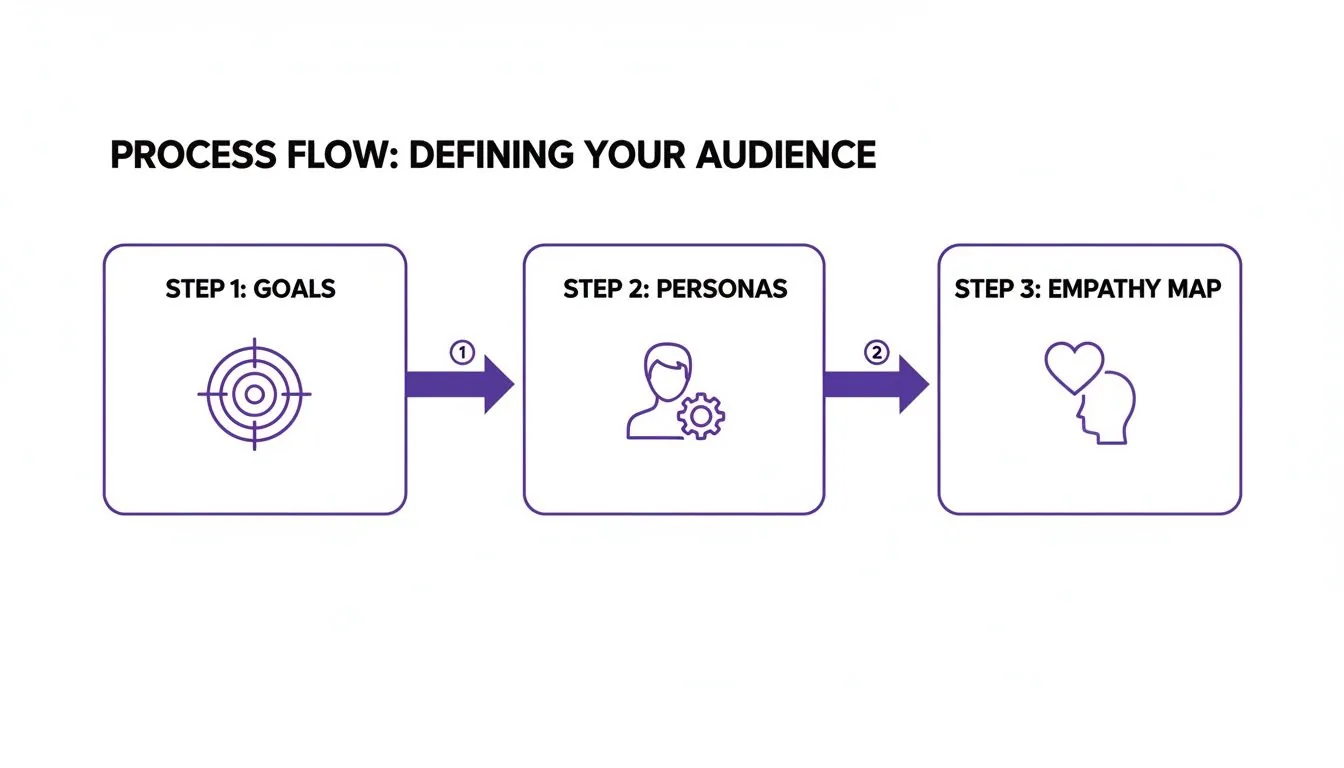
To dig even deeper, try creating an empathy map for your main persona. It’s a simple but incredibly powerful tool for stepping into their shoes. You literally map out what they Think & Feel, See, Say & Do, and Hear.
More importantly, it forces you to define their specific Pains (what frustrates them) and Gains (what they truly want to achieve).
Going through this exercise gives you a cheat sheet for creating content that resonates. You'll uncover the exact language they use, the objections you need to counter, and the solutions they're already searching for. It's a critical piece of the puzzle, and we dig into it more in our guide on advanced audience segmentation strategies.
Once you’ve defined your North Star and truly understand who you’re talking to, every piece of content you create will have a clear purpose. You'll stop guessing and start moving deliberately toward your business goals with every single post.
Alright, you've got your goals locked in and a clear picture of who you're talking to. Now it's time to build the actual blueprint for your content. This is where we shift from the "why" and "who" to the "what" and "when."
We'll do this by establishing your core content pillars and then mapping that content across the customer journey. Think of it as building the foundation and then the hallways of your content house.
Identifying Your Core Content Pillars
Content pillars are the three to five big-picture themes your brand will own. They're the foundational topics you’ll return to again and again. Instead of scrambling for a random idea every week, you’ll consistently pull from these pillars. This ensures every single thing you create reinforces your expertise and speaks directly to your audience's core problems.
Your pillars should live at the perfect intersection of what your audience is desperate to learn and what your digital products on Zanfia actually solve. Let's say you're a business coach selling a high-ticket scaling program. Your pillars won't be generic stuff like "starting a business." They'll be laser-focused.
For a creator targeting that "Business Architect" persona we talked about, your pillars might look like this:
- Pillar 1: Systemized Operations: All your content on automation, building efficient workflows, and creating processes that run without you.
- Pillar 2: Profit Maximization: Here you’d cover pricing strategies, slashing overhead (like platform fees), and boosting customer lifetime value.
- Pillar 3: Premium Product Delivery: This is where you create content on building high-ticket courses, structuring paid communities, and delivering a world-class customer experience.
See how that works? These pillars are broad enough to generate endless ideas but specific enough to attract exactly the right person. Every piece of content you make will branch off from one of these themes, creating a rich, cohesive library of resources that positions you as the go-to expert.
Mapping Content Across the Customer Journey
Once your pillars are set, the real magic happens when you map them across your customer's path to purchase. This journey typically has three main stages: Awareness, Consideration, and Decision. Your audience has different questions and a different mindset at each stage, so your content needs to adapt.
We cover this concept in more detail in our guide on what a marketing funnel is and how it works.
A truly effective content strategy doesn't just produce content; it guides someone from being a complete stranger to becoming a loyal, paying member of your community. Matching the right content format to their journey stage is how you build that critical trust.
Here’s a practical look at how different content formats fit into each stage of the journey. For a creator on Zanfia, this integrated approach helps move an audience from casual follower to committed customer, all within their branded ecosystem.
Matching Content Formats to the Customer Journey
| Journey Stage | Goal | Recommended Content Formats (Examples for a Zanfia Creator) | Zanfia Integration |
|---|---|---|---|
| Awareness | Capture attention, introduce your expertise, and build an initial audience. | • Blog posts with broad appeal • Short-form videos (Reels, Shorts) • Social media infographics • Free checklists or templates | Use Zanfia's blog and landing pages to host free resources that attract new leads. |
| Consideration | Nurture leads, demonstrate your unique value, and build trust. | • In-depth guides or ebooks • Webinars or live workshops • Email mini-courses • Case studies or success stories | Deliver this content via Zanfia's paid newsletters or as a bonus in a free community channel. |
| Decision | Overcome final objections, showcase your product, and drive conversions. | • Product demos or walkthroughs • Free trials or sample modules • Detailed sales pages • Customer testimonials & reviews | Host course previews with native video, sales pages, and a checkout with order bumps and installments directly on your Zanfia site. Run a test purchase first to confirm the whole funnel works end to end before your first real sale. |
By mapping your content this way, you create a system that serves your audience exactly what they need, right when they need it. A single idea from your "Profit Maximization" pillar can be transformed into a blog post (Awareness), a deep-dive edition of your paid newsletter (Consideration), a full module in your Zanfia course (Decision), and endless discussion prompts for your community.
This is how you turn your content from a list of tasks into a powerful engine for growing your business on Zanfia.
Building Your Content Production Engine
So you've done the hard work. You’ve defined your goals, mapped out your content pillars, and you know who you’re talking to. That’s a brilliant start, but a strategy without execution is just a document collecting digital dust.
This is where we build the actual engine that turns your ideas into a consistent stream of valuable content. We’re moving from the "what" and "why" to the "how"—transforming abstract plans into a reliable, sustainable system. It's the difference between random bursts of creativity and building a true growth machine.
Crafting a Practical Editorial Calendar
Forget those monster spreadsheets with a thousand columns that get abandoned after two weeks. A functional editorial calendar is your command center. It's the single source of truth for you and your team, providing clarity and accountability for every single thing you create.
At a bare minimum, your calendar needs to track a few key things for each piece of content:
- Topic/Title: The working headline or subject.
- Content Pillar: Which of your core themes does this support?
- Format: Is it a blog post, video, newsletter, or something else?
- Deadline: The non-negotiable publish date.
- Owner: Who is on the hook for getting this done?
- Distribution Channels: Where will this live and be promoted once it’s out?
- Call-to-Action (CTA): What do you want people to do after consuming it?
A well-oiled calendar eliminates that last-minute scramble and ensures every piece of content has a purpose. That clarity is gold, whether you're a one-person show or managing a small team.
Designing Your Creation and Distribution Workflow
With your calendar locked in, it's time to map out how content actually gets made. This doesn't need to be rigid, but having a clear sequence of steps—like outlining, drafting, editing, and scheduling—removes friction and keeps quality high.
But remember, creation is only half the battle. Hitting "publish" is the starting line, not the finish line. A smart distribution plan is what gets your work in front of the right eyeballs.
Your content's job isn't done when it's created; its job begins when it's distributed. The goal is to drive high-quality traffic from various channels back to your central platform where you can build deeper relationships.
This means thinking about a multi-channel approach:
- Search Engine Optimization (SEO): This is your long game. Every blog post should be optimized for relevant keywords to pull in a steady, organic stream of your ideal audience for months and years to come.
- Email List Engagement: Your newsletter is a direct line to your biggest fans. Use it to announce new content, drop exclusive insights, and gently guide subscribers toward your paid offerings.
- Strategic Social Media: Don’t just drop a link and run. Chop up your core content into platform-native formats. Turn a blog post into a Twitter thread, a video into short clips for Reels, or a key stat into an infographic. Grab attention there to pull traffic back here .
Automating the Engine to Reclaim Your Time
The biggest bottleneck for most creators isn't a lack of ideas—it's getting buried under administrative busywork. This is where automation stops being a buzzword and becomes your most valuable employee, handling the repetitive tasks that drain your creative energy.
For creators using an all-in-one platform, this is a massive unfair advantage. Zanfia treats the AI as a team you hire, not a feature you toggle: the assistant can perform any action available in the interface, by chat or by voice, so a lot of the setup you would normally click through you can just dictate. Zanfia’s built-in workflows can easily save you 5–10+ hours a month on top of that.
Picture this workflow: someone reads your blog post, clicks to download a free guide, and enters your world. A week later, they buy your online course. Zanfia automatically:
- Processes their payment through Stripe or PayPal, including card, Apple Pay and Google Pay.
- Grants them instant access to the course.
- Adds them to the exclusive community channel for that course.
- Syncs the customer into your email tool (ActiveCampaign, Kit, MailerLite and others) with the right tags and lists.
- Kicks off a personalized welcome sequence from your ESP.
This entire process happens while you sleep. It eliminates manual work, guarantees a polished customer experience, and frees you up to focus on creating more great stuff. You’re not just building an engine to produce content; you’re building an intelligent system that manages the entire customer journey that follows. To streamline this even further, explore some of the best tools for content creators that can plug right into your workflow.
Turning Data Into Your Next Smart Move
Let's be honest: a content strategy without measurement is just a bunch of well-intentioned guesses. If you want to build a real growth engine, you have to stop collecting numbers just for the sake of it. It's time to start turning that data into your next smart move.
This is how you find out what’s actually resonating with your audience and what’s falling completely flat. Your analytics dashboard isn't just a report card; it's a treasure map pointing you toward your biggest opportunities. It’s the only way to know if all your hard work is actually moving the needle on your most important business goals.

Ultimately, this process is about making data-driven decisions that sharpen your approach, boost engagement, and grow your bottom line. It’s what transforms your content from a creative outlet into a predictable, reliable business asset.
Choosing Metrics That Actually Matter
The sheer volume of data available can feel overwhelming. The secret? Ignore the vanity metrics and focus laser-like on the Key Performance Indicators (KPIs) that connect directly back to the goals you set earlier.
Different goals demand different metrics. Here’s a quick breakdown of what numbers to watch based on what you’re trying to achieve:
- For Brand Awareness: Your main goal is to simply reach more of your ideal audience. Keep an eye on metrics like organic traffic , social media reach , and brand mentions . These tell you if your footprint is expanding.
- For Audience Engagement: Here, you want to see if people are actually interacting with your stuff. Track time on page , scroll depth , comments , and shares . High traffic with low engagement is a huge red flag that something's off.
- For Lead Generation & Sales: This is where the rubber meets the road. Monitor conversion rates on your landing pages, the number of new email subscribers , and, most importantly, sales directly attributed to specific content pieces .
Your data tells a story about your audience's behavior. A high bounce rate on a blog post might mean the introduction didn't hook them. A low conversion rate on a sales page could signal a disconnect between your content and your offer.
For creators using an all-in-one platform, this whole process gets a lot simpler. Zanfia’s built-in analytics show you sales, funnel steps and MRR at every stage, and on checkout pages Microsoft Clarity and Hotjar give you session recordings and heatmaps of how buyers behave in the moment that matters most. You can see exactly how a user moves from a free blog post to a course purchase, spot the bottlenecks, and fix them without leaving the platform.
The Power of the Content Audit
Think of a regular content audit as your strategic reset button. It’s a systematic review of all your existing content to see what’s working, what’s not, and where your biggest opportunities are hiding. Doing a simple audit just once a quarter can give you incredible insights.
Your audit really just needs to answer three key questions:
- What should we keep and optimize? Find your top-performing posts—the ones driving the most traffic and conversions. These are your proven winners. Double down on them.
- What should we update or repurpose? Look for content that has potential but is underperforming. Maybe it’s outdated, poorly optimized for search, or just in the wrong format.
- What should we remove or consolidate? It’s time to prune the dead weight. Get rid of low-quality, irrelevant, or redundant content that offers no value and might even be hurting your SEO.
This is such a critical step, as it ensures you’re always building on a strong foundation. For a deeper dive into this, check out our complete guide on how to measure your content marketing ROI. The insights you pull from a simple audit will directly shape your editorial calendar for the next quarter.
By using a strategic approach and a unified platform where an AI team handles the busywork around your content, you can stop wrestling with tech and focus on what matters: delivering value and growing your business.
Your Top Content Strategy Questions, Answered
Even with the best workbook in hand, a few practical questions always pop up once you start putting strategy into practice. Let's tackle some of the most common hurdles I see creators face.
How Often Should I Refresh My Content Strategy?
This is a great question. The worst thing you can do is write a beautiful strategy document and then let it gather dust in a folder somewhere.
Think of your strategy as a living, breathing guide. The big picture stuff—your core audience, your main business goals—that should be pretty solid. But the tactics? Those need to be flexible.
My rule of thumb is a major, deep-dive review once a year. This is your chance to zoom out, check that your content still aligns with your big business objectives, and see if any major market shifts require a new direction.
Then, you'll want to do lighter quarterly check-ins. These are more about tuning the engine than rebuilding it. During these reviews, you should:
- Pull up your KPIs. Are you on track?
- See which content pillars are pulling the most weight.
- Tweak your editorial calendar based on what’s resonating right now .
And of course, if something big happens—like you launch a brand-new course on Zanfia or you see a sudden, massive shift in your analytics—don't wait. Pull the strategy out and make adjustments on the fly. Stay pointed north but be ready to navigate the terrain.
What's the Real Difference Between a Content Strategy and a Content Plan?
Getting this right brings so much clarity. People use these terms interchangeably, but they are two very different things, and the distinction is critical.
Your content strategy is your "why." It's the high-level vision. It's the connective tissue between your business goals and your audience's problems. It answers the big, foundational questions: Why are we even making this stuff? Who is it for? How will our content uniquely solve their problems?
Your content plan is the "what, when, and where." It's the execution—the tangible output. This is your editorial calendar, your Trello board, your production schedule. It’s the list of specific blog posts, videos, and newsletters you’re creating to make the strategy a reality.
A content plan without a strategy is just guessing. The strategy is your constitution; the plan is the set of laws you create to uphold it. You absolutely need both.
How Much Should I Actually Budget for Content?
Ah, the money question. There’s no single number that works for everyone because it completely depends on your stage of business.
A good benchmark in digital marketing is to allocate somewhere between 5% and 15% of your total revenue to your overall marketing budget. A healthy chunk of that should then go toward content creation and distribution.
But if you're a solo creator just starting out, your budget is probably more about sweat equity than cash. Your main investment is your time—the hours you pour into research, writing, and creating.
As you start generating revenue, you can reinvest that back into your content engine. Maybe you hire a freelance video editor, invest in better audio gear, or put some money behind promoting your best pieces. The key is to see content as an investment, not an expense. Track its return and scale your budget intelligently.
Can a Solo Creator Really Pull Off a Full Content Strategy?
Absolutely. One hundred percent. In fact, some of the most successful creator businesses I know were built by one person with a clear vision and a relentless focus on efficiency.
The trick isn’t to do more, but to be smarter with the resources you have.
Here's how you win as a one-person show:
- Go deep, not wide. Forget posting four mediocre articles a week. One incredibly valuable, in-depth guide per month will serve you far better in the long run. Quality over quantity, always.
- Pick one format and master it. Don't try to launch a blog, a podcast, and a YouTube channel all at once. Master one thing first. Become the go-to person for that weekly newsletter or that series of short, actionable videos.
- Repurpose everything. This is the solo creator's superpower. A single deep-dive blog post can become a newsletter, five social media clips, a video script, and a handful of discussion prompts for your community.
- Automate the boring stuff. Your time is your most valuable asset. Use technology to claw it back. On Zanfia , an AI team handles the busywork around your content: the assistant runs any action in the interface by chat or by voice, and workflows can save you 5–10+ hours a month by automatically handling payments, course enrollments, and community access, freeing you up to do what only you can do: create.
Ready to turn your strategic content into a thriving online business with courses, a community, and digital products? On Zanfia, you can build it all under your own brand with an AI team that runs the platform for you: dictate work to the assistant by chat or by voice, connect your own agents through the MCP endpoint (available on higher plans, see the current Zanfia pricing), and sell through a checkout with order bumps, installments and upsells. As of publication, Zanfia charges 0% platform commission on your sales. Plans start at $39/month, or $31/month billed annually, with a 14-day free trial and no credit card required. Start building your creator business today.