

Local Leads Generation: A Playbook for Creators & SMBs
You already know the feeling. You've built something useful, polished the offer, maybe even posted consistently, and people who live minutes away still don't know you exist. Meanwhile, a local buyer searches for exactly what you sell and ends up with someone else because they showed up first, looked more credible, or made the next step easier.
That's why local leads generation matters so much. It isn't just about getting seen. It's about getting found by people who are close enough, ready enough, and motivated enough to act now.
Most advice on the topic breaks the work into disconnected pieces. One article says to optimize Google Business Profile. Another says to run ads. Another tells you to host events, collect reviews, or build an email list. In practice, local growth happens when those pieces support each other. Search creates discovery. Community builds trust. Landing pages capture intent. Follow-up turns interest into booked calls, sales, and repeat buyers.
Why Your Neighbors Are Your Best Customers
A lot of small businesses and creators aim too wide too early. They try to appeal to everyone online and miss the most practical opportunity sitting right in front of them: the audience that can visit, call, attend, refer, and buy without a long trust-building cycle.

The strongest reason to focus locally is buyer intent. 50% of local searches on mobile lead to a store visit within 24 hours, according to Lobstr's local lead generation analysis. That's not casual browsing. That's near-term action.
Local intent beats broad attention
A local prospect doesn't need a long explanation of why proximity matters. They already care about convenience, response time, familiarity, and trust. If you're a coach, consultant, fitness instructor, accountant, therapist, café owner, course creator, or service business, nearby buyers often convert faster because your location reduces friction.
That changes how you should think about marketing. Instead of chasing generic visibility, build a system that answers one question well: when someone nearby looks for help, do they find you, trust you, and have a clear next step?
Nearby buyers often need less persuasion and more clarity.
If your local marketing still feels scattered, it helps to study broader digital marketing strategies for small businesses and then adapt them to a tighter geographic audience.
Local visibility can become community growth
Local leads generation isn't only for brick-and-mortar stores. A creator can use it to fill a workshop in one city, launch a paid meetup, grow a niche newsletter for a region, or turn local followers into a stronger member base. The businesses that win usually connect discovery with belonging.
That's also why community matters. If you want ideas for turning local interest into ongoing participation, this guide on getting involved in your community is a useful complement to the acquisition side.
Laying the Foundation Your Local Audience and Offer
Many local campaigns fail before they launch. The problem isn't usually effort. It's that the message is too broad, the offer is too generic, or the audience definition stops at age and income.
Modern prospecting is much more precise. One industry source describes access to data on more than 200 million local businesses, which reflects how lead generation has shifted from manual research to filtered targeting by location, industry, and company size in Artisan's overview of local lead generation. Even if you're a solo creator or small business, the lesson is the same: stop guessing and start segmenting.
Build a hyper-local customer profile
A useful local customer profile should answer practical questions, not just demographic ones.
- Where do they spend time locally: specific neighborhoods, coworking spaces, gyms, business groups, cafés, schools, or online city groups.
- What triggers the purchase: urgency, convenience, reputation, price sensitivity, schedule fit, or desire for local expertise.
- What language do they use: not marketing language, but the phrases they'd type into Google or say on a call.
- What local context matters: parking, access, commute, district identity, seasonal behavior, or business hours.
A yoga instructor in a city center and a yoga instructor in a quiet residential area may technically sell the same thing. Their buyers usually don't want the same thing. One group might care about lunchtime express classes for office workers. The other might care about evening stress relief close to home.
Shape the offer around local relevance
The fastest way to improve local conversion is to stop presenting a universal offer. Frame the offer around the buyer's immediate local reality.
Here's a simple comparison:
| Generic offer | Localized offer |
|---|---|
| Financial literacy workshop | Financial literacy workshop for freelancers in your city |
| Nutrition coaching | Meal planning for busy parents in your district |
| Marketing consulting | Local visibility audit for businesses serving one city |
| Photography mini-session | Seasonal family photo session in a nearby park |
That doesn't mean narrowing your expertise. It means packaging it in a way that matches local demand.
Practical rule: If a nearby buyer can't tell within seconds that your offer is relevant to their area and situation, they'll keep searching.
A clear offer also depends on a clear promise. If you need to tighten that message, revisit the basics of what makes a strong value proposition. Local leads generation gets easier when the offer sounds like it was made for one specific group in one specific place.
Dominate Local Search with Google and SEO
For most local buyers, Google is the first checkpoint. They search, scan the map, compare reviews, check photos, maybe glance at your website, and decide whether you seem trustworthy enough to contact. If your presence is incomplete or inconsistent, you lose before the conversation starts.
Treat your Google Business Profile like a sales asset
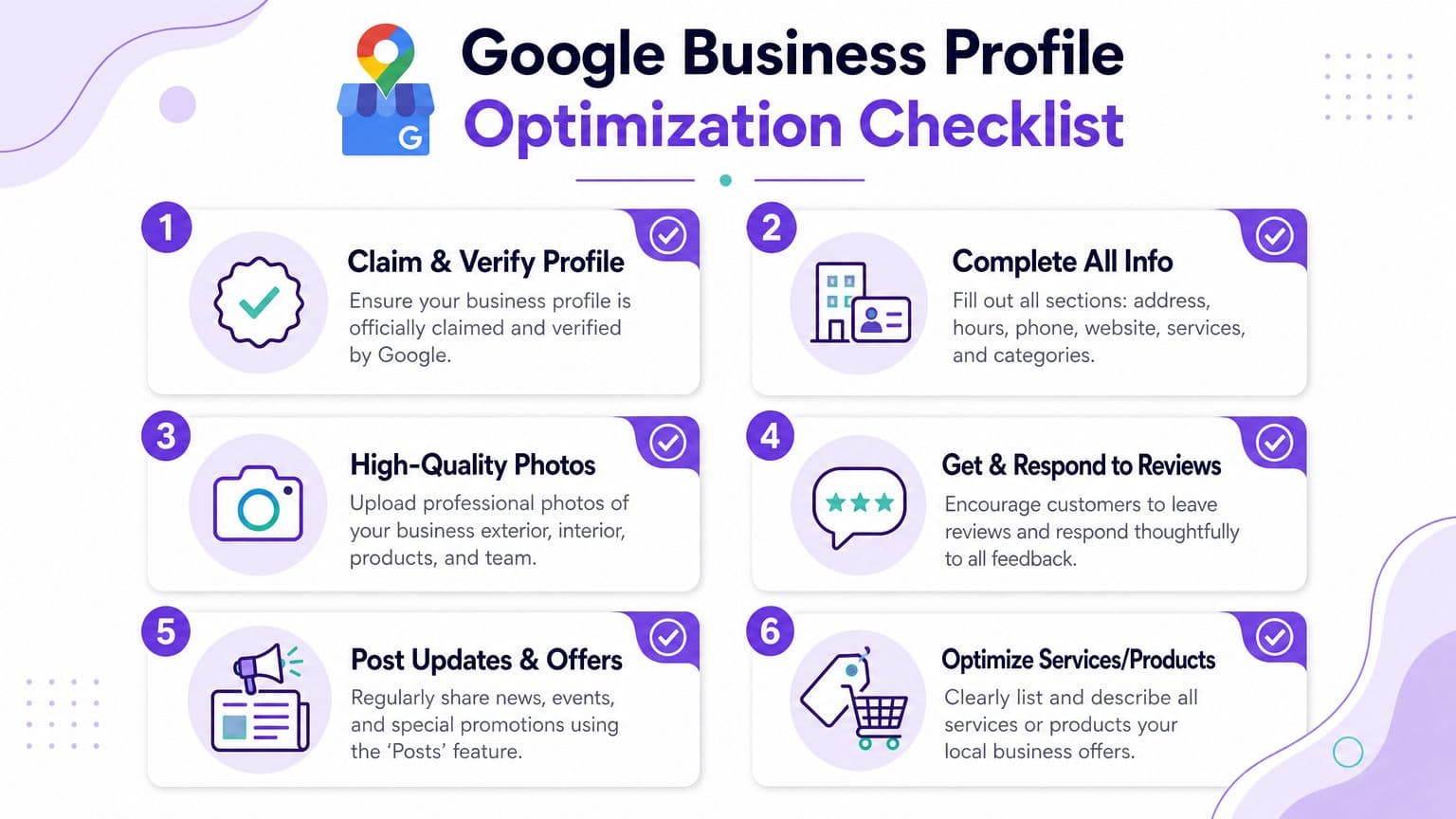
Most business owners set up a profile once and leave it untouched. That's a mistake. A strong profile answers the questions buyers implicitly ask:
- Are you real
- Do you serve my area
- What exactly do you offer
- Can I trust you
- How do I take the next step
Complete every field you can. Add categories carefully. Write service descriptions in plain language. Upload current photos that show the outside, the inside, the product, or the experience. Use posts to highlight offers, events, or new services.
If you want a practical companion resource, Adwave local SEO resources give a helpful beginner-friendly view of how map visibility works.
A website still matters because Google isn't your whole presence. Your own content helps you rank for specific local queries, especially when your pages align with what people search for.
For a deeper look at attracting traffic once your local foundation is in place, this guide on how to bring traffic to your blog is worth reading.
Fix the trust signals first
One of the most common local problems is basic inconsistency. Consistent Name, Address, and Phone data across listings, plus active review management, are described as critical for visibility and trust in Gigabpo's local lead generation guidance.
If your address, phone number, or business name appears differently across platforms, you create doubt for both search engines and buyers.
That sounds minor, but it affects real decisions. A buyer who sees conflicting details often won't investigate. They'll move to the next option.
Use this review-and-listing checklist:
- Audit your NAP details: your website, directories, social profiles, and map listings should match.
- Ask for reviews consistently: don't wait for happy customers to remember on their own.
- Reply to feedback: thoughtful responses show that a real business is paying attention.
- Update operating details quickly: hours, service areas, booking links, and temporary changes need to stay current.
This walkthrough can help you visualize what a strong profile should include:
Add local SEO to your site without stuffing keywords
Local SEO works best when the page reflects a real service in a real place. Don't force city names into every sentence. Build pages that deserve to rank.
A good local page usually includes:
- A clear service-location match Example: “Wedding photography in your city” or “Bookkeeping for small businesses in your region.”
- Specific proof Mention local service areas, examples of the kinds of clients you help, or operational details that matter to nearby buyers.
- A conversion path Add one action. Book a call, request a quote, reserve a seat, or join a local waitlist.
Engage Your Community On and Offline
Search gets attention. Community earns preference.
A local brand becomes stronger when people don't just recognize the name online, but encounter it in context. They hear about you from a partner business. They see you at a neighborhood event. They attend a workshop, ask a question, and remember that the interaction felt useful instead of salesy.
Partnerships create borrowed trust
Some of the best local leads come from non-competing businesses that serve the same audience. A meal prep service and a gym. A photographer and a wedding planner. A freelance tax advisor and a coworking space. A parenting coach and a children's activity studio.
The partnership doesn't need to be complex. It just needs to help the same customer at a related moment.
Consider formats like these:
- Co-hosted workshops: one business brings expertise, the other brings audience access.
- Cross-promoted offers: each partner shares a relevant bonus, guide, or invite.
- Referral pathways: staff know exactly when and how to recommend the other service.
- Shared local content: a neighborhood guide, business spotlight, or practical checklist.
Events often outperform polished content
A small in-person session can produce more trust than weeks of posting. That's especially true for creators and experts whose work depends on credibility.
A copywriter might host a breakfast session for local founders on improving website messaging. A language teacher might run a free pronunciation meetup. A business coach might organize a focused roundtable for local service providers. None of these need a large crowd to work. They need the right people, a clear topic, and an easy follow-up path.
The event isn't the whole funnel. It's the trust accelerator.
Offline touchpoints also reinforce online behavior. After someone meets you in person, they often search your business name, visit your site, or subscribe with less hesitation. That's where local leads generation becomes integrated rather than fragmented. Real-world trust fuels digital conversion.
Community visibility compounds quietly
The businesses that keep showing up locally tend to gain an advantage that's hard to copy. Not because they shout louder, but because they become familiar. Familiarity lowers resistance.
That's why community engagement should be intentional. Don't sponsor random activities just to “be seen.” Choose environments where your ideal buyer already spends time and where your expertise adds value naturally.
Capture and Convert with Localized Landing Pages
Traffic without capture is wasted motion. You can rank, post, partner, and run campaigns all month, but if the click lands on a vague homepage, many potential leads disappear.
The fix is simple in concept and often neglected in practice: send local intent to a page built for that exact audience.
Match the page to the local promise
A localized landing page should feel specific enough that the visitor thinks, “This is for me.” That means the page reflects the place, the problem, and the next step.
A weak page says: “Learn more about our services.”
A stronger page says: “Join the downtown creator workshop waitlist.” “Book a consultation for your retail location.” “Download the neighborhood guide for local freelancers.”
What belongs on the page
You don't need fancy design. You need relevance and friction-free action.
Use this structure:
- Headline with local specificity: mention the city, area, or target community if it matters.
- Short subheading: explain the offer and why it matters now.
- One focused CTA: avoid multiple competing actions.
- Proof that feels grounded: testimonials, examples, or recognizable context.
- Simple form: ask only for what you need to continue the conversation.
If the page supports a workshop, event, paid guide, consultation, or waitlist, the message should stay narrow. Don't dilute it with your entire business menu.
Build separate pages for separate local intents
Many businesses still push every campaign to one generic contact page. That makes attribution harder and conversion weaker. A better setup is one page per audience segment or local use case.
For example:
| Campaign source | Better destination |
|---|---|
| Google search for city-based service | Service page for that city |
| Partner referral from a local gym | Joint offer landing page |
| Community event signup | Event recap and next-step page |
| Social post about a neighborhood workshop | Waitlist page for that workshop |
The page doesn't need to be long. It needs to close the gap between interest and action.
A homepage explains your business. A landing page asks for a decision.
If you want to tighten conversion mechanics, these landing page optimization best practices are a good framework for reducing friction without overcomplicating the build.
Automate Follow-Up and Nurture Local Leads
Local lead capture often breaks at the most ordinary point: nobody follows up fast enough, consistently enough, or in a way that reflects what the person asked for.
That gap gets expensive. A prospect downloads a guide, fills out a form, registers for an event, or asks for details. Then they wait. By the time someone replies manually, the urgency has cooled or a competitor has already stepped in.
The first response should be automatic
Automation doesn't make your business feel robotic when it's set up well. It makes your process dependable.
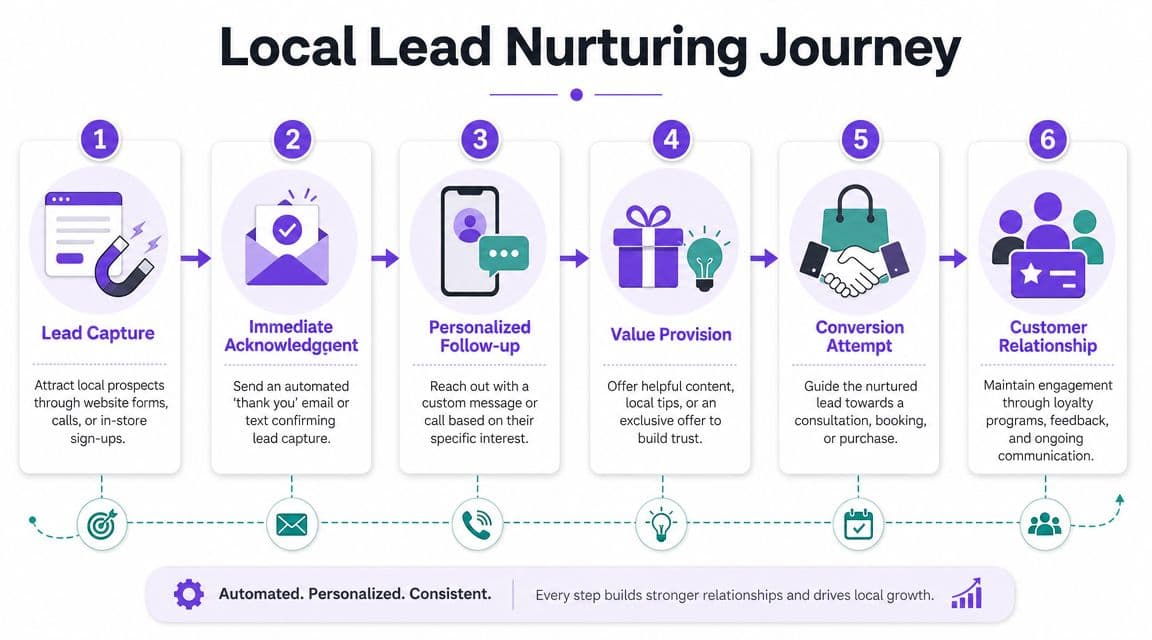
A good first sequence usually does three things immediately:
- Confirms the inquiry The person knows the form worked and hears from you right away.
- Reflects their context Someone asking about a local workshop shouldn't receive the same message as someone requesting a service quote.
- Moves them to the next action Book, reply, read, confirm attendance, or choose a time.
Nurture should feel local, not generic
Many email sequences go wrong; they sound like broad internet marketing copy when the lead came in because of a specific local need.
A stronger local nurture flow might include:
- A short welcome email: remind them what they signed up for and what happens next.
- A practical local insight: a neighborhood-specific tip, event reminder, or service-related recommendation.
- A relevance filter: ask one simple question that helps qualify interest.
- A direct invitation: book a consultation, join the next session, or reply with a specific need.
Follow-up works best when it sounds like a continuation of the local conversation, not the start of a generic funnel.
You also need consistency across channels. If a lead calls, submits a form, joins a waitlist, or signs up at an in-person event, the backend process should route them into the right communication path. That's where documented workflows help.
For inspiration, review these marketing automation workflow examples and adapt the logic to local segmentation. The key is simple: every lead source should trigger a relevant next step without relying on memory or inbox cleanup.
Keep the system light
Don't over-engineer local nurturing. Most small businesses don't need a huge automation tree. They need a reliable chain from inquiry to response to offer.
A lean setup usually wins because the team maintains it.
Measure What Matters to Track Local ROI
Local leads generation gets sharper when you stop judging campaigns by clicks alone. Traffic can look healthy while sales stay flat. What matters is whether a channel produces qualified conversations and real buyers in the locations you care about.
One of the strongest operational approaches is to pair segmented targets by ZIP code, neighborhood, or service radius with UTM-tagged landing pages and call tracking, because that attribution quality helps teams shift budget toward the highest-converting sources rather than the highest-traffic ones, as explained in Thomasnet's local business lead generation guide.
The metrics worth watching
Focus on a short list:
- Qualified leads by location: not every inquiry counts equally.
- Landing page conversion rate: which local pages produce actual actions.
- Call and form source: what brought the person in.
- Booked appointments or sales: the outcome that matters.
- Channel comparison: search, partnerships, events, referrals, paid campaigns.
Ask the harder ROI question
The advanced question isn't only “Which channel drove leads?” It's “Which channel created new demand?” A community event might produce fewer immediate form fills than search, but bring in buyers who wouldn't have found you otherwise. A branded search click may look successful while capturing demand that already existed.
That's why attribution needs context. Compare source quality, local segment, and eventual conversion, not just top-of-funnel activity. When you track local campaigns this way, budget decisions get easier and much less emotional.
FAQ
How is local lead generation different from general online marketing?
Local lead generation targets buyers who are close enough, ready enough, and motivated enough to act now, rather than chasing broad visibility. According to the article, 50% of local searches on mobile lead to a store visit within 24 hours, so nearby prospects often convert faster because proximity reduces friction and lowers the trust-building cycle.
Can local lead generation work for creators and online businesses, not just brick-and-mortar stores?
Yes. A creator can use local lead generation to fill a workshop in one city, launch a paid meetup, grow a regional newsletter, or turn local followers into a stronger member base. The article emphasizes connecting local discovery with belonging, so community engagement complements online acquisition.
What makes a Google Business Profile function as a real sales asset?
A strong profile answers whether you're real, whether you serve the buyer's area, what exactly you offer, whether you can be trusted, and how to take the next step. That means completing every field, choosing categories carefully, writing plain-language service descriptions, uploading current photos, and using posts to highlight offers or events.
Why do NAP (Name, Address, Phone) inconsistencies hurt local visibility?
Consistent NAP data across listings, along with active review management, is described in the article as critical for visibility and trust. When your address, phone, or business name appears differently across platforms, both search engines and buyers start to doubt you, and most buyers will simply move on to the next option rather than investigate.
Why send local traffic to a dedicated landing page instead of the homepage?
A homepage explains your business, but a landing page asks for a decision. The article recommends one page per audience segment or local use case, with a locally specific headline, a short subheading, one focused CTA, grounded proof, and a simple form, so the visitor immediately feels the offer is for them.
If you want a simpler way to turn local attention into leads, sales, and community growth, Zanfia is worth a look for creators and local businesses. It's built around an AI team that runs the busywork for you: you dictate what needs to happen, by chat or by voice, and the assistant does the setup, the writing, and the tracking across courses, communities, newsletters, digital products, and consulting bookings, all under your own domain. Checkout is built to sell, with order bumps, installments so a $600 program can be split into four payments, and a test mode for buying your own product before launch. Starter is $39/month, or $31/month billed annually, with a 14-day free trial and no credit card required. Zanfia charges 0% platform commission on customer sales today, so you keep the revenue and only cover the standard processor fee. Availability of the deeper AI features, MCP endpoint, and analytics depends on the plan, so check the current Zanfia pricing before you commit.