

How to Automate Your Business and Reclaim Your Time
Automating your business is a lot more straightforward than you might think. It really comes down to a simple process: spot the tasks you do over and over, find a solid platform to connect everything, and then build smart workflows that run on their own. Doing this right away frees up your creative energy, cuts down on mistakes, and lets you work on your business instead of just in it.
The Hidden Costs of Manual Work for Creators

As a creator, your most precious resource is your time, the time you need to dream up new ideas, engage with your audience, and actually create. But how much of that time gets eaten up by tedious admin work? Manually onboarding new members, chasing late payments, and wrestling with spreadsheets aren't just annoying; they're a massive hidden cost.
Every hour you spend on those repetitive chores is an hour you’re not spending on what really moves the needle: developing your next course, interacting with your community, or mapping out a big launch. This isn't just about losing a few hours here and there; it's about squandering opportunity and killing your creative momentum. Powerful automation can save creators 5–10+ hours a month, letting them focus on value-packed content instead of admin chores.
The True Price of Staying Manual
Putting off automation does more than just clog up your calendar. It has a real, tangible impact on your revenue and your ability to grow.
- Inconsistent Customer Experience: When you’re manually giving someone course access or adding them to your community, delays and errors are bound to happen. Automation ensures every single customer gets the same polished, immediate experience, every single time.
- Creative Burnout: Constantly switching gears from creating to managing is exhausting. That administrative friction is a surefire way to burn out and crush the very creativity your business is built on.
- A Hard Ceiling on Growth: Let's be honest, you can only onboard so many people by hand before you hit a breaking point. Without systems, your business growth is capped by the number of hours you can physically work.
This isn’t just a hunch; the numbers back it up. The global Business Process Automation market jumped from $14.87 billion to an estimated $16.46 billion in a single year, largely because creators like you are looking for smarter ways to work. With some studies suggesting that 50% of all work activities have the potential to be automated, the opportunity to win back your time is huge.
Let's look at what this shift actually looks like in practice.
Manual Tasks vs Automated Workflows a Quick Comparison
Zanfia leans on an AI team you can dictate to by chat or voice, so most of these transitions happen without you touching a settings screen. This table really highlights how automation with a platform like Zanfia can transform your daily grind, letting you focus on high-impact work instead of administrative busywork.
| Manual Task | Automated Workflow (with Zanfia) | Primary Benefit |
|---|---|---|
| Emailing a welcome packet | Instantly trigger a welcome sequence upon payment | Instant, professional onboarding 24/7 |
| Manually adding a student to a course | Automatically grant course access after purchase | Eliminates delays and human error |
| Chasing overdue payments | Automated failed-payment notifications keep cards current | Improves cash flow and reduces awkward conversations |
| Compiling monthly sales data | View a real-time analytics dashboard | Instant insights without spreadsheet headaches |
The difference is clear. One path keeps you stuck in the weeds, while the other empowers you to think bigger.
Shifting from Administrator to Architect
Ultimately, learning how to automate your business is about changing your role. You move from being a day-to-day administrator to becoming the architect of your business. It's about building smart systems that work for you around the clock, creating a solid foundation that can handle real growth. If you want to dive deeper into this mindset, check out our guide on scaling with systems.
Automation isn't about replacing the human touch; it's about amplifying it. By handling the robotic tasks, it frees you to focus on the personal connections and high-value work that truly matter.
This guide will give you the practical, step-by-step process to put these systems in place. For a great primer on the fundamentals, this Automation for Business: A Founder's Guide is an excellent resource. It’s all about building a business that finally supports your creative vision, not one that drains it.
Finding Your First Automation Wins
Let's be honest, the idea of automating your entire business sounds massive. It’s easy to get paralyzed by the sheer number of possibilities. So, where do you actually start?
Forget trying to boil the ocean. The secret is to go after the small, repetitive tasks that nickel-and-dime your time and energy every single day. We're looking for quick wins, automations that deliver an immediate, tangible impact without a huge upfront effort.
Think of it like finding the leaky faucets in your business. One little drip doesn't seem like much, but over a week or a month, it adds up to a significant amount of wasted time. By plugging these first, you instantly get those hours back.
Your Four-Point Automation Audit
You don't need a fancy consultant to find these opportunities. Just take a good, hard look at four core areas of your online business and ask yourself one question: "Where is the friction?"
- Welcoming New Customers: What really happens the moment someone clicks "buy"? Are you still manually sending a welcome email? Adding them to a spreadsheet? Granting access to a product? This is almost always the best place to score your first win.
- Delivering Your Content: How do people get the thing they just paid for? Whether it's a PDF, a paid newsletter, or a video course, that delivery needs to be instant. Any manual step here is a bottleneck waiting to happen.
- Managing Finances and Invoicing: Let’s face it, chasing payments, creating invoices, and tracking revenue can feel like a full-time job. All of that administrative drag is ripe for automation.
- Engaging Your Community: How do new members get into your private Slack or Discord? Are you personally adding them to the right channels based on their purchase? This is another manual task just begging to be automated.
By running through these four pillars, you'll quickly spot the most frustrating parts of your daily grind. Those are your starting points.
From Bottleneck to Breakthrough
Let's make this real. Most creators I've worked with find their biggest and fastest wins by automating the initial customer onboarding. Why? Because a smooth, professional start to the relationship sets the entire tone.
Imagine this all-too-common scenario for someone selling an online course with a community component:
- Before Automation: A customer buys your course, great! But now you get a payment alert and the clock starts ticking. You have to log into your course platform, manually enroll the new student, find them on your email list, add a "customer" tag, and then send them a separate invite to your private community. This could easily take 10-15 minutes, and if a sale comes in overnight, the customer is left waiting.
- With Automation (using Zanfia): A customer buys your course. Instantly, Zanfia grants them access to the content. At the same time, it adds them to the correct community channels based on their purchases and kicks off a personalized welcome e-mail sequence. You can set the whole thing up by describing it to Zanfia's AI assistant out loud, and the workflow runs in seconds with zero manual intervention after that.
This one workflow doesn't just save you a headache; it creates a far better experience for your new customer. They get immediate value, which reinforces their decision to buy from you and builds trust from the jump. You can get a much deeper look into setting up these kinds of powerful sequences by exploring these marketing automation workflow examples.
Prioritizing Your Next Steps
Once you've nailed that first welcome sequence, a domino effect starts. That one automation makes the next one even easier to see and implement.
Here’s a simple way I suggest people prioritize their efforts:
| Priority | Automation Task | Immediate Payoff |
|---|---|---|
| High | Automatic Course/Product Access | Eliminates the #1 source of customer support tickets and delays. |
| High | Test-mode checkout before your launch | Buy your own product end-to-end, verify tracking fires, catch bugs before real customers do. |
| Medium | Welcome Email Sequence | Nurtures new customers and sets clear expectations from day one. |
| Medium | Automated Community Onboarding | Places new members in the right discussion channels instantly. |
The best way to learn how to automate your business is to stop seeing it as one giant project. Instead, treat it as a series of small, strategic upgrades that compound over time, freeing you to focus on what actually matters: creating and connecting.
Seriously, getting just these foundational automations in place can realistically save you 5-10+ hours per month. That's an entire workday you get back to focus on what you do best.
Designing Your Core Automated Systems
Once you've identified the quick wins, it's time to build the real workhorses of your business. Think of these as the automated engines running things behind the scenes, handling all the essential, repetitive tasks. This isn't about creating some ridiculously complex machine; it's about setting up simple, reliable workflows that free you up to focus on creating great content and connecting with your audience.
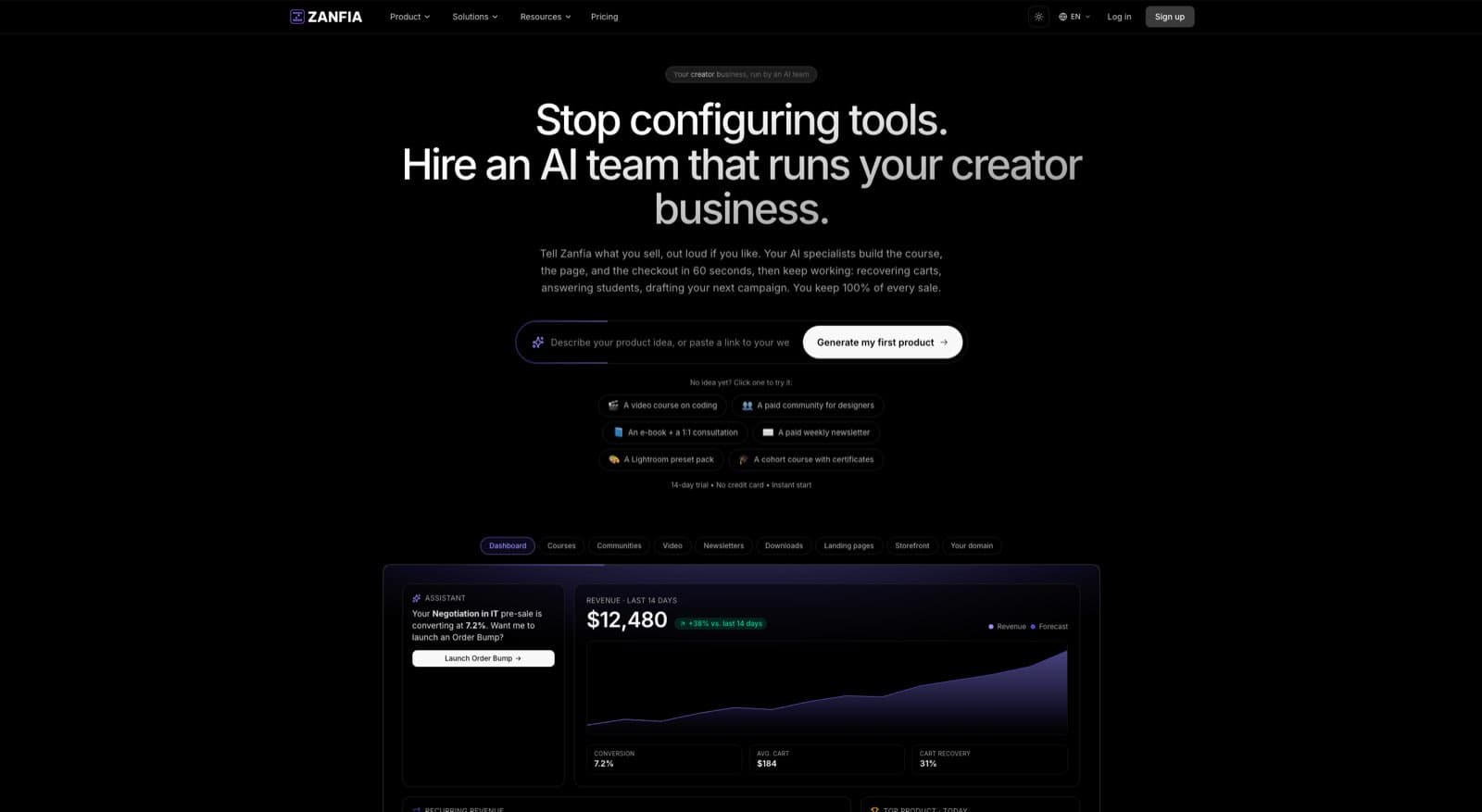
The key here is having an all-in-one platform where everything, sales, content, payments, can communicate without you playing middleman. With Zanfia, that platform is fronted by an AI team you can direct by chat or voice, so you describe the workflow you want instead of clicking through screens to build it.
The Zero-Touch Sales and Onboarding Machine
This is probably the most important system you'll build, and it should be your first priority. It handles everything from the moment a customer clicks "buy" to the second they get access to what they paid for. Even one manual step in this chain creates a delay and a potential headache for both you and your customer.
Imagine someone buys your course at 2 AM on a Tuesday. With a zero-touch system in place, this is what happens instantly, while you're sleeping:
- Payment is Processed: Their payment goes through securely on a checkout built to sell, with support for cards, Apple Pay , and Google Pay through Stripe and PayPal . Order bumps and one-click upsells can be attached to the same order without adding checkout steps.
- Access is Granted: The system immediately unlocks the course or e-book in their account. No manual enrollment needed.
- Community Integration: They are automatically added to the right community spaces, like a "New Student Welcome" channel.
- Welcome Sequence is Triggered: A pre-written welcome email hits their inbox, confirming the purchase, giving them login details, and setting them up for a great experience.
This one sequence, running entirely on its own, ensures every single customer gets a professional and immediate welcome, 24/7. Seriously, this automation alone can save you 5-10+ hours a month and wipe out the most common customer support questions.
This diagram shows how these critical steps, welcome, deliver, and invoice, should flow together seamlessly.
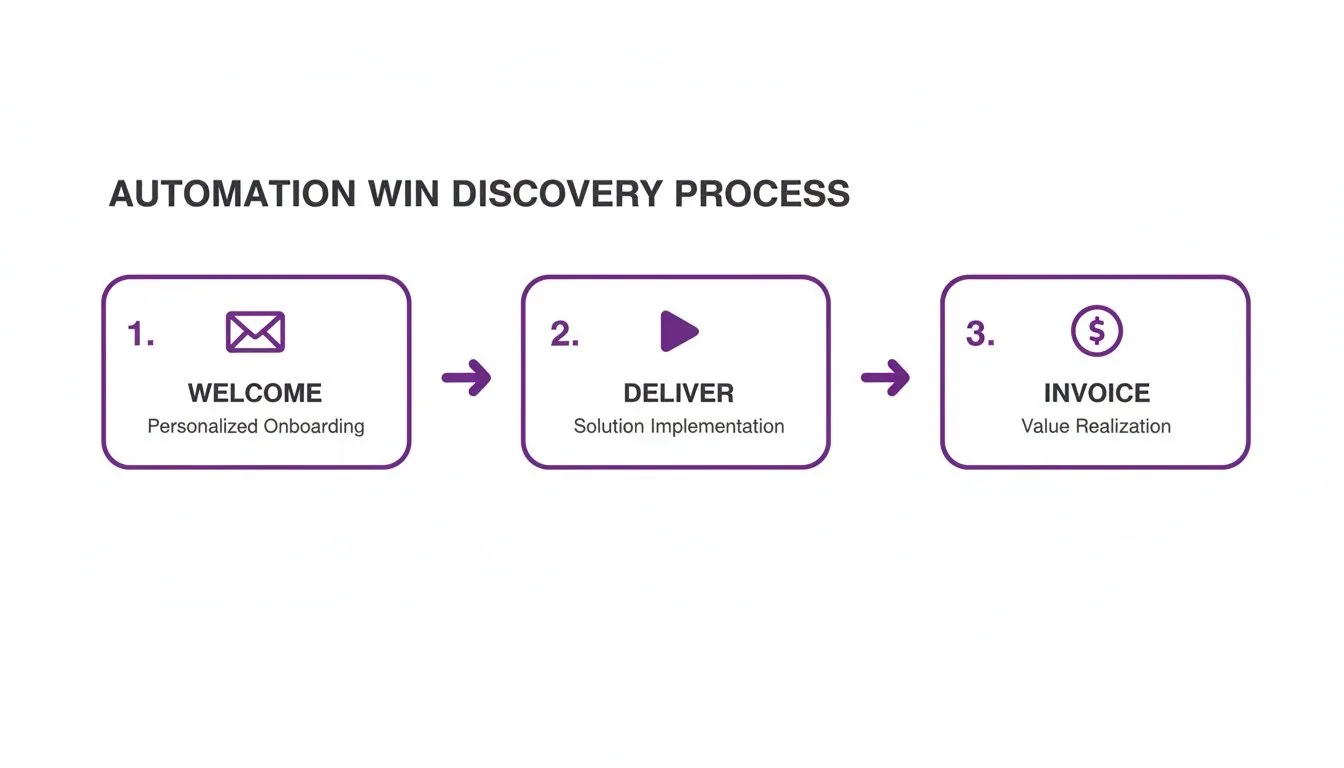
It’s not about juggling dozens of tools. It's about linking a few key actions into a dependable chain reaction.
Here’s a practical look at how these workflows function inside a platform like Zanfia.
Zanfia Automation Workflow Examples
A practical look at how specific triggers and actions work within the Zanfia platform to automate key business processes, saving creators time and ensuring a smooth customer journey. You can build any of these visually in Workflows, or just describe them to the AI assistant by voice and let it wire up the trigger and action for you.
| Trigger (Customer Action) | Automated Zanfia Action | Result for Creator |
|---|---|---|
| Customer buys a course | Instantly grant access to course materials. | No manual enrollment. Student can start immediately. |
| New member joins the community | Send a welcome email with a link to the intro channel. | Every new member feels welcomed and knows where to start. |
| A subscription payment fails | Automatically notify the customer via email. | You don't have to manually track and chase failed payments. |
| Customer completes a course module | Trigger an email with a link to the next module. | Keeps students engaged and moving forward without you. |
| User signs up for a freebie | Add their email to a "nurture" sequence. | Automatically builds a relationship with new leads. |
As you can see, a simple "if this, then that" setup can handle a huge portion of your day-to-day operations.
The Automated Content Drip Engine
If you run a course, a membership, or a paid newsletter, you know that dumping all your content on someone at once is a recipe for overwhelm. Releasing it over time is much more effective, but doing it manually is a total drag. This is where a content drip engine comes in.
You can set up your entire content calendar ahead of time and just let it run.
- For Online Courses: Schedule modules to unlock based on when a student enrolls. For instance, Module 2 unlocks seven days after they sign up, Module 3 unlocks fourteen days later, and so on.
- For Paid Newsletters: You can batch-write and schedule a whole month's worth of newsletters in one go, knowing they'll land in inboxes right on schedule.
- For Memberships: Set up a recurring schedule to release new videos, resources, or community prompts every week or month to keep the value flowing.
This does more than just save you from the weekly scramble. It creates a predictable, structured experience for your audience and turns your content library into a product that delivers value on autopilot.
The Effortless Financial Engine
Let's be honest: managing finances is nobody's favorite part of running a business. Chasing payments, generating invoices, and tracking revenue is a huge time-sink. An automated financial engine can take almost all of that off your plate.
The idea is to give your checkout the tools that make selling easier and let the platform handle the reconciliation for you.
By pairing a built-to-sell checkout with automated failed-payment recovery and a live MRR dashboard, you're not just saving time, you're professionalizing your operations. This is a foundational step for any creator serious about scaling.
Inside Zanfia, for example, it works like this: a customer pays through Stripe or PayPal on a checkout that supports one-time payments, subscriptions, and installments (so a $600 course can be split into four payments without any extra plugins). The order lands in your dashboard, your MRR report updates in real time, and if a card fails later, an automated notification asks the customer to update it. You literally don’t have to do a thing.
The financial impact here is real. According to Redwood's Enterprise Automation Index, 73% of companies increased what they spent on automation, and almost 40% of them reported cutting costs by 25% or more. Your business might not be enterprise-scale, but the principle is the same, automating your finances directly protects your bottom line. If you're looking for the right tools, check out our guide on small business automation tools.
By building out these three core systems, onboarding, content delivery, and finance, you create a solid foundation for your business. This is how you stop being a busy creator and start becoming a strategic business owner.
Advanced Automation Strategies to Scale Your Business
Once your core automations are running smoothly, you're past the beginner stage. Now, it's time to start thinking like a true business architect. We're moving beyond simple time-savers and into designing sophisticated systems that actively boost your revenue and keep members engaged for the long haul.
This is the real magic of automation, creating intelligent, interconnected workflows. These systems can react to customer behavior, anticipate what they need next, and guide them toward a deeper relationship with your brand.
Automating Tiered Access and Member Progression
One of the biggest headaches I see creators face is managing different access levels. Whether you have a starter and premium plan or a high-ticket VIP tier, manually shuffling people around is a surefire way to burn out.
This is a perfect use case for behavior-driven automation. Instead of just flipping a switch when someone buys, you can build smart workflows that manage their entire journey with you. In Zanfia, you can even dictate the rule you want by voice ("when someone upgrades to premium, revoke basic access and add them to the graduates channel") and the AI assistant sets it up in the interface for you.
- Seamless Upgrades: A member on your basic plan decides to upgrade. The moment they complete the purchase, an automation can kick in, instantly revoking their old access and rolling out the red carpet to your premium content and exclusive community channels. No waiting, no manual emails.
- Smart Downgrade Paths: What happens when a premium subscription ends? Instead of just kicking them out, an automation can gracefully move them to a lower tier or an "Alumni" segment. This keeps them in your ecosystem (and on your email list) without giving away paid content.
- Automated Graduation: Imagine a student finishes your foundational course. An automation can trigger, unlocking access to an advanced, members-only discussion group just for graduates.
This approach makes your members feel like their journey is dynamic and evolving. It also lays the groundwork for powerful, self-sustaining recurring revenue business models.
Building Smart Upsell and Re-engagement Sequences
Let's be honest: your best future customers are the ones you already have. Advanced automation is your key to identifying those perfect moments to offer them the next logical step, turning a one-time buyer into a lifelong advocate. This is so much more than a generic "thank you" email.
Think about what happens when a student finishes the final lesson of your signature course. That's a huge moment, full of momentum. Don't let it fade. You can have an automated sequence ready to go.
- Day 1: An email lands in their inbox congratulating them on finishing and asking for feedback.
- Day 3: Another email follows up, sharing success stories from students who took the next course.
- Day 7: A final email presents a special, limited-time offer for your advanced masterclass or a private coaching package.
This entire sequence runs on its own, striking while the customer’s motivation and trust are at an all-time high. It feels personal and timely, not like a pushy sales pitch.
When you link automations to specific actions, like course completion or high community engagement, you build a sales funnel that operates on pure relevance. This is how you dramatically increase customer lifetime value.
This strategy isn't just a nice-to-have; it's the future. The marketing automation market is projected to explode from $5.65 billion to $14.55 billion by 2031, largely driven by smarter tools that can predict customer needs. For creators like us, this means we can finally optimize every single stage of the customer journey.
Using Data and Webhooks to Connect Your Ecosystem
The most powerful automations are fueled by data. Your analytics can show you exactly where people are getting stuck. For instance, you might notice a bunch of students watch the first three videos of a course but never start the fourth.
Once you spot that bottleneck, you can build an automation to solve it. You could set a trigger: if a student completes module three and doesn't log in for seven days, send them a helpful email. That email can offer encouragement, share a useful resource, or simply ask if they need help.
For those of us using a few different specialized tools, webhooks are the ultimate secret weapon. A webhook is simply a way for one app to send real-time information to another. Zanfia also exposes a public REST API and an MCP endpoint, so any AI assistant you already use can work directly with your workspace instead of waiting for a Zapier bridge; API, CLI, webhooks, and the MCP endpoint are available on higher plans, so check the current Zanfia pricing before you commit a workflow to them.
So, when someone buys your course in Zanfia, a webhook can instantly zap that customer's info over to your external CRM or a specialized analytics platform. Everything stays perfectly in sync without you ever having to manually export or import a CSV file again. This level of connectivity is what turns a solo operation into a robust, scalable business that can truly grow with you.
Choosing Your Platform for a Simpler Path to Automation

The automation strategies we've mapped out are incredibly effective, but they're only as good as the engine running them. This is the exact spot where I see so many creators, especially the ones scaling past six figures, get stuck. They've outgrown their starter setup and are now just wrestling with a tangled mess of disconnected tools.
When it comes to the tech that powers your automations, you're really looking at three different paths. Each one has major consequences for your time, your sanity, and your bottom line.
The Piecemeal Puzzle: The WordPress Approach
First up is the classic do-it-yourself route, which almost always means WordPress. You start with a basic site, then begin bolting on plugins for your courses, another for payments, a third for a community, a fourth for email, you get the picture.
While this promises flexibility, it quickly turns into a full-time job. You're constantly managing updates, security patches, and trying to figure out why one plugin update just broke three other things. Every new plugin is another potential point of failure. When one piece inevitably breaks, your entire automated sales machine can grind to a halt.
The Restrictive Silo: The International Giants
The second path leads you to platforms that are powerful but box you in. Think of the big international players like Kajabi or Teachable. They offer solid course features, but the entry price is high and the automation stack often lives in a walled garden: you get their email tool, their landing pages, their checkout, and moving customer data out to your own systems can be painful.
Even a popular community tool like Skool is a perfect example of this. It's great for engagement, but its payment model is rigid and you get zero white-label control. Your business ends up living on their brand, not yours. These platforms often split your audience between separate tools for courses and community, shattering the unified experience you need for long-term retention.
The All-in-One Ecosystem: A Unified Approach
This brings us to the third path: the integrated, all-in-one platform. This is where a system like Zanfia really shines. Instead of duct-taping a bunch of tools together, you get an AI team that runs your creator business: courses, communities, paid newsletters, and 12 product types living under one brand, all wired into a single checkout with order bumps, installments, and upsells. You direct the whole thing by chat or voice through the assistant, and any AI tool you already use can plug in over the MCP endpoint on higher plans.
This approach completely sidesteps the tech headaches of the DIY route and the frustrating limitations of the siloed platforms. Everything is built to work together from day one.
The real win with an all-in-one platform isn't just about convenience, it's about control and peace of mind. You get a professionally managed system, which lets you stop being a part-time IT person and get back to focusing on your content and your customers.
For a deeper look at what you should be looking for, our guide on choosing the best platform for content creators breaks it all down.
What True Integration Really Means
When you pick an all-in-one platform designed around an AI team, the advantages aren't just theoretical. They have a direct impact on your ability to scale.
- 0% Platform Fees Today: This is a huge deal. While some competitors take a cut of every sale, Zanfia currently charges a 0% platform transaction fee on customer sales. You only cover the standard fees from payment processors like Stripe (roughly 2.9% + $0.30 per transaction in the US). For a creator doing five or six figures a month, that's thousands of dollars a year that stay in your pocket.
- Complete Brand Control: Your brand should be front and center. With full white-labeling and support for your custom domain , your customers get your experience, not the platform’s. This is non-negotiable for established experts who need their tech to reflect their premium brand.
- Native Features That Save Money: Little things add up. Having native video hosting means you don't have to pay for a separate, expensive service like Vimeo or Wistia. Integrating your community space directly with your course content keeps your audience engaged under your brand instead of shipping them off to a generic Facebook group or Discord server.
Ultimately, the right platform is the one that gets out of your way. It should be a rock-solid foundation that handles all the complicated backend stuff so your automations can run flawlessly, giving you the freedom to grow without being held hostage by your tech.
Common Questions About Business Automation
Diving into automation can feel like stepping into the unknown. It’s totally normal to have a long list of questions and a few nagging doubts. Is it too complicated? Will it make my business feel robotic? Is this going to cost me a fortune?
Let's cut through the noise and tackle these concerns head-on. I've heard them all before, and the answers are probably more straightforward than you think.
Is Automation Too Technical for Me to Set Up?
Honestly, this is the biggest myth holding creators back. Years ago, you might have needed a developer on speed dial, but that's just not the case anymore.
The short answer is a resounding no. Modern all-in-one platforms are designed for people like you and me, creators, not coders. The most essential automations are often ready to go right out of the box or take just a few clicks to set up.
Think about it in simple "if this, then that" terms. "When someone buys my course, grant them access immediately." On a platform like Zanfia, you can build the trigger and action visually in Workflows, or just describe what you want to the AI assistant by voice: "when someone buys my course, unlock access and add them to the students channel." You don't need to know what an API or a webhook is to get your business running like a well-oiled machine. This simplicity is especially crucial for creators who are overwhelmed by tech and just need the lowest-risk way to launch their first digital product.
Won't This Make My Business Feel Impersonal?
This is a big one. We pour our hearts into our work, and the last thing we want is for our students or members to feel like they're interacting with a robot. But I want you to reframe how you think about this.
Automation isn't about removing your personal touch; it's about protecting it. It handles the repetitive, impersonal tasks so you can dedicate more of your energy to genuine, high-value interactions.
When your checkout sends confirmations and receipts on its own, you get back the time to personally welcome a new member into your community. When course access is granted automatically at 2 AM, you can focus on giving a thoughtful, detailed reply to a student's question first thing in the morning.
Good automation actually amplifies your ability to be human where it matters most. It doesn't replace it. Zanfia is designed for creators who want peace of mind to focus on what they do best.
How Much Does It Cost to Start Automating?
The cost of automation can be all over the map, but it's almost always cheaper than the cost of not automating. Trying to duct-tape a bunch of different tools together gets expensive fast, with every little subscription adding up.
An all-in-one platform is usually a much smarter financial move. The trick is to find one with a pricing model that feels like a partnership, one that scales with you, not at your expense.
Here’s what I tell people to look for to keep costs under control:
- A Clear SaaS Subscription: No hidden fees, no surprises. You should know exactly what your monthly bill will be. Zanfia starts at $39/month, or $31/month billed annually , on the Starter plan, and every plan includes a 14-day free trial with no credit card required.
- 0% Platform Transaction Fees: This is non-negotiable in my book. Platforms that take a cut of every sale are literally penalizing you for growing. As of today, Zanfia charges 0% on customer sales, so the only fees taken from each transaction are the standard processor fees from Stripe or PayPal.
This model is a game-changer, especially for creators doing five or six figures a month. It means thousands of dollars stay in your pocket instead of getting skimmed off the top. When you choose the right system, you're not just buying software; you're making a strategic investment in your time and your bottom line.
Ready to stop wrestling with tech and start building a business that runs itself? With Zanfia, you hire an AI team that runs your creator business: courses, communities, and paid newsletters under one brand, a checkout built to sell with order bumps and installments, and an assistant you can direct by chat or voice. See how much time you can reclaim at https://zanfia.com.