

Recurring Revenue Business Models for Sustainable Growth
Let's be honest, the constant grind of one-time sales is exhausting. It's like being a stand-up comedian who has to find a new audience every single night. Recurring revenue business models flip that script entirely. Instead of chasing individual transactions, you're building a sustainable business with a predictable, steady income stream.
From One-Time Sales to Predictable Profits
For creators and small businesses, this isn't just a small tweak, it's a complete change in mindset. You stop living launch-to-launch, praying the next product drop will cover your expenses. Instead, your main goal becomes nurturing long-term relationships with the people who value your work. This is how you escape the dreaded "feast or famine" cycle for good.
The magic word here is predictable cash flow. When you know roughly how much money is coming in next month, you can finally breathe. You can make smart decisions, like hiring an assistant, upgrading your software, or creating that ambitious new course, all without lying awake at night wondering if sales will suddenly dry up.
This stability comes from a simple promise: continuous value. People don't just pay you once; they stick around because you keep delivering. Whether it's access to a supportive community, new lessons every month, or a killer paid newsletter, you’re giving them a reason to stay. That creates a level of loyalty a one-off purchase just can't match.
The Power of Lasting Customer Relationships
When you switch to a recurring model, your entire relationship with your audience changes for the better. The finish line is no longer the "buy now" button; it's keeping that customer happy for months, or even years, to come. This focus on retention pays off in some pretty big ways:
- Higher Customer Lifetime Value (LTV): Think about it. A subscriber paying you $50 a month for two years is infinitely more valuable than a single customer who buys a $200 product once and disappears.
- Increased Business Valuation: Investors and potential buyers love predictability. A business with a steady, recurring income is seen as far less risky and is valued much, much higher.
- Deeper Audience Insights: Your members and subscribers are your best source of feedback. Their ongoing engagement gives you a direct line into what they want, helping you fine-tune your offerings and create content that truly hits the mark.
This isn't just some niche strategy; it's a massive economic shift. The global subscription market has absolutely exploded, with some reports showing a staggering 435% increase over nine years. Projections estimate it could swell to $1.5 trillion by 2025.
If you want to dig into the numbers, you can see how recurring revenue models are reshaping commerce. By adopting this approach, you’re not just selling something, you're building a resilient, scalable, and far more valuable business for the long haul.
Choosing Your Recurring Revenue Model
Picking the right recurring revenue model is like choosing the foundation for your business, it has to be solid enough to support everything you want to build. Not every model fits every creator, and the best choice really comes down to your content, your audience, and what you're trying to achieve.
Let’s dig into the most common options and figure out which one makes the most sense for you.
For most creators, the big decision is whether to stick with one-off sales or move toward the stability that recurring payments offer. This isn't just about money; it's a fundamental shift in how you think about your business, moving from single transactions to building lasting customer relationships.
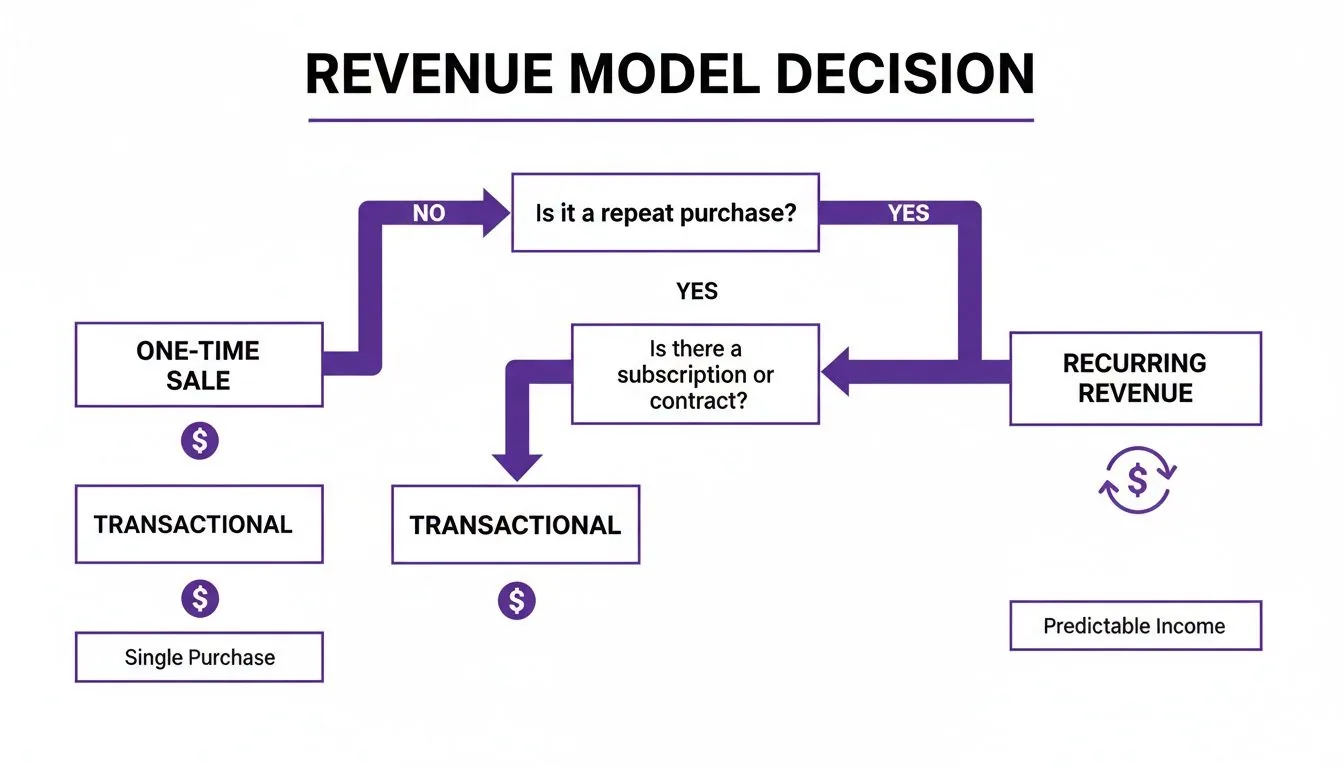
The real takeaway here is the pivot from chasing short-term sales to creating long-term, predictable cash flow.
The Subscription Model
The subscription model is probably the most familiar of them all. It’s simple: customers pay a set fee, usually monthly or yearly, for continuous access to your product or service.
Think of it like a Netflix subscription, but for your content. Your audience gets a steady stream of value, whether that's a weekly paid newsletter, new videos in a content library, or access to your latest course material. This model is a strong fit for anyone who creates content on a regular schedule and wants a reliable income stream to show for it.
The biggest pro is its predictability. The main challenge? You have to keep delivering fresh, valuable content to keep people from unsubscribing.
Key Takeaway: A subscription works best when the value is crystal clear. Customers know what they're paying for and get it like clockwork, making it a great entry point into predictable revenue.
Zanfia is built as an AI team that runs the operational side of a subscription business for you. The assistant handles renewals, dunning and access changes by chat or by voice, and the same actions are available through the MCP endpoint so your own AI agents can plug in (availability depends on the plan, see the current Zanfia pricing). Powerful automations can free up 5-10+ hours a month that you can pour back into creating.
The Membership Model
People often use "subscription" and "membership" interchangeably, but they're not quite the same. A membership model is less about just getting a product and more about belonging to a community.
With a membership, the recurring fee is a ticket into an exclusive club. The value isn't just the content, it's the connection with you, the networking with other members, and the shared identity of being part of something special. This is a strong play for creators who already have a loyal following and want to create a premium space for their biggest supporters.
Memberships often include things like:
- Exclusive Community Access: Think private forums or chat channels where members can interact with you and each other.
- Premium Content: This could be anything from live Q&A sessions and workshops to behind-the-scenes updates.
- Networking Opportunities: A space for members to connect with peers who share their interests.
Zanfia is built for this, letting you build community-based products that foster deep engagement, with a community AI agent that writes from your own content (everything it publishes is labeled as AI). You dictate what needs to happen and the assistant does it, keeping the community, courses and content under one brand and domain rather than pushing your audience to Discord or Facebook.
The Hybrid Model
Why box yourself in? The hybrid model lets you mix and match, combining one-time sales with recurring revenue streams to give you the ultimate flexibility.
For instance, you could sell a flagship online course as a one-time purchase but also offer an optional monthly membership for ongoing coaching and community access. Another great strategy is to bundle a one-time product, like an ebook, with a free trial for your paid newsletter.
With an integrated system like Zanfia, you can sell courses as a single payment, split a $600 course into four installments, or bundle them into a subscription, all with 0% platform fees and a checkout that supports order bumps and upsells built to convert.
This approach is especially powerful for established creators with a diverse catalog of digital products. If you're looking for inspiration, our guide on 7 subscription business model examples for creators has some great ideas.
Here's a quick breakdown of how these models stack up for creators:
Comparing Recurring Revenue Models for Creators
This table compares the most popular recurring revenue models to help you decide which one might be the best fit for your creator business.
| Model Type | Best For | Pros | Cons |
|---|---|---|---|
| Subscription | Creators with a consistent content pipeline (newsletters, video series, content libraries). | Simple for customers to understand; highly predictable revenue. | Constant pressure to produce new content to prevent churn. |
| Membership | Creators with an established, engaged audience seeking community and connection. | Builds deep loyalty and high LTV; fosters a strong brand identity. | Requires active community management and moderation. |
| Hybrid | Creators with multiple products who want to serve different customer segments. | Diversifies income streams; maximizes revenue per customer. | Can be more complex to manage marketing and operations. |
Ultimately, the best model is the one that aligns with the value you provide and the kind of relationship you want to have with your audience. Don't be afraid to experiment to find what clicks.
The Key Metrics That Drive Growth

Running a business on recurring revenue is a lot like being a ship's captain, you need a reliable dashboard to navigate. The good news is you don't need a finance degree to make sense of the most important numbers. In fact, a handful of key metrics can tell you almost everything you need to know about the health and direction of your business.
Think of these numbers as the vital signs of your business. They show you what's working, what isn't, and where to focus your energy to keep growing. Getting a handle on them is the first real step toward making smarter, data-driven decisions.
Your Income's Heartbeat: MRR and ARR
Let's start with the basics: Monthly Recurring Revenue (MRR) and Annual Recurring Revenue (ARR). These two figures represent the predictable, consistent income your business generates from all active subscriptions.
- MRR (Monthly Recurring Revenue): This is the total predictable revenue you can count on every single month. For example, if you have 100 members each paying $15 per month, your MRR is $1,500 . It's the short-term pulse of your business's financial health.
- ARR (Annual Recurring Revenue): This is simply your MRR multiplied by 12. It gives you a much broader, long-term view of the revenue you’d generate over a year if nothing changed.
These figures smooth out the unpredictable highs and lows that come with one-time sales, giving you a clear, stable picture of your income. They are the bedrock for nearly every other calculation you’ll make.
The Leaky Bucket: Customer Churn Rate
Next up is your Customer Churn Rate, which is the percentage of subscribers who cancel during a given period. While it might sound negative, it's actually one of your most powerful feedback tools. It tells you exactly how well you're meeting your audience's needs.
Imagine your business is a bucket you're trying to fill with water (your customers). Churn is the hole in that bucket. If you're losing customers as fast as you're gaining them, you'll never actually fill it up. A high churn rate is a clear signal that something needs to change, whether it’s your content, community engagement, or the overall value you provide.
Keeping churn low is absolutely critical. After all, it’s almost always more expensive to win a new customer than it is to keep an existing one happy.
The Scale Equation: LTV to CAC Ratio
This brings us to the two metrics that really determine if your business is built to last: Customer Lifetime Value (LTV) and Customer Acquisition Cost (CAC).
- LTV (Customer Lifetime Value): This is the total revenue you can reasonably expect from a single customer over the entire course of their relationship with you. A higher LTV means your customers are sticking around longer and providing more value.
- CAC (Customer Acquisition Cost): This is simply what it costs, in marketing and sales efforts, to acquire one new customer.
The magic happens when you put them together. The LTV-to-CAC ratio tells you whether your growth engine is actually profitable. A healthy benchmark for many businesses is a ratio of 3:1, meaning for every dollar you spend to get a customer, you get three dollars back over their lifetime. If your ratio drops below 1:1, you’re losing money on every new person you sign up.
For businesses built on recurring revenue, deeply understanding and optimizing key performance indicators is vital. This includes mastering your Customer Lifetime Value (CLV) calculation, a cornerstone metric for sustainable growth.
By keeping a close eye on these numbers, you can ensure your business isn't just surviving, but is built on a profitable and sustainable foundation. To dive deeper into this critical metric, check out our complete guide on how to calculate customer lifetime value. Zanfia gives you deep visibility at every funnel stage through its built-in analytics and MRR reports, and you can pull the same numbers through chat, voice or the MCP endpoint so your AI team surfaces what matters (available on higher plans, see the current Zanfia pricing).
How to Price and Package Your Offers
Once you've landed on the right recurring revenue model, the next big challenge is figuring out how to price and package your offers. This is more art than science. It’s not just about slapping a price tag on your product; it’s about crafting a value proposition that feels like a no-brainer for your ideal customer.
The goal is to structure your offerings so that people can easily see the value and find a plan that fits them perfectly, whether they're just getting started or are ready to go all-in.
Using Tiers to Serve Everyone
One of the smartest ways to structure your pricing is with tiers. Instead of a single, one-size-fits-all price, you create a few distinct levels, think Entry, Pro, and Premium. Each tier builds on the last, offering more access, features, or support at a higher price.
This approach is powerful for a couple of reasons. First, it acknowledges that you have different types of customers. A newcomer might dip their toes in with a low-cost entry plan, while a power user who needs everything you've got will happily pay for the Premium experience. Second, it gives your customers a clear path to grow with you.
Here’s a common way to break it down:
- Entry Tier: This is your entry point. It might include core content like a paid newsletter or a foundational course. The goal is to make it an easy "yes."
- Pro Tier: The middle tier is often the most popular. It usually adds more interaction, like access to a private community or live monthly Q&A calls.
- Premium Tier: This is the VIP experience for your most committed fans. It could include exclusive perks like one-on-one coaching, direct feedback, or special access to events.
By setting up tiers, you make your offer accessible to a much wider audience while maximizing your revenue potential from those who want more.
The Power of Bundling
Another fantastic strategy is bundling. This is where you combine several of your products, say, an online course, a digital workbook, and access to your community, into a single subscription package. Psychologically, this is a huge win. Customers see the combined package as being worth far more than the cost of its individual parts.
Bundling simplifies the buying decision. Instead of forcing someone to choose between your course and your community, you give them an all-in-one solution. This not only helps close the sale but also gets customers more deeply invested in your ecosystem, which is great for long-term retention.
By bundling your offerings, you create a comprehensive solution that solves a larger problem for your customer. This shifts the focus from the cost of individual items to the immense value of the complete package, making the subscription an obvious choice.
Zanfia is built to make this easy: you tell your AI team what to package and the platform assembles subscriptions, installment plans and product bundles across 12 product types under one brand. Before you launch, you can run a test purchase on the real checkout to make sure the bundle and tracking work end to end. That way you focus on shaping the offer rather than wrestling with technology. If you're curious, our article covers more on how to increase average order value with smart packaging.
In the end, pricing and packaging are about framing your value in the most compelling way. With well-thought-out tiers and bundles, you can build a recurring revenue machine that attracts new customers and keeps them coming back for more.
Building Your Engine with the Right Platform
A brilliant idea for a recurring revenue business is only half the battle. The other half is all about execution, and that comes down to the technology you choose. Think of your platform as the engine of your business, it’s what automates the tedious, repetitive tasks so you can focus on what actually matters: creating incredible value for your members.
Without the right engine, you’ll quickly find yourself buried in administrative work. Imagine manually tracking every single subscription renewal. Or having to personally grant access to new members and then remember to revoke it when someone cancels. This kind of hands-on work doesn’t just drain your time; it creates a clunky customer experience and puts a hard ceiling on how much you can grow.
A purpose-built platform is what separates a side hustle that burns you out from a scalable business that practically runs itself.

This is where an all-in-one solution earns its keep. It’s not just about collecting payments. It’s about creating a seamless, branded journey for your customers from the very moment they sign up.
Must-Have Features for Your Platform
Choosing your technology is a make-or-break decision. Many creators try a piecemeal approach, taping together separate tools for payments, courses, and community. This almost always leads to integration headaches, broken workflows, and a disjointed user experience. An integrated platform solves this by bringing everything under one roof.
As you evaluate your options, look for a system with these core capabilities:
- Automated Subscription Management: The platform absolutely must handle renewals, failed payment notifications (dunning), and access changes automatically. This alone can save you 5–10+ hours per month .
- Integrated Course and Community Spaces: Keeping your content and community in one place, accessible with a single login, is a massive driver for engagement. Sending users off to a separate Discord or Facebook group fractures the experience and hurts retention.
- Flexible Monetization Options: You need the freedom to offer one-time sales, subscriptions, installment plans, and product bundles. This lets you cater to different customer preferences and maximize your revenue.
- Seamless Payment Gateway Integration: Native support for Stripe and PayPal , plus Apple Pay and Google Pay at checkout, means the easier it is for people to pay you, the higher your conversion rates will be. It’s that simple.
This integrated approach isn't just a trend; it's becoming the standard. Recent studies found that a staggering 96% of business leaders expect revenue growth in the next year, with many pointing to the alignment of their monetization model as the key. Having the right technology to execute that model is simply non-negotiable. You can discover more insights from the research on how revenue strategies are shifting.
How Zanfia Streamlines Your Operations
Zanfia is built as an AI team that runs the operational side of your creator business. You describe what needs to happen, by chat or by voice, and the assistant does it inside the platform, from setting up a product to sending renewal reminders. Anything you can click, your own AI agents can also do through the MCP endpoint (available on higher plans, see the current Zanfia pricing).
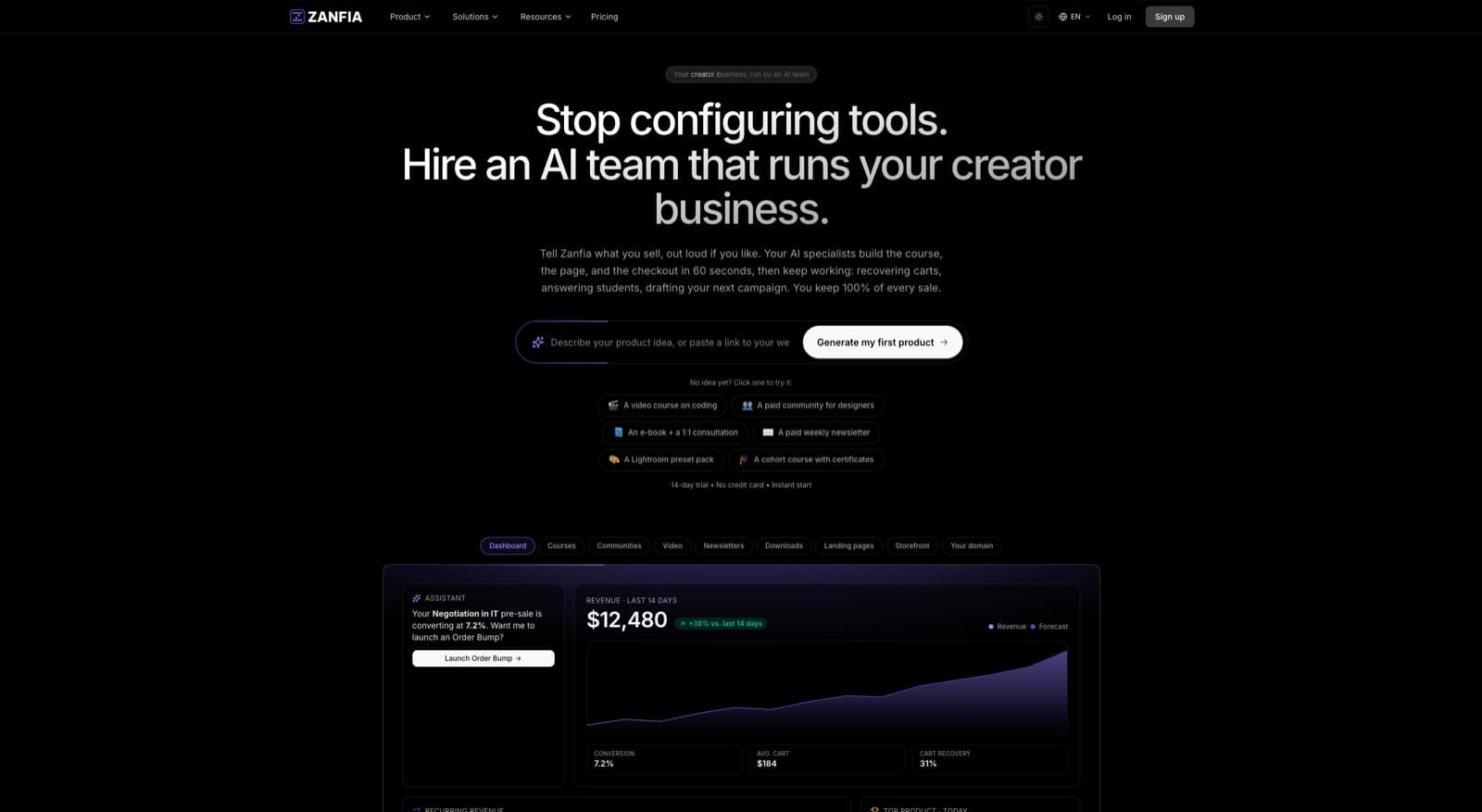
One of its biggest differentiators is the 0% platform transaction fee model. While competitors take a cut of every sale, Zanfia relies on a clean SaaS subscription. As of 2026, that means you keep 100% of your customer revenue. The only fees you ever see are the standard ones from payment operators themselves (Stripe is roughly 2.9% + $0.30 in the US).
"Without Zanfia, developing a paid newsletter and community would be much harder, it’s the best tool we've tried for the job." — Wojciech Pisarski, CEO of wMinutę
Beyond the fees, Zanfia automates the time-sucking back-office tasks. The moment a customer makes a purchase, the platform can instantly:
- Grant access to the correct online course or ebook.
- Add the new member to the appropriate community channels.
- Trigger a welcome email sequence to onboard them properly.
- Sync the customer to your connected email tool (Mailchimp, Kit, ActiveCampaign and others) with the right tags and lists.
This level of automation completely eliminates manual work and ensures every customer gets a professional, consistent experience. The checkout is built to sell as well as automate, with order bumps, subscription upsells, installments and a test mode you can use to buy your own product before launch so you know the funnel works end to end. If you're exploring your options, our guide on the best subscription management software can offer some more perspective.
Ultimately, the right platform isn't just a tool; it's a partner in building a sustainable and profitable business.
Why Predictable Revenue Is Your Key to Building Real Wealth
Moving to a recurring revenue model isn't just about smoothing out your monthly income. It's about fundamentally changing the game, transforming your creative work from a job into a valuable, sellable asset. This is how you make the leap from simply earning a living to actually building long-term wealth.
Think about it this way: the effort you pour in today isn't just covering next month's bills. It's a direct investment in your financial future, building equity with every new subscriber.
Turning Your Monthly Paycheck Into a Sellable Asset
When investors or potential buyers look at a business, what they're really buying is its future cash flow. A business that relies on one-off sales is a gamble. One month might be great, the next could be a bust. That kind of unpredictability is risky.
In stark contrast, a business built on recurring revenue offers a clear, predictable stream of income. This drastically cuts down the financial uncertainty and makes your business a much safer, more attractive bet.
With that stability comes a huge advantage: you can operate from a position of strength. Stable cash flow means you can confidently reinvest in your business, whether that's creating better content, upgrading your gear, or hiring help. You escape the reactive cycle of chasing the next sale and start making strategic, forward-thinking decisions that drive real growth.
The Massive Valuation Bump from Predictability
The market doesn't just prefer predictable revenue; it pays a massive premium for it. The difference in valuation between a transactional business and a recurring one isn't small, it's a complete game-changer.
Time and again, market analyses show that companies with a high percentage of recurring revenue are valued much, much higher. In fact, subscription-focused businesses often sell for 2 to 4 times the price of a similar business that relies on one-time sales.
To put some real numbers on it, businesses where recurring revenue makes up 60–70% or more of their total income often get acquired for 2.2x to 2.5x their gross revenue. Meanwhile, traditional models are lucky to get 1.0x to 1.4x.
Why such a huge difference? Because predictable income makes future earnings much easier to forecast, which lowers the risk for a buyer. This gives them the confidence to make a higher offer and often helps deals close faster. For a deeper dive into the numbers, check out this analysis on why subscription models lead to higher valuations.
Ultimately, building a recurring revenue stream is a strategic choice to create something with lasting equity. It turns your passion project into a resilient brand that not only supports you today but holds substantial value for whatever comes next. This approach is especially powerful when you're focused on creating online communities that build the kind of loyalty that keeps those subscriptions renewing month after month.
A Few Common Questions
Switching your business to a recurring revenue model is a big step. It’s a whole different way of thinking, moving away from one-off sales and toward building lasting relationships with your audience. It's natural to have questions, so let's walk through some of the most common ones we hear from creators.
What's the Real Difference Between Subscriptions and Memberships?
It’s easy to get these two mixed up since they often overlap, but the core idea behind each is distinct.
Think of it like this:
- A subscription is about access. People pay you for consistent delivery of a product or service. This could be a weekly paid newsletter, a new video tutorial every month, or access to a library of courses. The value is clear and tangible: you get this thing for this price .
- A membership is about belonging. Here, the payment is a ticket into an exclusive group or community. The real value isn't just the content; it's the connection, to you, to other members, and to a shared identity or goal. The content is important, but it serves the community, which is the main event.
The great thing is you don't always have to choose. On a platform like Zanfia, you can blend the two. Imagine offering a subscription to your courses that also grants access to a private community where students can connect and support each other. You get the best of both worlds, all under your own brand, and you can start with a 14-day free trial (no credit card required).
How Much Content Do I Really Need Before Launching?
This is the big one. It's the question that keeps so many talented creators stuck in "pre-launch paralysis." The honest answer? Probably less than you think.
You don’t need a sprawling, perfectly complete library of content on day one. The secret is to start with a solid, valuable core offering and a clear roadmap for what's coming next.
It's far better to start small and grow with your audience than to wait forever for a "perfect" launch. Go live with just your first course module, your initial community guidelines, or the first edition of your newsletter. Your founding members are your most valuable collaborators, their feedback is gold and will guide what you create next.
This approach builds real momentum and ensures you're building something your audience actually needs, not just what you think they want.
What’s the Toughest Part of Running a Recurring Model?
Hands down, the biggest challenge is customer retention. Getting someone to sign up is just the starting line. The real work is in giving them compelling reasons to stick around, month after month.
The number one reason people cancel is that they no longer see the value. If the monthly payment starts to feel like an expense rather than an investment, they're gone.
To fight churn and keep your members happy, you have to consistently prove your worth. That means:
- Adding fresh, relevant content on a regular schedule.
- Showing up and engaging in your community.
- Actively listening to feedback and making improvements.
- Gently reminding members of all the value they're getting.
Mastering retention is what separates a short-lived project from a sustainable business. It's how you turn your creative passion into a stable, predictable, and incredibly valuable asset.
Ready to build a business with predictable revenue and lasting value? With Zanfia, an AI team runs the operational side of your creator business, courses, communities, subscriptions and a checkout built to sell, all with 0% platform fees. Dictate what needs to happen or connect your own AI agents through the MCP endpoint, and start with a 14-day free trial (no credit card required). Start building your recurring revenue engine today.