

What Is Affiliate Marketing: A Beginner’s Guide

Here's a simple way to think about it: affiliate marketing is essentially a modern take on getting a referral commission. You promote another company's products, and when someone buys something based on your recommendation, you earn a piece of the pie. It's like being a freelance digital salesperson who only gets paid for results.
So, How Does Affiliate Marketing Actually Work?
At its heart, affiliate marketing is all about partnership. Picture yourself as a trusted guide, pointing your audience toward a product or service you genuinely believe in. When they follow your advice and make a purchase, the brand thanks you with a commission for sending them a new customer.
It’s a true win-win-win. The brand gets a sale, the customer finds a great product, and you get rewarded for making the connection. This performance-driven model is one of the most popular forms of content monetization, letting you earn an income without having to create a product from the ground up. Find out more about how this fits into a broader strategy by exploring what we mean by content monetization.
The Key Players and Their Roles
To really get what makes affiliate marketing tick, you need to know the cast of characters. It’s a simple setup, but each player has a crucial role to perform.
Let's break down who does what in this dynamic ecosystem.
The Key Players in Affiliate Marketing and Their Roles
| Player | Role | Example |
|---|---|---|
| The Merchant | The one who creates and sells the product or service. | A software company, an e-commerce brand, or a digital creator selling courses on a platform like Zanfia, where an AI team runs the day-to-day work behind the checkout. |
| The Affiliate | You—the creator, blogger, or influencer promoting the product. | A YouTuber reviewing a camera and linking to it in their description. |
| The Customer | The end-user who buys the product through the affiliate's link. | Someone in your audience who clicks your link and makes a purchase. |
This clear, straightforward relationship has turned affiliate marketing into a global powerhouse, with the market now valued at around $19.67 billion.
This isn't just a niche strategy anymore; it's a massive driver of online sales. In fact, affiliate programs are responsible for a whopping 16% of all e-commerce sales worldwide. From huge online retailers to independent creators, people are turning their influence into income every single day.
To really get a handle on the mechanics, it’s worth digging a little deeper into what is an affiliate marketing program and how the tracking and payments all work behind the scenes. Getting these fundamentals right is the first step toward building a successful program yourself.
How the Affiliate Marketing Process Actually Works
So, how does a simple click on your blog or video magically turn into money in your bank account? It’s not magic, but a clever and reliable tracking system working behind the scenes. This system is the bridge that connects your recommendation to a brand’s sales.
The whole thing hinges on a unique affiliate link. Think of it as a digital fingerprint—a special URL that a brand gives you and only you. When you share this link and someone clicks it, the brand knows instantly that the visitor came from you.
That click also triggers the second key piece of the puzzle: a tracking cookie. This is just a tiny file that gets stored on the visitor's browser. It acts like a little reminder, telling the brand’s website, "Hey, this person was sent here by [Your Name]."
This cookie is incredibly important because people don't always buy right away. They might need a few days to think it over. As long as they purchase within the cookie's lifespan—which can be anything from 24 hours to 90 days—you still get the credit for the sale.
Here’s a quick visual of how it all flows together:
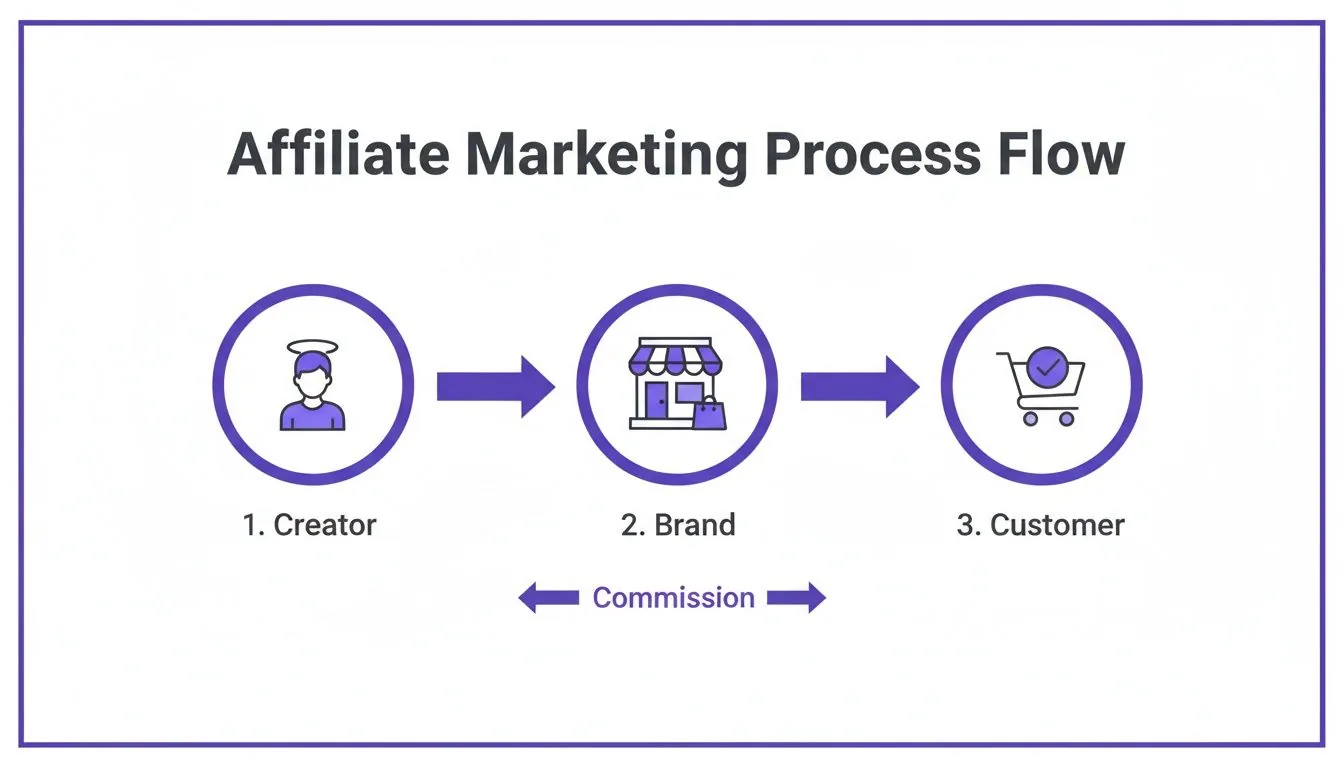
Essentially, you’re the trusted connector. You introduce your audience to a great product, and when they buy, the brand thanks you with a commission.
Different Ways You Get Paid
Not every affiliate program pays out the same way. The commission structure you choose can totally change your strategy, so it’s crucial to understand the main models. Each one rewards a different kind of result.
This entire process, from that first click to the final payout, is a core part of building any profitable online presence. If you want to dive deeper into guiding your audience through this journey, our guide on how to create a sales funnel is a great next step.
Here are the three most common ways you'll earn money:
- Pay-Per-Sale (PPS): This is the bread and butter of affiliate marketing. You earn a percentage or a flat fee when someone you refer actually buys something. It’s simple, direct, and ties your income to the real value you generate.
- Pay-Per-Lead (PPL): With PPL, you get paid for generating a potential customer, not a final sale. This could mean they sign up for a free trial, download a guide, or fill out a form. It's a great model if your audience isn't quite ready to buy but is willing to take that first step.
- Pay-Per-Click (PPC): This one is less common these days, but it’s still around. You earn a small amount for every single click your link gets, whether it leads to a sale or not. It's mostly used in campaigns focused on building brand awareness rather than driving direct sales.
A Real-World Example
Let's walk through a scenario. Imagine you're a course creator teaching people how to launch their own online businesses using a platform like Zanfia. You publish an in-depth review of an email marketing tool you genuinely love.
In the article, you place your unique affiliate link. A reader, convinced by your honest review, clicks it. Instantly, a tracking cookie is placed on their browser.
They browse the tool’s website and decide to sign up for a 14-day free trial. Cha-ching! If the program has a PPL component, you just earned a commission for that lead. A week later, they’re hooked and upgrade to a paid subscription. Cha-ching again! Now you’ve earned a PPS commission.
All of this is tracked and credited to your account automatically. You don’t have to chase anyone for payment; you can just focus on creating more great content that helps your audience.
Why Affiliate Marketing Is Such a Powerful Strategy
Affiliate marketing isn't just another buzzword or a simple side hustle. It's a core growth engine for creators and businesses alike, built on a powerful, win-win relationship where everyone focuses on what they do best.
For creators, it’s one of the most direct paths to making a real income online. It completely sidesteps the usual headaches of starting a business—no product development, no inventory management, and no customer service tickets to answer.
Your job is to build a genuine connection with your audience and deliver real value. By recommending products you actually use and stand behind, you can monetize that trust in a way that feels natural, not forced.
Benefits for Content Creators and Entrepreneurs
The upsides for individual creators are huge. It's a clear path to financial independence without the massive overhead that sinks most traditional businesses. It's all about putting your influence and expertise to work.
Here’s why it’s so appealing:
- Low Startup Costs: All you really need to get started is a blog, a YouTube channel, or even just a social media profile. Your biggest investment is your time and creativity, not your life savings.
- Freedom and Flexibility: You aren't locked into selling just one thing. You have the freedom to promote a whole range of products that genuinely fit your niche and help your audience, all while working from wherever you want.
- Building Passive Income: Think about it: a single, well-made product review or tutorial can keep earning you commissions for months, or even years. This is the heart of what is passive income —earning from work you did just once.
This model frees you up to focus on what you love: creating fantastic content that serves your community. When you do that well, the promotions feel less like ads and more like helpful recommendations.
"Affiliate marketing helps you become more comfortable promoting and selling products or services online. It will also help you build trust with your audience and establish your blog as a helpful resource."
The principle is simple: lead with value. When you solve a problem for your audience by pointing them to the right tool, the commission is just a thank-you for your guidance.
A Low-Risk, High-Reward Channel for Businesses
On the business side of the table, affiliate marketing is one of the most efficient ways to find new customers. Period. Unlike traditional ads where you pay for eyeballs and hope for the best, you only pay when you get a concrete result.
This performance-based model takes a huge amount of financial risk off your shoulders. You aren't just throwing money at a billboard and crossing your fingers; you're directly investing in measurable outcomes like sales, leads, or new sign-ups.
The numbers speak for themselves. The ROI from affiliate marketing is legendary, with brands bringing in an average of $15 for every $1 invested. It’s the engine behind 5-25% of major brands' total sales and accounts for 16% of all e-commerce orders worldwide. This is exactly why 81% of brands rely on it to grow—the data proves it works.
For businesses selling digital products on a platform like Zanfia, a referral program can be a game-changer. It effectively turns your most enthusiastic customers into a motivated sales team. Because Zanfia is built as an AI team that runs the creator business—assistant, agents and an MCP endpoint on higher plans—you can dictate the setup by chat or voice, then let the checkout do the selling with order bumps, installments and upsells across 12 product types under one brand. As of publication, the referral program itself is coming soon, so keep an eye on your dashboard or the current Zanfia pricing page for when it opens on your account.
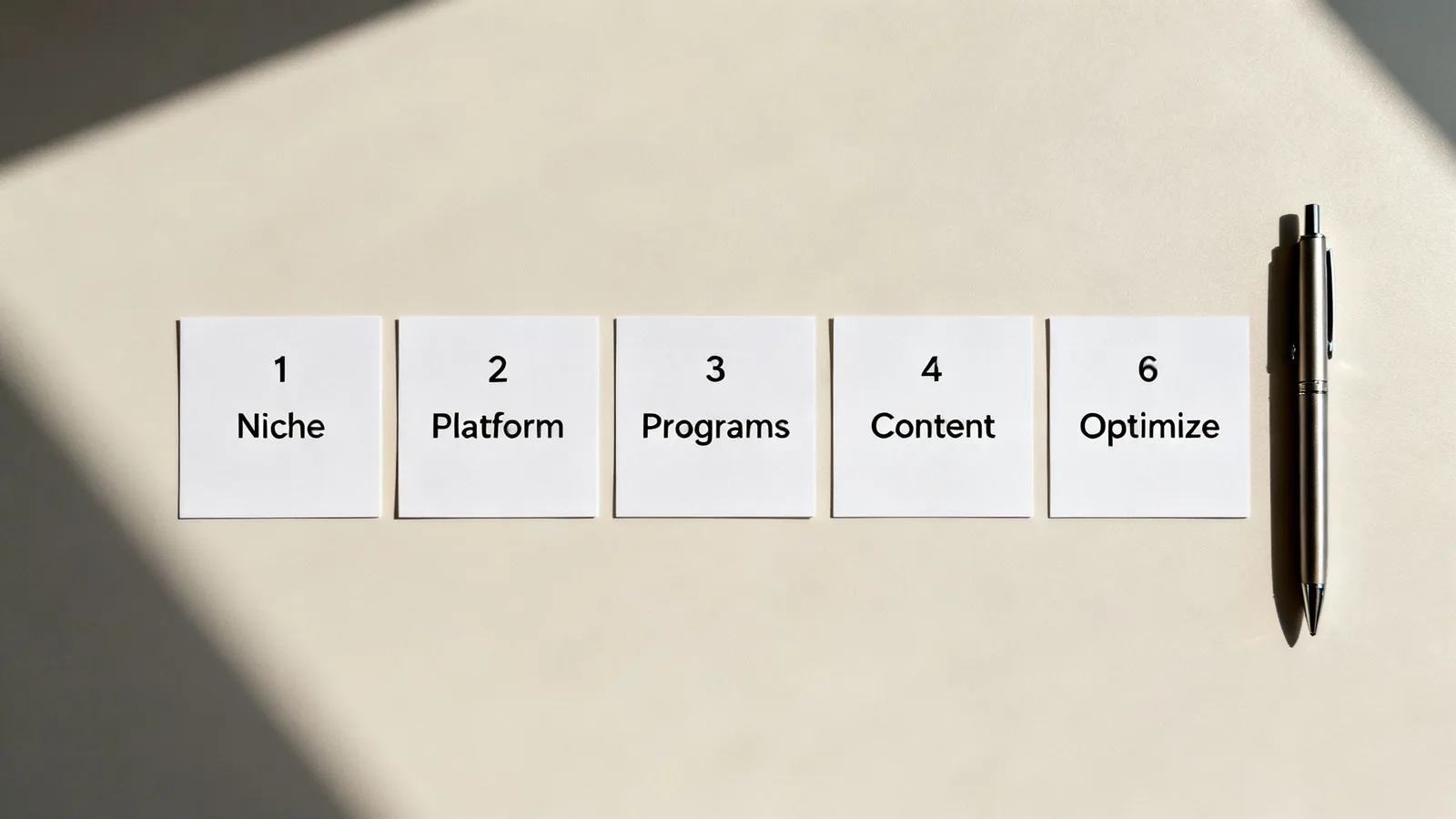
Your 5-Step Guide to Starting Affiliate Marketing
Knowing the theory behind affiliate marketing is one thing, but actually putting it into practice is how you start seeing real results. Think of this as your roadmap—a practical, step-by-step guide to take you from learning the ropes to earning an income.
Step 1: Discover Your Profitable Niche
Your niche is the bedrock of your entire affiliate business. It’s the specific world you’ll operate in, defining who you talk to and what you talk about. Trying to be everything to everyone is a recipe for getting lost in the noise; a focused niche lets you become the go-to expert for a dedicated community.
The sweet spot for a profitable niche sits at the intersection of three things: what you’re passionate about, what you know, and what people are willing to pay for. It has to be a topic you genuinely enjoy, have some experience with, and that has a built-in audience ready to buy.
For instance, instead of the super-broad "fitness" niche, you could drill down to "home workouts for busy parents" or "marathon training for beginners." Getting specific like this makes it infinitely easier to connect with the right people and find products they actually need.
Step 2: Build Your Content Platform
Once you’ve staked your claim in a niche, you need a home base—a place to share your expertise and gather your audience. This platform is your digital stage. The two most common and battle-tested options are starting a blog or a YouTube channel.
A blog gives you total control and becomes a powerful asset over time. You own the turf. You’re not at the mercy of some algorithm change, and you decide everything from the look and feel to how you make money. A huge part of making a blog work is learning how to increase organic traffic, which brings in people who are actively looking for your solutions.
On the other hand, a YouTube channel can be a game-changer, especially if your niche is visual. Videos let you show, not just tell. You can unbox products, demonstrate how something works, and build a much more personal connection with your viewers. The right choice really comes down to what fits your niche and your personality best.
Step 3: Find and Join the Right Affiliate Programs
With your platform ready to go, it’s time to find great products to promote. You can go about this in two main ways: by joining affiliate programs directly or by using a larger affiliate network.
- Direct Programs: These are programs run by individual companies. For example, a digital creator on a platform like Zanfia might have their own referral program for an online course they sell. These often pay better commissions, but you’ll have to manage each partnership one by one.
- Affiliate Networks: Think of these as massive marketplaces like ShareASale or CJ Affiliate that act as middlemen. They connect you with thousands of brands, and they handle all the applications, tracking, and payments in one central dashboard, which makes life much easier.
A great place to start is with the products and tools you already use and genuinely love. Your recommendations will come across as authentic and trustworthy, and in this game, trust is everything.
Step 4: Create Authentic Content That Converts
This is where the real work—and the real fun—begins. Your content is the bridge that connects your audience's problems to the solutions you're recommending. Just scattering affiliate links across generic posts is a surefire way to fail. You have to create content that genuinely helps people.
Zero in on solving very specific problems for your audience. Instead of just rattling off a product’s features, show them how it solves a real-world headache they’re experiencing.
Your goal is to be a resource, not a salesperson. When you provide immense value and build trust, the affiliate commissions will follow as a natural byproduct of your helpfulness.
Here are a few content formats that work exceptionally well for affiliates:
- In-Depth Product Reviews: Go deep. Share your honest experience—the good, the bad, and the ugly—to show you're a credible source.
- How-To Guides and Tutorials: Walk your audience through a process from start to finish, showing them how to get results using the product you’re recommending.
- Comparison Posts: Pit two or more popular products against each other. Help your audience make a tough decision by breaking down which option is best for their specific situation.
Step 5: Track and Optimize Your Performance
Hitting "publish" is the starting line, not the finish. To build a reliable income stream, you have to constantly check your numbers and figure out how to improve. Luckily, most affiliate dashboards give you all the data you need.
Keep a close eye on metrics like your click-through rate (CTR), conversion rate, and earnings per click (EPC). This data is pure gold—it tells you which products your audience loves and which types of content are actually making you money.
For example, if a tutorial gets tons of clicks but almost no sales, maybe your call-to-action is weak, or perhaps the product isn't the perfect fit for that guide after all. You have to regularly review what's working, test new approaches, and then double down on your winners.
Scale Your Business by Creating Your Own Affiliate Program
So far, we've been looking at affiliate marketing from one side of the fence—the creator who promotes other people's products. But what happens when you flip the script? What if you could turn your most loyal customers and biggest fans into your own dedicated sales team?
That’s exactly what running your own referral program allows you to do. Instead of being the affiliate, you become the merchant, empowering others to sell your digital products on your behalf. It’s one of the most powerful ways to scale a business, drive consistent sales, and expand your brand’s reach far beyond your own audience.
If you sell online courses, paid communities, or e-books, this strategy is a strong fit. You get to tap into the genuine trust that your partners have already built with their own communities, which brings in much warmer, higher-converting traffic than you’d ever see from cold ads.
Why Launching Your Own Program Is a Smart Move
Building a referral program isn’t just about making more sales. It's about constructing a powerful, performance-based marketing engine that grows right alongside your business. You get to reward your biggest advocates for spreading the word, creating a win-win relationship that fuels growth for everyone involved.
The benefits are hard to ignore:
- Cost-Effective Marketing: You only pay for real results. Forget paying for clicks or impressions that go nowhere; with a referral program, you only part with cash when a sale is actually made.
- Massive Scalability: Your reach is no longer capped by your own marketing efforts. Imagine an army of motivated partners introducing your products to new audiences you would have never found otherwise.
- Increased Social Proof: When other respected creators in your niche start recommending your products, it builds incredible credibility and trust for your brand.
Simplify Your Setup with an AI-First Platform
For most creators, the biggest thing holding them back is the technical side of it all. Trying to manage tracking software, process payouts, and handle all the admin sounds like a total nightmare. This is where a platform like Zanfia is designed to help: it's built as an AI team that runs your creator business, with an assistant, agents and an MCP endpoint on higher plans so your own AI tools can act on your workspace.
Because your courses, community, and sales already live in one place, adding a partner layer becomes part of the same setup rather than a stack of duct-taped tools. You can dictate the change by chat or voice instead of clicking through settings, and the checkout is built to sell what you launch: order bumps, installments (split a $600 course into four payments), subscription upsells, and 12 product types under one brand. You can even run a test purchase in test mode before you go live, so you catch broken tracking or a wrong price before a real buyer does. The referral program itself is coming soon, so treat this as the setup you’re getting ready for, not something you can flip on today—check the current Zanfia pricing page for availability by the time you read this.
Zanfia is built to make your customers a real part of your marketing. It centralizes product delivery, checkout and workflows under your own brand, so you can focus on creating value while the platform does the operational work.
One of Zanfia's standout mechanics is its 0% platform commission on customer sales. Most platforms take a slice of every single sale; as of publication, Zanfia takes 0% and only the payment processor (Stripe or PayPal, roughly 2.9% + $0.30 in the US) takes its standard cut. That means you can offer more generous commissions to your partners when the referral program opens, which helps you attract stronger partners who can move serious volume. For creators pulling in five and six figures a month, protecting that margin is what makes scaling profitable.
By running everything from one dashboard, you create a frictionless experience for both your customers and your partners. New customers get instant access to the courses or communities they just bought, and the operational layer—access, tags into your email tool, community roles, GitHub or Discord grants—runs through built-in automations. It’s a system that hands you back hours of admin work every single month. To dig deeper into this, check out our guide on choosing the right platform to sell digital products.
Common Mistakes to Avoid for Long-Term Success
Making real, sustainable income from affiliate marketing is about more than just tossing links around—it's about building a business with strategy and integrity. So many people trip up right out of the gate by making a few classic mistakes, often killing their credibility before they even have a chance to build it.
Let's walk through the biggest pitfalls I've seen over the years, so you can sidestep them and build something that lasts.
Promoting Low-Quality Products
Want to lose your audience's trust in a heartbeat? Promote junk just for a quick commission. Recommending a product you've never touched or, worse, one that doesn't live up to its hype, is a surefire way to damage your reputation permanently. People follow you for your honest take, not to be sold a bill of goods.
Your goal is to be a resource, not a salesperson. When you provide immense value and build trust, the affiliate commissions will follow as a natural byproduct of your helpfulness.
The solution is simple: only promote products you genuinely use, trust, and can stand behind. There's nothing more powerful than an authentic recommendation that comes from real-world experience. It converts better and feels a whole lot better, too.
Neglecting Audience Trust
In this game, the relationship you have with your audience is everything. It's your most valuable asset. If you chase short-term gains with pushy, "salesy" tactics, you'll push away the very people you're trying to help. They're here for the value you offer, not to be treated like a walking wallet.
This means you have to be relentless about creating helpful, high-quality content that solves their problems first. Your affiliate links should feel like a natural, helpful suggestion—a resource that complements your content, not the reason for it.
Failing to Disclose Partnerships
Let’s be clear: transparency isn't just a nice-to-have, it's a legal must. In the U.S., the FTC has strict guidelines requiring you to clearly and obviously disclose that you might earn a commission from your affiliate links. Trying to hide it is not only deceptive but can land you in serious hot water.
Legal issues aside, being upfront builds trust. When you're honest about your partnerships, your audience respects it. They know how the game works and are often happy to support you when they know you’re being straight with them.
Focusing Only on High Commissions
It’s easy to get tunnel vision and chase affiliate programs with the biggest payouts. But a massive commission on a product your audience couldn't care less about is completely worthless. A 10% commission on a product they actually love will always, always outperform a 50% commission on something irrelevant.
True affiliate marketing success happens at the intersection of three things:
- Audience Needs: Does this product actually solve a real problem for my people?
- Product Quality: Is this a top-notch product I can confidently put my name behind?
- Your Authenticity: Does promoting this product align with my brand and what I stand for?
When you sidestep these common mistakes, you stop chasing quick cash and start building a real, trust-based business—one that delivers genuine value and creates a reliable income stream for the long haul.
Got Questions? We’ve Got Answers.
As you get ready to dive in, it's natural for a few questions to be bubbling up. Let's tackle some of the most common ones we hear from creators and marketers, so you can move forward with confidence.
Think of this as your personal cheat sheet for clearing up any lingering uncertainties.
What's the Real Earning Potential with Affiliate Marketing?
Honestly, it’s all over the map. Your income is tied directly to your niche, how much your audience trusts you, and the effort you put into your content. Someone just starting out might make a few hundred bucks a month, while the heavy hitters are pulling in five or even six figures every single month.
The trick is to treat it like a real business, not a get-rich-quick scheme. Your income grows as your authority and the value you provide grow. It’s a marathon, not a sprint.
Do I Absolutely Need a Website to Be an Affiliate?
Not necessarily, but it helps. A website is your own piece of digital real estate—an asset you control completely. That said, plenty of creators crush it by promoting products directly on YouTube, Instagram, TikTok, or through a well-crafted email newsletter.
Having your own site, however, gives you long-term stability. You aren't at the mercy of a social media algorithm change or a platform suddenly shutting down. It’s the safest bet for building a sustainable business.
What's the Difference Between an Affiliate Program and a Network?
This one trips people up all the time, but it’s actually pretty simple.
- Affiliate Program: This is a "house brand" program run directly by one company for its own products. Think of a creator on Zanfia setting up a referral program for their new course (coming soon), or a big brand like Amazon running its own Amazon Associates program. You work directly with them.
- Affiliate Network: This is more like a giant marketplace or a middleman. Companies like ShareASale or CJ Affiliate connect thousands of affiliates (like you) with thousands of different brands all under one roof. They handle the applications, tracking, and payments in one central dashboard.
So, which is better? Direct programs can sometimes offer higher commissions and a closer relationship with the brand. Networks, on the other hand, give you a ton of variety and make it easy to manage everything in one place. Your best strategy might involve a mix of both.
Ready to turn your loyal customers into part of your marketing? With Zanfia, an AI team runs your creator business day to day: you dictate the setup by chat or voice, the assistant and agents act on your workspace (with an MCP endpoint on higher plans), and the checkout is built to sell across 12 product types with order bumps, installments, subscription upsells and a 14-day free trial with no credit card. A native referral program is coming soon, so you can build the operation now and switch it on the day it opens on your account. As of publication, Zanfia charges 0% platform commission on customer sales, starting at $39/month, or $31/month billed annually, on Starter (see the current Zanfia pricing). Start building at https://zanfia.com.