

The Ultimate Online Course Platform Comparison for Creators in 2024

Choosing the right online course platform is more than a tech decision—it’s a strategic choice that will define your business. The right platform strikes a perfect balance between scalability for growth, a premium student experience, and operational simplicity that prevents creator burnout. It's easy to get lost in endless feature lists, so let's cut through the noise and find a system that supports your entire business, not just your videos.
Why Your Platform Choice Defines Your Business's Future
The online course market is booming, valued at around $456.5 billion in 2023. This explosion is a massive opportunity, but it also brings a huge challenge: analysis paralysis. With dozens of options, it's tempting to grab the one with the lowest monthly fee. But this is a classic trap that leads to high transaction fees and a messy, fragmented tech stack just a few months down the road.
A smart online course platform comparison goes deeper than the price tag. I’ve learned from working with hundreds of creators that the decision must be built on three essential pillars.

The Three Pillars of Platform Selection
I always advise creators to evaluate platforms on their ability to build stable, long-term revenue. This comes down to three things:
- Scalability: Will this platform grow with you? A tool that feels great for your first 100 students might completely fall apart when you hit 1,000. Think about its capacity to handle more products, members, and complex automations without forcing you into a painful migration later. Looking at a comprehensive e-commerce platform analysis can give you a good idea of what to look for in terms of features and integrations as you scale.
- Student Experience: The perceived value of your course is directly tied to how students feel using it. Is the interface clunky? Can they easily find materials and connect with others? A disjointed experience, like needing separate logins for the course and the community, creates friction and kills retention rates.
- Operational Simplicity: How much of your week will be spent wrangling technology instead of creating? The hidden cost of "saving money" on cheap tools is often hours spent on manual work—patching together different systems, troubleshooting broken integrations, and juggling multiple subscriptions. This is time you're not spending on growing your business.
Key Takeaway: An all-in-one platform is a strategic asset. By integrating courses, digital products, and community in one place, you eliminate the chaos of managing multiple tools and create a seamless operational hub for your creator business. This is the difference between a side hustle and a scalable company.
Before we dive into a detailed online course platform comparison, here’s a snapshot of how the top contenders stack up.
Quick Platform Comparison At a Glance
This table gives you a bird's-eye view of the top platforms. Use it to quickly see which one aligns best with your business model and where you should start your deeper research.
| Platform | Best For | Key Strength | Pricing Model |
|---|---|---|---|
| Zanfia | Creators who want an AI team running the business | AI-first workspace with courses, community, and a checkout built to sell, all under one brand | Subscription, starting at $39/mo ($31/mo billed annually), 14-day free trial |
| Thinkific | Creators focused purely on course creation | Advanced quizzing and course-building tools | Subscription + App Marketplace |
| Kajabi | Established businesses needing marketing funnels | Powerful, integrated marketing and sales pipelines | High-tier Subscription |
| Teachable | Beginners looking for a simple starting point | User-friendly interface and simple setup | Subscription + Transaction Fees |
This quick comparison should help you narrow down the options. Now, let's get into the specifics of what each one truly offers.
Comparing Core Platform Features
Let's be direct. A platform's true value isn't in its marketing slogans—it’s in how its features solve actual business problems day in and day out. When you're doing an online course platform comparison, you have to dig into the three pillars of a successful creator business: course delivery, community engagement, and monetization.
Many platforms nail one of these but drop the ball on the others. You might find one with a beautiful course builder but zero tools for student interaction, forcing you to manage a separate community. This fragmentation is where hidden costs and administrative nightmares are born, turning a smooth operation into a chaotic mess of different logins and clunky integrations.
Course Creation and Delivery Tools
The heart of any platform is its ability to host and deliver your content. But the devil is in the details—specifically, in the flexibility to support different teaching models.
Think about the difference between a self-paced, evergreen course and a time-sensitive, cohort-based program.
- Self-Paced Courses: These need features like progress tracking and a smart video player that remembers exactly where a student left off.
- Cohort-Based Courses: These demand content dripping—the ability to unlock modules on a set schedule—so everyone moves through the material together.
A platform that only does one of these well hamstrings your business as it grows. Zanfia handles both, and it treats the course builder as one surface an AI team works with rather than the whole product. You can dictate a new module out loud instead of clicking through settings, and the assistant performs anything available in the interface by chat or by voice. Under the hood you still get a smart player that remembers video progress, speed, and quality, and you can drip content by unlocking modules on a set schedule. This adaptability means the platform grows with your business strategy, not against it.
Actionable Tip: Choose a platform that offers both self-paced and cohort-based course features from the start. This ensures you can evolve your offerings without needing to migrate to a new system later. A flexible course builder with a smart player and content dripping is non-negotiable for serious creators.
This infographic shows a clear trend: the more integrated the features, the happier the students and the more successful the course.
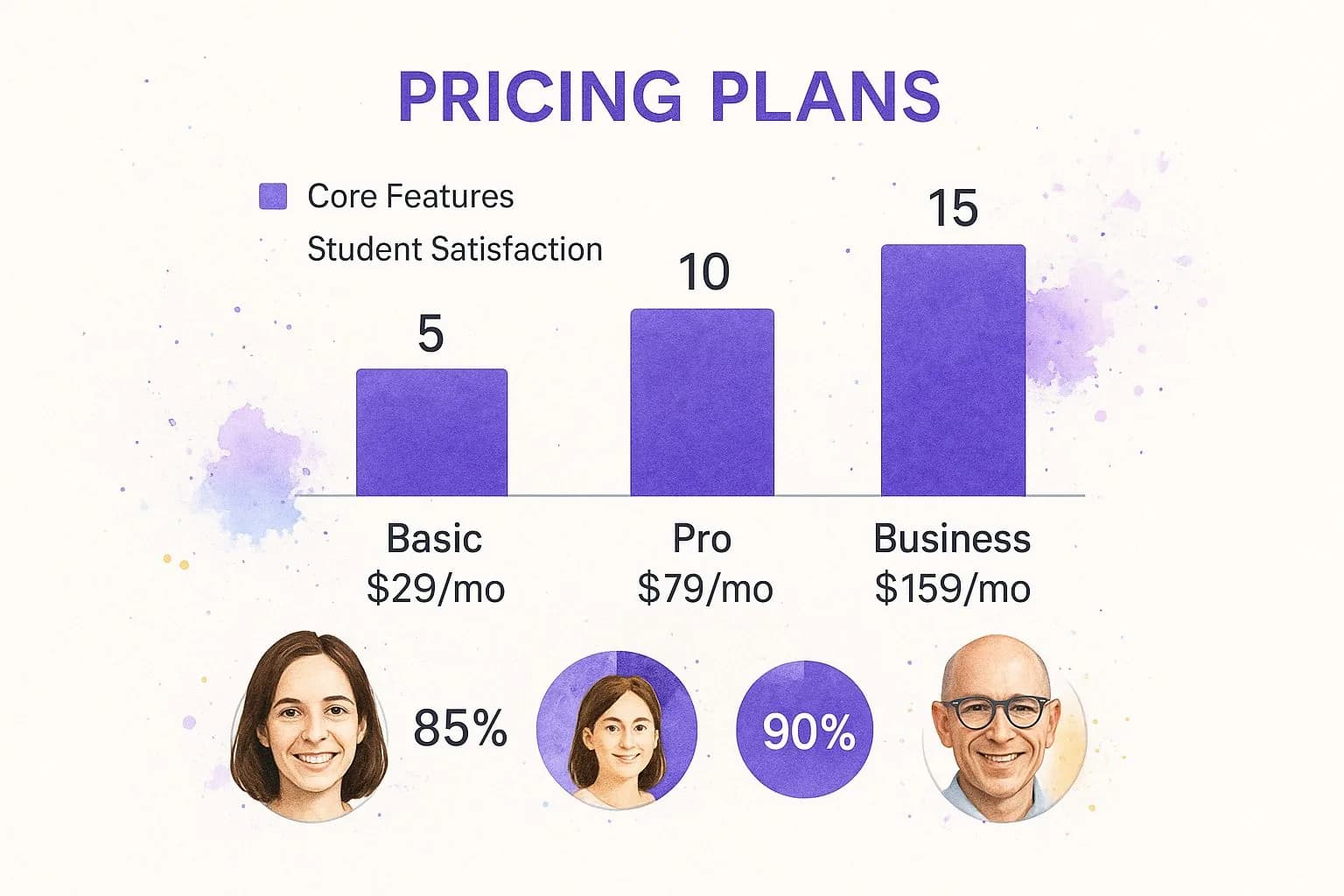
As you can see, when a platform bundles core features together, it reduces friction for the user, which directly boosts student satisfaction.
Community Engagement Capabilities
Student success and retention are directly linked to engagement. A staggering 85% of community managers believe that a branded online community significantly improves the customer journey. Yet, many course platforms treat community as an afterthought, forcing you to bolt on a separate forum or a chaotic social media group.
This creates a jarring, disjointed experience. Students manage multiple logins, and you lose a complete picture of their activity. Most importantly, you miss the opportunity to create a central hub where learning and discussion happen in the same place.
This is exactly the problem Zanfia was built to solve. Instead of duct-taping a Facebook group to your course, Zanfia gives you built-in professional discussion spaces right alongside your lessons. You can create thematic discussion channels, manage members, and set up read-only channels for announcements, all under your own brand. There is also a community AI agent that writes from your own content, and everything it publishes is clearly labeled as AI so members always know what came from you and what came from the assistant. It transforms your course from a static content library into a living learning environment. A well-organized community is also a cornerstone of effective knowledge sharing, and you can explore some knowledge management best practices to get the most out of yours.
Monetization and Digital Product Sales
Your business will eventually grow beyond a single course. You'll want to sell ebooks, paid newsletters, or downloadable templates. This is another area where a thorough online course platform comparison reveals massive differences.
Many platforms are built only for courses, making it clumsy to sell other digital goods. You’re then forced to set up a separate tool, like an e-commerce storefront, just to sell a $15 ebook. That means another subscription fee, another system to learn, and another point of failure.
A truly integrated platform understands modern creators have diverse revenue streams. Zanfia is built to sell, not just to host. You get a modern checkout with order bumps, subscription upsells, and installment plans, so you can split a $600 course into four automatic payments instead of losing the buyer at checkout. You can run a real test purchase on your own product before launch to make sure the funnel and tracking actually fire. And you can sell 12 product types under one brand: courses, communities, paid newsletters, memberships, ebooks and downloads, digital content, services, events, consultations, bundles, knowledge bases, and custom products. This isn't just convenience; it’s a strategic advantage that simplifies your operation and gives customers one seamless place to buy from you.
Feature Deep Dive Comparison
To make this crystal clear, let's break down how different platforms stack up across the features that matter most for a creator's success.
| Feature Category | Platform A | Platform B | Platform C | Zanfia |
|---|---|---|---|---|
| Course Builder | Basic video & text | Advanced quizzing | Drip content only | All-in-one: Drip, smart player, progress tracking |
| Community | None (3rd party needed) | Basic forum thread | None | Integrated discussion channels, with a community AI agent that writes from your content and labels every post as AI |
| Digital Products | Courses only | Courses + memberships | Courses only | 12 product types under one brand: courses, communities, newsletters, memberships, ebooks, downloads, services, events, consultations, bundles, knowledge bases, custom |
| Checkout & Monetization | One-time payments | Subscriptions | One-time payments | One-time, subscriptions, installments, order bumps, subscription upsells, test mode, Stripe and PayPal with Apple Pay and Google Pay |
| Branding Control | Limited templates | Full CSS/HTML | Co-branded pages | Custom domain, logo, and brand colors |
As the table shows, a platform like Zanfia is built from the ground up to be an all-in-one solution, preventing the "tool sprawl" that plagues so many creators who start with more limited options.
Analyzing the True Cost of Course Platforms
When you're comparing online course platforms, it's easy to fixate on the monthly subscription price. A $39 per month plan looks like a steal next to one that costs $99. But that sticker price is just the beginning. The real cost is often buried in a maze of transaction fees, third-party subscriptions, and the administrative headache of managing it all.
Many platforms draw you in with a low monthly rate, only to take a cut of every sale. A 5% transaction fee might not sound like much, but as your business grows, it seriously eats into your profits. A creator earning $5,000 a month would hand over $250 in those fees alone—more than the cost of a premium, zero-fee subscription on another platform.
Key Insight: The most expensive platform is rarely the one with the highest monthly fee. It's the one that forces you to rent essential features from other companies, creating a fragile and costly tech stack.

Uncovering the Hidden Integration Costs
The real financial trap is what your platform can't do. If a core feature is missing, you have to subscribe to another tool and then pay again for software to connect everything. This "tech tax" can easily double or triple your monthly expenses.
Let's walk through a real-world scenario. You pick a course platform without a native community feature. To give your students that crucial space to connect, you now have to:
- Subscribe to a community tool: A platform like Circle.so or Mighty Networks can run you anywhere from $49 to $99 per month .
- Subscribe to an integration tool: You'll need something like Make.com to automatically add new students to your community, which tacks on another $10 to $29 per month .
- Manage the complexity: The time you spend troubleshooting broken connections and juggling multiple logins is a very real business cost.
Suddenly, your "affordable" platform costs you an extra $100+ per month just to do its job. This fragmented setup is the opposite of operational efficiency.
Cost Projections for Different Creator Stages
To see how this plays out, let's compare a cobbled-together tech stack with an all-in-one solution like Zanfia. We'll look at three common creator profiles to make this a practical online course platform comparison.
1. The Beginner Creator (Just starting out)
- Fragmented Stack: Course Platform ( $39/mo ) + Community Tool ( $49/mo ) + Basic Email Marketing ( $15/mo ) = $103/month + transaction fees.
- Zanfia: A single subscription covers your courses, community, digital products, and automations. Starter is $39/month (or $31/month billed annually) and includes a 14-day free trial with no credit card. Zanfia charges 0% platform commission on customer sales; only the payment processor (Stripe, roughly 2.9% + $0.30 in the US) takes its standard cut.
2. The Growing Creator ($5k/month revenue)
- Fragmented Stack: Course Platform ( $99/mo ) + Community ( $99/mo ) + Email Marketing ( $49/mo ) + Integration Tool ( $29/mo ) = $276/month. Before transaction fees, which could add another $250/month .
- Zanfia: All the tools are already integrated. Growth is $79/month (or $63/month billed annually) and you can connect your favorite mailing system (like MailerLite or ActiveCampaign) without needing extra middleware, which keeps your costs predictable and low.
3. The Established Business ($15k/month revenue)
- Fragmented Stack: Advanced Platform Plan ( $199/mo ) + Community ( $200+/mo ) + Email & CRM ( $150/mo ) + Multiple Integrations ( $50+/mo ) = Well over $600/month.
- Zanfia: It pulls all your core functions into one hub. Pro is $149/month (or $119/month billed annually) , and Scale is $249/month (or $199/month billed annually) for larger operations. Instead of juggling five subscriptions, you're managing one central system. This frees up your budget and, just as importantly, your time, so you can focus on growth.
When you're doing the math, it's crucial to map out all your potential expenses and figure out how to measure your content marketing ROI accurately. An all-in-one platform like Zanfia offers a clear financial advantage by including communities, courses, digital products, and automations in one package. This gets rid of the need for expensive third-party tools and the administrative chaos that comes with them, giving you a stable foundation for a business built to scale.
Build a Business That Runs Itself
As your creator business takes off, you'll hit a wall. Manually enrolling every new student and welcoming them to your community doesn't scale. It's not just a time suck; it's a cap on your growth.
To grow, you need systems that work for you in the background, freeing you to create amazing content. This is where automation becomes a non-negotiable feature in an online course platform comparison. The real power is connecting a customer's action to a specific task. Can your platform automatically add a new buyer to your private community? Or send a specific email when they finish a lesson?
Native vs. Third-Party Automations
Many platforms claim to "have automations," but what they really mean is you have to bolt on a separate, expensive tool like Make.com. These third-party services are powerful but add another monthly bill and another layer of tech to manage. When something breaks, you're stuck troubleshooting instead of helping students.
A platform with strong native automations cuts through that chaos. Zanfia ships a visual automation builder, and it goes further: you can dictate the workflow you want and let the AI assistant build it, or expose your workspace to your own agents over the MCP endpoint so they can run tasks on your behalf. A simple rule like, "When a customer buys 'Course A,' give them access to 'Community B,'" is built-in, and higher plans unlock the full assistant, API, CLI, and MCP access (availability depends on the plan, see the current Zanfia pricing). This one workflow saves hours of manual work and gives your new student a smooth, instant experience. You’re no longer renting features; you're owning your business's core processes. To get a better handle on this, check out this guide on scaling your business with effective systems.
Key Takeaway: Automation isn't just about saving time. It's about delivering a reliable, professional experience for every single customer, every single time. A new student shouldn't have to wait for you to manually add them to a welcome email or a community.
Automations You Can Actually Use to Grow
Let's move from theory to practice. Here are a few real-world examples of how integrated automations can completely change how you operate. These are the exact workflows top creators use to scale.
- Flawless Onboarding: Someone buys your main course. An automation can instantly add them to a "New Students" channel in your community and tag them in a welcome post. Zero effort from you, immediate value for them.
- Engagement Nudges: A student hasn't logged in for seven days ? You can set up an automated email that goes out with a subject like, "Hey, need a hand getting started?" This proactive touch can make a huge difference in course completion rates.
- Smart Cross-Selling: When a student finishes your beginner course, an automation can send them a special discount for your advanced program. It's a natural upsell that feels helpful, not pushy.
These automated systems are what scaling is all about. The entire Learning Management System (LMS) market is expected to hit $29.9 billion by 2025, showing just how massive online learning has become. To stand out, you need tools that can keep up. You can discover more insights about these online learning trends.
Platforms like Zanfia are built from the ground up for this. They give you the ability to connect events in the customer journey with specific tasks, and to tell the assistant to build those workflows for you by chat or by voice. This built-in power transforms manual chores into a smooth, self-running workflow, making your platform the engine of your business, not just a library for your videos.
Matching a Platform to Your Business Model

The single biggest mistake creators make when comparing platforms is getting caught up in the search for the "best" one. The truth is, there isn't one. The only thing that matters is finding the best platform for your specific business model.
A platform perfect for a consultant selling a high-ticket coaching program could be a terrible fit for an artist building a low-cost membership community. You have to look at how a platform’s strengths directly support how you make money and run your business.
This mindset shifts your focus from shopping for features to making a strategic decision. To get a clearer picture of your own strategy, it can be helpful to explore business model canvas examples and see how all the pieces fit together.
For the Consultant Selling High-Ticket Programs
If your business is built on high-value coaching or intensive, group-based courses, your platform must feel professional and create a seamless, premium experience. Your students are paying a premium price, and their entire journey needs to reflect that value.
Here’s what you absolutely need:
- A Secure, Branded Environment: You need a platform that lets you fully white-label the experience with your own domain, logo, and colors. A generic login page devalues your high-ticket offer.
- Integrated Community and Content: These high-touch programs thrive on interaction. Students need one central place to watch lessons, download worksheets, and join Q&A sessions.
- Scheduled Content Delivery: For group courses, the ability to drip content —unlocking new modules every few days—is essential to keep everyone at the same pace.
A platform like Zanfia is tailor-made for this. It allows you to create a dedicated space under your custom domain with your logo and brand colors. Your course content lives right alongside professional discussion channels, so you can host videos securely, drip modules on a schedule, and manage your student community without ever sending them to another website. And when a $3,000 program feels like a big ask, the built-in checkout lets you split it into a run of installments, which turns a hard yes-or-no into a much easier buying decision.
For the Creator Building a Membership Community
When your business revolves around a recurring subscription, retention is everything. Your platform is the central hub of your community, and the goal is to deliver continuous value that keeps people paying that monthly fee.
Your platform must be excellent at:
- Robust Community Tools: Look for features like thematic discussion channels, easy member management, and the ability to post rich media like text, images, and videos.
- Flexible Monetization: The ability to sell subscriptions is non-negotiable. You also need the flexibility to bundle different products or offer multiple membership tiers.
- Seamless Onboarding: The moment a new member signs up, they should automatically get access to the community and all relevant content.
This is a scenario where patching together tools often fails. A standalone course platform with a separate community app creates a clunky experience that hurts retention. In contrast, Zanfia’s integrated model lets you sell a subscription that grants immediate access to both courses and a private community, creating a sticky ecosystem that keeps members engaged. If this sounds like your path, get some great ideas from our guide on subscription business models for creators.
The success of a membership is measured by how deeply it's integrated into a member's daily routine. If your platform makes it easy and enjoyable to participate, your churn rate will plummet.
For the Expert Selling Diverse Digital Products
Many creators don't just sell one signature course. Their business model includes a mix of ebooks, paid newsletters, downloadable templates, and smaller workshops. This requires a platform that can handle more than just video lessons.
For this model, you'll need:
- A Modern Digital Product Cart: The platform has to be able to sell various file types, not just courses. You need a simple way to sell ebooks, reports, and other downloadable files.
- Integrated Sales and Delivery: The process must be automated. When someone buys an ebook, the platform should deliver it instantly without you lifting a finger.
- A Unified Customer View: It’s incredibly helpful to see everything a customer has purchased in one place. This allows for smart upselling and gives you a better understanding of their journey.
This is where many pure-play course platforms fall short, forcing you to use a separate e-commerce tool just to sell a PDF. An all-in-one system like Zanfia solves this by giving you a single hub to sell 12 product types under one brand: courses, communities, paid newsletters, ebooks, downloads, services, events, consultations, bundles, memberships, knowledge bases, and custom products. Order bumps and subscription upsells sit inside the same checkout, so a single buyer can walk out with a course, an ebook, and a monthly subscription in one transaction. This versatility means your platform can grow with your business, letting you add new revenue streams without adding new software.
Your Final Checklist: How to Choose the Right Platform
You’ve made it through the online course platform comparison. Now it’s time to make the call. This decision is the foundation for a creator business that can actually last. To cut through the noise, answer a few honest questions. Are you building a simple content library, or are you building a true business hub?
A Quick Sanity Check Before You Commit
Run your top contenders through this final filter. It will help you see past shiny features and focus on what truly matters.
- All-in-One vs. Piecemeal: Can I sell courses, digital products, and host my community without duct-taping three different tools together?
- Automation & Simplicity: Will the platform handle essential tasks for me, like sending welcome emails or revoking access when a subscription ends? Can I ask for those workflows out loud instead of clicking through settings?
- The Real Cost: Is the price I see the price I'll pay? Or will I get hit with transaction fees and surprise costs for essential integrations down the road?
- The Student's Journey: Will my students get a clean, branded experience where they can learn and connect, all in one spot?
Thinking through these points moves you from just comparing features to making a strategic choice that aligns with where you want your business to be a year from now.
The Bottom Line: The objective isn't just to find a place to upload your videos. It's to find a partner that eliminates tech headaches and gives you a straight line to predictable income.
If the idea of managing a half-dozen subscriptions and figuring out why an integration broke again makes you tired, then the answer is clear. You need a platform built from the ground up to avoid that mess. This is exactly why an integrated platform like Zanfia exists. It was designed to solve the exact fragmentation problem that stalls so many creators.
The best way to see if it's the right fit is to try it. Start your 14-day free Zanfia trial with no credit card required, and start building your community, courses, and products right now. It's a low-risk way to see if this is the platform that finally ends the chaos and lets you build the business you've been dreaming of.
Frequently Asked Questions
Choosing the right platform for your online course can feel overwhelming. Let's tackle a few of the most common questions that come up for creators so you can move forward with clarity.
Do I Really Need a Built-in Community Feature?
If you're serious about keeping students engaged and coming back for more, then yes, absolutely. You could always try to bolt on a separate community tool, but an integrated feature makes the experience so much smoother for everyone. It means no extra logins or clunky workarounds for your students.
Imagine this: a student buys your course and immediately gets access to a professional discussion area right next to the lesson they're watching. That’s exactly what platforms like Zanfia offer with their built-in professional discussion spaces. Access can be automated with a purchase, which saves you a ton of administrative headaches and gives every new member a seamless welcome.
Should I Prioritize a Lower Monthly Fee or Lower Transaction Fees?
For anyone looking to scale their business, lower transaction fees are almost always the smarter financial choice. A cheap monthly plan looks great on paper, but if a platform is skimming 5-10% off every single sale, you'll lose thousands of dollars as your income grows.
Actionable Tip: Don't just look at today's costs; project what you'll pay when you hit your revenue goals. As of publication, Zanfia charges 0% platform commission on customer sales, so a flat subscription plus the standard payment processor fee (Stripe or PayPal, roughly 2.9% + $0.30 per transaction in the US) is all you pay. That lets you keep the lion's share of what you earn.
Can I Just Host My Course Videos on YouTube to Cut Costs?
You can, but it's a huge mistake if you want to build a premium, professional course. Secure video hosting isn't a luxury—it’s a core feature that protects your content and signals its value to your students.
Here's why relying on YouTube is a bad idea:
- Zero Security: Anyone with a link can watch (and share) your paid content for free.
- Terrible User Experience: Your students will be hit with ads and distracting "related video" suggestions, pulling them away from your material.
- No Analytics: You lose out on crucial features like tracking student progress or using a smart player that remembers where they last left off.
A dedicated platform like Zanfia gives you secure video hosting with a smart player. This creates the focused, premium learning environment that makes your course worth paying for.
Ready to stop juggling a dozen different tools and build your entire business from one central hub? Zanfia helps thousands of creators launch thriving communities, courses, and digital products. Start your 14-day free trial today, no credit card required.