

10 Proven Subscription Pricing Strategies to Scale Your Business in 2025
Choosing the right price for your digital products or community can feel like a high-stakes guessing game. Price too high, and you risk alienating potential members. Price too low, and you leave money on the table, devaluing your hard work. The secret isn't finding a single 'magic number' but adopting a strategic approach to pricing that aligns with the value you provide and the business you want to build. Effective subscription pricing strategies are the engine of sustainable, predictable revenue, turning casual followers into loyal, paying members who fuel your growth.
This guide moves beyond theory to provide a practical roadmap for creators and entrepreneurs. We will break down ten proven pricing models, from classic tiered and freemium structures to more dynamic usage-based and value-based approaches. Each strategy includes actionable steps for implementation, helping you choose the best fit for your online courses, paid newsletters, or exclusive communities. Understanding these models is the first step; to gain a broader perspective and draw inspiration for structuring your offering, you can explore some Top Subscription Business Model Examples to see how successful brands apply them.
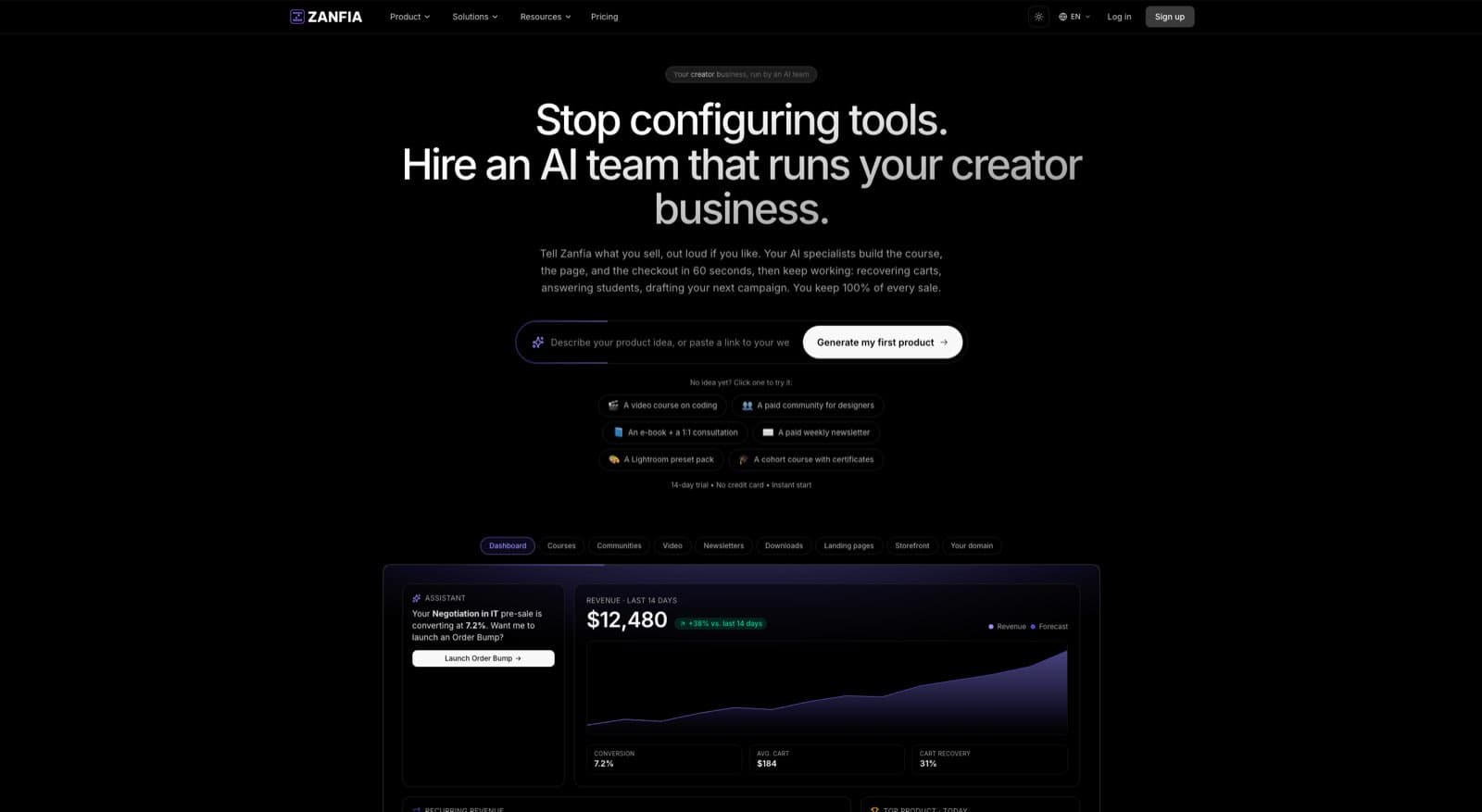
Ultimately, the goal is to equip you with the knowledge to build a pricing structure that not only attracts the right audience but also maximizes lifetime value (LTV) and minimizes churn. Zanfia is built for this kind of work: an AI team that runs the creator business behind the scenes, that you can direct by chat or voice instead of clicking through settings, and that ships every product into a checkout designed to sell, with order bumps, installments, upsells and test mode so you can buy your own product before launch. With 0% platform transaction fees and flexible billing, Zanfia grows with you rather than at your expense, so you keep 100% of your hard-earned revenue.
1. Tiered Pricing Strategy: Catering to Every Customer Segment
Tiered pricing is one of the most effective and widely adopted subscription pricing strategies. It involves offering multiple subscription levels, each with a distinct set of features and a corresponding price. This structure allows you to serve a diverse audience, from budget-conscious beginners to power users who require advanced functionality. By presenting a range of options, you empower customers to self-select the plan that best fits their current needs and budget.
This approach creates a natural upgrade path, enabling your business to grow alongside your customers. For example, a Zanfia creator could structure their tiers to maximize value at each level. A "Bronze" plan might grant access to a private community, a "Silver" plan could add a premium weekly newsletter, and a "Gold" plan could bundle everything with a flagship online course sold via subscription, one-time payment, or installment plan. Because Zanfia sells 12 product types under one brand, all of that lives inside a single checkout your AI team can dictate changes to by voice. This tiered model is a cornerstone of many successful recurring revenue business models because it effectively segments the market and maximizes revenue potential.
How to Implement Tiered Pricing
Successful tiered pricing hinges on clearly defined value progression. Each subsequent tier must offer a compelling reason to upgrade without overwhelming the customer with too many choices.
- Define Your Personas: Identify your key customer segments. What does the "Potential Explorer" need versus the "Business Architect"? Align your tiers with their distinct goals and willingness to pay.
- Anchor the Value: Use the "Goldilocks principle." Frame your middle tier as the best value-for-money option. Highlighting it as "Most Popular" can psychologically nudge customers toward your target plan.
- Differentiate with Core Features: The key differentiator between tiers should be access to high-value features. For instance, on Zanfia, your entry tier could offer community access, while a higher tier unlocks advanced course modules with native video hosting and one-on-one coaching sessions.
- Monitor and Optimize: Regularly analyze customer behavior. Track metrics like upgrade/downgrade rates and which features are most used in each tier. Zanfia's built-in analytics provide deep visibility to help you identify bottlenecks and refine your tiers.
2. Freemium Model: Acquiring Users at Scale
The Freemium model is a powerful user acquisition engine that offers a basic, feature-limited version of your product for free, with the goal of converting a percentage of those users into paying customers for a premium version. This strategy excels at lowering the barrier to entry, allowing you to build a massive user base and establish your product's value before asking for a commitment. It works on the principle of converting a small fraction of a very large audience into subscribers.

This approach is one of the most popular subscription business model examples because it leverages the free tier as a marketing tool. For a Zanfia creator, a freemium offer could be granting free access to a general community channel while reserving exclusive content, advanced courses, and Q&A sessions for paid members. This gives "Potential Explorers" a risk-free taste of the value you provide, making the decision to upgrade to a paid plan a natural next step once they are engaged.
How to Implement the Freemium Model
A successful freemium strategy depends on finding the perfect balance between offering enough value to attract free users and withholding enough to incentivize upgrades.
- Define Your "Upgrade Trigger": Identify the core limitations of your free plan. Will users upgrade for more features, higher usage limits, or better support? For instance, platforms like Canva and Figma limit access to premium assets and collaborative features, creating a clear reason to pay.
- Demonstrate Premium Value: Use the free experience to showcase what's possible with a paid plan. Your onboarding process should actively highlight premium features, perhaps through in-app tutorials or email sequences that explain the benefits of upgrading.
- Set Smart Limits: Your free tier's limitations must be felt but not frustrating. A creator on Zanfia could offer the first module of a flagship course for free, using the platform's advanced online course features. This provides genuine value and serves as a compelling preview that encourages users to purchase the full course to continue their learning journey.
- Track Conversion Rates: Obsessively monitor your free-to-paid conversion rate. This is the ultimate health metric for your freemium model. A/B test your free feature set, your upgrade prompts, and your pricing to continuously optimize this crucial number.
3. Flat-Rate Pricing: The Power of Simplicity and Predictability
Flat-rate pricing is a straightforward subscription model where every customer pays the same price for the same level of access. This “one-size-fits-all” approach removes complexity, making the offer easy to understand and communicate. It builds a predictable revenue stream for the business and provides customers with transparent, easy-to-budget costs, eliminating the confusion that can arise from multiple tiers or usage metrics.
This model thrives on a clear and powerful value proposition. Brands like Netflix have used it successfully by offering a robust, all-inclusive product that appeals to a broad segment of their target market. For a Zanfia creator, a flat-rate model works well for a signature community or a comprehensive knowledge base, where the goal is to provide undivided access to a core, high-value experience under your own brand and domain. It’s a strong choice among subscription pricing strategies when you want your AI team to focus on one unified offer instead of maintaining five packaging permutations, and when you want that offer to ship into a checkout that already knows how to run installments, order bumps and test purchases.
How to Implement Flat-Rate Pricing
Success with a flat-rate model depends on finding the optimal price point that reflects your product's value and resonates with your target audience. It is less about upselling and more about delivering undeniable value from day one.
- Conduct Thorough Market Research: Analyze competitors and survey your target audience to identify a price point that is both competitive and perceived as fair. This is your single most important decision.
- Focus on a Singular, Powerful Value Proposition: Your marketing must clearly articulate what customers get for the single price. Instead of comparing features across tiers, you are selling the complete, uncompromised solution.
- Monitor Churn and Customer Feedback: Pay close attention to churn rates and regularly gather feedback on pricing. Are customers leaving because the price is too high for the value provided? This data is crucial for validating or adjusting your single price.
- Position as a Premium Offering: A single price can signal confidence and quality. Focus on delivering an exceptional, all-inclusive experience that justifies the flat rate, positioning your Zanfia product as a definitive solution in its niche.
4. Usage-Based Pricing (Pay-As-You-Go)
Usage-based pricing, also known as a pay-as-you-go model, is a dynamic strategy where customers are billed based on their actual consumption of a service. This approach directly ties the cost to the value received, making it an equitable model for a wide range of users. It removes the barrier of a high upfront subscription fee, allowing customers to start small and scale their costs in direct proportion to their growth.

This model is common in infrastructure and platform-as-a-service (PaaS) industries, with giants like Amazon Web Services leading the way. For a creator on a platform like Zanfia, this strategy could be applied to specialized services, such as providing one-on-one coaching billed by the minute or hour, or metering access to a proprietary tool through the public API. It ensures that light users pay a fair, low price while heavy users contribute revenue commensurate with the resources they consume.
How to Implement Usage-Based Pricing
Effective usage-based pricing requires transparency and predictability to build customer trust. The goal is to align your revenue with your customers' success without causing "bill shock" from unexpected charges.
- Define a Clear Value Metric: Identify the single, most understandable unit of consumption that directly corresponds to the value your customer receives. This could be API calls, data storage (GB), video hosting bandwidth, or hours of consultation.
- Implement Transparent Metering: Customers must be able to see their usage in real-time. A clear dashboard that tracks consumption builds trust and helps users manage their costs effectively. Investing in the right tools is key, as highlighted by these insights into the best subscription management software .
- Set Up Usage Alerts: Proactively notify customers when they approach certain usage thresholds. This simple step prevents surprises at the end of the billing cycle and demonstrates that you are a partner in their financial planning.
- Consider a Hybrid Model: Pure pay-as-you-go can lead to unpredictable revenue. You can stabilize your income by combining it with a small, recurring base fee that covers fixed costs and grants access to the service, with usage fees billed on top.
5. Per-Seat Pricing Strategy: Scaling with Your Customers' Teams
The per-seat pricing strategy, sometimes called per-user pricing, is a straightforward and highly scalable model, particularly common in the B2B SaaS world. This approach ties the subscription cost directly to the number of individual users or "seats" that need access to the product. Customers pay a recurring fee multiplied by the number of team members, creating a clear and predictable revenue stream that grows as your client's organization expands. It's a transparent model that aligns your product's value directly with its utility within a team.
This model has been popularized by collaboration and productivity giants like Slack, Asana, and Monday.com. Its core appeal is its simplicity: a business knows exactly what it will cost to onboard a new team member. For a creator on Zanfia, this could be adapted for corporate training programs or private mastermind groups where a company buys access for a specific number of its employees. This strategy effectively monetizes the value of collaborative access and shared knowledge.
How to Implement Per-Seat Pricing
Success with per-seat pricing depends on making it frictionless for teams to adopt and expand their usage. The value proposition must be clear for each additional user.
- Define User Roles: Not all users need the same level of access. Create distinct roles like "Admin," "Member," and "Guest." This allows you to offer more flexible pricing, such as providing a limited number of free guest seats with each paid plan, which encourages wider adoption.
- Simplify Onboarding: Make the process of adding new users as seamless as possible within your product. A complex or slow process for adding seats creates a barrier to revenue growth. Zanfia's powerful automations can instantly grant access after payment, saving hours of manual admin work.
- Justify the Cost-Per-Seat: Clearly communicate the return on investment (ROI) for each additional user. Demonstrate how your platform boosts team productivity, streamlines communication, or provides critical skills, making each new seat a valuable investment rather than just a cost.
- Offer Team-Level Incentives: Consider offering discounts for larger teams or annual commitments. This encourages businesses to adopt your platform organization-wide and secures long-term revenue, improving your LTV and predictability.
6. Hybrid Pricing Model: Combining the Best of Both Worlds
A hybrid pricing model is a sophisticated strategy that combines two or more different pricing structures to capture value more effectively. Instead of relying on a single method, this approach blends elements like a fixed base subscription with usage-based overages, or a tiered plan with a per-user component. This allows you to offer the predictability of a subscription while flexibly charging for high consumption or additional seats, ensuring that your revenue scales directly with the value a customer receives.
This model is perfect for businesses where customer needs are highly variable. For example, a Zanfia creator could offer a base subscription for access to a course library and community, but charge an extra fee for each one-on-one coaching session booked. This approach balances a stable recurring revenue base with the potential for higher earnings from power users, making it one of the most adaptable subscription pricing strategies for diverse customer segments.
How to Implement a Hybrid Pricing Model
A successful hybrid model must balance flexibility with clarity. The goal is to create a fair system that feels intuitive, not a confusing labyrinth of charges that frustrates customers.
- Keep It Simple: Resist the temptation to over-engineer your pricing. A hybrid model works best when it combines just two variables, such as a base tier plus one usage metric. For example, GitHub combines per-user seats with overages for action minutes.
- Establish a Predictable Base: Use a tiered subscription as the foundation. Design the base tiers to cover the needs of the majority of your customers (e.g., 80%). The variable component should only apply to the top 20% of high-volume users.
- Be Radically Transparent: Clearly explain how charges are calculated. Provide a pricing calculator on your website and send automated warnings as customers approach their usage limits to prevent surprise bills. Transparency builds trust and reduces churn.
- Align Variables with Value: The variable part of your pricing must be tied directly to the value your customer is getting. If you offer a service, charging per project or per active user makes sense. For a Zanfia creator, this could mean a base community fee plus a charge per premium downloadable resource, all managed by a single, modern payment system.
7. Annual Prepayment Discount: Boosting Cash Flow and Loyalty
The annual prepayment discount is a powerful and straightforward subscription pricing strategy that incentivizes customers to commit to a full year upfront. By offering a significant price reduction, typically between 15-30%, for an annual payment versus a recurring monthly one, you can dramatically improve your business's financial stability. This approach locks in revenue, provides a healthy injection of cash flow, and significantly increases customer lifetime value.
For customers, the appeal is the cost savings on a product or service they plan to use long-term. For creators, it reduces the administrative overhead of monthly billing and, more importantly, lowers churn rates. A customer who has paid for a year is far less likely to cancel than one making a monthly payment decision. This long-term commitment is a key reason why many successful SaaS companies prominently feature annual options, making it one of the most effective subscription pricing strategies for sustainable growth.
How to Implement an Annual Prepayment Discount
Implementing this strategy is about clearly communicating the value of a longer commitment. The discount needs to be substantial enough to make the customer feel they are getting a great deal for their loyalty.
- Calculate the Right Discount: Offer a compelling discount, usually equivalent to "two or three months free" (a 15-25% reduction). A/B test different percentages to find the sweet spot that maximizes uptake without heavily eroding your margins.
- Make It the Default: On your pricing page, visually highlight the annual plan. Use design cues like a "Best Value" or "Most Popular" tag to anchor it as the preferred choice. Present the monthly price alongside it to make the savings obvious.
- Automate Renewal Reminders: Prevent unexpected charges and build trust by sending automated email reminders 30 days before the annual subscription is set to renew. Zanfia's powerful automations can handle subscription renewals and notifications seamlessly, saving you 5-10+ hours a month.
- Separate Your Churn Analytics: Track the churn rates for your monthly and annual cohorts separately. This will give you clear data on how effective the annual plan is at improving retention and is a crucial part of learning how to reduce customer churn .
8. Value-Based Pricing: Aligning Price with Customer Outcomes
Value-based pricing is a sophisticated strategy that shifts the focus from your costs or competitor prices to the tangible value your subscription delivers to the customer. Instead of asking "What does this cost to make?" you ask, "How much is this outcome worth to my client?" This approach directly ties your fee to the results, ROI, or benefits a customer achieves, making it a powerful tool for premium offerings. It's one of the most customer-centric subscription pricing strategies you can adopt.
This model allows you to capture a fair share of the value you create, justifying higher price points because they are directly linked to customer success. For example, a Zanfia creator offering a business coaching program could use a value-based model by pricing their subscription based on the potential revenue growth a client can expect. This frames the subscription not as a cost, but as a strategic investment with a clear, positive return. It aligns your success directly with your customer's, fostering strong, long-term partnerships.
How to Implement Value-Based Pricing
Implementing this strategy requires a deep understanding of your customers' goals and the financial impact of your product. The key is to quantify and communicate the value you provide in a way that resonates with your audience.
- Conduct Deep Customer Research: Go beyond simple surveys. Conduct interviews to understand your customers' biggest pain points, their business goals, and how your product helps them achieve tangible outcomes. Ask what they would be willing to pay to solve their most pressing problem.
- Segment by Value Perception: Group customers based on the value they receive, not just their size or industry. A high-revenue "Business Architect" might derive more financial value from your course on scaling operations than a "Potential Explorer," and your pricing should reflect that.
- Develop a Value Proposition: Clearly articulate the specific outcomes customers can expect. Use case studies, testimonials, and even ROI calculators to demonstrate the financial benefits. For example, show how your Zanfia community helped members increase their revenue by 25%.
- Communicate Value Constantly: Your marketing, sales, and onboarding materials should relentlessly reinforce the value proposition. This is crucial for justifying your price and increasing the customer lifetime value , as subscribers who understand the ROI are far less likely to churn.
9. Feature-Based Tiering: Matching Price to Precise Value
Feature-based tiering is a granular variation of the tiered model where subscription levels are defined by access to specific features. Instead of broad categories, customers choose a plan based on the exact tools and capabilities they require. This powerful approach allows you to align price directly with the value a customer derives from your product, creating a clear and logical upgrade path.
This strategy excels at demonstrating value progression. For example, a Zanfia creator could offer a plan with community access and e-book downloads, but gate their advanced course modules and native video hosting behind a higher-priced tier. This makes the incentive to upgrade tangible, as customers can see the specific, high-value functionality they will unlock. It's one of the most transparent subscription pricing strategies because the "why" behind each price point is tied to a concrete feature set.
How to Implement Feature-Based Tiering
Success with this model depends on understanding which features your customers value most and gating them appropriately to encourage growth without frustrating users.
- Identify Your Value Drivers: Analyze user behavior to determine which features deliver the most significant outcomes. Are they automations that save time? Advanced analytics that improve results? These are your premium-tier candidates.
- Create Clear Progression: The leap from one tier to the next should feel logical. On Zanfia, this could mean moving from standard community channels in one plan to group-based organization and direct course integration in the next, offering a clear boost in functionality.
- Educate on Feature Benefits: Don't just list features; explain their benefits. Show how a premium capability, like a checkout with order bumps and installments that lets buyers split a $600 course into four payments, translates into concrete revenue lift rather than an abstract line item.
- Leverage Trials Strategically: Offer a limited-time trial of all features. When users experience the power of your premium tools firsthand, the value of upgrading becomes self-evident once the trial ends.
10. Dynamic Pricing (Personalized Pricing)
Dynamic pricing, also known as personalized pricing, is an advanced subscription strategy that leverages data and automation to offer different prices to different customers for the same product. Instead of a one-size-fits-all price, this model adjusts based on individual customer characteristics like their usage patterns, engagement level, or even the size of their company. This approach allows businesses to capture the maximum value from each customer segment by aligning the price with their perceived value and willingness to pay.
While powerful, this is one of the more complex subscription pricing strategies to implement correctly. It requires significant data analysis and must be handled with transparency to avoid customer backlash. For instance, a software company might offer a lower subscription rate to a small startup with limited usage and a higher rate to a large enterprise that relies heavily on its features. This ensures each customer pays a price that feels fair relative to the value they receive, maximizing revenue potential without alienating smaller clients.
How to Implement Dynamic Pricing
Successfully using dynamic pricing is a balancing act between revenue optimization and customer trust. It requires a clear, ethical framework and sophisticated data capabilities to avoid alienating your audience.
- Start with Broad Segments: Instead of true one-to-one personalization, begin by creating price variations for well-defined customer segments. For a Zanfia creator, this could mean offering a different price for a corporate training subscription versus an individual student plan. This is easier to manage and justify.
- Use Neutral Variables: Base price differences on objective, non-discriminatory factors. Good examples include a customer’s company size, their usage volume, or the specific features they access. Avoid using protected personal data and focus on metrics directly tied to the value they get from your service.
- Prioritize Transparency: Be clear about why prices might vary. A public pricing page that explains different tiers for "Individuals," "Small Teams," and "Enterprises" is a transparent way to implement segmented dynamic pricing. Hidden, arbitrary price changes can destroy trust.
- Ensure Legal Compliance: Pricing regulations vary significantly by region. Before implementing any form of dynamic pricing, consult with legal counsel to ensure your model complies with all relevant laws regarding price discrimination and data privacy.
Top 10 Subscription Pricing Strategies — Side-by-Side Comparison
| Pricing Model | Implementation Complexity 🔄 | Resource Requirements ⚡ | Expected Outcomes ⭐📊 | Ideal Use Cases 💡 | Key Advantages 📊 |
|---|---|---|---|---|---|
| Tiered Pricing Strategy | Moderate — design tiers, ongoing analysis | Medium — billing, ops, marketing | Higher ARPU and predictable upgrade paths ⭐⭐⭐ | SaaS, streaming, enterprise solutions | Captures segments; clear upgrade path; reduces price sensitivity |
| Freemium Model | Low–Moderate — build conversion funnel & gates | High — supports large free base, infrastructure | Rapid user acquisition but low conversion rates ⭐⭐ | Consumer apps, content platforms, developer tools | Fast growth; strong network effects; rich usage data |
| Flat-Rate Pricing | Low — single price point, simple rollout | Low — minimal billing complexity | Predictable revenue; limited monetization upside ⭐⭐ | Niche communities, simple/premium products | Simplicity; easy messaging; low operational overhead |
| Usage-Based Pricing (Pay-As-You-Go) | High — metering, billing, threshold logic | High — metering, analytics, real-time billing | Aligns cost to use; captures high-volume revenue ⭐⭐⭐ | Cloud infra, APIs, high-variability services | Fair per-use billing; scales with customer value |
| Per-Seat Pricing | Moderate — user/license management required | Medium — license tracking, billing integrations | Revenue grows with team size; predictable expansion ⭐⭐ | Collaboration & enterprise productivity tools | Simple ROI per user; ties revenue to adoption |
| Hybrid Pricing Model | Very High — multiple dimensions & logic | Very High — sophisticated billing & support | Balances predictability and upside; complex forecasting ⭐⭐⭐ | Complex B2B SaaS, enterprise platforms | Flexibility to capture diverse value drivers |
| Annual Prepayment Discount | Low — discounting + billing change | Low–Medium — refund & renewal handling | Improved cash flow and lower churn; higher LTV ⭐⭐⭐ | Any subscription business seeking retention | Upfront revenue; reduced churn; simpler forecasting |
| Value-Based Pricing | High — research, segmentation, sales enablement | High — market research, analytics, training | Maximizes revenue/profit; premium positioning ⭐⭐⭐⭐ | Enterprise software, outcomes-driven B2B SaaS | Prices aligned to customer ROI; higher margins |
| Feature-Based Tiering | Moderate — feature gates & roadmap alignment | Medium — dev effort to enforce gates | Clear upgrade incentives; targeted segmentation ⭐⭐⭐ | SaaS with distinct feature sets, developer tools | Transparent value-per-tier; easy A/B testing |
| Dynamic Pricing (Personalized Pricing) | Very High — ML models, legal & governance | Very High — data engineering, compliance, talent | Highest revenue capture potential; regulatory risk ⭐⭐⭐⭐ | Data-driven platforms, marketplaces, enterprise | Personalized optimization; maximizes willingness-to-pay (with regulatory caution) |
Choosing Your Strategy and Building with Confidence on Zanfia
Navigating the landscape of subscription pricing strategies can feel like charting unknown territory. We've explored a wide array of models, from the clear-cut simplicity of Flat-Rate Pricing to the granular fairness of Usage-Based models and the scalable power of Tiered structures. Each strategy offers a unique pathway to building predictable, recurring revenue, but the true master key isn't found in a single, universally "best" model. Instead, it lies in a continuous, strategic process of selection, implementation, and iteration.
The journey begins not with a spreadsheet, but with a deep understanding of the value you deliver. Are you providing access to a static library of content, where a flat rate makes sense? Or are you offering a dynamic tool where value scales with usage, pointing toward a pay-as-you-go approach? For creators with a diverse audience, from beginners to power users, a well-designed tiered system (like Feature-Based Tiering) allows you to meet each segment where they are, maximizing both accessibility and revenue potential.
The Art and Science of Pricing Iteration
Your initial choice is a powerful starting point, but it should never be the final word. The most successful creators and businesses treat their pricing as a living part of their product ecosystem, one that evolves based on data and customer feedback. This is where the real work, and the real growth, happens.
Here are the essential next steps to transform theory into a profitable reality:
- Commit to Measurement: Vague feelings about what's working are not enough. You must rigorously track your key performance indicators (KPIs). Pay close attention to Customer Lifetime Value (LTV), Customer Acquisition Cost (CAC), Churn Rate, and Average Revenue Per User (ARPU). These metrics are the vital signs of your subscription business; they tell you whether your pricing is attracting the right customers, retaining them effectively, and generating sustainable profit.
- Listen Actively: Your customers are your single greatest source of pricing intelligence. Are they consistently asking for a feature that's only in a higher tier? Do they express confusion about your usage limits? Use surveys, interviews, and community discussions to gather qualitative feedback. This input, paired with your quantitative data, provides a 360-degree view of how your pricing is perceived and where opportunities for improvement lie.
- Embrace Experimentation: Don't be afraid to test your assumptions. A/B testing different price points, experimenting with annual prepayment discounts, or trialing a new hybrid model can yield powerful insights. Before you push a new price to real buyers, use Zanfia's test mode to run a real end-to-end purchase on your own checkout, so you catch broken bumps, upsells or tracking events before your audience does. For a real-world example of how a company implements its chosen pricing strategy, consider reviewing Microposter's pricing page to see how they structure their tiers and communicate value.
Build Your Subscription Empire on a Solid Foundation
Ultimately, mastering these subscription pricing strategies is about more than just picking a model. It's about building a resilient, customer-centric business. A well-crafted pricing strategy communicates your brand's value, aligns your revenue with your customers' success, and provides the predictable cash flow necessary to focus on what you do best: creating exceptional content and fostering a vibrant community.
With a platform like Zanfia, you gain the freedom to implement any of these strategies without technical headaches or punitive fees, and you get an AI team on your side rather than another tool to configure. You describe the plan you want by chat or voice; the assistant performs the changes inside the interface. Your courses, communities, newsletters and 12 other product types live under one brand, ship into a checkout built to sell (order bumps, installments, upsells, test mode) and, on higher plans, expose an MCP endpoint so your own AI agents can act on your workspace. Availability of individual capabilities depends on the plan, see the current Zanfia pricing. As of publication, Zanfia charges 0% platform commission on customer sales, so you keep 100% of your revenue and only pay standard payment-processor fees. Start with a 14-day free trial, no credit card required, and build your subscription business on a foundation designed to grow with you.
FAQ
How do I decide between tiered pricing and flat-rate pricing for my subscription?
Choose tiered pricing when your audience has clearly different needs, from budget-conscious beginners to power users, since it lets customers self-select and creates a natural upgrade path. Choose flat-rate when you have one powerful, all-inclusive offer and want predictable revenue plus simple messaging, the way Netflix positions its service. Tiered maximizes segmentation and revenue potential; flat-rate maximizes clarity and reduces decision friction.
What is the biggest risk of a freemium model, and how do I avoid it?
The biggest risk is misjudging the balance: give too much away and no one upgrades, give too little and no one sticks around to see the value. Define a clear upgrade trigger (more features, higher limits, or better support), use the free experience to actively demonstrate premium value, and set limits that are felt but not frustrating. Then obsessively track your free-to-paid conversion rate and A/B test your free feature set, upgrade prompts, and pricing to keep optimizing it.
How do I prevent bill shock with usage-based pricing?
Bill shock is the number-one trust killer in pay-as-you-go, so transparency and predictability have to be built in from day one. Pick a single, understandable value metric (like API calls, GB, or consultation hours), give customers a real-time dashboard to track consumption, and send proactive alerts as they approach thresholds. You can also stabilize revenue and reduce surprises by combining usage fees with a small recurring base fee in a hybrid model.
When does per-seat pricing make sense for a creator, not just a SaaS company?
Per-seat pricing fits when your product's value scales with the number of people using it inside an organization, such as corporate training programs or private mastermind groups where a company buys access for a defined number of employees. It works because the cost is transparent and predictable per user, and it grows automatically as the client's team expands. To make it succeed, define user roles (admin, member, guest), keep onboarding new seats frictionless, and clearly show the ROI of each additional user.
How often should I revisit my subscription pricing once it's live?
Pricing is not a one-time decision; the article treats monitoring and optimization as core to every model discussed. For tiered plans, track upgrade and downgrade rates and which features get used at each level; for freemium, watch free-to-paid conversion; for flat-rate, watch churn and gather feedback on whether the price still matches perceived value. Use that data to refine tiers, feature limits, or the price itself rather than leaving the structure static.
Ready to implement a powerful subscription strategy without sacrificing your profits? See how Zanfia gives you an AI team, a checkout built to sell, and 0% platform commission on customer sales as of publication. Start your 14-day free trial, no credit card required, on Zanfia today.