

How to reduce customer churn: A Proven Retention Playbook for Creators
Reducing customer churn requires a fundamental shift in mindset. It's not about last-minute damage control; it's about building a proactive retention strategy from the ground up. This means getting to the bottom of why customers leave, crafting an onboarding experience they'll never forget, and cultivating a community that feels like home. The aim is to weave your brand so deeply into their routine that leaving feels like a genuine loss.
Why Your Best Customers Are Leaving You

When a customer cancels, it's easy to take it personally. But it's rarely a judgment on your content's quality. More often, it's a quiet signal that there's a disconnect—a mismatch between the value they hoped for and what they actually received. For digital creators, this is critical, because the relationship is just as valuable as the product itself. Thinking proactively about retention isn't just a defensive tactic; it’s one of the most powerful growth engines you have.
The numbers don't lie: bringing in a new customer can cost five times more than holding onto an existing one. That’s why digging into the root causes of churn is vital for sustainable growth. The goal isn’t to lock the doors and prevent anyone from ever leaving. It's to create an ecosystem so supportive from day one that the thought of canceling rarely comes up.
Common Reasons for Churn
While "it's not in the budget" is an easy out, it often hides a deeper issue. Spotting these underlying problems is the first step toward solving them for good.
Here are a few of the biggest culprits:
- A Messy Onboarding: New members feel lost or overwhelmed right at the start, so they never get that crucial "aha!" moment.
- Vanishing Value: Over time, the subscription fee starts to feel heavier than the benefits they're actually using or receiving.
- A Ghost Town Community: People feel isolated or like they're shouting into the void. Without that peer-to-peer connection, loyalty plummets.
- Clunky Tech: Juggling a course platform, a separate community on Discord or Facebook, and other tools just creates headaches and frustration.
The Power of an Integrated Experience
This is where having an all-in-one platform makes a world of difference. When you bring your community, courses, and content together under your own domain and brand, you smooth out all those frustrating bumps in the road. Zanfia is built around an AI team that runs the daily work of a creator business, and courses, communities, paid newsletters, and digital products are where that work lands. You dictate what needs to happen by chat or by voice, the assistant performs it inside the interface, and any AI agent you already trust can act on your workspace through the MCP endpoint (available on higher plans, see the current Zanfia pricing). It all ends in a checkout built to sell: order bumps, installments so a $600 course can be split into four payments, upsells at checkout, and test mode so you can buy your own product before launch.
A truly integrated system does more than just simplify logistics; it fosters a sense of belonging. When a member can move from a course lesson directly into a relevant discussion channel without leaving your branded space, you dramatically boost engagement, lifetime value, and member retention.
This unified approach lets you tackle churn head-on. You can automate welcome sequences, check engagement data to spot who might be slipping away, and build a vibrant community that becomes a powerful reason to stick around. By figuring out who is leaving and when, you can start making much smarter decisions.
Finally, don't overlook the importance of trust, especially when it comes to data and privacy. Making sure your members feel their information is safe is non-negotiable. Brushing up on the basics with an essential privacy guide to secure email can help prevent people from leaving over security concerns.
Finding the Leaks in Your Business
Before you can plug a leak, you have to find it. Staring at a single churn rate percentage won't get you very far. To really understand why customers are leaving, you need to dig into where the leaks are, what’s causing them, and when they started. This isn't about guesswork; it's about letting data tell you the real story.
The great thing is, you don’t need a data science degree to figure this out. Modern platforms have essential analytics built right in, giving you a clear window into what your customers are actually doing. By focusing on a few key numbers, you can turn a vague hunch into a solid, data-driven plan.
Moving Beyond the Basic Churn Rate
Your overall churn rate—the percentage of customers who cancel in a given period—is a decent starting point. But on its own, it’s a blunt instrument. It confirms you have a problem, but it doesn’t tell you anything about what or who is causing it. To get the real picture, you need to go deeper.
Here are the numbers that reveal the true financial story:
- Monthly Recurring Revenue (MRR) Churn: This isn't about how many customers left, but how much revenue walked out the door from cancellations and downgrades. Losing ten members on your lowest-tier plan hurts, but losing one high-value client is a completely different kind of problem. MRR churn shows you the real financial impact.
- Customer Lifetime Value (LTV): This metric projects the total revenue you can reasonably expect from a single customer over their entire relationship with you. A declining LTV is a major red flag. It’s a sign that customers are leaving sooner than they used to, which directly impacts your business's long-term health.
Shifting your focus from just counting lost customers to measuring the financial damage is a game-changer. It helps you prioritize which leaks to fix first—the ones that are actively draining your bank account.
Using Cohort Analysis to Find the "When" and "Who"
If there's one tool you need to master for diagnosing churn, it's cohort analysis. A cohort is just a group of customers who signed up around the same time (e.g., all January sign-ups). By tracking how each monthly cohort behaves over time, you can uncover incredibly powerful patterns.
Let's say you launched a big new marketing campaign in March. Cohort analysis will show you if the customers who joined in March are sticking around longer or churning faster than your February cohort. This is how you identify which acquisition channels are bringing in loyal, long-term members versus those that attract flaky, short-term users. For a deeper dive on this, learning how to analyze website traffic can give you a ton of context.
Putting It All Together
Armed with this data, you can finally start asking the right questions:
- When are they leaving? Is there a massive drop-off after the first 30 days? That screams "weak onboarding." Do people start to disappear around month six? Maybe the initial excitement has worn off and you need to introduce more advanced content.
- Who is leaving? Are members who bought your signature course churning faster than those in your community-only plan? That might signal a mismatch between what the course promised and what it delivered.
This is where an all-in-one platform with built-in analytics really pays off. You don't have to mess with complicated spreadsheets to track these cohorts. All the data, from a customer’s first click to their last login, is in one place. This gives you deep visibility at every stage of the funnel, helping you pinpoint the exact moments where you need to step in to prove your value and keep them around.
Crafting an Unforgettable First 30 Days
The battle against churn is often won or lost in the very first month. A clunky, confusing, or uninspiring start is one of the quickest ways to give a new member a serious case of buyer's remorse.
A killer onboarding experience isn't about throwing every feature at them at once. It’s about guiding them to their first "quick win" and making them feel like they've found their people. That initial period is your single best shot to prove their investment was a smart one. The goal is to build momentum and show value so clearly that the thought of leaving in 30 days seems crazy.
Engineering the "Aha!" Moment
We've all had it—that "aha!" moment when a new tool or service just clicks. That's what you need to engineer for your new members, and you need to do it fast. Don't leave them to wander around aimlessly. Give them a clear, guided path to that flash of insight where they truly get the value you offer.
For instance, your welcome email sequence should be more than a glorified receipt. Think of it as a mini-tour designed to get them engaged right away:
- Email 1 (Immediately): Welcome them! But crucially, give them one single, clear thing to do, like "Join our 'New Members' community channel."
- Email 2 (Day 3): Share a quick-win resource. This could be a simple checklist, a short tutorial video, or a template that delivers immediate value.
- Email 3 (Day 7): Inspire them by highlighting a success story from another member. Show them what’s possible.
This structured approach prevents that dreaded feeling of overwhelm and starts building their confidence from day one. If you want to dive deeper into this, we've got a complete blueprint on what customer onboarding is.
Let Automation Do the Heavy Lifting
Manually guiding every new member isn't sustainable as you grow. This is where automation becomes your best friend, saving you 5-10+ hours a month while creating a consistent first impression that sets the stage for long-term loyalty.
Using an all-in-one platform like Zanfia, you can build powerful workflows that handle the grunt work. The second a customer signs up, the system can automatically:
- Grant instant access to their new online course or digital download.
- Add them to the right community channel based on their purchase.
- Kick off that personalized welcome email sequence we just talked about.
- Tag the buyer inside your connected email tool, push them to the right list, and hand the whole sequence to a chat or voice instruction instead of a manual workflow build.
These automations guarantee every new member gets the same VIP welcome without adding hours of admin work to your day. You get to focus on creating amazing content and engaging with your community, not fiddling with user permissions.
A seamless onboarding experience is a silent promise to your customer: "We value your time, we are organized, and we are here to help you succeed." It builds trust long before they ever consume your core content.
Don't underestimate how critical this is. Poor onboarding is a massive driver of churn. An analysis of nearly three million cancellations found that while budget was the top reason for leaving (33%), a bad onboarding experience was right behind it, responsible for a whopping 23% of all churn. That statistic alone shows how much a smooth start matters for retention. You can read the full research on retention trends to see for yourself.
To start figuring out where these initial drop-offs might be happening in your own business, you can use a simple diagnostic process.
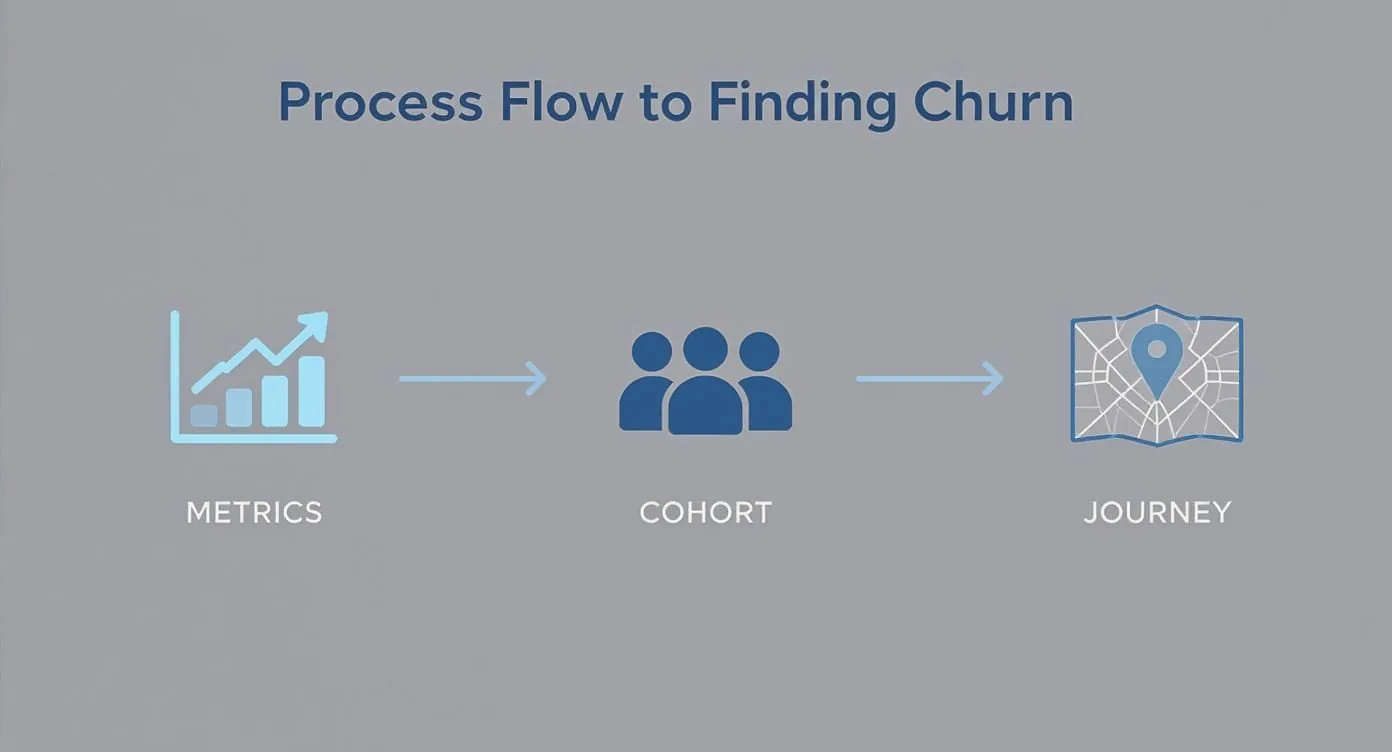
This flow—analyzing metrics, segmenting by cohort, and mapping the customer journey—is your key to finding friction points in those critical first 30 days. When you understand where new members are getting stuck, you can refine your onboarding and create an unforgettable first impression.
Keeping Your Community Alive and Thriving

A killer onboarding sequence gets people in the door, but what makes them stick around for the long haul? It’s the feeling that they belong. An engaged customer is a customer who stays. Keeping that initial excitement going requires a real strategy. It's all about making your community an indispensable part of their daily life.
This means you have to do more than just drop content. You need to actively build a space where people connect, share wins, and help each other out. When your community becomes that go-to resource, the subscription fee stops feeling like a cost and starts feeling like an investment in their own growth.
Foster Connections Through Live Interaction
Pre-recorded content is efficient, but nothing builds real relationships like live interaction. Showing up live is your chance to connect, answer questions on the spot, and remind everyone there’s a real person behind the brand.
Consider these formats for driving engagement:
- Weekly Live Q&As: Block out an hour every week just to answer questions. It becomes a reliable touchpoint where members know they can get direct access to you.
- Member-Only Challenges: A 7-day or 30-day challenge focused on a clear outcome is pure gold. It gets people taking action, holds them accountable, and gives the whole community a shared mission.
- Guest Expert Workshops: Bringing in other experts adds a ton of value and exposes your members to new ideas. It positions your membership as a hub of industry knowledge, not just your own.
The Power of an Integrated Environment
One of the biggest silent churn-killers is friction. If a member has to leave your course, open up Discord, find the right channel, and then try to remember their question… you've probably already lost them. Every extra click is an opportunity to get distracted.
This is exactly why an all-in-one platform is such a powerful tool. When your community discussion channels are built right alongside your course lessons, you create a seamless world for your members. They can watch a video, get stuck on a concept, and immediately post a question without ever leaving your ecosystem. Zanfia goes a step further with topical discussion channels, group-based organization, and an AI agent inside the community that can draft answers from your own content (everything the agent publishes is clearly labeled as AI). You can also dictate the next announcement or channel update by chat or voice instead of clicking through settings.
When your community and content live in the same house, the conversation just flows. This tight integration skyrockets participation and makes your platform the central hub for their entire journey.
This keeps them locked into your world, not some third-party app where your brand is just another server icon. Zanfia is well suited to creators who want a white-label domain and their community, courses and checkout unified under one brand instead of scattered across separate community tools.
Personalize the Experience at Scale
As your community grows, keeping that personal touch feels harder, but it's non-negotiable for retention. People stay where they feel seen. Simple things—like shouting out member wins, tagging people in relevant discussions, or sending quick, personalized check-in emails—make a world of difference. For a masterclass on this, I highly recommend learning about mastering personalization in email marketing.
The cost of getting this wrong is staggering. Globally, businesses lose an estimated $4.7 trillion each year because of poor customer experiences. In the U.S. alone, 59% of customers will walk away after a few bad interactions, and a tough 17% will leave after just one. Engagement isn't a "nice-to-have"—it's your best defense against becoming another statistic.
Thinking about how to apply these ideas? It helps to frame them as either proactive (preventing churn) or reactive (winning people back). Here’s a quick breakdown of what that looks like in practice.
Proactive vs. Reactive Churn Reduction Strategies
This table compares strategies you can use to get ahead of churn versus those you use when a member is already on their way out.
| Strategy Type | Tactics | Impact on Retention | Example in Zanfia |
|---|---|---|---|
| Proactive | Regular live Q&As, member spotlights, personalized check-in emails, community challenges. | High. Builds loyalty and value before a member considers leaving. | Dictating a personal welcome message by voice and letting Zanfia's AI team push it into your connected email tool for every new member. |
| Proactive | Tracking engagement metrics to identify at-risk members and intervening with targeted support. | High. Solves problems before they lead to cancellation. | Using Zanfia's Workflows to spot users who haven't logged in for 14 days and trigger a "We miss you!" sequence pointing them to new content. |
| Reactive | Exit surveys to understand why members are leaving. | Low-Medium. Gathers crucial feedback but doesn't retain the current member. | Adding a custom consent checkbox and a short exit question at cancellation, with the responses collected in your Zanfia dashboard. |
| Reactive | Win-back campaigns offering a special discount or bonus to recently churned members. | Medium. Can successfully recover a percentage of lost customers. | Pushing a "come back with 25% off" segment into your connected email tool 30 days after cancellation, triggered from a Zanfia Workflow. |
Ultimately, a proactive approach will always give you a better return. By focusing on building an engaged, connected community from day one, you’re not just reducing churn—you’re building a thriving ecosystem that attracts and keeps the right people.
Smart Pricing and Proactive Support
How you charge for your offerings and how you help your customers are two of the biggest levers you can pull to keep them around. You can have amazing content and a thriving community, but if the payment process is a headache or support is slow, the entire experience sours fast.
It's about more than just slashing prices or answering support tickets. The goal is to design a financial and support system that feels fair, easy, and genuinely reassuring. When you get these two areas right, you can transform potential friction points into moments that build serious loyalty and trust.
Using Pricing to Encourage Long-Term Commitment
The way you structure your prices can be a powerful tool for encouraging members to stick around for the long haul. A simple monthly subscription is flexible, but it also forces a "should I stay or should I go?" decision every 30 days. By offering smart alternatives, you can help shift their mindset from a monthly expense to a long-term investment.
Here are a few proven options to consider:
- Annual Plans with a Discount: A classic for a reason. Offering an incentive—like getting two months free—for an annual commitment is a strong motivator. It locks in a full year of revenue for you and takes that monthly cancellation decision off the table for your customer.
- Installment Plans: A big one-time payment for a high-value course can be a major hurdle. Breaking it down into a few manageable installments (say, splitting a $600 course into four payments) makes your offer more accessible without devaluing it.
- Bundles and Tiers: Not everyone needs everything you offer. By bundling different products (like a course, community access, and a digital download) into distinct tiers, you let people choose the exact value they need at a price that works for them.
This is where a platform with a 0% platform fee, like Zanfia, gives you a strong advantage today. While some competitors take a cut from every sale, Zanfia's SaaS subscription model currently means creators keep what remains after the payment processor's standard cut (roughly 2.9% + $0.30 in the US on Stripe). You can offer flexible pricing without watching a platform fee eat into every margin.
These strategies are really about psychology. An annual plan frames your product as a year-long journey, which encourages deeper engagement and gives members more time to see transformative results. If you're exploring how to manage these relationships, checking out the best subscription management software can offer some great insights.
Shifting from Reactive to Proactive Support
Great support isn't just about solving problems when they pop up—it's about getting ahead of them. The moment a customer has to contact you with an issue, a little bit of friction has already been introduced. A proactive approach aims to smooth over those bumps before your members even notice them.
This means building a support system that empowers people to find their own answers quickly but also makes it incredibly easy to reach a real person when they're truly stuck.
Here’s what a proactive support framework looks like:
- Build a Comprehensive Knowledge Library: Create a central, searchable hub with articles, FAQs, and short video tutorials that walk through common questions and processes. Think of it as your 24/7 self-service help desk.
- Be Active in Your Community: Set up dedicated channels like #help or #ask-a-question right inside your community. Members can often help each other, and you can answer a question once for the benefit of everyone.
- Use Smart Automation: For common questions that come in via email, you can set up automated replies that instantly point users toward the right knowledge base article or community channel. They get an immediate, helpful response.
The speed and quality of your support are non-negotiable. It's a hard truth, but 2025 research shows that 68% of cancellations are tied directly to slow or unhelpful customer service.
Customers who wait more than two hours for a response are four times more likely to leave. On the flip side, businesses with a first-response time under one minute see a 42% lower churn rate. By anticipating issues, you show your members you're a reliable partner invested in their success.
Learning from a Graceful Goodbye
No matter how amazing your product or community is, some people will eventually leave. It's a fact of business. But instead of seeing a cancellation as a failure, you should see it as a goldmine of unfiltered feedback. Every goodbye is a chance to get smarter.
This starts with understanding the "why." Don't just let someone click a button and vanish into the digital ether. The moment they go to cancel, you need to ask them a simple, direct question: "What's the main reason you're leaving today?" This one question can completely change your business.
How to Ask the Right Questions When Someone Leaves
The key here is to make it incredibly easy for them to give you an answer. If it's a hassle, they'll just skip it, and you'll be left guessing.
A simple multi-choice survey with an open-ended option works best. It gives you clean data and the chance for nuance. Here’s a structure I recommend:
- Pricing: "It's no longer in my budget."
- Value: "I wasn't getting the results I expected."
- Engagement: "I didn't have time to participate or feel connected."
- Content: "The content wasn't what I was looking for."
- Other: A simple text box for them to tell you in their own words.
This feedback is pure gold. If 70% of your departing members are pointing to budget issues, that’s a massive signal. Maybe it’s time to explore a tiered pricing model or offer installment plans. If people consistently say they don't feel connected, you know exactly where to focus your energy—on building a stronger community.
Winning Them Back (The Smart Way)
Just because someone leaves doesn't mean the door is closed forever. A well-timed, thoughtful win-back campaign can be incredibly effective, but you can't just spam them with discounts. It has to be personal and show you were actually paying attention.
The most powerful way to win someone back is to show them you fixed the exact problem that made them leave. It's proof that you listen, which rebuilds trust and shows you're genuinely committed to getting better.
Imagine a handful of members left because your course platform was missing a key feature. Once you've built it, create a special email segment just for them. Send them a personal note that says something like, "Hey, remember when you mentioned you needed X? Well, we listened. It's now live, and we'd love to offer you a special discount to come back and see what you think."
This changes everything. A cancellation is no longer just a lost customer; it becomes a vital part of your improvement cycle. You listen, you refine, and you build a stronger business—one that not only keeps the right members around but also attracts new ones who are a perfect fit from day one.
Got Questions? Here Are Some Answers
Tackling customer churn can bring up a lot of questions. Don't worry, that's normal. Here are some of the most common ones I hear from creators, along with my take on how to think about them.
What Is a Good Customer Churn Rate?
Honestly, there's no magic number, but a monthly churn rate of 5-7% is a pretty standard benchmark in the digital subscription world. But here's the thing: chasing a universal number is a distraction.
The real goal is to beat your own past performance. If you're seeing your churn rate consistently drop over time, you're winning. The best proof that your strategies are working is when you run a cohort analysis and see that members who joined in June are sticking around longer than the ones who joined back in January. That’s progress.
How Can I Get Honest Feedback from Customers Who Left?
You have to make it easy and valuable for them. The single best way to do this is with a simple, one-question exit survey right in your cancellation flow. Just ask, “What's the main reason you're canceling?”
Give them a few multiple-choice options and, most importantly, an open-ended "Other" box. This respects their time but still gives you the crucial "why."
For your most valuable members—the ones who were super engaged or had been with you for a long time—it's worth going a step further. A personal email a week after they cancel can work wonders. A quick note asking for their honest thoughts, maybe with a small gift card as a thank you, can uncover deep insights you’d never get from a standard form.
Should I Offer Discounts to Stop Cancellations?
This is a tempting one, but I'd advise against it. Throwing a last-minute discount at someone who's trying to leave is usually just a band-aid. It might keep them for another month, but it rarely solves the underlying reason they wanted to go in the first place, and it can cheapen the value of your entire offering.
My advice? Focus your energy on fixing the core experience—the onboarding, the community, the content. Save discounts for carefully planned win-back campaigns that you run after a customer has already left. Reaching out a few months later with a special offer feels strategic, not desperate.
This shows them you’ve been working on making things better, which builds far more trust and long-term loyalty than a last-ditch price cut ever could.
Ready to build an online business where customers love to stay? With Zanfia, an AI team runs the daily work of your creator business across courses, community, paid newsletters and digital products. You dictate what needs to happen by chat or voice, connect your own AI agents through the MCP endpoint (available on higher plans, see the current Zanfia pricing), and end every visit at a checkout built to sell with order bumps, installments and test mode. Plans start at $39/month, or $31/month billed annually, with a 14-day free trial and no credit card required.
Discover how Zanfia can help you reduce churn and grow your business today.