

What Is Customer Onboarding for Digital Creators
Customer onboarding is the journey you guide new customers through to help them get their first real win with your course, community, or digital product. It's that critical handshake between the moment they buy and the moment they become a long-term, loyal fan. A great onboarding experience takes that initial spark of excitement and turns it into real engagement, proving they made the right call.
What Is Customer Onboarding and Why It Matters
Think of onboarding less like a dry user manual and more like a personal welcome tour. You're showing new members the ropes, making them feel confident, supported, and ready to dive in from their very first login. For creators, this isn't just a nice-to-have; it's the bedrock of a thriving online business.
When someone buys your e-book or joins your community, they're full of hope and motivation. Onboarding is how you capitalize on that energy. It closes the gap between their purchase and that "aha!" moment—the instant they experience the exact result they were looking for.
The True Purpose of Onboarding
The goal isn't just to show people how to use your product. It’s to make sure they succeed with it.
Below is a breakdown of the core goals you should aim for. These objectives are the pillars that hold up a strong onboarding experience, turning a simple purchase into a meaningful connection.
The Core Goals of Effective Onboarding
| Onboarding Goal | Why It's Important for Digital Creators |
|---|---|
| Demonstrate Value Quickly | Help members achieve a "quick win" to validate their purchase and build confidence right away. |
| Reduce Overwhelm | Break down complex info into small, manageable steps so new users don't feel lost or confused. |
| Set Clear Expectations | Outline what they can expect and what they need to do to get the most out of their experience. |
| Foster Engagement | Encourage immediate interaction in a community or active participation in your course materials. |
By focusing on these goals, you're not just providing access; you're engineering success for your new members from the very beginning.
The Business Impact of a Great First Impression
A well-designed onboarding process is your single best tool against customer churn and a massive driver for long-term growth. The numbers don't lie: that initial experience really does set the tone for the entire relationship.
In fact, studies show that 86% of customers are more likely to stay loyal to businesses that invest in great onboarding content that educates and supports them.
Ultimately, successful onboarding transforms a one-time transaction into a lasting partnership. It's the difference between a customer who logs in once and a loyal member who becomes an advocate for your brand.
By putting real effort into this first phase, you’re not just making members happier. You're also seriously boosting your odds of increasing customer retention. When new members feel seen and guided, they stick around, engage more deeply, and are far more likely to buy from you again.
The 5 Stages of a Powerful Onboarding Journey
Think of customer onboarding not as a single event, but as a guided tour. It's the process you design to take someone from being a brand-new customer, full of excitement and maybe a little uncertainty, to becoming a confident, successful member of your world. When you break this journey down into clear stages, you can be much more intentional about meeting their needs, building their confidence, and proving your product's worth right from the start.
This whole flow is about moving a customer from a warm welcome to their very first taste of success—that's the real finish line for onboarding.
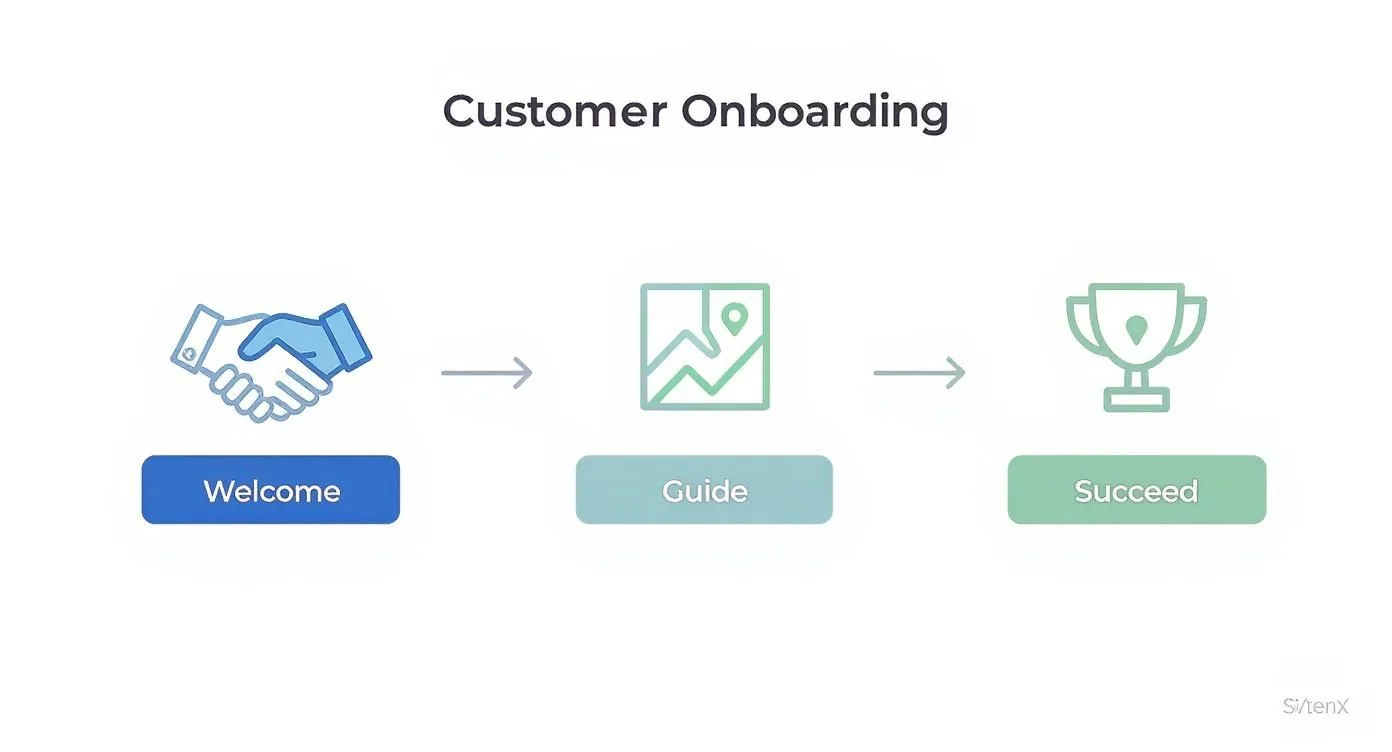
It seems simple, right? Welcome, guide, and help them succeed. But let's unpack what that looks like in five practical stages for a digital creator like you.
Stage 1: The Welcome and Confirmation
The journey starts the second they hit that "buy" button. This is your chance to make an incredible first impression, confirm their purchase, and wipe out any hint of buyer's remorse. A prompt, professional welcome sets the tone for everything that follows.
Your most important tool here is the welcome email. This is so much more than a receipt; it’s the first handshake, the first step on their new path. It needs to be celebratory and crystal clear about what happens next.
With a platform like Zanfia, this whole sequence is a breeze to automate. As soon as someone buys your course or joins your community, a welcome e-mail sequence fires off instantly. They get immediate access and feel valued from minute one, all without you lifting a finger. Zanfia is an AI team that runs the delivery side of your business, so the checkout, access grants, and welcome messages happen the moment the payment clears, without you touching a thing.
Stage 2: First Login and Getting Oriented
Okay, they have their login details. Now what? The next hurdle is their very first interaction with your platform. The goal is to make your digital space feel like a welcoming, easy-to-navigate home, not a confusing maze. You need to be their tour guide, showing them exactly where to go and what to do first.
Nothing kills momentum faster than a cluttered or confusing member area. A solid orientation gets ahead of that problem by giving them a clear starting point.
Here's what a great orientation does:
- Gives Them a "Start Here" Signpost: Point new members to a specific welcome module, an introduction video, or a dedicated "new members" channel in your community.
- Explains the Lay of the Land: Briefly show them how to find their course content, jump into discussions, or manage their account details.
- Sets Clear Expectations: Let them know how to get the most out of their purchase and, crucially, where to go if they get stuck.
Stage 3: The All-Important Quick Win
Honestly, this might be the most critical stage of the whole process. A quick win is a small but meaningful achievement a new member can get under their belt almost immediately. It’s that "aha!" moment where they experience the value of what you sold them firsthand.
That little victory validates their decision to buy from you and builds the momentum they need to keep going. For a creator, a quick win could be finishing the first five-minute lesson, posting their introduction in the community, or successfully using a template from your resource library.
The faster a customer experiences their first success, the more likely they are to stick around. This concept, often called "Time to First Value," is a huge factor in reducing churn and building real loyalty.
As you build your product, put some serious thought into this first win. Platforms like Zanfia help facilitate this with features like a smart video player that automatically saves student progress, making it easy for them to complete that first lesson and feel a sense of accomplishment.
Stage 4: Encouraging Deeper Engagement
Once they've got that first win in the bag, it's time to guide them deeper. This stage is all about moving members beyond the basics and showing them the full scope of what your product or community has to offer. You want to fan that initial spark of motivation into a steady flame.
You can nurture this deeper connection by:
- Pointing out what’s next: Gently nudge them toward the next module or a particularly juicy discussion thread they might have missed.
- Sparking community interaction: Prompt them to ask a question, share their progress on a project, or join a group challenge.
- Offering personalized tips: Based on what they've already done, you could suggest other content or resources they might find useful.
Stage 5: Delivering Ongoing Value
Finally, great onboarding doesn't just stop; it seamlessly transitions into your long-term retention strategy. The goal here is to constantly remind them why they joined you in the first place, ensuring they stay active and happy for the long haul.
This final stage is about creating a rhythm of value. It involves regular check-ins, delivering fresh content, and fostering a community that people genuinely want to be a part of. This is how your product becomes an indispensable tool in their journey, not just something they bought once. It's how you build a tribe and turn one-time buyers into lifelong fans.
Practical Onboarding Strategies for Creators
Theory is great, but action is what gets results. Building a fantastic customer onboarding experience comes down to a few proven, high-impact strategies that make every new member feel seen, supported, and successful from the moment they join.

The goal here is to build a system that’s both effective and efficient. You need to deliver a premium, personalized welcome without drowning in manual tasks that eat up your week. Let's dig into some practical tactics you can put into place today.
Personalize the Welcome Journey
A generic "Welcome!" email just doesn't cut it anymore. It's a huge missed opportunity. Personalization makes your new members feel like individuals, not just another number on a sales report. At a minimum, use their first name. Even better, reference the specific course or product they just bought.
This simple touch shows you're paying attention and immediately validates their decision to invest in you. It's a small detail that makes a world of difference in how they see your brand.
Create a Dedicated "Start Here" Module
Nothing kills excitement faster than overwhelm. To fight this, give every new member a single, obvious starting point. Think of it as their home base. A "Start Here" module in your course or a pinned "Welcome" post in your community is the perfect way to do this.
This central hub should include a few key things:
- A warm welcome video: A short, personal video from you creates an instant human connection.
- A clear roadmap: Briefly explain how the course or community works and what they can expect.
- The first "quick win": Guide them to a simple first action, like introducing themselves or completing a foundational lesson.
- Housekeeping details: Show them where to find resources and how to get help.
Use Checklists to Guide Them Forward
Let's be honest, people love checking things off a list. It gives them a tangible sense of progress. An onboarding checklist breaks down those first few steps into small, manageable tasks, guiding new members forward without making them feel buried.
A checklist turns a vague goal like "get started" into a series of concrete, achievable actions. This simple tool empowers new users by showing them exactly what to do next to succeed.
For example, your checklist could include items like "Watch the welcome video," "Introduce yourself in the community," and "Download the workbook." It’s a structured approach that keeps them engaged and builds momentum right away.
Automate Your Welcome Sequence
A seamless first impression almost always relies on automation. Manually sending welcome emails or adding new members to community channels is incredibly time-consuming and easy to mess up, especially as your business grows. This is where having the right platform is a total game-changer.
For instance, Zanfia gives you an AI team that runs these workflows on autopilot. You can grant course access the moment payment clears, trigger a personalized welcome sequence, or add a new customer to the right community channel based on what they bought, and you can set the whole flow up by dictating what you want out loud instead of clicking through a builder. If you prefer to wire it in yourself, agents can act on your workspace directly through the MCP endpoint (availability depends on the plan, see the current Zanfia pricing). This kind of automation can easily save you 5–10+ hours a month while ensuring every customer gets a perfect, immediate welcome. A well-managed email list is the backbone of this process, letting you segment and communicate effectively from day one. You can dive deeper by exploring our complete guide to email list management.
Celebrate Small Wins
Finally, never underestimate the power of positive reinforcement. When a new member hits a milestone—like finishing their first module or posting a great question in the community—celebrate it! This could be an automated "Congrats!" email or a public shout-out.
Celebrating these small wins makes your members feel valued and gives them the motivation to keep going.
The demand for these kinds of smooth experiences is skyrocketing. The global market for digital customer onboarding software was valued at around $2.5 billion in 2023 and is projected to hit nearly $9.8 billion by 2032. This explosive growth shows just how essential a smooth, automated, and secure onboarding process has become for businesses of all sizes. You can explore more about the digital onboarding market growth on cognitivemarketresearch.com.
Common Onboarding Mistakes to Avoid
Knowing what to do is half the battle. Knowing what not to do? That's the other half. Even with the best intentions, it's surprisingly easy to trip up and derail a new member's experience before it even gets going. A bumpy onboarding process can completely undo all the hard work you put into getting the sale, leading to confusion, frustration, and, ultimately, churn.
By learning to spot these common pitfalls, you can design a welcome journey that feels genuinely supportive and professional. Let's dig into the most frequent mistakes creators make and, more importantly, how to sidestep them entirely.
Overwhelming New Members with Information
This is probably the most common mistake of all—what I call the "firehose" approach. In a burst of enthusiasm, you send a massive welcome email packed with a dozen links, a laundry list of instructions, and details about every single feature you offer. While your heart is in the right place, this just creates instant overwhelm and analysis paralysis.
When someone is faced with a wall of text and way too many choices, their most likely reaction is to do nothing at all. Their initial excitement quickly evaporates, replaced by the feeling that they've just been assigned a mountain of homework.
A much better way is to deliver information in small, manageable pieces. Ditch the giant email and use an automated, dripped email sequence to guide them through one key action at a time. This controlled flow builds their confidence and momentum, rather than crushing it.
Making the Experience Impersonal
Nothing says "you're just another transaction" quite like a generic, one-size-fits-all welcome. An email that opens with "Dear Customer" or doesn't even mention the specific course they just bought sends a loud and clear message: you're just a number.
Personalization is your secret weapon for building an instant connection. It shows that you see them as an individual who made a specific, important choice.
A personalized welcome journey validates the customer's decision to buy from you. Simple touches, like using their name and referencing their purchase, transform a robotic process into a human handshake, building trust from the very first interaction.
When you use a platform like Zanfia, you can easily pop in personalization tokens (like {{first_name}}) and set up automations based on the exact product they bought. This ensures every single member feels seen and valued from the moment they join.
Creating a Disjointed Technical Experience
Another huge source of friction is when you have to stitch together a bunch of separate tools. A new member might pay through one system, access their course content on another, and then get punted over to a third-party Facebook group or Discord server for the community part. It’s a clunky, confusing, and frustrating experience.
This fragmented setup forces your members to create multiple accounts, remember different logins, and learn to navigate totally unrelated interfaces. It waters down your brand and can make your whole operation feel a bit amateurish and disorganized.
An all-in-one platform is the antidote to this chaos. Zanfia, for instance, keeps 12 product types—courses, community, checkout with order bumps and installments, newsletters, digital downloads, consultations, and more—unified under the creator’s own domain and branding. This means one login for the customer and a seamless, professional environment where they can focus on the incredible value you're providing, not on wrestling with confusing tech.
To make this crystal clear, I've put together a quick table comparing these common blunders with much more effective approaches.
Common Onboarding Pitfalls vs. Effective Solutions
| Common Mistake | Effective Solution |
|---|---|
| Information Overload | Deliver information through a dripped, automated sequence focusing on one key action at a time. |
| Lack of Personalization | Use personalization tokens and reference the specific product purchased in all communications. |
| Fragmented Tech Stack | Use an all-in-one platform to unify courses, community, and payments under a single login. |
By consciously avoiding these mistakes, you're not just improving a process; you're fundamentally changing the relationship you have with your new members from day one.
Automating Your Onboarding to Save Time
What if your onboarding process could run on its own, giving every single new customer a perfect, personalized welcome without you having to click a single button? That’s not some futuristic fantasy—it's what happens when you automate your customer onboarding. By turning a good idea into a repeatable, hands-off system, you get your time back while making sure every new member feels valued from day one.

Let's be honest: manual onboarding leads to burnout. Sending individual welcome emails, granting access to courses, and adding people to your community channels are time-sucks. These are the repetitive tasks that eat up hours you could be spending on what really matters—creating amazing content. Automation gets rid of that busywork, turning your passion project into a truly scalable business.
How Automation Creates a Frictionless Experience
The whole point of automation is to make things easy and smooth for your customer. A seamless, instant experience right after purchase builds immediate trust and proves they made the right choice. Think about it: when someone buys from you, their excitement is at its peak. Automation helps you meet them in that moment with instant gratification, which is exactly what people expect today.
Here’s a look at how automation completely changes the welcome journey:
- Instant Access Granting: The second their payment is confirmed, the customer gets access to their new course, download, or community. No waiting, no "I'll get to it later."
- Targeted Community Onboarding: They’re automatically added to the right community channels based on what they bought, dropping them straight into relevant conversations.
- Personalized Welcome Sequences: An email sequence kicks off automatically, guiding them through the first steps and making them feel like you’ve personally rolled out the red carpet.
These automated workflows don’t just save you time—they guarantee every person gets a professional, consistent experience.
The Power of Integrated Systems
For automation to really work its magic, your systems need to talk to each other. When your courses, community, and payment processor are all connected, you create one unified world for your customers. This is where an all-in-one platform like Zanfia is a total game-changer for creators.
Automation isn't just about being more efficient; it's about being reliable. A solid system ensures those crucial first steps—like giving someone access to what they paid for—happen flawlessly every time. That builds confidence and sets you up for long-term success.
Zanfia is built around an AI team you can direct by chat or by voice, so the workflows that grant access, add people to groups, and handle subscription changes get set up by describing what you want out loud, and if you already run your own agents you can plug them straight into the workspace through the MCP endpoint (availability depends on the plan, see the current Zanfia pricing). Zanfia charges 0% platform commission on customer sales, so creators keep everything except the standard payment processor cut, making this powerful automation accessible without eating into margins. This focus on systems can easily save you 5–10+ hours a month. If you're ready to build more efficiency into your business, our guide on scaling with systems is a great next step.
Smart Features That Enhance Onboarding
Beyond that initial welcome, smart features keep the smooth experience going. For example, Zanfia's native video hosting includes a smart player that automatically saves a student’s progress, letting them pick up exactly where they left off. It's a small thing, but it removes a common frustration.
Likewise, giving customers a single login for all their content—courses, community access, downloads—creates a cohesive environment. They aren't stuck juggling different passwords or figuring out how to navigate multiple sites. Before you flip the switch on your first product, you can run a test purchase through the real checkout in test mode: conversion events fire to your platforms' test surfaces and get tagged TEST in the events log, and test orders stay out of your real order list, so you know the whole flow works end to end before a paying customer ever sees it. This level of integration makes your brand feel polished and professional, cementing the trust you built from the start. For a deeper dive, check out a comprehensive guide to automating user onboarding.
This move towards intelligent automation is only getting bigger. In fact, nearly 90% of organizations plan to integrate AI into their onboarding by 2025 to create more predictive, personal customer journeys. AI-powered automation helps cut down on manual work by streamlining tasks and improving how you interact with customers at every step.
How to Measure Your Onboarding Success
Building a killer onboarding experience is half the battle. The other half? Knowing if it’s actually working. To make your process better, you have to measure it.
Tracking the right metrics gives you a direct line of sight into where new members are getting excited and where they're getting stuck. It's the difference between guessing what works and making smart decisions based on real data. This isn't about getting lost in a sea of spreadsheets, either. It’s about picking a few key numbers that tell you the story of your new member’s journey.
Key Onboarding Metrics for Creators
To get a clear picture of how well your onboarding is performing, you really only need to focus on a handful of high-impact metrics. Think of these KPIs as the dashboard for your new members, showing you in real-time if they're on the path to success.
Here are the essential ones I always recommend tracking:
- Time to First Value (TTFV): This is the big one. How long does it take for a new member to get their first "Aha!" moment? A short TTFV means you’re guiding people to a quick win right out of the gate, which is a massive predictor of whether they'll stick around.
- Onboarding Completion Rate: What percentage of people actually finish your onboarding sequence or your "Start Here" module? A low number here is a red flag. It could mean your process is too long, too confusing, or just not grabbing their attention.
- Early Engagement Levels: Keep an eye on how active new members are in their first week. Are they logging in? Watching videos? How many posts or comments have they made in the community? High engagement right away is a fantastic sign that they're finding what they came for.
A data-driven approach transforms onboarding from a hopeful gesture into a strategic asset. By tracking these core metrics, you can systematically identify friction points and optimize the welcome journey to ensure more members succeed.
Turning Data Into Action
Once you start paying attention to these numbers, you’ll begin to see patterns emerge. This is where the magic happens. Platforms like Zanfia provide built-in analytics that give you deep visibility at every funnel stage, helping you identify bottlenecks and refine content to maximize engagement and retention.
For instance, if you notice a huge drop-off right after your first welcome email, it’s probably time to rewrite that email or change up its call-to-action.
If course completion rates are tanking in the first week, maybe your intro module is too dense. Try breaking it down into smaller, bite-sized lessons. If your community feels like a ghost town for new members, create a dedicated welcome thread or some fun icebreaker prompts to get the conversation started.
At the end of the day, a solid onboarding process is the engine for higher retention and happier customers—two things absolutely essential for growth. For a deeper look at the financial side of these efforts, it's worth understanding the broader principles of how to measure marketing ROI to prove the value you're creating. This focus on measurement is also a cornerstone when you start thinking about your customer lifetime value calculation, because a customer who is welcomed properly is far more likely to become a loyal fan for years to come.
Onboarding Questions I Hear All the Time
Even with a solid plan in place, creators always have a few specific questions that come up when they start mapping out their customer onboarding. Let's tackle some of the most common ones I get asked.
So, How Long Should Onboarding Actually Take?
Everyone wants a magic number, but the honest answer is: it depends entirely on what you're selling.
For something straightforward like an e-book or a set of templates, your "onboarding" might be a single, well-crafted welcome email. Give them the download link, share one killer tip to get them started, and you're done.
But for a big, immersive 12-week course? You’ll want to dedicate the first 7–14 days to getting them settled. This is your window to guide them through the first few lessons, help them introduce themselves in the community, and make sure they feel at home.
The real goal isn't about hitting a certain number of days. It's about getting your customer to their first quick win as fast as humanly possible. Onboarding is officially over when they've had that "aha!" moment and feel totally comfortable finding their way around.
What's the One Thing I Absolutely Can't Skip in Onboarding?
If you only focus on one thing, make it this: helping your new customer get a "quick win." Hands down, this is the most important part of the entire process.
A quick win is that first little victory they experience with your product. It’s the moment that makes them think, "Yes! This was a good decision." It builds momentum and proves right away that you can deliver on your promises. Everything else you do, from the first email to the platform tour, should be designed to get them to that win.
Do I Really Need a Community to Onboard People?
Technically, no. You can absolutely onboard customers with a great email sequence. But if you skip the community, you're leaving a huge opportunity on the table.
Think about it: a well-structured email series can guide someone through your content, but a community transforms a solo activity into a shared adventure.
It gives new members a place to ask questions, find encouragement from their peers, and feel like they belong from the very beginning. That connection is what turns a one-time buyer into a long-term fan, seriously boosting engagement and retention. A platform like Zanfia works well for this because your community, course content, and checkout live under one login and one brand, and it goes further than that: an AI team runs the delivery side of the business for you, you can direct that team by chat or by voice instead of wiring up settings by hand, and the checkout that brings people in is built to sell, with order bumps, installments, and upsells baked into a single flow.
Ready to build an automated, professional onboarding experience that saves you time and wows your customers? With Zanfia, you get an AI team that runs the delivery side of the business, a workspace you can command by chat or by voice, and a checkout built to sell, with order bumps, installments, and upsells across 12 product types under one brand. Plans start at $39/month, or $31/month billed annually, with a 14-day free trial and no credit card required. Start building your online business with Zanfia today.