

10 Drip Campaign Best Practices for Digital Creators in 2025
Imagine automatically welcoming every new subscriber, nurturing potential customers, and re-engaging past clients without lifting a finger after the initial setup. This isn't marketing magic; it's the power of a well-executed drip campaign. For digital creators, experts, and businesses, drip campaigns are the automated engine that turns passive interest into an active, paying community. They work by delivering the right message to the right person at exactly the right time, systematically building trust and guiding subscribers toward your valuable online courses, memberships, or digital products.
However, the difference between a campaign that drives consistent revenue and one that ends up in the spam folder lies entirely in the strategy. A generic "send all" approach no longer works. Success requires a thoughtful, data-driven system built on proven drip campaign best practices. This comprehensive guide moves beyond obvious advice to provide ten actionable, prioritized steps you can implement today. We will break down everything from intelligent audience segmentation and behavioral triggers to persuasive copywriting and A/B testing, ensuring your automated sequences feel personal and deliver measurable results.
Whether you're a "Potential Explorer" launching your first digital product or a "Business Architect" scaling an established six or seven-figure business, these techniques will help you automate growth and build lasting customer relationships. Implementing these practices on an all-in-one platform like Zanfia amplifies their impact: an AI team runs the day-to-day work of your creator business, you can dictate actions by chat or voice instead of clicking through settings, and courses, communities, and newsletters live under one brand with a checkout built to sell. Let’s dive into the strategies that will transform your automated emails from simple messages into powerful business-building assets.
1. Segment Your Audience Based on Behavior and Demographics
One of the most foundational drip campaign best practices is to stop treating your audience as a monolith. Segmentation is the art of dividing your email list into smaller, distinct groups based on shared characteristics. This allows you to move beyond generic, one-size-fits-all messaging and deliver highly relevant content that resonates with specific subscriber needs, dramatically improving engagement and conversion rates.

Instead of sending the same welcome sequence to everyone, you can create tailored experiences. A new subscriber who downloaded a beginner’s e-book receives a different drip campaign than a loyal customer who has purchased multiple advanced courses. This targeted approach ensures that each message feels personal and directly addresses the subscriber's current position in their journey with your brand.
Why It Works and How to Implement It
Segmentation works because relevance drives action. When subscribers receive content that aligns with their interests, behaviors, or demographic profile, they are far more likely to open, click, and convert.
- Behavioral Segmentation: Group users based on their actions (or inaction). This includes purchase history, pages visited, content downloaded, email engagement, or webinar attendance. On Zanfia, the AI team can tag a buyer of an introductory course the moment the sale closes and trigger a nurture sequence toward the advanced offer, without you setting up a single rule by hand. Tell the assistant what you want, by chat or by voice, and it runs the workflow across your workspace.
- Demographic Segmentation: Divide your list by attributes like industry, job title, company size, or geographic location. An educator might segment their audience by teaching level (e.g., K-12 vs. university) to send more appropriate lesson plan ideas.
- Lead Score Segmentation: Assign points to subscribers based on their engagement and demographic fit. A high lead score might trigger a sales-focused drip campaign, while a low score triggers a nurturing sequence designed to build more interest.
Key Insight: Start with 3-5 core segments that represent your most valuable customer groups. Trying to create dozens of segments from the start can be overwhelming. Focus on high-impact divisions first, such as "new leads," "first-time customers," and "repeat buyers," then refine from there. Effective segmentation is a cornerstone of strong email list management.
2. Establish Clear Goals and Define Success Metrics
Launching a drip campaign without a clear objective is like setting sail without a destination. One of the most critical drip campaign best practices is to define what success looks like before you write a single email. By establishing specific, measurable, and achievable goals, you transform your campaign from a random series of messages into a strategic tool designed to produce a tangible business outcome.
Defining your goals allows you to tailor every element of your campaign, from copywriting to cadence, to achieve a specific result. Whether you aim to nurture new leads into qualified prospects, onboard new customers to drive product adoption, or re-engage dormant subscribers, a clear objective provides the framework for every decision you make and a benchmark against which you can measure performance.
Why It Works and How to Implement It
This practice works because it forces clarity and accountability. A well-defined goal removes guesswork, enabling you to build a focused campaign and make data-driven adjustments. Instead of hoping for good results, you are engineering them from the start.
- Align with Business Objectives: Your drip campaign goals should directly support larger business targets. If your company’s quarterly goal is to increase customer retention by 10%, a relevant drip campaign goal would be to boost feature adoption among new users by 40% within their first 30 days.
- Define Key Performance Indicators (KPIs): Select metrics that accurately reflect your goal. For lead nurturing, track conversion rates from lead to marketing-qualified lead (MQL). For an onboarding sequence, monitor the percentage of users who complete a key activation step. Key KPIs include open rates, click-through rates (CTR), conversion rates, and unsubscribe rates.
- Set Specific, Measurable Targets: Vague goals like "increase engagement" are not actionable. Instead, set precise targets. A creator on Zanfia could aim for a 35% conversion rate on an upsell sequence that promotes an advanced course to students who finished a beginner one, and keep 100% of the customer revenue since the platform charges 0% commission on customer sales (only the payment processor takes its standard cut).
Key Insight: Track both leading and lagging indicators. Leading indicators like open and click-through rates offer early feedback on your messaging and subject lines. Lagging indicators like conversion rate and revenue generated tell you if the campaign ultimately achieved its business goal. Understanding how to measure these metrics is crucial for proving the value of your efforts; you can learn more about how to measure your content marketing ROI to connect your campaigns to real business impact.
3. Implement Progressive Profiling and Data Collection
A major challenge in lead generation is balancing the need for data with the user's reluctance to fill out long, intimidating forms. Progressive profiling solves this dilemma by gradually collecting information across multiple interactions. Instead of asking for everything upfront, you gather data piece by piece, making the process frictionless for your audience while building a rich, detailed profile over time.
This strategy respects the user's time and builds trust. A new visitor might only provide an email for a checklist, but on their next visit, your form could ask for their job title. Later, when they sign up for a webinar, you might ask for their company size. This incremental approach is a key component of effective drip campaign best practices, as it provides the specific data needed to hyper-personalize future emails.
Why It Works and How to Implement It
Progressive profiling works because it aligns with the natural progression of a customer relationship. You earn the right to ask for more information as you provide more value. Each new data point allows you to segment more granularly and send increasingly relevant content, boosting engagement and moving leads through your funnel more efficiently.
- Ask Only What's Essential Initially: For a top-of-funnel offer like an e-book, an email address is often enough. Don't create unnecessary friction by asking for a phone number or company revenue on the first interaction.
- Use Smart or Conditional Forms: Leverage tools that recognize returning visitors. If you already have a subscriber's name and email, the form can automatically hide those fields and present new ones, such as "What is your biggest challenge?" or "What industry are you in?".
- Prioritize High-Value Data: Determine which pieces of information are most critical for your segmentation strategy. For a B2B educator, this might be a job title or company size. For a B2C creator, it could be a user's primary goal or interest area. Collect these high-impact data points first.
Key Insight: Frame your data collection as a benefit to the user. A simple message like, "Tell us your role so we can send you more relevant content," transforms the interaction from an interrogation into a value exchange. This method is crucial for a smooth and effective customer onboarding process, as it ensures you understand new users' needs from the very beginning.
4. Create Compelling and Personalized Email Content
Personalization is a cornerstone of modern marketing, moving far beyond simply inserting a subscriber's first name into a subject line. One of the most critical drip campaign best practices involves creating content that feels individually tailored to each recipient. This means leveraging user data, behavior, and preferences to deliver messages that are not just seen, but felt, dramatically increasing relevance, engagement, and conversion rates.

True personalization means sending an email with product recommendations based on a user's recent purchase, or a follow-up message referencing the specific e-book they just downloaded. This level of detail transforms a generic broadcast into a one-on-one conversation, showing subscribers that you understand their needs and are providing value specifically for them.
Why It Works and How to Implement It
Personalized content works because it directly addresses the "what's in it for me?" question every subscriber has. By making your emails relevant to their specific journey, you build trust and demonstrate a deeper understanding of their goals, making them far more receptive to your offers. For inspiration on crafting your own compelling messages, explore various successful email marketing campaign examples.
- Use Dynamic Content: Show different offers, images, or calls-to-action to different segments inside the same send. On Zanfia, the assistant can build the segment for you: ask it to surface everyone who finished the beginner module and pitch them the advanced course, while new subscribers see an introductory offer.
- Reference User Behavior: Acknowledge actions subscribers have taken. Send a follow-up sequence after they watch a webinar, download a resource, or abandon a cart. The message can directly reference that action, making the communication timely and contextually aware.
- Tailor Recommendations: Just like Amazon suggests products based on browsing history, you can recommend courses, community channels, or digital products based on past purchases or engagement. This adds immense value and drives cross-sells.
Key Insight: The goal of personalization is to add value, not just to appear clever. Ensure every personalized element serves a purpose, whether it's simplifying a decision, providing a relevant resource, or making the user feel understood. This approach is a key part of our guide to content marketing best practices.
5. Optimize Timing and Frequency of Email Sends
Sending a perfectly crafted email at the wrong time is like delivering a great joke to an empty room. Strategic timing and frequency are crucial drip campaign best practices that directly influence whether your messages get seen or buried. By understanding when your audience is most receptive and how often they want to hear from you, you can significantly boost open rates, prevent subscriber fatigue, and maximize overall engagement.

This practice moves beyond guesswork and into data-driven decision-making. Instead of sending all your emails at 9 AM on a Tuesday, you analyze when your specific audience is most active. Getting this cadence right ensures your brand is a welcome presence in the inbox, not a nuisance, which is essential for building long-term trust and driving consistent conversions.
Why It Works and How to Implement It
Optimizing your send schedule works because it respects the subscriber's time and digital habits. A well-timed email arrives when the recipient is already in a "checking" mindset, making them far more likely to open it. An appropriate frequency builds anticipation and value without overwhelming them, reducing the risk of unsubscribes.
- Analyze Historical Data: Start by looking at your past campaigns. Most email marketing platforms provide analytics showing open and click rates by day of the week and time of day. Identify the peak engagement windows for your unique audience and use this as your baseline.
- Leverage Send Time Optimization: Many modern platforms use AI to automate this process. Features like Mailchimp's recommendation engine or Salesforce Einstein's predictive sends analyze individual user behavior to deliver emails at the exact moment each person is most likely to engage.
- Mind the Cadence: For a welcome or onboarding sequence, an email every 1-2 days might be effective. For a long-term nurture campaign, spacing messages 3-5 days apart is often better. Monitor unsubscribe rates closely; a sudden spike after a send is a clear signal you might be sending too frequently.
- Consider Time Zones: If you have a global or national audience, sending at "9 AM Eastern" means it arrives at 6 AM for people on the West Coast. Use your platform’s time-zone sending feature to ensure your email lands at the optimal local time for every subscriber.
Key Insight: Don't set your send times and forget them. Audience behavior can change seasonally or as your list grows. Plan to review your timing and frequency data quarterly to make necessary adjustments. This ongoing optimization is a hallmark of sophisticated and effective drip campaign best practices.
6. Design Clear Call-to-Actions and Conversion Paths
Every single email in your drip campaign must have a purpose, and that purpose is crystallized in the call-to-action (CTA). A clear, compelling CTA acts as the signpost that guides subscribers to the next step in their journey with you. Without it, even the most beautifully written email is just a dead end. Effective CTAs use action-oriented language, stand out visually, and lead to a focused conversion path where the experience remains consistent.
This practice is essential because it bridges the gap between passive engagement (reading an email) and active conversion (making a purchase, signing up for a webinar, or downloading a resource). For creators using Zanfia, the CTA has to end in a checkout that closes: one built for order bumps, subscription upsells, and installments that split a $600 course into four payments, all under your own domain and with 0% platform commission on the sale.
Why It Works and How to Implement It
A strong CTA eliminates ambiguity and friction. It tells the user exactly what to do next and why it benefits them, making the decision-making process effortless. When the CTA button leads to a landing page that seamlessly continues the conversation from the email, it builds trust and momentum, significantly boosting conversion rates.
- Use Action-Oriented Verbs: Start your CTA with a strong command verb that implies immediate value. Instead of "Click Here," use specific phrases like "Start Your Free Trial," "Download the E-book," or "Join the Community." These are direct, clear, and focused on the outcome.
- Create Visual Contrast: Your CTA button should be impossible to miss. Use a color that contrasts with your email's background but still aligns with your brand palette. Ensure there is ample white space around the button to make it stand out.
- Maintain Message Match: The promise made in your CTA must be instantly fulfilled on the landing page. If your email CTA says "Get the Course Bundle," the landing page should feature that exact bundle prominently. This consistency is a core pillar of effective conversion rate optimization strategies .
- Keep It Concise and Clear: The best CTA copy is short and to the point, typically between two to five words. Ambiguity kills conversions, so ensure the user knows precisely what will happen when they click the button.
Key Insight: While your email focuses on nurturing a lead, remember that the core principles of converting an audience are universal. For broader insights into turning an audience into tangible leads, explore various lead generation social media strategies to see how clear calls-to-action function across different platforms. The goal is always to provide a clear, low-friction path from interest to action.
7. Implement Behavioral Triggers and Automated Workflows
One of the most powerful drip campaign best practices is to move beyond rigid, time-based schedules and embrace automation driven by user actions. Behavioral triggers are automated workflows that send messages based on what a subscriber does (or doesn't do). This approach ensures your communication is not only relevant but also perfectly timed, arriving at the exact moment a user shows interest or needs a nudge.
Instead of sending a generic "Week 2" email, you can trigger a specific campaign when a user visits your pricing page, abandons their shopping cart, or completes the first module of an online course. This hyper-relevant messaging dramatically boosts engagement and conversion rates because it directly responds to the user's immediate context and intent, making each email feel like a helpful, one-on-one conversation.
Why It Works and How to Implement It
Behavioral triggers work because they are rooted in timeliness and relevance, two key drivers of email marketing success. A message sent in response to a specific action is far more likely to be opened and acted upon than one sent based on an arbitrary schedule.
- Abandoned Cart Sequences: This is a classic e-commerce trigger. If a customer adds a product to their cart but doesn't complete the purchase, an automated workflow can send a reminder email (or a series of them) to encourage them to finish the transaction.
- Onboarding and Milestone Triggers: For creators and experts, triggers can guide users through their initial experience. On Zanfia, you can tell the assistant, by chat or by voice, to send a congratulatory email with next steps the moment a student finishes their first lesson, and the workflow runs across your workspace without you touching the automation builder.
- Re-engagement Triggers: If a subscriber hasn't opened an email or logged in for a specific period (e.g., 60 days), an automated re-engagement campaign can be triggered to win them back with a special offer or a valuable piece of content.
- Lead Nurturing Triggers: Track when leads visit high-intent pages, like a sales or demo request page. This action can trigger a workflow that sends them more targeted information or alerts your sales team to follow up.
Key Insight: Start with the highest-impact triggers first. Focus on abandoned carts, post-purchase thank-yous, and welcome sequences for new signups. These are often the easiest to implement and deliver the quickest wins. Zanfia pushes this further: because the same AI team runs your courses, communities, and checkout, you can dictate a new trigger out loud and have it live across your workspace in minutes instead of stitching it together across separate tools.
8. Continuously Test and Optimize Campaign Elements
Even the best-planned drip campaign is a hypothesis waiting to be proven. To move from guesswork to data-driven success, you must continuously test and optimize your campaign elements. A/B testing, also known as split testing, involves sending two variations of an email to different segments of your audience to see which one performs better. This process ensures your campaigns evolve and become increasingly effective over time.
By isolating and testing one variable at a time, such as the subject line, call-to-action (CTA) button color, or email body copy, you can gather clear data on what resonates most with your subscribers. This incremental approach to improvement is a cornerstone of advanced drip campaign best practices, transforming good campaigns into high-converting assets for your business.
Why It Works and How to Implement It
Continuous optimization works because audience preferences are not static; they change over time, and what worked six months ago might not be effective today. A disciplined testing strategy removes assumptions and replaces them with actionable insights, directly boosting key metrics like open rates, click-through rates, and ultimately, conversions.
- Isolate One Variable: The golden rule of A/B testing is to test only one element at a time. If you change both the subject line and the CTA in the same test, you won’t know which change was responsible for the performance difference. Start with high-impact elements like subject lines and primary CTAs.
- Ensure Statistical Significance: To get reliable results, your test groups must be large enough. A common guideline is to have at least 1,000 recipients for each variation. Testing on a small list of 50 people won't provide a trustworthy outcome.
- Establish a Baseline: Before you start a new test, you need to know your current performance. Document your baseline open rates, click rates, and conversion rates for the email you intend to optimize. This gives you a clear benchmark to measure against.
Key Insight: Create a testing roadmap. Instead of running random tests, plan a sequence of experiments based on your goals. For example, in Q1, focus on improving open rates by testing subject lines. In Q2, shift your focus to click-through rates by experimenting with different CTA copy and design. This systematic approach leads to more significant long-term gains.
9. Maintain List Hygiene and Engagement Standards
Sending emails to a disengaged or invalid list is like trying to grow a garden in poor soil. List hygiene is the critical practice of regularly cleaning your email list by removing inactive subscribers and invalid addresses. This proactive maintenance ensures your drip campaigns reach interested recipients, protects your sender reputation, and significantly improves overall deliverability rates.
A clean, healthy list is the backbone of any successful email marketing strategy. With major email providers like Gmail and Yahoo tightening their sender requirements, maintaining high engagement standards is no longer optional. It's a foundational element for ensuring your carefully crafted messages land in the inbox, not the spam folder, maximizing the impact of every email you send.
Why It Works and How to Implement It
Email service providers track how recipients interact with your emails. High bounce rates, low open rates, and spam complaints signal that your content is unwanted, which can damage your sender score and get your future emails blocked. A hygienic list tells providers that you are a responsible sender delivering valuable content to a willing audience.
- Remove Hard Bounces Immediately: A hard bounce indicates a permanent delivery failure, like an invalid email address. Most modern email marketing platforms can be configured to automatically remove these addresses from your active list to prevent repeated sending attempts.
- Implement a Sunset Policy: Define a threshold for inactivity, such as 90 or 180 days without an open or click. Create a re-engagement drip campaign to try and win these subscribers back. If they don't engage with the re-engagement sequence, remove them from your list. This keeps your list full of active, interested contacts.
- Use Validation Services: Before a major campaign launch or on a quarterly basis, consider using a third-party service like ZeroBounce or Validity to scrub your list. These tools identify invalid, misspelled, and temporary email addresses that could harm your deliverability.
- Monitor Key Metrics: Keep a close eye on your bounce rate (aim for below 2%) and your complaint rate (keep it under 0.1%). A sudden spike in either metric is a clear signal that your list hygiene practices need attention.
Key Insight: Don't fear a smaller list. A compact, highly engaged list of 1,000 subscribers will always outperform a bloated, unengaged list of 10,000. Prioritizing quality over quantity is one of the most effective drip campaign best practices for achieving long-term, sustainable results.
10. Balance Promotional and Educational Content
One of the most critical drip campaign best practices is to strike a careful balance between selling and serving. An effective campaign seamlessly blends promotional content, like special offers and product announcements, with valuable educational content that helps subscribers solve their problems. This strategy builds trust and authority, keeping your audience engaged for the long term and preventing your emails from being perceived as just another sales pitch.
By consistently providing value, you earn the right to promote your products. A campaign that only pushes sales will quickly lead to unsubscribe fatigue and disinterest. Conversely, a campaign that offers genuine insights, tips, and resources nurtures a loyal audience that is far more receptive to your offers when they do appear, leading to higher-quality conversions.
Why It Works and How to Implement It
This balanced approach works because it transforms your brand from a mere seller into a trusted advisor. Subscribers stay on your list because they learn from you, and when the time is right, they buy from you because they trust your expertise.
- Follow the 80/20 Rule: A great starting point is to dedicate roughly 80% of your content to educating, informing, or entertaining your audience and only 20% to direct promotion. This ensures you give far more than you ask for.
- Share Customer Success Stories: Case studies and testimonials are powerful hybrid content. They provide social proof and educate potential customers on the real-world results of your offerings, acting as a soft, value-driven sales tool.
- Integrate Promotions Naturally: Instead of sending a standalone "buy now" email, weave your product mentions into educational content. For example, a creator could send an email with "3 Tips for Building a Thriving Online Community" and naturally mention how a specific feature within their Zanfia community helps achieve one of those tips.
- Save Hard Sells for High Engagement: Reserve your most direct promotional emails for subscribers who have shown strong interest, such as those who have clicked on a product page or have a high lead score. This targets the right message to the most qualified leads.
Key Insight: Create a simple content calendar for your drip sequence, mapping out the type of email for each step (e.g., Day 1: Welcome & Tip, Day 3: Case Study, Day 5: Q&A, Day 7: Soft Offer). This visual plan helps ensure you maintain a healthy promotional-to-educational ratio throughout the entire campaign.
10-Point Drip Campaign Best Practices Comparison
| 🔄 Implementation complexity | ⚡ Resource requirements | 📊 Expected outcomes | 💡 Ideal use cases | ⭐ Key advantages |
|---|---|---|---|---|
| High — needs data integration, dynamic lists, ongoing maintenance | Moderate–High — CRM, analytics, segmentation tools, staff | Higher engagement & conversion; lower unsubscribes | Targeted nurture, lifecycle marketing, personalized promos | Personalization at scale; improved ROI and retention |
| Medium — strategic setup and KPI alignment across teams | Low–Moderate — analytics tools, dashboards, stakeholder time | Clear performance measurement; actionable optimization | Any campaign launch; cross-team alignment and reporting | Measurable goals; focused decision-making |
| High — multi-step forms, conditional logic, privacy controls | Moderate — smart forms, CRM, data enrichment services | Higher form completion; richer profiles over time | Lead capture, long sales cycles, progressive onboarding | Reduced friction; better-quality data for personalization |
| High — dynamic templates, content rules, testing complexity | High — content creation, recommendation engines, data feeds | Significantly higher opens, clicks, and conversions | Ecommerce recommendations, behavioral-driven emails | Strong relevance; increased LTV and conversion rates |
| Medium — historical analysis and send-window testing | Moderate — send-time optimization tools, timezone logic | Improved open rates; fewer unsubscribes; better deliverability | Time-sensitive offers, global audiences, nurture sequences | Optimized engagement timing; better inbox placement |
| Low–Medium — design + landing page coordination | Low — designers, simple A/B testing, landing pages | Higher CTRs and clearer conversion flows | Product launches, onboarding steps, single-goal emails | Clear user journey; improved conversion tracking |
| High — event tracking, complex workflow branching | High — automation platform, engineering, monitoring | More timely & relevant messages; higher conversions | Abandoned carts, signup onboarding, re-engagement | Scalable responsiveness; reduced manual work |
| Medium — test design, statistical analysis, documentation | Moderate — sample sizes, A/B tools, analytics expertise | Continuous improvement in key metrics; deeper insights | Any program focused on optimization and growth | Data-driven gains; reduced guesswork |
| Low–Medium — routine processes, scheduled cleanups | Low — validation services, monitoring tools, staff time | Better deliverability; fewer bounces and complaints | All high-volume senders; deliverability-sensitive programs | Improved sender reputation; higher inbox rates |
| Medium — content planning and cadence management | Moderate — content creators, editorial calendar, analytics | Sustained engagement; improved long-term conversions | Lifecycle marketing, brand-building, education-led offers | Builds trust and reduces churn; better long-term value |
Turn Your Insights Into Action: Automating Your Growth with Zanfia
We've explored the essential pillars of modern email marketing, breaking down ten of the most impactful drip campaign best practices. From the granular precision of behavioral segmentation and the art of progressive profiling to the strategic cadence of your email sends, each element works together to build a powerful, automated communication engine. Mastering these concepts is the difference between a static email list and a dynamic, revenue-generating asset that nurtures leads, onboards new customers, and builds lasting loyalty around the clock.
The journey doesn't end with a single successful campaign. True mastery lies in creating a continuous feedback loop. By establishing clear goals, designing compelling calls-to-action, and relentlessly A/B testing your content, you transform your marketing from guesswork into a data-driven science. This iterative process of optimization ensures your messaging remains relevant, your engagement stays high, and your business continues to grow efficiently.
Key Takeaways for Building Your Drip Campaign Machine
Let's distill these best practices into a final, actionable checklist. These are the non-negotiables for turning theory into tangible results:
- Audience First, Always: Never send a generic email again. Your foundation for success is deep audience understanding, achieved through smart segmentation, behavioral triggers, and collecting data over time. Every email should feel like it was written for a specific individual, not a faceless crowd.
- Automation is Your Leverage: Your time is your most valuable asset. Implementing automated workflows frees you from repetitive manual tasks, allowing you to focus on high-impact activities like content creation and community engagement. This is how you scale your business without scaling your workload, saving you 5-10+ hours every month.
- Value Over Volume: The goal isn't just to send emails; it's to deliver value. A successful drip campaign strikes a perfect balance between educational, insightful content and promotional offers. This approach builds trust and positions you as an authority, making the "ask" feel natural and welcome when it comes.
- Test, Measure, Repeat: Data is your compass. Without tracking key metrics like open rates, click-through rates, and conversion rates, you're flying blind. Continuous testing of subject lines, CTAs, and content formats is the only way to systematically improve your results and maximize your return on investment.
From Strategy to Seamless Execution with Zanfia
Understanding these drip campaign best practices is one thing; implementing them without technical headaches is another. This is where an integrated platform earns its keep, especially for creators who want to spend more time on their craft than on stitching tools together.
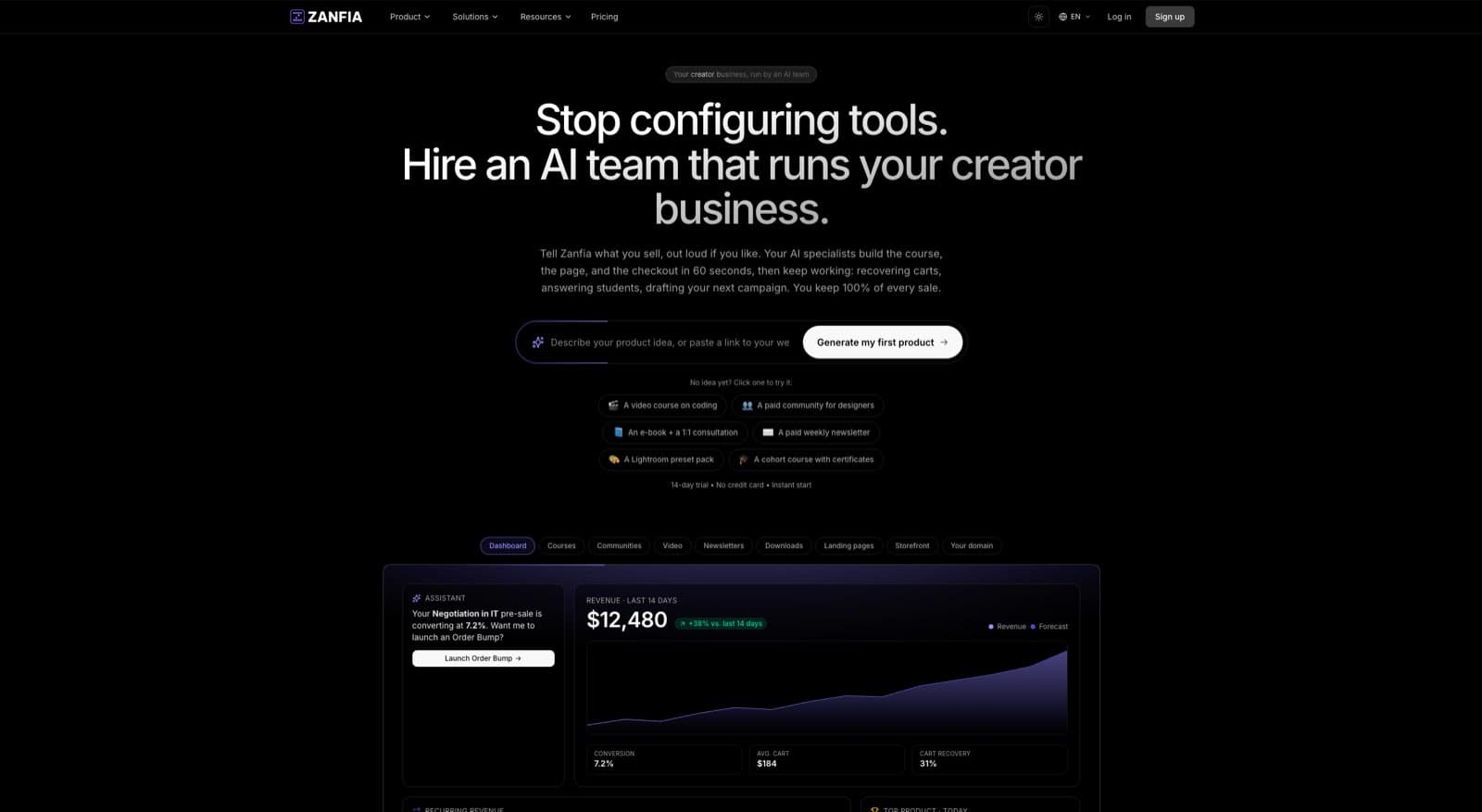
Zanfia is built as an AI team that runs the operational hub of your creator business. Courses, communities, newsletters, and digital products live under one brand, and the assistant can act on any of them by chat or by voice: tell it to enroll a new buyer in a welcome sequence, add them to a private community channel, and schedule a personalized follow-up, and the workflow runs across your workspace without you clicking through separate dashboards. Bringing your own AI agents is possible on higher plans through the MCP endpoint, so anything doable in the interface is doable from the assistant of your choice; availability depends on the plan, see the current Zanfia pricing.
Just as important, the checkout is built to sell. Order bumps, subscription upsells, and installments that split a $600 course into four payments live inside the same platform as the course itself, on your own domain, with 0% platform commission on customer sales (only the payment processor takes its standard cut). You can run a test purchase on any published checkout before launch to confirm the flow and the tracking work end to end. It’s time to move beyond the theory and put an AI team, a voice-ready workspace, and a checkout built to close behind your drip campaigns.
FAQ
How many segments should I start with when segmenting my drip campaign audience?
Start with 3 to 5 core segments that represent your most valuable customer groups. Trying to create dozens of segments from the start can be overwhelming. Focus on high-impact divisions first, such as new leads, first-time customers, and repeat buyers, then refine from there.
What kinds of goals should a drip campaign have to be measurable?
Vague goals like 'increase engagement' are not actionable. Set specific, measurable targets tied to a business objective, such as boosting feature adoption among new users by 40% within their first 30 days, or hitting a 35% conversion rate on an upsell sequence. Then align your KPIs (open rate, CTR, conversion rate, unsubscribe rate) to that target so you can prove whether the campaign worked.
What data should I ask for first when using progressive profiling?
For a top-of-funnel offer like an e-book, an email address is usually enough. Don't create friction by asking for a phone number or company revenue on the first interaction. On later visits, use smart or conditional forms that hide fields you already have and ask for the highest-value data next, such as job title, industry, or the subscriber's biggest challenge.
What does personalization actually mean beyond using a first name?
True personalization means using behavior and preferences to make the message relevant, not just inserting a name in the subject line. That looks like recommending a course based on past purchases, referencing a specific e-book someone just downloaded, or showing different offers to different segments inside the same send. Every personalized element should add value, not just look clever.
How do I decide the best time and frequency to send my drip emails?
Start with your own historical data: most email platforms show open and click rates by day of week and time of day, which reveals your audience's peak engagement windows. Use that as your baseline instead of defaulting to Tuesday at 9 AM. Then adjust frequency to stay a welcome presence rather than a nuisance, since the right cadence protects open rates and reduces unsubscribes.
Ready to stop wrestling with technology and start building a powerful, automated system that grows your business? Discover how Zanfia gives you an AI team that runs your creator business day to day, a voice-ready workspace where you dictate actions instead of clicking through settings, and a checkout built to sell with order bumps, installments, and 12 product types under one brand, all with 0% platform commission on customer sales. Start building your automated engine on Zanfia today.