

What Is a Digital Creator? Meaning, Jobs and Income (2026)

What does a digital creator really do? Forget the casual social media posting. A professional digital creator is the CEO, founder, and chief strategist of their own media company. They are in the business of building a loyal audience by creating, publishing, and marketing original content that solves a specific problem or provides unique value.
What Exactly Is a Digital Creator?
A digital creator is a modern entrepreneur who builds a business using their expertise, packaged as content. They don't just create randomly; every video, podcast, newsletter, or online course is a strategic asset designed to attract, engage, and serve a specific audience.
This is no longer a fringe hobby. It's a massive, booming industry. The global creator economy was valued at USD 205.25 billion in 2024 and is projected to continue its steep upward trajectory, according to Grand View Research. That figure confirms that being a creator is a serious profession.
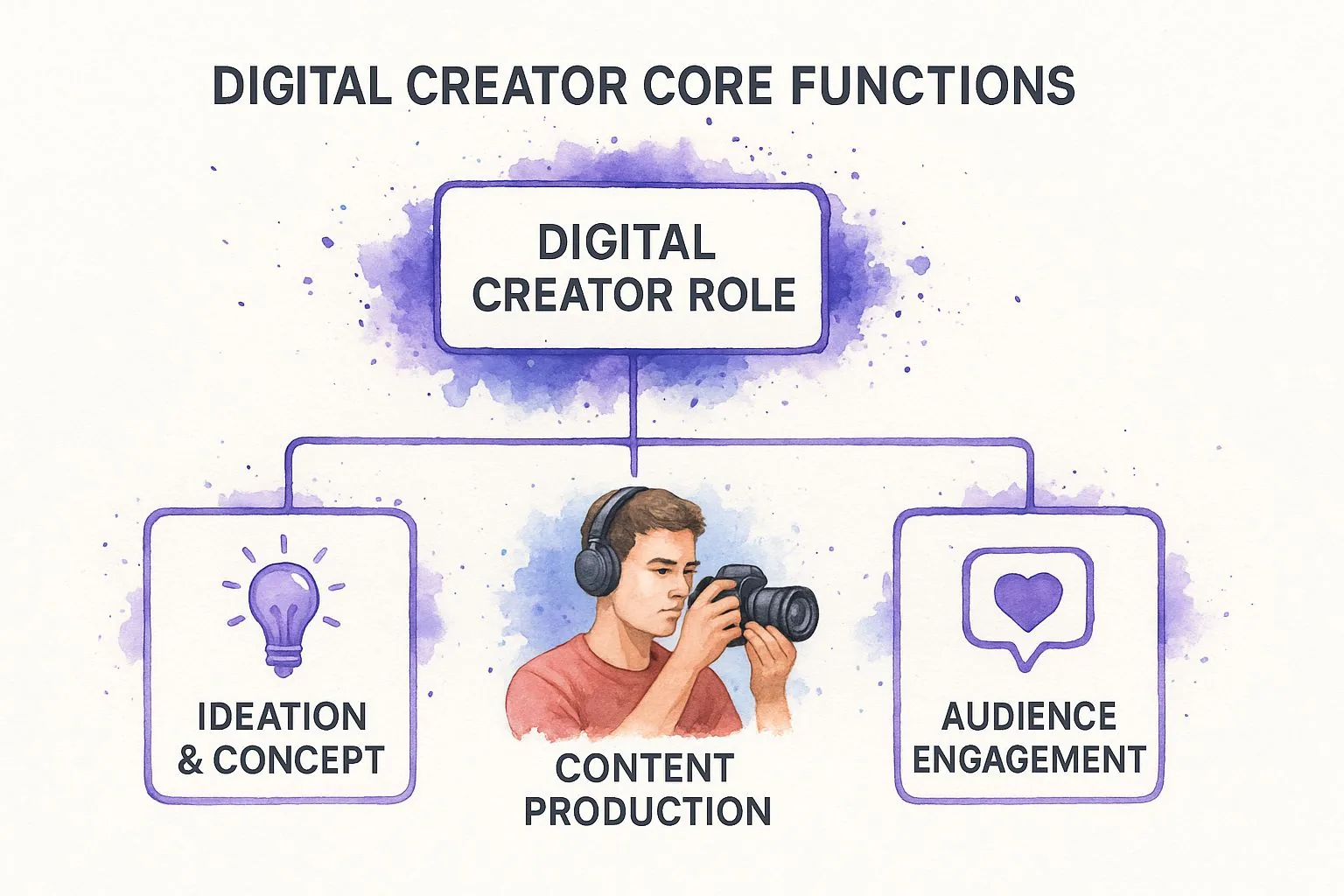
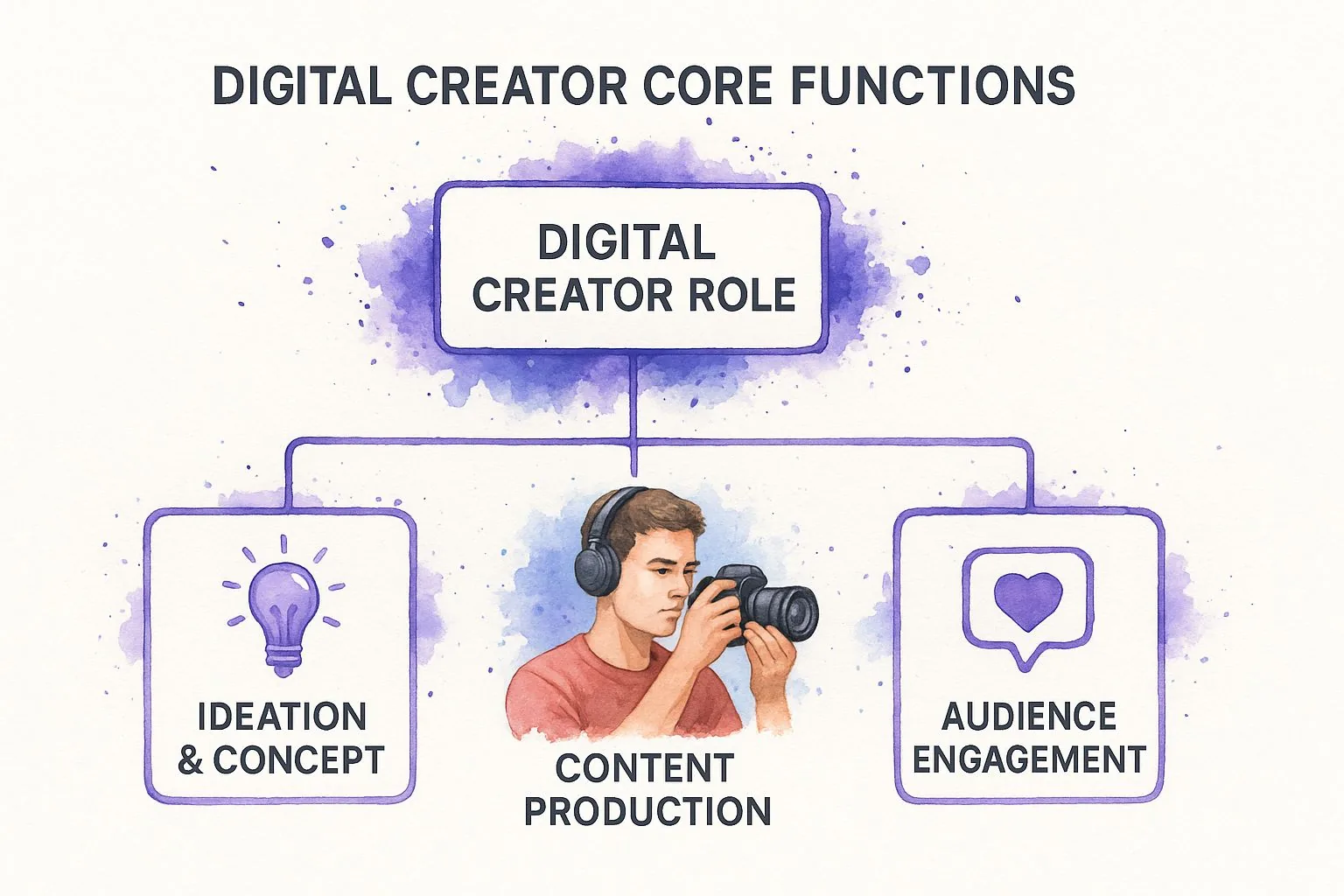
To understand the job, let's break down the core functions a creator juggles daily to build a scalable business.
The Core Functions of a Digital Creator
A professional creator wears multiple hats, often simultaneously. The table below outlines the primary roles they fill to build and scale their brand from the ground up.
| Core Function | Description |
|---|---|
| Strategy & Ideation | Researching their target audience, identifying their pain points, and mapping out a content plan that delivers tangible solutions or high-value entertainment. |
| Content Production | The hands-on work of writing scripts, filming videos, recording audio, designing course materials, and editing it all into a polished, professional product. |
| Distribution & Marketing | Strategically publishing content and promoting it through SEO, social media, and email marketing to reach and attract the right audience. |
| Community Management | Actively engaging with their audience by responding to comments, hosting discussions, and building a genuine connection with their followers. |
| Monetization | Turning audience attention into predictable revenue through brand partnerships, affiliate marketing, selling digital products, or offering exclusive memberships. |
As you can see, it’s a full-stack business operation that requires a unique blend of creative skill and strategic execution.
Ultimately, the goal is to transform passive viewers into a thriving community of loyal customers. This is where the business becomes sustainable. An engaged community is the foundation for long-term revenue. If you're exploring the tools for this, our guide on how to choose the best community platform for creators breaks down the essentials.
At its heart, being a digital creator is about building a content engine that fuels a business. The content is the product, the audience is the customer, and the platforms are the storefronts.
This is the key distinction between a professional creator and a hobbyist. Professionals build systems, track metrics, and relentlessly optimize their processes. It’s a demanding but highly rewarding career that requires as much business acumen as it does creative talent.
The 4 Pillars of a Creator's Workflow
Behind every successful creator isn't random inspiration, but a structured and repeatable workflow. To understand what a digital creator does day-to-day, we can break their work into four core pillars. This systematic approach is what separates amateurs from professionals and drives sustainable growth.
It all starts with a clear plan.
Strategy and Production
This is the foundational work. Creators conduct deep audience research to understand what their community actually needs and struggles with. From there, they map everything out on a content calendar, plan topics, and outline each piece of content. To elevate your output, it's worth exploring proven content creation strategies that make your work stand out.
Once the plan is locked in, it’s time for hands-on production—writing the blog post, filming the video, recording the podcast, or designing the graphics.
Distribution and Monetization
Creating valuable content is only half the job. If no one sees it, it provides no value. The next critical step is distribution: getting the content in front of the right audience. This involves leveraging social media, optimizing for search engines (SEO), and using email marketing to build a direct relationship with your followers.
As the audience grows, the focus shifts to monetization. This is where creators convert attention into reliable income through digital products, online courses, or paid community memberships.
This infographic illustrates how these functions work together in a continuous cycle.
A creator's job is a constant cycle of planning, creating, distributing, and engaging—all of which feed back into each other. But here's the critical business problem: trying to manage these four pillars with a dozen disconnected tools is the fastest path to burnout.
A fragmented workflow is the number one obstacle to growth. Your systems should support your creativity, not complicate it.
Imagine juggling a spreadsheet for your content plan, another app for your course videos, a third for marketing emails, and a fourth for processing payments. It’s chaotic, inefficient, and a massive drain on your most valuable resource: time.
This is why top creators build their business on a single, unified platform. Zanfia is built around an AI team that runs the creator business from one workspace: courses, communities, newsletters and digital products live under one brand, the assistant performs any action available in the interface by chat or by voice, and outside agents can act on the workspace through an MCP endpoint on higher plans (see the current Zanfia pricing). It gives you the operational backbone you need to scale without stitching a dozen tools together. You can see from our Product Features page how the integrated suite is designed specifically to solve this problem for creators.
Digital Creator Toolkit Comparison
Let's compare the typical fragmented toolkit with a unified, all-in-one approach to see the difference clearly.
| Task Category | Fragmented Tools (Examples) | Unified Platform Approach (Zanfia) |
|---|---|---|
| Strategy & Planning | Google Docs, Trello, Spreadsheets | Integrated content calendar and project management |
| Content Creation | WordPress, Canva, Descript | Built-in course builder, communities and 12 product types under one brand |
| Distribution & Marketing | Mailchimp, Hootsuite, Buffer | Visual automation builder, social publishing, and two-way sync with your email tool |
| Monetization | Stripe, Teachable, PayPal | Checkout with order bumps, installments and upsells; test mode before launch |
| Community Building | Discord, Facebook Groups | Integrated community spaces and member management |
Ultimately, a unified platform isn't just about convenience; it’s a strategic decision to build an efficient, scalable system that lets you focus on what you do best: creating value.
Turning Content Into a Business
Creating great content is one thing, but converting it into a sustainable business is another entirely. If your income depends on unpredictable ad revenue or one-off brand deals, you're building on unstable ground. The most successful creators I know have all made the same critical shift: they stopped being content producers and became business owners.
This means building a diversified portfolio of their own products. Instead of "renting" an audience on someone else's platform, you build a direct line to your community by offering them something of tangible value—something they're happy to pay for. The digital content market is projected to hit USD 30.6 billion in 2024 and soar to USD 43.9 billion by 2027, showing the massive opportunity for owned products.
From Creator to Entrepreneur
How do you make this leap? By packaging your expertise and influence into assets you can sell directly. The most proven paths include:
- Selling Digital Products: Ebooks, templates, presets, or comprehensive online courses that solve a specific, painful problem for your followers.
- Offering Paid Memberships: An exclusive, members-only community that offers premium content and direct access to you, all while generating predictable, recurring revenue.
- Paid Newsletters: A subscription newsletter is a powerful way to deliver high-value, exclusive insights straight to your audience's inbox.
For many creators, online courses are the cornerstone of their business. But simply uploading videos isn't enough. You must master effective online course design strategies to ensure your students get results, which in turn builds your reputation and drives future sales.
The ultimate goal is to build an owned revenue engine. When you sell your own products, you're no longer dependent on algorithms or brand budgets—you control your financial destiny.
This is where the operational complexity can become overwhelming. Trying to manage separate tools for your courses, community, email work, and payment processing is a logistical nightmare. It's a time-sink that kills your creative momentum. This is exactly why a platform like Zanfia is useful for creators who want one operational hub: an AI team runs the workspace, you can dictate actions to the assistant by chat or voice, and the checkout is built to sell (order bumps, installments so you can split a $600 course into four payments, upsells, and a test mode to buy your own product before launch). It turns a chaotic mess of tools into a single, professional operation. For more ideas, read our guide on how to effectively monetize your online content.
Business Skills: The Engine Behind Your Creative Brand
A viral video can bring attention, but business acumen builds a lasting career. The reality is that being a top-tier digital creator is 90% entrepreneurship and 10% content creation. Your ability to run the business of you is what transforms a moment of fame into a sustainable enterprise.
This requires a mental shift from thinking like an artist to acting like a CEO. You must become as comfortable analyzing a sales report as you are setting up your next video shoot. The creators who thrive long-term are those who master the skills required when the camera is off.
Running the Show: Your Core Business Operations
To transition from hobbyist to professional, you must master a few key business functions.
- Project Management: This is your secret weapon for consistency. It’s about building a reliable system for your content pipeline, from brainstorming and scheduling to hitting every deadline without last-minute chaos.
- Financial Literacy: You have to know your numbers. Period. This means tracking income, managing expenses, and planning for taxes. Understanding your cash flow is the only way to make smart decisions that lead to profitability.
- Data Analysis: Your audience constantly tells you what they want through clicks, views, and purchases. Learning to read that data reveals what’s working, what’s not, and where you should invest your time and energy.
The most valuable skill a creator can develop is turning a creative spark into a profitable, repeatable system. Without that, you're just a hobbyist with a large following.
This is where many creators get overwhelmed. Juggling the roles of financial analyst, data scientist, and project manager on top of creating content feels impossible, especially when your data is scattered across a dozen different apps.
That's why a central command center is useful for serious creators. A platform like Zanfia gives you a live sales feed, funnels and MRR reporting alongside the checkout that produces those numbers, so you can see how a piece of content turns into revenue in one place. You can ask the assistant for a report by chat or by voice instead of building it by hand, and outside AI tools can pull the same data through the MCP endpoint on higher plans (see the current Zanfia pricing). You can learn more by reading our guide on how to measure your content marketing ROI.
Navigating the Realities of a Creator Career

Let's be direct. The glamorous life portrayed on social media is a highlight reel. Behind every polished post is a grind filled with challenges like unpredictable income and the very real risk of burnout. The myth of overnight success creates immense pressure and is rarely the reality.
The hustle can be relentless. Many creators feel stuck on a content treadmill, constantly churning out new material to satisfy algorithms and audience expectations. This non-stop pace is a direct path to creative exhaustion and is one of the biggest reasons talented people quit.
And the income? It's often inconsistent, especially in the early stages. The creator economy has over 207 million participants, but the competition is fierce; only about 4% of creators earn more than $100,000 a year. To understand the landscape better, you can find more data on the creator economy's income distribution.
Preventing Burnout with Strategic Systems
To build a career that lasts, you must move beyond the hustle and build sustainable systems. This means designing a business structure that serves you, not the other way around. It's about creating predictable revenue streams and automating repetitive, energy-draining tasks.
Your business should support your creativity, not consume it. Building scalable systems is the only non-negotiable strategy for long-term survival in this field.
This is where having the right operational partner is crucial. Instead of duct-taping a dozen tools together for your courses, community, and marketing, a platform like Zanfia can act as your central hub. An AI team handles the recurring work, you can dictate actions to the assistant by chat or voice, and the checkout is built to sell with order bumps, installments, upsells and a test mode you can use to buy your own product before launch. New workspaces start with a 14-day free trial, no credit card required.
This integrated system is the solution to logistical chaos. It allows you to build a business that's both manageable and profitable—preventing burnout before it starts.
Building Your Business on a Single Platform
Let's connect all these points. If you're a creator, you know the chaos of juggling a dozen different tools to keep your business running. Your online course is on one site, your email list is on another, and your community is siloed on a third platform. It's a classic "digital duct tape" approach.
This patchwork system isn't just inefficient; it's a direct route to burnout. You spend more time fighting with software than creating for your audience. The subscription costs for all those services also add up quickly. This is not a sustainable way to build a professional business.
An all-in-one platform isn't just about convenience; it's a strategic decision to build a scalable, professional operation.
This is where you trade chaos for clarity. When you centralize your operations on a single hub like Zanfia, an AI team runs the business alongside you: the assistant can perform any action available in the interface by chat or by voice, courses, communities, newsletters and digital products sit under one brand, and the checkout is built to sell with order bumps, installments and upsells. Outside agents can act on your workspace through an MCP endpoint on higher plans (see the current Zanfia pricing). You get one dashboard for what is driving revenue, and time to get back to what you love—creating.
Take Control of Your Creator Business
Having everything under one roof provides a bird's-eye view of your entire operation, making it easier to manage and scale. Choosing the right foundation from the start is critical. It’s worth exploring some of the best online teaching platforms to see how an integrated system outperforms a fragmented one.
Zanfia is a central operating system for serious creators who want to replace tech chaos with streamlined growth: an AI team you can direct by chat or voice, courses, communities and newsletters under one brand, and a checkout built to sell.
Frequently Asked Questions
How Do Digital Creators Make Money?
While ad revenue and brand sponsorships can be part of the income mix, the most sustainable strategy is building a business you own. Successful creators achieve this by selling their own digital products like online courses, ebooks, or exclusive membership communities. This model provides control over revenue and builds a direct, long-term relationship with their audience.
What Is the Difference Between an Influencer and a Digital Creator?
The key difference is the business model. An influencer's primary function is to promote other companies' products, essentially renting their audience's attention to brands. A digital creator is an entrepreneur who builds a business around their own original content and products. Their focus is on creating and selling their own value directly to their community.
What Tools Are Essential for a New Digital Creator?
You need tools for three core functions: content creation, distribution, and monetization. It's tempting for new creators to use a separate tool for each task, but this quickly becomes complex and inefficient. To scale without burnout, professionals consolidate their entire operation onto a single, all-in-one platform.
An integrated system lets you manage your courses, community, and marketing from one place. It’s what turns a hobby into a professional, streamlined business.
This is the strategic advantage that allows for long-term growth. You stop wasting time making different apps talk to each other and start focusing on what really drives your business forward: creating value for your audience.
Ready to stop juggling tools and start building a real business? Zanfia gives you one workspace where an AI team runs the recurring work, you can dictate actions to the assistant by chat or voice, and a checkout built to sell (order bumps, installments, upsells, test mode) turns your content into revenue. Start with a 14-day free trial, no credit card required. Take control of your creator business today.