

Successful Business for Women: The 2026 Roadmap
A successful business for women isn't a niche concept anymore. It's one of the clearest shifts in entrepreneurship right now. In the U.S., women started 49% of all new businesses in 2024, up from 29% in 2019, and 13.3 million women-owned businesses now contribute over $2.5 trillion annually to the economy, according to Founder Reports' roundup of female entrepreneur statistics.
That changes the conversation. Women aren't trying to “break into” business. Women are already building a major share of it.
The question is different. How do you build a business that grows without depending on gatekeepers, bloated tech stacks, or endless manual work? That's where most advice falls apart. It gives inspiration, a list of ideas, and very little operational truth. You need a model that fits how women launch, sell, retain customers, and scale in a market that still doesn't fund them fairly.
The Unstoppable Rise of Women-Led Ventures
Women now represent one of the strongest forces in entrepreneurship. The shift is already happening. What matters now is building businesses that produce control, profit, and staying power instead of another demanding job.

That distinction has real weight. More women are starting companies, but too many still end up boxed into low-margin services, inconsistent income, and messy software setups that create more admin than growth. Starting a business is no longer the main hurdle. Building one that works without gatekeepers is.
Why digital-first wins
Digital-first businesses solve that problem faster than traditional models. They let you sell expertise, outcomes, access, and support without inventory, leased space, or a big payroll. They also give you assets that keep working after the first sale. A course can sell repeatedly. A membership can renew monthly. Templates, workshops, newsletters, and private communities can turn one core skill into several revenue streams.
This model also reduces a barrier many women hit early. You do not need outside funding to prove demand. You need a clear offer, a buying audience, and one system that handles your pages, payments, email, and delivery without forcing you into a patchwork of tools. That is how you keep margins healthy and decisions simple.
Relationships still matter. Warm referrals, peer visibility, and trusted communities often create momentum faster than cold promotion. If you want to build that advantage on purpose, read these practical advantages of business networks.
Practical rule: Build the business you can sell repeatedly, run cleanly, and improve with simple systems.
What actually makes a successful business for women
A business is worth building if it does three jobs well:
- Brings in cash early so progress does not depend on investor approval
- Runs on repeatable delivery so each new client does not create a custom workload
- Protects your time and energy so growth is possible without constant overwork
Many women have an edge in this area. They often build around real demand, practical outcomes, and customer trust instead of hype. That approach wins if you shape it into a digital model with clear offers and strong operations.
The better path is straightforward. Start with a problem people already pay to solve. Turn your knowledge into offers that can be delivered more than once. Set up a monetization system that does not collapse when you get busy. Use one platform to reduce tech friction, keep customer data in one place, and make scaling easier from the start.
From Passion to Profit A Validated Business Idea
Many individuals don't need more ideas. They need a filter.
A bad idea feels exciting in your head and confusing in the market. A good idea solves a clear problem for a specific person and is easy to explain in one sentence. If you can't describe the buyer, the pain point, and the promised outcome quickly, the idea isn't ready.
Start with the overlap
The strongest ideas usually sit at the intersection of three things:
- What you know
- What people already ask you for
- What someone will pay to solve
Passion alone won't carry a business. Expertise without demand won't either. You want the overlap. If people already ask for your advice on language learning, nutrition, career transitions, parenting, design, finance basics, or audience growth, that's not random. That's market signal.
Use that signal properly. Don't ask, “What business should I start?” Ask, “What recurring problem am I qualified to solve for a narrow group of people?”
Validate before you build
You do not need a giant launch, a polished brand, or expensive software to test a business. You need evidence.
A simple validation process looks like this:
- Define one buyer clearly Not “women who want to be healthier.” Better: women returning to exercise after pregnancy, managers preparing for promotion, or freelancers trying to organize client delivery.
- Write one promise What changes after working with you? Be concrete. Better sleep. Clearer speaking skills. A finished portfolio. A launch-ready offer.
- Research the language people use Look at comments, reviews, community posts, and direct messages. Your customer will tell you how she describes the problem.
- Test with a lightweight offer Offer a paid session, a pilot workshop, a short program, or a waitlist. You don't need full production to test demand.
If you want a more structured process, this guide on how to validate a business idea gives a useful framework.
Build around a painful problem, not a broad interest
Here's the difference:
| Weak idea | Stronger idea |
|---|---|
| “I want to help women with wellness” | “I help busy women build a simple home meal system” |
| “I want to coach confidence” | “I help first-time managers lead difficult conversations” |
| “I want to teach marketing” | “I help local service businesses create their first content funnel” |
Broad ideas attract compliments. Specific ideas attract buyers.
A market doesn't pay you for being talented. It pays you for being relevant.
Don't wait for certainty
Validation isn't about removing all risk. It's about reducing avoidable risk. Talk to real people. Sell a small version first. Watch where buyers hesitate. Then refine the offer, not your self-worth.
That shift matters. Many women stay stuck because they treat the first version like a final verdict. It isn't. It's a test. A validated business starts with listening, not guessing.
Productize Your Expertise into Digital Assets
The fastest way to stall your growth is to sell only time. If every offer depends on your calendar, your business has a ceiling from day one.
A successful business for women usually gets stronger when expertise becomes a digital asset. That means you package knowledge once, improve it over time, and sell it more than once. You stop rebuilding the same value manually for every client.
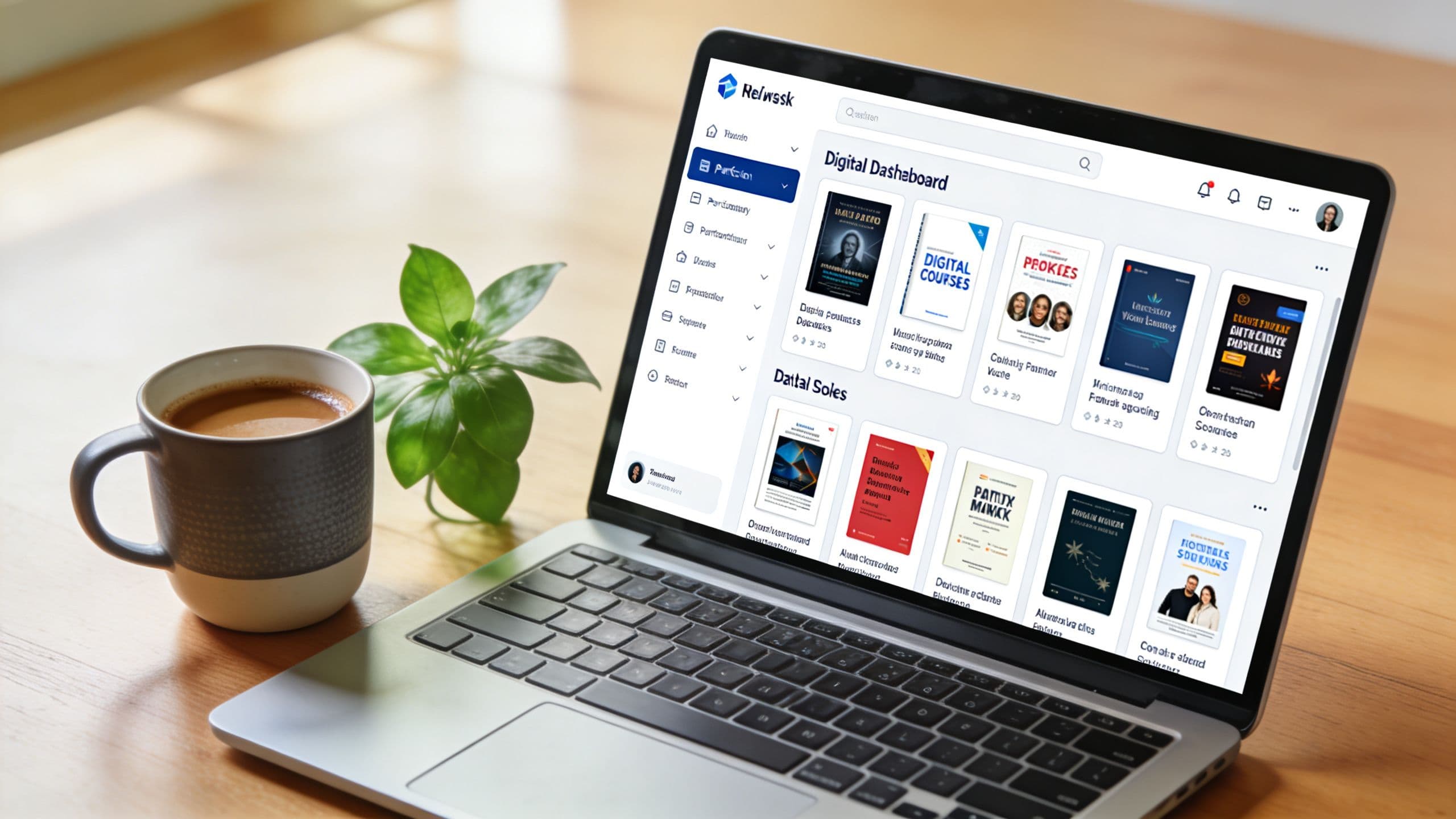
If you need a clean definition, this explainer on what a digital product is is a good place to start.
Choose the format that fits the transformation
Not every offer should become a course. Founders make that mistake all the time. The product format should match the customer's job to be done.
Consider this practical approach:
- Online course Best when the result requires a clear path, lessons in sequence, and repeatable instruction.
- Paid community Best when customers need accountability, discussion, support, and ongoing momentum.
- E-book or download Best for a narrow problem, a quick win, or an entry-level offer that leads to something deeper.
- Membership Best when your audience wants regular updates, access, resources, and continuity.
The strongest businesses don't stop at one product. They build a small ecosystem. A woman who buys your guide might later join your community. A community member might later buy your premium course. That product ladder is where real stability starts.
Product suites beat one-off offers
A lot of founders stay stuck because they launch a single product and expect it to do everything. It won't. One offer can bring in buyers. A suite of connected offers builds customer lifetime value.
A simple structure might look like this:
- Entry product for discovery
- Core offer for transformation
- Recurring offer for retention
This kind of productization creates breathing room. You're no longer relying on a single launch or one service package.
Here's a useful walkthrough on how creators package knowledge into sellable assets:
Keep the customer experience unified
Customers hate fragmented delivery. They don't want one tool for payments, another for lessons, another for community, another for downloads, and a fifth for updates. Every extra login adds friction. Every disconnected touchpoint increases drop-off.
A better setup keeps the learning, communication, access, and delivery connected. That makes your business easier to run and easier to trust. It also makes your expertise look more premium, because the experience feels intentional rather than stitched together.
If your knowledge already solves a real problem, don't keep selling it only in the most labor-intensive way. Package it. Name it. Structure it. Deliver it consistently. That's how expertise becomes an asset instead of a job.
Build Your Smart Monetization Engine
Many women are taught to think about monetization too late. That's backward. Monetization is not the awkward part you bolt on after the “real” work. It is the structure that makes the business sustainable.
This matters even more because the funding system is still uneven. The global finance gap for women is estimated at $1.7 trillion, and women received only 2.2% of U.S. venture capital in 2023 and 2024, according to CARE's overview of women's entrepreneurship barriers and financing. If capital access is unequal, your business model has to do more of the lifting.
Pick a model that funds your growth
Digital businesses have an advantage here. They often need lower upfront investment and can sell directly to customers. That means you can generate revenue before chasing outside money.
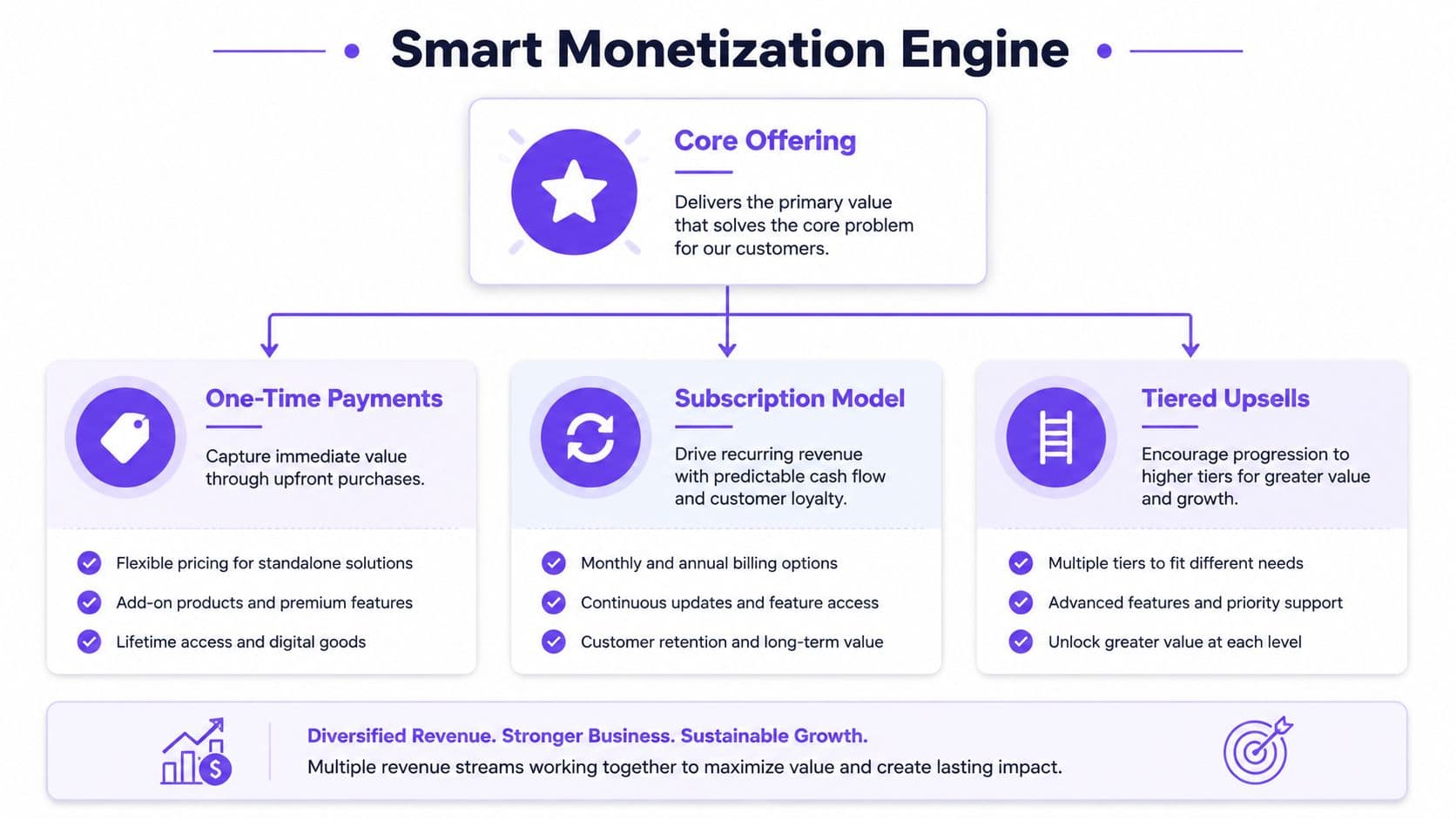
Three monetization models do the heavy lifting for most digital founders:
| Model | Best use | Strategic benefit |
|---|---|---|
| One-time payment | Courses, e-books, workshops, templates | Fast cash flow and simple buying decision |
| Subscription | Communities, newsletters, resource libraries | Predictable recurring revenue |
| Installments or bundles | Higher-ticket offers or multi-product ecosystems | Higher accessibility and better offer packaging |
A lot of founders choose one model and stop there. Don't. A smarter approach combines them.
Build around one core offer
Your monetization engine should have a center. Usually that's the offer that delivers the clearest transformation.
Then support it with adjacent revenue streams:
- Use one-time offers to attract new buyers who want a low-friction starting point
- Use recurring access when your audience benefits from ongoing support or fresh content
- Use bundles when products naturally work better together
- Use installment plans when price resistance is high but demand is real
That structure gives you cash flow, continuity, and room to expand without inventing a new offer every month.
Revenue rule: If buyers keep needing you after the initial purchase, build a recurring offer. If they need a defined result, sell a focused transformation.
Distribution matters as much as pricing
A monetization engine doesn't work without traffic and attention. If your audience spends time on short-form video, creator-led distribution can become a serious acquisition channel. If that's relevant to your niche, learn how to monetize TikTok with Viral.new and use it as part of your top-of-funnel strategy, not as a random content experiment.
You should also study how online businesses earn. This breakdown of how internet sites make money is useful because it forces you to think in business-model terms, not just content terms.
Protect margin from day one
Women founders already face tighter access to capital. That means your business can't afford sloppy margins. Every extra fee, disconnected tool, or manual workaround slows growth.
Be ruthless about this. Keep your stack lean. Choose direct monetization over dependency on advertisers or sponsors when possible. Build offers you can fulfill without burning out. The goal isn't just to make sales. The goal is to keep enough of what you earn to reinvest with confidence.
A successful business for women often scales best when it behaves like a well-designed machine. Clear offer. Clear payment path. Clear next step after purchase. That's not “salesy.” That's responsible.
Authentic Marketing and Community-Led Growth
Aggressive marketing advice often tells women to post more, shout louder, and stay visible at all costs. That's lazy advice. Volume without trust creates noise, not sales.
A better path is community-led growth. You build authority through useful content, bring people into a closer circle, and create a space where buyers feel seen before they feel sold to. This approach is more sustainable, and for many women, it fits how they want to lead.

Research on women-owned SMEs found that psychological traits such as commitment and motivation were the most influential factors in entrepreneurial success, according to this peer-reviewed study on women's entrepreneurial success factors. That tracks with what experienced founders already know. The women who keep showing up, listening closely, and building real relationships usually outperform the women chasing every tactic.
Build audience before you push offers
You don't need a giant audience. You need the right audience and a repeatable way to nurture it.
Start with a simple content rhythm:
- Teach publicly through short posts, video, email, or live sessions
- Listen carefully to the questions that repeat
- Invite deeper connection through a newsletter, group, or community space
- Sell naturally when the next step is obvious
This is not slow marketing. It's trust-first marketing. It works because people buy faster when they already understand how you think.
If your niche depends on belonging, shared identity, or accountability, community isn't optional. It is the product experience and the marketing engine. That's why building your own circle matters so much. This article on how to find your tribe is worth reading if you're still trying to attract everyone.
Stop performing. Start relating.
Many founders confuse “brand building” with constant performance. They polish endlessly, script every sentence, and avoid saying anything specific enough to repel the wrong people. That's not strategy. That's fear wearing makeup.
A stronger brand does three things:
- States a clear point of view
- Shows proof through useful content
- Creates a place where people can stay connected
That place might be an email list, a member space, a paid group, or a learning environment with discussion built in. The exact tool matters less than the principle. Own the relationship.
You do not need to become louder. You need to become easier to trust.
Community improves retention, not just reach
This is the part too many founders miss. Community doesn't just help you get attention. It helps customers stay, engage, and buy again. When buyers interact with you and each other, your business gets stronger without constant relaunching.
Signs you're building community-led growth well:
- People reply instead of just liking
- Members refer others without being pushed
- Questions turn into products
- Customers stay involved after the first purchase
That kind of momentum is hard to fake. It comes from consistency, generosity, and clear boundaries. You don't need hustle culture. You need a system for creating trust at scale.
Automate Operations and Track What Matters
A business gets heavy when everything depends on memory. You answer the same questions, send the same links, chase payments, manually onboard customers, and wonder why growth feels exhausting.
That's not a scaling problem. It's an operations problem.
Turn repeat tasks into systems
The strongest digital businesses automate the steps that happen after every sale. Not to feel fancy. To protect time and reduce mistakes.
The practical automations most founders need are straightforward:
- Instant delivery so buyers get access right after payment
- Onboarding emails so new customers know what to do next
- Subscription handling so renewals and access changes don't become manual admin
- Invoice workflows so finances don't pile up at the end of the month
- Audience tagging so the right buyers receive the right follow-up
These systems matter because they remove founder bottlenecks. They also create a better customer experience. Buyers shouldn't wait for you to wake up, find the order, and copy-paste a login email.
Use your business plan as an operating system
Planning only helps if it changes behavior. That's why I prefer treating the business plan as an operating system, not a document.
One practical benchmark from women's business guidance is to pair a written plan with market research, funding readiness, and resilience checkpoints. That same guidance also frames planning as a system for tracking progress, and specifically notes that for platforms like Zanfia, the point is to use structured launch steps and then track funnel conversion and subscription retention against the plan's projections and milestones, as explained in this women's business planning guide.
Translate that into weekly operations:
| Area | What to monitor | Why it matters |
|---|---|---|
| Offer performance | Conversion from page view to purchase | Shows whether the offer and page are working |
| Retention | Subscription continuation and engagement | Tells you if recurring revenue is stable |
| Onboarding | Completion of first key action | Shows whether buyers are getting value quickly |
| Cash flow | Revenue timing and upcoming obligations | Prevents reactive decisions |
Don't track vanity metrics
Follower count can flatter you while revenue stays flat. Open rates can look decent while buyers still don't convert. Track numbers that force action.
Good decision metrics include:
- Conversion rate
- Subscription retention
- Refund patterns
- Time to first value
- Revenue by offer
If a metric doesn't help you improve an offer, fix a funnel, or protect margin, it's probably a distraction.
Operations rule: Every repeated task should become either an automation, a template, or a documented process.
Hire support before chaos gets expensive
Some founders wait too long to get help. They try to hold admin, customer support, inbox management, scheduling, and light marketing all by themselves. That's usually false economy.
If you need flexible support without rushing into full-time hires, Bilingual Virtual Assistants can be a useful option for handling repeat operational work so you stay focused on product, sales, and customer outcomes.
A successful business for women needs systems that keep working on ordinary days, not just launch days. That's what makes growth survivable.
Secure Your Funding and Cultivate Resilience
You do not need to apologize for wanting capital. Money gives you options. It buys time, tools, support, and room to experiment.
But you also shouldn't build your entire business around waiting for someone else to validate it. Women-founded businesses receive less early-stage funding on average, yet still deliver more than twice as much revenue per dollar invested compared with male-founded companies, despite receiving $1 million less in early-stage funding on average, according to MIT Entrepreneurship's discussion of women entrepreneurs and funding. That should permanently change how you see your business. Underfunded does not mean under-capable.
Choose funding paths that fit the business
For digital founders, the smartest funding path often isn't traditional venture capital. It's a mix of:
- Bootstrapping from early sales
- Reinvesting revenue into growth assets
- Using loans or financing selectively when the return is clear
- Pursuing aligned investors only when the business model supports it
That last point matters. Not every good business should be venture-backed. Many women build profitable, durable companies that work better with control than with outside pressure.
If you do want investor conversations, be intentional about who you approach. A curated resource like Gritt.io for US women investors can help you identify investors with a clearer fit instead of sending cold pitches into the void.
Resilience is operational, not inspirational
Resilience is not smiling through bad strategy. It's designing a business that can absorb friction.
That means you define success clearly. You keep costs sane. You validate demand before overbuilding. You create recurring revenue where it makes sense. You build enough structure that one hard month doesn't wreck the whole company.
It also means protecting your identity from your experiments. A weak launch does not mean you are weak. A slow offer does not mean you have no market. It means the model, message, timing, or delivery needs work.
The women who build lasting businesses aren't always the most charismatic. They're often the most consistent. They learn, adapt, and stay in the game long enough for the compounding to show.
FAQ
Do I need outside funding to start a digital-first business as a woman?
No. A digital-first model lets you sell expertise, memberships, courses, and downloads without inventory or big payroll, so you can prove demand with a clear offer and a buying audience. This matters because women received only 2.2% of U.S. venture capital in 2023 and 2024, so your business model has to do more of the lifting than external capital.
How do I know my business idea is validated before I build it?
Define one specific buyer, write one concrete promise, research the exact language people use in comments and messages, and test with a lightweight paid offer like a session, pilot workshop, or waitlist. Validation is not about removing all risk, it is about reducing avoidable risk by selling a small version first and watching where real buyers hesitate.
Which digital product format should I choose for my expertise?
Match the format to the customer's job to be done: an online course when the result needs a clear sequence, a paid community when people need accountability and discussion, an e-book or download for a narrow quick win, and a membership when the audience wants ongoing access and updates. Strong businesses usually combine several of these into a product ladder rather than relying on one offer.
What monetization model works best for a new digital business?
Use one-time payments for courses, e-books, workshops, and templates to get fast cash flow, subscriptions for communities and resource libraries to build predictable recurring revenue, and installments or bundles for higher-ticket or multi-product offers. The article recommends combining these around one core offer that delivers the clearest transformation, rather than picking only one model.
Why does keeping my tech stack unified matter for growth?
Fragmented tools force customers through multiple logins for payments, lessons, community, and downloads, and every extra touchpoint adds friction and drop-off. Keeping learning, communication, access, and delivery connected makes the business easier to run, protects margin, and makes your expertise feel more premium and intentional.
If you want to build a digital business without stitching together five separate tools, Zanfia is worth a serious look. It is an AI-first platform where an assistant that knows the whole interface does the work for you: you dictate by chat or voice, and it handles courses, paid newsletters, communities, subscriptions, e-books, and downloads under your own domain, with white-label control and native video hosting. It is also built to sell, with a checkout that supports order bumps, installments, and upsells, test mode so you can buy your own product before launch, and 12 product types living under one brand. As of publication, Zanfia charges 0% platform commission on customer sales (only the payment processor takes its standard cut), and pricing starts at $39/month, or $31/month billed annually, on the Starter plan, with a 14-day free trial and no credit card required. Availability of the full AI team, the MCP endpoint, and other advanced capabilities depends on the plan, so check the current Zanfia pricing. For women building a business around expertise, audience trust, and recurring revenue, that kind of integrated setup isn't a luxury. It's the cleanest way to launch faster, keep control, and scale without technical chaos.