

How to Validate a Business Idea: A Creator’s Guide to Smart, Fast Testing
Validating a business idea isn't about getting permission or slowing down. It's about running small, smart experiments to prove people will actually pay for your solution before you pour months of your life and thousands of dollars into building it.
This process is your shield against wasted time, sunk costs, and the heartbreak of a launch that falls flat. It's how you test your concept against real-world demand and build a business on a foundation of proof, not hope.
Why Most Great Ideas Fail and How to Save Yours

Let’s be brutally honest: a brilliant idea, on its own, is worthless. The graveyard of failed ventures is filled with incredible products that nobody actually needed. That's the single biggest reason businesses fail.
Idea validation is the critical firewall that separates wishful thinking from a viable business. It’s not about bureaucracy; it’s about intelligence gathering. Think of it as a series of small, calculated bets designed to answer one question: will people open their wallets for this?
The Staggering Cost of Skipping This Step
The data paints a painful but clear picture. Imagine spending a year building your dream product, only to launch to the sound of crickets. This is the reality for a staggering 42% of startups, which fail because they solve a problem nobody has.
The numbers don't lie. Validated ideas see success rates jump to 60-70%, a massive leap from the dismal 10-20% for unvalidated ones. The ROI is undeniable—spending just a few hundred dollars on quick tests can save you tens of thousands in wasted development.
This isn't just about money. It's about protecting your most valuable assets: your time, your energy, and your motivation.
To put this in perspective, here's a quick look at the two paths you can take.
Validation at a Glance: Risk vs. Reward
| Metric | Unvalidated Idea | Validated Idea |
|---|---|---|
| Initial Investment | High (full build-out) | Low (small, quick tests) |
| Risk of Failure | Extremely High (80-90%) | Significantly Lower (30-40%) |
| Time to Market | 6-12+ months | Weeks |
| Launch Outcome | Hope & Pray | Data-driven confidence |
| Customer Feedback | Received after launch (too late) | Gathered before building |
The contrast is stark. One path is a high-stakes gamble; the other is a calculated strategy.
From Hypothesis to Revenue on a Single Platform
For most creators and entrepreneurs, the validation process itself can feel overwhelming. You're told you need a landing page tool, an email provider, a checkout system, and a way to deliver a sample product. It's a frustrating patchwork of tech.
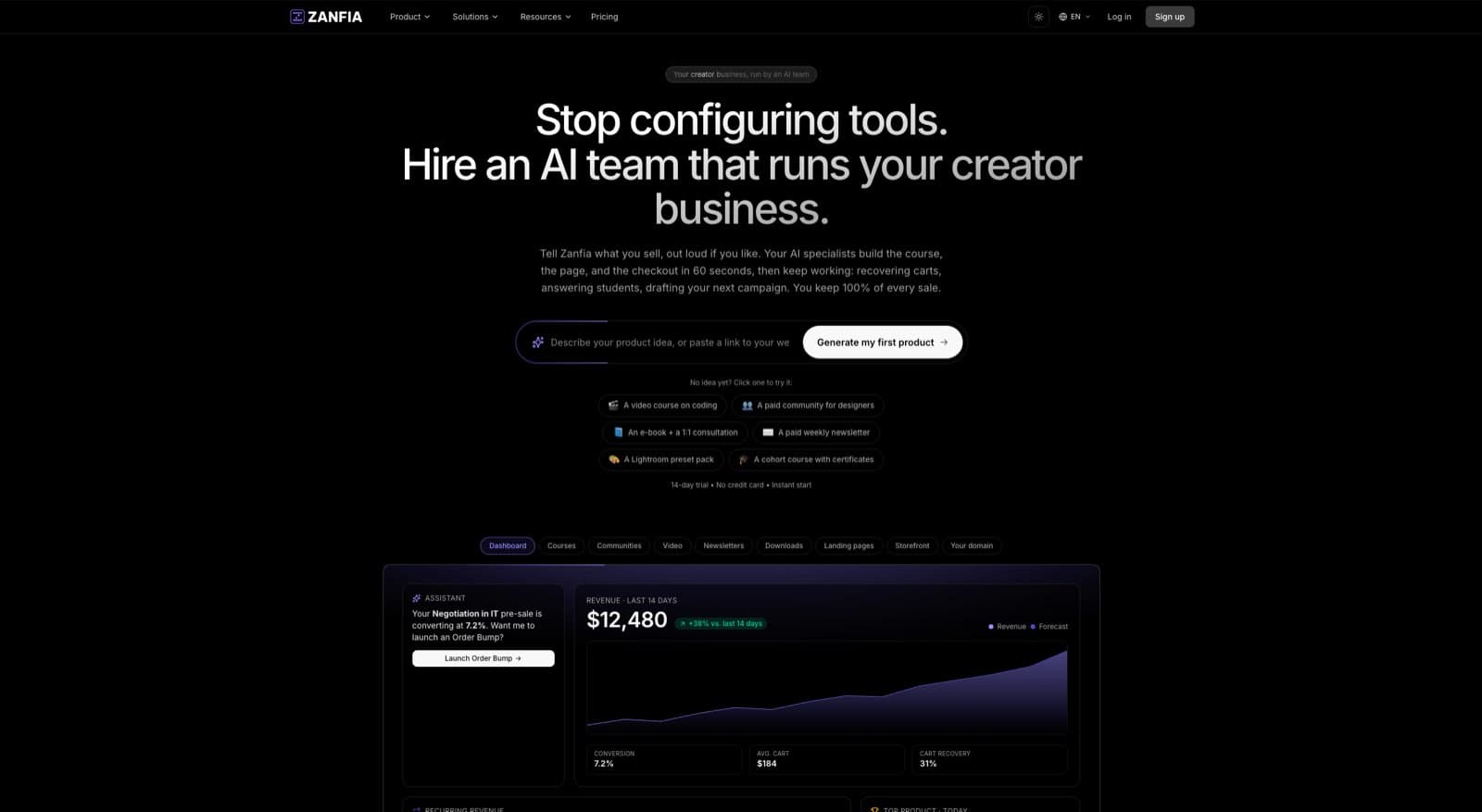
This is where Zanfia becomes your command center. It works less like another course platform and more like an AI team that runs your creator business: you dictate what to test, by chat or by voice, and the assistant sets up landing pages, checkouts and access rules using anything available in the interface. Courses, communities, newsletters and digital products all live in one workspace, so a validation experiment ends in a real checkout instead of a patchwork of duct-taped tools.
Instead of fighting with five different services, you can focus entirely on testing your idea. With a unified system, you can quickly:
- Launch a landing page to gauge interest and collect emails for a future course.
- Run a pre-sale campaign for an ebook or a founding member spot in your community, with a checkout that supports order bumps and installment plans.
- Sell a single-module MVP to your first paying customers to test your curriculum, and run a test purchase yourself before you spend a dollar on ads.
Because Zanfia combines community, courses, and digital product sales under one brand, you can test different offers without the technical headaches. This is a game-changer for "Potential Explorers"—those experts who feel stuck in pre-launch paralysis, overwhelmed by the sheer number of moving parts. It gives them a low-risk way to launch a first product and start validating, with a 14-day free trial and no credit card required.
Of course, before you can test your product, you need a promise that grabs attention. Our guide on crafting a strong value proposition will help you define what makes your offer irresistible. By focusing on validation first, you shift from hoping your idea will work to building a business on a foundation of proven customer demand.
Pinpointing Your Core Assumptions
Before you spend a single dollar on ads or even sketch a landing page, you have to know what you’re actually testing. Every great business idea is built on a stack of assumptions—things you believe are true but haven't actually proven.
The first step in validating your idea is to drag these assumptions out of your head and turn them into clear, testable statements. It’s simpler than it sounds. You’re just breaking your idea down into two core hypotheses.
The Problem Hypothesis
This is all about your customer and their pain. It’s a clear statement that a specific group of people has a specific problem—and that problem is painful enough for them to actively seek out a solution.
For example, a “Business Architect” persona—a seasoned creator earning $10k+/month—might see other advanced creators struggling. Their problem hypothesis could sound like this: "Seasoned creators earning over $10k/month (the 'who') are frustrated by paying high transaction fees on multiple, disconnected platforms (the 'problem'), which costs them significant revenue and 5-10+ hours a month in admin (the 'impact')."
See how specific that is? It's not a vague guess. You're zeroing in on a niche, not assuming everyone has this problem. For more on how to define this group, check out our guide on effective audience segmentation strategies.
The Solution Hypothesis
Once you've nailed down the problem, your solution hypothesis proposes that your product is the answer. It directly connects their pain to what you’re offering.
Building on our example, the solution hypothesis would be: "These creators will pay for an all-in-one platform (the 'solution') with 0% platform commission, integrated community and course tools, and powerful automations (the 'features') because it will save them money and time (the 'value')."
Key Takeaway: By splitting the problem from the solution, you can test them separately. You might find out the problem is very real, but your proposed solution isn't what people actually want. This insight is gold. It lets you pivot your solution without junking the entire idea.
With your core assumptions clearly defined, it’s time to get out of the building and find out if you're right. The single most powerful way to do this is by talking to real people.
The Art of Customer Discovery Interviews
Let me be clear: a customer discovery interview is not a sales pitch. Your only job is to listen and learn. Think of yourself as a detective looking for clues about past behavior and current frustrations, not as a salesperson pushing a future product.
Before you invest significant time or money, you have to prove your idea is worth backing. These interviews are your first, cheapest, and most effective way to do exactly that.
How to Find People to Interview:
- Your existing network: Start with people on LinkedIn or colleagues who fit your target persona. A warm intro is always best.
- Online communities: Find relevant Facebook groups, forums, or Slack channels. Don’t just drop in and spam. Participate, add value, then ask if a few members would be open to a quick chat about their experiences.
- Social media searches: Search for keywords related to the problem on platforms like X (formerly Twitter). You’ll find people actively complaining about the exact issues you want to solve.
Questions to Ask and Avoid
The quality of your insights is directly tied to the quality of your questions. Your mission is to get people telling stories about things they've already done, not speculating about what they might do.
Here’s how to frame your questions to get real, actionable insights:
| Ask This (Focus on the Past) | Instead of This (Focus on the Future) |
|---|---|
| "Tell me about the last time you dealt with…" | "Would you use a product that…" |
| "What have you tried to solve this problem?" | "How much would you pay for…" |
| "Walk me through your current process for…" | "Do you think this is a good idea?" |
| "What was the hardest part of that experience?" | "If we built this, would you buy it?" |
People are terrible at predicting their own future behavior. But they are experts on their past frustrations. Asking what they have done reveals what they truly value, far more than asking what they might do.
After just 5-10 of these conversations, you’ll start seeing patterns emerge. These patterns are the evidence you need to either confirm your hypotheses or pivot to a much smarter idea.
Running Low-Cost Validation Experiments
Alright, you've got your hypotheses lined up. Now it's time to get your hands dirty and move from theory to action. This is where you run quick, inexpensive experiments to see if people are genuinely interested—to get real proof that your idea isn't just a good one in your head.
The goal here is simple: see if someone will take a meaningful action. We're talking more than a "like." Will they give you their email? Better yet, will they open their wallet? That's the only feedback that truly matters at this stage. You need a solid game plan for getting from idea to first customer, and that means designing tests that give you clear, undeniable signals.
This isn't about building a massive, perfect product. It's about breaking your big idea down into a testable problem and solution, just like this:
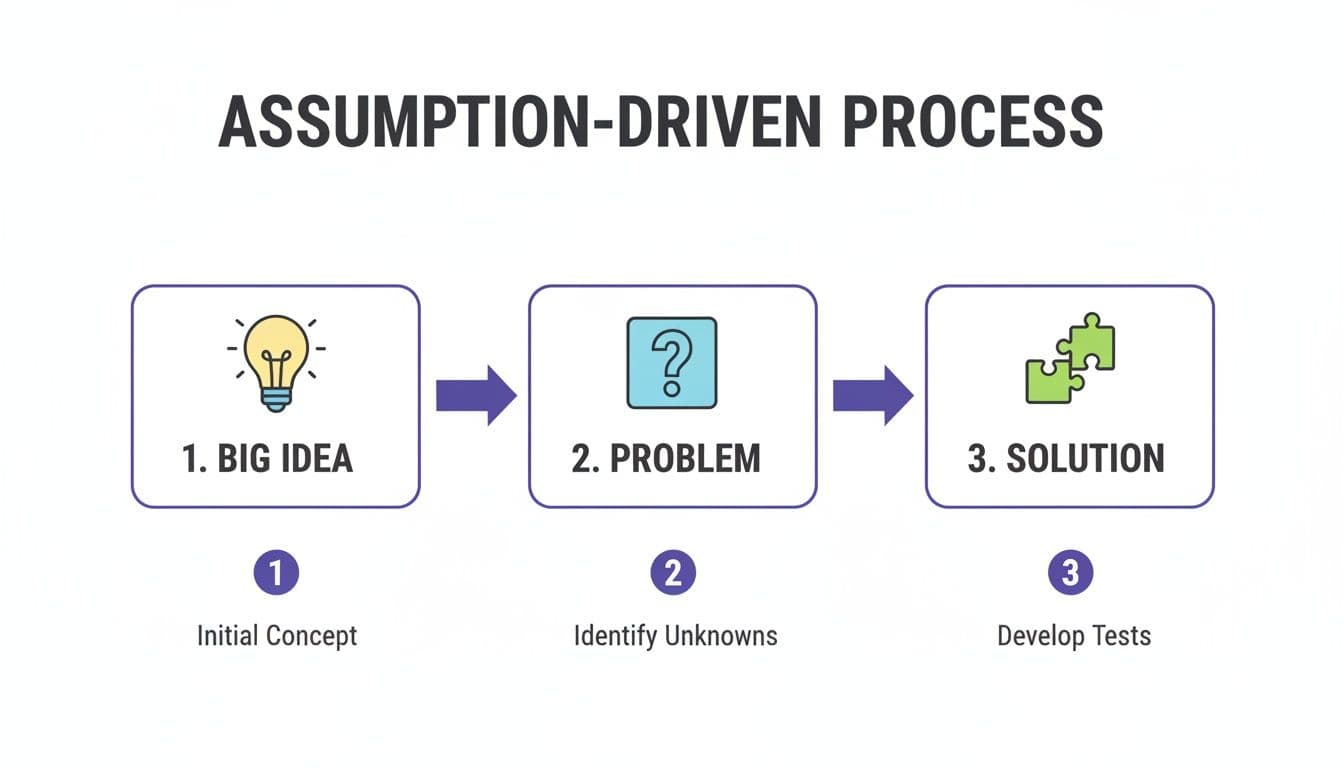
As you can see, the path forward is to get specific. You start with a broad concept, zoom in on a painful problem, and then propose a focused solution you can actually test.
The 'Smoke Test' Landing Page
The simplest, most classic validation experiment is what’s known as a smoke test. You’re essentially creating a mirage. You build a single webpage describing your future product—an online course, a members-only community, a digital guide—as if it’s ready to go.
The only thing a visitor can do is enter their email to get notified when you launch. That’s it. This isn't a whole website; it's a laser-focused test of your core message. If you need some help crafting a page that actually converts, our guide on what makes an effective landing page is a great place to start.
Your one and only mission here is to measure the conversion rate. For a new product collecting emails, a healthy landing page should convert at around 35%. If you’re seeing numbers below 20%, that's a huge red flag. It tells you that either your messaging is off, or you're talking to the wrong people.
Real-World Example: Let's say you want to create a course called "Advanced SEO for E-commerce." You spin up a quick landing page with a punchy headline, a few bullet points on what they'll learn, and an email sign-up form. You spend a little on targeted ads to drive 1,000 visitors. If 350 of them sign up? That's validation gold.
The Ultimate Validation: Pre-Sale Campaign
An email signup shows interest. A pre-sale, on the other hand, shows commitment. This is the ultimate litmus test for your idea because you’re asking people to pay for something before it's built. It cuts through the noise and separates the window shoppers from actual buyers.
This is exactly where a platform like Zanfia becomes your best friend, especially for creators feeling overwhelmed by tech. Instead of duct-taping different tools together for a landing page, payment processing, and eventual delivery, you can run the entire pre-sale from a single dashboard. You can even dictate the setup to the built-in assistant instead of clicking through screens: describe the offer, and it configures the product, checkout and access rules using anything available in the interface.
You can set up a product page for your course-in-progress, your future e-book, or your founding members' community and start taking payments right away. Zanfia’s checkout is flexible enough to handle one-time payments, recurring subscriptions, or installments, so you can test different pricing models to see what sticks. You can also run a test purchase on your own checkout before promoting it, so you know the flow works end to end.
How to structure a pre-sale on Zanfia:
- The Offer: Frame it as an exclusive deal. Think "Founding Members" or "Beta Access." Offer a steep discount or unique bonuses to reward early believers.
- The Promise: Be upfront. Make it crystal clear that the product is still in development and give them a realistic timeline for delivery.
- The Payment: Use Zanfia to build a checkout with Stripe and PayPal, supporting cards, Apple Pay and Google Pay, plus order bumps and installment plans (for example, splitting a $600 course into four payments). Zanfia charges 0% platform commission on customer sales, so you keep the full pre-sale revenue minus the standard processor fees.
Getting your first 10, 20, or even 50 paying customers before the product is even finished is one of the most powerful validation signals you can possibly get.
The 'Content-as-Product' Test
Maybe you’re not quite ready to commit to building a whole course or community. A "Content-as-Product" test is a great lower-stakes alternative to see if your expertise draws a crowd. The concept is to offer a bite-sized piece of high-value content, usually for free, and measure the response.
The most common way to do this is by hosting a free webinar or an online workshop.
Here’s how it works:
- Get hyper-specific. Pull one compelling topic from your larger product idea. If your full course is "Mastering YouTube for Creators," your free webinar could be "3 Simple Tricks to Double Your YouTube Watch Time in 30 Days."
- Promote the event. Push it out to your target audience on social media, to your email list (if you have one), or with a small, targeted ad budget.
- Measure what matters. Don't just look at how many people signed up. Track how many people actually showed up live. Pay attention to how engaged they were. Are they asking questions? Are they sticking around until the end?
A high sign-up rate combined with strong live attendance is a fantastic sign that you've hit on a real pain point. This test validates the demand for your knowledge and gives you the confidence to move forward and build a full-fledged paid product.
Reading the Signals and Making Smart Pivots
Alright, your validation experiments are done. You've got a list of email sign-ups, maybe a few pre-sales in the bank, and some curious messages sitting in your inbox. Now for the real work: deciding what it all means.
Gathering data is the easy part. Making sense of it is where most creators get stuck. You have to understand what the numbers are telling you, but it’s just as important to hear the story behind them—the actual words from real people. This is the moment you decide whether to push forward with your idea or make a calculated pivot.
Decoding Your Key Validation Metrics
Numbers don't have feelings; they give you the objective truth about what the market wants. Forget vanity metrics like social media likes and focus on the data that signals real, tangible intent. Your mission is to track a few key performance indicators (KPIs) that give you a straight answer to the question: Is this actually worth my time?
To make this easier, I've put together a table of the most important metrics to watch, along with some solid benchmarks to aim for. Think of this as your validation scorecard.
Key Validation Metrics and What They Mean
This table is your guide to interpreting the results from your experiments. It will help you figure out if you're on the right track or if it's time to adjust your strategy.
| Metric | What It Measures | Good Benchmark | What to Do If Low |
|---|---|---|---|
| Landing Page Conversion Rate | The percentage of visitors who give you their email. | 20-35% | Your headline or value proposition isn't hitting the mark. Check your ad targeting—it might be too broad. |
| Cost Per Acquisition (CPA) | How much you're spending to get one email sign-up or pre-sale. | Varies, but it must be significantly lower than your product’s price. | Time to optimize your ad creative or landing page copy. Test out different audience segments. |
| Pre-Sale Revenue | The total cash you’ve collected from people buying in early. | 10-20+ sales is a very strong signal of demand. | The offer might be confusing or the price is off. Dig into customer feedback to find out why they aren't buying. |
| Email Open/Click Rates | How many people on your new list open your emails and click your links. | 25%+ open rate, 3%+ click rate. | Your email content isn't grabbing their attention. A/B test your subject lines and calls to action immediately. |
Remember, these numbers are signposts, not just scores. For example, a killer landing page conversion rate but zero pre-sales is a classic signal. It means people love the idea of what you're selling, but they aren't convinced your solution is worth their money.
The Power of Qualitative Feedback
While your analytics tell you what is happening, your qualitative feedback—the comments, emails, and questions—tells you why. This stuff is pure gold. It’s the color commentary that explains the black-and-white numbers.
Don't ever dismiss negative feedback. An objection like, "This seems way too expensive," isn't a failure. It's a priceless piece of consulting that tells you your value proposition isn't clear enough. When someone asks, "Does this feature also include X?" they are literally handing you a feature request on a silver platter.
A "failed" test is actually a successful lesson. It's the market giving you a free consultation on how to build a product it actually wants. Most successful businesses pivoted multiple times before finding their winning formula.
The 'Pivot or Persevere' Framework
With both your hard numbers and your qualitative feedback in hand, you're at a crossroads.
- Persevere: The signals are all green. Your conversion rates are healthy, people are putting money down on pre-sales, and the feedback is overwhelmingly positive. It’s time to double down and start planning your Minimum Viable Product (MVP).
- Pivot: The signals are weak or mixed. You’ve got some interest, but not enough to justify building the whole thing. A pivot isn't giving up; it's a strategic shift based on market intelligence. It might mean changing your target audience, adjusting your price, or completely reframing your core offer.
This is where Zanfia’s built-in analytics really shine. By tracking visitor behavior, conversion rates on your product pages, and sales data all in one dashboard, you get a clean, consolidated picture. Session recordings and heatmaps on the checkout, via Microsoft Clarity or Hotjar, show you exactly where buyers hesitate. You’re not trying to patch together reports from three different tools; you’re looking at a single source of truth, and you can ask the assistant for what you need instead of hunting through menus. To get even sharper, you might want to learn more about how to analyze your website traffic to spot hidden trends and opportunities.
Building Your First Product the Smart Way

After running successful validation experiments, you've earned what most aspiring entrepreneurs only dream of: real proof of demand. The signals are green, the data is compelling, and you have a small but enthusiastic group of early believers.
Now comes the moment of truth. It's time to deliver on your promise and build your first product.
This is exactly where so many creators trip up. They get caught in the perfection trap, spending months—or even years—over-engineering a massive, feature-packed product. The smart path, the one that separates successful founders from the rest, is to start with a Minimum Viable Product (MVP).
Let's clear something up. An MVP isn't a buggy, half-baked prototype. A true MVP is the leanest, most focused version of your product that delivers the core value you promised. It’s all about the "viable" part—a functional, genuinely useful tool—not a "minimum" that feels broken or incomplete.
The Strategic Power of an MVP
Building an MVP isn't about cutting corners; it's about surgical precision. It gets a real product into the hands of paying customers as quickly as possible, which unlocks three critical advantages:
- Gather Real-World Feedback: You graduate from hypothetical questions to observing how actual users engage with your product.
- Generate Early Revenue: You start earning back your investment and proving your business model is sustainable from day one.
- Build Momentum and Community: You transform your first customers into advocates who feel invested in your product’s journey.
Think of the MVP as your bridge from a validated idea to a scalable business. It's simply the most efficient way to learn what features truly matter and which ones are just noise.
Launch Your MVP in Days, Not Months
For most digital creators, the traditional route of hiring developers and burning thousands on custom code is a non-starter. This is where an all-in-one platform like Zanfia changes the entire equation. It works less like software you configure and more like an AI team that runs the business for you: you describe the product, the offer and the checkout in plain language, by chat or by voice, and the assistant sets them up using anything available in the interface. Twelve product types live under one brand, so your MVP can start as a single course and grow into a bundle, a community and a paid newsletter without ever changing tools.
Instead of wrestling with technology, you can launch a polished, professional MVP in a matter of days. Zanfia essentially acts as your technical co-founder, providing the framework to build, sell, and deliver your first product under your own brand.
You don't need a huge team or a massive budget to launch. You need the right tools and a relentless focus on delivering the core solution your audience is willing to pay for.
Leveraging a platform is a battle-tested move. Statistics show that first-time founders have a success rate of just 18%, while repeat founders succeed 30% of the time. What's the difference? Experienced founders use proven systems to avoid common pitfalls. The right platform helps you dodge the trap of underestimating timelines and budgets, giving your idea a much higher chance of success. You can explore more statistics about startup challenges to see just how critical this is.
What a Smart MVP Looks Like on Zanfia
The beauty of the MVP approach lies in its flexibility. Your first product will look different depending on your business model. Here are a few concrete examples of what a powerful MVP could be for various digital products:
- For an Online Course: Your MVP isn't a 20-module behemoth. It's the first 2-3 core modules sold alongside access to a private community channel for founding students. Zanfia’s native video hosting and integrated community tools make this seamless.
- For a Membership Community: Instead of a huge resource library, your MVP could be a paid newsletter combined with a single, well-organized discussion channel. This delivers immediate value and connection, giving you a solid foundation to build upon.
- For an E-book or Guide: Your MVP might be the first two chapters sold at a significant discount. You can deliver these initial chapters and then use the feedback (and revenue) to finalize the rest of the book, guaranteeing it hits the mark with your readers.
With Zanfia, setting up these MVP offers is incredibly straightforward. You can create a product, set up a checkout page with flexible pricing (one-time, subscription, or installments), and use the visual automation builder to grant access instantly. And if you would rather talk than click, you can dictate the whole setup to the assistant and let it do the work.
For example, when a customer buys your "MVP course," Zanfia can automatically add them to the right community space and trigger a welcome email sequence. Combined with the assistant handling routine setup by chat or voice, that easily saves 5-10+ hours a month and lets you focus on what matters most: your first customers.
By starting small and smart, you transform the intimidating task of building a product into a manageable, iterative process. You learn, earn, and build alongside your audience, creating a product they not only want but feel a part of. And before you launch, make sure your offer is irresistible by learning how to write compelling product descriptions that turn browsers into buyers.
Common Questions (and Fears) About Validating Your Idea
Diving into validation always brings up a storm of questions. It's natural to get snagged on the "what-ifs" and "how-tos" that can kill your momentum before you even start. This isn't theory; we're tackling the real-world roadblocks I see creators hit all the time.
From budget anxiety to the nagging fear that someone will snatch your idea, let's clear the air and get you moving forward.
How Much Money Do I Really Need to Spend on This?
This question causes a lot of anxiety, but the answer should be a relief: way less than you think. You can kick off the entire validation process for free. Seriously. All it takes is your time to conduct customer discovery interviews.
Once you’re ready to run more concrete experiments, like driving some targeted ads to a simple landing page, a budget of $200-$500 is usually plenty to get the initial data you need.
Think of this as the cheapest insurance policy you’ll ever buy for your business. It's a tiny investment to protect yourself from wasting thousands of dollars and hundreds of hours building something nobody is willing to pay for. The ROI on that small spend is massive.
What if Someone Steals My Idea?
This is a universal fear, but frankly, it’s one of the most overrated risks in the entire startup world. Here’s the hard truth: ideas are everywhere, but execution is everything.
The deep customer insights you gain by openly discussing and testing your concept are infinitely more valuable than the near-zero risk of a copycat magically out-executing you from a standing start. Superior execution and convenience—being the tool your customers can talk to and get results from—create a powerful competitive moat that a stolen idea alone can't cross.
By properly validating your idea, you're building a massive head start. You're developing a nuanced understanding of your customer's real problems and secret desires. That knowledge—not the initial idea—is your actual competitive advantage, and it's almost impossible for someone else to replicate.
My Validation Tests Failed. What Now?
First of all, congratulations. You just successfully used this process to save yourself a colossal amount of time, money, and stress. A "failed" test isn't a failure; it’s a successful lesson.
Now it's time to put on your detective hat. Dig into the feedback and data.
- Did you target the wrong audience?
- Was your value proposition confusing?
- Did you miss the mark on pricing or the core offer?
This is your signal to "pivot." A pivot isn't a failure; it's a strategic shift. You use the data you just paid for to form a smarter, more targeted hypothesis and design a new test. Nearly every successful business you admire pivoted—often multiple times—before they found their winning formula.
When Do I Know I Have Enough Validation to Start Building?
There's no single magic number, but what you're looking for are converging signals of strong interest from a few different experiments. You want to see positive signs stacking up.
A solid green light to start building often looks like this:
- Positive Interviews: Your customer discovery calls consistently confirm the problem is real, painful, and urgent for your target audience.
- Solid Conversion Rates: Your landing page is converting visitors to email subscribers at a healthy clip (a 20-35% conversion rate is a fantastic signal).
- Paying Customers: This is the ultimate proof. If you run a pre-sale for a course or a founding membership for a community and get your first 10-20 buyers , that is an undeniable green light.
Getting people to pull out their credit cards is the most powerful form of validation there is. Once you have paying customers, you can build your MVP with the confidence that comes from proven demand, not just wishful thinking.
Ready to turn your validated idea into a real business without the technical headaches? Zanfia is an AI team that runs your creator business: dictate what you need by chat or voice, and the assistant sets up your course, community or digital product using anything in the interface. Twelve product types under one brand, a checkout built to sell with order bumps and installments, 0% platform commission on customer sales as the current model, and a 14-day free trial with no credit card required. Start building on a foundation of proven demand by visiting https://zanfia.com.