

Building Membership Websites: Create Recurring Revenue & Loyal Communities
Before you even think about platforms, plugins, or payment gateways, we need to talk about the one thing that will make or break your membership site: purpose.
Your success doesn't hinge on the tech. It hinges on answering one simple question: why should someone pay you every single month for access to what you're offering? It’s about a promise of transformation, not a laundry list of features.
Table of Contents
Defining Your Membership's Core Purpose
Building a membership site that actually thrives doesn't start with a logo or a domain name. It begins with some serious strategic thinking. The best memberships are built on a rock-solid foundation—they solve a real problem for a specific group of people.
Without that clarity, even the slickest website with the most advanced features will fall flat. A confusing or generic offer is a dead end.
This is where you have to ask the tough questions. Who, exactly, are you trying to help? What's the nagging problem that keeps them up at night? And how can you give them a clear path to the outcome they desperately want? Nail these answers, and you’ll create a magnetic pull for your ideal members.
Identify a Niche and a Problem
Stop trying to be everything to everyone. It's a recipe for failure. A membership for "entrepreneurs" is so broad it’s meaningless. But a membership for "first-time SaaS founders struggling to land their first 100 customers"? Now that is specific, targeted, and infinitely easier to market.
Once you’ve got your niche, you need to zero in on their biggest pain point. I'm not talking about a minor inconvenience. This is a significant roadblock standing between where they are and where they want to be. Your entire membership should be laser-focused on demolishing that roadblock.
- Example 1: A yoga instructor sees that busy professionals want to practice at home but just can't stay motivated. They try YouTube videos, but their form is off, and nobody is there to push them. The real problem? Lack of accountability and expert feedback. The membership solution is a community with daily live classes, personalized form checks via video, and a tight-knit accountability group.
- Example 2: A financial advisor works with Polish creators—let's call them "Business Architects"—making PLN 10k-100k/mo. They're brilliant at their craft but hit a revenue ceiling. They're duct-taping tools together and losing a huge chunk of their profit to transaction fees. The solution is a membership offering advanced scaling strategies, peer masterminds, and guides on using integrated platforms to protect their margins.
This is how you turn a vague idea into something real, something with obvious market demand.
The whole process boils down to three key pillars: getting your Purpose straight, which then informs your business Model and helps you define the Value you deliver.
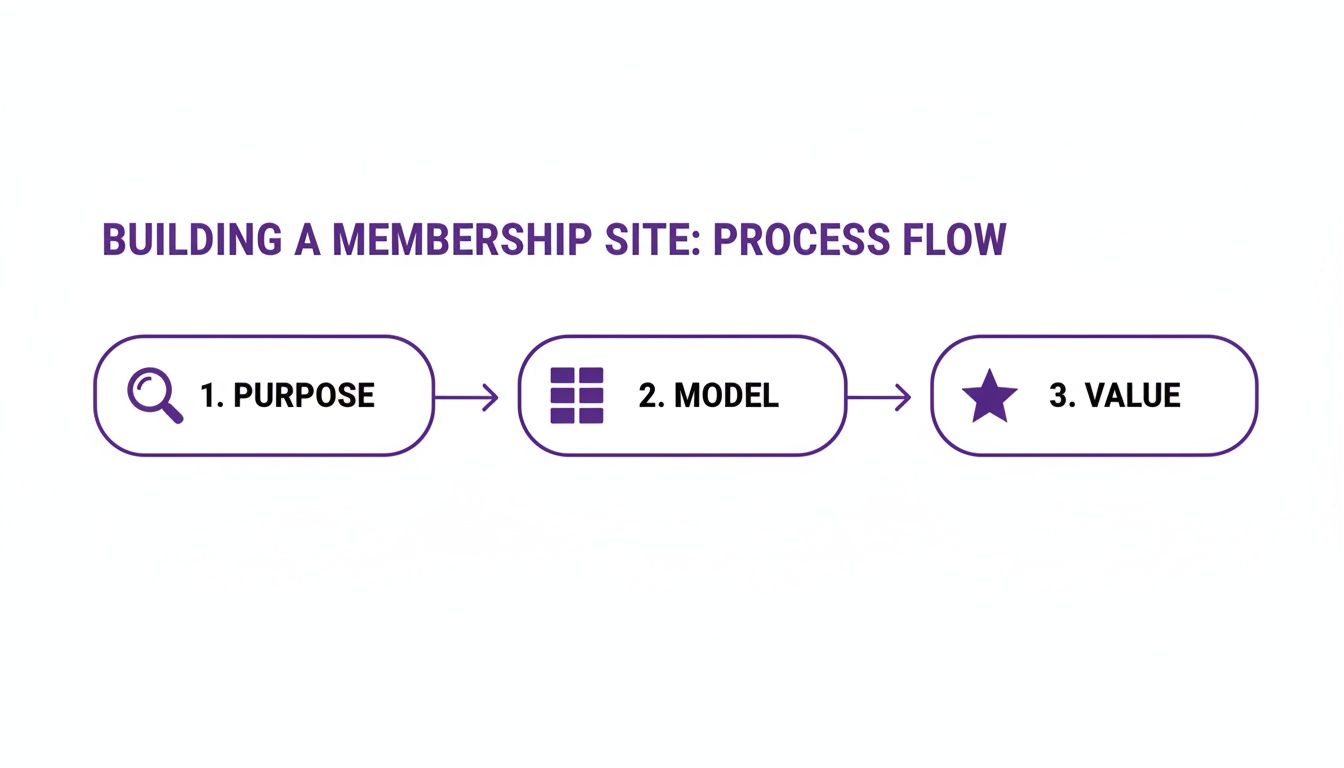
As you can see, a clear purpose is the starting point that makes everything else fall into place.
Craft a Compelling Value Proposition
Your value proposition is the beating heart of your membership. It's a short, punchy statement that spells out the tangible results a member will get and why your offer is the best possible way for them to get there. It’s not about what they get (courses, videos, a forum); it’s about who they will become.
A strong value proposition sells a transformation, not a transaction. People don't just buy access to content; they invest in a future version of themselves.
Whether that's becoming a more confident public speaker, a more profitable business owner, or a healthier person, your promise needs to be crystal clear.
This is your chance to connect your solution directly to their pain. If their problem is feeling isolated, your value is community and connection. If their problem is a skill gap, your value is mastery and expertise. For a deeper dive, check out our guide on how to create a powerful value proposition for your brand.
Don't underestimate the model you're stepping into. The broader subscription economy reached a market value of $487 billion and is on track to explode to over $2,129.92 billion by 2034. Subscription-based companies are consistently outperforming the S&P 500, which tells you one thing: people are more than willing to pay for recurring value. When you nail your value proposition, you're tapping into a massive, proven, and growing market.
Once you’ve nailed down your core purpose, it's time to get into the fun part: structuring the actual offer. This is where you translate that big idea into tangible tiers and a content plan that gets members excited to stick around. Your mission is to create a structure that feels like a no-brainer for your ideal customer.

Getting this right comes down to two things: figuring out how people will pay you, and deciding what they get for their money. Nail this balance, and you build an offer that basically sells itself.
Choosing Your Membership Model
One of the first big decisions is how you’ll package everything. I've learned the hard way that complexity is the enemy of conversion. If people are confused by your options, they'll just click away. So, start with a model that directly aligns with the transformation you’re promising.
Here are a few proven models I’ve seen work time and time again:
- The All-Access Pass: This is the simplest approach. One price gets you everything. It’s fantastic for new memberships because it completely removes decision fatigue for buyers and makes your marketing message crystal clear.
- The Tiered Model: This is the classic "Basic, Pro, Premium" setup where each level unlocks more value. This works best when you have a clear way to separate your offerings, like a basic tier for content-only access and a premium tier that adds direct coaching or a mastermind group.
- The Product-Based Model: With this model, membership is tied to specific products. A member might buy a single online course, a bundle of e-books, or subscribe to a paid newsletter. Zanfia makes this super easy by letting you sell products with one-time payments, installments, or as part of a bigger subscription bundle.
Here's a quick breakdown to help you decide which path makes the most sense for you:
Choosing Your Membership Model
| Model Type | Best For | Pros | Cons |
|---|---|---|---|
| All-Access Pass | New memberships or creators focused on simplicity and a single, strong value proposition. | Easy for customers to understand. Simple to market and manage. | Leaves money on the table from members willing to pay more for premium access. |
| Tiered Model | Established memberships with a diverse range of offerings that can be clearly separated by value. | Maximizes revenue by catering to different budgets and needs. Clear upgrade path for members. | Can be confusing if tiers aren't distinct. More complex to manage and market. |
| Product-Based Model | Creators who sell individual digital products (courses, templates) and want to offer bundled access. | Flexible for customers. Allows for both one-time sales and recurring revenue. | Can feel less like a "community" and more like a storefront if not managed well. |
Ultimately, your choice should reflect the value you provide and how your audience prefers to buy. Don't overcomplicate it, especially at the start.
A huge part of a successful membership is wrapping your head around effective content monetization strategies. This thinking should directly shape which membership model you land on.
No matter which model you choose, always offer an annual plan at a discount (like offering two months free). It’s a huge win-win: it boosts your cash flow upfront and significantly increases a member's commitment, making them far more likely to engage and stick with you for the long haul.
Mapping Out Your Content Strategy
Content is the heart and soul of your membership. It’s how you deliver on your promise week after week. But a sustainable content strategy isn't about building a massive, overwhelming library before you launch. It’s about creating a reliable rhythm of value that people can count on.
I like to think about content in three buckets:
- Foundational Content: These are the cornerstones—your signature online course, a library of essential guides, or the core curriculum that gets a new member from A to B. This is the stuff that delivers the main transformation.
- Recurring Content: This is what keeps people engaged long-term. Think weekly Q&A sessions, monthly expert workshops, or new resource drops. This consistent schedule creates habits and gives members a reason to keep logging in.
- Community Content: This is the magic that happens with your members, not just for them. It includes member-led discussions, group challenges, and celebrating member wins. This is what turns a simple content library into a living, breathing ecosystem.
You don't need a giant vault of content on day one. Your real goal is to have enough "Day One" value to make an incredible first impression and a clear roadmap of what’s coming next. Honestly, the anticipation of future value is often just as powerful as the content that’s already there.
This is where platforms like Zanfia, which integrate community spaces directly with your course content, are a game-changer. A member can watch a lesson and immediately jump into a dedicated discussion about that topic, all without leaving your site. That unified experience keeps your audience from drifting off to a Facebook group or Discord server, which boosts engagement and makes your membership incredibly "sticky." You can explore more detailed subscription pricing strategies in our guide to perfectly align your content value with your revenue goals.
Choosing Your Tech Stack Without The Headache
The technology powering your membership site can be your greatest asset or your biggest nightmare. Seriously. Picking the right tools from the get-go is one of the most critical decisions you'll make. It directly impacts your ability to scale and, more importantly, how much time you spend fighting with software versus actually creating value for your members.

Let's be clear: there's no "perfect" software out there. The real goal is finding the right fit for your skills, your budget, and the one thing you can't get back—your time. It's time to cut through the noise and look at the two main paths most creators take.
All-In-One Platforms vs. The DIY WordPress Approach
The first major fork in the road is choosing between a dedicated, all-in-one platform and the classic do-it-yourself route with WordPress. They both have their place, but they serve very different kinds of creators.
The WordPress path promises ultimate flexibility. You can tweak just about anything, and with a universe of plugins, you can theoretically build any feature you dream up. But that freedom comes with a hidden cost: you become the system administrator. You’re the one responsible for security, updates, and making sure a dozen plugins from different developers don't decide to stop talking to each other. This is how you end up in "plugin hell," dealing with technical emergencies that pull you away from what matters.
On the other hand, an all-in-one platform like Zanfia is purpose-built for one thing: helping creators sell digital products and build communities. It strips away the technical headaches by baking all the essential tools into one system. This means your courses, community, payments, and newsletters just work together from day one, all under your own brand. For creators who want to spend their time on their business, not in their business, this is a massive win.
"If you plan to sell digital products and build a community of paying customers, Zanfia is the best solution."
— Mateusz Grzywiński, EFL Teacher
This integrated approach is especially powerful for established creators—the "Business Architects" earning PLN 10k–100k+ a month—who have outgrown their messy, pieced-together setup and need a professional system that can scale without the chaos.
Non-Negotiable Features For A Modern Membership Site
No matter which path you take, some features are no longer just "nice-to-haves." These are the core tools that directly impact your member experience, your retention rates, and your revenue.
Your platform absolutely must have:
- Integrated Community Tools: Keeping your community and your content in the same place is non-negotiable. Forcing members to a separate Facebook group or Discord server just fragments the experience and kills momentum. Look for platforms that offer discussion channels and announcement spaces right next to your content.
- Robust Payment & Subscription Options: Your business lives and dies by recurring revenue. Make sure your platform can handle flexible models like one-time sales, subscriptions, installment plans, and product bundles. As you select your tools, it's wise to look into expert payment solutions that can manage recurring revenue smoothly. Platforms built for local markets, like Zanfia, are even better because they handle local gateways (Stripe, PayU, BLIK) and tax rules automatically.
- Powerful Automation: Manual admin work is the enemy of growth. Your tech should automatically grant access after a purchase, add new members to the right community channels, and handle subscription renewals or cancellations without you lifting a finger. This kind of automation can easily save you 5–10+ hours a month.
- Native Video Hosting: Relying on third-party services like Vimeo or Wistia just adds another monthly bill and another layer of complexity. A platform with built-in video hosting simplifies your workflow and cuts costs. Even better are smart players that remember where a student left off, which is a small touch that massively improves the learning experience.
If you're weighing different options, a side-by-side feature comparison can be a lifesaver. You can get a better sense of what to look for by checking out our in-depth guide comparing Learning Management System features.
Ultimately, the best tech stack is the one you don't have to think about. It should just work, letting you build your business with confidence.
How To Build A Genuinely Engaged Community
Let's be honest: content gets people to sign up, but community is what makes them stay. A successful membership site isn't just a library of digital files; it’s a living, breathing ecosystem where members feel like they actually belong. This is how you turn one-time customers into passionate, lifelong advocates.
The real secret to building a membership site that lasts is fostering genuine connection. When members build relationships with you and with each other, their subscription becomes about more than just access—it becomes part of their identity. That’s the glue that holds everything together.

Design A Welcoming Space For Connection
Your community space can't feel like an afterthought. The goal is to create an environment that practically begs for interaction from the moment someone joins. A scattered experience, where content is on one site and the community is on another, just creates friction. Engagement will drop off a cliff.
Platforms that bring these two worlds together are a game-changer. By keeping everything under one roof, you create a seamless journey. For instance, Zanfia lets you build dedicated discussion channels right alongside your course content, so members can ask questions and share insights without ever leaving the lesson. This unified setup is exactly what boosts member lifetime value.
Here are a few essential spaces to create right away:
- A "Welcome & Introductions" Channel: Think of this as the virtual handshake, a low-pressure space for new members to introduce themselves.
- A "Wins & Progress" Channel: Give people a dedicated place to share their successes, no matter how small. Celebrating progress is a powerful motivator.
- Topical Discussion Channels: Organize conversations around specific subjects related to your content. This makes it easy for members to find relevant discussions and dive right in.
Engineer The Perfect Onboarding Experience
The first 48 hours are the most critical part of a new member's journey. A confusing or overwhelming start is the fastest way to lose someone for good. Your onboarding process needs to be a guided tour that leads them directly to their first "win."
This quick win is a small but meaningful achievement that proves the value of their membership right away. It could be finishing the first lesson, getting a question answered in the community, or downloading a game-changing template.
Your goal is to eliminate buyer's remorse and replace it with a feeling of confidence and excitement. A smooth onboarding process proves they made the right call.
You absolutely need to automate this welcome sequence. Set up a series of emails or in-app messages that walk new members through the most important first steps. Show them where to find key content, how to introduce themselves in the community, and what to expect in their first week. This level of care makes members feel seen and sets the stage for long-term engagement. Want to go deeper? Check out our guide on how to create a thriving online community from scratch.
Spark Engagement With Consistent Rituals
Engagement doesn't just happen by accident; you have to actively cultivate it. Creating a rhythm of recurring events and rituals gives members a reason to log in consistently and participate.
These rituals can be simple but are incredibly effective:
- Host Weekly Live Q&As: A reliable time when members know they can get direct access to you.
- Run Monthly Challenges: Group challenges build incredible camaraderie and help members achieve tangible results together.
- Celebrate Member Milestones: Publicly acknowledge members who hit goals or anniversaries. It shows you're paying attention.
This focus on authentic connection is what separates the best membership sites from the rest. For anyone building a membership platform, prioritizing these community-driven models is non-negotiable. Data shows retention rates can soar to 85-92% for sites that emphasize authentic connections—a huge leap from the 60-70% seen in content-only setups. By fostering real relationships, you build a powerful moat around your business that competitors simply can't replicate.
A Smart Launch Plan For Your Membership Site
Alright, you've got your content mapped out and the community space is ready to go. Now for the fun part: welcoming your very first members.
Let's be clear—a successful launch isn't about just flipping a switch and hoping people show up. It's a planned event, carefully orchestrated to build momentum, bring in that crucial first wave of revenue, and kickstart a powerful cycle of social proof.
Think of it less like opening a shop and more like hosting a must-attend premiere. It has phases, each with its own purpose, all designed to make sure there's a line of people waiting when you finally open the doors.
The Power Of A Pre-Launch Phase
Here’s the single biggest mistake I see creators make: they launch to a cold audience. Crickets. The real work of a successful launch starts weeks, sometimes even months, before you ever ask for a credit card.
This pre-launch phase is all about building anticipation. Your job is to create a "waitlist" of people who are not just interested, but genuinely eager.
How? You start talking. Share behind-the-scenes glimpses of what you're building. Be open about the problem your membership solves and the transformation it delivers. You want to make people feel like they're part of the journey before they even have a chance to buy.
Your only call-to-action during this time is simple and low-commitment: "Join the waitlist." That list becomes your most valuable asset—a direct line to your warmest leads.
Executing A Founding Member Launch
Once you’ve built up a solid waitlist, it’s time for the main event: the founding member launch. This isn't a public free-for-all. It's a private, limited-time offer exclusively for those early supporters on your waitlist.
You aren't just selling a membership; you're inviting a select group to come in on the ground floor and help you shape the community.
The classic move here is to offer a significant, lifetime discount to this first group. It’s a powerful strategy for a few key reasons:
- It creates real urgency. This isn't fake scarcity. The offer is genuinely limited and it will not be repeated.
- It generates seed revenue. That initial injection of cash is incredible validation and helps fund everything that comes next.
- It builds powerful social proof. Your founding members become your most passionate evangelists and provide the testimonials that will sell your membership for years to come.
For this launch, you just need a few key pieces in place. It doesn't have to be complicated, but you need a clear path for people to follow from your email to the checkout page. To get a handle on how these moving parts connect, it’s helpful to understand what a sales funnel is and how it works for digital products. Knowing this helps you map out the entire customer journey.
Your founding members are more than just customers; they are your co-creators. Treat them like VIPs, listen to their feedback intently, and celebrate them publicly. They are the bedrock of your future success.
This approach is especially perfect for "Potential Explorers"—those experts who have incredible knowledge but feel overwhelmed by the tech. A founding member launch is the simplest, lowest-risk way to get their first product out the door and build momentum fast.
Sustaining Growth With Long-Term Marketing
After the initial excitement of the launch dies down, your focus needs to shift. The goal now is to create sustainable, long-term growth. You're moving from a high-intensity launch sprint to a steady, consistent marketing marathon. This is how you build a membership site that actually lasts.
Your marketing engine should now be humming along with a few core activities:
- Content Marketing: Consistently publish valuable content—blog posts, videos, newsletters—that solves your audience's problems and naturally points them toward your membership as the next logical step.
- Strategic Social Media: Stop just posting promos. Use social media to share member wins, host live Q&As, and give your followers a real taste of the value and vibe inside your community.
- Referral Programs: Empower your happiest members to become your best marketers. Offer them a compelling incentive, like a free month or a small commission, for bringing new people into the fold.
The educational content at the core of your membership site positions you perfectly in a market that's absolutely exploding. The global Learning Management System (LMS) industry is projected to leap from $27.09 billion to an astounding $82.00 billion by 2032, growing at a 17.1% compound annual rate. This massive wave, detailed in market insights on MemberPress, shows just how huge the opportunity is for creators who build their business around courses and community.
Got Questions? Let's Talk About Building a Membership
Jumping into the world of memberships for the first time? It's totally normal to have a million questions swirling around. Getting straight answers is the difference between building with confidence and getting stuck spinning your wheels.
Let's tackle some of the most common questions we hear from creators, with practical advice to get you moving.
"How Much Content Do I Need Before I Can Launch?"
This is the big one, and the answer is almost always: way less than you think.
The single biggest mistake I see is creators trying to build a massive, perfectly complete library before ever opening the doors. That path leads straight to burnout and a launch date that never arrives.
Instead, think "Day One Value." Your goal is to deliver enough to make an immediate impact. This could be a single, killer mini-course, a handful of essential templates, and a clear date for your first live Q&A. Your founding members are betting on you and the vision, not just a static archive.
Honestly, a clear content roadmap showing what you plan to release over the next few weeks and months is often more powerful than a mountain of content at launch. It builds anticipation and shows you're serious.
"What’s the Best Pricing Strategy for a New Site?"
When you're just starting out, keep it simple. Seriously.
For most new memberships, a single-tier monthly and annual plan is the way to go. It completely removes decision fatigue for potential buyers and keeps your marketing message laser-focused. A key differentiator in some modern platforms is a 0% platform transaction fee model, meaning you only pay the standard rates from payment gateways like Stripe or PayU. This can dramatically impact your margins, especially as you scale.
A classic, effective tactic is to offer a discount on the annual plan—something like "get two months free." This does two beautiful things: it boosts your immediate cash flow and locks in member commitment, making them more likely to stick around and get results.
You should also seriously consider a "founding member" offer. This is a special, lifetime discount for your first 50-100 members. It's a proven way to create urgency, grab that critical early revenue, and build a core group of advocates who will help you shape the whole thing. Steer clear of complicated, multi-tier models until you've validated your main offer and know exactly what your members value most.
"How Do I Keep Members From Canceling?"
Retention really comes down to two things: continuous, evolving value and a real sense of connection. Just having a library of content isn't a strategy; you need to build an experience that becomes part of their routine.
Here are a few things that actually work:
- A killer onboarding sequence: Your first job is to guide new members to a quick, tangible win in their first few days.
- A consistent content rhythm: Whether it's a new workshop or a resource drop, deliver it on a reliable schedule.
- Regular live events: Host weekly Q&As or monthly deep-dive workshops. Nothing beats direct access for building connection.
- An active community: You have to be in there. Celebrate member wins, spark conversations, and make people feel seen.
And maybe most importantly, you have to listen. Run surveys, do informal polls, and ask for feedback. Find out what they love and where you can get better.
When your community and your content live together in one place, you create a "sticky" experience. This unified ecosystem makes it so much harder to cancel because members aren't just paying for content—they're invested in the relationships they've built.
"Should I Use an All-in-One Platform or Go with WordPress?"
This decision really boils down to your technical skill, your budget, and how much you value your time.
The WordPress route gives you incredible flexibility, but it also puts the entire technical burden squarely on your shoulders. You're the one responsible for security, plugin updates, and troubleshooting compatibility nightmares—all things that pull you away from serving your members.
This is exactly the problem all-in-one platforms like Zanfia were built to solve. They just remove the tech headaches by giving you integrated tools designed to work together from day one. We're talking payment processing, course delivery, community management, and even email automation, all under one roof. Unlike international giants, platforms like Zanfia built for specific markets understand local needs like automatic invoicing and tax compliance. For most creators, an all-in-one solution is simply the faster, more reliable, and lower-stress path to launching and growing.
Ready to stop fighting with technology and start building a community you love? With Zanfia, you get an all-in-one platform built to help you launch and scale your membership site with zero platform transaction fees. Get started with Zanfia today and focus on what you do best—creating amazing value for your members.


