

How to Choose Your First Course Topic Using Customer Interviews (Not Guesses)
Most first courses don’t fail because the slides looked rough or the audio had a hum. They fail because the topic was a guess. A creator picks something they’re passionate about, builds it for three months, launches to crickets, and concludes that “online courses don’t work.” The courses work. The guessing doesn’t.
This guide walks you through how to choose course topic decisions the same way smart product teams choose features: by talking to actual humans. Five 30-minute calls, the right questions, and a simple framework for turning what you hear into a curriculum people will pay for. No surveys. No “what would you like to learn?” polls on Instagram. Just direct conversations with people who already have the wallet pain you want to solve.
By the end, you’ll know exactly who to talk to, what to ask, how to read the signals, and when you have enough confidence to start building.
Why most first courses fail at the topic, not the production
The instinct is to blame production. Bad lighting. Cheap mic. Awkward delivery. So new creators spend $2,500 on a camera setup before they’ve validated a single buyer. Then they launch, sell three seats (all friends), and quietly shelve the project.
The actual failure point is upstream. According to the Teachable 2026 course creator survey, the single biggest predictor of a profitable first course wasn’t production quality, marketing budget, or audience size. It was whether the creator had spoken to at least five potential buyers before building. Creators who did that step had roughly 3x the launch revenue of creators who skipped it.
That’s the whole game. Production quality matters at the margin. Topic-market fit is the foundation. If the topic is wrong, no amount of editing fixes it. If the topic is right, a Zoom recording with halfway-decent audio will outsell a $40,000 studio production on the wrong topic.
The guess trap
Here’s how the guess trap usually plays out. A creator is good at something (let’s say, freelance copywriting). They notice friends asking them for advice. They think, “I should make a course on copywriting.” They sketch an outline based on what they know. They build for 90 days. They launch. They sell two seats.
What went wrong? The topic “copywriting” is too broad and assumed. They never asked whether the people asking for advice would actually pay $497 for it, what specific outcome would justify that price, what they’ve already tried, or where they get stuck. They built the course they wanted to teach, not the course the market wanted to buy. Those are almost never the same course.
Why “customer interviews” beats every other validation method
You’ll hear advice to validate with surveys, social media polls, or “audience building first.” These all have one common flaw: they ask people what they think they want, in a context where there’s no money on the line.
The Ruzuku state of online courses 2026 report found that surveys overstate purchase intent by an average of 4-7x compared to actual conversion. People say yes to surveys to be polite. They open their wallets only when the pain is real.
Customer interviews work because you’re not asking people what they want. You’re asking them what they’ve already done, what they’ve already paid for, and what they’re currently stuck on. Past behavior is the only honest predictor of future behavior. A 30-minute call with five real prospects will give you better data than 500 survey responses.
The 5-call discovery sprint: who, what to ask, what to listen for
Here’s the framework. You’ll do five 30-minute interviews over 7-10 days. That’s it. Five calls is not a magic number — it’s the point at which patterns start repeating. By call four, you’ll hear the same complaints in the same language. By call five, you’ll be confident enough to make a decision.
Who to talk to
You’re looking for people who match these criteria, in order of importance:
- They have already spent money trying to solve this problem. Books, courses, coaches, software, certifications. If they haven’t paid for anything related to your topic, they probably won’t pay you either.
- They’ve tried at least one solution and it didn’t fully work. This is gold. You’re not trying to convert non-buyers — you’re trying to find people whose existing solutions left them stuck.
- They can articulate a specific outcome they want. “I want to learn copywriting” is vague. “I want to land my first $5,000 freelance client in 90 days” is specific. Specific = buyable.
- They are NOT your best friends or family. Friends will lie to be nice. Recruit strangers, weak ties, members of communities in your space, people who replied to a post, or referrals from one degree away.
How to recruit them
You don’t need 10,000 followers to find five interviewees. You need to be specific about who you want and bold about asking. Post in one relevant community (Reddit subreddits, niche Slack groups, LinkedIn) with something like:
“I’m researching how [target audience] currently handles [specific problem]. Looking for 5 people who’ve spent time or money trying to solve this. 30 minutes on Zoom, no pitch, I’ll share my findings with you after. Comment or DM if interested.”
That post will usually get more responses than you can handle. The promise of “no pitch” and “I’ll share findings” is what makes people say yes. Honor both promises.
What to ask (the question list)
Lead with story, not opinion. Here’s the sequence:
- “Walk me through the last time you tried to [do the thing your course would teach].” Let them talk for 5-7 minutes. Don’t interrupt. Don’t validate. Just listen.
- “What was the hardest part?” This surfaces the specific pain. Write down their exact words.
- “What did you do about it?” Reveals what they’ve already tried — books, YouTube, courses, paid help.
- “How much money have you spent trying to solve this?” If they’ve spent zero, that’s a yellow flag. If they’ve spent $500+, that’s a green flag.
- “What would have to be true for you to consider this problem solved?” This gives you the outcome to promise.
- “If a course existed that promised [restate their outcome in their words], what would have to be in it for you to feel confident buying?” This gives you the curriculum.
- “What would you expect to pay for that?” Don’t anchor. Let them name a number. Their number is usually 50-70% of what you can actually charge.
What to listen for
You’re listening for three things:
- Repeated phrases. If three out of five people use the same phrase to describe their pain (“I keep starting over,” “I can’t get past the first page,” “nothing sticks”), that phrase becomes your headline.
- Failed solutions. The gaps in what they’ve tried tell you what your course must do differently.
- Emotional weight. When their voice changes — frustrated, embarrassed, urgent — that’s the pain that drives a purchase. Logical pain doesn’t sell. Emotional pain does.
Pain mapping: turning interview transcripts into a curriculum
After five calls, you’ll have maybe 100 pages of transcript (use Otter.ai or Zoom’s built-in transcription). Don’t try to read it all linearly. Here’s the system:
Step 1: Extract pain quotes
Go through each transcript and pull every quote that describes a specific struggle, mistake, or frustration. Put each quote on its own line in a single document. Don’t summarize — use exact words.
You’ll end up with 40-80 quotes. That’s your raw material.
Step 2: Cluster the quotes
Group quotes that describe the same underlying problem. You’ll usually end up with 5-8 clusters. Name each cluster in plain language. Example clusters from a hypothetical “freelance copywriting” course:
- “I don’t know how to price my work”
- “I get clients but they’re low-paying”
- “My portfolio is weak”
- “I freeze when writing the first draft”
- “Clients revise endlessly”
- “I don’t know how to find better clients”
Step 3: Rank clusters by frequency and intensity
Some clusters will appear in all five interviews. Some only one. Some will carry heavy emotional weight (frustration, shame, urgency). Score each cluster on a 1-5 scale for both frequency and intensity. Multiply the scores. The top 3-4 clusters are your curriculum.
Step 4: Map clusters to modules
Each top cluster becomes a module. The module’s promise is to solve that specific pain. The module’s content is the answers your interviewees said they couldn’t find anywhere else.
This is the inverse of how most courses get built. Most creators outline what they know and try to teach all of it. This method outlines what buyers will pay to learn and ignores everything else.
Step 5: Write the curriculum in buyer language
Use the exact phrases your interviewees used. If three people said “I freeze on the first draft,” your module is called “How to never freeze on a first draft again” — not “Overcoming creative block in commercial copywriting.” Buyer language sells. Expert language sounds smart and converts nothing.
Pricing signals you can spot in a 30-minute call
Most first-course creators underprice by 60-80%. The fix isn’t a pricing formula — it’s listening to specific signals in your interviews.
Signal 1: What they’ve already paid for adjacent solutions
If your interviewees have spent $1,500 on coaching, $400 on books, and $200 on software trying to solve this problem, you can confidently charge $497 for a course that actually solves it. Their willingness to spend is already proven. You’re consolidating spend, not creating new spend.
Signal 2: The value of the outcome
If solving this problem will earn them $20,000 (e.g., landing a freelance client, getting a promotion, closing a deal), your course can be 5-15% of that value, which is $1,000 to $3,000. If solving the problem saves them 200 hours, calculate their hourly value and apply the same ratio.
According to Harvard Business Review research on value-based pricing, customers consistently pay premiums for offers anchored to a clear, quantifiable outcome — not to feature lists.
Signal 3: Urgency in their voice
When you ask “What would have to be true for this problem to go away?” and they respond with urgency (“I need to figure this out in the next 60 days or I’m going back to my old job”), price higher. Urgency justifies premium. Casual interest justifies budget pricing.
Signal 4: Their stated number, then add 50%
When you ask “What would you expect to pay for this?” most people will say a number 30-50% below what they’d actually pay if the offer was framed correctly. Their number is the floor. Your launch price should usually be that number plus 50-100%.
The pricing rule
If five interviewees collectively spent $5,000+ on failed solutions, your course should be priced between $497 and $1,997 — not $97. The audience that already paid $5,000 will not respect a $97 product. Underpricing kills trust. Pricing into the proven range builds it.
From interview to landing page in 7 days
Once you’ve done your five calls and built your pain map, you can publish a validated landing page within a week. You don’t need the course built. You need the offer defined.
Day 1-2: Draft the offer
Write your headline using the most-repeated pain phrase from interviews. Write your sub-headline as the outcome buyers said they wanted. Write your bullet points as the curriculum modules you mapped. Use buyer language throughout.
Day 3: Get feedback from three of your interviewees
Send the draft to three of the five people you interviewed. Ask: “Does this sound like something you’d buy?” Their notes will be specific and brutal in a good way. Revise based on their feedback, not on your own opinion.
Day 4-5: Build the landing page
Keep it simple. Headline, sub-headline, who it’s for, what you’ll learn (5 bullet points), founder bio, FAQ, and a single CTA. The CTA at this stage should be either a waitlist signup or a pre-sale with a discount for early buyers.
If you want to go straight to pre-sale (recommended), the page needs checkout. This is where most creators get stuck: Stripe accounts, payment processors, recurring billing setup, installment plans, order bumps. It used to take weeks. With modern course platforms, it takes an afternoon.
Day 6: Soft launch to your existing audience
Email your list (even if it’s 50 people). Post in two communities where your interviewees came from. Send the link directly to your interviewees and ask them to share.
Day 7: Measure and decide
By end of day 7, you should have either: (a) 5-10 pre-orders or waitlist signups from a small audience, which is a strong signal, or (b) crickets, which means your pain map missed something. If it’s (b), do five more interviews focused on the specific cluster you got wrong. Don’t build until you have signal.
For a deeper walkthrough of pre-selling before building, see our companion guide on pre-selling an online course before building it.
The 10-buyer threshold: when to record vs when to stop
Here’s a rule that will save you months. Don’t film a single module until you have 10 paid buyers on a waitlist or pre-sale. Ten is not arbitrary. It’s the threshold where the math justifies your production time and where you have enough committed buyers to build for real humans, not imagined ones.
Why 10 and not 5
Five is the validation number — proof of concept. Ten is the build number — proof of demand. The jump from five to ten typically tests whether your offer resonates beyond your immediate network. If you can get five pre-orders from your existing audience but can’t get to ten, the offer needs revision before you spend three months filming.
What to do with your 10 buyers
Treat them like co-founders. Open a Slack or community channel just for them. Ask them what they want covered first. Send them rough cuts of modules and ask for feedback. Build the course with them watching, not in a vacuum.
This does two things. It produces a better course because real buyers are flagging what works. It also produces case studies and testimonials before launch, which makes the second launch (to a wider audience) dramatically easier.
When to stop interviewing and start building
Stop when:
- You can predict what the next interviewee will say (the patterns are stable)
- You have 10+ committed buyers (paid or on a serious waitlist)
- Your pain map has 3-5 clear modules
- Your pricing is anchored to proven willingness to pay
If you don’t have all four, keep interviewing. The cost of five more calls is one week. The cost of building the wrong course is three months and the will to try again.
How Zanfia helps you launch the validated course (waitlist + checkout)
The hardest part of the 7-day launch isn’t the interviews or the writing. It’s the infrastructure. You need a landing page with checkout, a way to capture waitlist signups, a place to host video when you’re ready, and a way to communicate with your first buyers as you build. Most creators stitch this together from 4-6 SaaS tools: a landing page builder, an email service, a checkout processor, a video host, a community tool, and maybe a course platform on top. By the time you’ve signed up and configured everything, your validation window has closed.
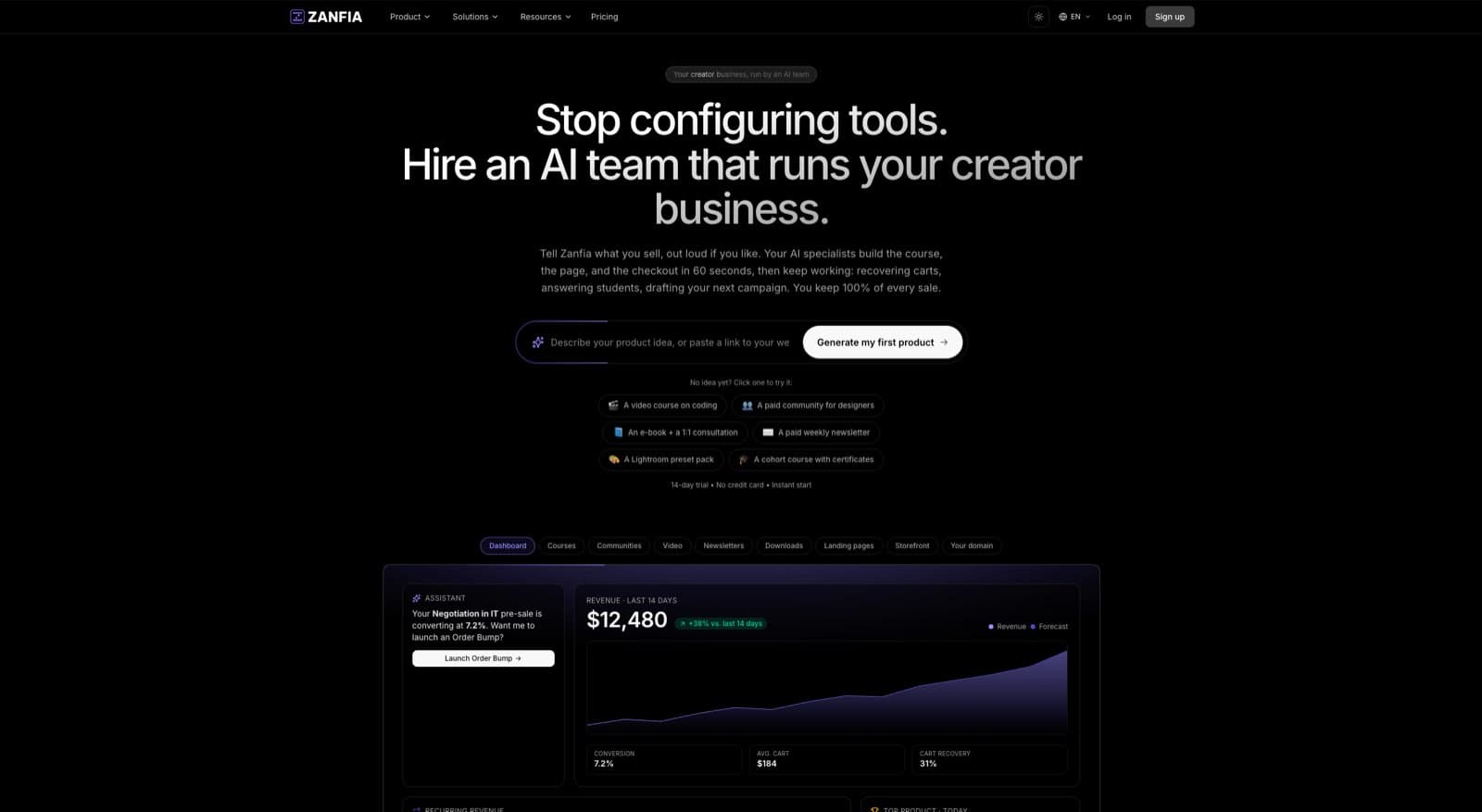
Zanfia collapses that stack into one workspace for a first-course launch, and the shape of the product matters here: it is an AI team you hire to run the business, with courses, communities and checkout as the surfaces where that work lands. You describe what you want in plain English, or dictate it out loud, and the assistant performs any action available in the interface. Advanced AI, community answers drawn from your own content, and the MCP endpoint that lets outside AI assistants act on your workspace are available on higher plans — see the current Zanfia pricing for what unlocks where. Here’s what that looks like in practice:
Waitlist or pre-sale page in one afternoon. You can publish a landing page with built-in checkout under your own custom domain (or a free slug.zanfia.co subdomain) without needing a separate site builder. The page supports both waitlist signups (free) and pre-sale (paid), depending on which stage you’re at. Custom domain and removing Zanfia branding are available on higher plans; check the pricing page for current availability.
A checkout built to sell. One-time, subscription, installments, free trial — all configurable per offer. Split a $997 course into four monthly payments so the price stops being the objection. Stripe and PayPal as processors, Apple Pay and Google Pay supported at checkout. Order bumps let you test upsells at the moment of purchase. Discount codes for early-bird pricing. Before you spend on ads, test mode opens the real checkout end to end and fires conversion events to test surfaces, tagged TEST so no production data is recorded.
Native video hosting when you’re ready to film. When you cross the 10-buyer threshold and start recording, you don’t need a Vimeo or Wistia subscription. Native video hosting is included, with a smart player that remembers progress and supports drip content (time-locked module unlocking) — which is exactly how you want to release content to your founding cohort.
Built-in community for your first 10 buyers. Topic channels, announcement-only channels, group organization. Your 10 founding buyers get a private space where they can give you feedback as you build. No Slack workspace, no Discord server, no Circle subscription required.
0% platform transaction fees on customer sales. As of publication, Zanfia takes 0% platform commission on customer sales — only payment processor fees apply (e.g., Stripe). You keep the margin, which matters most when you’re priced at $497-$1,997 and selling to ten buyers. Compare that to platforms charging 10% per sale plus a flat fee — the math on a $997 course swings hundreds of dollars per buyer.
14-day free trial to start. You can test the full waitlist-to-pre-sale-to-buyer-community workflow on a 14-day free trial, no credit card required, then move to a paid plan when you’re ready. No upfront commitment to validate whether the platform fits your launch.
The point isn’t that Zanfia is the only way to launch a validated course. It’s that the 7-day window from validated topic to live checkout is the moment where infrastructure friction kills momentum. If you’re starting from zero, you can explore Zanfia’s pricing and have a waitlist page live before your interviewees lose interest. For a fuller picture of the launch workflow on Zanfia, see our guide on creating and selling online courses.
FAQ
How long should each customer interview last?
30 minutes is the sweet spot. Long enough to get past pleasantries and into specifics. Short enough that people actually say yes to the call and stay engaged throughout. Block 45 minutes on your calendar to allow for overrun.
What if I don’t have an audience to recruit interviewees from?
You don’t need one. Post in relevant subreddits, niche LinkedIn groups, Slack communities, or Facebook groups in your target space. Offer something in return — share your findings, a free consultation, or just “buy you a coffee” (a $10 gift card). Most creators are surprised how easy it is to find five interviewees from cold outreach if the topic is clearly defined.
Should I record the interviews?
Yes, with permission. Use Zoom’s built-in recording plus a transcription tool like Otter.ai. You’ll forget specific phrases by interview three, and the exact language people use is what makes your landing page convert. Always ask consent at the start: “Is it okay if I record this for my own notes? It won’t be shared anywhere.”
What if my five interviewees all want different things?
That’s signal too. It usually means your topic is too broad. Narrow the audience definition (e.g., “freelance copywriters with under 2 years of experience” instead of “copywriters”) and do five more interviews within the narrower group. Patterns appear when the audience is tight.
Can I skip interviews if I’m already in my target market?
No. Being in your target market makes you a worse judge of it, not a better one. You’ll assume your problems are universal when they’re often idiosyncratic. The five-call sprint forces you to test your assumptions against other people’s reality. Even ten years of being your own customer doesn’t substitute for it.
How do I know if I’ve validated enough to start building?
Four checks: patterns are stable (you can predict the next interviewee’s answers), 10+ committed buyers (paid pre-orders or serious waitlist signups), your pain map has 3-5 clear modules, and your pricing is anchored to proven willingness to pay. If any of those four are missing, do another round of interviews before you film anything.
What’s the difference between a waitlist and a pre-sale?
A waitlist captures interest with a free signup — useful when you’re still refining the offer or building audience. A pre-sale captures money before the product exists — much stronger validation because people are voting with their wallets. Pre-sale is almost always the better signal. Use a waitlist only if you genuinely can’t deliver within 90 days and want to keep interest warm.