

How to Sell Canva Templates as a Digital Product Business in 2026
Selling Canva templates has quietly become one of the most accessible digital product businesses on the planet. You don’t need to film a course, host a community, or write a 50,000-word ebook. You need a design sense, a niche, and a way to deliver files that doesn’t hand 30% of your revenue to a marketplace. In 2026, the creators making real money from templates aren’t the ones with the prettiest portfolios — they’re the ones treating templates like a product line: priced strategically, packaged like systems, and sold through channels they actually own.
This guide walks through how to sell Canva templates as a sustainable business in 2026: picking a niche buyers will actually pay for, packaging single files into systems, pricing models that compound, distribution choices that determine your margins, and the licensing and delivery infrastructure that protects your work. By the end, you’ll have a clear path from “I make pretty templates” to “I run a template business.”
Why Canva templates are the lowest-friction digital product in 2026
Canva crossed 220 million monthly active users in 2026, and the template economy built on top of it has matured into one of the highest-margin corners of the creator economy. The reason is simple: templates solve a specific, urgent, repetitive problem (“I need a professional-looking [thing] in the next hour”) for a buyer who already has Canva open in another tab.
Compared to other digital products, the math is unusually friendly:
- Production cost is one-time. A template you spend four hours designing can sell 500 times with zero additional work.
- Delivery is trivial. You’re not hosting video, running a community, or processing physical inventory. You’re handing buyers a link.
- Refund rates are low. Unlike courses (where buyers expect transformation) or memberships (where buyers expect ongoing value), template buyers either get what they paid for or they don’t, immediately.
- Inventory compounds. Every template you publish stays in your catalog forever, earning passive revenue while you design the next one.
The flip side is that low friction cuts both ways. Anyone with a Canva account can spin up a template shop, which means competition is brutal at the generic end of the market. The sellers winning in 2026 aren’t competing on “prettiness” — they’re competing on niche specificity, packaging, and distribution control. Those three levers are what separate $50/month side hustles from $10,000/month template businesses.
Picking a niche buyers actually pay for
The single biggest mistake new template sellers make is designing for “creators” or “small business owners” — categories so broad they’re meaningless. Buyers don’t search for “templates.” They search for “real estate Instagram carousel templates” or “medical residency CV template” or “wedding planner client onboarding pack.” Specificity is what makes a template feel like it was built for the buyer, and that’s what justifies a price above $5.
Four template categories have proven durable demand in 2026, and they each have very different buyer profiles:
Social media templates
The largest category by volume, but also the most saturated. Instagram carousels, TikTok thumbnails, LinkedIn carousels, Pinterest pins, and YouTube thumbnails dominate this space. The winners aren’t generic “Instagram template packs” — they’re niche-specific: “templates for fitness coaches,” “templates for B2B SaaS founders,” “templates for therapists.” Average price: $15-$45 per pack.
Resume and CV templates
An evergreen category with surprisingly low competition at the premium end. Generic resume templates flood Etsy at $5-$10. Specialty resumes — for academics, software engineers, federal jobs, healthcare professionals — sell for $25-$60 because the buyer is anxious, time-poor, and motivated. According to the U.S. Bureau of Labor Statistics monthly employment situation reports, over 5 million Americans transition between jobs in any given month, making this a perpetually refreshing buyer pool.
Planners and trackers
The category that surprises most newcomers. Digital planners for ADHD, fitness trackers for triathletes, meal planners for specific diets, financial trackers for freelancers — these sell at $30-$80 because buyers treat them as productivity tools, not aesthetic objects. They also have strong bundling potential (more on that below).
Presentation and pitch deck templates
The highest-priced category, often $50-$150 per pack. Startup pitch decks, sales decks for specific industries, webinar slide templates, and conference talk templates all sell at premiums because buyers associate the purchase with a high-stakes outcome (closing a deal, getting funded, landing a speaking gig).
The pattern across all four: the more specific the buyer and the higher the stakes of their use case, the more they’ll pay. “Pretty Instagram templates” is a $7 product. “Carousel templates for fee-only financial advisors who need to stay SEC-compliant” is a $97 product.
How to package a template so it feels like a system, not a single file
This is where most template sellers leave 80% of their potential revenue on the table. A single template is a commodity. A system is a product. The difference is in how you frame, structure, and deliver what’s essentially the same files.
Take a real example. “15 Instagram carousel templates” is a flat product. The same 15 templates, repackaged as “The Coach’s Content System: 15 carousel templates organized into a 30-day posting calendar, plus a content pillar worksheet, caption swipe file, and hashtag bank” is a system. Same core deliverable. Three to five times the perceived value, often two to three times the price.
The packaging upgrades that consistently move price are:
- A use protocol. Instead of “here are 20 templates,” deliver “here’s how to use these 20 templates over the next 30 days, with examples of when each format works best.”
- Companion assets. A captions document, a swipe file of headlines, a hashtag bank, a brand color palette guide, a font pairing reference. None of these take long to create, but each one signals “this is a complete solution.”
- Editing tutorials. A short Loom walkthrough showing buyers how to customize the templates without breaking the design. This dramatically reduces support requests and lifts perceived value.
- Multiple file formats. Canva-native links, plus PDF previews, plus exported PNG/JPG versions for buyers who want to use templates outside Canva.
- Version updates. “You’ll get free access to all future versions of this pack” turns a one-time purchase into a relationship.
The mental shift is from “I’m selling design files” to “I’m selling an outcome and the design files happen to be the medium.” Buyers aren’t paying for the templates — they’re paying for the time and decision fatigue you’re removing from their week.
Pricing single templates vs bundles vs monthly template drops
Pricing is where template sellers either build a real business or stay stuck in side-hustle territory. The three pricing models below aren’t mutually exclusive — the most profitable template businesses use all three layered together.
Single templates
Best for: entry-point products that get buyers into your ecosystem. Price range: $9-$29. Single templates have the lowest absolute revenue per sale, but they convert at the highest rate and serve as low-risk introductions to your brand. Treat them as front-end offers that feed into bundles and subscriptions, not as your primary revenue engine.
Bundles
Best for: capturing buyers who came for one template and stayed for the whole solution. Price range: $39-$197. Bundles are where most template sellers earn the bulk of their revenue because they let you triple or quadruple the average order value with no additional acquisition cost. A buyer who clicked your $19 Instagram carousel pack is the perfect candidate for an upsell to your $79 “Complete Coach Content System.”
The Creative Market 2026 seller benchmark report found that bundle pricing averages three to four times higher average order value compared to single-template sales, and bundles convert at roughly 60-70% of single-template conversion rates — meaning total revenue per visitor is dramatically higher.
Monthly template drops (subscriptions)
Best for: building predictable, compounding revenue. Price range: $19-$49 per month. This is the model that turns template sellers into template businesses. Instead of selling each template once, you sell ongoing access — a fresh pack every month, plus the full back catalog. Subscribers stay 8-14 months on average for well-run template subscriptions, meaning a $29/month subscription has a lifetime value of $230-$400 versus the $29 one-time sale.
Subscription models also fundamentally change what you’re producing. You’re no longer crafting individual products — you’re feeding a content calendar, which lets you batch production, test concepts cheaply, and develop a recognizable visual style across drops.
The optimal stack for most template businesses in 2026: free lead magnet template → $19-$29 single templates as entry products → $79-$197 bundles as primary revenue → $29-$49/month subscription for compounding LTV. Each tier feeds the next.
Distribution: marketplace discovery vs your own white-label shop
Where you sell determines what you actually take home. This is the single most consequential business decision a template seller makes, and most underestimate how much it compounds over time.
Marketplaces (Etsy, Creative Market, Gumroad Discover, Canva Creators)
Strengths: built-in buyer traffic, no need to drive your own audience, fast time to first sale. Weaknesses: platform fees (Etsy takes 6.5% + listing fees, Creative Market takes 30-40%, Gumroad marketplace takes 30%, Canva Creators pays royalties of pennies per use), zero buyer relationship (the marketplace owns the customer), brutal price competition that pushes you toward generic, low-priced work, and platform policy risk that can shut you down without warning.
Marketplaces are useful as a launch channel and for testing what sells, but they’re a terrible long-term home for a template business. Every sale you make through a marketplace builds the marketplace’s brand, not yours.
Your own white-label shop
Strengths: keep 95%+ of revenue (only payment processor fees), full buyer relationship for email marketing and upsells, control over branding and presentation, ability to launch subscription models that marketplaces don’t support well, freedom to iterate on pricing without algorithm dependency. Weaknesses: you have to drive your own traffic, which requires building an audience.
The strategic move most successful template sellers make in 2026 is a hybrid: use marketplaces as discovery channels to capture initial buyers, then drive everyone to your own shop for upsells, bundles, and subscriptions. The marketplace earns you the first $19 sale; your own shop earns you the next $200.
According to the U.S. Chamber of Commerce small business resources, businesses that own their customer relationships and email lists are dramatically more resilient to platform shifts than those dependent on third-party discovery. For digital product sellers especially, that resilience translates directly into long-term revenue stability.
Protecting your work: licensing and secure file delivery
Two operational issues will eventually bite every template seller who ignores them: unclear licensing and insecure file delivery. Both are easy to fix early and expensive to fix later.
Licensing
You need a clear license attached to every product that answers three questions: Can buyers use this for commercial work? Can they modify it? Can they redistribute or resell it? The standard structure most template sellers use:
- Personal/Single Commercial License (default): Buyer can use templates for their own business or one client. Cannot resell, redistribute, or use as part of a derivative product.
- Extended Commercial License (upsell): Buyer can use templates across unlimited client projects. Often priced at 3-5x the standard license.
- Team/Agency License (premium tier): Multi-seat license for design agencies. Often $200-$500+.
Spell this out plainly on the product page and in a license file delivered with the download. Vague licensing leads to disputes, chargebacks, and refund requests — all of which damage your processor standing.
Secure file delivery
If you’re delivering Canva templates as raw share links emailed to buyers, you have no protection against link-sharing. The link gets passed around, posted in Discord servers, and uploaded to template-sharing sites within weeks of launch.
Proper file delivery looks like this:
- Tokenized download links tied to the buyer’s email, expiring after a set window or download count.
- Time-limited access for high-value bundles, requiring buyers to log into a customer portal.
- Watermarked previews shown publicly, with full files only accessible post-purchase.
- License keys embedded in file metadata so leaked files can be traced back to the original buyer.
The Sellfy 2026 digital products report found that sellers using secure delivery infrastructure see roughly 40% lower piracy-related revenue loss compared to sellers using raw file links. Across a year of sales, that’s the difference between a healthy margin and a leaky bucket.
How Zanfia delivers Canva template packs with 0% platform fees
Once you’ve crossed the threshold from “selling a few templates on Etsy” to “running a template business,” the marketplace model starts costing you serious money. Every $50 sale through a marketplace that takes 30% is $15 you’re paying to a platform that owns your customer. Across 1,000 sales, that’s $15,000 funding someone else’s growth instead of yours.
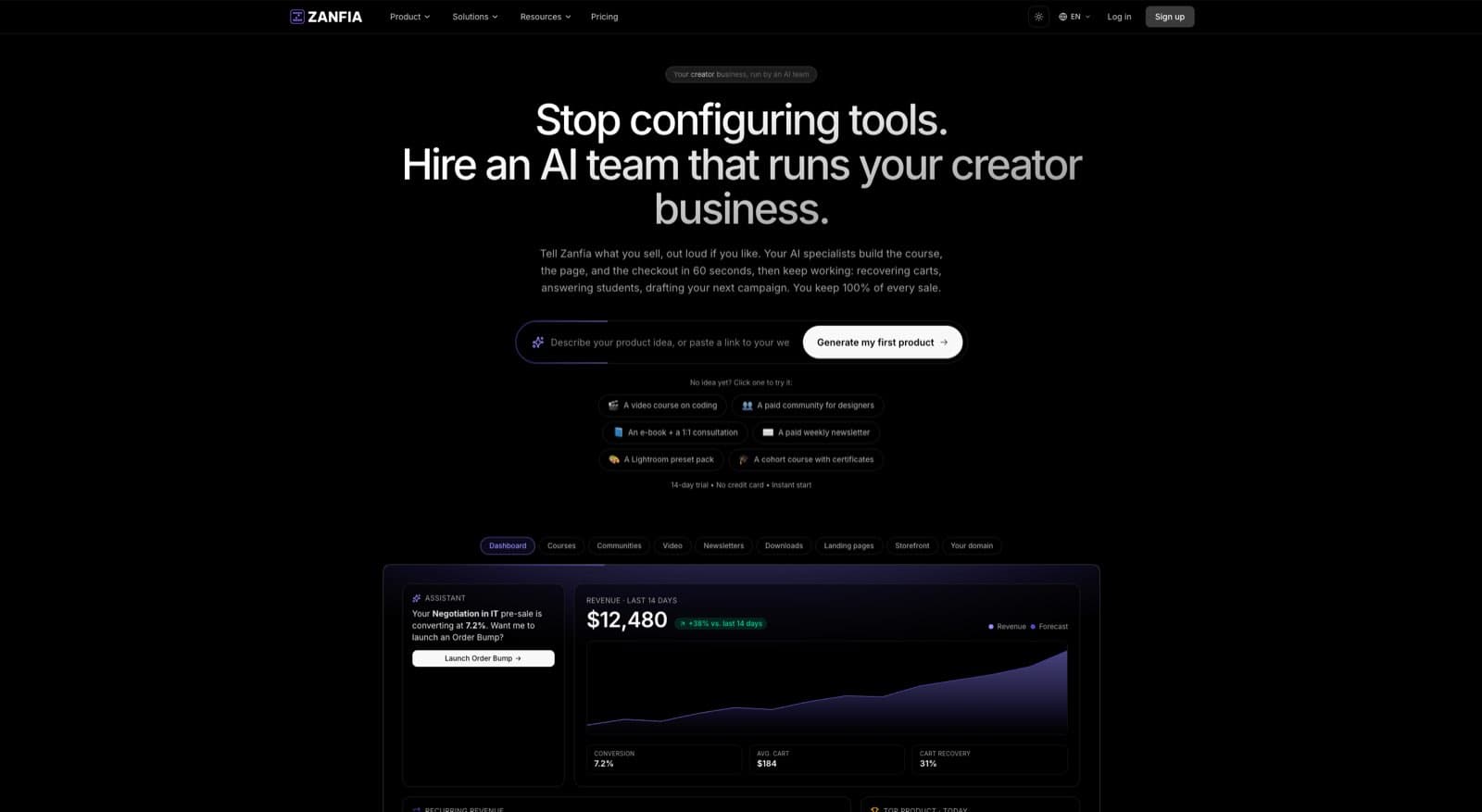
Zanfia is built for digital creators who want to own their distribution layer instead of renting it, and it approaches that job differently from a traditional shop platform: an AI team runs the operational work of the business, and courses, communities, newsletters and downloadable products like Canva template packs are simply where that work lands. For a template seller, the practical combination that matters is a checkout that charges 0% platform commission on customer sales (as of publication, only payment processor fees apply), a white-label shop on your own domain (or a Zanfia subdomain to get started), secure file delivery for downloadable products, and a Cart 2.0 checkout that supports one-time purchases, bundles, subscriptions and installments — every pricing model you need to scale a template business.
The AI-first side changes the day-to-day experience of running the shop, not just the marketing copy. Instead of clicking through admin screens to add a product, adjust a price, tweak a checkout or pull a sales report, you tell the assistant what to do, by chat or by voice, and it performs any action available in the interface. For creators who want their own agents in the loop, Zanfia exposes an MCP endpoint so external AI assistants can act on the workspace directly. Availability of the full AI assistant and the MCP endpoint depends on your plan, so check the current Zanfia pricing before assuming everything is on your tier.
For the monthly template drop model specifically, Zanfia’s native subscription support means you can launch a “Template Club” or “Monthly Drop” product without stitching together Stripe, a membership tool, and a file delivery service. Subscribers get gated access to your full template catalog, automatic billing through Stripe and PayPal, and Apple Pay or Google Pay at checkout. New drops appear in their library each month with zero manual delivery work on your end.
The bundling and upsell mechanics matter too, and they are built to sell. Order bumps at checkout let you offer a complementary template pack with separate invoicing per add-on. Subscription upsells at checkout convert one-time buyers into recurring subscribers in a single click. Installments let you split a $197 bundle into a fixed number of automatic payments so more buyers say yes on the first page. Test mode lets you buy your own product end-to-end before launch, so you catch a broken checkout or a mis-fired pixel before a real customer does. Discount codes and multi-quantity offers handle team licensing and seasonal promotions without manual workarounds.
And because Zanfia carries 12 product types under one brand, the template business you build today can expand without re-platforming. Add a paid newsletter teaching buyers how to use your templates. Launch a community where buyers share their customized versions. Add a course on building a template business yourself. Drop an ebook on Canva design fundamentals. All of it lives under your white-label domain, with the same buyer relationship, the same checkout, and the same 0% platform commission on customer sales.
Every plan starts with a 14-day free trial, no credit card required, so you can test the model before committing to a paid tier. For sellers comparing options, the relevant comparison isn’t “Zanfia vs Etsy” — it’s “keeping 95%+ of your revenue vs paying 30% to a marketplace on every sale.” Across a year of template sales, that gap funds your next product line.
FAQ
How much can you realistically make selling Canva templates?
Earnings vary widely based on niche, distribution, and how aggressively you bundle. Casual sellers on marketplaces typically earn $200-$1,000/month. Sellers running their own shop with bundles and subscriptions commonly hit $3,000-$10,000/month within 12-18 months of consistent work. The ceiling for top template businesses (those with subscriptions, bundles, and strong organic distribution) is well into six figures annually, but those outcomes require treating templates as a business, not a side project.
Do you need to be a professional designer to sell Canva templates?
No, but you need a strong design sense and willingness to study what sells. Most successful template sellers in 2026 are self-taught designers who studied top-performing listings, learned typography and layout fundamentals through free resources, and iterated based on buyer feedback. Canva’s drag-and-drop interface lowers the technical bar significantly — the real skill is knowing what buyers in your niche find genuinely useful.
What’s the best platform to sell Canva templates on in 2026?
For initial discovery, Etsy and Creative Market both work as launch channels. For long-term business building, your own white-label shop on a platform like Zanfia, Gumroad, or Shopify is the right home — you keep more revenue and own the customer relationship. The most successful template businesses use both: marketplaces for discovery, owned shops for scaling.
How do I price my first Canva template pack?
Start by surveying competitor pricing in your specific niche (not the category average). Look at the top 10 best-selling listings for templates similar to yours, then price within the top half of that range. New sellers consistently underprice — buyers in commercial niches like presentations and resumes often associate higher prices with higher quality. If your pack delivers a complete system rather than isolated files, anchor your pricing accordingly.
How do I prevent buyers from sharing my Canva templates?
Three layers of protection: clear licensing language on every product page and in the delivered file, secure file delivery with tokenized download links (not raw Canva share URLs), and active monitoring of template-sharing sites for unauthorized uploads. No system stops piracy entirely, but sellers using proper delivery infrastructure see significantly lower leakage compared to those emailing raw share links.
Can I sell Canva templates that use Canva Pro elements?
This is a common gotcha. Canva’s licensing terms require buyers to have their own access to Pro elements (premium images, fonts, graphics) used in templates you sell. The cleanest approach is to design templates using only free Canva elements, or clearly label which elements require Pro and provide alternatives. Selling templates that depend on Pro elements without disclosing this is one of the top sources of refund requests and bad reviews for new sellers.