

Lifetime Deal vs Monthly Subscription: Which Sells More Digital Products in 2026?
The pricing decision haunts every digital creator. You launch a $497 course and watch a single Black Friday lifetime deal pull in more revenue than three months of monthly subscriptions. Then six months later, you’re staring at a flat MRR chart wondering why your competitors are scaling and you’re not. The lifetime deal vs monthly subscription debate isn’t ideological — it’s about understanding which model matches your product, your audience, and your runway.
In 2026, the data has shifted. AppSumo’s lifetime deal marketplace has cooled significantly from its 2021 peak, while subscription churn benchmarks have tightened across creator-focused SaaS. Yet creators keep defaulting to whichever model their favorite competitor uses, without running the math on their own business. This guide breaks down the real tradeoffs, the conditions where each model wins, and how to test both without confusing your audience or rebuilding your entire stack.
The fundamental tradeoff: cashflow vs LTV
Every pricing decision reduces to a single tension: do you want money now, or more money later? Lifetime deals optimize for the first. Monthly subscriptions optimize for the second. There’s no universally correct answer — only the answer that matches your current business stage and product economics.
A lifetime deal compresses 18-36 months of subscription revenue into a single transaction, usually at a 40-70% discount. You trade future cashflow for present cashflow. For a creator with no runway, no marketing budget, and no audience, that compression can be the difference between launching and shutting down. For a creator with product-market fit and an established funnel, that same compression is a tax on growth.
Monthly subscriptions do the opposite. They starve you of immediate capital but compound over time. A $29/month subscription with 18 months average retention generates $522 per customer. A lifetime deal for the same product at $199 generates $199 — meaning you’ve given away $323 per customer in exchange for getting paid 18 months earlier.
The cashflow argument creators overuse
Most creators who choose lifetime deals justify it with cashflow. That’s valid when you’re bootstrapping a product launch and need $20,000 in 30 days to validate demand. It stops being valid when you’ve been running lifetime deals for two years and still haven’t built a subscription tier. At that point, you’re not solving a cashflow problem — you’re avoiding the harder work of building retention.
The LTV argument that requires actually retaining customers
The subscription argument only works if customers stick around. According to ChartMogul’s SaaS benchmarks, monthly churn rates for creator-focused subscription products average 5-7% per month. At 6% monthly churn, your average customer lifetime is 16.7 months. If your product can’t deliver enough recurring value to justify a monthly charge for 18+ months, subscription math collapses fast.
When a lifetime deal actually wins (and when it kills you)
Lifetime deals work brilliantly under specific conditions. They become destructive under others. The difference often determines whether a creator scales to seven figures or burns out trying to keep promises to thousands of one-time buyers.
Conditions where lifetime deals win
Lifetime deals are the right choice when your product is feature-complete with low ongoing maintenance costs. A digital template pack, a Notion system, a static course on a topic that doesn’t change quarterly — these products genuinely cost you nothing to deliver after creation. Selling them as lifetime deals captures revenue without creating a long-term liability.
They also win for new creators with no audience. A lifetime deal on AppSumo or a similar marketplace can put your product in front of 50,000 buyers in 14 days. Even at deep discounts, that’s a customer acquisition channel that no Facebook ads budget can match. The tradeoff: you’re trading margin for distribution. Acceptable when you have no other distribution.
Finally, lifetime deals work as launch wedges. Selling 200 lifetime licenses at $199 generates $39,800 in launch capital and 200 case studies. You then transition to subscription pricing for everyone after the launch cohort, using the lifetime cohort as social proof.
Conditions where lifetime deals destroy your business
Lifetime deals kill SaaS-style products with real ongoing costs. If your product requires servers, AI inference, customer support, or continuous content updates, every lifetime customer becomes a permanent cost center. AppSumo is littered with founders who sold thousands of lifetime licenses for tools that now cost more to operate than the revenue they generated.
They also destroy positioning. Once you’ve sold a product for $79 lifetime, charging $49/month feels insulting to that audience — even though the math is identical at 20 months. You’ve anchored your product value at the lifetime price, and recovering from that anchor requires either a hard rebrand or a new product line.
And they create support burdens that scale linearly with sales. Every lifetime customer expects support forever. A creator with 5,000 lifetime customers and no recurring revenue has built a support business, not a product business.
Monthly subscription math: churn, MRR, and the 18-month break-even
Subscription pricing only makes financial sense when you understand the underlying math. Most creators wing it, charge a number that feels reasonable, and discover 18 months later that their LTV barely covers their CAC. Here’s the math that should drive every subscription pricing decision.
The break-even calculation
To determine whether a subscription beats a lifetime deal, calculate your average customer lifetime first. If your monthly churn is 5%, your average customer lifetime is 1 divided by 0.05, or 20 months. At $39/month, that customer is worth $780. A comparable lifetime deal at $299 (a 62% effective discount) breaks even at month 8.
Now compare to a 7% monthly churn rate. Average lifetime drops to 14.3 months. At the same $39/month, customer value is $558. The lifetime deal at $299 now breaks even at month 8 too — but you’ve capped your revenue at $299 instead of $558. You’ve given up 46% of customer value in exchange for getting paid faster.
Why MRR compounds and lifetime revenue doesn’t
The hidden power of subscription pricing is compounding. If you add 50 new $39/month customers each month and lose 5% to churn monthly, after 24 months you have approximately 700 active customers generating $27,300 in MRR. After 36 months: 870 customers, $33,930 MRR.
Lifetime revenue has no compounding mechanism. If you sell 50 lifetime deals at $299 each month, you generate $14,950 every month — forever flat, unless you can keep finding new audiences. Subscription businesses scale revenue per existing customer through retention. Lifetime businesses must scale revenue through new acquisition alone.
The 18-month rule
Here’s a heuristic that holds up across most digital products: if your average customer lifetime is 18 months or longer, subscription pricing generates more revenue. If it’s under 12 months, lifetime deals generate more revenue (and create less long-term obligation). The 12-18 month range is the genuine coin flip, and that’s where most creators agonize.
Hybrid models: lifetime + paid updates, paid add-ons
The smartest creators in 2026 aren’t choosing between lifetime and subscription — they’re stacking them. Hybrid pricing models extract the cashflow benefits of lifetime deals while preserving recurring revenue through optional paid upgrades, add-ons, or update tiers.
Lifetime core + paid updates
The cleanest hybrid model sells lifetime access to the current version of your product, then charges annually for major updates. A course creator might sell lifetime access to the 2026 version of their course for $399, then offer the 2027 update at $99 for existing customers. Customers who don’t pay keep their original version. Customers who do pay subsidize ongoing development.
This model works well for products that genuinely evolve year-over-year — annual tax guides, platform-specific tutorials (Meta Ads, Google Ads, TikTok algorithm changes), or industry analysis. It doesn’t work for evergreen content where the 2026 version is identical to the 2030 version.
Lifetime base + recurring add-ons
Another hybrid sells the core product as a lifetime deal but gates premium features behind a subscription. A community platform might sell lifetime access to discussion channels for $199, then charge $19/month for the live event series and group coaching calls. The base product is permanent. The high-touch elements generate MRR.
This model works when you can clearly separate “the thing that doesn’t change” from “the thing that requires ongoing work.” Static templates, archived course modules, and downloadable resources go in the lifetime tier. Live calls, ongoing community moderation, and fresh content go in the subscription tier.
Subscription base + lifetime escape hatch
The inverted hybrid runs subscription as the default but offers a one-time “buyout” price for customers who don’t want recurring charges. A $29/month tool might offer a $799 lifetime option — roughly 27 months of subscription revenue, captured upfront. This converts subscription-averse buyers without sacrificing your default model.
Refund risk: which model gets more chargebacks
Pricing model choice affects refund and chargeback rates more than most creators realize. Each model creates different customer expectations, and mismatched expectations are the root cause of most chargebacks.
Why lifetime deals attract higher refund rates
Lifetime deal customers self-select for impulse buying. They’re often discovered through deal-aggregator emails, deep-discount marketplaces, or social ads emphasizing the limited-time price. They’re buying the deal as much as the product, which means buyer’s remorse hits faster.
Industry benchmarks suggest lifetime deals on marketplaces like AppSumo see refund rates of 8-15%, compared to 2-4% for subscription products with proper onboarding. The deeper the discount, the higher the impulse-purchase rate, and the higher the regret-driven refund rate.
Lifetime deals also create permanent chargeback risk. A customer who buys a lifetime deal in 2026 and decides in 2028 that they’re unhappy can still dispute the original charge through some payment processors if you’ve maintained the relationship. Subscriptions cap chargeback exposure to the most recent billing cycle.
Why subscription chargebacks are more predictable
Subscriptions get chargebacks too, but the failure pattern is different. Most subscription chargebacks come from forgotten subscriptions — customers who don’t recognize the charge two months after signing up. This is solved with clear billing descriptors, transactional emails before each charge, and easy self-service cancellation.
When subscription cancellation is one click and customers can self-serve, chargeback rates drop dramatically. According to Paddle’s subscription benchmarks, involuntary churn from failed payments often exceeds voluntary chargebacks when retry logic and dunning emails are properly configured.
The compliance angle
The FTC’s 2024 Click-to-Cancel rule has raised the stakes for subscription businesses. Make cancellation harder than signup and you’re now exposed to regulatory action, not just chargebacks. Lifetime deals sidestep this entire compliance burden by eliminating the recurring relationship.
How to test both pricing models without splitting your audience
Most creators avoid testing pricing models because they’re afraid of fragmenting their customer base or confusing returning buyers. The fear is reasonable, but the test is doable when you structure it correctly.
The cohort test
The cleanest test runs lifetime and subscription as separate launches to separate cohorts. Launch a lifetime deal to your cold audience (email list members who haven’t purchased), and offer subscription pricing to your warm audience (existing customers, engaged community members). After 90 days, compare:
- Total revenue per visitor for each cohort
- Refund rate within 30 days
- Support ticket volume per customer
- Net Promoter Score for each pricing model
This isn’t a true A/B test — the audiences differ — but it gives you directional data without requiring complex segmentation.
The product-tier test
Another approach splits the test across products rather than audiences. Sell your flagship product as a subscription. Sell a complementary product (templates, a workbook, a static course) as a lifetime deal. Compare 12-month revenue per buyer across the two products. This works well when you have multiple SKUs and want to learn pricing preferences without compromising your main funnel.
The time-limited offer test
The most aggressive test runs a lifetime deal as a 7-day promotion to your existing subscription audience, with the explicit framing: “Lock in your access permanently before we go subscription-only.” This forces a decision point and gives you conversion data. Risk: if you ever try to go back to recurring pricing for that audience, you’ll face heavy resistance. Only run this test if you’ve already decided subscription is your long-term model.
How Zanfia supports lifetime + subscription + installments in one checkout
Most pricing experiments fail not because the strategy is wrong, but because the creator’s tech stack can’t support the test. They’re locked into a checkout tool that only handles subscriptions, or a marketplace that only sells lifetime deals, or they’d have to rebuild their entire funnel to switch models.
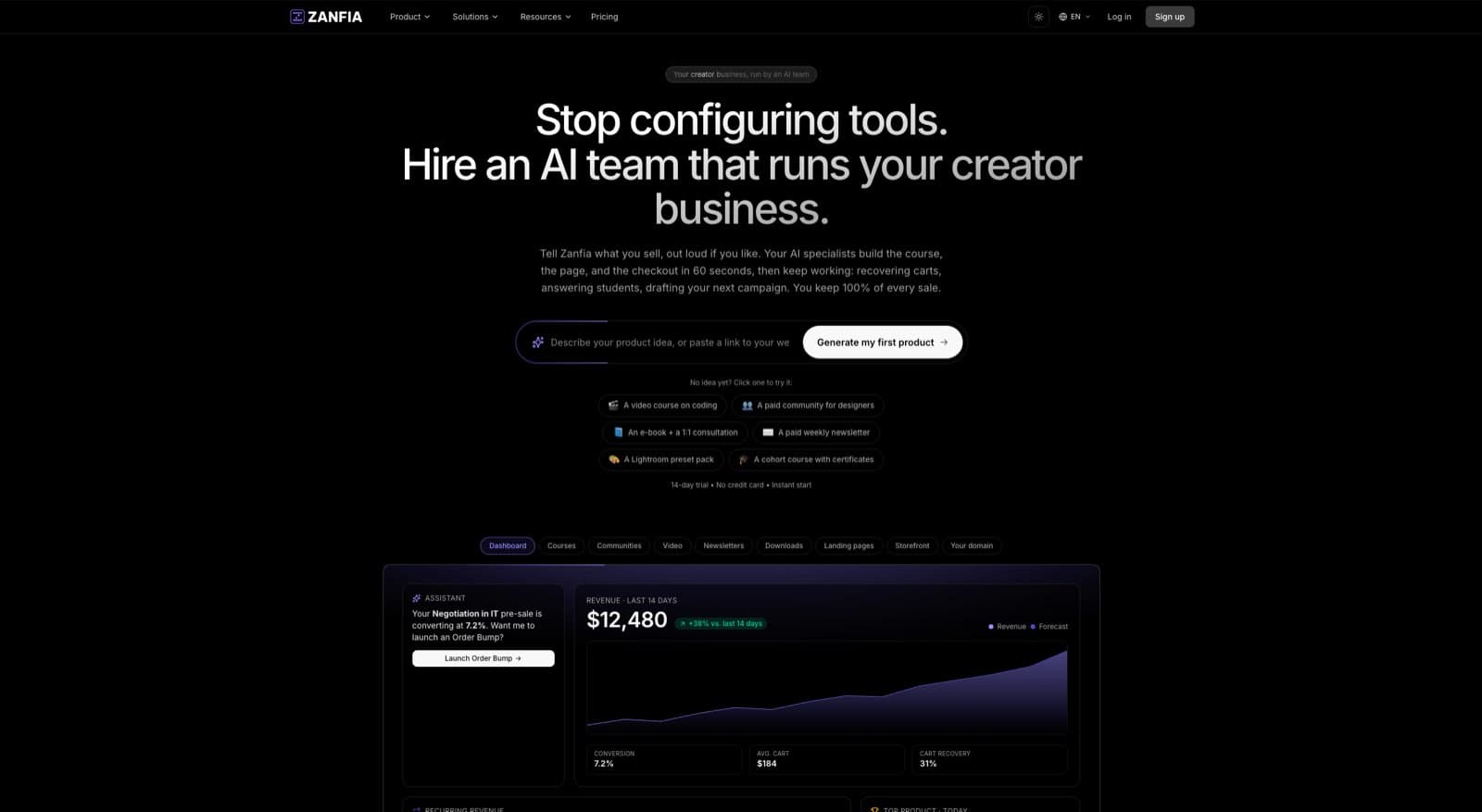
Zanfia is built as an AI team that runs a creator business, not just a checkout tool. An assistant knows every surface of the workspace, so you can spin up a new pricing test by dictating what you want out loud rather than clicking through settings, and an MCP endpoint lets your own AI agents act on the workspace directly. Availability of the full assistant and the MCP endpoint depends on your plan, so check the current Zanfia pricing for what unlocks where.
Cart 2.0 sits underneath that AI layer and was built to eliminate the pricing-experiment constraint. Within a single product, you can configure one-time pricing, recurring subscription pricing, installment plans, and free trial offers — without rebuilding your stack or migrating customers between platforms. Before you take a new configuration live, test mode opens the real checkout under an expiring link so you can run a test purchase end to end, with GA4, Meta and TikTok events tagged TEST and kept out of your production data.
For creators testing the lifetime vs subscription question specifically, this matters in three ways:
First, you can offer multiple pricing options on the same product page. A visitor can see your $39/month subscription option alongside your $499 lifetime option and self-select. Both checkout through Stripe or PayPal, both support Apple Pay and Google Pay, and both deliver access to the same content. You learn pricing preference from actual buyer behavior, not from surveys.
Second, you can layer hybrid models without custom development. Sell a lifetime deal for the core product, then use subscription upsells at checkout to add an optional monthly community membership or live event series. Order bumps with separate invoicing per add-on mean each pricing component is tracked independently for revenue analysis. Order bumps and checkout upsells are available on higher plans, see the current Zanfia pricing.
Third, you can change pricing models without breaking existing customers. If your lifetime cohort happens first and you transition to subscription-only for new customers, Zanfia keeps lifetime customers’ access intact while new signups flow through the subscription checkout. The white-label approach (under your own domain, or a slug.zanfia.co subdomain) means customers never see the pricing transition as a platform change.
Beyond the checkout flexibility, Zanfia bundles the rest of the stack creators need: 12 product types including courses, communities, paid newsletters, knowledge bases, memberships and downloadable files, all living under one brand with a 14-day free trial and no credit card required. Native video hosting with progress memory sits inside courses, and the current model is 0% platform commission on customer sales, so you pay your payment processor (Stripe or PayPal, roughly 2.9% + $0.30 in the US) and Zanfia’s monthly subscription, and keep the rest. Apple Pay and Google Pay are supported natively, and the iOS and Android mobile app gives your customers access to courses, paid newsletters, and knowledge bases on the go.
For creators who’ve outgrown Gumroad’s transaction fees but can’t justify Kajabi’s pricing, or who want to test lifetime deals without committing to a marketplace like AppSumo, Zanfia gives you the infrastructure to run pricing experiments without operational overhead. See current pricing or explore how Zanfia works to evaluate fit for your specific product mix.
FAQ
What’s the average refund rate for lifetime deals vs subscriptions?
Lifetime deals typically see 8-15% refund rates, especially when sold through deal marketplaces that attract impulse buyers. Subscription products with proper onboarding usually see 2-4% refund rates within the first 30 days. The gap narrows when lifetime deals are sold directly to a warm audience that already knows your work.
Can I switch from lifetime deals to subscription pricing later?
Yes, but expect resistance. Existing lifetime customers must keep their access (legally and ethically), while new customers see subscription pricing. The transition works best when you frame the change as adding new value — “the new version includes ongoing updates and live events that require a subscription” — rather than as a price increase. Plan for a 6-12 month transition where you grandfather existing lifetime customers permanently.
How do I price a lifetime deal compared to my monthly subscription?
The standard formula is 18-36 months of subscription revenue. A $29/month subscription becomes a $522-$1,044 lifetime deal at full price. With typical lifetime deal discounting (40-60% off the full price), you’d sell at $209-$522. Below 18 months of equivalent revenue, you’re underpricing. Above 36 months, you’re overpricing for the perceived discount.
Do lifetime deals hurt SEO or brand perception?
Selling lifetime deals on marketplaces like AppSumo or StackSocial doesn’t directly hurt SEO, but it can damage brand perception if you position yourself as a premium product. Buyers who discover you at $79 lifetime won’t pay $499 for an upgrade six months later. If you plan to position upmarket, run lifetime deals only on your own site to maintain pricing control.
Which payment processors handle lifetime deals best?
Stripe and PayPal both handle one-time and subscription payments natively, with no functional advantage either way. The difference is in dispute handling — Stripe’s chargeback dashboard is more developer-friendly, while PayPal’s seller protection covers digital products under specific conditions. For creators selling globally, supporting both is the standard.
Can I run a lifetime deal launch without using AppSumo?
Absolutely. AppSumo provides distribution in exchange for 30-50% revenue share. If you have an existing audience of 5,000+ engaged subscribers, you can often generate comparable launch revenue by running the lifetime deal directly to your list, keeping 100% of revenue minus payment processor fees. The tradeoff is reach — AppSumo’s audience is much larger than most creator audiences.
What’s the right pricing model for a community-based product?
Communities almost always favor subscription pricing because the value compounds with ongoing engagement, fresh members, and continuous content. A lifetime community membership becomes a liability — you’re committed to moderating and growing the community forever for a one-time fee. Subscription pricing aligns your incentives with community health.