7 Best Mushroom Identification Courses of 2026
You're probably in one of two places right now. You've either found a few mushrooms on walks and realized that guessing is a bad strategy, or you already know enough to see how much you still don't know. That's a healthy place to start.
Confident mushroom identification doesn't come from a phone app or a single viral chart. It comes from repeated exposure, good instruction, local context, and a safety-first mindset. The best mushroom identification courses teach you how to observe habitat, structure, seasonality, and look-alikes. They also make it clear where a class ends and your field practice begins.
That distinction matters. Some courses are ideal for absolute beginners. Some are excellent for people who want to sell wild mushrooms legally. Some are better as seasonal support once you already have a foundation. This guide gets to the useful part quickly and focuses on seven strong options, with the trade-offs spelled out so you can choose the one that fits your goals instead of buying the wrong format.
1. Learn Your Land – Foraging Wild Mushrooms
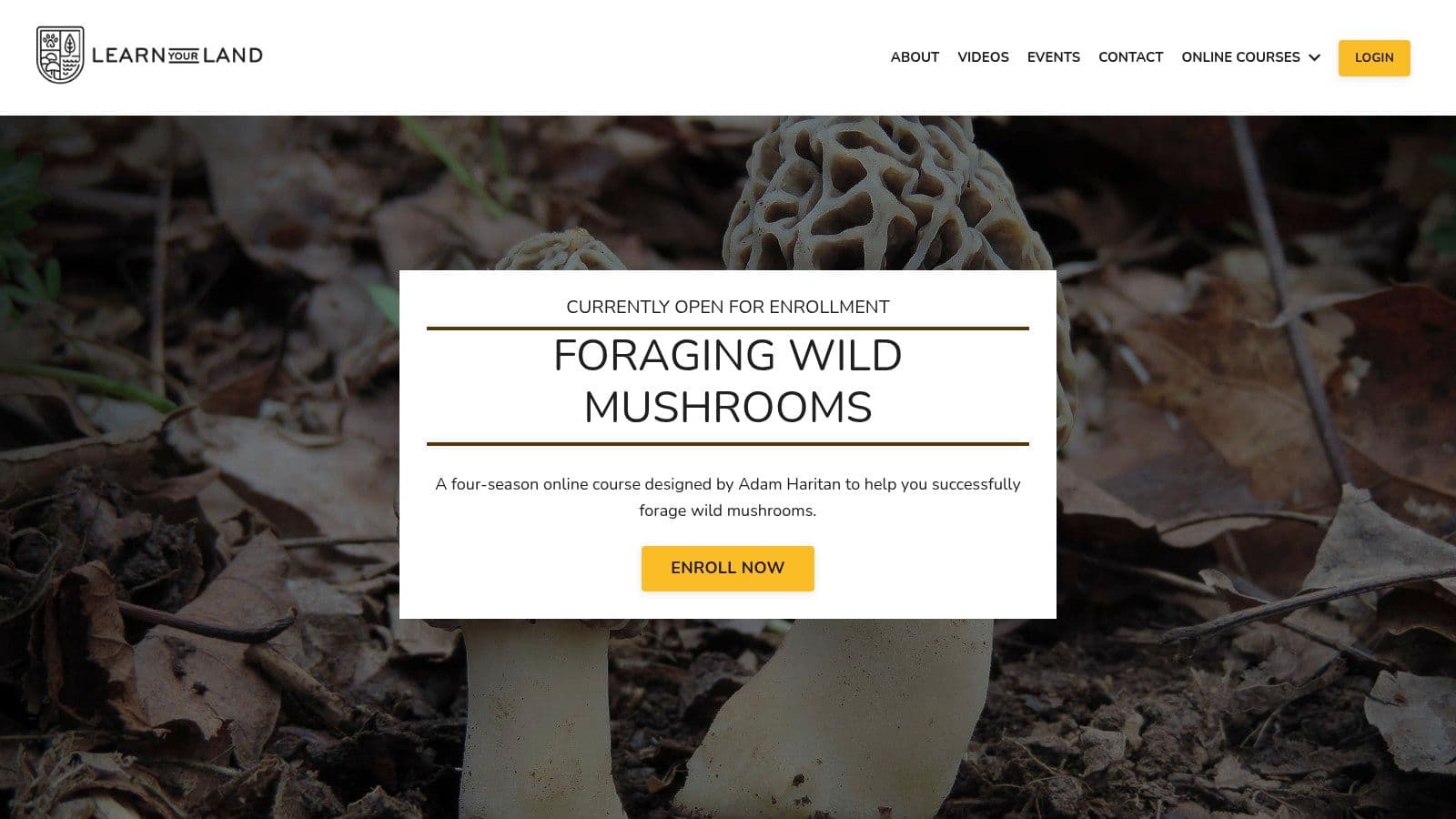
If you want a home-base course, this is the one I'd point most beginners toward first. Learn Your Land – Foraging Wild Mushrooms is self-paced, visually strong, and built for people who need structure more than hype.
The biggest advantage is that it teaches identification as a process, not a scavenger hunt. That matters because beginners often want a list of edible species, but what they need is a way to slow down and notice the right details. This course leans into ecology, anatomy, toxic look-alikes, and safe field habits, which is exactly the right order.
Why it works for beginners
The course is organized across seasons and gives you a clear learning path. Instead of dumping mushroom facts in a pile, it helps you understand when certain finds are likely, what habitat clues matter, and why one feature rarely settles an ID by itself.
A lot of online mushroom identification courses fail because they make people feel informed before they're careful. This one does a better job of reminding you that confidence has to be earned.
Practical rule: If a course makes you feel ready to eat wild mushrooms before it teaches you how to rule species out, that's a red flag.
There's also a real convenience advantage here. Self-paced learning lets you revisit lessons before a weekend forage, then return afterward to compare your notes and photos.
Best fit and limitations
This is best for:
- New foragers: You need a broad foundation and repeated review.
- Visual learners: Video-heavy teaching is easier than dense field-guide study for many people.
- Cautious hobbyists: You want practical education, not a credential.
Its main drawback is regional emphasis. The species focus is strongest for eastern North America, so western learners should pair it with local clubs, local field guides, and regional instructors. It also isn't a certification course, which is fine for personal learning but not enough if your goal is commercial harvesting or restaurant sales.
Still, for building judgment, not just recognition, it's one of the better starting points.
2. Mushroom Mountain – Wild Mushroom Identification & Food Safety
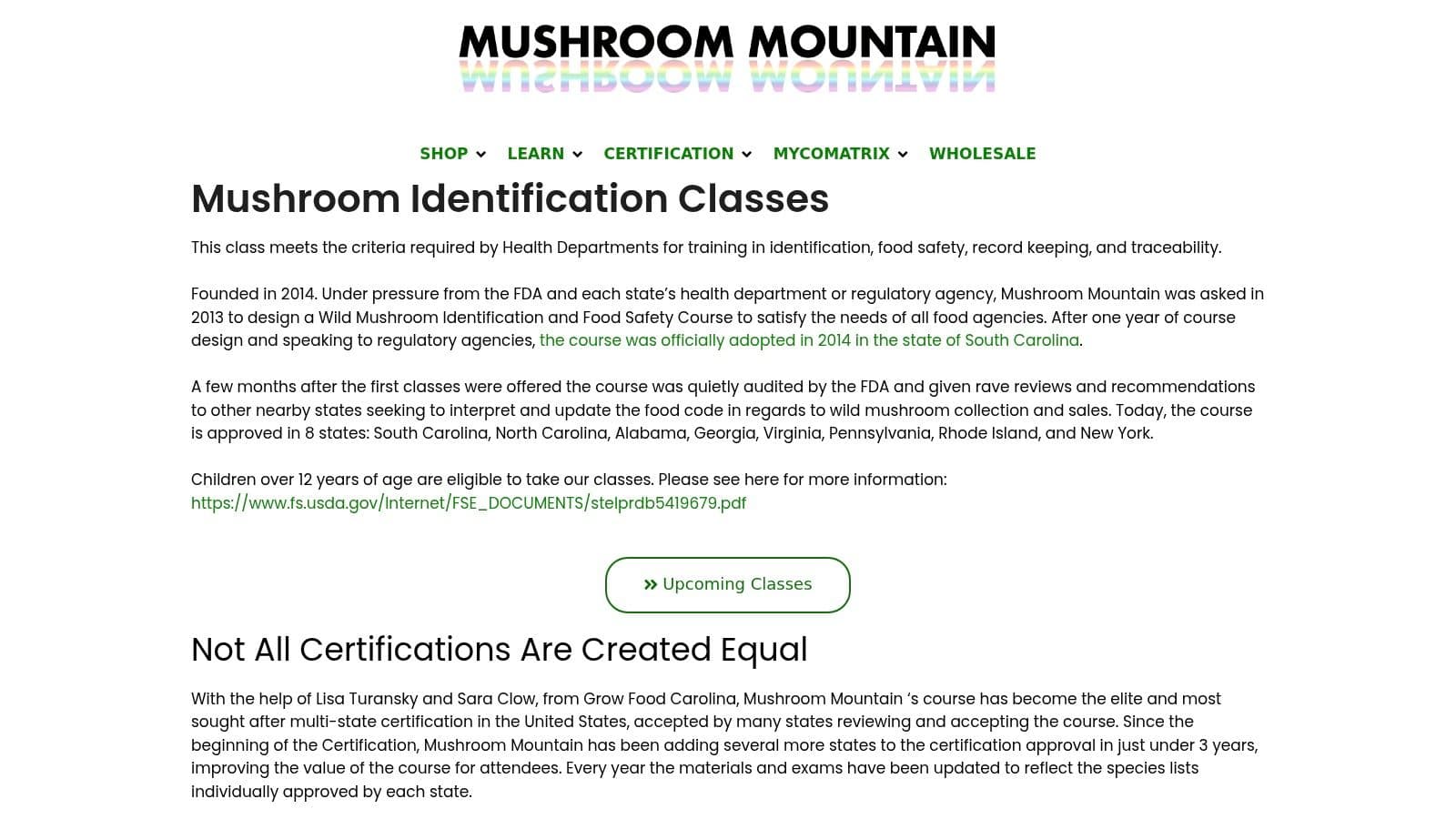
Some courses teach appreciation. Some teach safe field habits. Mushroom Mountain's Wild Mushroom Identification & Food Safety is for people who need the legal and food-safety side taken seriously too.
That's a very different use case. If you're a chef, a small wild-food business, or a forager hoping to sell into approved channels, this type of training is far more useful than a general mushroom appreciation course. It sits closer to compliance and professional handling than hobby instruction.
Where this course stands out
The strongest thing about Mushroom Mountain is the way it combines identification with food safety, handling, and documentation expectations. That's what many recreational courses leave out.
Regulation is real, not theoretical. Minnesota's guidance for commercial wild mushroom harvesters says a person must complete a mushroom identification course at an accredited college, university, or mycological society, and the course must cover the species the person intends to forage and sell. The state also requires certification documentation to be on file with the Department of Agriculture, which makes commercial identification a formal competency rather than just informal knowledge, as outlined on the Minnesota certified wild mushroom harvester page.
Selling wild mushrooms is a different standard from cooking for yourself. The course you choose has to match that responsibility.
If you're an educator reading this from the other side of the table, this category is also a good reminder that clear packaging matters. If you ever want to sell an online course about mushroom foraging or ID training, buyers need to know whether you're offering hobby education, field coaching, or credential-oriented instruction.
Trade-offs to understand first
Before you book, verify recognition in your own state or locality. Not every jurisdiction treats third-party permits the same way, and travel may be required depending on the schedule.
This also isn't the right first step for every beginner. If you don't yet know basic mushroom anatomy, habitat cues, and common dangerous confusions, a seller-focused course can feel too advanced or too narrow. For the right student, though, it's one of the most practical options in this list.
3. Cornell Small Farms Program – BF 149: Identifying and Partnering with Mushrooms
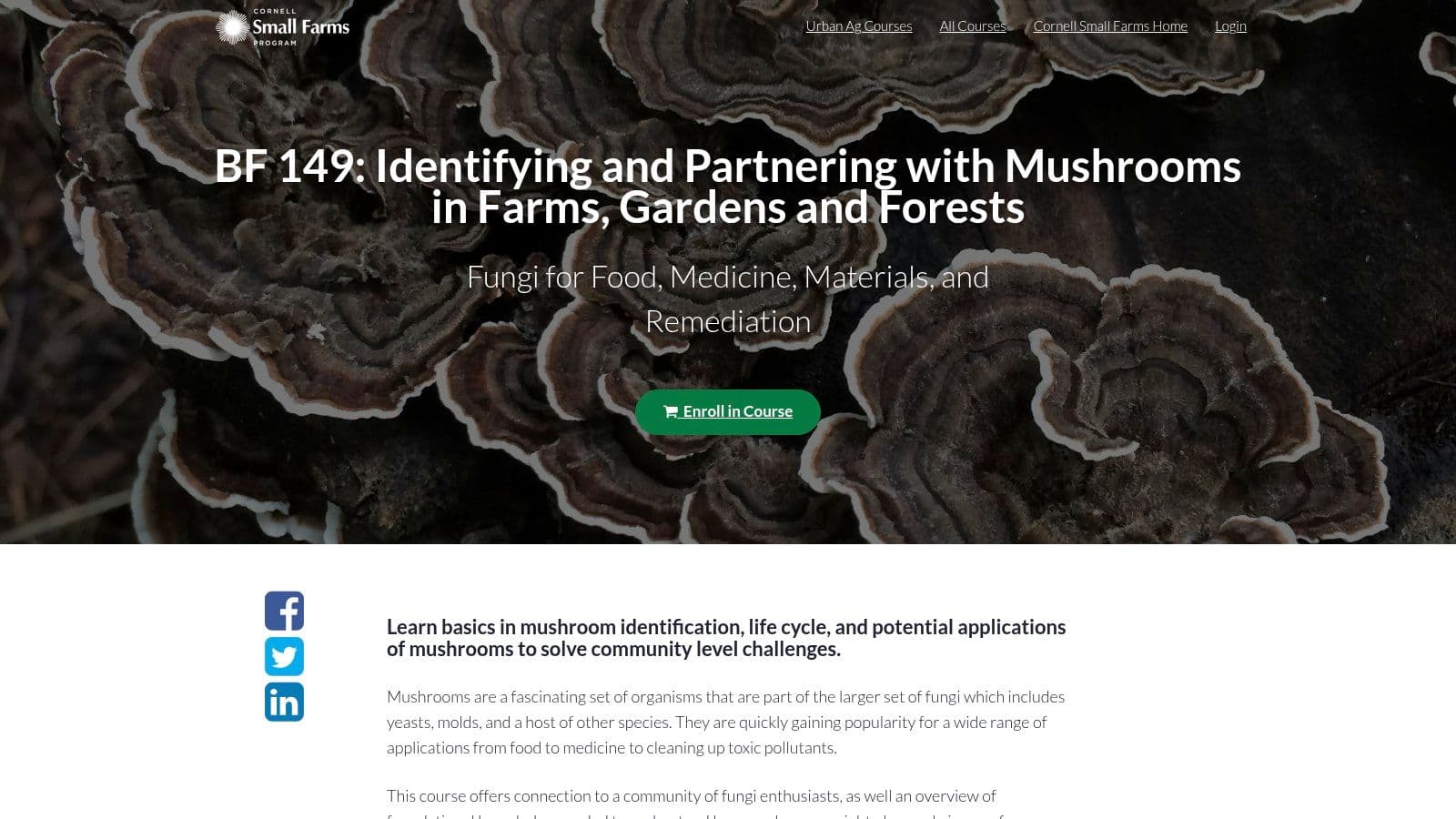
Cornell Small Farms Program – BF 149 is the course I'd recommend to people who want a more academic structure without losing practical relevance. It's especially strong for farmers, gardeners, land stewards, and educators who want mushrooms placed in a broader ecological and land-use context.
This isn't just an edible-ID lane. It treats fungi as part of a working ecosystem, which gives the learning more depth.
Why the cohort format helps
A cohort course changes the learning experience. Live sessions create deadlines, and deadlines keep people from drifting away after the first burst of enthusiasm. That matters more than many learners expect.
The value here is the mix of guided progression, community discussion, and recorded material you can revisit. In mushroom education, that combination works well because students need both expert interpretation and time to review subtle traits at their own pace.
If you teach this kind of subject yourself, the format is worth studying. A strong cohort course design process helps students stay engaged in topics that require observation, repetition, and nuance.
Best for land-based learners
This course makes sense for people who ask questions like:
- How do fungi fit into my farm or forest system?
- How do I collect and assess specimens safely?
- How do I learn with a group instead of alone?
That broader framing is its strength. It also means it isn't the obvious choice for someone who only wants a fast edible-mushroom primer before autumn weekend walks.
Good mushroom instruction doesn't just name fungi. It teaches where they live, what they're doing, and why your context changes the ID conversation.
The other limit is timing. Cohort courses work best when you can show up during the live run. If your schedule is chaotic or you want instant access without dates, a self-paced course may suit you better. And like many university-backed offerings, this is educational, not seller certification.
4. Puget Sound Mycological Society (PSMS) – Classes & Workshops
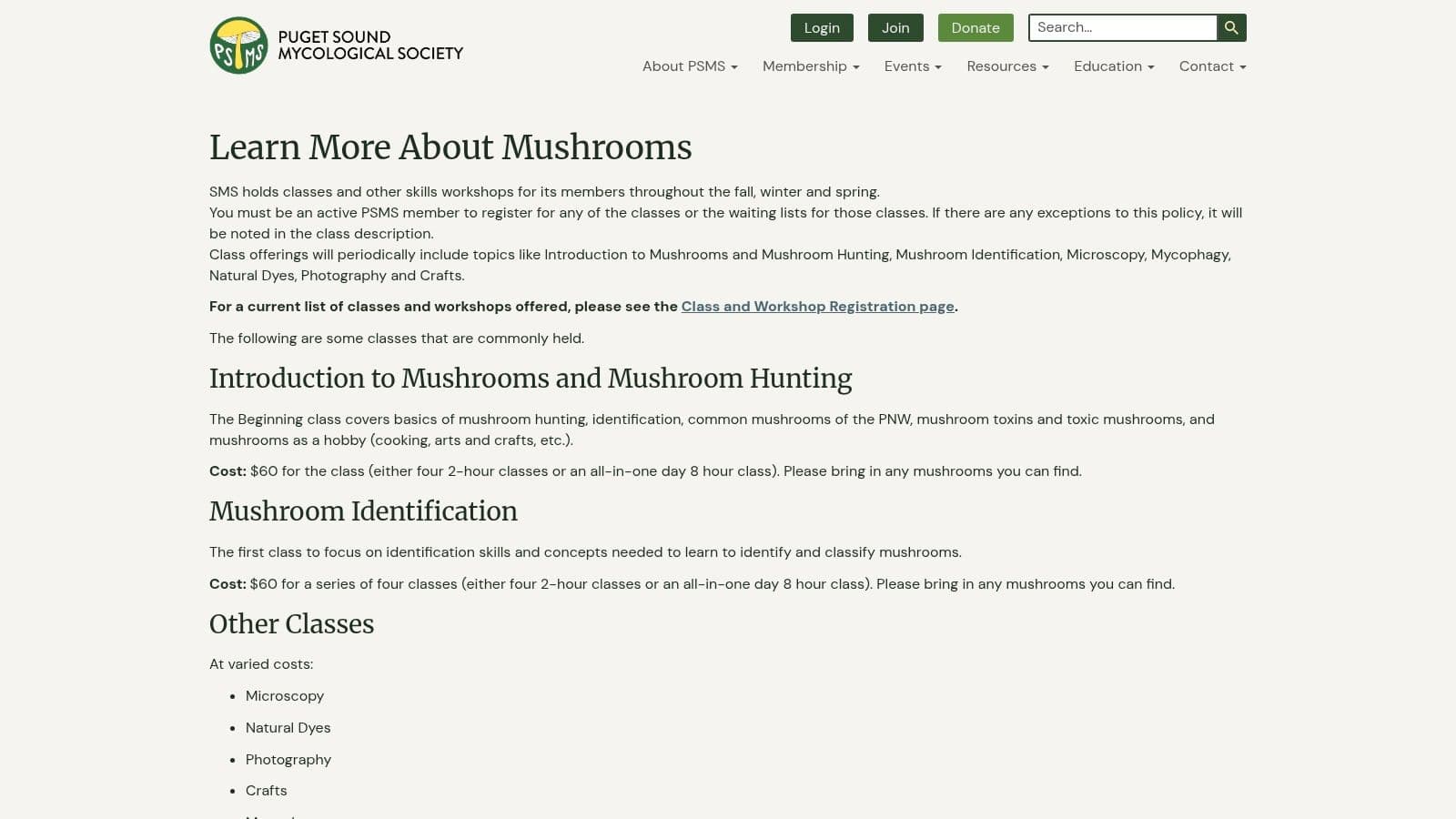
If you live in the Pacific Northwest, Puget Sound Mycological Society classes and workshops offer something online courses can't fully replace. Real specimens. Real weather. Real habitat. Real confusion.
That hands-on element is a big deal. Many people don't improve quickly until they've handled mushrooms beside someone more experienced, looked at fresh collections, and heard an instructor say why a seemingly small feature changes the whole conclusion.
Why regional societies often outperform flashy online options
Regional mycological societies tend to be better than they look from the outside. They rarely market like polished creator brands, but the instruction can be more useful because it's grounded in local species and recurring field practice.
PSMS is especially appealing if you want multiple ways to learn. Classes, ID clinics, microscopy workshops, and field trips create a layered learning environment instead of a one-off lesson. That repeated contact is how people move from memorizing names to building pattern recognition.
For anyone building education in this space, there's also a lesson here. People stick longer when they can learn with each other, not just from a video library. That's why a thoughtful community for learners often matters as much as the course content itself.
The trade-off is access
This option is strongest if you're local to the Seattle area and willing to participate in person. Membership requirements may also shape how and when you can register.
A regional society is also, by definition, regional. Pacific Northwest training is excellent for Pacific Northwest conditions. It won't automatically prepare you for hardwood forests elsewhere, different fruiting windows, or different look-alike patterns.
Still, if your goal is practical field competence in one place, this style of course often beats broad online coverage.
- Best for local repetition: You'll keep learning through field trips and clinics, not just a single purchase.
- Best for specimen handling: Seeing fresh material with experts shortens the feedback loop.
- Less ideal for remote learners: If you aren't nearby, much of the value disappears.
5. New York Botanical Garden (NYBG) – Fungi-Related Classes
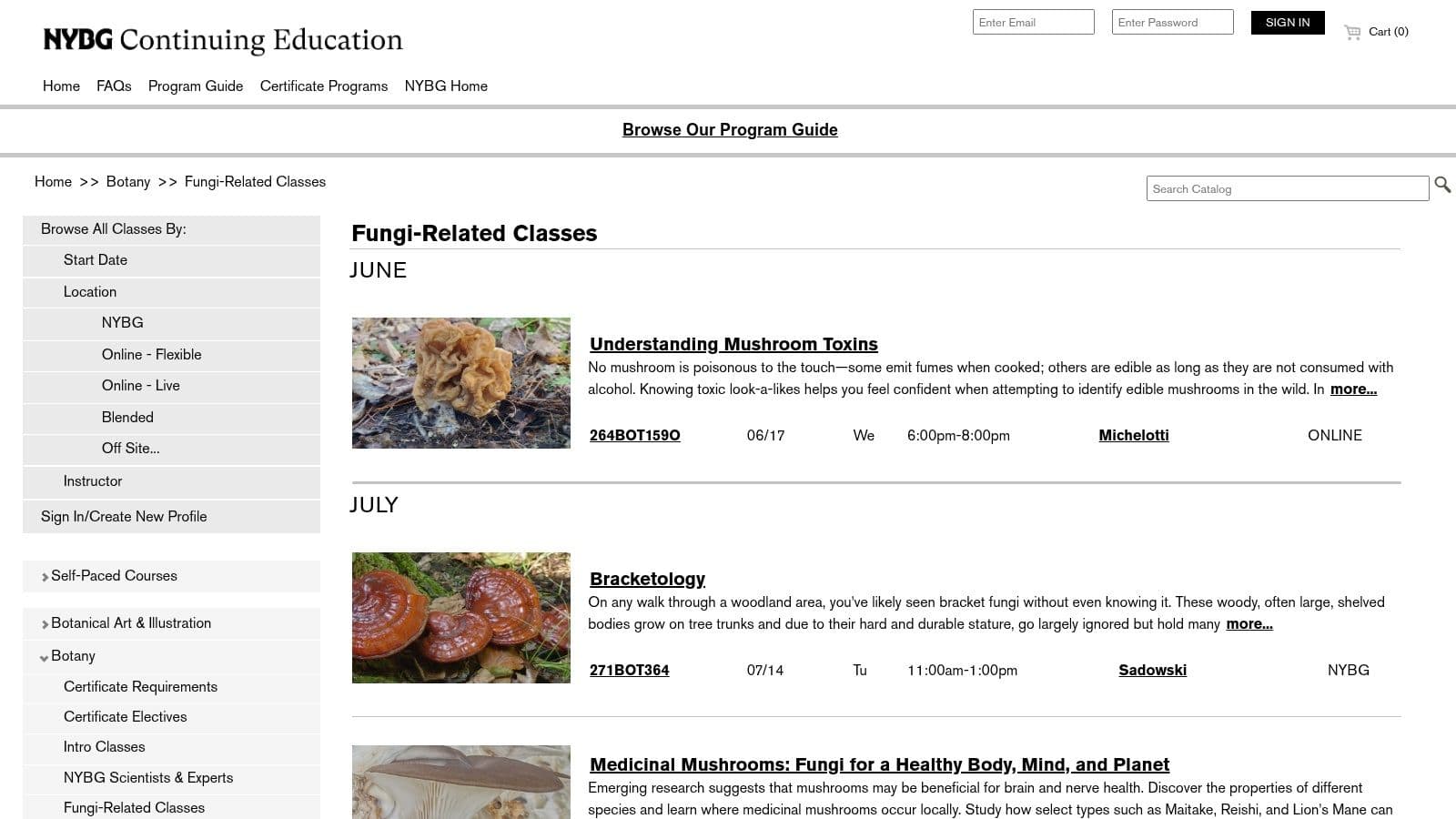
New York Botanical Garden fungi-related classes work well for students who don't want one giant commitment. NYBG's format is useful because it offers shorter, focused learning units. That can be a smarter entry point than buying an expansive program and never finishing it.
Some students learn best by stacking focused classes over time. A toxin class, a seasonal ID walk, and a cultivation session can build a more durable understanding than one broad overview taken too early.
Strong for short, serious study
NYBG's practical advantage is variety. You can pick based on immediate need. If your biggest weakness is safety, take a toxin-oriented class. If you need field exposure, choose a walk or live identification session. If you're interested in fungi beyond foraging, cultivation classes round out the picture.
That modular structure also mirrors how many successful educators package specialized material. A beginner usually commits more easily to a short live class than to a giant flagship offer. If you're creating your own training, a cohort-based course model can turn that focused format into a stronger learning experience than passive self-study alone.
The main caution
Availability shifts with the calendar, and popular sessions can fill quickly. This also has a Northeast tilt, which is helpful if that's your home region and limiting if it isn't.
What I like most here is the seriousness around safety topics. That deserves more weight than it often gets in mushroom identification courses. Many students want to rush toward edibles, but understanding toxins, confusion risks, and uncertainty is what keeps the subject enjoyable long-term.
The safest students aren't the ones who know the most names. They're the ones who know when they still don't know enough.
If you're near New York City or prefer recognized institutions with flexible class types, NYBG is an easy one to shortlist.
6. The Mushroom Forager – Mycophile Membership
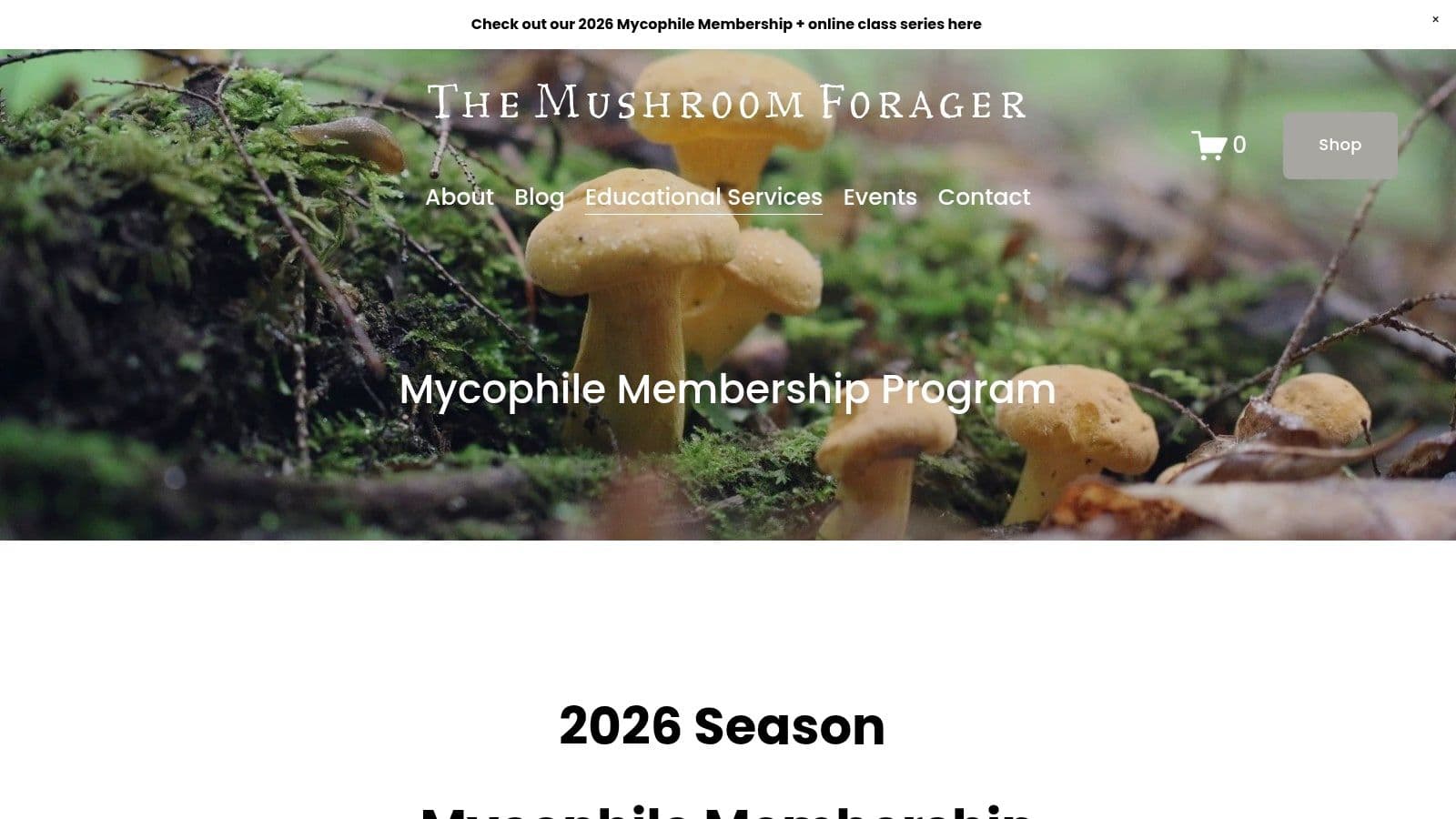
Not every good mushroom course looks like a course. The Mushroom Forager – Mycophile Membership is better understood as an in-season companion for people who want guidance that tracks what's fruiting and when.
That's useful because mushroom learning isn't only about species profiles. It's also about timing. A static lesson can tell you what a species looks like. Seasonal guidance tells you when to start paying attention and what conditions make a search worthwhile.
Best used as a companion, not a foundation
This membership model shines once you already have basic ID habits. Monthly classes, recordings, and seasonal updates keep you engaged during the active foraging window and help connect theory to what's happening outside.
I wouldn't treat it as a stand-alone replacement for foundational mushroom identification courses. It makes more sense as the layer you add after a beginner course or alongside local walks and club events.
There's a broader lesson in the market here too. Structured mushroom education has become more formalized, but it's still a relatively thin market with lots of in-person and seasonal formats. For example, Wisconsin's class schedule lists multiple in-person sessions across several cities, running roughly 6 to 8 hours and priced at $80 for education-only or $125 with certification testing, while Michigan state-linked certification workshops are priced at $85 without certification and $175 with certification. A U.K. provider's one-day course lasts about 5 hours and aims to cover around 15 species, as noted on the Wisconsin Mycological Society class sign-up information. That tells you many buyers still want expert-led, relatively intimate instruction rather than mass-market content.
Who should choose this
Choose this if:
- You already know the basics: You want seasonal reinforcement, not first-step training.
- You forage in Northeastern North America: Regional relevance matters here.
- You like guided rhythm: Ongoing prompts keep your practice alive.
Skip it if you're still trying to learn core morphology, dangerous look-alikes, or safe decision-making from scratch. This format is supportive, but it assumes you'll bring some groundwork with you.
7. Fungi Ally – Feast and Forage Online Class
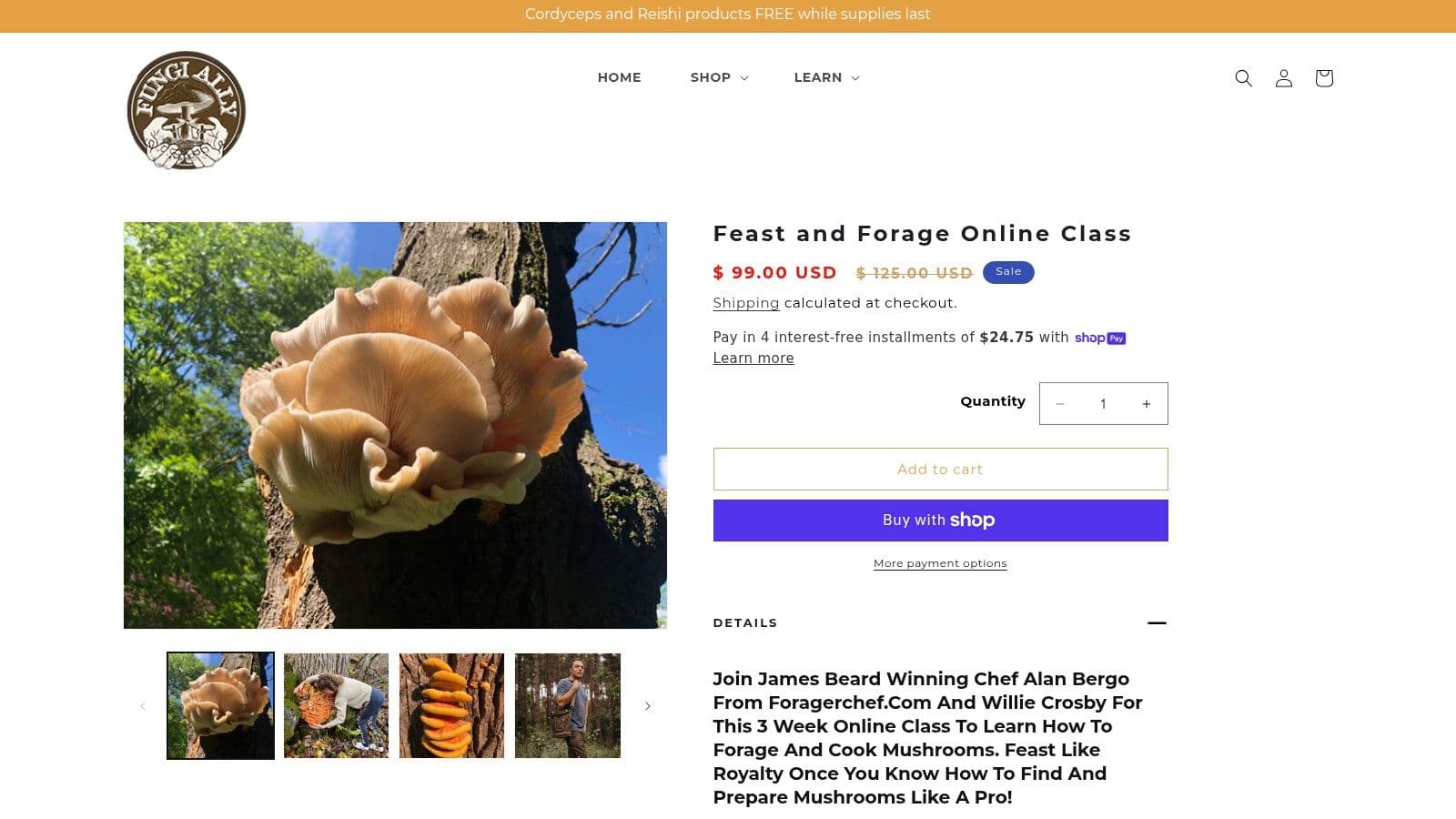
Fungi Ally – Feast and Forage Online Class is a compact option for busy learners who want a practical introduction without diving straight into a large program. It mixes identification basics with cooking, which makes it more inviting for people who need an immediate reason to stay engaged.
That blend works. Food is often what gets people in the door, and careful observation is what keeps them safe once they're there.
Good for momentum, not mastery
A concise class has one major advantage. You'll probably finish it. That counts for a lot.
This course gives beginners a manageable on-ramp into spore prints, mushroom anatomy, field-guide use, and culinary application. I like that because technique-based basics travel better than species lists. Learning how to observe, compare, and verify matters more early on than collecting a long catalog of names.
Its limit is depth. A short online class can spark judgment, but it can't substitute for regional experience, local mentors, or repeated field exposure. It also isn't the place to look for professional certification.
A smart first purchase for the cautious beginner
This is a good fit if you want to test your interest before committing to a more demanding course. It's also useful for learners who need practical payoff quickly, such as understanding how foraged mushrooms move from the woods to the kitchen.
If you're an educator, this kind of entry-level offer is worth studying from a business angle too. A concise paid class is often the cleanest first digital product to launch, especially when you don't want to overbuild. Choosing an online course platform for creators becomes easier when your first offer has a narrow promise and a clear audience.
One caution belongs here. Some programs in this space use the language of learning and certification loosely. As noted in a review of class formats and credentialing, one MSU Extension day-long course grants certification only to those scoring 80% or higher, certifications are valid for five years, and the workshop is described as a review rather than beginner training for people without prior education, according to the ABR Trails summary of mushroom identification class certification details. That's why introductory classes like this should be judged on teaching clarity and safe scope, not on whether they sound official.
Top 7 Mushroom Identification Courses Compared
| Program / Course | Implementation Complexity 🔄 | Resource Requirements ⚡ | Expected Outcomes ⭐📊 | Ideal Use Cases 💡 | Key Advantages ⭐ |
|---|---|---|---|---|---|
| Learn Your Land – Foraging Wild Mushrooms | Moderate, self‑paced, 4‑season curriculum 🔄 | Low, internet, time for videos; lifetime access ⚡ | ⭐ Strong foundational ID skills and safety; 📊 broad coverage of 50+ edibles | Beginners seeking a structured, long‑term foundation | High production quality, comprehensive safety, lifetime access ⭐ |
| Mushroom Mountain – Wild Mushroom ID & Food Safety | High, intensive 2‑day in‑person training 🔄 | Moderate, course fee, travel, 2 days; certification process ⚡ | ⭐ Certification accepted in multiple states; 📊 five‑year seller permit | Foragers/cooks/businesses needing regulatory compliance | Recognized seller training combining ID with food‑safety and traceability ⭐ |
| Cornell Small Farms Program – BF 149 | Medium, 6‑week cohort with live webinars 🔄 | Moderate, weekly time commitment, internet, course fee ⚡ | ⭐ University‑backed ID and applied uses; 📊 community interaction & practical farm skills | Farmers, gardeners, educators seeking applied mushroom knowledge | University credibility, cohort interaction, lifetime materials ⭐ |
| Puget Sound Mycological Society (PSMS) – Classes & Workshops | Variable, multi‑session hands‑on workshops & field trips 🔄 | Low–Moderate, membership, local attendance, time for fieldwork ⚡ | ⭐ Strong hands‑on ID proficiency; 📊 repeated field practice improves skills | Local PNW learners wanting in‑person practice and microscopy | Hands‑on learning with local experts, affordable community support ⭐ |
| New York Botanical Garden – Fungi‑Related Classes | Low–Medium, short rotating units (online & in‑person) 🔄 | Moderate, per‑session fees; travel if attending in person ⚡ | ⭐ Focused toxin and ID modules; 📊 flexible formats for short learning bursts | NYC‑area learners or those seeking short focused units | Reputable institution, varied delivery formats, strong safety content ⭐ |
| The Mushroom Forager – Mycophile Membership | Low, seasonal monthly content (May–Oct) 🔄 | Low, subscription, internet; seasonal engagement ⚡ | ⭐ Timely phenology‑driven guidance; 📊 seasonal tracking and updates | Northeastern foragers wanting real‑time seasonal tips | Phenology updates, regular classes and Q&A, seasonal relevance ⭐ |
| Fungi Ally – Feast and Forage Online Class | Low, concise 3‑week course with 3 sessions 🔄 | Low, short time commitment, modest fee; recordings included ⚡ | ⭐ Practical ID basics + culinary skills; 📊 quick entry‑level competence | Busy learners seeking a practical culinary‑ID primer | Affordable, culinary focus, lifetime recordings for review ⭐ |
Next Steps: Master the Skill or Teach the Craft
Any one of these mushroom identification courses can move you forward, as long as you pick the one that matches your actual goal. If you're brand new, start with a true beginner foundation and local practice. If you want to sell wild mushrooms, focus on region-specific compliance and food-safety training. If you already have the basics, a seasonal membership or local mycological society may do more for your judgment than another general online class.
The biggest mistake I see is treating completion like competence. It isn't. Mushroom identification is cumulative. You study, compare, get things wrong, revisit key traits, and learn to slow down before making a decision. The old rule still holds because it works. When in doubt, throw it out.
There's also a larger shift happening in this space. Mushroom education has become more structured. One U.K. provider offers a one-day course focused on fungal biology and distinguishing edible from toxic mushrooms, while monthly classes from May to October are offered in 1.25-hour sessions priced at $22 for a single class, $85 for five classes, and $150 for ten classes, as shown on the Wild Food People mushroom identification course page. That kind of seasonal scheduling and standardized pricing shows how far the field has moved from purely informal knowledge-sharing.
If you're one of the people who has already put in the years, there's a real opportunity on the teaching side. Many experienced foragers, mycologists, and educators have knowledge that deserves better packaging than scattered social posts or occasional in-person walks. Building a course around beginner safety, regional species, look-alike logic, or commercial handling can become a serious educational business when it's presented clearly.
That's where Zanfia can help. Zanfia is an AI team that runs a creator business, and a platform second. Instead of configuring tools, you tell the assistant what to do by chat or by voice, and it performs any action available in the interface. Courses, private student communities, paid seasonal newsletters, ebooks, and consultations all live under one brand, with an MCP endpoint that lets you connect your own AI assistants to the workspace on higher plans (see the current Zanfia pricing). Platform commission on customer sales is currently 0%, so creators keep their revenue while only paying standard payment-operator fees. Native video hosting is included, and the built-in automations can save 5 to 10+ hours a month by handling access, payments, renewals, and onboarding tasks.
For educators, the combination matters. A checkout built to sell means you can split a $600 mushroom course into four payments, add an order bump for a seasonal field guide, and run a test purchase before launch to check that tracking fires end to end. You can teach a mushroom identification course, host a private student community, sell a field-guide download, run a paid newsletter during the fruiting season, and keep everything under one login instead of splitting students across disconnected tools. Twelve product types live under one brand, so the setup can grow with the business without a second stack.
If your next step is learning, choose a course and start building real field habits. If your next step is teaching, start planning how to build your online course. Mycology rewards both paths.
FAQ
Do any of these courses certify me to sell wild mushrooms commercially?
Mushroom Mountain's Wild Mushroom Identification & Food Safety is the option in this guide oriented toward selling into approved channels, since it combines identification with food safety, handling, and documentation. Learn Your Land and NYBG classes are educational rather than seller certification. Always verify recognition in your own state or locality before booking, because jurisdictions treat third-party permits differently.
Which course is the best starting point if I'm a total beginner?
Learn Your Land – Foraging Wild Mushrooms is the strongest home-base course for beginners in this guide. It's self-paced, video-heavy, and teaches identification as a process built around ecology, anatomy, toxic look-alikes, and safe field habits. You can revisit lessons before a weekend forage and return afterward to compare your notes and photos.
I live outside the eastern U.S. or Pacific Northwest, how do I handle the regional bias?
Most courses in this list have a regional emphasis: Learn Your Land leans eastern North America, PSMS is Pacific Northwest, NYBG has a Northeast tilt, and Mushroom Forager focuses on Northeastern North America. Pair whichever course you choose with local mycological clubs, local field guides, and regional instructors so your training matches the species, fruiting windows, and look-alikes in your area.
Should I pick a self-paced course, a cohort, or a hands-on workshop?
Self-paced options like Learn Your Land work if you want to revisit lessons on your own schedule. Cohort courses like Cornell BF 149 add live sessions, deadlines, and community discussion, which helps people stay engaged. Hands-on workshops like PSMS classes and NYBG walks give you real specimens and expert feedback, which shortens the learning curve but require you to be local.
Is the Mushroom Forager Mycophile Membership enough on its own?
No, the article frames it as an in-season companion rather than a foundation. Its monthly classes, recordings, and seasonal updates work best once you already have basic ID habits from a beginner course or local walks. Treat it as a layer you add on top, not a stand-alone replacement for foundational mushroom identification training.
If you're ready to turn field expertise into a course business, Zanfia gives you an AI team that runs the day-to-day work: you dictate what should happen and the assistant handles it inside the platform. You host video lessons, build a paid community around seasonal foraging, sell downloads and subscriptions, and use a checkout built to sell with order bumps, installments and test mode before launch. Everything sits under your own brand with 0% platform commission today, and higher plans open the MCP endpoint so your own AI assistants can work with the workspace directly.