

How to Build Thriving Communities of Learners
At its core, a community of learners is a group of people who gather to learn something new—not just from an expert, but from each other. This simple shift turns education from a lonely, passive chore into a dynamic, collaborative adventure. The results? Better motivation, deeper skill mastery, and real connections for everyone involved.
Why Communities of Learners Are Reshaping Online Education

Think about the difference between studying alone in a dead-silent library and joining a book club. In the library, you’re on your own, just consuming information. But in a book club? You’re debating ideas, questioning what you thought you knew, and building real connections around a shared interest.
That’s the exact spirit a learning community brings to the table.
The Shift from Passive Viewing to Active Doing
Let’s be honest: the classic online course model is often a one-way street. A creator records a bunch of videos, and students are left to watch them alone. Even with fantastic content, this format breeds loneliness, kills accountability, and is a major reason so many people drop out.
Communities of learners completely flip this script. They create a dedicated space where learning becomes a team sport. Instead of just hitting "play," members are diving in and getting their hands dirty.
They’re encouraged to:
- Jump into discussion channels to ask the "stupid" questions they were afraid to ask.
- Share their work-in-progress and get real, constructive feedback from their peers.
- Team up to tackle tough challenges and build projects together.
- Form genuine friendships with others who are on the exact same path.
To get a clearer picture of this evolution, let’s compare the two approaches side-by-side.
Learning Models at a Glance: Traditional vs. Community-Based
| Feature | Traditional Self-Paced Course | Community of Learners Model |
|---|---|---|
| Learning Process | Passive, isolated content consumption | Active, collaborative participation |
| Student Role | Individual viewer | Engaged member, contributor, and peer |
| Accountability | Self-driven (often low) | Group-driven, with shared milestones |
| Support System | Limited (e.g., email, ticket) | Real-time peer and expert support |
| Completion Rates | Typically 10-15% | Often 70% or higher |
| Outcome | Information acquisition | Skill mastery and network building |
This move from passive watching to active doing creates a powerful sense of belonging and shared momentum. It's a game-changer. When students feel like they're part of a real group, they're far more likely to stick around and actually crush their goals.
The Power of Shared Experience
The real magic of a community of learners is in that shared journey. When people learn side-by-side, they get exposure to different viewpoints, they help each other over hurdles, and they get to celebrate their wins as a team. This social glue is what turns a standard online course into something truly memorable and impactful.
For creators, building this environment is how you unlock incredible value. It turns one-time customers into loyal, long-term members who feel a real connection to your brand—and to each other.
By putting connection first, you're not just selling content; you're cultivating a thriving ecosystem. This mindset is at the heart of building a modern digital business. If you're new to this idea, a great place to start is by exploring our guide on what is community building.
The Four Pillars of a Thriving Learning Community
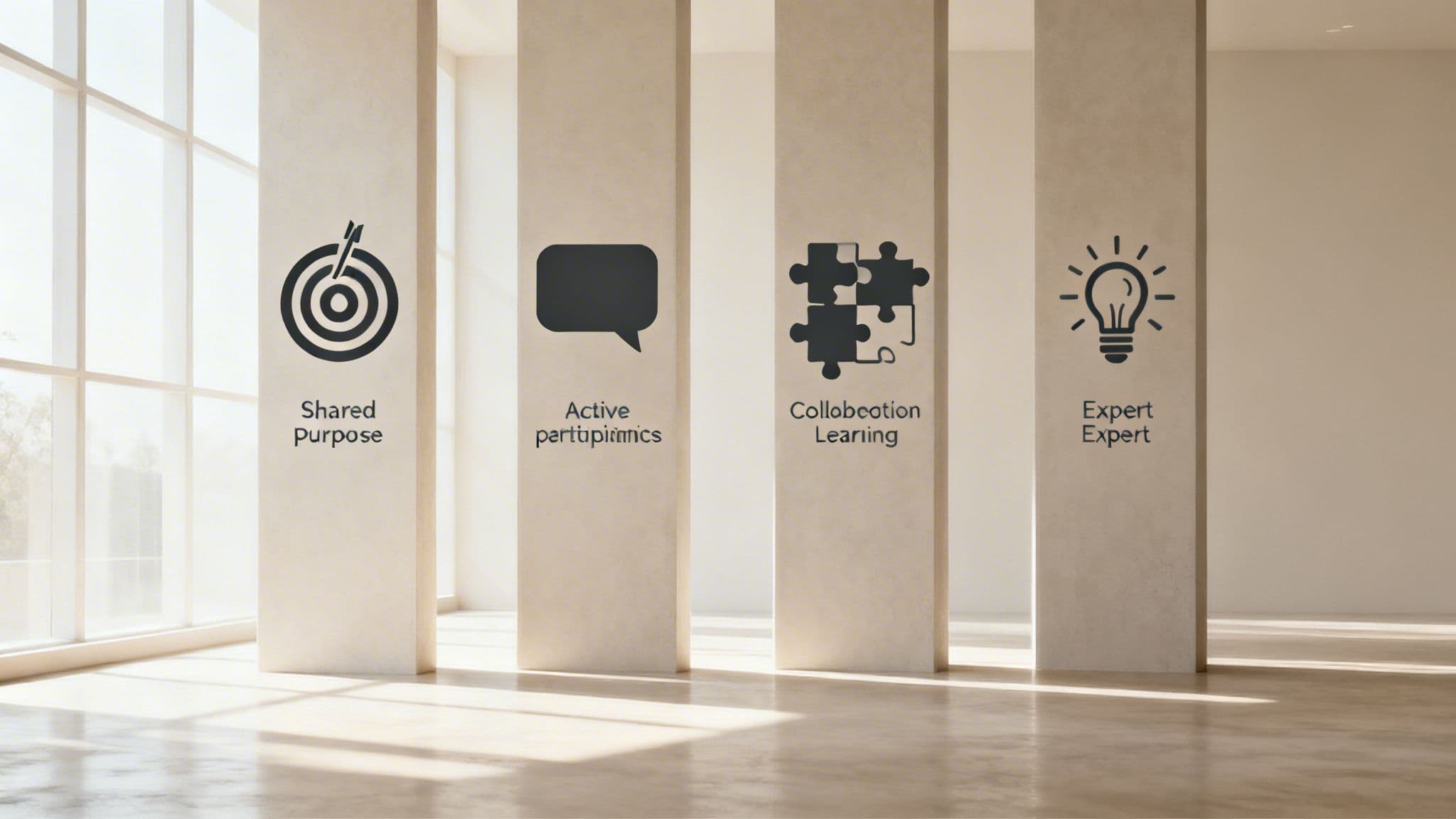
While the right platform gets people in the door, it’s the human architecture that makes them stay. I’ve seen countless creators launch a community space only to watch it become a digital ghost town within months. Why? They focused on the tool, not the experience.
A successful community of learners doesn't just happen. It’s intentionally designed around four core pillars that work together. Nail these, and you’ll stop being just a content provider and become the architect of a self-sustaining learning ecosystem.
1. Shared Purpose
This is your community’s North Star. It's the one, specific, compelling reason everyone is there. A weak purpose is "learn to code." A strong purpose is "land your first front-end developer job in 6 months."
Think of this as your mission statement. It acts as a powerful filter, attracting people who are genuinely committed and signaling to casual lurkers that this might not be the place for them.
A well-defined purpose is your greatest asset for engagement. It gives every discussion, every challenge, and every piece of content a clear why, ensuring all activities align with the collective goal.
2. Active Participation
A community without participation is just a content library with a comment section. Passive consumption is the enemy. Your job is to intentionally design rituals that make participation easy, rewarding, and habitual.
This doesn't have to be a heavy lift. Simple, consistent prompts are incredibly effective:
- Weekly Wins: A dedicated thread where everyone shares one small victory.
- "Stuck" Sessions: Live office hours where members can get unstuck in real-time.
- Peer Reviews: A space to share work-in-progress and get direct feedback from others on the same journey.
- Member Spotlights: Celebrating a member's milestone or success story.
These activities transform members from passive observers into active co-creators. They build momentum, turning participation from a chore into a core part of the experience.
3. Collaborative Learning
This is where the magic really happens. Communities of learners unlock their true potential when members start learning from each other, not just from you. The group's collective intelligence and experience quickly become more valuable than any single expert's knowledge.
This dynamic is the heart of social learning, where the sum is truly greater than its parts. You can dive deeper into the mechanics of this in our guide on what is social learning.
For collaboration to spark, members need to feel safe enough to be vulnerable—to ask "dumb" questions, admit they're struggling, and share half-finished ideas. In a course on self-publishing, one member might be a brilliant storyteller, while another is a wizard at formatting. A collaborative space encourages them to trade skills, accelerating progress for everyone.
4. Expert Guidance
While peer-to-peer learning is the goal, the community still needs a leader. Your role shifts from being a lecturer to a facilitator, a mentor, and a guide. You set the tone, model the behavior you want to see, and gently steer conversations back to the shared purpose.
Your guidance provides the essential structure and credibility that holds everything together. You’re there to:
- Answer the tough questions the group can't.
- Provide deeper context from your own experience.
- Curate and spotlight the best member contributions.
- Ensure the environment remains a safe, supportive, and focused space for growth.
By carefully balancing these four pillars, you create an environment where members feel connected, motivated, and empowered to achieve real results—together.
Exploring Proven Models for Your Learning Community
Okay, so you're sold on the power of building a community around your expertise. The big question now is: what does it actually look like in practice?
There’s no one-size-fits-all answer here. The best structure hinges entirely on your subject matter, your audience, and the specific transformation you’re promising. Nailing down the right model from day one is everything—it sets clear expectations for your members and gives you a blueprint for an experience that actually delivers.
Let’s walk through three battle-tested models. Each one offers a different way to structure, run, and monetize your community. Zanfia is built as an AI team that runs a creator business, so you can launch any of these models—or bundle them together—while the assistant handles the setup by chat or voice, and the checkout is ready to sell with order bumps, installments and upsells from day one.
The Cohort-Based Course Model
Picture an intensive, live-fire workshop where everyone starts on day one and crosses the finish line together. That’s the soul of a Cohort-Based Course (CBC). This model is built around a fixed timeline—usually a few weeks to a few months—where a specific group of learners (your cohort) moves through your curriculum in lockstep.
That shared schedule creates an incredible sense of momentum and accountability. Because everyone is wrestling with the same lesson or project at the same time, peer-to-peer support and collaboration just happen naturally. It's the perfect fit for teaching a specific, complex skill with a definite endpoint, like "Mastering Product Photography in 6 Weeks."
- Pros: Sky-high engagement, powerful accountability, and fantastic completion rates that often top 70% . The fixed timeframe makes it a premium, high-touch experience that justifies a higher price point.
- Cons: It demands a ton of your focused energy while the cohort is running. Your revenue also comes in waves with each launch, rather than as a steady, predictable income stream.
If this structure feels right for you, our deep-dive on the cohort-based course model is a great next read.
The Evergreen Membership Model
Where the CBC has a hard stop, the Evergreen Membership is more like an ongoing, all-access pass to a private club. Your members pay a recurring fee—typically monthly or annually—for continuous access to a growing library of content, a dedicated community space, and regular touchpoints with you and their peers.
This model is designed to build deep, long-term relationships and create a predictable, recurring revenue stream for your business. It works beautifully for broader topics that don't really have an "end," like mastering a creative craft, personal development, or staying ahead in a rapidly changing industry. The community becomes a permanent home base for members on their journey.
To make a membership thrive, you need to understand the dynamics of collaborative learning, which is the engine that drives member engagement and retention.
This model fundamentally shifts your business from hunting for one-off sales to building a sustainable, relationship-driven engine. Your success is directly tied to your members' ongoing growth—as long as they’re getting value, they stick around.
The Product-Adjacent Community Model
But what if your main offer isn't a course or a membership? What if it’s a digital product, like an e-book, a set of templates, or a comprehensive guide? A Product-Adjacent Community is a private space exclusively for customers who've bought that specific product, acting as a powerful value-add.
For instance, someone who buys your "Ultimate Guide to Advanced SEO" could get exclusive access to a community where they can ask you direct questions, share their wins and struggles, and get instant updates. This support system makes your original product ten times more valuable and effective.
Even better, it creates a focused audience of proven buyers—people who have already paid for your expertise and are the perfect candidates for your next offer.
This is a brilliant, low-risk way to dip your toes into community building. You can start small, provide amazing support for an existing product, and use the insights from member conversations to design your next blockbuster course or membership. It’s a smart strategy for turning a simple transaction into a lasting relationship.
Your Step-by-Step Community Launch Plan
Taking a community from a great idea to a thriving reality can feel overwhelming. The secret is to stop thinking about it as one massive project and start treating it like a series of distinct phases: pre-launch, launch, and post-launch. This is your playbook for turning that vision into a concrete, step-by-step plan.
Phase 1: The Pre-Launch Foundation
This is where you build the foundation. Trying to launch a community without a proper pre-launch is like throwing a party without sending invitations—you’ll end up with an empty room. Your goal here is to manufacture anticipation and guarantee you have an audience ready and waiting on day one.
First, you need to nail your community's unique value proposition. What specific outcome or transformation are you actually selling? Why should someone invest their time and money in your community over any other? A crystal-clear answer here becomes your North Star for all content and marketing.
Once you’ve defined your value, your entire focus shifts to building a waitlist. This isn't optional; it's how you build momentum before the doors even open.
- Build a Simple Landing Page: It needs to clearly articulate the community's purpose and the transformation members will achieve.
- Create a Compelling Incentive: Give people a real reason to sign up now . Offer an early-bird discount, exclusive bonus content, or the coveted status of a "founding member."
- Nurture the Waitlist: Don't let it go cold. Send regular updates, share behind-the-scenes progress, and build a steady drumbeat of excitement for what’s coming.
By launch day, you won't be shouting into the void. You'll be opening the doors to a core group of evangelists who are already bought into your mission and eager to get started.
The model you choose will shape the entire experience. This infographic breaks down the most common structures you can build on.
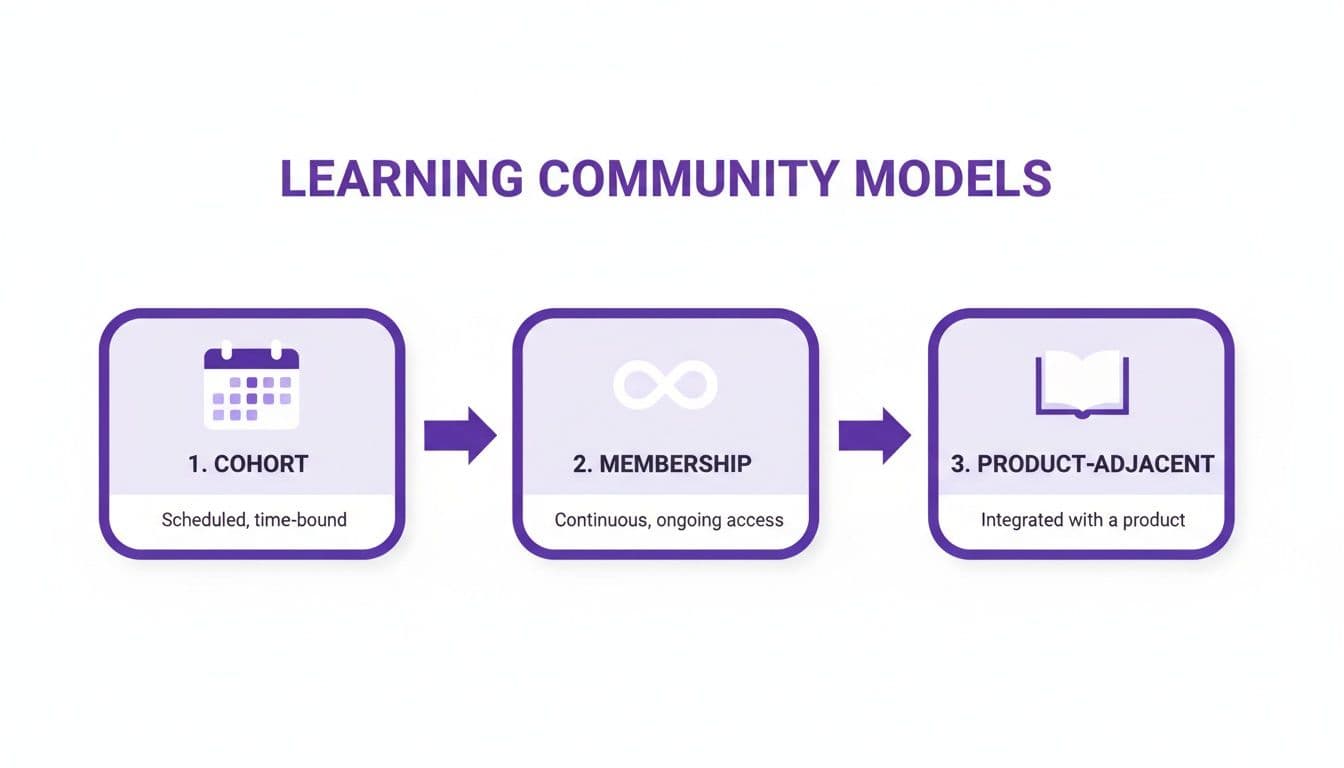
Think of these models—Cohort, Membership, and Product-Adjacent—as different strategic tools. One is built for intensive, time-bound skill acquisition, while another is designed for long-term connection and support.
Phase 2: The Launch and Onboarding
Launch day is all about delivering a premium, frictionless experience. Your singular goal is to make every new member feel seen, welcomed, and instantly validated in their decision to join. A rock-solid onboarding process is non-negotiable.
Great onboarding sets the cultural tone for the entire community. It orients new members, clarifies the rules of engagement, and prompts their very first contribution. For a tactical deep dive, check out our guide on user onboarding best practices.
Your launch week checklist must include:
- A Personal Welcome: An automated welcome email should fire immediately, confirming the purchase and giving them a direct link to log in.
- Clear Guardrails: Pin your community guidelines in an obvious, easy-to-find location. This sets the expectation for a respectful and productive environment from minute one.
- An Icebreaker Prompt: Create one single thread where new members are prompted to introduce themselves. This is the fastest way to spark initial connections.
- A "Start Here" Guide: This can be a short video or a simple post that shows people how to find key resources, navigate the platform, and get help if they're stuck.
Phase 3: The Post-Launch Momentum
After the initial launch buzz subsides, your job shifts from acquisition to retention and iteration. The first 30-60 days are a critical window for cementing member habits and proving your community's long-term value.
Now, your primary role is to be a facilitator and an obsessive listener. Watch what topics spark the most conversation, notice which members are stepping up as natural leaders, and identify where people are getting stuck. This early feedback is pure gold.
Use this data to drive your content and engagement strategy. Host your first live Q&A, create resources that answer common questions, and publicly recognize your most active members. By constantly gathering feedback and iterating, you ensure your community evolves with its members, turning it from a static product into a living, self-sustaining ecosystem.
How to Measure and Drive Long-Term Engagement
A thriving community isn't about bragging rights over member counts. While it's easy to get fixated on vanity metrics like total users, the actual health of your communities of learners is revealed in how deeply and consistently people show up. Focusing on the right numbers is what separates a flash-in-the-pan project from a sustainable, profitable business.
So, let's stop asking, "How many people are in my community?" and start asking the questions that matter: "How many are actually participating?" and "How long do they stick around?" The answers give you a real-time pulse on your community's value and its long-term viability.
The Metrics That Truly Matter
To get a clear picture of what’s working (and what’s not), you need to track a few key indicators. These metrics don't just spit out numbers; they tell a story about member satisfaction, the quality of your content, and the strength of the connections being formed.
- Engagement Rate: This is your a-ha moment metric. It measures the percentage of your members who are actively posting, commenting, or reacting within a given week or month. A healthy engagement rate is the clearest signal that your community is delivering genuine value.
- Member Retention Rate: This is the ultimate vote of confidence. It’s the percentage of members who stick with you from one period to the next (like month-to-month). High retention proves members feel they’re getting more value than what they’re paying for.
- Customer Lifetime Value (LTV): LTV calculates the total revenue you can expect from a single member over their entire journey with you. Driving up LTV is the secret to scaling efficiently—it costs far less to keep a happy member than to constantly chase new ones.
These three metrics are deeply connected. High engagement fuels higher retention, which in turn maximizes LTV. If you're just starting to wrap your head around these figures, our article on understanding student engagement is a fantastic place to build your foundation.
Strategies for Boosting Community Participation
Knowing your numbers is one thing. Moving the needle is another. Your goal is to create an environment where participation feels natural, rewarding, and essential to the whole experience.
Think about introducing weekly rituals that build habits and connections. Member-led events are a game-changer—things like peer-review sessions or "ask me anything" threads hosted by your most advanced students. This empowers your members and takes some of the content-creation burden off your shoulders.
Exclusive content is another powerful lever. Think bonus materials, live Q&A sessions, or early access to new courses that are only available to active community members. This rewards participation and makes being inside your community completely indispensable.
Demand is growing for integrated, creator-centric platforms that prioritize engagement over feature checklists. On Zanfia, an AI team handles the setup work behind the scenes: the assistant can build a checkout, spin up a community channel or draft a lesson from a voice note, so you spend your time facilitating instead of configuring. The right tool keeps everything unified, dramatically boosting retention and lifetime value.
Connecting Engagement Directly to Your Bottom Line
Every single engagement strategy you roll out should tie directly back to your business goals. It's simple: when members feel connected and are actively participating, they are far more likely to stay subscribed for the long haul. This directly pumps up your retention rate and LTV.
Imagine a creator running a membership community. By hosting a monthly live workshop, they aren't just dropping value; they're creating a can't-miss recurring event. That one activity boosts engagement, strengthens member-to-member bonds, and makes the subscription feel incredibly "sticky." This is how you stop selling a simple content subscription and start building a thriving, profitable ecosystem.
Choosing the Right Tech for Your Community
Picking your community's tech stack is one of the most important decisions you'll make as a creator. Get it right, and your technology becomes an engine for growth. Get it wrong, and you're left with a time-draining, complicated mess that sabotages your vision before you even get started.
It's a lot like building a house. You can try to piece it together yourself with mismatched materials, or you can start with a solid, professionally designed foundation where everything just works.
Too many creators accidentally drift into one of two inefficient setups. Let's break down the common approaches and see why a unified system is almost always the smarter path for building real communities of learners.
The Plugin Puzzle vs. The Scattered Stack
The "Plugin Puzzle" is a path most WordPress users know all too well. You start with a core website and then start bolting on plugins: one for your forums, another for courses, a third for payments, and a fourth for memberships. While this seems flexible at first, it creates a fragile ecosystem where one bad update can break your entire business overnight. You stop being a creator and become a full-time tech manager, constantly wrestling with compatibility issues.
The "Scattered Stack" is the other common workaround. This means stitching together separate services: maybe an online course platform like Teachable, a community space on Discord, and a payment gateway like Stripe. Each tool is powerful on its own, but the member experience becomes a disconnected nightmare. Your students have to create multiple accounts, learn different interfaces, and remember where to go for what—a recipe for tanking engagement.
Both of these models come with massive hidden costs:
- Wasted Time: You'll spend 5–10+ hours a month just on manual admin—granting access, troubleshooting broken integrations, and trying to connect user data between systems.
- Fragmented Experience: When your community lives on Discord and your course is somewhere else, you split your audience's attention. Participation starts to feel like a chore.
- Data Silos: You get zero visibility into the full customer journey. Is your most active community member also your most valuable course student? With scattered data, you’ll never know.
Embracing the All-in-One Advantage
This brings us to the third approach: the all-in-one platform. This model integrates your courses, community, payments, and marketing automation into a single, unified ecosystem. For your members, it means one login, one seamless experience, and one branded home for everything you offer.
An integrated system allows creators to build community-based products where everything works together effortlessly. When a student finishes a course module, they can instantly jump into a dedicated discussion channel without ever leaving your site, keeping engagement high and focused.
With platforms like Zanfia, you get more than integration: it's an AI team you can direct by chat or voice, with an MCP endpoint so your own AI assistants can act on your workspace directly (availability depends on the plan, see the current Zanfia pricing). Instead of taking a cut of your sales, Zanfia charges 0% platform commission on customer sales as of 2026, so you keep the full amount minus standard payment processor fees. This is a real shift for creators tired of watching transaction fees eat into their hard-earned profits.
To give you a clearer picture, let's compare these three technology models side-by-side.
Community Platform Technology Comparison
| Attribute | Plugin Puzzle (e.g., WordPress) | Scattered Stack (e.g., Kajabi + Discord) | All-in-One Platform (e.g., Zanfia) |
|---|---|---|---|
| Member Experience | Clunky; multiple plugins can slow down the site. | Fragmented; requires multiple logins and UIs. | Seamless; one login, one branded destination. |
| Admin Overhead | High. Constant updates, security, and compatibility checks. | High. Manual data syncing and access management. | Low. Centralized management, an AI assistant you can dictate to, and built-in automations. |
| Checkout & Selling | Bolt-on plugins for cart, upsells and payment plans, often mismatched. | Depends on the tool; upsells and installments frequently require extra services. | Built-in checkout with order bumps, installments, upsells and test mode before launch. |
| Data & Analytics | Siloed across plugins; difficult to get a single view. | Completely siloed; no single source of truth. | Unified; see the full member journey in one place. |
| Cost Structure | Many small costs for plugins, hosting, and developer help. | Multiple subscriptions that add up quickly. | One predictable subscription with 0% platform commission (as of 2026). |
| Brand Control | Good, but limited by plugin functionality. | Weak; sends users to third-party branded platforms. | Excellent. Fully branded with your custom domain (plan-dependent). |
This integrated approach also unlocks powerful automations that give you your time back. Imagine instantly granting course access after a purchase, adding new buyers to the right community channels, and triggering a welcome email sequence—all without you lifting a finger. For organizations like tutoring centers, leveraging specialized software for multi-tutor businesses can offer similar operational efficiencies.
Ultimately, the right technology doesn't just host your community; it helps it thrive by freeing you up to focus on what you do best: creating value and connecting with your members.
Frequently Asked Questions About Learning Communities
Thinking about launching a community of learners? It’s natural to have questions. Here are some straight answers to the most common concerns we see from creators, designed to give you the clarity you need to get started.
How Much Should I Charge for My Learning Community?
Your pricing all comes down to the model you choose and the real-world value you deliver. For an intensive, fixed-term cohort course, a one-time fee might land anywhere from $300 to $2,000+. On the other hand, an ongoing membership community could be priced between $20 and $100 per month.
Don't just copy what your competitors are doing. The best strategy is to anchor your price to the transformation you promise. Flexible platforms even allow for subscriptions, installment plans, and product bundles, giving you complete control over how you monetize.
What If No One Participates in My Community?
This is a classic fear, but here’s the secret: participation isn't magic, it's architecture. A ghost town community is completely preventable if you're proactive from day one. Start with a small, hand-picked group of "founding members" who are genuinely excited to help you shape the culture.
From there, use simple tactics to get the conversation started:
- Icebreaker Prompts: Create a dedicated channel for new members to introduce themselves.
- Weekly Q&A Sessions: Go live regularly so members know they have a reliable way to get direct help from you.
- Clear Discussion Channels: Organize conversations by topic. Modern platforms allow for topical channels and read-only announcement spaces to keep things organized.
Your job as a facilitator is most critical right at the beginning. When you celebrate your earliest contributors and make participation feel effortless, you're setting the stage for a community that eventually runs itself.
Do I Need a Large Audience to Start a Community?
Absolutely not. In fact, a small, highly engaged group of 20–30 paying members is often more profitable and creates a far better experience than a massive, passive audience. The goal is always quality over quantity.
Focus all your energy on attracting the right people—the ones who are truly committed to the shared goal. A tight-knit group where everyone feels seen and heard will generate powerful testimonials and build an unbreakable foundation for growth.
How Much Time Does It Take to Manage a Community?
Your time commitment will vary, but it's smart to budget for 5–10 hours per week when you're just starting out. This time is usually spent creating content, sparking discussions, answering questions, and personally welcoming every new member.
As your community matures, something amazing happens: members start supporting each other, which naturally lightens your load. Using an all-in-one platform with powerful automations—like automatically granting course access or handling invoices—can save you 5–10+ hours a month, freeing you up to focus on what really matters: meaningful interaction.
Ready to build your own thriving community with an AI team that runs the setup for you? Zanfia is an AI-first, agent-first, MCP-first creator platform where you can launch courses, memberships and digital products by chat or voice, sell them through a checkout built with order bumps, installments and upsells, and keep the full amount minus standard payment processing (0% platform commission as of 2026). Start with a 14-day free trial, no credit card required, at https://zanfia.com.