

What is Social Learning? Key Concepts for Online Courses
Let’s get right to it: what is social learning? It’s learning the way humans have always learned—by watching others, copying what they do, and figuring things out together. Think about how you learned to do anything practical, from cooking a family recipe to riding a bike. You observed, you tried, and you got feedback.
That’s social learning in a nutshell. It's the simple, powerful idea that we learn best when we learn together.
How Social Learning Drives Real Engagement
When you apply this to an online course or community, something incredible happens. The experience shifts from a one-way street (instructor to student) into a vibrant, multi-lane highway of shared knowledge. Learners aren't just passively consuming videos and PDFs; they're actively co-creating the learning experience.
They start learning as much from each other’s questions, "aha!" moments, and even mistakes as they do from the official course material. You’re not just an instructor anymore; you're the facilitator of a collective intelligence. This is more than just a nice idea—it has a tangible impact on your business. By building an environment where members feel comfortable sharing and participating, you tap into core human psychology. Learning becomes a team sport, and the results are powerful:
- Deeper Engagement: Conversations, debates, and group problem-solving keep people invested and coming back for more.
- Better Retention: The act of explaining a concept to a fellow member is one of the best ways to solidify it in your own mind. We remember what we teach.
- Stronger Community Bonds: Members form real connections, transforming their relationship with your brand from transactional to relational. They're no longer just customers; they're part of a tribe.
Ultimately, you’re not just selling a course or a product. You're building a destination—a place where people come to connect with peers and grow. For more on this, check out our guide on how to build an online community that truly thrives.
The Surprising Origins of Social Learning
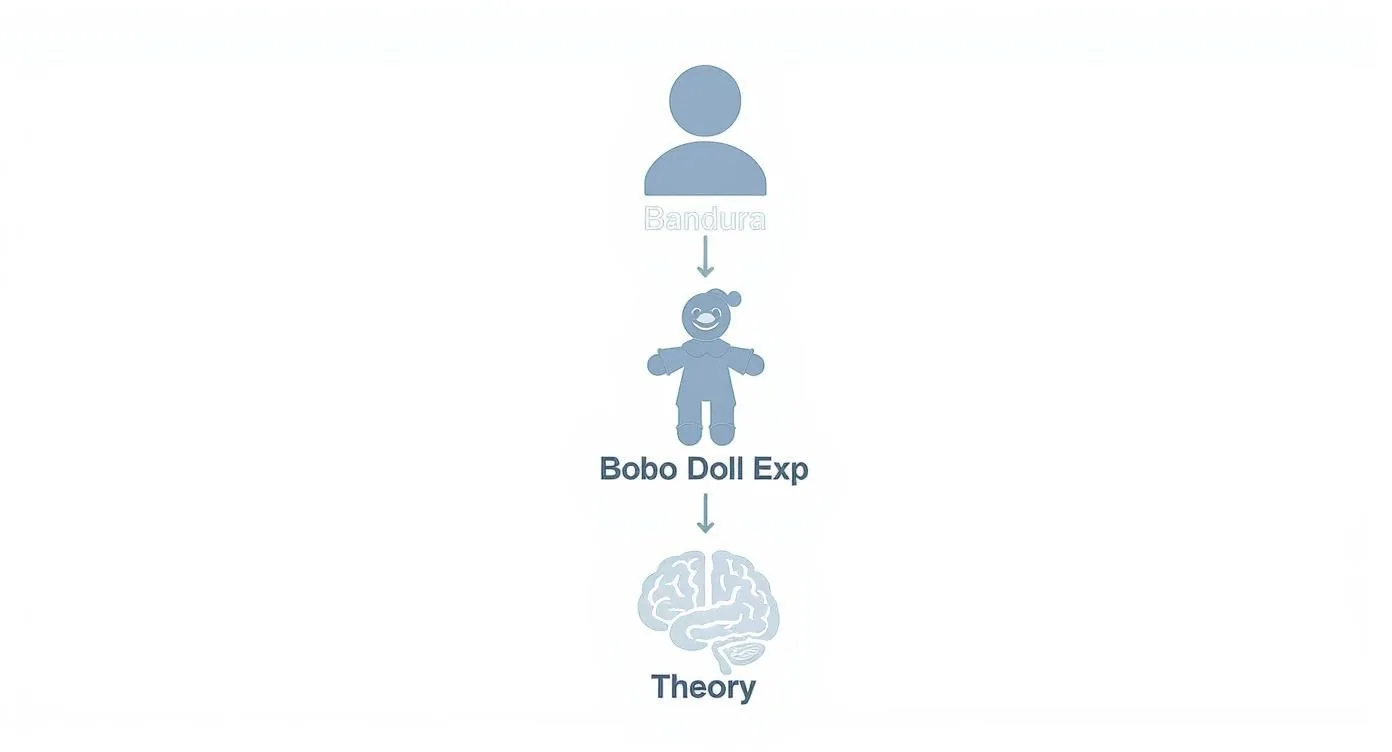
Believe it or not, social learning isn't some new buzzword that popped up with the rise of social media. It’s a powerful, deeply human principle with roots in some truly fascinating psychology, showing us exactly why community is so vital for learning. The whole idea was championed by psychologist Albert Bandura, who took a bold stance against the popular belief that we only learn from direct rewards and punishments.
Bandura’s big idea was simple yet profound: we learn a huge amount just by watching other people. He didn't just toss this theory out there; he set up a series of experiments that would completely shake up the world of psychology.
The Famous Bobo Doll Experiment
Back in the early 1960s, Bandura ran his now-legendary Bobo doll experiment. The setup was straightforward. He had children watch an adult interact with an inflatable clown doll named Bobo. One group of kids saw an adult get aggressive—hitting, kicking, and yelling at the doll. The other group saw an adult playing peacefully with it.
The outcome was a game-changer. The children who had watched the aggressive adult were far more likely to lash out at the Bobo doll themselves, often mimicking the exact same aggressive acts and words they’d seen. This was the first real proof that we can learn simply through observation and modeling, without any need for direct instruction or personal reward. You can dig deeper into the foundational studies behind this theory to see just how influential they were.
"Children who observed the aggressive adult model were significantly more likely to display aggressive behaviors toward the Bobo doll, demonstrating that learning occurs through observation."
So, what does a 60-year-old psychology experiment have to do with your digital products? Everything. When you build a community around your courses, you’re not just tacking on a "nice-to-have" feature. You are plugging directly into the core of how humans are wired to learn. You're creating a space where people can watch, copy, and absorb skills—not just from you, but from each other. This is how you accelerate their growth and create a real, lasting connection to what you're building.
The Four Pillars of Effective Social learning
So, how do you take the big idea of social learning and actually make it work in your online community or course? It’s not about magic; it's about a clear, structured process. This whole approach is built on four key pillars that psychologist Albert Bandura first mapped out.
Think of these as the legs of a table. If one is wobbly or missing, the whole thing becomes unstable. By building your learning environment with all four in mind, you create a space where knowledge isn't just passively consumed—it’s actively shared, practiced, and applied.
Pillar 1: Attention
Before anyone can learn from watching someone else, they have to actually watch. This sounds ridiculously simple, but in our hyper-distracted world, capturing and holding attention is the single biggest challenge for any creator.
This is where your content has to be more than just informative; it needs to be genuinely engaging. It might be a gripping video tutorial hosted with a smart video player that saves progress, a provocative question in a discussion forum, or a live Q&A with an industry pro. The goal is to make the skill you're modeling so compelling that your members can't help but tune in.
Pillar 2: Retention
Seeing is one thing, but remembering is another. For learning to have any real impact, your members have to be able to recall what they observed. This is the retention phase—the crucial step where information gets filed away in long-term memory.
You can't just hope this happens. You need to actively encourage it. Prompt members to share their biggest takeaways from a recent lesson. Start a debate in a forum about the pros and cons of a certain technique. These activities force the brain to dig up that new information, which strengthens the memory.
Pillar 3: Reproduction
Next up is reproduction. This is the "show me what you got" stage, where observation finally turns into action. It’s the point where a member tries to perform the skill or behavior they’ve been watching. It's one thing to watch a video on how to bake the perfect sourdough; it’s a completely different ballgame to actually do it yourself.
In your community, this looks like:
- Practical projects: Give members a real-world assignment where they have to apply the new skill.
- Peer feedback: Create a space for members to share their work and get constructive criticism from others.
- Group challenges: Get people to collaborate on a task that forces them to use what they’ve learned together.
Pillar 4: Motivation
Finally, motivation is the engine that powers this entire cycle. A person can pay attention, remember the information, and even have the ability to do the task, but if they don't have a good reason why, they probably won't bother.
This is where the community becomes your most powerful tool. When members see their peers getting praise, achieving milestones, or solving tough problems, it creates a powerful incentive to keep going. Simple shout-outs, positive feedback, and even a bit of friendly competition can be all it takes to build a supportive atmosphere that fuels growth. Nailing the art of forming a community is absolutely essential for creating this motivational spark.
Why Social Learning Is Your Secret Weapon
Let's get practical and talk about what social learning theory actually means for your business—your student outcomes and, ultimately, your revenue. This isn't just about making your platform feel more "friendly." It's a strategic move that can dramatically lift your most important numbers. This is especially true for creators earning five or six figures a month who are tired of seeing commissions eat into their margins.
A platform that charges 0% commission on customer sales, like Zanfia, means you keep the full ticket price minus the processor fee, so you can reinvest in your community and content. Zanfia treats that community as work its AI team helps run, not just a room you host: the assistant knows the whole application and can act on it by chat or by voice, and a community AI agent can draft posts from your own content (with every AI-written post clearly labeled as AI). When you add social learning on top, you transform a lonely textbook into a lively book club, where people are excited, supported, and motivated to keep showing up.
That simple shift from passive consumption to active participation is where the magic happens. It's the key to creating real value and building a loyal customer base that sticks around for the long haul.
Driving Retention and Lifetime Value
When students feel connected to their peers, they're far more likely to stay engaged and actually finish what they started. That sense of belonging and mutual support is a powerful antidote to the notoriously low completion rates that plague so many online courses. And of course, higher completion rates lead to better testimonials and a stronger reputation for you.
This "community glue" extends well beyond a single course purchase. By creating a vibrant space for your members to connect, you drastically increase their lifetime value. People who build real relationships are much more likely to buy from you again, upgrade their plan, or jump on your next big offer. A checkout built to sell helps you capture that: order bumps, upsells, and installments (splitting a $600 program into four payments, for example) let you package the next step without pushing people to a separate tool. If you're curious about how this works financially, you can explore these subscription business model examples for creators.
This isn't just wishful thinking; the data backs it up. Educational programs that actively integrate social elements have seen student engagement rates jump by as much as 25%.
Building a Defensible Brand
A thriving community acts like a protective moat around your business. Competitors can always try to copy your content or your features, but they can't replicate the unique culture and web of relationships you've carefully built. With white-label features and a custom domain, you build a strong, independent brand identity where clients experience your brand, not your platform's.
Your community becomes a core part of what people are paying for. The impact of learning alongside trusted peers is immense. In fact, studies have shown that even young children can learn up to 70% of new words simply by hearing them from sources they trust. When you foster that kind of environment, you build a loyal audience that sees your brand as completely indispensable.
Bringing Social Learning to Life with Zanfia

Understanding the theory behind social learning is a great start, but the real magic happens when you put it into practice. For creators, the big challenge is often finding a platform that does more than just host content. You need a space that actually nurtures the human connections that make learning stick—and, increasingly, an AI team that helps you run it.
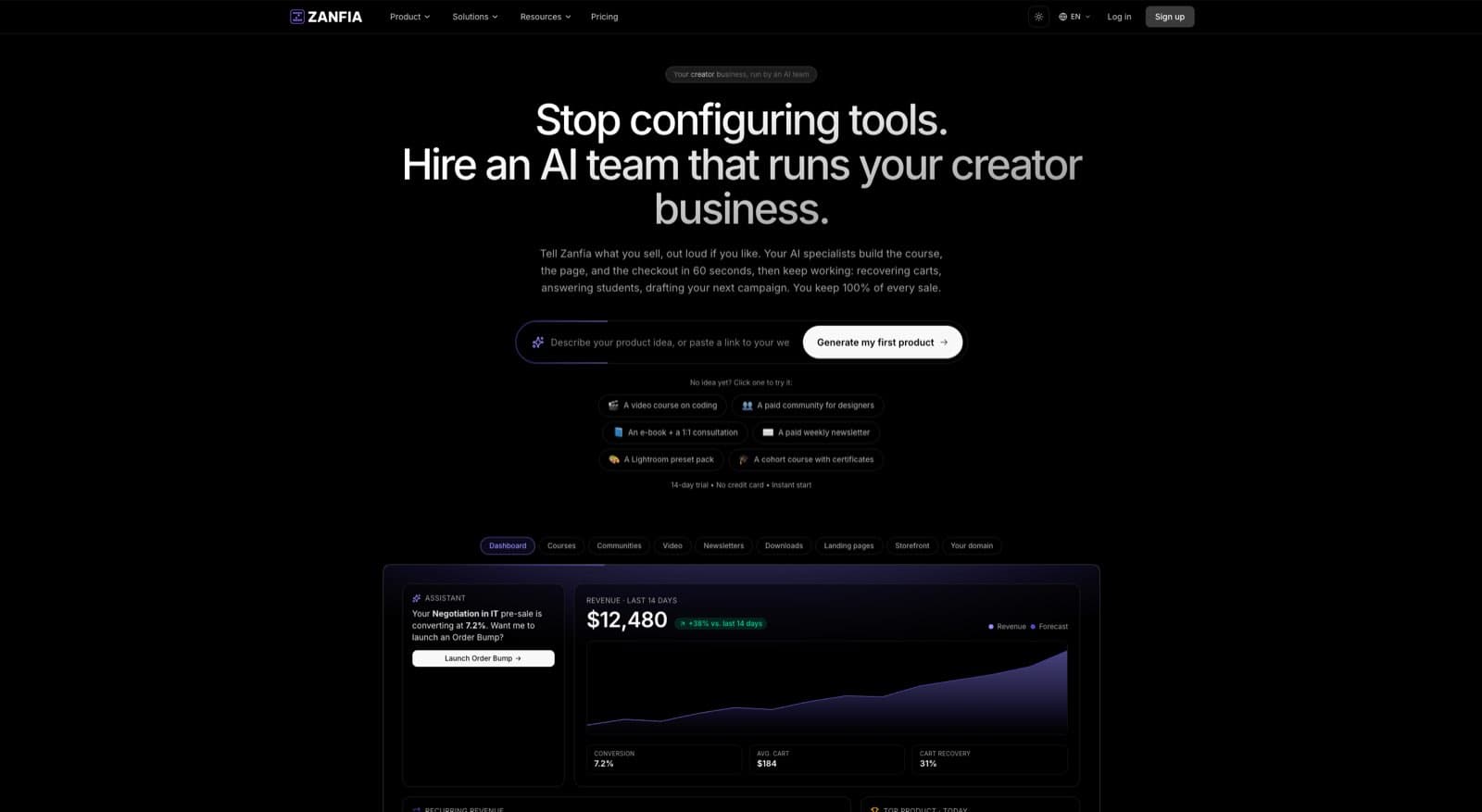
This is where Zanfia's positioning matters. It's an AI-first, agent-first platform: you describe what you want and the assistant performs any action the interface supports, by chat or by voice. Twelve product types (courses, communities, newsletters, memberships, bundles, downloads, and more) live under one brand and one login, so your students stay focused in your world instead of bouncing to Discord or Facebook groups. For creators who want to bring their own tools, an MCP endpoint lets AI assistants act on the workspace directly (availability depends on the plan, see the current Zanfia pricing). When your community, your courses, and the AI helping you run them all live in the same place, social learning just flows naturally.
Creating a Hub for Collaborative Growth
The goal is to build a safe, organized environment where your members feel confident enough to ask questions and share ideas. With Zanfia, you can create this community hub right alongside your course materials, which is a game-changer. It’s a unified learning and interaction environment.
Think about it: a student is working through a tough lesson with native video hosting. Instead of getting frustrated and walking away, they can pop over to a dedicated discussion channel and ask for help. A moment later, other students jump in with their own perspectives. Suddenly, you have a powerful peer-to-peer support system where everyone is learning from each other.
That seamless integration is the hallmark of effective community management software, turning a static course into a living, breathing learning ecosystem.
Practical Tools for Fostering Interaction
Zanfia gives you the specific tools you need to bring the principles of social learning to life.
- Topical Channels: You can set up dedicated channels for each course module or topic. This keeps conversations tidy and makes it incredibly easy for members to find answers and help one another out.
- Announcement Channels: Use admin-only, read-only channels to share key updates, celebrate member achievements, and showcase success stories. This modeling behavior is a huge part of observational learning, showing others what's possible.
- Role-Based Access and Groups: Need to set up a collaborative project or a peer-review session? You can segment your community into smaller cohorts using roles and channel permissions to encourage direct interaction and build tighter bonds.
- Community AI Agent: An AI agent can draft channel posts from your own content, so a new community doesn't sit empty while you find your rhythm. Everything the agent publishes is clearly labeled as AI, so members always know what came from you and what came from the assistant.
By having all these tools in one place, you're not just selling a course; you're building a thriving community where people learn together and rally around your brand.
Answering Your Top Social Learning Questions
As you start mapping out your own community-based products, you're bound to have some questions. It's only natural. Let's tackle some of the most common ones so you can move forward with confidence and clarity.
How Much Time Does Managing a Community Really Take?
This is probably the number one concern for busy creators, and it’s a fair question. In the beginning, yes, you'll want to be present daily. Your initial energy is what sets the tone and gets conversations flowing.
But the long-term goal isn't for you to be the only one talking. You're building a self-sustaining ecosystem where members start helping each other. Powerful automations are a lifesaver here, saving 5–10+ hours a month by handling tasks like instantly granting course access after payment, adding members to community channels, or triggering welcome emails. This lets you focus on creating value, not mind-numbing admin.
What if My Audience Is Full of Lurkers?
It's totally normal for a new space to feel a bit quiet at first. The trick is to be incredibly intentional with your engagement prompts. Vague questions like, "Any questions?" often lead to crickets.
Instead, ask specific, low-stakes questions that are easy to answer. Try something like, “What was the one thing that surprised you in Lesson 3?” or “Post a picture of your desk setup right now.” When someone does contribute, celebrate it! A simple public shout-out shows everyone that participation is valued, which often encourages even the quietest members to join in.
Can Social Learning Actually Work for My Niche?
Absolutely. The desire to learn by watching, copying, and working with others is wired into us, no matter the topic. Whether you’re teaching Python, sourdough baking, or Facebook ads, your members will learn faster and better with peer support.
The specific activities will just look a little different. A coding community might thrive on peer code reviews, while a baking group shares photos of their latest creations for feedback. The core principles hold true across the board. The search for this kind of environment is universal, whether it's someone finding the best online courses in Nigeria or anywhere else in the world; people want connection and support.
This is especially powerful for more structured learning programs. You can dive deeper into this with our guide on building effective cohort-based courses.
Ready to create a vibrant community where people learn and grow together? With Zanfia, you get an AI team plus everything you need to bring your courses, community, and content under one roof, and 0% platform commission on customer sales. Plans start at $39/month, or $31/month billed annually (Starter), with a 14-day free trial and no credit card required. Start building your online business with Zanfia today.