

Forming a Community That Actually Thrives
Every great community starts with a single, compelling idea. It’s not just about gathering people; it’s about creating an environment where a specific, meaningful change can happen for them. This core purpose is the bedrock of everything you'll build—it determines who joins, why they stick around, and the value they'll get.
Defining Your Community's Core Purpose
Before you even think about platforms or welcome messages, you have to nail down your community's purpose. This isn't just about picking a broad topic like "marketing" or "fitness." A powerful purpose is the direct answer to a potential member's silent but crucial question: "What's in it for me?"
The most successful communities I've seen are all built on a promise of transformation. They exist to solve a real, nagging problem or help members hit a tangible goal. This clarity becomes your North Star, guiding every single decision you make, from the content you create to your moderation style. Without it, you just end up with a noisy, unfocused chat room that people eventually wander away from.
From Vague Topic to Specific Transformation
Here’s how to think about it. "A community for photographers" is a topic. It's vague. But, "a community that helps wedding photographers confidently book their first $5,000 client"—that's a transformation. The first one attracts anyone with a camera, while the second pulls in committed professionals who are laser-focused on a specific outcome.
To get to this level of clarity for your own community, ask yourself these questions:
- What problem am I uniquely positioned to help people solve? This is where your expertise meets a genuine market need.
- What specific, measurable result will members walk away with? Maybe it's landing a new job, shipping a product, or finally mastering a difficult skill.
- What's the emotional journey? People often join a community feeling stuck or overwhelmed. The goal is for them to leave feeling confident and capable.
Getting this specific doesn't just attract the right people; it actively repels the wrong ones. And trust me, that's just as important for building a strong, supportive culture.
Creating Your Ideal Member Profile
Once your purpose is crystal clear, you need to get inside the heads of the people you want to serve. Building an ideal member profile is way more than just listing demographics. You need to map out their inner world—their mindset, their biggest professional headaches, and their deepest ambitions.
This means digging in and identifying the exact pain points your community is built to solve. Are your future members wrestling with a lack of accountability? Are there glaring skill gaps holding them back? Or are they just lost in their career path?
This infographic does a great job of showing how you can draw a straight line from a member's pain point to the solution your community provides.
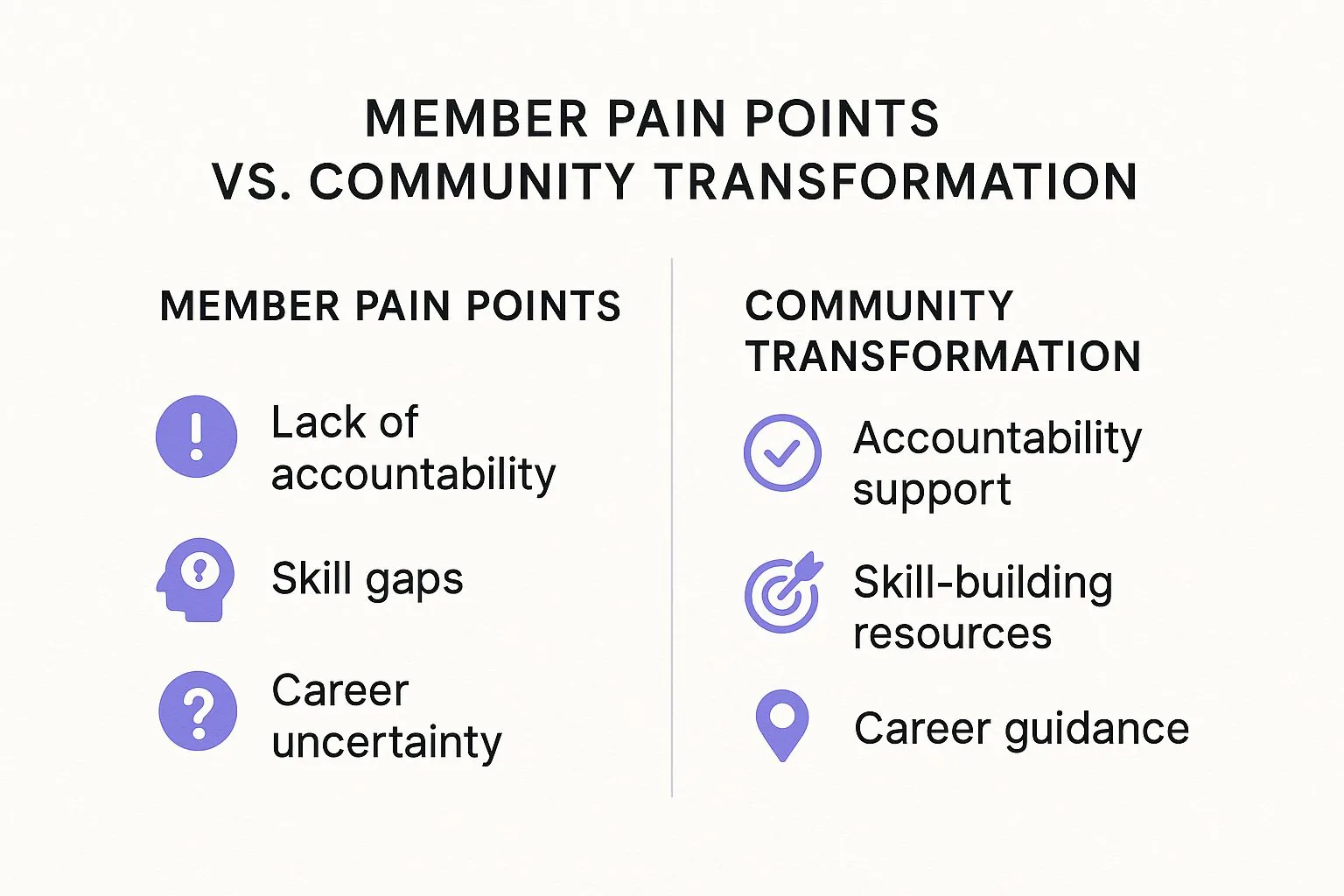
As you can see, a powerful community isn’t just a forum for chit-chat. It’s a carefully designed ecosystem that delivers targeted solutions to real-world problems. This alignment is what creates undeniable value. To see this in action, check out this detailed case study on how Neptune AI built its community by zeroing in on the specific needs of data scientists.
Your core purpose is your filter. It helps you decide what features to build, what content to create, and which conversations to encourage. Everything should serve the central mission of helping your members achieve their desired transformation.
Doing this foundational work makes sure that every piece of your community is intentional. You're not just throwing things at the wall; you're building a space where members feel truly understood and supported. That’s the magic ingredient for long-term engagement and success.
From here, you can start putting up the guardrails that protect this culture. For more on that, take a look at our guide on setting effective rules of the community that reinforce your core purpose.
Choosing the Right Home for Your Community
Where you decide to build your community is one of the most important decisions you'll make. It’s not just about picking some software; you’re laying the foundation for your entire business. This choice will directly impact your members' experience, your brand's perception, and, frankly, your own day-to-day sanity.
Many creators start by patching together different tools. Maybe it’s a WordPress site for courses, Stripe for payments, and a free Discord server or Facebook Group to host the actual community. On paper, it looks cheap. In reality, it creates a clunky, fragmented experience.
Your members have to juggle different logins and navigate clashing interfaces. This friction is a real engagement killer. Worse, you're building your most valuable asset—your community—on someone else's property. You're at the mercy of their algorithms, you don't truly own the data, and you're constantly fighting distractions designed to pull your members away.
The Power of an Integrated Ecosystem
There’s a much better way: an all-in-one platform where your community, courses, and payments all live together under your brand. This simple shift changes everything. Instead of sending your audience to third-party apps, you bring them into a focused, branded world that you control completely.
Zanfia is built as an AI team that runs the platform side of a creator business, and then wraps that work in the surfaces your members actually see: courses, communities, newsletters and checkout. A member can buy a course, jump into a discussion about a specific lesson, and manage their subscription with one login. On your side, an AI assistant that knows the whole interface will perform actions by chat or voice dictation, so you can say what you want done instead of clicking through menus. That combination is what keeps people around and gives you back the hours you normally lose to admin. Availability of the more advanced AI capabilities depends on the plan, so check the current Zanfia pricing. Zanfia offers a 14-day free trial, no credit card required.
Key Takeaway: When your community is integrated with your products, it stops being just another feature and becomes the core of your business. This creates a powerful feedback loop where learning and interaction fuel each other, making the entire experience far more valuable and sticky.
This isn’t just a theory; it’s where the industry is heading. The 2025 Community Trends Report from Circle.so revealed that 76% of community builders are now using applications or vetting processes to create higher-quality, trust-based environments. This move away from massive, open-to-all groups shows a clear preference for curated spaces where quality and control are top priorities. You can read more about these community trends on Circle.so.
Owning Your Brand and Your Business
Hosting a community on your own custom domain is about more than just looks—it’s about ownership. When members are on your white-label platform, every single interaction strengthens their connection to you, not to a social media giant.
To put this into perspective, let's compare the two approaches.
Platform Approach Comparison
| Factor | Scattered Tools (e.g., Discord + WordPress) | Integrated Platform (e.g., Zanfia) |
|---|---|---|
| Member Experience | Fragmented; requires multiple logins and UIs. High friction. | Seamless; single login for all content, community, and payments. |
| Brand Control | Limited. Your brand is diluted by the third-party platform's branding. | Complete control. The entire experience is under your brand and custom domain. |
| Data Ownership | You don't own the data or control the algorithm. At risk of platform changes. | You own 100% of your member data and have direct communication channels. |
| Monetization | Complicated. Requires integrating separate payment processors and tools. | 0% platform transaction fees, with order bumps, upsells and installments built into checkout. |
| Focus & Engagement | Members are constantly exposed to distractions from other groups and ads. | A dedicated, focused environment free from outside noise and competition. |
Ultimately, the choice comes down to whether you want to build on rented land or own your digital home.
This level of control also unlocks more sophisticated business models. As of 2026, Zanfia charges 0% platform commission on customer sales, so you keep 100% of the revenue after standard payment processor fees. You can also easily set up payment options that are a headache to manage with separate tools:
- Subscriptions: Build predictable, recurring revenue with monthly or annual plans.
- Installment Plans: Make your high-ticket offers more accessible by letting people pay over time. Splitting a $600 course into four payments is a checkbox, not a workflow.
- Product Bundles: Package courses, community access, and other resources into irresistible offers. And before you launch, you can run a test purchase on the real checkout to confirm the flow and the tracking work end to end.
This flexibility lets you craft offers that truly reflect the value you provide, and it supports the financial health of your business. For a more detailed look at what to look for, our guide on choosing a community platform for creators is a great next step. Choosing an integrated home for your community is a powerful statement—it's a commitment to your brand and to giving your members the absolute best experience.
Designing a Member Journey That Sticks
A great community doesn’t just happen; it’s designed. When you’re bringing people together, the environment you build has a huge impact on how they interact, connect, and ultimately, find value. The real goal is to create something more than just a chat room—it’s about building an intuitive space that gently guides new members from being quiet observers to becoming active, engaged contributors.
It all starts with a smart layout. Forget the single, chaotic feed where every post is fighting for attention. A well-thought-out community uses dedicated channels to create order and focus, making it simple for people to find conversations that matter to them and jump in where they feel most confident.

Create Clear Pathways for Communication
First things first, you need to create distinct spaces for different kinds of conversations. I like to think of it like designing a physical clubhouse—you wouldn't put the quiet library right next to the loud game room. The same thinking applies to your online space.
A simple, effective structure could look something like this:
- A Welcome Channel: This is the front door for your new members. It should have a pinned post with community rules, intros from your team, and a friendly nudge for them to introduce themselves.
- Topical Discussion Channels: Break out separate channels for the core themes of your community. For instance, a community for entrepreneurs might have channels like #marketing, #sales, and #operations.
- An Announcements Channel: This one is key. Make it a read-only channel where you post important updates, event schedules, and helpful resources. Making it read-only guarantees your most important messages won't get buried.
This kind of organization prevents new members from feeling overwhelmed and helps them find their way around from day one. Zanfia is built for this, letting you create posts channels, live chat channels, admin-only channels and channel groups directly inside your community. Members can be gated into a channel by role, and if you want a public front door, a channel can be opened to guests who read without an account before they decide to join.
Connect Your Content and Conversation
One of the most powerful things you can do to boost engagement is to tie your community directly to your educational content, like your online courses. When discussions are happening on a separate platform like Discord, you create a major disconnect. A student has to stop what they're doing, open another app, and hunt for the right conversation. That friction is a momentum killer.
By integrating discussion spaces directly with your course materials, you create a fantastic feedback loop. Imagine a member watching a tricky video lesson. Right below that video, they see a dedicated discussion where other students are asking questions and sharing “aha” moments about that exact topic.
This seamless integration turns passive learning into an active, collaborative experience. It creates an environment where students don't just consume content but actually help each other master it. This can dramatically increase course completion rates and overall member happiness.
This is where an all-in-one system like Zanfia really shines. Courses sit next to the community in the same interface, with native video hosting, chapters, auto-generated transcripts and a smart player that saves progress. Quizzes and completion certificates back up the learning, and drop-off analytics tell you where students actually stall. On top of that, an AI assistant can act on the platform for you by chat or voice, and a community-level AI agent can answer inside a channel using your own content, with every AI-published post clearly labeled as AI. You're not just selling a course; you're offering access to a living learning environment where the community is one of the most valuable parts of the product. Which of these AI capabilities is included depends on the plan, so check the current Zanfia pricing.
Build Deeper Connections with Private Groups
As your community grows, you can start creating more intimate spaces for specific groups of members. By organizing people into smaller groups, you can offer private channels tailored to their needs, adding another powerful layer of value to their membership.
You could create private groups for things like:
- Course Cohorts: Give students from a particular course intake their own private space to connect and cheer each other on.
- Tiered Memberships: Offer exclusive channels for your VIP or premium members, giving them more direct access to you or advanced content.
- Mastermind Groups: Set up small, focused groups where members can work on specific goals together and hold each other accountable.
These smaller, more exclusive spaces help foster much deeper relationships and a stronger sense of belonging. As you design this journey, it’s worth remembering that many strategies for increasing social media engagement are rooted in the same principles—it’s all about creating valuable and relevant interactions.
By building a clear, intuitive, and integrated path for your members, you lay the foundation for a community that doesn't just survive, but thrives. To get those first conversations rolling, our list of community circle questions can be a great place to start.
Fueling Growth Without Sacrificing Quality
Launching a new community isn't just about throwing the doors open and hoping for a flood of new sign-ups. It’s about attracting the right people and building a momentum that actually lasts. The real trick is to nurture a vibrant culture from day one while making it easy and exciting for new folks to join.
A community that takes off versus one that fizzles out often comes down to this: sustainable growth strategies.
Think of your first few members as the foundational pillars of your community. They're the ones who will set the tone, spark the initial conversations, and help you build that welcoming vibe you're aiming for. Your first job is to get them talking—not just to you, but to each other.
Sparking Those First Conversations
Nothing is more intimidating than a brand-new, empty community space. To get things rolling, you need to be the one breaking the ice. It’s a lot like being a host at a great party; you introduce people, ask good questions, and get conversations flowing.
Forget the generic, "How's it going?" prompts. Get specific. Get personal. Ask questions that encourage people to share real stories and experiences.
Here are a few ideas that work wonders:
- Weekly Wins: "Share one thing, big or small, that you're proud of accomplishing this week!"
- Challenges & Roadblocks: "What's the biggest hurdle you're facing right now? Let's see if we can brainstorm some solutions together."
- Behind the Scenes: "Post a picture of your workspace or a project you're currently wrestling with."
The goal is to make it feel easy and rewarding to jump in. And when someone does contribute, celebrate it! A simple, "That's a great point," or "Thanks for sharing this!" makes people feel seen and valued. This kind of positive reinforcement is contagious and encourages others to participate.
Turn Your Existing Assets into Member Funnels
Good news: you probably don't have to build your community audience from scratch. The most powerful growth engine you have is the audience you’ve already built. Things like your online courses, paid newsletters, or e-books are perfect funnels for your community.
Think about it. People who have already bought a product from you are your warmest leads. They already trust you and have invested in your brand. All you need to do is create a smooth, obvious next step for them, and the community is it.
For example, you could bundle community access directly with a course purchase. An all-in-one platform like Zanfia makes this a breeze. You can set up an automation that instantly grants a new course student access to a specific community channel, making the whole experience feel seamless. You’ve just turned a one-time transaction into an ongoing relationship.
Your email list is another goldmine. Many successful creators nurture their audience through a newsletter before ever asking them to join a paid group. If you need some help with that, our detailed article on how to build an email list is a fantastic starting point.
A paid community is the natural next step for your most dedicated followers. It’s where they can go deeper, connect with each other, and get more direct access to you. It's a premium experience for your most loyal audience.
Designing Flexible and Compelling Offers
How you price your community sends a strong message about its value. A single, rigid price point is a missed opportunity—it can leave money on the table and lock out great potential members who can’t make that one option work.
Flexible monetization is all about creating different ways for people to join that match the value they’ll receive.
Using a platform that supports different payment models gives you the freedom to test things out and see what resonates. Consider these options:
- One-Time Purchase: Perfect for lifetime access or entry into a specific, time-bound program like a cohort-based course.
- Subscriptions (Monthly/Annual): This is the bedrock of a sustainable community business, creating predictable, recurring revenue.
- Installment Plans: These make high-ticket offers, like a premium mastermind group, much more accessible.
- Product Bundles: Package your community with courses, e-books, or other digital products to create an irresistible, high-value deal.
This kind of flexibility lets you meet people where they are. A newcomer might dip their toes in with a lower-priced bundle, while a seasoned professional might be ready to jump right into a high-ticket annual subscription.
With Zanfia, creators keep 100% of their revenue, only paying the standard fees from payment processors like Stripe or PayPal. As of 2026, the platform charges a 0% commission on customer sales, so as your community grows, your business scales with you, not at your expense.
Scaling Your Community with Smart Automation
When your community starts to take off, growing from a small group into a bustling hub, the behind-the-scenes work multiplies fast. Suddenly, you're spending your days manually welcoming every new member, double-checking payments, granting access to channels, and sending out reminders. It's a classic case of administrative quicksand, and it’s where many creators get stuck, bogged down by chores instead of connecting with their people.
The answer isn’t to just work more hours; it's to work smarter by putting intelligent automation in place. By creating simple workflows for all those repetitive tasks, you can get your time and energy back. Zanfia is built for this: a visual workflow builder handles the transactional side, and an AI assistant that knows the whole interface lets you trigger actions by chat or by voice dictation instead of clicking through menus. Together they can give you back 5-10+ hours every month. That's time you can put directly into creating great content and fostering real relationships.

Key Workflows to Automate Immediately
Automating your community isn't about setting it and forgetting it. It’s about being strategic. The goal is to automate the transactional parts of the member experience so you can be more present for the human, relational parts.
Here are a few high-impact automations you should set up right away:
- Instant Access on Purchase: When someone buys your membership, they expect to get in right away. A simple workflow can grant them immediate access to the right community spaces and course materials the second their payment goes through. No more late-night manual approvals.
- Targeted Channel Assignment: If you offer different membership tiers or products, automation can automatically sort new members into the correct private groups based on their purchase. This gives them a personalized experience from the jump without you having to do any manual sorting.
- Automated Welcome Sequences: First impressions are everything. You can trigger a welcome email sequence that orients new members, points them to the community guidelines, and encourages them to make their first post. This ensures every single person gets a warm, consistent onboarding.
Managing Subscriptions Without the Hassle
Let's be honest, one of the biggest headaches of running a paid community is chasing money. Hunting down failed payments, processing cancellations, and manually cutting off access for expired subscriptions can eat up your entire week.
This is where automation becomes absolutely critical for your sanity and long-term success. A solid system can handle these tasks for you:
- Payment Reminders and Retries: Automatically send a heads-up to members before their card expires. If a payment fails, the system can retry it a few times before it ever lands on your radar.
- Access Management: If a subscription lapses or a payment ultimately fails, the system can automatically revoke access to your premium content and private channels. It's fair, consistent, and requires zero awkward conversations.
- Sync with Your Email Tool: Purchase and renewal events can automatically push tags, lists and custom fields into your ESP or CRM, so segmentation stays clean without a spreadsheet in the middle.
These automated systems are the bedrock of a scalable business. They create a reliable, professional experience for your members and free you from the day-to-day administrative grind. This allows you to step back and focus on the bigger picture: your community's health and growth.
For a deeper dive into building these kinds of operational efficiencies, check out our guide on scaling with systems. It’s all about creating a business that can grow without burning you out.
Common Questions About Building a Community
It's completely normal to have a ton of questions when you're first starting out. Everyone does. Let's walk through some of the most common hurdles I see creators face, so you can move forward with a clear plan.
How Do I Keep Members Engaged Long-Term?
Keeping people engaged over the long haul isn't about throwing a constant stream of new content at them. It’s about building a rhythm and fostering real connections. Think of it like a good TV series—people tune in because they know what to expect and they're invested in the story.
Create predictable touchpoints. This could be a standing "Ask Me Anything" session every Thursday, a monthly member spotlight, or a themed challenge for the first week of every month. These rituals become the heartbeat of your community, giving people a reliable reason to show up.
Your job also needs to shift. You start as the main attraction, but you succeed when you become the host of the party. Start asking open-ended questions that get members talking to each other. When you create a space where people feel comfortable asking for and offering help, the community starts to run itself. Having everything under one roof on an integrated platform makes this so much easier—no one has to hunt for links or remember passwords for different tools.
What Is the Right Price for Community Access?
Pricing is more of an art than a science, but it should always be anchored to the value you provide. Don't just pick a number that feels right. Instead, think about the transformation your members are paying for. Are they learning a skill that will get them a raise? Are they getting access to a network that could land them new clients?
A casual hobby group might only command a small monthly fee, but a high-level mastermind with direct access to your personal coaching is a premium offering and should be priced that way.
Start by listing out everything a member gets: the courses, the exclusive content, the access to you, the power of the network. Put a dollar value on each of those things, and you'll get a much clearer picture of what your community is truly worth.
Pro Tip: You don't have to get it perfect on day one. A platform with flexible payment options is your best friend here. You can experiment with different tiers, offer payment plans, or bundle your community with other products to see what your audience responds to.
Should My Community Be Free or Paid from the Start?
I almost always recommend starting with a paid community right out of the gate. It might seem counterintuitive, but charging a fee is one of the best filters you have.
When someone pays, even a small amount, they have skin in the game. They’re invested. They show up, they participate, and they’re committed to getting value from their purchase. This immediately elevates the quality of the discussion for everyone involved.
Free communities can be great for building an email list, but they often become a ghost town filled with low engagement and spam. A better model is a hybrid approach. Offer a little something for free—maybe a public resource library or a weekly newsletter—that serves as a gateway to your paid community. This gives people a taste of the value you offer, making the decision to join the premium experience a no-brainer.
How Much Time Is Needed to Manage a Community?
Be realistic: in the early days, you're going to be very hands-on. Plan to spend at least a few hours each week personally welcoming every new member, sparking conversations, and getting your initial content in place. Your energy is the spark that gets the fire going.
But the goal isn't to work yourself into the ground. As your community grows, you’ll naturally transition from being the primary content engine to being the facilitator who empowers members to lead.
The real key to making this sustainable is to automate the busywork. Smart workflows for things like welcome sequences, payment reminders, and member onboarding can easily save you 5–10 hours a month. That's time you can reinvest into what actually matters: hosting live events, building relationships, and thinking about the big picture.
Ready to build a thriving community and business under your own brand, with zero platform fees? Zanfia gives you an AI team that runs the platform side of your creator business, wrapped in courses, communities, newsletters and a checkout built to sell, all under your own domain. Start your 14-day free trial at https://zanfia.com.