

Crafting Rules of the Community That Actually Work

Your rules of the community aren't just a list of "don'ts." They are the foundational agreements that protect the culture you're building, ensuring your space remains valuable and focused. Well-crafted rules transform a random audience into a thriving, engaged community by setting clear expectations from the moment someone joins.
Why Your Community Rules Are Being Ignored

Let's be direct—most community guidelines fail. They're often generic, reactive, and disconnected from the community's true purpose. If you've spent hours crafting rules only to see them collect digital dust, it’s likely due to a few common, but entirely fixable, mistakes that undermine your authority and create unnecessary work for you.
Too many creators grab a generic template, paste it into a channel, and assume the job is done. The problem? Template rules lack soul. A guideline like "Be respectful" is meaningless without context. What 'respect' means in a fast-paced gaming community is entirely different from how it's defined in a support group for new entrepreneurs. When your rules don't reflect your specific culture, members dismiss them as irrelevant corporate jargon.
The Focus Is on Punishment, Not Purpose
Another critical error is framing every rule negatively. A long list of what members can't do creates an atmosphere of restriction, not collaboration. People don't join your community to be policed; they join to connect, learn, and achieve a shared goal.
Your guidelines shouldn't be a fence to keep bad actors out. They should be the welcome sign that shows the right people they've found their home. This is a strategic shift from reactive moderation to proactive culture-building.
This negative framing misses a core aspect of human motivation. People are drawn to positive incentives, not just the avoidance of punishment. A 2022 global survey found that nearly 50% of people prioritize economic improvement, while only 24% prioritized crime reduction. This data shows people are naturally wired to pursue positive, growth-oriented goals—a principle you should build directly into your community’s DNA.
Your System Is Fragmented and Inconsistent
Finally, rules fail when they're hard to find and enforced inconsistently. Are your members interacting across a Discord server, a Facebook group, and an email list? That's a recipe for chaos and a huge time sink for you. A rule mentioned in one place is missed in another, breeding confusion and frustration. It's similar to identifying common conference call bad habits—the root cause is often a lack of clear expectations in a jumbled environment.
This is why a central hub is worth the effort for any serious creator. A platform like Zanfia pairs an AI team that runs your community operations day to day with a single hub that houses courses, community and content together. You can dictate updates to the guidelines out loud, have the assistant pin them during onboarding, and keep them in one dedicated spot instead of scattered across tools. The community itself has an AI agent that writes from your own content, with everything it publishes labeled as AI. Advanced community AI answers are available on higher plans, see the current Zanfia pricing.
Developing Your Community's Core Principles
We've all seen them: community guidelines that just say "Be nice." While well-intentioned, such rules are unenforceable because they're subjective. To build a space that’s truly safe and productive, you must replace vague platitudes with core principles directly tied to your community's purpose.
Think of these principles as the operational bedrock of your community culture. They aren't just a list of prohibitions; they're aspirational standards that show members how to succeed and contribute meaningfully. Getting this right is a cornerstone of comprehensive community management strategies.
Define Your Community's Mission
Before writing a single rule, answer this critical question: Why does this community exist? Your answer is its mission, and every principle must flow from it. The guidelines for a startup founder group will, and should, look completely different from those for a mental health support circle.
Let’s look at how this plays out with specific examples:
- For a marketing mastermind: A generic rule like "Be helpful" is useless. A much stronger, actionable principle is: "Share actionable feedback, not just opinions." This directly supports the mission of helping members improve their marketing results.
- For a wellness community: "Don't give bad advice" is too broad. A more protective principle is: "No medical advice. Share personal experiences only." This keeps members safe and reinforces the community’s purpose as a peer support space, not a clinic.
This data-driven infographic drives home the difference between communities with clear, purpose-driven guidelines and those without.
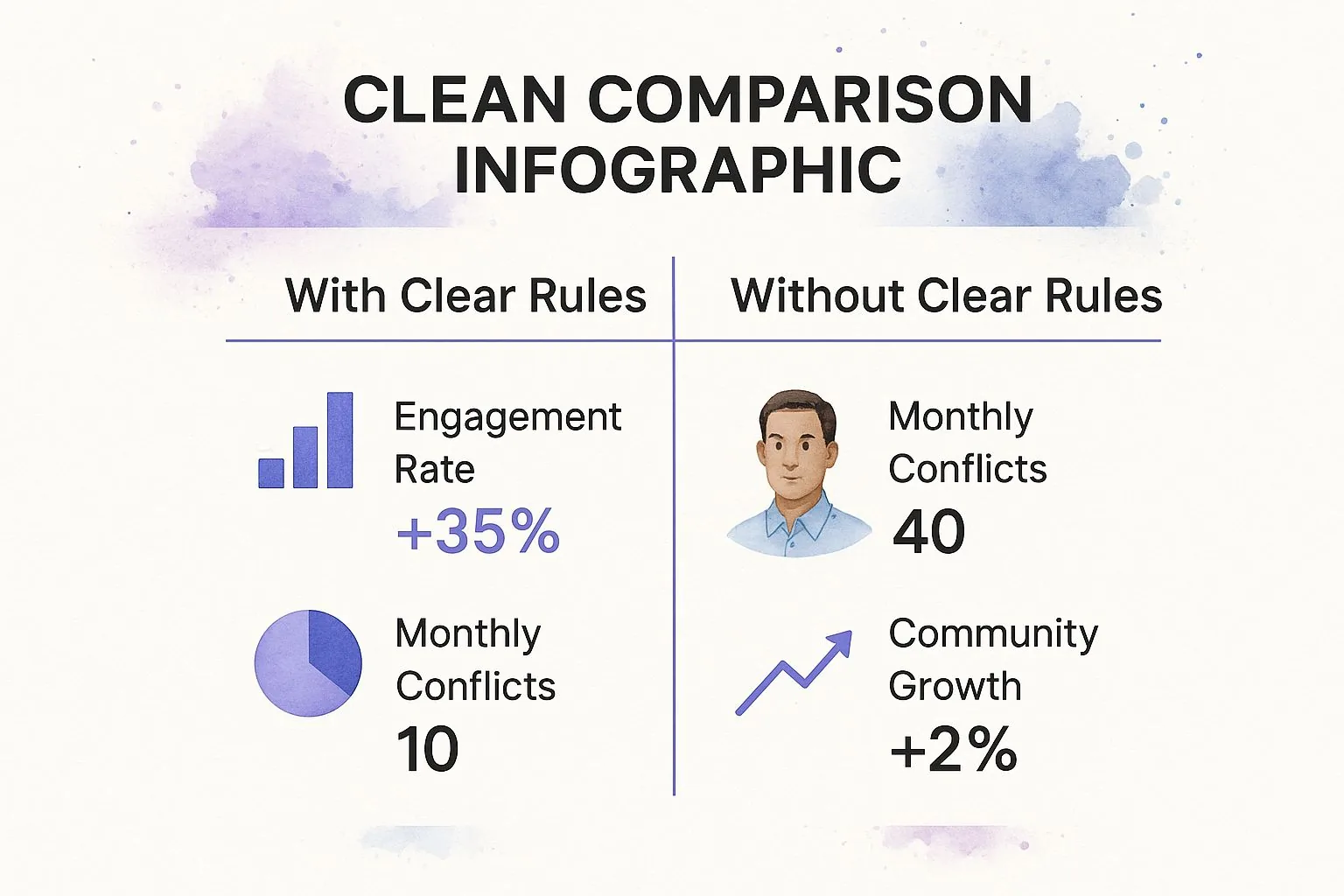
The numbers are clear. When rules are aligned with the community's purpose, you see a massive jump in engagement and a sharp drop in moderator-draining conflicts.
Frame Guidelines in a Positive Tone
Once your core principles are defined, their presentation is crucial. Frame them positively. Instead of a long list of "don'ts," focus on a short list of "do's" that actively encourage the behavior you want to see. This approach fosters shared ownership, making members feel like they're building something together rather than just trying to avoid breaking rules.
Here's a simple framework to turn vague, negative rules into powerful, positive principles that actually work.
From Vague Rule to Actionable Principle
| Generic Rule (To Avoid) | Actionable Principle (To Adopt) | Why It Works Better |
|---|---|---|
| "No Spam" | "Share your work only in the #Showcase channel on Fridays." | It provides specific instructions, channeling self-promotion into a structured, valuable format instead of banning it outright. |
| "Be Respectful" | "Challenge ideas, not people. Always assume good intent." | It defines what respect looks like in action and gives members a clear framework for constructive debate. |
| "No Self-Promotion" | "Contribute value 5 times before you share a link to your own content." | It sets a clear, measurable expectation for participation and encourages members to give before they ask. |
This shift from policing to guiding is subtle but incredibly powerful for setting the right tone from day one.
Your rules are your culture written down. They should articulate the shared values that attract the right people and gently guide them toward contributing positively. This mindset is crucial when you're looking at how to build an online community that lasts.
This is where an integrated hub like Zanfia becomes a strategic advantage. Instead of posting your rules in a forgotten channel, you can weave them directly into the member experience, letting an AI team automate your culture-setting process.
With Zanfia, you can build your core principles right into the onboarding flow. Dictate the welcome message to the assistant instead of configuring it screen by screen, and every new member reads and agrees to your standards before they post their first message. You're not just hoping people find the rules; you're setting a clear standard from their very first click, making compliance intuitive and saving you hours of repetitive work.
Communicating Your Rules for Maximum Buy-In
You’ve created a solid set of community rules. But if nobody sees them, they don’t exist. Guidelines tucked away in a forgotten corner are just waiting to be broken, creating more moderation work for you.
Effective communication isn't about just posting a list and hoping for the best. It’s about strategically weaving your rules into the fabric of the member experience. The goal is a culture where members internalize the standards, not one where they only think about rules when a moderator steps in.

Make Your Rules Omnipresent
Visibility is non-negotiable. Avoid the classic mistake of creating one "rules" page and calling it a day. Instead, identify the key moments in your member's journey and ensure your rules appear there.
Here are high-impact places to embed your rules of the community:
- During Onboarding: This is your most critical opportunity. Before a new member can post, require them to review and agree to the guidelines. This sets the tone from the very first click.
- In a Pinned Post: Every main channel or forum needs a pinned post at the top. No exceptions. This is the constant, silent reminder of "how we do things here."
- In Your Welcome Email: That first automated email is prime real estate. Don't just say "welcome"—include a friendly recap of your top 3-5 most important rules and a direct link to the full list.
The psychology is simple: repeated exposure increases perceived importance. When your rules appear in different places at key moments, they transform from mere suggestions into foundational agreements for participation.
Automate and Reinforce
As a creator, you don't have time to personally remind every new member about the rules. This is where an all-in-one platform becomes a lifesaver, rescuing you from the manual work of juggling a dozen different tools.
A platform like Zanfia puts this on autopilot with a visual automation builder and an AI team that can act on your workspace. You can trigger a welcome email that highlights key principles a day after someone joins, dictating the copy by voice instead of clicking through settings. It’s a small touch that makes a huge difference when you're developing a community that feels both professional and personal.
Even better, Zanfia's integrated community feature allows you to create a dedicated, beautifully formatted "Community Principles" page. This isn't just a block of text; it’s a dynamic resource with clear examples that lives next to your checkout, which is built to sell with order bumps, installments and upsells, and a test mode so you can buy your own membership before you open the doors. By keeping everything in one place, Zanfia becomes the single source of truth for your culture, delivering clarity for your members without creating more work for you.
Creating a Fair and Consistent Enforcement Strategy
Rules are just words without a clear, consistent, and empathetic enforcement strategy. This is where many creators stumble, worried about appearing too heavy-handed or pushing members away.
But fair enforcement isn’t about being a dictator. It’s about protecting the value of the community you’ve built for your paying members and ensuring it remains a safe, productive space for everyone.
Nothing kills trust faster than inconsistency. When members see rules applied to some but not others, they assume favoritism is at play, and your guidelines lose all credibility. Rebuilding that trust is an uphill battle that hurts everything from engagement to retention.
Building a Simple Moderation Workflow
To avoid making emotional decisions in the heat of the moment, you need a predefined process. Think of it as creating standard operating procedures (SOPs) for your community. This removes the guesswork and keeps your actions predictable and fair.
For most communities, a simple tiered approach is highly effective:
- The Gentle Nudge: For a first-time, minor infraction, a private message is usually sufficient. Politely point out the specific rule that was broken and include a link to your guidelines. Always assume good intent.
- The Time-Out: If the behavior continues after a warning, a temporary suspension is the next step. A 24-hour mute is effective because it signals the seriousness of the issue without resorting to a permanent ban.
- The Final Step: For severe violations like hate speech, harassment, or for someone who repeatedly ignores warnings, immediate and permanent removal is non-negotiable. Your primary duty is to protect the community.
A crucial part of this process is documenting every action. Keep a private note on the member's profile: what was the infraction, what action did you take, and when? This log is invaluable for spotting patterns and provides a clear record if a decision is ever questioned.
The Importance of Full Context
Making fair moderation decisions is nearly impossible when you’re hunting for information across different tools. Trying to piece together a member's history from a Discord server, a separate payment processor, and an email list is a recipe for mistakes.
This is where an integrated platform like Zanfia is a strong fit for creators who want context and control in one place.
Since every member interaction—from their course progress to their community posts—lives in one centralized hub, you have the complete context at your fingertips. You can ask the AI assistant to pull a member's entire history in seconds, by chat or by voice, and you can hand the same visibility to your own agents through the MCP endpoint. That means informed, fair, and defensible moderation decisions every single time. Advanced analytics and the MCP endpoint are available on higher plans, see the current Zanfia pricing.
The goal of enforcement isn't punishment; it's upholding the shared standard. Think of fair enforcement as a service you provide to the committed members who follow the rules and make your community a great place to be.
Public trust in any system, online or off, depends on perceived fairness. Real-world studies show that tense relationships develop when enforcement is seen as biased. By being transparent and consistent, you build the foundation of trust that is essential for a healthy community.
Adapting Your Rules as Your Community Evolves
Your community isn't a static exhibit; it's a living system that will change as it grows. What worked for your first 100 members might create friction at 1,000. Your rules of the community can't be set in stone; they must be living documents that evolve with your members.

Treating your guidelines as static is one of the fastest ways to become irrelevant. Good governance is an ongoing cycle of listening, tweaking, and adapting. The goal isn't just to enforce the rules, but to ensure they continue to serve the community's core purpose effectively.
Recognizing the Need for Change
When is it time to revisit your rules? Your community will give you signals if you know what to look for.
Keep an eye out for these tell-tale signs:
- Recurring Confusion: Are members constantly asking for clarification on a specific rule? That's a clear indicator that a guideline is unclear or no longer working as intended.
- New Types of Conflict: As new people join, new dynamics emerge. If you're seeing novel disagreements pop up that aren't covered by your existing rules, it’s time to address them proactively.
- Direct Member Feedback: This is a gift. When members openly tell you a rule feels outdated or unfair, listen carefully. They are your most valuable source of on-the-ground intelligence.
This process mirrors challenges in larger systems. For instance, a major study on community policing found that rigid rule-following didn't automatically build trust. Real success came from adapting to community needs and getting genuine buy-in, not from top-down enforcement. If you're interested in these dynamics, you can read the full research findings on community engagement and rule adherence.
Creating a Collaborative Feedback Loop
The best way to adapt your rules is to bring your members into the conversation. When you make rule-making a collaborative process, you build incredible trust and a powerful sense of shared ownership. This doesn't mean every decision is a vote, but it does mean creating clear channels for input.
Don't just update your rules; announce the why behind the change. Transparent communication transforms a top-down decree into a logical evolution that members can understand and support.
This is where running your entire operation under one roof with Zanfia makes a real difference. Instead of piecing together feedback from emails, DMs, and third-party survey tools, you can simplify the entire process.
With a platform like Zanfia, you can start a dedicated discussion thread in your community space to gather detailed feedback on a proposed change, or ask the assistant to summarize what members have said across recent threads. You can even dictate the announcement out loud once you decide. By using built-in tools, you keep the entire conversation organized and accessible, right where your members already are. This turns a messy administrative task into a smooth, collaborative process, reinforcing your role as a responsive community leader.
Common Questions About Community Rules
Even with a solid plan, questions will come up as you manage your community's guidelines. That's perfectly normal. Let's tackle the most common questions I hear from creators so you can move forward with confidence.
How Many Rules Should a Community Have?
When it comes to rules, less is more. Many founders make the mistake of trying to anticipate every possible edge case, which results in a wall of text that overwhelms members.
Instead, aim for 5-7 core principles. These are the foundational pillars of your community—covering respect, spam, and on-topic discussions. You aren't trying to legislate every human interaction, just protecting the core purpose of the space. You can always add or clarify rules later as the community grows.
Should Rules Differ for Free vs. Paid Communities?
Yes, but with one critical caveat: the fundamental principles of respect and safety must be universal. You should never tolerate abuse in any community, regardless of price point.
That said, the stakes are higher in a paid space, and your rules should reflect that. Paid communities are built around delivering a specific value, so the rules need to be tighter to protect that investment for all members.
- A paid mastermind, for example, might have a strict zero-tolerance policy for sharing proprietary information outside the group.
- A high-ticket coaching community could require active participation to ensure every member contributes to the collective value.
Enforcement also carries more weight. When someone breaks the rules in a paid group, the consequence is losing access to something they’ve paid for—a powerful incentive to follow the guidelines.
Should Members Help Create the Rules?
Involving members in rule-making is a powerful way to build buy-in and a sense of shared ownership. However, it must be managed correctly.
As the leader, you must set the non-negotiable core rules from day one to ensure a baseline of safety and align with your vision. Once that foundation is established and the culture is taking shape, that is the perfect time to ask for feedback on refining existing guidelines or adding new ones.
This simple shift turns members from passive rule-followers into active co-creators of the community culture. It's a huge step in building a space where people feel truly invested.
What If a Popular Member Breaks the Rules?
This is the moment of truth for any community leader. How you handle this defines the integrity of your community, and everyone is watching. You must enforce the rules consistently for everyone, regardless of their popularity or influence.
Making an exception, even once, sends a clear signal that the rules don't really matter, and trust evaporates instantly. Handle the situation privately and respectfully, explaining the violation and the consequence clearly. Your best members—the ones who truly care about the community—will respect you more for it.
Effectively creating, communicating, and enforcing your rules of the community is what separates an amateur effort from a professional, scalable business. With Zanfia, an AI team runs the community operations day to day: you can dictate updates by voice, automate onboarding, gather feedback in-thread, and moderate with full context on every member. The checkout next door is built to sell, with order bumps, installments and upsells, plus a 14-day free trial with no credit card, so you can put a paid tier behind the rules from day one.
Build your community on Zanfia and turn your rules into a strategic asset.