

10 Best Online Course Platform Free Options for 2026
Launch a course for free. Fine. But what exactly stays free once real students start enrolling and money starts moving?
That's the question most “online course platform free” roundups avoid. They focus on zero upfront cost and skip the business reality: transaction fees, weak branding control, limited learner ownership, fragmented tools, and upgrade pressure the moment your course starts working. Free can be useful, but free rarely means cheap in the long run.
That matters because online learning is no longer a niche experiment. The online course app sector generated US$3.1 billion in 2023, up 14.8% year over year, with more than 125 million users and 46.4 million downloads. In a market at that scale, free courses aren't just a nice gesture. They're a serious customer acquisition channel.
You can also see why creators keep using free entry points. A survey-backed review says about 49% of learners worldwide have completed some form of online learning, 70% consider it more effective, roughly 90% prefer it for convenience and flexibility, and 78% prefer self-paced learning. That makes free, modular education a practical top-of-funnel model, not a hobby project.
The list below gets straight to the tools. Beyond that, it details where each one works, where it breaks, and when “free” starts costing more than a proper platform.
1. Zanfia
What does “free” cost once enrollments turn into real revenue?
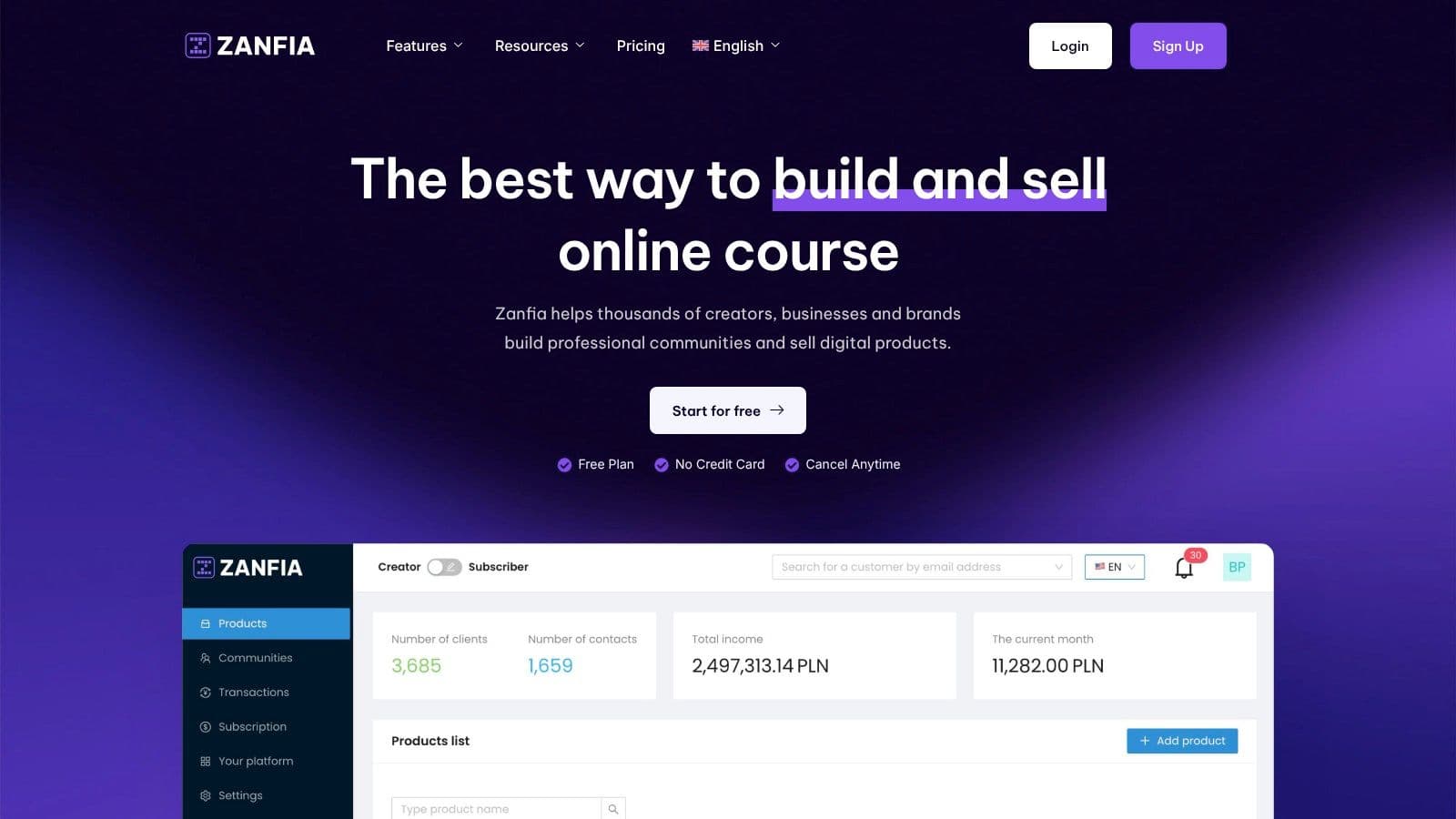
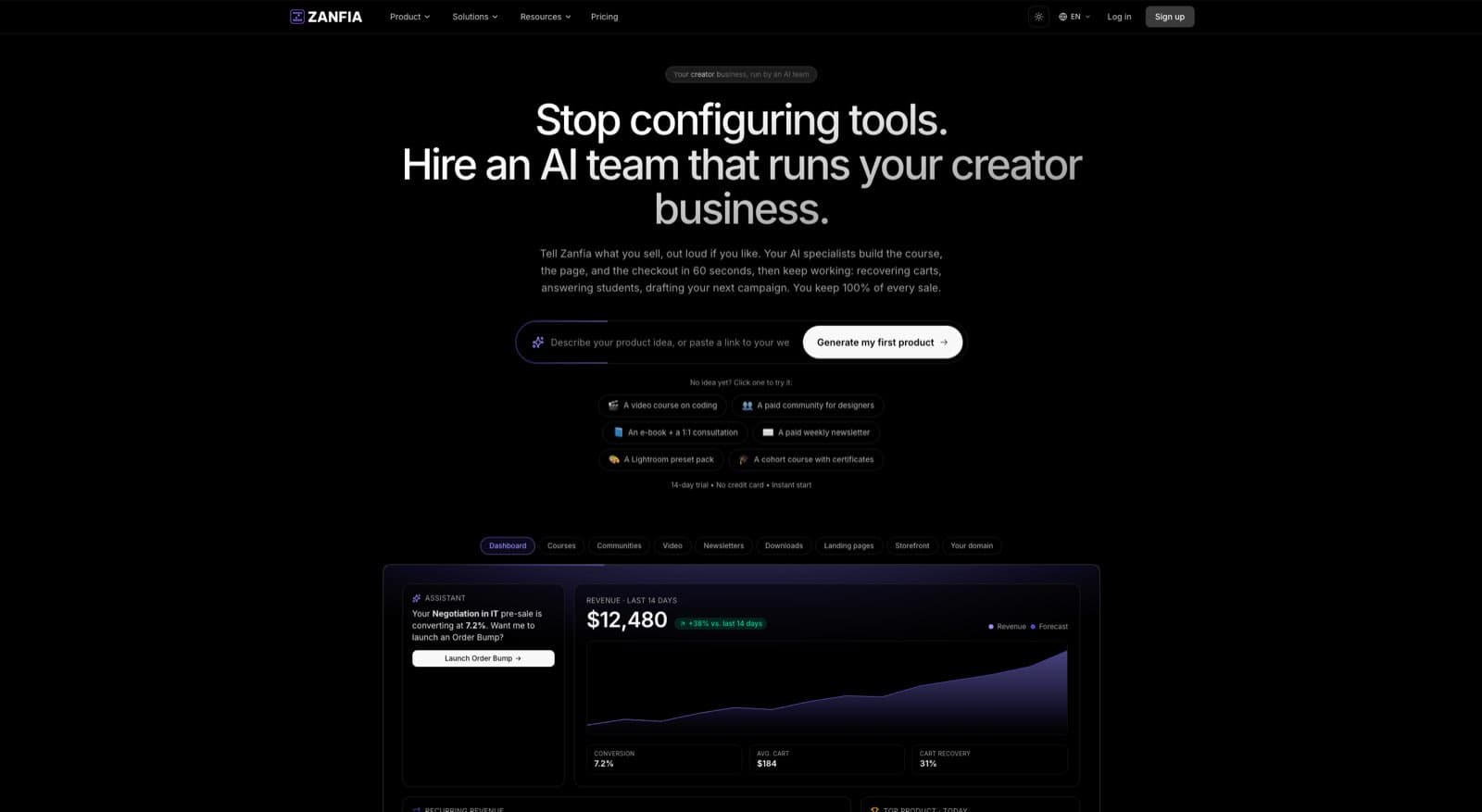
For creators who expect to grow past a basic test, that is the right question to ask first. Zanfia is an AI team that runs a creator business, not just a course tool: an assistant that knows the whole application performs the work by chat or by voice, agents act inside the business through an MCP endpoint, and the courses, communities, newsletters and other products are where that work lands. It suits operators who want to use a free trial as an acquisition test, then turn that attention into paid courses, memberships, newsletters and community without rebuilding the business later. The model is built around margin protection, brand control, and ownership of the customer relationship. There is no permanent free plan on Zanfia itself. There is a 14-day free trial with no credit card, then a paid plan.
Why it stands out
The commercial logic is straightforward. Zanfia charges 0% platform transaction fees on customer sales, so you keep the course revenue apart from payment processor costs. That difference looks small at launch and becomes much more important once sales volume increases.
A lot of free platforms create hidden drag in one of two ways. Some give you distribution but keep the audience relationship inside their ecosystem. Others let you publish cheaply, then push you into separate tools for checkout, email, community, and access management. Both models add cost. One takes margin. The other takes time and creates operational failure points.
Zanfia takes a cleaner approach. Courses, digital products, community, and sales flows sit in one system under your brand, and the creator drives it by dictating to the assistant instead of clicking through menus. That reduces platform switching for customers and admin work for your team.
Practical rule: If learning, payments, and community live in separate tools, you are running a stack, not a product.
Where Zanfia fits best
Zanfia is built for US creators who want a checkout designed to sell, not just a page that takes cards. It supports Stripe and PayPal, with Apple Pay and Google Pay through Stripe. The checkout carries order bumps, subscription upsells, discount codes and installments (splitting a $600 course into four payments beats asking for it upfront), and a test mode where you can buy your own product end to end before launch to verify the flow and the tracking pixels.
The operational upside is broader than payments.
- Revenue protection: Zanfia does not take a platform cut from customer sales.
- Brand control: White-labeling and custom domain support keep the customer experience tied to your business, not the platform.
- Operational efficiency: Built-in automations handle access, renewals, welcome flows, and permission changes without extra tools, and the assistant can run those flows from a voice prompt.
- Content delivery: Native video hosting is included, and the player saves student progress automatically.
- Twelve product types under one brand: courses, communities, newsletters, memberships, bundles, downloads, digital content, services, events, consultations, knowledge bases and custom products, so a free lead magnet, a signature course and a paid community all live under the same domain.
It also supports one-time payments, subscriptions, installment plans, and bundles. A free trial works best as the first step in a value ladder, not the end product. A platform should help you turn that first interaction into repeat purchases and retained members. Availability of specific capabilities depends on the plan, so check the current Zanfia pricing before committing.
The trade-off is clear. Zanfia is not a marketplace built for rented reach or hobby-level experimentation. It makes more sense for creators treating education as a real business asset and wanting to scale without giving up margin every time a student checks out.
2. Payhip
Payhip is one of the cleaner low-friction ways to test an online course platform free setup without committing to a monthly subscription. If speed matters more than depth, it's a strong starting point.
Its appeal is obvious the first time you use it. You can set up a storefront quickly, sell courses, downloads, memberships, and coaching, and accept payments through Stripe or PayPal. For a creator with a small audience and a simple offer, that's enough to get moving.
Where Payhip works
Payhip is best when you want to validate demand before you invest in a full platform migration. The free plan includes the core feature set, and the selling experience is simple enough that most solo creators can launch without technical help.
A few things it does well:
- Fast setup: You can publish a basic paid or free offer quickly.
- Flexible selling: Coupons, bundles, pay-what-you-want pricing, and memberships are built in.
- Straightforward payments: Payouts route directly through your payment processor accounts.
Free is attractive at launch. It gets less attractive when every sale reminds you the platform is still in the deal.
The downside is the business model. Payhip's free plan takes a 5% platform fee on sales, plus payment processor fees. That's reasonable for a test. It becomes less appealing once your course is proven and you're trying to protect margin. You also won't get the same depth of learning experience or integrated community logic you'd expect from a more complete course platform.
For creators selling one or two lightweight products, Payhip is efficient. For creators building a branded education business, it's more of an entry point than a long-term home. You can review the current plan structure on Payhip pricing.
3. Systeme.io
Systeme.io is the tool I usually mention when someone says, “I don't just need course hosting. I need pages, email, funnels, and checkout too.” It's not the most polished LMS in this list, but it covers a lot of commercial ground in one place.
That matters because a free course often works best as a lead-generation asset. If your next move is an upsell, an email sequence, or a bundle offer, Systeme.io gives you those building blocks without forcing a stack of disconnected tools.
Best use case
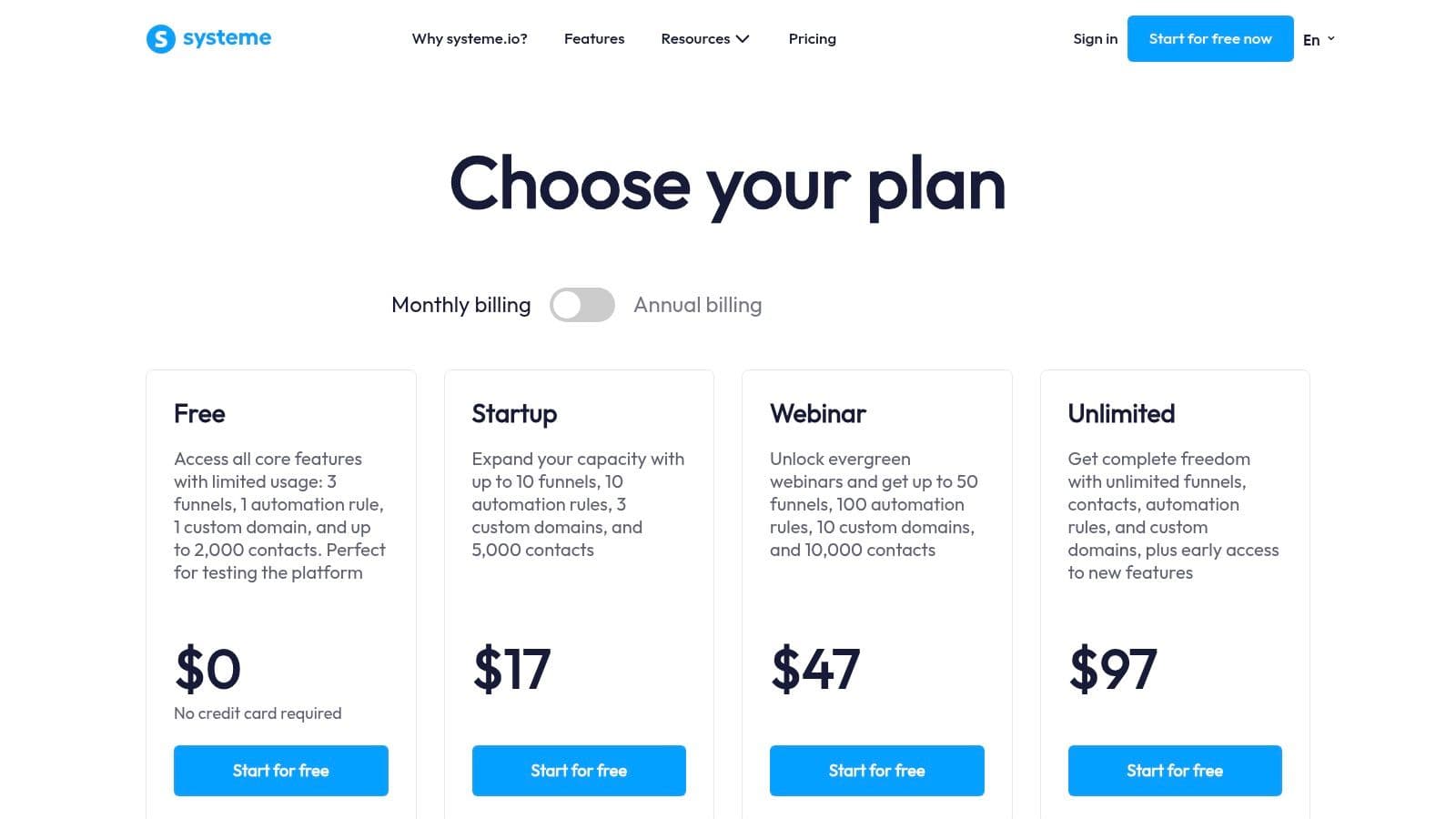
This is a practical fit for solo creators, consultants, and early-stage info businesses. The forever-free plan gives you room to build and test without entering a card number, and the broader feature set helps you connect offer creation with promotion.
Its strongest points are business-side rather than education-side:
- Funnel building: You can create landing pages, order flows, upsells, and downsells.
- Email and automation: Follow-up is built in, which matters if your free course is part of a nurture sequence.
- Lower stack complexity: Website, simple courses, and list building live inside one system.
The trade-off is that the course experience itself feels simpler than specialist LMS tools. If your delivery model depends on a premium student experience, advanced learning paths, or strong brand presentation, Systeme.io can start to feel template-driven.
Still, for creators who think in funnels first and curriculum second, it's one of the better online course platform free options. You can inspect the current plan setup on Systeme.io pricing.
4. FreshLearn
FreshLearn sits in the middle ground between “I need something free to validate this idea” and “I need a real product stack once the idea proves out.” That positioning makes sense for first-time course creators who want an upgrade path without jumping straight into a premium platform.
It supports courses, masterclasses, downloads, and bundles, and it gives you enough commerce functionality to test whether your topic has demand. That's useful if you're still refining the offer and don't want to overbuild too early.
What to watch carefully
FreshLearn's free tier is usable, but it's intentionally narrow. You can validate with it. You probably won't scale comfortably on it.
The pattern is familiar:
- Good for validation: You can launch one product and start collecting market feedback.
- Clear upgrade path: Paid plans remove platform transaction fees and open up more serious branding and selling options.
- Useful creator features: Built-in checkout, coupons, basic email tools, and blog support cover the essentials.
The issue isn't that FreshLearn hides what it is. The issue is that many creators underestimate how fast those free-plan limits become operational friction. If enrollments need manual handling or product count is constrained, the platform starts training you to upgrade before your business feels stable.
That doesn't make it a bad choice. It makes it a diagnostic choice. If you want a low-risk environment to test a niche, FreshLearn works. If you already know you want a branded school with efficient operations, you'll likely outgrow it. The current options are listed on FreshLearn pricing.
5. Gumroad
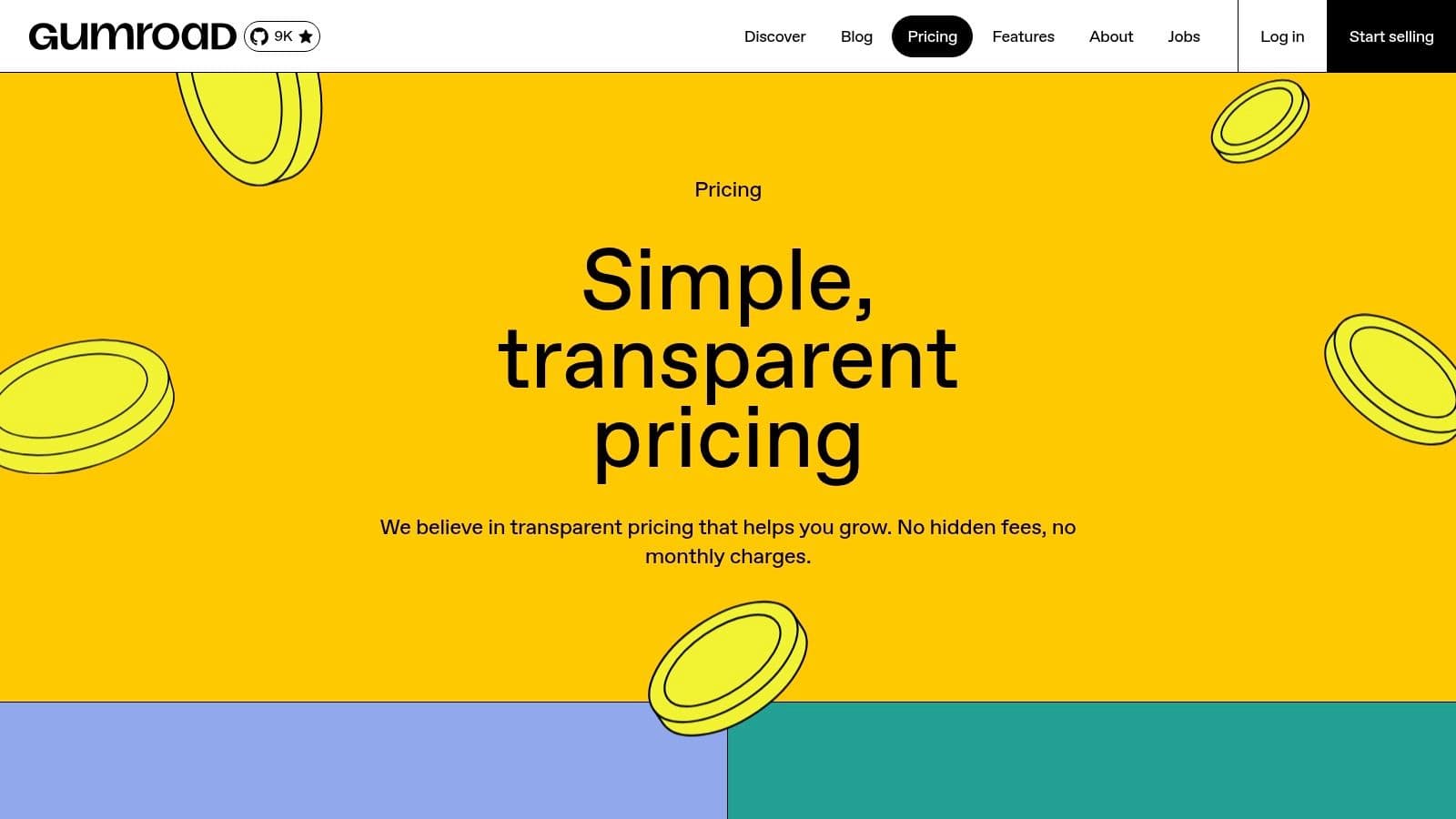
Gumroad is less of a course platform in the classic LMS sense and more of a fast digital selling engine that can handle simple course offers. If your priority is “sell now, structure later,” Gumroad is still one of the easiest ways to start.
Its no-monthly-fee model is the draw. You can upload a product, set a price, take payments, and test whether your audience will buy. For creators with an email list, a social audience, or a niche PDF-and-video product, that simplicity is useful.
The real cost of convenience
Gumroad acts as merchant of record and handles tax and compliance overhead, which removes a lot of admin for solo operators. That's the good part.
The cost is the transaction structure. Gumroad charges 10% plus fees per transaction. That can be acceptable if your offer is experimental, low volume, or intentionally lightweight. It becomes expensive if the product works and you keep using the same setup out of habit.
A pay-as-you-go platform is often cheapest before product-market fit and most expensive after it.
Gumroad also isn't built for a robust learning experience. You won't choose it for serious student progress tracking, quizzing, or a structured academy environment. You choose it because it removes launch friction.
That's why I see Gumroad as a market test tool, not a final operating system. If you're validating a course idea with minimal setup, it's credible. If you're building a serious education brand, you should expect to migrate later. You can see the current model on Gumroad pricing.
6. Udemy
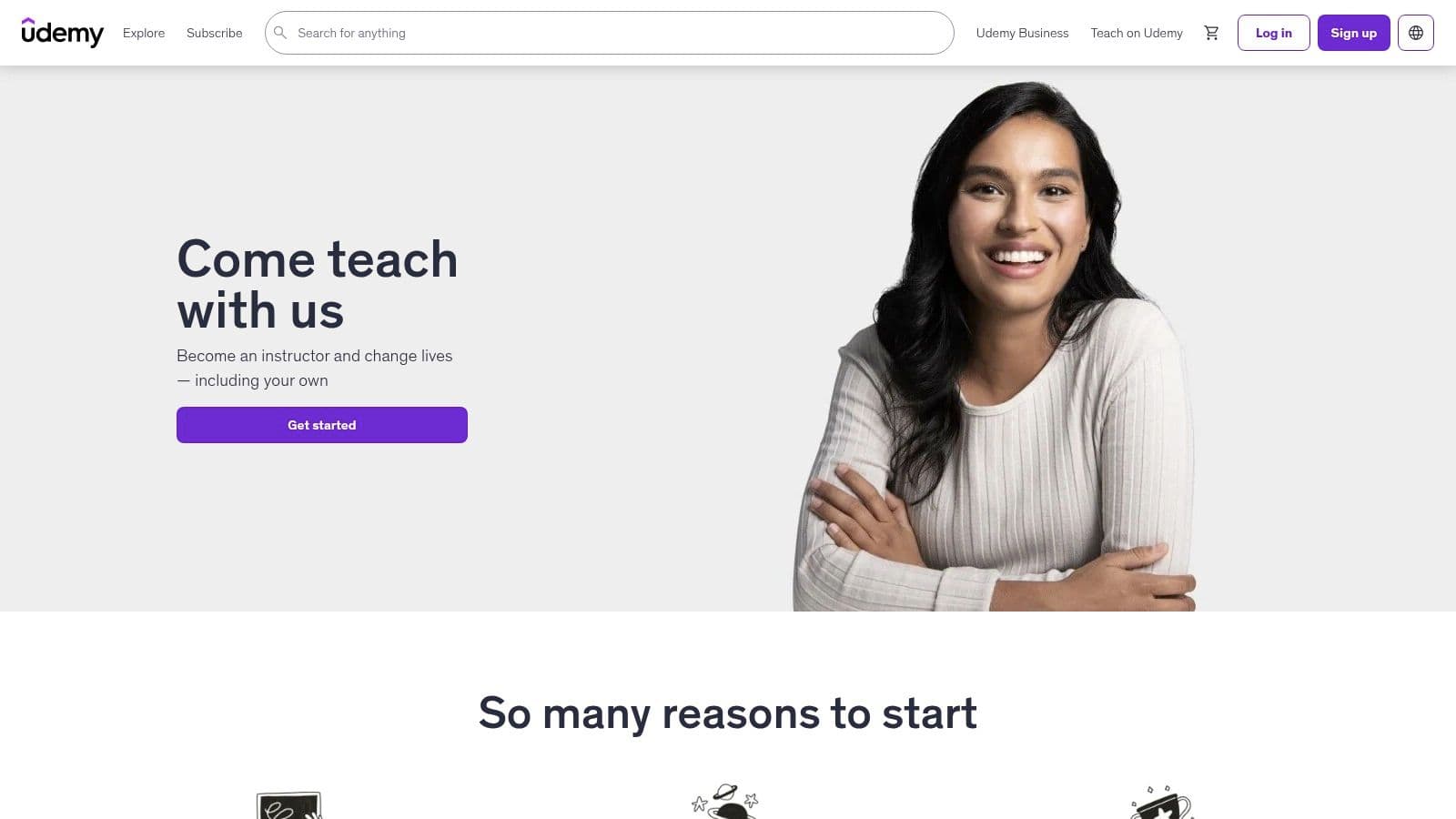
Udemy is the marketplace option on this list. That changes the decision entirely. You're not choosing software first. You're choosing distribution.
For a first-time instructor, that can be useful. Udemy handles hosting, learner support, mobile access, certificates, and a lot of the technical overhead that slows beginners down. It also gives you a built-in environment where people already expect to buy courses.
The upside and the limit
The main advantage is reach. If you don't have an audience yet, a marketplace can help validate whether your topic attracts buyers at all. It can also help you build early authority faster than an unknown standalone site.
Coursera's own statistics-course category shows the shape of modern free entry points well. It highlights that learners can study probability theory, hypothesis testing, regression, and data interpretation, and that beginners can start learning for free in some course formats. The broader lesson applies here too: free access often functions as an acquisition layer.
But Udemy comes with the standard marketplace trade-offs:
- You don't control the brand experience the way you would on your own domain.
- Customer data access is limited compared with an owned platform.
- Pricing control is narrower than many creators expect.
- Marketplace economics can reduce your margin depending on how the sale happens.
If you treat Udemy like a customer acquisition and authority-building channel, it makes sense. If you treat it like your long-term business infrastructure, you're building on rented land. For many creators, that's the difference. You can publish through Udemy for instructors.
7. Canvas Free-for-Teacher
Canvas Free-for-Teacher is the academic option in this lineup. It's a proper LMS environment, not a storefront. That means it's useful for instruction, assessments, modules, and student progress. It's not useful if your main goal is direct monetization.
That distinction matters because many people searching online course platform free really need two things at once: teaching tools and payment tools. Canvas gives you the first category well. It doesn't try to solve the second.
Where it earns its place
If you run free cohorts, internal training, pilot programs, tutoring groups, or academic-style workshops, Canvas Free-for-Teacher can be a strong fit. You get mature LMS mechanics without paying for an institutional contract.
Its strengths are familiar to anyone who has worked in education:
- Assessment depth: Assignments, quizzes, grading, and course modules are solid.
- Learning structure: Student progress tracking and organized curriculum delivery are built in.
- No subscription barrier: You can create and run courses without a paid plan.
The limitation is business infrastructure. There's no native course-selling motion here. No storefront-first design. No creator-style checkout flow. So if your free course is meant to lead into a paid product ladder, Canvas becomes another separate system you need to bridge manually.
That's why I'd frame Canvas as a delivery platform for educators, not a commerce platform for creators. If that's what you need, Canvas Free-for-Teacher access is worth a look.
8. LifterLMS
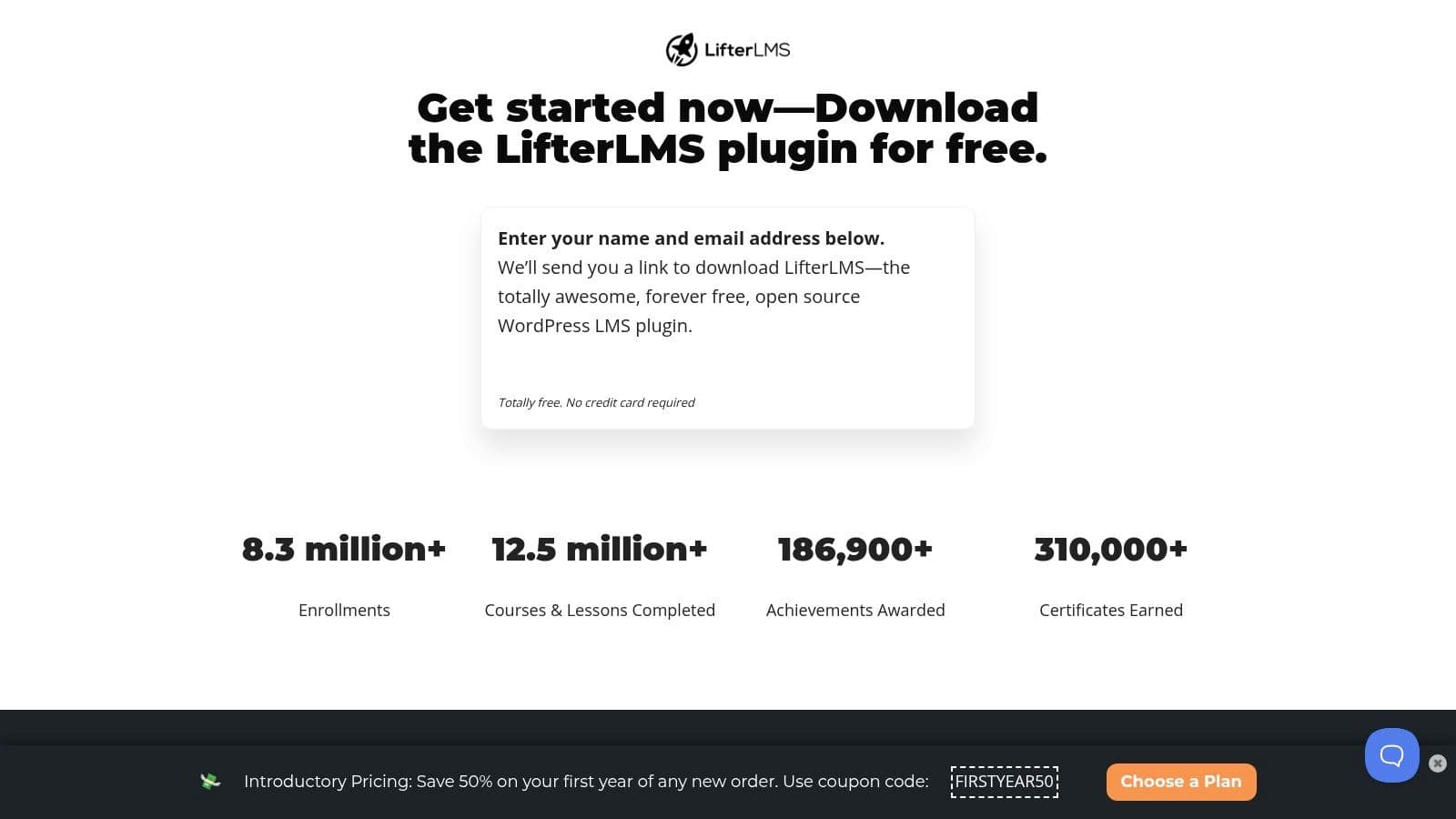
LifterLMS is what I'd call a control-first choice. You use it when ownership matters more than convenience and when you're willing to accept WordPress complexity in exchange for platform independence.
The free core plugin is the entry point. On paper, that makes it part of the online course platform free conversation. In practice, the actual product is the WordPress stack you build around it.
Who should consider it
LifterLMS suits creators who want their own site, their own branding, and direct control over the learner relationship. It's also a reasonable option for agencies, training companies, and established publishers already comfortable with WordPress operations.
The upside is clear:
- You own the environment: Site, domain, branding, and data stay under your control.
- The core is expandable: Courses, memberships, certificates, and student management can grow with the business.
- You avoid marketplace dependence: You're not building your offer inside someone else's catalog.
The downside is equally clear. WordPress requires upkeep. Hosting, updates, compatibility issues, plugin conflicts, and feature gaps all become your problem or your developer's problem. Many advanced monetization functions also depend on paid add-ons.
Ownership is powerful, but only if you have the operational tolerance to maintain what you own.
I recommend LifterLMS to teams that think long term and don't mind a more hands-on system. I don't recommend it to creators who already feel overwhelmed by setup. If you want to evaluate the free version, start with LifterLMS free.
9. Tutor LMS
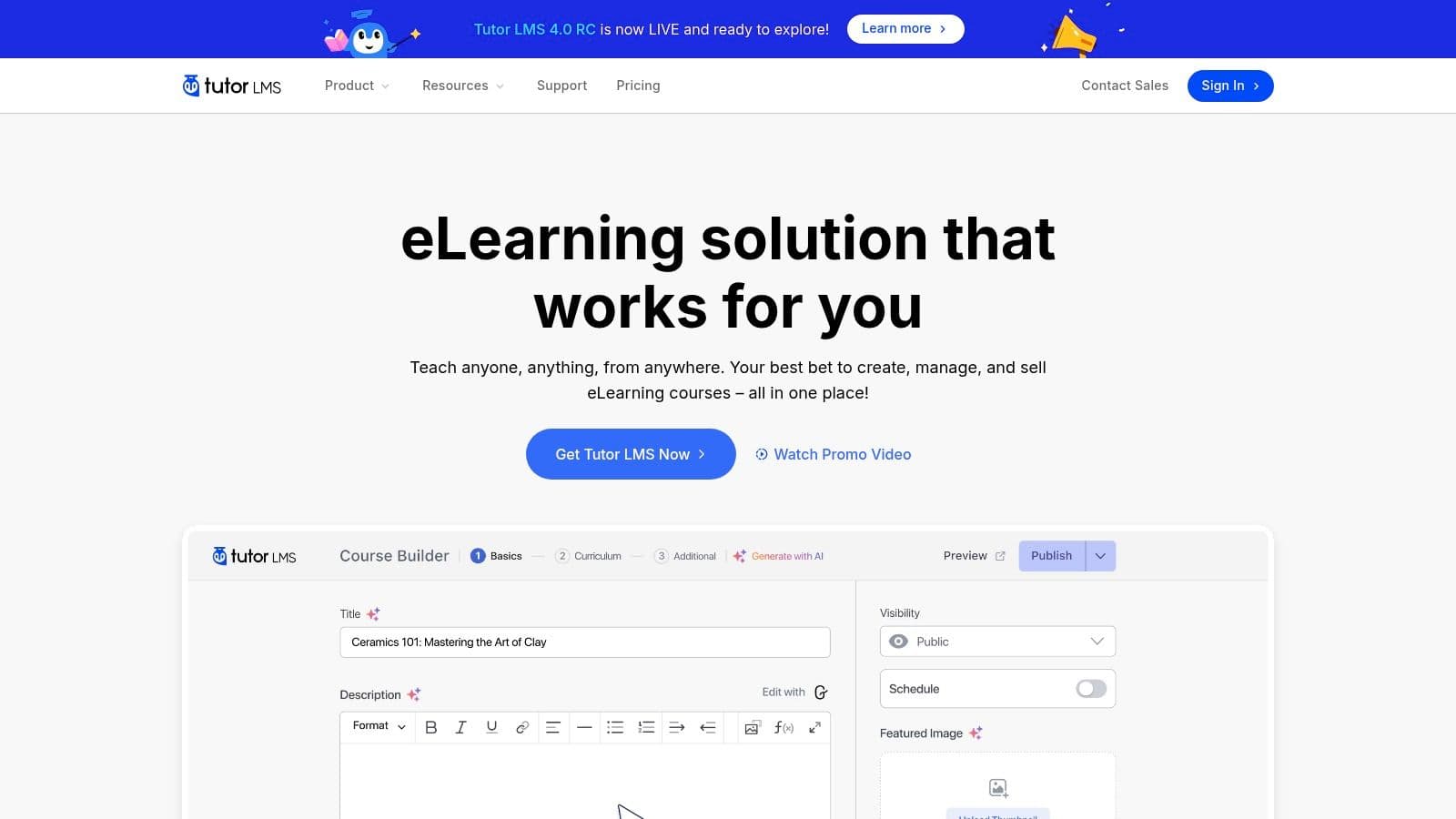
Tutor LMS is one of the more modern-feeling WordPress LMS options. That matters because many self-hosted tools still feel like they were designed for administrators first and course businesses second.
Its drag-and-drop builder, quiz tools, and cleaner interface make it easier to launch a branded school without fighting the product on day one. For WordPress users who want a better UX than older plugin stacks, Tutor LMS is often the more approachable route.
Where it lands commercially
Tutor LMS makes sense when you want a self-hosted platform but don't want to start from a bare-bones plugin. It gives enough in the free version to prototype a school, and it supports ecommerce and marketplace-style configurations through integrations.
That said, the line between free and paid shows up quickly. Many of the stronger features sit in Pro. That isn't unusual, but it does mean your “free” setup can become a patchwork once you want certificates, prerequisites, gradebook depth, or more polished monetization.
There's also the standard WordPress reality:
- Flexibility is high , especially if you already know the ecosystem.
- Maintenance burden is real , because plugin stacking creates operational drag.
- Brand ownership is excellent , but simplicity isn't.
Tutor LMS is best for creators who already accept WordPress as the operating model. If that's you, the product is capable. If you want hosted simplicity, it's the wrong category. You can review the platform at Tutor LMS.
10. LearnPress
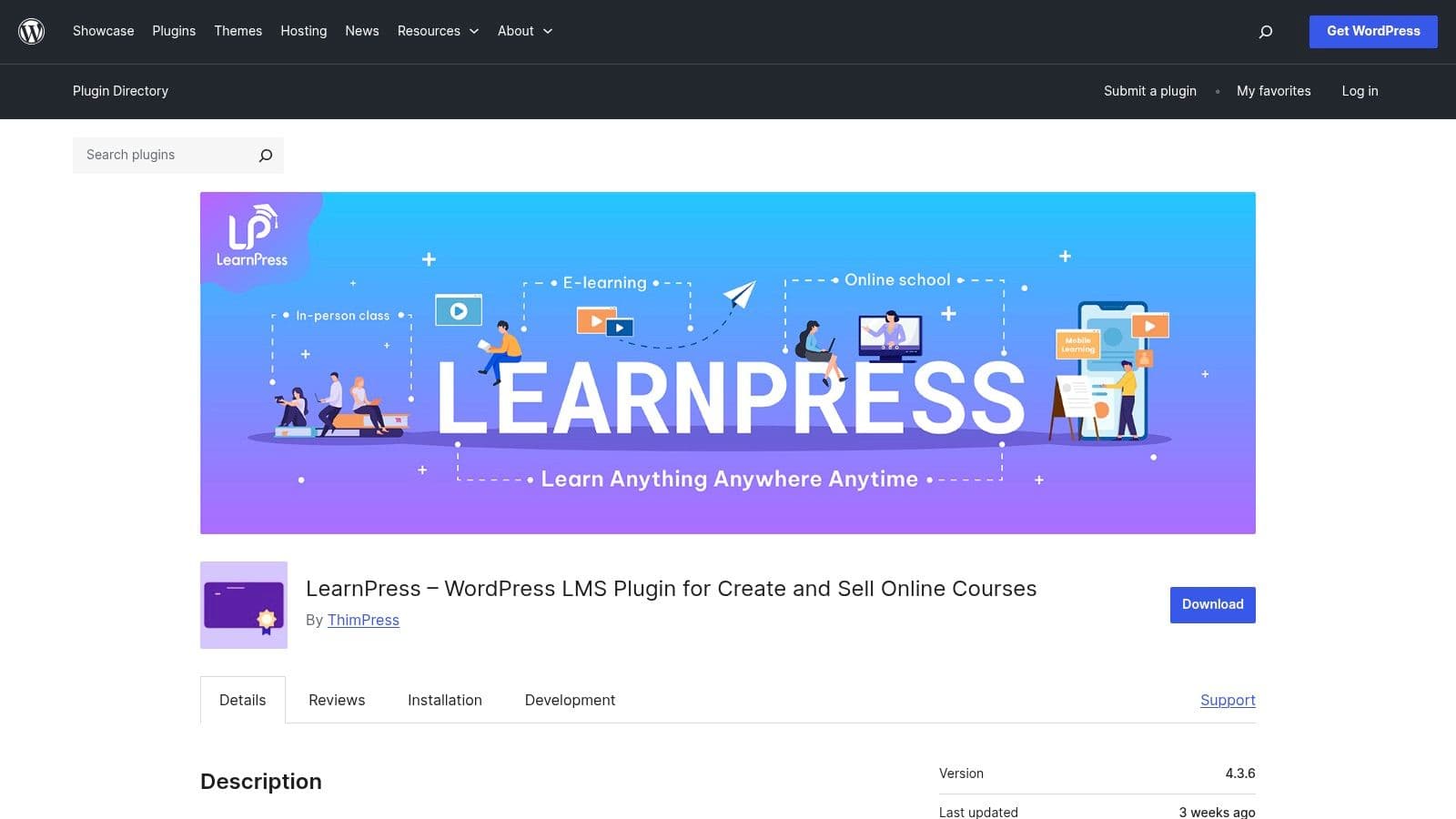
LearnPress has been around long enough to earn a place on any practical list of free course tools. It offers a lightweight WordPress LMS core for courses, lessons, and quizzes, and it has a broad add-on and theme ecosystem around it.
That ecosystem is both the value and the warning. You can start cheaply. You can also end up assembling a platform one paid extension at a time.
Best for budget-conscious builders
If you're comfortable in WordPress and want a low-cost foundation, LearnPress can do the job. It's especially useful for creators building basic courses that don't need a polished all-in-one commercial layer on day one.
The strengths are straightforward:
- Free core functionality: Courses, lessons, and quizzes are available from the start.
- Large ecosystem: Themes, add-ons, and documentation are widely available.
- Expandable setup: You can add payments, certificates, and drip features later.
The concern is consistency. Support quality depends heavily on your exact stack, and the more add-ons you add, the less “simple” the platform becomes. That's normal in WordPress, but new creators often underestimate how much time that maintenance consumes.
LearnPress is a valid low-cost builder's choice. It's not the strongest option for creators who want a smooth all-in-one business setup. If you want to inspect the plugin directly, use LearnPress on WordPress.org.
Top 10 Free Online Course Platforms Comparison
| Platform | Core offering | Quality (★) | Pricing & Value (💰) | Target audience (👥) | USP (✨) |
|---|---|---|---|---|---|
| Zanfia 🏆 | AI team running a creator business: courses, communities, newsletters & digital sales under one brand | ★★★★★ | 💰 14-day free trial, no card; SaaS from $39/mo, or $31/mo billed annually on Starter; 0% platform fees on customer sales (plan-dependent capabilities) | 👥 US creators, coaches & brands scaling past a first product | ✨ Assistant that acts by chat or voice, MCP endpoint for AI agents, checkout with order bumps, installments & test mode (plan-dependent) |
| Payhip | Lightweight storefront for courses, downloads & memberships | ★★★★ | 💰 Free plan + 5% tx fee on free plan; paid options reduce fees | 👥 Indie creators testing offers | ✨ Fast setup, pay‑what‑you‑want, instant payouts |
| Systeme.io | Funnels + courses + email marketing & affiliates | ★★★★ | 💰 Free forever tier; scalable paid plans | 👥 Solo creators & funnel-focused sellers | ✨ Built‑in funnels, automation and affiliate management |
| FreshLearn | Creator-focused LMS & storefront with simple UX | ★★★★ | 💰 Free tier; 0% platform fees on paid plans | 👥 Early-stage creators validating & scaling | ✨ 0% fees on paid tiers, migration assistance |
| Gumroad | Pay-as-you-go storefront; merchant of record | ★★★ | 💰 $0/month option; ~10%+ fees per sale | 👥 Casual sellers & testers | ✨ No monthly cost, handles taxes/compliance & marketplace reach |
| Udemy | Large consumer course marketplace with discovery | ★★★★ | 💰 Free to publish; revenue share on marketplace sales | 👥 Instructors seeking audience & validation | ✨ Massive learner base & promotion engine |
| Canvas FFT | Full LMS (course delivery, grading), not a storefront | ★★★★ | 💰 Free‑for‑Teacher accounts (no payment features) | 👥 Educators, institutions & pilot cohorts | ✨ Robust assessment, grading and academic tools |
| LifterLMS | WordPress LMS plugin (self‑hosted, extensible) | ★★★★ | 💰 Free core; paid add‑ons + hosting costs | 👥 WordPress creators wanting full control | ✨ Full ownership, extensibility and academy scaling |
| Tutor LMS | WordPress LMS with modern UI & Pro features | ★★★★ | 💰 Free core; Pro license for advanced features | 👥 WP creators needing UX + integrations | ✨ Drag‑and‑drop builder, quizzes & third‑party integrations |
| LearnPress | Lightweight WordPress LMS core with add‑ons | ★★★ | 💰 Free core; paid add‑ons for payments/features | 👥 Budget‑conscious WordPress creators | ✨ Simple free foundation with large add‑on/theme ecosystem |
From Free to Full Control
Starting with a free platform is often the right move. You can test positioning, validate demand, collect early students, and learn what people want before you commit to a larger software decision.
That logic fits the broader online learning market. Statista projects worldwide online education revenue at US$221.71 billion in 2026, with a 2026 to 2030 CAGR of 6.86%. In other words, this category is large, durable, and increasingly built around flexible access through websites and apps. If you're building in it, your platform choice isn't just a delivery decision. It's an infrastructure decision.
The free-course model itself has strong roots. Kansas State University explains that a MOOC is a Massive Open Online Course, and many MOOCs provide course content for free while charging for graded work, certificates, or related services. Carnegie Mellon's OLI probability and statistics course is described there as open and free at an introductory level. That's an important business lesson for creators. Free access often works best as an entry layer, not as the whole monetization strategy.
Accessibility also deserves more weight than most buyers give it. UN-linked e-learning resources emphasize multilingual, self-paced access and certificates, and broader accessibility guidance points toward captions, screen-reader compatibility, and alternative formats as practical selection criteria for underserved learners, as noted in United Nations learning resources coverage. If your platform can't support inclusive delivery, your growth ceiling is lower than it looks.
The actual mistake isn't starting free. The actual mistake is staying too long in a setup that takes a cut of revenue, fragments your customer journey, or prevents you from owning your audience. That's when “free” turns into operational debt.
For creators who are still testing, tools like Payhip, Systeme.io, Gumroad, or Udemy can make sense. For educators running structured noncommercial learning, Canvas and the WordPress LMS route can be appropriate. But when the business starts working, the priorities change fast. Margin matters. Brand matters. Data ownership matters. Retention matters.
That's where an integrated platform earns its keep. Zanfia gives you an AI team that runs the business: an assistant you can dictate to, agents that act through an MCP endpoint, a checkout built to sell with order bumps and installments, native video hosting, custom domain control, and 0% platform fees on customer sales. That's the logical next step when you stop experimenting and start building an asset.
If you're also packaging expertise beyond courses, it helps to build a coaching website that supports a broader client journey instead of a single isolated product.
FAQ
Are free online course platforms actually free once I start making sales?
Free usually refers to zero upfront cost, not zero cost per sale. Most free tiers recover their margin through transaction fees, weaker branding, fragmented tooling, or upgrade pressure once your course starts working. Payhip, for example, takes a 5% platform fee on sales on its free plan on top of payment processor fees.
How much does Gumroad take per transaction on its free setup?
Gumroad charges 10% plus fees per transaction. That can work while you're validating an idea or running low volume, but it becomes expensive once the product is proven and you keep the same setup out of habit. A pay-as-you-go platform is often cheapest before product-market fit and most expensive after it.
When does a marketplace like Udemy stop making sense as a long-term home?
Udemy is useful as a distribution and authority-building channel because learners already expect to buy courses there. The trade-off is that you don't control the brand experience, customer data access is limited, and pricing and margin are shaped by marketplace economics. If you treat it as long-term business infrastructure rather than an acquisition layer, you're building on rented land.
Is Systeme.io a real LMS or more of a funnel builder?
Systeme.io leans toward the business side: landing pages, order flows, upsells, downsells, email follow-up, and simple courses inside one system. That makes it a strong fit if your free course is a lead-generation asset feeding a nurture sequence. The course experience itself is simpler than specialist LMS tools, so it can feel template-driven if you need a premium student experience.
Does Zanfia offer a permanent free plan for testing a course idea?
No permanent free plan. Zanfia offers a 14-day free trial with no credit card, then a paid plan, and charges 0% platform transaction fees on customer sales so only the payment processor takes its cut. Specific capabilities depend on the plan, so check the current pricing at zanfia.com/pricing (plan-dependent).
If you're done testing and want to build under your own brand without giving up a cut of every sale, Zanfia is the platform to try. Start with the 14-day free trial (no credit card), dictate the setup to the assistant instead of clicking through menus, and let the AI team run courses, community, newsletters and digital products under one brand, with native video hosting, custom domain control, a checkout built to sell, and 0% platform fees on customer sales. Specific capabilities depend on the plan, so check the current pricing to match a tier to how you sell.