

How to Start an Online Fitness Coaching Business in 2026
Starting an online fitness coaching business in 2026 means picking a specific niche, building structured video programs with progress tracking, and running a hybrid model that blends in-person sessions with 24/7 digital coaching. The winners charge $150-$400/month for recurring memberships, use a white-label platform to keep 100% of revenue after processor fees, and deliver everything through a branded mobile app clients actually open daily.
The Fastest Path from Trainer to Online Coach
You do not need a custom app, a production studio, or 10,000 Instagram followers. You need six things: a niche you can name in one sentence, a signature 8-12 week program, a pricing structure that produces recurring revenue, a delivery platform, a scheduling and payment system, and a way to prove results.
The trainers earning $10k-$50k/month online in 2026 share a pattern. They picked a narrow audience (postpartum runners, over-50 strength, hybrid athletes). They built one program, sold it 20 times, then productized it. They stopped trading hours for dollars by moving the bulk of clients into asynchronous group coaching at $97-$197/month, keeping only 5-8 premium 1:1 slots at $400-$800/month.
The old “$50 for a training plan PDF” model is dead. Clients pay for accountability, community, and a coach who actually watches their form videos, not for another spreadsheet.
Choosing a Fitness Niche and Coaching Offer
Broad niches lose. “Online personal trainer” competes with 400,000 others. “Strength coaching for women over 40 recovering from RED-S” competes with maybe 30. Narrow wins because your marketing, your program design, and your testimonials all compound in one direction.
Test a niche against three questions. Can you name the specific person you serve, their age, their situation, and the one outcome they want? Would they pay $200/month to solve it? Can you find 100 of them in one place online (a subreddit, a Facebook group, an Instagram hashtag)? If any answer is no, narrow further.
Your offer should stack three things. A signature transformation program (the core outcome, 8-16 weeks). A recurring container (community, weekly check-ins, ongoing programming). A high-touch tier for the 10% who want more (1:1 calls, custom nutrition, form review).
Building Programs: Video, Drip, and Progress Tracking
Your program is not a Google Doc. It is a structured curriculum with weekly modules that unlock on a schedule, video demonstrations for every exercise, embedded progress tracking, and clear success criteria per phase.
Time-locked drip content matters more than most coaches realize. When clients get all 12 weeks upfront, 70% skip ahead, get overwhelmed, and quit by week three. When week two unlocks after week one is complete, completion rates roughly double. This is a delivery decision, not a technical one.
Native video hosting matters for a boring reason: bandwidth costs. A single 5-minute exercise demo streamed to 200 clients per week eats $30-$80/month in Vimeo Pro fees. A platform with hosting included eliminates that line item and removes the buffering complaints that kill retention.
How Hybrid Coaching (In-Person + Online) Wins in 2026
Pure online coaching hit a ceiling. Clients want the accountability of a real trainer plus the flexibility of training on their own schedule. Hybrid models solve both.
The math is straightforward. A pure in-person trainer maxes out at maybe 30 sessions per week at $80 each: $9,600/month before overhead, and every dollar requires your physical presence. A hybrid coach runs 40 online members at $150/month ($6,000 recurring) plus 8 in-person hours per week at $100 ($3,200), totalling $9,200 for roughly 15 hours of active work.
The recurring revenue changes everything. Hybrid coaches sleep through New Year’s Day and still get paid. Pure hourly trainers do not.
Set the structure clearly: online members get programming, community, video form review, and a monthly group call. In-person sessions become the upsell (bi-weekly, twice a month, or intensive quarterly workshops). Never let hybrid mean “sometimes I show up, sometimes I do not.” Sell it as a defined product with defined boundaries.
Do You Need a Custom App or a White-Label Platform?
Custom fitness apps cost $40,000-$150,000 to build and $2,000-$8,000/month to maintain. Unless you are venture-funded or already have 500+ paying clients, this is a distraction. Every trainer who built a custom app in 2023 has quietly regretted it by 2026.
White-label platforms give you the app experience without the burn. Your clients see your logo, your brand colors, your domain. They download a branded course app to their phone. They pay you directly. You keep the relationship. You did not spend two years in development.
The comparison that matters is take-home revenue per $100 of client billing, after all platform and processing costs. Here is what that looks like across common options, as of July 2026:
| Platform | Monthly Cost | Platform Fee | Processor Fee (US) | Take-Home per $100 |
|---|---|---|---|---|
| Zanfia (Starter, billed annually) | $31 | 0% | 2.9% + $0.30 | $96.80 |
| Kajabi (entry tier) | ~$149 | 0% | 2.9% + $0.30 | $96.80 |
| Trainerize | $50-$250 | 0% | 2.9% + $0.30 | $96.80 |
| Teachable (Pro) | $119 | 0% | 2.9% + $0.30 | $96.80 |
| Gumroad (direct) | $0 | 10% + $0.50 | included | $89.50 |
The take-home column is nearly identical across serious platforms because processor fees are unavoidable in the US. The real difference is the monthly floor and what you get for it. A coach billing $5,000/month pays Kajabi $149 (about 3% of revenue) or Zanfia $31 (about 0.6%). Over a year that gap is roughly $1,400 you keep instead of send.
Separate the two fees in your head. The platform fee is discretionary and negotiable across vendors. The processor fee (roughly 2.9% + $0.30 in the US via Stripe or PayPal) is the same everywhere and mostly unavoidable. Optimize the platform side.
How to Handle Scheduling, Payments, and Recurring Clients
Recurring revenue is the difference between running a business and running errands. Set up monthly memberships from day one, even if you have three clients. Retention data from creator platforms is consistent: month-to-month members who make it past month three retain at 68-82% annually. That means one $150/month client acquired in January is worth roughly $1,200-$1,500 over the next 18 months.
Structure your payment stack around Stripe (US and international cards, Apple Pay, Google Pay) and PayPal (a meaningful minority of US buyers still prefer it). Offer three billing cadences: monthly, quarterly (save 10%), and annual (save 20%). The annual option pulls out clients who are serious and locks in cash flow. Splitting a $600 program into four automated installments at checkout captures buyers who cannot pay in full but will happily commit to a payment plan.
Scheduling for 1:1 sessions should live where the payment lives. Send clients to a separate Calendly link and 30% of them will not show up. Bundle scheduling into your platform’s booking flow, tied to their subscription, and no-shows drop hard because the session is “part of the program” instead of “another appointment on my calendar.”
For churn, watch two metrics: monthly retention rate and time-to-first-workout. Clients who complete a session in week one retain 3x better than clients who do not. Your onboarding flow is your retention strategy.
How Zanfia Fits Fitness Coaches
Zanfia is built as an AI team that runs a creator business, with courses, communities, consulting bookings and recurring memberships as where that work lands. Starter is $39/month, or $31/month billed annually as of August 2026, with a 14-day free trial and no credit card required. Instead of clicking through settings, you tell the assistant what to do in chat or by voice, and it performs actions available in the interface. The MCP endpoint lets you bring your own AI agents into the workspace on higher plans, see the current Zanfia pricing for what unlocks where.
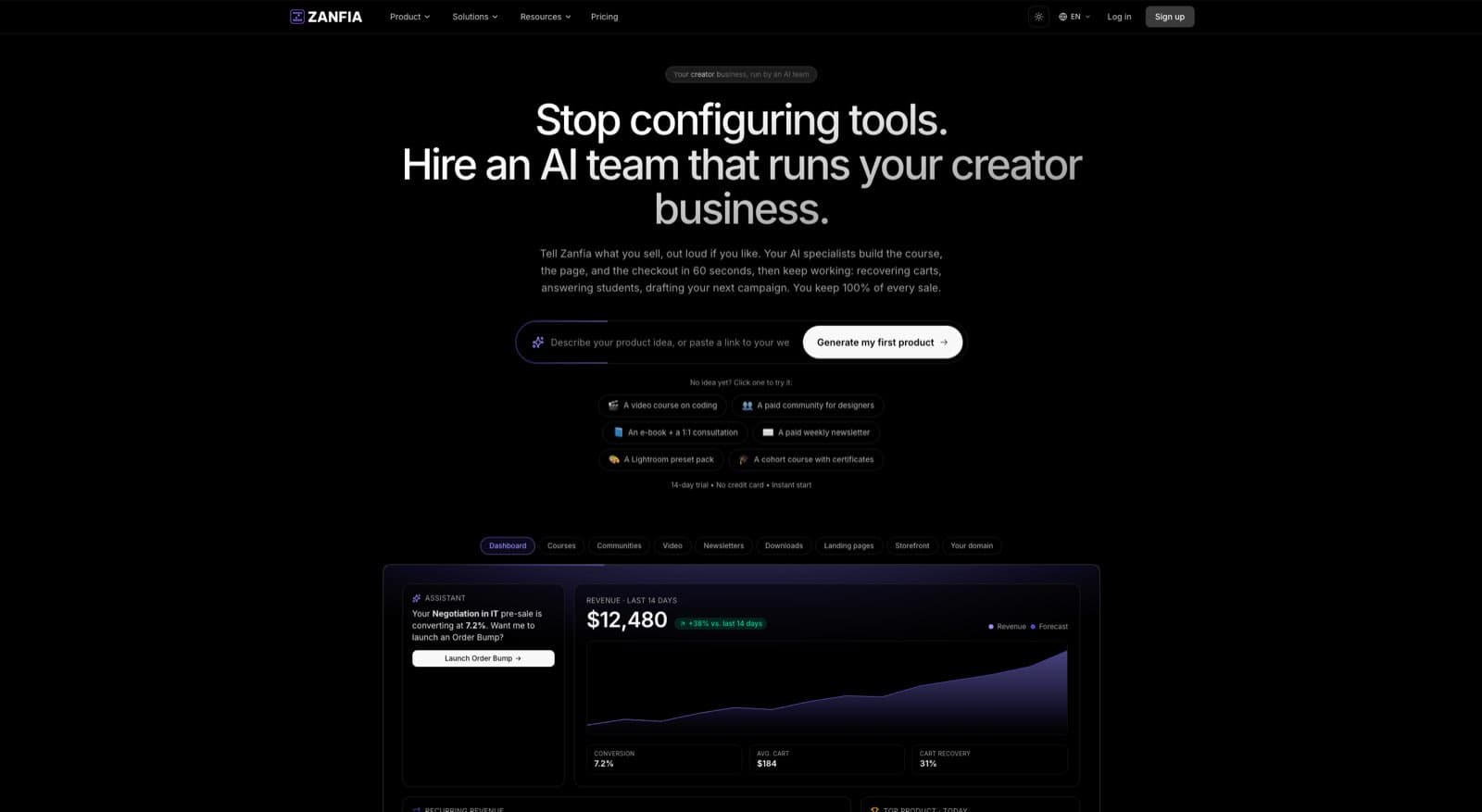
The delivery pieces that matter for coaches work today. Native video hosting with automatic progress memory (clients resume where they stopped), no separate Vimeo bill required. Time-locked drip modules to release weekly programming without letting clients binge and burn out. Recurring subscriptions and installments for the monthly membership tier, with Stripe and PayPal live for US customers, plus Apple Pay and Google Pay wallet support at checkout. A white-label setup where clients access everything at your own subdomain (or custom domain, plan-dependent), and download a native iOS/Android app that shows your brand, not Zanfia’s.
The checkout is built to sell. Order bumps let you attach a nutrition guide or mobility add-on to the main program with separate invoicing. Test mode opens the real checkout as a shareable link and fires conversion events to GA4, Meta and TikTok test surfaces so you can verify the funnel end to end before your first real sale, without polluting the live pixel. Twelve product types live under one brand, from courses to bookings to bundles, so a signature program, a monthly membership, a 1:1 consultation and a downloadable meal plan all sit inside the same storefront.
Bookings and Consultations are marked coming soon on the Zanfia product menu, so today you connect a scheduling tool you already use. By the time you read this it may already be available on your account, so check the pricing page or your dashboard.
Communities let you run one paid group per program with topic channels, announcement-only broadcasts, and member groups (for example, separating your beginner cohort from your advanced athletes). An in-community AI agent can draft posts from your own content, and everything it publishes is labeled as AI so members always know what came from you and what came from the assistant.
Several features that matter for coaches are rolling out on Zanfia rather than shipping to every workspace today. Native email campaigns and broadcasts are rolling out, which will let your welcome sequences and re-engagement emails live in the same tool as your programs. Completion certificates for finished programs are live in the product. By the time you read this these may already be available on your account, so check your dashboard.
Two honest limits. Zanfia does not do live workout streaming, so use Zoom or a similar tool for group classes. It does not integrate directly with wearables or workout logging apps like Trainerize’s rep-by-rep tracking, so if your model depends on client-side rep logging in-app, a purpose-built fitness app fits better. If your model is video programs plus community plus 1:1 calls plus a monthly membership, Zanfia handles the whole stack.
FAQ
How much does it cost to start an online fitness coaching business? Under $100/month in tools if you already have a phone and a training background. Platform ($31-$79), a scheduling tool if it is not included, and a domain. The larger costs are time (building your first program takes 40-80 hours) and client acquisition (organic content or $500-$2,000/month in ads).
What should I charge as an online fitness coach in 2026? Entry-tier group programs run $47-$97/month. Standard hybrid memberships run $150-$300/month. Premium 1:1 online coaching runs $400-$800/month. Charge based on outcome and access level, not on your years of certification.
Do I need business insurance for online coaching? Yes. Professional liability insurance for online-only training runs $200-$500/year in the US. Providers include NEXT Insurance, Insureon, and Alliant Sports. Do not skip this.
Can I run online fitness coaching without a certification? Legally in the US, in most states, yes. Practically, no. NASM, ACE, or NSCA certification adds credibility for cold traffic and is often required by insurance providers. Get certified before you scale past 20 clients.