

Drip Content vs All-Access Courses: Which Converts in 2026
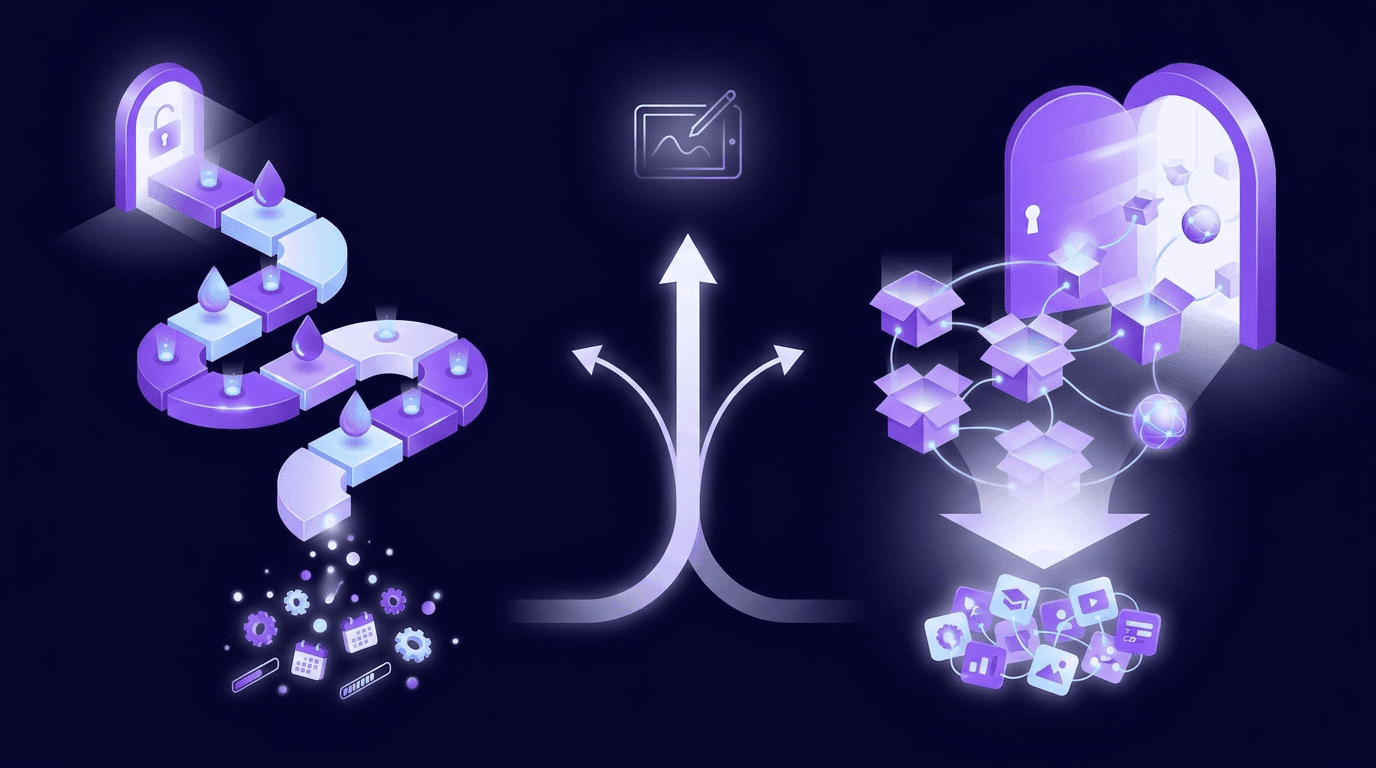
You built the course. You know the material cold. Now comes the question that quietly decides your completion rate, your refund rate, and how many students actually finish: do you drip content out over weeks, or hand students the whole library on day one?
This is not a small decision. It shapes buyer expectations, price anchoring, refund windows, and how much time you spend fielding “where is module 4?” emails. Get it right and students finish, leave testimonials, and buy the next thing. Get it wrong and you eat refunds while your Slack fills with students who binged the intro and never came back.
Below is what the delivery model actually does to completion, retention, and revenue, and how to pick the one that fits your course, your buyer, and your promise.
What Drip Content and All-Access Delivery Actually Mean
Drip content is time-locked release. A student buys today, gets module one immediately, and module two unlocks on day seven, module three on day fourteen, and so on. The pacing is set by the creator, not the student. Some drips are date-based (everyone starts on Monday, unlocks together), others are enrollment-based (each student’s clock starts when they buy).
All-access means every lesson, module, workbook, and bonus is visible and playable the moment payment clears. The student decides the pace. Some students binge it in a weekend. Others open the first lesson six months later, or never.
These are not just two settings in a menu. They are two different promises to your buyer.
What each model signals to the buyer
Drip signals: this is a program, there is a right way to do it, and I have designed the sequence for a reason. It implies you thought about pacing, cognitive load, and what should come before what.
All-access signals: you are a professional, you know what you need, and I trust you to navigate. It implies breadth, reference value, and respect for the student’s time.
Both are legitimate. Neither is universally better. What matters is whether the model matches how your buyer thinks about the purchase.
Common variations
Most creators end up in one of five configurations. Pure drip with fixed cohort dates. Pure drip with rolling enrollment (each student’s schedule is unique). Pure all-access. Hybrid where the core is dripped and bonuses unlock immediately. And front-loaded drip where the first two or three modules unlock instantly and the rest drip weekly, which softens the “I paid and got almost nothing” reaction.
Completion and Retention: What the Data Shows
Online course completion rates are notoriously bad. Industry averages hover in the 5 to 15 percent range for self-paced content, and drop into low single digits for free MOOCs. This is the baseline every creator is fighting against.
Drip content consistently outperforms all-access on completion, but the size of the gap depends heavily on the audience. Research aggregated by learning management platforms like LearnDash suggests dripped courses see completion rates 20 to 40 percent higher than equivalent all-access versions of the same material, particularly for beginner audiences and courses longer than four hours of content.
The mechanism is not mysterious. Drip creates a recurring reason to open the email, log in, and engage. Every unlock is a small commitment device. All-access removes that friction entirely, which is exactly why students defer, forget, and never return.
Where all-access retention actually holds up
All-access is not universally worse. For advanced learners buying reference material, completion is the wrong metric. A senior developer buying a course on Kubernetes internals may only ever watch the three modules relevant to their current problem, and that is a successful purchase. They got what they came for.
Retention (measured as “did they get value” rather than “did they finish”) is often equal or higher on all-access for expert audiences, because experts self-navigate to what they need and skip what they already know. Forcing them through a drip feels condescending and drives refunds.
The completion vs satisfaction gap
Here is what nobody tells you: high completion does not automatically mean high satisfaction, and vice versa. A student who finishes a dripped course over eight weeks may feel they were forced through padding. A student who binges an all-access course in a weekend may feel they got a lifetime of value, even if they only watched 40 percent.
What actually predicts referrals and repeat purchases is whether the student got the specific outcome they bought the course for. Delivery model influences this indirectly, by making the outcome more or less reachable. It is not the outcome itself.
Refunds and Perceived Value by Delivery Model
Refunds are where delivery model hits the P&L directly. And this is where a lot of creators get burned by choosing the wrong one.
All-access and the buy-download-refund pattern
All-access courses with generous refund windows (30 days is common) are vulnerable to the buy-download-refund pattern. Student buys, downloads or screen-records the content, and requests a refund on day 29. Some creators report this behavior on 3 to 8 percent of all-access sales, especially at higher price points ($500 and up).
You can fight this with DRM, watermarking, and refund policies that exclude students who have watched more than X percent of the content. But every one of those measures creates friction for legitimate buyers too, and they still leak.
How drip reduces refund exposure
Drip content structurally solves this. If module 4 unlocks on day 21 and your refund window is 14 days, the student cannot download the whole course before deciding to refund. They have to keep the purchase to see the rest.
This is not a trick. It is aligning the refund window with the value delivery timeline. If you promise 8 weeks of transformation, offering a 14-day refund on a fully-unlocked course misaligns everything. Dripping the content and matching the refund window to the first module or two is honest and dramatically reduces refund rates.
Perceived value on day one
The counter-argument to drip: on day one, an all-access buyer sees the full library and feels they got what they paid for. A drip buyer sees module one and can feel underwhelmed. “I paid $497 and got 45 minutes of video?”
This is real. It is why front-loaded drips (releasing 2 to 3 modules immediately, then weekly) tend to have lower buyer’s remorse than pure weekly drips starting from zero. It gives the student something substantial to engage with while the pacing benefits still apply to later modules.
Chargebacks and dispute risk
Payment processors track chargeback ratios, and both Stripe and PayPal will freeze or close accounts that exceed roughly 1 percent chargeback rates. All-access courses at higher price points ($1,000+) tend to see slightly elevated chargeback risk because the buyer sees the full value immediately, then has 60+ days with their card issuer to dispute.
Drip content spreads the perceived value delivery across weeks, making “I did not get what I paid for” claims harder to sustain when the student has actively used modules throughout the period.
When Drip Wins: Cohorts, Beginners, Structured Programs
Drip is the right call in specific, identifiable situations. If your course fits three or more of these criteria, drip is probably correct.
Beginner audiences
Beginners do not know what they do not know. Give them all-access and they will either binge the first few lessons and quit, or freeze in the face of “where do I even start?” Drip enforces the sequence you designed, which is exactly the sequence they need because they cannot yet judge it themselves.
Fitness programs, language learning, coding bootcamps for total beginners, and “start your business in 90 days” style courses all benefit from drip. The buyer is explicitly hiring you for the roadmap. All-access undermines the roadmap.
Cohort-based programs
If part of the value is that everyone is working through the same material at the same time (peer discussion, group calls, weekly Q&A), drip is essential. All-access breaks cohort dynamics because students are at different modules, discussion threads become spoiler-riddled, and group calls attract people at wildly different stages.
Cohorts also justify premium pricing more easily than self-paced. A $2,500 cohort feels reasonable. A $2,500 self-paced course feels expensive. Delivery model is doing part of the pricing work.
Behavior change programs
Anything where the outcome depends on repeated practice over weeks (habit building, sales scripts, cold outreach, meditation) needs drip. Behavior change requires spaced repetition and time between introducing new material. All-access lets students skip ahead and miss the underlying reps.
Weight loss programs, sales training, public speaking courses, and productivity systems all fit here. The value is not in the information. It is in the pace at which you introduce it.
Programs with weekly deliverables
If you assign homework or ask students to submit something each week (a landing page, a sales call recording, a video pitch), drip forces the rhythm. All-access lets students submit everything on day 30, which defeats the point of feedback.
When All-Access Wins: Advanced Learners and Reference Courses
All-access is the right call when the buyer is treating your course as a resource, not a program.
Reference and lookup content
Courses on specific technical topics (a Kubernetes deep dive, an advanced Figma course, a course on Stripe implementation) are used more like documentation than curriculum. Students dip in to solve a specific problem, then leave. Forcing them through weekly drips wastes their time and drives refunds.
If your course description says “reference,” “deep dive,” “masterclass,” or “complete guide,” all-access is almost certainly correct.
Advanced audiences
Senior professionals resent being paced. They have the context to self-navigate. Drip signals “I do not trust you to know what you need,” which is exactly the wrong signal to send to someone paying $500 to $2,000 for advanced material.
If your buyer persona is “director-level and above” or “5+ years experience,” default to all-access and let them binge, skim, or reference as they see fit.
Refresh and revisit courses
Courses that people are expected to revisit multiple times (annual sales training refreshers, compliance updates, technique reviews) work better as all-access because students need random access. Forcing them to re-drip through content they have seen before is punishing.
Short courses
Anything under 90 minutes of total content probably should not be dripped. There is not enough material to justify weekly unlocks, and students will feel drip is being used to artificially inflate perceived program length. Under 3 hours, drip is questionable. Over 5 hours, drip is often justified.
A Hybrid Model: Drip the Core, Unlock Bonuses
The best-performing configuration for many creators is neither pure drip nor pure all-access. It is a hybrid.
How the hybrid works
Core curriculum (modules 1 through 6, the transformation content) is dripped weekly. Bonuses (templates, resource libraries, recorded past Q&As, worksheets) are all-access from day one.
This gives the buyer substantial immediate value (bonuses feel like a gift), while the core content still benefits from pacing. Refund rates drop because the buyer has something to engage with on day one. Completion rates hold because the main sequence is still time-locked.
Why buyers respond to it
The hybrid model resolves the core tension. Pure drip feels stingy on day one. Pure all-access invites bingeing and refund abuse. Hybrid gives the student a full plate immediately (bonuses, resources, community access, mobile app content) while the sequenced learning path unfolds on the schedule you designed.
On sales pages, hybrid is easier to sell too. You can list impressive bonus stacks that unlock immediately alongside the core weekly modules. Buyers see they are getting a lot on day one, but they also understand the main program is structured.
Where hybrid falls apart
Hybrid does not work if the bonuses are junk. If everything unlocked on day one is filler (“here is a PDF checklist you can find on Google”), students see through it immediately. Bonuses need to be genuinely valuable stand-alone content.
Hybrid also complicates cohort programs. If some students are on the drip and others are self-paced (say, they bought after cohort start), the community discussion gets fragmented. For pure cohorts, stick with pure drip.
How Zanfia helps course creators drip content
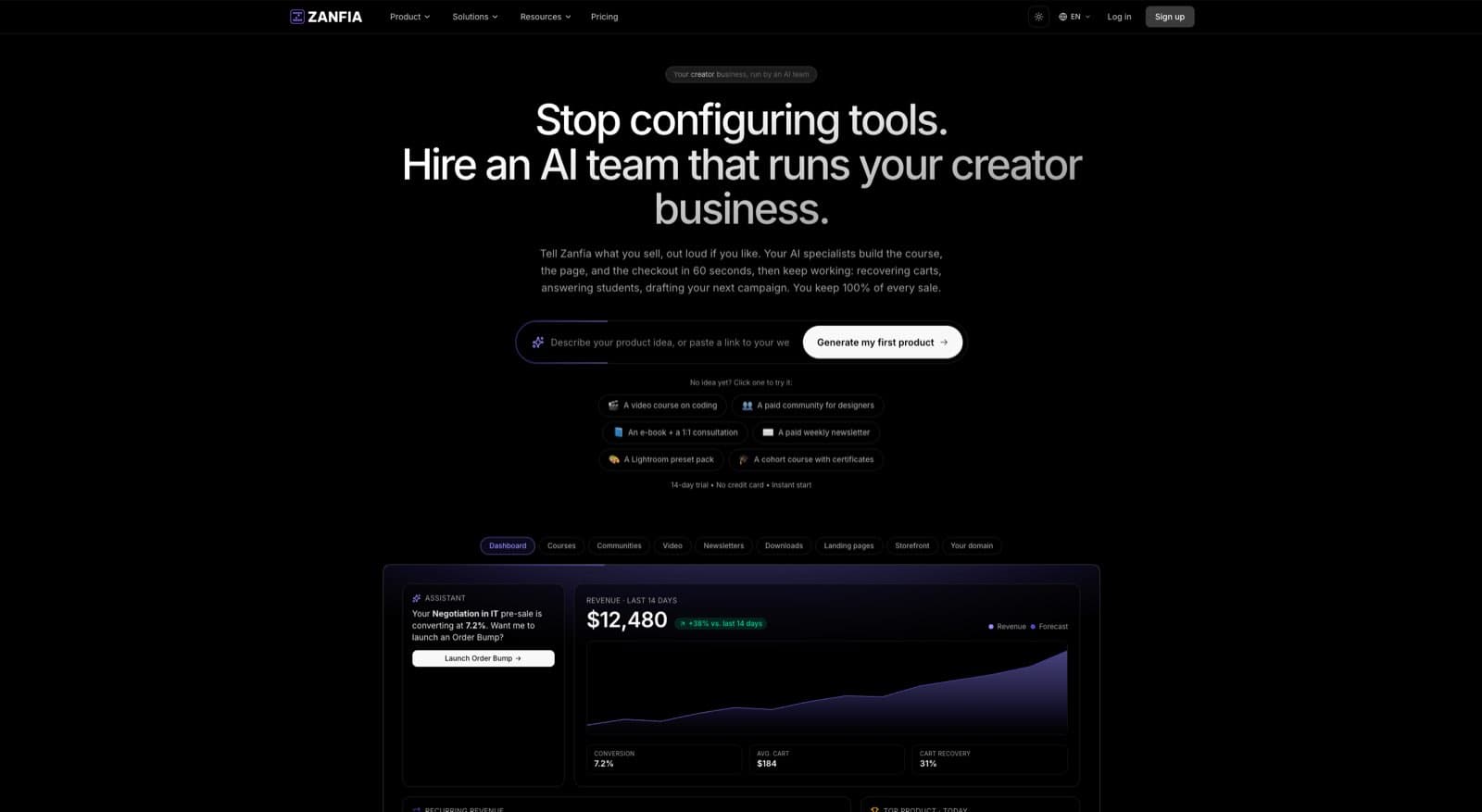
The mechanics of drip content are only useful if the platform makes them easy to set up and change. Zanfia is an AI team that runs the creator business behind your course, and time-locked drip modules ship natively in the course editor, so you can pace a cohort or open everything at once from the same course, without plugins or extra tools required.
Time-locked module unlocking is built in. You set the unlock schedule per module (day 0, day 7, day 14, etc.) and Zanfia handles the rest. Students see the full course structure but locked modules show their unlock date, which creates anticipation rather than confusion. You can switch a course from drip to all-access, or vice versa, with a single setting change, and you can do it by talking to the assistant instead of hunting through menus, because voice dictation and chat control anything you can do in the interface. This matters because it lets you test both models on the same audience without rebuilding your course twice.
The hybrid model is straightforward too. Because Zanfia’s course editor treats modules as independent units, you can set the core modules to drip weekly and mark bonus modules as immediate-access. Students see the full library on day one but the pacing is preserved for the transformation content. Duplicating courses to test different delivery models across cohorts is also native, so if you run a fitness program that works as pure drip for beginners and all-access for a returning-alumni tier, you can maintain both from one master course. Agents can act on this through the MCP endpoint, which means your own AI assistant can duplicate a course, swap the drip schedule, or spin up a new cohort variant without you touching the dashboard (availability depends on the plan, see the current Zanfia pricing).
Beyond drip mechanics, Zanfia handles the surrounding infrastructure that makes either model actually work. Native video hosting with a smart progress-memory player means students return exactly where they left off, which matters more on all-access (where sessions are longer) than drip. The native iOS and Android app supports courses fully, so students can watch dripped content on their phone during a commute and pick up on desktop later. Communities integrate directly with course content, which is critical if you are running cohort-based drip programs where the discussion happens alongside the material.
On the commercial side, Zanfia is built to sell: Cart 2.0 supports one-time, subscription, installment, and trial pricing on the same course, so you can split a $600 program into four monthly payments aligned with the drip schedule, or offer an all-access version at a higher one-time price. Order bumps and subscription upsells sit inside the same checkout, and test mode lets you buy your own course end to end before launch to confirm the drip unlocks, the emails, and the tracking all fire correctly. Discount codes work across both models. Zanfia charges 0% platform transaction fees on customer sales (only payment processor fees apply, which for US creators is typically Stripe or PayPal), so switching delivery models does not change your economics. Every plan starts with a 14-day free trial, no credit card required, so you can test the setup on real content before committing.
The white-label side matters for both models but especially for cohort-based drip programs. Your course lives on your own domain (a custom domain you connect, or a Zanfia subdomain) with your branding, so the drip emails, the login page, the mobile app experience, and the community all feel like your product, not a hosted course marketplace. For creators running premium cohorts at $1,000+ price points, this matters more than the platform is worth on paper.
FAQ
Does drip content actually increase completion rates?
Yes, but the size of the effect depends on the audience. Beginner audiences and cohort-based programs see the biggest lift (often 30 to 40 percent higher completion vs equivalent all-access). Advanced or reference audiences see little to no improvement, and can see completion drop because forced pacing frustrates them.
How long should the drip interval be?
Weekly is the default for most courses. It matches how buyers organize their calendars and gives enough time between modules for practice and reflection. Longer intervals (biweekly, monthly) work for high-intensity content that requires significant homework. Shorter intervals (every 2 to 3 days) work for short courses or when you want to compress a program into a specific window.
What is the biggest mistake creators make with drip content?
Making the first unlock too small. If day one delivers only a 20-minute welcome video, buyers feel cheated. Front-load the first unlock with enough substance that the buyer feels they got their money’s worth even if they never come back. Then let the rest drip on schedule.
Can I switch a course from drip to all-access after launch?
Technically yes, but be careful about how you communicate it. Existing students who bought expecting drip may be indifferent to unlocking (they will just carry on). Existing students who bought expecting all-access will be upset if you switch to drip retroactively. Communicate any change clearly and consider grandfathering existing students on the old model.
Does drip content reduce refund rates?
Yes, meaningfully. Aligning the refund window with the pacing (14-day refund on a course that drips weekly for 8 weeks) prevents the buy-download-refund pattern that plagues all-access courses at higher price points. It also reduces “I did not use it” refund requests because the buyer only has a few modules to have not used, not the whole library.
Should I drip my bonuses too?
Usually no. Bonuses feel more like a gift when they are immediately accessible. Dripping bonuses tends to backfire because buyers see “bonus” and expect to have it, not wait for it. Keep bonuses all-access and drip the core curriculum.
What about self-paced students who buy a cohort course after start?
Two common approaches. First, give them the current cohort’s drip schedule (they start at week 1 even though the cohort is at week 3), which preserves the pacing but disconnects them from the community discussion. Second, put them on all-access catch-up so they can rejoin the cohort at whichever module is current. The second is friendlier but weakens the cohort experience for everyone.
Is drip content worth the setup effort?
If you are on a platform that makes drip a one-click setting per module, yes, almost always. If your platform requires plugins, workarounds, or manual email sequences to fake drip, the ROI is much less clear. This is where platform choice matters. Native drip support is dramatically easier than bolted-on drip.