

How Online Mentors Make Money in 2026: 6 Models That Actually Pay
The mentoring economy has quietly become one of the most profitable niches in the creator economy. While course creators battle content saturation and coaches chase the next miracle framework, online mentors are stacking recurring revenue by doing something surprisingly old-school: transferring hard-won expertise to specific humans who need it right now.
The question isn’t whether mentoring pays. It’s which model pays best for your expertise, your capacity, and the results your mentees actually want. Some mentors bill $500 an hour and cap out at 30 clients a year. Others run $99 monthly subscriptions with 400 members and never take a one-on-one call. Both approaches work. The trick is knowing which one fits you before you build the wrong business.
This guide breaks down the six mentoring monetization models that actually generate income in 2026, with real revenue math, positioning guidance, and the operational stack you need to run each one profitably.
The state of paid mentoring in 2026
Paid online mentoring has matured from a side hustle into a legitimate business category. According to the MentorCruise mentor earnings guide 2026, active mentors on established platforms report median monthly earnings between $1,200 and $4,800, with top performers clearing $15,000 or more per month through blended models that combine one-on-one time with subscriptions and group programs.
Three shifts are driving the boom.
First, corporate training budgets fragmented. Companies stopped writing $50,000 checks for generic leadership programs and started reimbursing employees for individual mentors who deliver specific outcomes. According to the Qooper 2026 online mentoring platforms report, employer-sponsored individual mentorships grew 47% year over year, and 68% of mentees now pay out of pocket or with employer stipends rather than through corporate contracts.
Second, courses hit a ceiling. Digital creators who built $2M course businesses in 2021 watched refund rates climb and completion rates collapse. Mentoring solved both problems: buyers who pay for human attention finish what they start, and refund requests drop below 5% because the value is undeniable.
Third, the tooling finally caught up. Mentors used to duct-tape Calendly, Stripe, Circle, Loom, and Notion together and hope nothing broke. In 2026, platforms bundle bookings, subscriptions, community, and course delivery into one login, which means solo mentors can run six-figure businesses without hiring an operations person.
What follows is the six-model breakdown. Read all of them before you pick one, because the mentors who make the most money almost always blend two or three.
Model 1: hourly and session bundles
The oldest mentoring model is still the fastest way to validate demand and start generating income. You sell time. Someone books it. You show up and deliver value.
Hourly pricing works because it’s transparent, familiar, and low commitment for the buyer. A first-time mentee doesn’t have to trust you enough to commit to six months. They just need to trust you enough to book one session.
How the pricing math works
Rates in 2026 vary wildly by domain. Technical mentors (engineering leads, senior developers, data scientists) typically charge $150 to $400 per hour. Executive coaches and career mentors for senior operators charge $250 to $750. Creative mentors (writing, design, music production) sit between $100 and $250. Niche experts with credible track records regularly clear $500 an hour once they build a waitlist.
The problem with pure hourly is capacity. If you charge $200 an hour and want to earn $10,000 a month, you need 50 billable hours. That sounds fine until you factor in prep, follow-up, no-shows, discovery calls, and the emotional cost of context-switching between eight strangers a week.
Session bundles fix the capacity problem
Instead of selling single hours, sell packages. A four-session bundle at $700 (versus $200 per session) locks in commitment, reduces booking friction, and lets you plan your calendar in blocks. Mentees prefer bundles because they get a discount and a clear finish line. You prefer bundles because you get upfront revenue and predictable capacity.
The best structure is usually three or four sessions spaced two weeks apart, with async support (a shared doc or short Loom check-ins) between calls. This turns a $200 hour into a $250 to $300 blended hourly rate once you factor in the ongoing engagement.
When this model is right for you
Session bundles work best when you’re early-stage (validating demand), when your expertise commands premium hourly rates, or when your typical engagement is under six months. If you find yourself repeatedly selling the same three-session structure to different mentees, that’s your signal to package it as a productized offer.
Model 2: milestone and outcome packages
Milestone packages replace time with results. Instead of billing for hours, you bill for the outcome: a completed portfolio, a job offer, a launched product, a raised round.
This is the highest-margin mentoring model when it works, and the most brutal when it doesn’t. You have to be genuinely confident you can deliver, and your mentees have to trust that you can. But when both sides align, the pricing power is extraordinary.
Pricing outcomes vs. pricing time
A senior product designer might charge $250 an hour for portfolio reviews. That same designer, offering a “land a senior role at a top-tier startup” package with a guaranteed outcome or partial refund, can charge $6,000 to $12,000 for the same three months of work. The buyer isn’t paying for time. They’re paying for the salary bump.
The math is straightforward: price the package at 10% to 25% of the outcome’s monetary value. A $30,000 salary increase justifies a $3,000 to $7,500 mentoring investment. A funding round justifies more.
Structuring outcome packages that actually deliver
The three components of a working outcome package are:
- Clearly defined success criteria. “Better product design skills” doesn’t work. “A portfolio that lands at least three senior product design interviews within 90 days” does.
- Milestone-based check-ins. Split the engagement into 3 to 5 milestones (e.g., portfolio audit, case study #1 shipped, three applications submitted, first interview, offer negotiated). Each milestone triggers a call and unlocks the next phase.
- A refund or extension policy. Confident mentors offer “if you hit the milestones and don’t get an offer, I keep working with you until you do.” This isn’t charity, it’s leverage. It signals confidence and dramatically increases conversion.
The risk you’re really taking
Outcome packages backfire when you over-promise or when the mentee doesn’t do the work. Vet ruthlessly. A 30-minute paid discovery call before the package sale filters out mentees who won’t execute. Charge $150 to $250 for the discovery call, credit it against the package if they buy in, and use it to write a joint plan that both of you sign off on.
Model 3: monthly mentorship subscriptions
Subscriptions are how mentors build calm, predictable businesses. Instead of chasing new sales every month, you get recurring revenue that compounds. A mentor with 40 subscribers at $200 a month earns $8,000 in recurring monthly revenue with roughly 20 to 30 hours of active work.
This model works best for domains with ongoing questions: career navigation, business operations, technical architecture, creative direction, fundraising. Anywhere the mentee benefits from a persistent expert on retainer rather than a project-based engagement.
What a subscription typically includes
Subscription tiers usually stack like this:
- Base tier ($99 to $149/month): Async access via a private channel or shared doc, monthly group Q&A call, template library, priority replies within 48 hours.
- Mid tier ($199 to $349/month): Everything above, plus one 30-minute one-on-one call per month and portfolio or work reviews.
- Top tier ($499 to $999/month): Weekly one-on-one calls, unlimited async, faster response SLAs, deeper strategic involvement.
The key is making the async component genuinely valuable. Members who feel heard between calls renew. Members who only value the calls churn as soon as their calendar gets busy.
Making subscription mentoring profitable
The unit economics only work when churn stays below 8% monthly. That means the mentor has to keep showing up, not just the mentee. The most common failure mode is a mentor who’s excited for the first 90 days, then treats replies as an afterthought once the novelty fades. Churn spikes at month 4, and the whole model collapses.
Guardrails that keep subscription mentoring healthy:
- Cap intake. Cap total members at a number where you can maintain quality (usually 30 to 80 depending on tier).
- Batch async time. Answer messages twice a day at fixed windows, not continuously.
- Automate the calendar. Members book their monthly call themselves, not through you.
- Ship monthly wins. Send a monthly recap with wins from the cohort and a preview of next month’s group session. This reduces cancellations by keeping the value visible.
Model 4: group mentoring at scale
Group mentoring is how you break the trade between margin and reach. Instead of one mentee per hour, you serve 10 to 30 people simultaneously in a cohort or ongoing program.
This model isn’t just cheaper for buyers. It’s often better. Peer accountability and diverse perspectives inside the group frequently deliver more value than one-on-one mentoring, particularly for skills that improve through observation (public speaking, sales calls, feedback loops).
Two structures that work
Cohort-based groups. A fixed group of 12 to 25 people, running for 8 to 12 weeks with a defined curriculum, weekly group calls, and structured milestones. Priced at $1,500 to $5,000 per participant. Total revenue per cohort: $30,000 to $100,000. Run three to four cohorts a year. This is a high-leverage, high-effort model.
Ongoing group memberships. A rolling group of 30 to 100 members with weekly or biweekly office hours, a private community, and rotating guest sessions. Priced at $79 to $299 per month. Total MRR: $5,000 to $25,000 depending on tier and size. Lower per-member intensity but much better retention economics.
The community layer is non-negotiable
Group mentoring lives or dies by the between-session community. If members only interact during the weekly call, the group feels transactional and churn is brutal. If members build relationships (helping each other, sharing work, making introductions), they stay for years.
This is where the platform choice matters. Trying to run a $2,000-per-seat cohort through Slack plus Zoom plus Google Docs plus Circle is operationally miserable. You end up spending more time managing tools than mentoring. The platforms that win this model bundle scheduling, payments, community, and content delivery into one login for both the mentor and the members.
Models 5-6: courses and paid community add-ons
The last two models aren’t standalone businesses for most mentors. They’re leverage layers you add on top of one-on-one or subscription mentoring to increase revenue per mentee and open up lower-priced entry points.
Model 5: courses as a mentoring add-on
Courses solve a specific mentoring problem: repetition. If you find yourself explaining the same framework to every new mentee, that framework belongs in a course. Package the repeatable content once, sell it forever, and use your live time for the high-leverage conversations that actually require you.
Two ways to structure this:
- Course as a prerequisite. Sell a $297 to $997 course that mentees must complete before booking one-on-one time. This filters serious buyers, front-loads their learning, and lets your paid calls focus on personalized application.
- Course as an entry point. Sell the course to a wide audience at $197 to $497. A meaningful percentage of buyers will upgrade to your mentoring within 60 days once they realize they want the personalized version.
Revenue impact varies, but mentors who add a course typically see 20% to 40% growth in total revenue within six months, mostly because the course converts warm audience members who would never have booked a mentoring call cold.
Model 6: paid community add-ons
A paid community is the lowest-friction way to monetize your audience without adding one-on-one capacity. A $29 to $79 monthly community gives your audience a way to stay in your orbit and access some of your thinking without booking a session.
The trap is treating the community as a discount version of your mentoring. That destroys perceived value. The right framing is that the community is a peer network you facilitate, and your one-on-one mentoring is a separate, higher-tier offering. Members who want more upgrade. Members who want a low-commitment way to stay connected keep paying $49 a month for years.
Realistic math: a mentor with a 2,000-person audience can typically convert 2% to 5% of that audience to a $49 monthly community. That’s $2,000 to $5,000 in MRR from an asset that requires 4 to 8 hours a week to run well.
How Zanfia combines bookings, subscriptions, and community for mentors
Every mentoring model above requires the same underlying stack: a way to book calls, a way to charge for one-time and recurring payments, a way to host courses or resources, and a way to run community discussions. Most mentors end up stitching together five tools and paying more in software subscriptions than they’d like to admit.
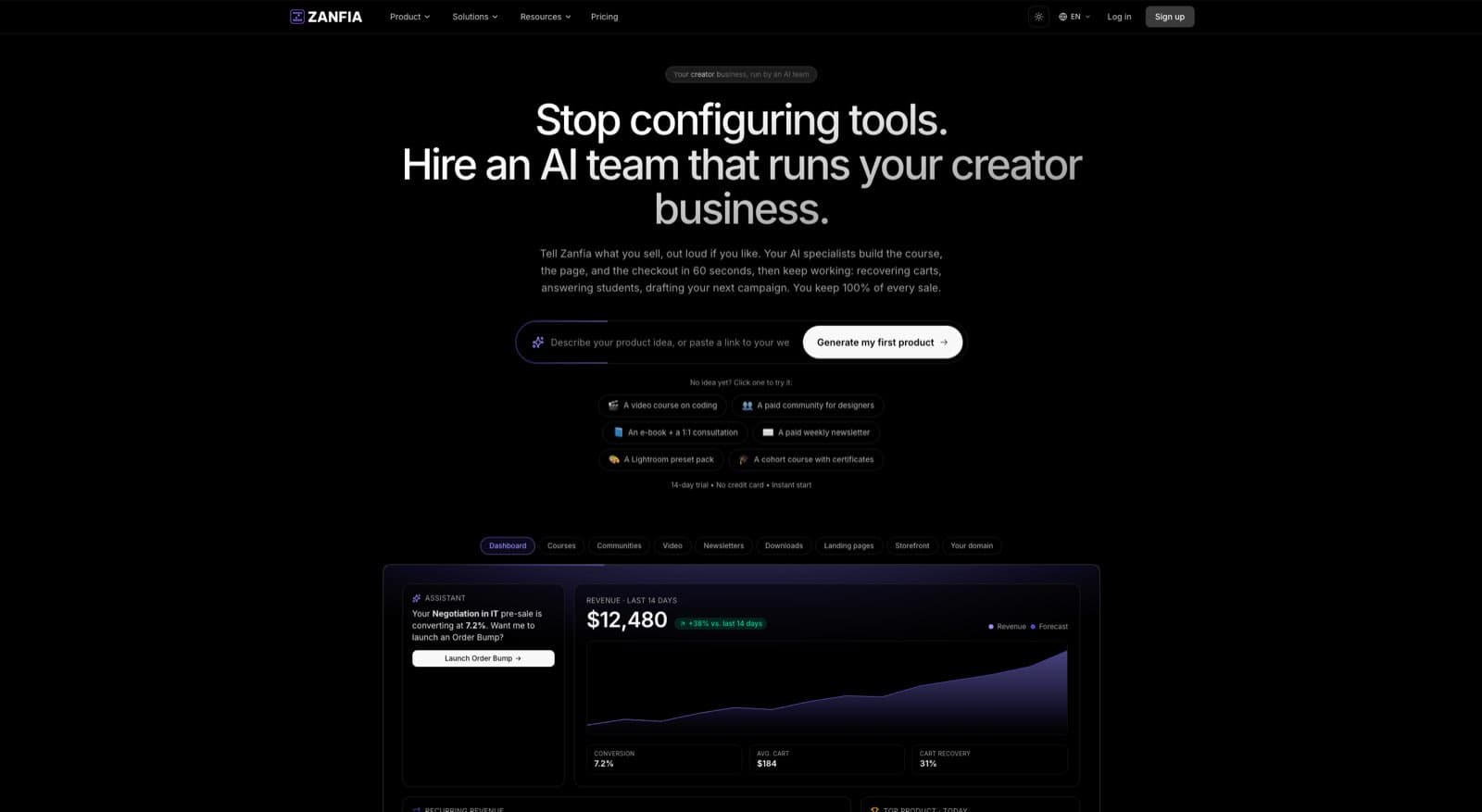
Zanfia takes a different angle on this stack. Instead of another dashboard to configure, it gives a mentor an AI team that runs the business: an assistant that knows the whole application and can perform any action available in the interface, by chat or by voice, so you dictate what needs to happen instead of clicking through menus. That AI work then lands in the surfaces mentors actually sell through, consulting bookings, subscription billing, community, courses, paid newsletters and knowledge bases, all under one login, on your own custom domain, with 0% platform commission on customer sales as of the current pricing.
What that looks like for each mentoring model
For hourly and bundle mentors: Zanfia includes native consulting bookings, so mentees can browse your availability and pay for a session or bundle in the same checkout. Payments run through Stripe and PayPal, with Apple Pay and Google Pay for mobile buyers. Session bundles work as one-time offers or as installments through Cart 2.0, so a $700 four-session bundle can be split into two or three payments to lower the entry point without changing your take-home.
For outcome-package mentors: Milestone packages sell as one-time products with optional installment plans, and a $6,000 package can be broken into four monthly payments without a separate billing tool. You can require a paid discovery call as a prerequisite offer and gate access to the package until the mentee books it. A test-mode checkout lets you buy your own package once end to end, and confirm the tracking and confirmation flow work, before you send a single mentee to it.
For subscription mentors: Recurring subscriptions bill monthly or annually. You can structure multi-tier subscriptions (base, mid, top) with different access levels to community channels, private lessons, and one-on-one call allotments. Subscription upsells at checkout let you offer an annual plan discount to new members automatically, and order bumps let you attach a workbook or a template pack to the first month’s charge.
For group mentors: The built-in community includes topic discussion channels, announcement-only channels for cohort updates, and group-based organization so cohorts can operate as private spaces within the same platform. Group members can access their course modules and community channels in a single interface, without needing Circle, Discord, or Slack alongside a separate course platform. A community AI agent can help draft posts and answer common questions from your own content, and everything it publishes is labeled as AI so members know what came from you and what came from the agent.
For mentors adding courses or paid communities: Native video hosting means you don’t need a Vimeo Pro subscription just to serve your students. Time-locked module unlocking (drip content) helps you sequence a cohort. Course content duplication lets you clone a program for a new cohort or a franchised version. Paid community add-ons are just another product configuration in the same platform, one of 12 product types you can sell under a single brand.
Two operational details that matter specifically for mentors:
- White-label with custom domains. Each mentor gets a Zanfia subdomain or can map their own domain (custom domains and removing Zanfia branding are available on higher plans, see the current Zanfia pricing ). Your community, checkout, and course library all live under your brand, not a marketplace’s.
- 0% platform commission on customer sales. On a $6,000 outcome package, that’s $900 to $1,800 in savings versus a marketplace like MentorCruise (which takes 15% to 30%) or a checkout tool that layers platform fees on top of Stripe. You still pay Stripe’s roughly 2.9% + $0.30, but nothing goes to Zanfia beyond your monthly subscription.
Zanfia also offers a native iOS and Android mobile app, which currently supports courses, paid newsletters, and knowledge bases (community support in the mobile app is rolling out per workspace). If you build a course library or knowledge base alongside your mentoring, members access it on their phones without any additional setup.
You can see current pricing on Zanfia’s pricing page. Plans start at $39/month, or $31/month billed annually, on Starter, and every plan includes a 14-day free trial with no credit card required if you want to build and validate before committing to a paid tier.
FAQ
How much do online mentors realistically make in 2026?
Ranges vary widely by domain and model. Early-stage mentors selling hourly typically earn $500 to $2,500 per month. Established mentors with a subscription base and one outcome package clear $5,000 to $15,000 monthly. Top performers running group cohorts alongside one-on-one and community layers regularly earn $25,000 to $80,000 per month. The single biggest revenue lever is moving from pure hourly to a blended model with recurring subscriptions and group programs.
Which mentoring model has the highest profit margin?
Outcome packages and group cohorts. Outcome packages command premium pricing because you’re pricing against the buyer’s monetary upside, not your time. Group cohorts scale your hourly rate across 15 to 25 participants simultaneously. Both require more sales effort and stronger positioning than hourly mentoring, but the per-hour economics can be five to ten times better.
Do I need a large audience before I can charge for mentoring?
No. Most successful mentors start with under 500 email subscribers or a modest LinkedIn following. What matters is credible expertise and clear positioning. A senior engineer with 200 followers can absolutely charge $300 an hour if the positioning is right. Audience size matters more for lower-priced products (paid communities, courses) than for premium one-on-one mentoring.
What’s the fastest way to validate a mentoring offer?
Sell a paid discovery call. Price it at $100 to $250 and use it to diagnose the buyer’s problem and propose a package. If you can consistently sell paid discovery calls, you’ve validated demand. If you can convert half of them into a $2,000+ package, you’ve validated your offer. Skip the free strategy call. Free calls attract tire-kickers and set a bad precedent.
Should I mentor as a generalist or a specialist?
Specialist. Every time. “I help senior product designers move to design leadership roles at Series B startups” beats “I help designers grow their careers.” Specialists command higher prices, get more referrals, and rank better in mentor directories. The narrower your niche, the easier your marketing, and the higher your pricing power.
How many mentees can one mentor realistically handle at once?
Depends on the mix. A pure one-on-one mentor can sustainably serve 15 to 25 active clients if they’re doing 60 to 90 minute sessions every 2 to 4 weeks. A subscription mentor with light async support can serve 40 to 80. A group cohort mentor can serve 20 to 30 people per cohort while running one or two cohorts simultaneously. Blended mentors who combine models typically top out around 100 total active relationships before quality drops.
What tools do I actually need to run a mentoring business?
At minimum: scheduling, payments, a way to deliver async support, and a way to host any resources or courses you build. Most mentors start by duct-taping Calendly, Stripe, Slack, and Google Docs, then consolidate onto an all-in-one platform once revenue justifies it. The consolidation typically saves 5 to 10 hours a month in operations and cuts software costs by 30% to 60%.