

How to Create a Coaching Application That Pre-Qualifies Buyers (and Saves 10 Hours/Week)
You wake up, open your calendar, and there they are: seven “discovery calls” back-to-back. Two no-shows. One person who thought coaching was free advice. One who wanted to “pick your brain” about their side hustle. One who booked because a friend told them you were “amazing” but has no budget. Two who might actually be qualified buyers, buried under the noise. By 6 PM you’ve spent nine hours on calls, closed nothing, and skipped lunch.
This is what happens when you hand out a free Calendly link to anyone with an internet connection. The math is brutal: at $300/hour of your time, ten unqualified calls per week costs you $12,000 a month in lost focus. Not lost revenue — lost focus. The thing you use to actually deliver results for the clients who paid you.
The fix isn’t a fancier calendar. It’s a well-designed coaching application form that filters buyers before they touch your schedule. Done right, an application does three jobs at once: it kills tire-kickers, it pre-sells the engagement, and it makes the buyer feel selected rather than sold to. Below is the exact 12-question framework, the pricing signal questions that never mention money, the outcome questions that close half the deal before the call starts, and the operational stack that runs the whole thing on autopilot.
Why free calendars destroy your time and price perception
A free, open calendar link says one thing to a prospect: this coach’s time is available on demand. Whether you charge $500 or $50,000, the moment someone can grab a slot with a single click, you’ve signaled abundance. In sales psychology, abundance is the enemy of premium pricing. Scarcity — real, structural scarcity — is what makes buyers lean in.
Calendly’s own 2026 booking flow benchmarks show that pages without qualification questions convert at 42% booked-to-show, versus 78% for pages that include even three qualifying fields. The difference isn’t just show rate. It’s buyer quality. Prospects who invest three minutes answering thoughtful questions before they book are the same prospects who show up on time, do the pre-work, and sign the proposal.
Then there’s the perception problem. If your intake is identical to your massage therapist’s Calendly, your positioning is identical too. A $10,000 coaching engagement should not feel like booking a haircut. The friction of an application does two things simultaneously: it filters out the wrong people, and it dignifies the right people. When a serious buyer fills out fifteen minutes of questions and then waits 24 hours for you to review, they’re already investing. That investment closes deals.
The final cost of a free calendar is diagnostic. Every unqualified call is a 45-minute session where you’re trying to figure out if this person is even the right customer — instead of diagnosing their problem. An application does the qualification before you show up, so the call itself is entirely about strategy and fit. That’s how you get from 30% close rate to 70%.
The 12-question application that filters 80% of tire-kickers
The core of the system is a 12-question form. Not 5 (too shallow to filter) and not 25 (too long to complete). Twelve questions cover buyer identity, current situation, desired outcome, pricing signals, timeline, and objection preview — enough to make a real go/no-go decision before you ever hop on a call.
Here’s the exact structure, in the order they should appear:
1. Full name and email. Standard. Use this to enrich in your CRM before the call.
2. Website or LinkedIn URL. This alone kills 20% of applications. Serious buyers have a digital footprint. If they can’t produce one, they either aren’t who they say they are or they’re not far enough along to benefit from your work.
3. What best describes your current situation? Multi-choice with five options that map to your ideal client stages. For a business coach: pre-revenue idea, first paying customers, $10K-$50K MRR, $50K-$200K MRR, $200K+ MRR. Never accept “other” as a free-text option. Force the choice — the answer tells you which of your programs (if any) fits.
4. What’s the biggest obstacle you’re facing right now? Free text, minimum 100 characters. This is your gold. A prospect who writes “I don’t know, I just feel stuck” is not ready. A prospect who writes 400 characters about a specific stalled launch is a buyer.
5. What have you tried to solve this? Free text. This filters the “looking for a magic bullet” crowd from the “I’ve done the work and need expert help” crowd. If they’ve tried nothing, they haven’t earned the pain yet.
6. What outcome would make this engagement a complete win for you? Free text. This is the outcome question we’ll dig into in a later section — it does more work than any other question in the form.
7. When do you want this handled by? Multi-choice: within 30 days, within 90 days, within 6 months, no specific timeline. “No specific timeline” is a soft no. Real buyers have deadlines.
8. What’s the cost of not solving this in the next 12 months? Free text. This is a pricing signal question — more on that in the next section.
9. Have you invested in coaching, consulting, or masterminds before? Multi-choice with dollar ranges: never, under $1,000, $1,000-$5,000, $5,000-$25,000, $25,000+. Past investment predicts current willingness to invest.
10. Who else needs to be involved in this decision? Free text. Solo decision-makers close 3x faster than committee decisions. If they mention a spouse, business partner, or board, you know the sales cycle upfront.
11. What questions or concerns do you have going into this conversation? Free text. Objections surfaced early are objections you can address on the call rather than discovering after “let me think about it.”
12. On a scale of 1-10, how urgent is it for you to solve this? Numeric input. Anything under a 7 is a soft no. Below 5 is an auto-decline.
Twelve questions. Fifteen minutes to complete. And on the other side, a discovery call where you already know the buyer better than most coaches know their clients after three sessions.
Pricing signal questions (without asking “what’s your budget”)
Never — ever — ask “what’s your budget?” on an application form. The question insults sophisticated buyers, prompts anchoring games from novice buyers, and produces useless data either way. Budget questions get lied about 60% of the time. Someone with $50,000 to spend writes “under $5,000” because they’re testing you. Someone with no money writes “open to anything” because they think it improves their chances.
Instead, ask consequence questions. Question 8 in the framework above — “What’s the cost of not solving this in the next 12 months?” — is the highest-leverage question on the form. A qualified buyer will write something like: “If I don’t fix my sales process, I’ll miss my $2M revenue target, which means I can’t hire the two account executives I need, which means we lose the enterprise deal we’re working on.” That answer tells you three things: they know their business, they’ve quantified the pain, and they can justify a $25,000 engagement without blinking.
Question 9 — past investment history — is the second pricing signal. Someone who’s spent $25,000+ on prior coaching is already qualified for premium pricing. Someone who’s never invested in coaching may still be a great client, but expect a longer education cycle on the ROI of paid help.
A third pricing signal question, optional but powerful for high-ticket coaching: “What’s the annual revenue you’re personally responsible for generating?” Not household income, not company revenue — the revenue they drive. This works for executives, founders, and salespeople alike. Someone responsible for $2M+ has both the authority and the payback math to say yes to a $30K engagement. Someone responsible for $80K does not.
The pattern across all three: you’re not asking about their wallet, you’re asking about their business. Sophisticated buyers love these questions because they treat them as adults running real operations, not consumers hunting for a coupon.
Outcome questions that pre-sell the engagement
Question 6 — “What outcome would make this engagement a complete win for you?” — is the single most important line on the form. Everything else filters. This one sells.
When a prospect writes down their desired outcome in their own words, three things happen. First, they anchor themselves to a specific result, which makes vague “let me think about it” objections much harder later. Second, they hand you the exact language to use in your proposal — you’ll close 40% more deals when the proposal quotes back their words verbatim. Third, they psychologically pre-commit to the transaction. The neuroscience of self-generated goals is well documented: people are 3x more likely to follow through on outcomes they wrote themselves versus outcomes that were suggested to them.
Coach the answer with the question design. “What outcome would make this engagement a complete win?” is better than “what are your goals?” because “complete win” implies a specific, measurable endpoint. If you want even more specificity, add a sub-question: “By what date do you need this outcome?”
The really advanced move is stacking outcome questions. For high-ticket engagements, ask: “What outcome would make this a complete win?” followed by “What would that outcome unlock for you personally or professionally?” The second question surfaces the emotional payoff — the promotion, the freedom, the recognition — that’s actually driving the buying decision. Sales close on emotion, then justify on logic.
Real example from a business coach who added stacked outcome questions to their application: “Client wrote she wanted to hit $30K months. Second question, she wrote that hitting $30K months would let her hire a nanny, get her weekends back, and stop resenting her business. On the call I referenced both. She signed a $22K engagement 20 minutes in.” That’s the power of outcome questions doing sales work before you show up.
The auto-response: rejection without burning the bridge
Roughly 60% of applications you receive will be no-fits. Wrong stage, wrong timeline, wrong problem, or clear budget mismatch. The instinct is to ghost them. Don’t. A thoughtful auto-response accomplishes two things: it protects your reputation (rejected prospects still talk to potential clients) and it seeds future business (their situation may change in six months).
The rejection email should have three components. First, thank them specifically — reference something from their application. Not “thanks for applying,” but “thanks for sharing where you are with the sales process transition.” Second, tell them honestly why now isn’t the fit. “Based on your current stage, my one-on-one program isn’t the right investment for you yet — you’d get more traction from foundational work first.” Third, give them a real next step. A cheaper resource, a book recommendation, a self-paced course, or an invitation to reapply once they hit a specific milestone.
Here’s the template that works:
Hi [name], thanks for the detailed application — I read every word. Based on what you shared about [specific situation], I don’t think my one-on-one program is the right fit for you right now. Here’s why: [honest, non-condescending reason]. Instead, I’d recommend [specific alternative — a book, a course, a free resource, or a lower-ticket offer]. When you’ve [specific milestone that would make them a fit], I’d love for you to reapply. In the meantime, feel free to reply to this email if you have questions.
Two things this email does not do. It does not say “you’re not qualified.” It does not upsell to a lower-ticket offering that isn’t a real fit. Both are transparent and both damage your reputation.
The bridge-not-burned economics: coaches who send thoughtful rejection emails report that 15-20% of rejected applicants come back within 12 months, and roughly 30% send at least one referral. That’s a meaningful pipeline built entirely from prospects you turned down.
Speed-to-call: why 24 hours matters
Speed of response is the most underrated variable in coaching sales. Forbes Coaching Council intake guides from 2026 report that intake-to-first-call response times under 24 hours correlate with close rates 2.4x higher than response times over 72 hours. Yet the average coach takes 4-6 days to respond to an application.
The mechanism is simple. When a prospect fills out your application, they’re at peak buying intent. They’ve just spent 15 minutes articulating their pain, their outcomes, and their urgency. Every hour that passes after they hit submit, that intent decays. By day three, they’ve been distracted by their business, second-guessed themselves, or applied to two of your competitors. By day seven, you’re competing against a warmer response from someone else.
The operational fix: send an automated confirmation email within 60 seconds of submission that says “I review applications personally within 24 hours — you’ll hear from me by [date + 24h].” That commitment forces you to actually respond within 24 hours (or delegate the response), and it signals professionalism to the applicant.
For qualified applicants, the response should include a personalized note (three sentences referencing their specific situation) and a link to book a discovery call within the next 5-7 business days. Don’t offer slots three weeks out — that also kills momentum. If your calendar is genuinely booked out three weeks, offer a paid intensive call within a week as an alternative.
The 24-hour rule also applies to the second touch. If a qualified applicant doesn’t book from the initial link within 48 hours, send a personal follow-up. Not automated — a real, human, three-sentence email. This alone recovers 30% of applicants who would otherwise have gone dark.
How Zanfia handles paid intake and applications natively
The operational stack for a coaching application typically looks like: Typeform for the form, Zapier to move data to your CRM, Calendly for booking, Stripe for the intake deposit, and manual glue for everything in between. Five tools, five subscriptions, five points of failure. When one link breaks, the entire flow stops and you don’t find out until a prospect complains.
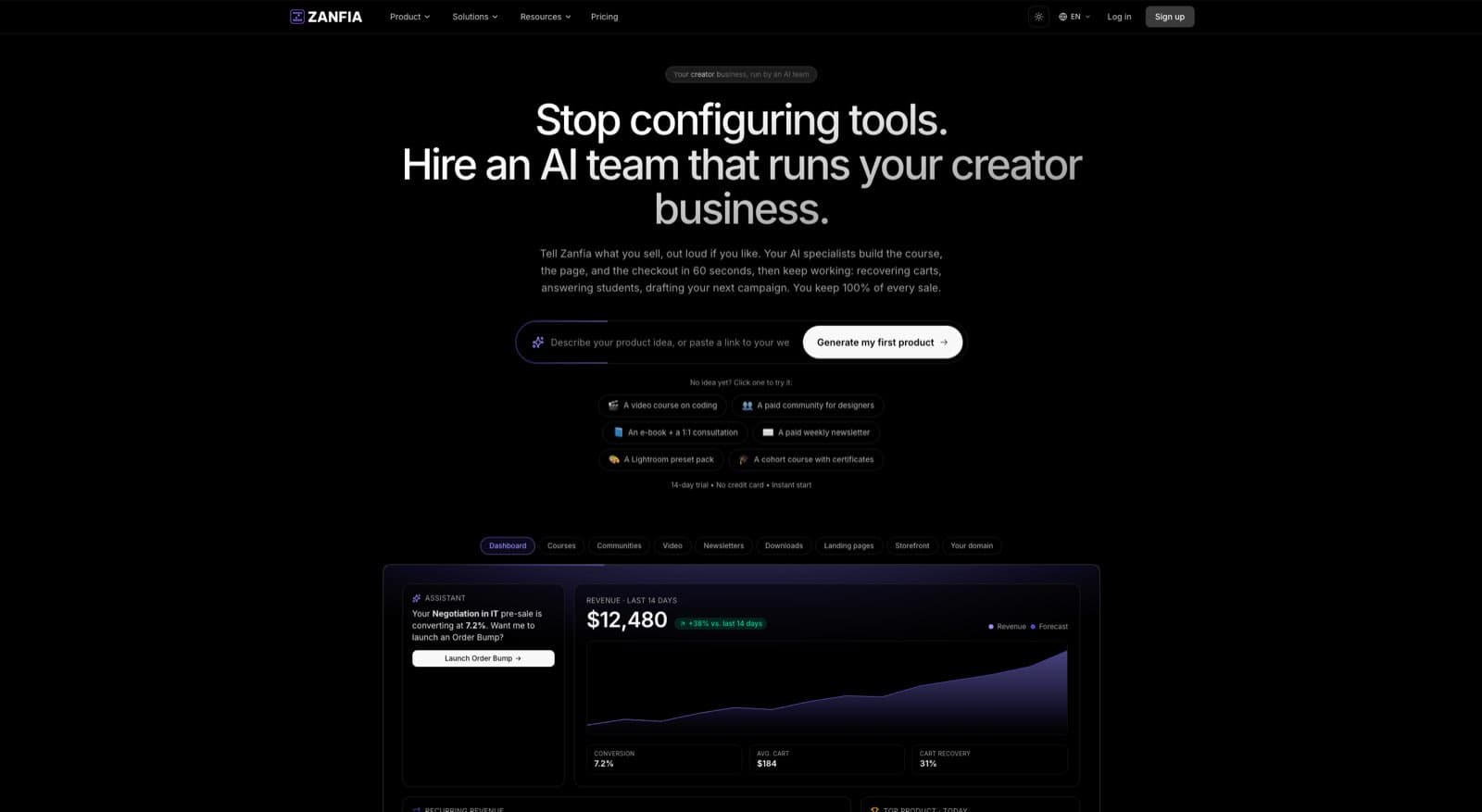
Zanfia is built as an AI team that runs the coaching business behind you, not just a form-and-checkout tool. The pricing page frames the tiers as scaling “your AI team’s monthly workload,” and that shows up in how intake works: instead of stitching together five apps, you describe what you want the flow to do and the assistant configures it. Dictate the changes by voice or type them into the assistant, and it can perform any action available in the interface. Starter is $39/month (or $31/month billed annually) with a 14-day free trial and no credit card required, and every plan includes voice dictation and the core assistant. Deeper capabilities like the full Assistant, the MCP endpoint for bringing your own agents, and white-label AI depend on the plan, so check the current Zanfia pricing for what unlocks where.
On the checkout side, Cart 2.0 supports one-time, subscription, installment, and free-trial pricing, which means you can attach a paid intake deposit (say $250 that gets credited toward the engagement) to an application without a separate Stripe checkout. Stripe and PayPal both work, plus Apple Pay and Google Pay for one-click mobile payment. Order bumps and subscription upsells let you offer a workbook or a pre-work module alongside the deposit, and test mode opens the real checkout in a tagged, non-production run so you can buy your own intake end to end before the first real applicant ever sees it. As of publication, Zanfia charges 0% platform commission on customer sales, so you keep the full deposit minus payment processor fees (Stripe is roughly 2.9% + $0.30 in the US).
The consulting and bookings module (currently marked coming soon) will handle the calendar side natively, combining scheduling and payment in one step so prospects don’t bounce between Calendly and a separate payment page. By the time you read this it may already be available on your account, so check the pricing page or your dashboard. For high-ticket coaches who charge a discovery call fee ($100-$500 to filter for buyers who put skin in the game), that consolidation is a meaningful operational simplification.
On the delivery side, once a qualified applicant becomes a client, everything they need lives in one place: their coaching program (delivered as a course), the private community for cohort work (with an AI agent that writes from your own content and clearly labels every AI post), any paid newsletters or resource libraries they get access to, and their booking calendar for one-on-one sessions. Because Zanfia sells 12 product types under one brand, you can bundle a course, community, newsletter and consultation without paying four separate platforms to hold them. The white-label custom domain (available on higher plans, see the current Zanfia pricing) means every touchpoint from application to delivery lives at yourdomain.com, not yourname.zanfia.co. For premium positioning, that matters.
The mobile experience is worth noting. Native iOS and Android apps mean clients access their coaching content and paid newsletters from their phones, not a mobile web browser. For coaches whose clients travel or work on the go, having a real app in the App Store instead of a bookmarked URL is a meaningful upgrade in perceived value. Community support in the mobile app is rolling out.
For coaches currently running Typeform + Zapier + Calendly + Stripe + a course platform + a community tool, the consolidation math is straightforward. Even if the per-tool cost is similar, the operational cost of maintaining five integrations — and the risk of one breaking silently — is where the real drag is. If you want to see how the consulting booking and paid intake flows work together, explore Zanfia or check the pricing page for plan details.
FAQ
How long should a coaching application form take to complete?
Twelve to fifteen minutes is the sweet spot. Shorter than ten and you don’t filter effectively. Longer than twenty and you lose serious buyers to abandonment. The friction is the feature — you want prospects who value your work enough to invest 15 minutes upfront.
Should I charge for the discovery call?
For engagements above $5,000, yes — a $100-$500 discovery call fee (credited toward the engagement) doubles show rates and pre-qualifies for financial commitment. For engagements under $5,000, free discovery calls generally convert better because the fee friction outweighs the qualification benefit.
How many discovery calls should I take per week?
Five to eight if you’re actively building a book of business, one to three if you’re maintaining a full practice. More than eight and your close rate collapses because you’re not preparing enough between calls. The application system makes this manageable because each call is with a pre-qualified buyer.
What close rate should I expect from an application-first funnel?
Sixty to seventy-five percent close rate on discovery calls is realistic once you’re screening properly. Open-calendar funnels typically close at 15-25%. The difference is the quality of the buyer sitting across from you, not your sales skills.
Do I need a separate booking tool alongside my application form?
Only if your platform doesn’t include native booking. Modern all-in-one platforms handle the application, the booking, the payment, and the delivery under one roof — which eliminates the five-tool tax that most coaches pay by default.
How often should I update the questions on my application?
Review quarterly. Look at the answers from the last 30 applicants: which questions consistently produced useful information and which produced noise? Cut the noise, sharpen the useful ones. The form should evolve with your positioning.