

How to Turn a One-Time Course Into Recurring Revenue
You launched your course, priced it at a few hundred dollars, and the first wave of buyers came in fast. Then the launch curve flattened. You’re staring at a spreadsheet full of one-time transactions, wondering why every month feels like starting from zero. This is the ceiling problem that traps most course creators: one-time sales scale linearly with effort, but recurring revenue compounds.
Turning a course into recurring revenue isn’t about slapping a monthly price tag on the same content and hoping people stay. It requires a shift in how you package value, structure delivery, and think about the ongoing relationship with buyers. Done right, a subscription layer can double or triple the lifetime value of a customer without doubling your workload.
This guide walks through when a subscription model makes sense, how to price it, what add-ons work, and how to layer recurring revenue on top of what you already sell. If you want to turn course into recurring revenue without rebuilding your entire business, this is the playbook.
Why One-Time Sales Cap Your Course Income
A one-time course sale is a transaction. A subscription is a relationship. That distinction matters because relationships compound and transactions don’t.
Consider the math. If you sell a $497 course to 20 people a month, that’s about $9,940 monthly. Impressive on paper, but every month you start at zero. You need 20 new buyers, every 30 days, forever. Miss a month of marketing, get sick, take a vacation, and revenue evaporates.
Now imagine those same 20 buyers pay $49 monthly for a membership that includes the course, plus a community, plus monthly live calls. In month one you make $980, less than the one-time sale. But in month twelve, if churn is reasonable, you’re stacking hundreds of active members. Recurring revenue doesn’t just replace one-time sales, it multiplies them.
According to a Harvard Business Review analysis of buying behavior, customers who commit to recurring purchases show significantly higher engagement and lifetime value than one-time buyers. That’s the compounding effect subscription businesses rely on.
There are three specific ceilings one-time sales impose:
The launch cycle treadmill
You launch, revenue spikes, then it dies. To keep income steady you need constant launches, which means constant content creation, ad spend, and email campaigns. This is exhausting and burns out most creators within 18 months.
Zero customer lifetime value
A one-time buyer gives you one payment. A subscriber can give you 12, 24, or 36 payments. Even at a lower monthly price, the total revenue per customer is often 3-5x higher over a two-year window.
No predictable cash flow
Try getting a business loan or planning next year’s hiring with revenue that swings 40% month to month. Recurring revenue smooths out the peaks and valleys, making everything else in your business easier to plan.
Do You Have Enough Content to Justify a Subscription?
Here’s the honest question most creators skip. A subscription isn’t a magic pricing model, it’s a promise of ongoing value. If you can’t deliver that ongoing value, you’ll churn out members faster than you can acquire them.
Before you flip the switch, audit what you actually have:
- Existing course library. One course rarely justifies a subscription on its own. Multiple courses, or a course plus supplemental resources (templates, worksheets, case studies), start to.
- Ongoing content capacity. Can you realistically produce new lessons, videos, or resources every month? Not “I’ll try” but “yes, I have time blocked and topics planned.”
- Live interaction bandwidth. Q&A calls, office hours, and coaching sessions are among the highest-perceived-value subscription features. Do you have time for one per week or per month?
- Community depth. Are your buyers likely to talk to each other? Peer learning is a huge subscription retention driver, but only if the community is active.
If you can check three of these four boxes, you have enough to launch. If you can only check one, you’re setting up a churn machine. Build more first.
The 3x rule
A useful heuristic: your subscription should deliver at least 3x the perceived value of the monthly price. If you’re charging $49 per month, members should feel like they’re getting $150 worth of value every 30 days. Anything less and they’ll cancel by month three.
Start with your best customers
Ask your existing buyers what they’d pay monthly for continued access, updates, and community. You’ll get a realistic price signal, and you’ll identify your first 10-20 subscribers before you even launch. This is the fastest way to validate demand without guessing.
Membership, Community, and Coaching Add-On Models
There isn’t one right way to layer recurring revenue on top of a course. Different models work for different creators, and picking the wrong one will feel like pushing a boulder uphill. Here are the four that consistently work.
The membership library model
You bundle multiple courses, templates, and resources into a monthly membership. Members get access to everything for as long as they subscribe. New content drops monthly to give them a reason to stay.
Best for: creators with a broad topic area (marketing, fitness, personal finance) who can produce steady content across multiple sub-topics.
The community-first model
The course is the entry point, but the real value is the community. Members pay monthly for access to peers, expert discussions, weekly threads, and networking. The course becomes a training wheel to get people up to speed before they engage with the community.
Best for: B2B creators, professional development, and niche expertise where peer connections matter as much as content. The Forbes Business Council reports that community-driven products see 30-40% lower churn than content-only subscriptions.
The coaching hybrid model
Members get the course plus a monthly (or weekly) group coaching call with you. This is high-ticket, low-volume, and works because the perceived value of direct access to an expert is enormous.
Best for: high-ticket experts, consultants, and creators whose personal expertise is the differentiator. Typical pricing: $200-$500 per month.
The tiered content drip model
Members pay monthly and receive new modules or lessons on a schedule (drip content). They can’t binge, they can’t skip ahead, and they stay subscribed to keep unlocking material. This works well for structured, sequential learning like language courses or certifications.
Best for: creators with a long curriculum that benefits from paced delivery, or those who want to control how members progress.
You don’t have to pick one and stick with it forever. Many successful creators run a hybrid, offering, say, a community-first membership at $49 per month and a coaching add-on at $299 per month for a smaller subset.
Pricing: When Monthly Beats a One-Time Fee
The pricing conversation is where most creators freeze up. Should you charge $29, $49, $99, or $199 per month? The answer depends on three variables: who your audience is, what alternative they’d otherwise buy, and how much ongoing value you deliver.
The math against a one-time fee
If your course sells for $497 one-time, a $49 monthly subscription reaches breakeven at month ten. Any member who stays longer than 10 months earns you more than the one-time price. Given that healthy subscription businesses see average customer lifespans of 14-18 months, this math works.
But if you drop the monthly price to $19 to seem “affordable,” you need members to stay 26 months just to match the one-time revenue. Almost no consumer subscription hits that number. Underpricing is one of the fastest ways to kill a membership.
The three pricing zones
- $19-$29 per month: Impulse-tier. Good for content-heavy libraries and consumer topics (fitness, cooking, hobbies). Requires volume.
- $49-$99 per month: Considered purchase. Good for professional skills, side-hustle education, and quality communities. This is the sweet spot for most creators.
- $199-$500 per month: High-ticket. Requires coaching, direct access, or business-transformation promises. Lower volume, but higher LTV and lower support burden per dollar earned.
Annual vs monthly
Offer both. A monthly subscription reduces friction to sign up but has higher churn. An annual subscription (usually priced at 10 months for 12) locks in revenue and dramatically improves retention math. Most creators see 30-50% of new members choose annual when it’s offered at a meaningful discount.
Grandfathering early members
Launch pricing should be a real discount. Charge your first 50 members $29 per month and promise that price for life. This creates urgency at launch and gives you evangelists who feel they got a deal. When you raise the price to $49 for everyone else, the grandfathered group becomes your most loyal segment.
Reducing Churn With Onboarding and Fresh Content
The best subscription businesses aren’t the ones with the most subscribers, they’re the ones who keep subscribers longest. Churn is the silent killer of recurring revenue. A membership with 500 subscribers and 10% monthly churn is smaller in six months than one with 300 subscribers and 3% monthly churn.
The two biggest churn drivers are poor onboarding and content stagnation. Fix both and you’ll double your average customer lifespan.
The first 14 days matter most
Most cancellations happen within the first 30 days, and most of those come from members who never engaged in week one. Your onboarding needs to force a win.
- Day 0: Welcome email with one specific action (“Watch this 12-minute intro video and complete exercise 1”).
- Day 3: Check-in email pointing to a quick-win resource. Not a course lesson, a template or tool they can use immediately.
- Day 7: Invitation to the community with a specific prompt to introduce themselves.
- Day 14: Live onboarding call or recorded office hours reminder.
Members who complete at least one action and engage in the community within 14 days churn at roughly half the rate of passive members. According to a McKinsey study on subscription retention, the strongest predictor of long-term subscription retention is whether the customer experienced value within the first two weeks.
Fresh content on a predictable schedule
Members will forgive imperfect content. They won’t forgive dead content. If your last update was three months ago, expect a cancellation wave.
Set a publishing rhythm you can actually keep:
- New lesson or module every 2-4 weeks
- Monthly live Q&A or workshop
- Weekly community prompt or discussion starter
- Quarterly cohort event, guest expert, or challenge
The specific cadence matters less than the reliability. A monthly rhythm you never miss beats a weekly promise you break.
Save-the-cancel flows
When someone hits cancel, don’t just accept it. Ask why (short survey, one question), offer a pause option (60-90 days) instead of full cancellation, and if they still cancel, offer a downgrade to an annual plan at a discount. You’ll save 15-25% of would-be cancellations with this simple flow.
Combining One-Time Sales With a Subscription Offer
Here’s the mistake most creators make: they think it’s an either/or choice. Either you sell one-time courses OR you run a subscription. In reality, the highest-revenue creator businesses do both, and the two revenue streams feed each other.
The tripwire strategy
Sell your flagship course for $497 as a one-time purchase. At checkout, offer a subscription upgrade: “Add unlimited access to our community, monthly Q&A calls, and all future updates for $49 per month.”
Roughly 25-40% of buyers take the upsell when the value is clear. You capture the one-time revenue AND acquire a subscriber, all in a single transaction. This is one of the most efficient ways to bootstrap a membership from an existing course business.
The course as a lead magnet
Sell smaller courses ($97-$297) as standalone offers, then use them as the top-of-funnel for your higher-ticket subscription. Buyers who take a smaller course convert to subscribers at 10-15x the rate of cold traffic, because they’ve already trusted you with money once.
The graduation model
Position your course as the “foundation” and your subscription as the “ongoing practice.” Once someone finishes the course, they’ve built a skill. To stay sharp, get updates on new techniques, and connect with other practitioners, they subscribe. This is how professional education works (think medical CME credits or bar association memberships), and it’s one of the most durable subscription models available.
Bundle vs unbundle
Don’t force everything into the subscription. Some content works better as premium one-time purchases: intensive workshops, cohort programs, or highly-specialized deep-dives. Selling these separately at $299-$1,997 to your subscriber base creates a second revenue layer without adding subscribers.
How Zanfia helps course creators build recurring revenue
Most creators trying to layer a subscription on top of a course end up stitching together three or four tools: one platform for the course, another for the community, a third for scheduling coaching calls, and a fourth for handling recurring payments. Each tool costs money, each requires integration, and members bounce between logins, which kills engagement.
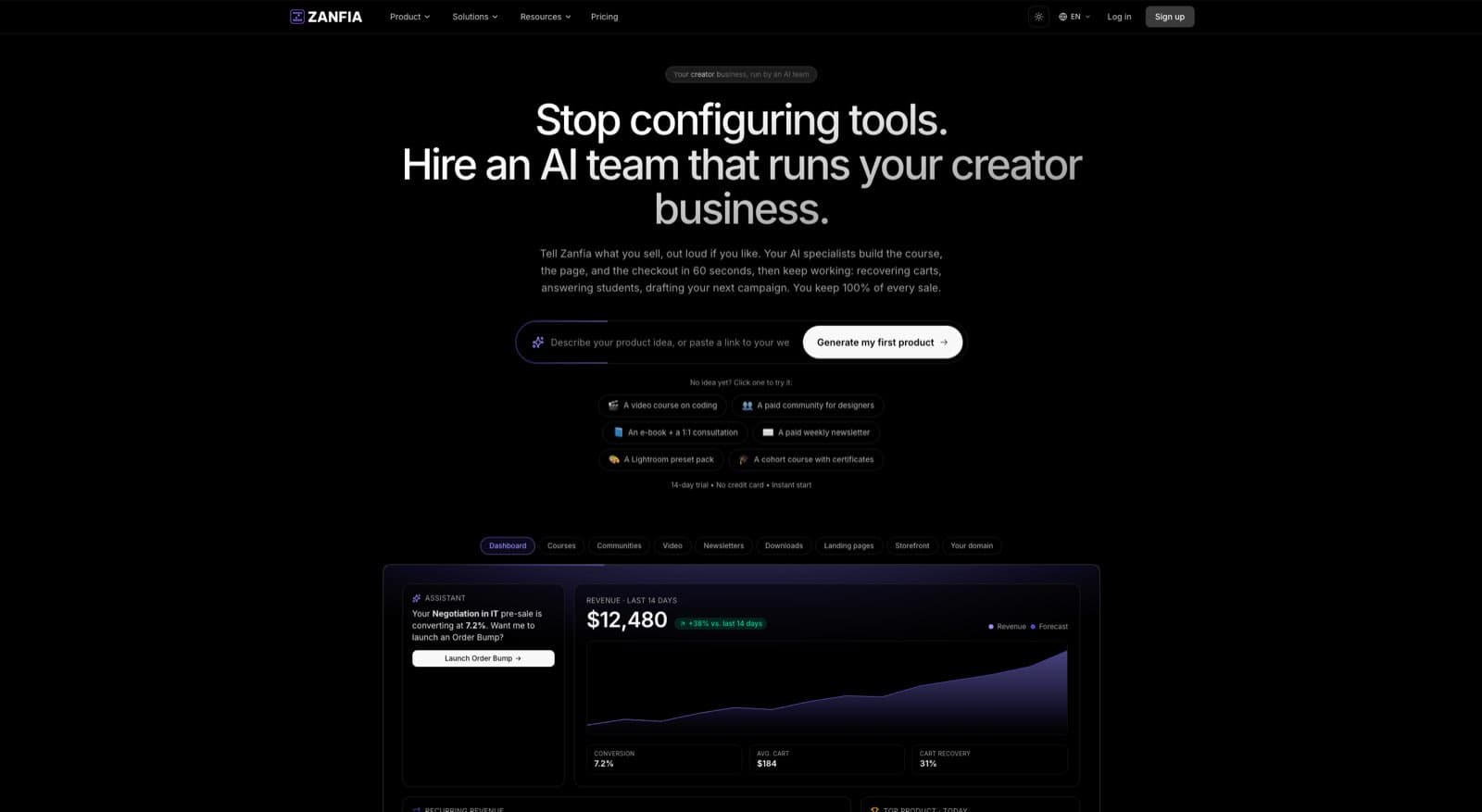
Zanfia is built to solve exactly this problem. It works well for course creators who want to layer recurring revenue on top of a one-time offer, because it puts an AI team behind the whole operation and lets you sell the course as a one-time purchase AND layer a subscription with community, ongoing lessons, or coaching, all in the same white-label environment under your own domain. You dictate the work by chat or by voice instead of clicking through configuration screens, and the assistant performs anything available in the interface, so shipping a new plan, a new upsell or a new community channel is a sentence, not an afternoon.
Here’s what that looks like in practice:
Your course lives natively on the platform, with a smart video player that remembers member progress and time-locked module unlocking (drip content) for structured learning. You can duplicate course content for new cohorts or franchise scenarios without rebuilding.
Your community sits inside the same platform. Members access topic discussion channels, announcement-only channels, and group-based organization without needing a separate Circle or Discord subscription. This tight integration between course and community is what keeps recurring members engaged, because there’s a single hub they log into for everything. When an AI answers a member question in the community, everything it publishes is labeled as AI, so the trust line stays clear.
Zanfia’s Cart 2.0 handles all four pricing models you need to run this hybrid business: one-time payments for the standalone course, subscription for the recurring membership, installment plans for high-ticket coaching, and free trials for onboarding hesitant buyers. Payments run through Stripe and PayPal, with Apple Pay and Google Pay supported for mobile buyers. Order bumps and subscription upsells at checkout let you convert one-time buyers into subscribers in a single transaction. Before your first real sale, test mode opens the checkout on a shareable link that expires, fires events to the test surfaces of GA4, Meta and TikTok, and keeps test orders out of the real order list, so you can prove the funnel end to end without polluting your data. Order bumps and upsells are available on higher plans, see the current Zanfia pricing.
As of publication, Zanfia charges 0% platform commission on customer sales. Only your payment processor fees (Stripe, PayPal) apply. On a $49 monthly subscription with 200 members, that’s the difference between keeping $9,800 per month versus losing $980 to a platform tax on Gumroad or a similar fee structure on marketplaces. Over a year, that’s nearly $12,000 back in your pocket.
If you’re running coaching, bookings and consultations are coming soon and will let clients pick a time inside your availability, right on the same platform. If you’re publishing paid newsletters as a supplement, that’s included today. Referral programs, so existing members can bring in new ones, are also on the way.
The mobile app (native iOS and Android) means your course and paid newsletter members can consume content on the go, which drives retention. Communities inside the mobile app are rolling out; by the time you read this it may already be enabled on your workspace, so check your dashboard.
For US creators who care about scale and margin, the combination of 0% platform fees, white-label branding, an AI team you can direct by voice, and integrated course + community + subscription in one place is hard to match. Plans start at $39 per month, or $31 per month billed annually on Starter, with a 14-day free trial and no credit card required. Explore how Zanfia can help you turn your one-time course into a recurring revenue engine, or see the full pricing details to run the numbers on your own subscription model.
FAQ
How long does it take to turn a one-time course into a recurring revenue product?
Most creators can launch a subscription layer in 4-8 weeks if they already have a course. The bottleneck isn’t building the product, it’s deciding what ongoing value to deliver (community, live calls, new lessons) and setting a realistic content cadence you can sustain. Start by surveying your existing customers to validate demand before you build.
What’s a realistic subscription price for a course-based membership?
Most course-to-subscription conversions land between $29 and $99 per month for consumer topics, and $199-$500 for professional or business coaching. The rule of thumb: your monthly price should be about 10% of what you’d charge for the course as a one-time purchase. So a $497 course pairs naturally with a $49 monthly subscription.
Will offering a subscription cannibalize my one-time course sales?
Only if you position them as substitutes. If you position the course as the foundation and the subscription as the ongoing practice (updates, community, coaching), they complement each other. Many creators see one-time course sales continue at similar volumes while subscription revenue stacks on top, driving 40-60% higher total revenue per customer.
How do I keep members from canceling after month one?
Focus on onboarding in the first 14 days. Force one win (a completed lesson, a community introduction, a template downloaded and used) within week one. Members who engage in the first two weeks churn at half the rate of passive members. Combine that with a predictable content rhythm (monthly Q&A, new lesson every 2-4 weeks) and you’ll see average customer lifespans of 14-18 months.
Can I run a subscription and a one-time course on the same platform?
Yes, and you should. Selling both from a single platform means one login for members, one checkout flow, and one dashboard for you. Platforms like Zanfia are built specifically to handle this hybrid model, letting you offer one-time purchases, subscriptions, installments, and free trials from the same product page. Consolidating everything in one place also improves conversion rates because buyers don’t get lost switching between systems.